Mining the Web for Relations between Digital Devices using a Probabilistic
Maximum Margin Model
Oksana Yakhnenko Iowa State University
Ames, IA, 50010
Barbara Rosario Intel Research Santa Clara, CA, 95054 [email protected]
Abstract
Searching and reading the Web is one of the principal methods used to seek out infor-mation to resolve problems about technol-ogy in general and digital devices in partic-ular. This paper addresses the problem of text mining in the digital devices domain. In particular, we address the task of detecting semantic relations between digital devices in the text of Web pages. We use a Na¨ıve Bayes model trained to maximize the margin and compare its performance with several other comparable methods. We construct a novel dataset which consists of segments of text extracted from the Web, where each segment contains pairs of devices. We also propose a novel, inexpensive and very effective way of getting people to label text data using a Web service, the Mechanical Turk. Our re-sults show that the maximum margin model consistently outperforms the other methods.
1 Introduction
In the digital home domain, home networks are moving beyond the common infrastructure of routers and wireless access points to include application-oriented devices like network attached storage, Internet telephones (VOIP), digital video recorders (e.g., Tivo), media players, entertainment PCs, home automation, and networked photo print-ers. There is an ongoing challenge associated with domestic network design, technology education, de-vice setup, repair, and tuning. In this digital home
setting, searching the Web is one of the principle methods used to seek out information and to resolve problems about technology in general and about dig-ital devices in particular (Bly et al., 2006).
This paper addresses the problem of automatic text mining in the digital networks domain. Under-standing the relations between entities in natural lan-guage sentences is a crucial step toward the goal of text mining. We address the task of identifying and extracting the sentences from Web pages which ex-pressed a relation between two given digital devices in contrast to sentences in which these devices co-occur.
As an example, consider a user who is looking for information on digital video recorders (DVR), in particular, on how she can use a DVR with a PC. This user will not be satisfied with finding Web pages that simply mention these devices (such as the many products catalogs or shopping sites), but rather, the user is interested in retrieving and read-ing only the Web pages in which a specific relation between the two devices is expressed. The user is interested to learn that, for example, “Any modern Windows PC can be used for DVR duty” or that it is possible to transfer data from a DVR to a PC (“You can simply take out the HD from the DVR, hook it up to the PC, and copy the videos over to the PC”).1
The specific task addressed in this paper is the fol-lowing: given a pair of devices, search the Web and extract only the sentences in which the devices are actually involved in an activity or a relation in the retrieved Web pages.
Note that we do not attempt to identify the type
1
of relationship between devices but rather we clas-sify sentences into whether the relation or activity is present or not, and thus we frame the problem as a binary text classification problem.2 We propose a directed maximum margin probabilistic model to solve this classification task. Maximum margin probabilistic models have received a lot of atten-tion in the machine learning and natural language processing literature. These models are trained to maximize the smallest difference between the proba-bilities of the true class and the best alternative class. Approaches such as maximum margin Markov net-works (M3N) (Taskar et al., 2003) have been con-sidered in prediction problems in which the goal is to assign a label to each word in the sentence or a document (such as part of speech tagging). It has also been shown that training of Bayesian networks by maximizing the margin can result in better per-formance than M3N in a flat-table structured domain (simulated and UCI repository datasets) and a tured prediction problem (protein secondary struc-ture) (Guo et al., 2005). Given this background, we draw our attention to the application of maxi-mum margin probabilistic models to a text classifi-cation task. We consider a directed model, where the parameters represent a probability distribution for words in each class (maximum margin equiv-alent of a Na¨ıve Bayes). We evaluate the maxi-mum margin model and compare its performance with the equivalent joint likelihood model (Na¨ıve Bayes), conditional likelihood model (logistic re-gression) and support vector machines (SVM) on the relationship extraction task described above, as well as several other classification methods. Our results show that the maximum margin Na¨ıve Bayes outper-forms the other methods in terms of classification accuracy. To train such a model, manually labeled data is required, which is usually slow and expensive to acquire. To address this, we propose a novel, inex-pensive and very effective way of getting people to label text data using the Mechanical Turk, an Ama-zon website3where people earn “micro-money” for
2
Classifying or clustering the relation types would involve the tricky task of defining the possible semantic relations be-tween devices as well as relations. We plan of addressing this in the future work, however, we believe that such binary distinc-tion is already quite useful for many tasks in this domain.
3
Available at http://www.mturk.com
completing tasks which are simple for humans to ac-complish.
The paper is organized as follows: in Section 2 we discuss related work. In Section 3 we review joint likelihood and conditional likelihood models and maximum margin Na¨ıve Bayes. In Section 4 we describe the collection of the training sentences, and how Mechanical Turk was used to construct the labels for the data. Section 5 introduces the exper-imental setup and presents performance results for each of the algorithms. We analyze Na¨ıve Bayes, maximum margin Na¨ıve Bayes and logistic regres-sion in terms of the learned probability distributions in Section 6. Section 7 concludes with discussion.
2 Related work
2.1 Relation extraction
There has been a spate of work on relation extrac-tion in recent years. However, many papers actually address the task of role extraction: (usually two) en-tities are identified and the relationship is implied by the co-occurrence of these entities or by some linguistic expression (Agichtein and Gravano, 2000; Zelenko et al., 2003).
Several papers propose the use of machine learn-ing models and probabilistic models for relation ex-traction: Na¨ıve Bayes for the relation subcellular-location in the bio-medical domain (Craven, 1999) or for person-affiliation and organization-location (Zelenko et al., 2003). Rosario and Hearst (2005) have used a more complicated dynamic graphical model to identify interaction types between proteins and to simultaneously extract the proteins.
2.2 Maximum margin models
Probabilistic graphical models and different ap-proaches to training them have received a lot of at-tention in application to natural language process-ing. McCallum and Nigam (1998) showed that Na¨ıve Bayes can be a very accurate model for text categorization.
model (Na¨ıve Bayes) and its discriminative coun-terpart (logistic regression), and they have shown that while for large number of examples logistic re-gression has a lower error rate, Na¨ıve Bayes often outperforms logistic regression for smaller data sets. However, Klein and Manning (2002) showed that for natural language and text processing tasks, con-ditional models are usually better than joint likeli-hood models. Yakhnenko et al. (2005) also showed that conditional models suffer from overfitting in text and sequence structured domains.
In recent years, the interest in learning parameters of probabilistic models by maximizing the proba-bilistic margin has developed. Taskar et al. (2003) have solved the problem of learning Markov net-works (undirected graphs) by maximizing the mar-gin. Their work has focused on likelihood based structured classification where the goal is to assign a class to each word in the sentence or a document. Guo et al. (2005) have proposed a solution to learn-ing parameters of the maximum margin Bayesian Networks.
Surprisingly, little has been done in applying probabilistic models trained to maximize the mar-gin to simple classification tasks (to the best of our knowledge). Therefore, since the Na¨ıve Bayes model has been shown to be a successful algorithm for many text classification tasks (McCallum and Nigam, 1998) we suggest learning the parameters of Na¨ıve Bayes model to maximize the probabilis-tic margin. We apply the Na¨ıve Bayes model trained to maximize the margin to a relation extraction task.
3 Joint and conditional likelihood models and maximum margin
We now describe the background in probabilistic models as well as different approaches to parame-ter estimation for probabilistic models. In particular, we describe Na¨ıve Bayes, logistic regression (analo-gous to conditionally trained Na¨ıve Bayes) and then introduce Na¨ıve Bayes trained to maximize the mar-gin.
First, we introduce some notation. Let D be a corpus that consists of training examples. LetT be the size of D. We represent each example with a tuplehs, ciwheresis a sentence or a document, and cis a label from a set of all possible labels,c∈C=
{c1...cm}. LetD=
si , ci
where superscript1≤ i≤Tis the index of the document in the corpus, and ci
is the label of examplesi
. LetV be vocabulary of D, so that every document s consists of elements ofV. We will usesj to denote a word from sin positionj, where1≤j≤length(s).
3.1 Generative and discriminative Na¨ıve Bayes models
A probabilistic model assigns to each instance s a joint probability of the instance and the class P(s, c). If the probability distribution is known, then a new instance snew can be classified by giv-ing it a label which has the highest probability:
c= arg max
ck∈CP(ck|snew) (1)
Joint likelihood models learn the parameters by maximizing the probability of an example and its class, P(s, c). Na¨ıve Bayes multinomial, for in-stance, assumes that all words in the sentence are independent given the class, and computes this prob-ability asP(c)Qlength(s)
j=1 P(sj|c). Each ofP(sj|c) andP(c)are estimated from the training data using relative frequency estimates. From here on we will refer to joint likelihood Na¨ıve Bayes multinomial as NB-JL.
Since the conditional probability is needed for the classification task, it has been suggested to solve the maximization problem and train the model so that the choice of the parameters maximizes P(c|s) di-rectly. One can use a joint likelihood model to ob-tain joint probability distribution P(s, c) and then use the definition of conditional probability to get P(c|s) = P(s, c)/P
ck∈CP(s, ck). The solutions that maximize this objective function are searched for by using gradient ascent methods. Logistic re-gression is a conditional model that assumes the in-dependence of features given the class, and it is a conditional counterpart to NB-JL (Ng and Jordan, 2001).
3.2 Maximum margin training of Na¨ıve Bayes models
The basic idea behind maximum margin models is to choose model parameters that for each example will make the probability of the true class and the exam-ple as high as possible while making the probability of the nearest alternative class as low as possible. Formally, the maximum margin objective is
γ = parameter learning is reduced to solving a convex optimization problem (Guo et al., 2005).
In order for the example to be classified correctly, the probability of the true class given the example has to be higher than the probability of getting the wrong class or
is the true label of examplesi . The larger the marginγiis, the more confidence we have in the prediction.
We consider a Na¨ıve Bayes model trained to maximize the margin and refer to this model as MMNB. Using exponential family notation, let P(sj|c) = e
sj|c. Then the log-likelihood
logP(s, c) =wc+ where w is the weight vector for all the parame-ters that need to be learned, andφ(s, c)is the vector of counts of words associated with each parameter φ(s, c) = (...count(sjc)....)insfor classc.
The general formulation for Bayesian networks was given in Guo et al., and we adapt their formu-lation for training a Na¨ıve Bayes model. The para-meters are learned by solving a convex optimization problem. If the margin γ is the smallest log-ratio, thenγ needs to be maximized, where the constraint is that for each instance the log-ratio of the proba-bility of predicting the instance correctly and pre-dicting it incorrectly is at leastγ. Such formulation also allows for the use of slack variablesξso that the
classifier “gives up” on the examples that are diffi-cult to classify. a regularization parameter, andδ(ci
, c) = 1ifci
6
=c and0otherwise. The inequality constraint for abilities is needed to preserve convexity of the prob-lem, and in the case of Na¨ıve Bayes, the probability distribution over the parameters (the equality con-straint) can be easily obtained by renormalizing the learned parameters.
The minimization problem is somewhat similar to ℓ2-norm support vector machine with a soft margin (Cristianini and Shawe-Taylor, 2000). The first con-straint imposes that for each example the log of the ratio between the example under the true class and the example under some alternative class is greater than the margin allowing for some slack. The sec-ond constraint enforces that the parameters do not get very large and that the probabilities sum to less than 1 to maintain valid probability distribution (the inequality constraint is required to preserve convex-ity, and the probability distribution can be obtained after training by renormalization).
4 Data and labels
4.1 The problem of labeling data
One major problem of natural language processing is the sparsity of data; to accurately learn a linguis-tic model, one needs to label a large amount of text, which is usually an expensive requirement. For in-formation extraction, the labeling process is particu-larly difficult and time consuming. Moreover, in dif-ferent applications one needs difdif-ferent labeled data for each domain. We propose a creative way of con-vincing many people to label data quickly and at low cost to us by using the Mechanical Turk. Sim-ilarly, Luis von Ahn (2006) creates very successful and compelling computer games in such a way that while playing, people provide labels for images on the Web.
4.2 Collecting data and label agreement analysis
To collect the data, we identified 58 pairs of dig-ital devices, as well as their synonyms (for exam-ple, computer, laptop, PC, desktop, etc), and differ-ent manufacturers for a given device (for example Toshiba, Dell, IBM, etc). The devices alone were used to construct the query (for example ‘computer, camera’, as well as a combination of manufacturer and devices (for example ‘dell laptop, cannon cam-era’). Each of these pairs was used as a query in Google, and the sentences that contain both devices were extracted resulting in a total of 3624 sentences. We use the word ‘sentence’ when referring to the examples, however we note that not all text excerpts are sentences, some are chunks of text data.
To label the data we used the Mechanical Turk (MTurk), a Web service that allows you to create and post a task for humans to solve; typical tasks are labeling pictures, choosing the best among several photographs, writing product descriptions, proof-reading and transcribing podcasts. After the task is completed the requesters can then review the sub-missions and reject them if the results are poor.
We created a total of 121 unique surveys consist-ing of 30 questions. Each question consisted of one of the extracted statements with the devices high-lighted in red. The task for the labeler was to choose between ‘Yes’, if the statement contained a relation between the devices, ‘No’ if it did not, or ‘not
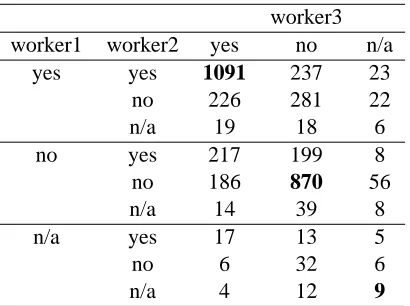
ap-worker3 worker1 worker2 yes no n/a
yes yes 1091 237 23
no 226 281 22
n/a 19 18 6
no yes 217 199 8
no 186 870 56
n/a 14 39 8
n/a yes 17 13 5
no 6 32 6
n/a 4 12 9
Table 1: Summary of the labels assigned by the MT workers to all the sentences.
plicable’ if the text extract was not a sentence, or if the query words were not used as different devices (as for noun compounds such as computer stereo).4 Each survey was assigned to 3 distinct workers, thus having 3 possible labels for all 3624 sentences.5
We used Fleiss’s kappa (Fleiss, 1971) (a general-ization of kappa statistic which takes into account multiple raters and measures inter-rater reliability) in order to determine the degree of agreement and to determine whether the agreement was accidental. Kappa statistics is a number between 0 and 1 where 0 is random agreement, and 1 is perfect agreement.
In order to compute kappa statistic, since the com-putation requires that the raters are the same for each survey, we mapped workers into ‘worker1’, ‘worker2’, ‘worker3’ with ‘worker1’ being the first worker to complete each of the 121 surveys, ‘worker2’ the second, and so on. The responses are summarized in Table 1.
The overall Fleiss’s kappa was 0.416, and there-fore, it can be concluded that the agreement between the workers was not accidental.
We had perfect agreement for 49% of all sen-tences, 5% received all three labels (these examples were discarded) and for the remaining 46% two
la-4
This dataset, including all the MTurk’s workers responses is available at http://www.cs.iastate.edu/˜oksayakh/relation data.html
5
The requirement for the workers to be different was im-posed by the MTurk system, which checks their Amazon iden-tity; however, this still allows for the same person who has mul-tiple identities to complete the same task more than once.
6
bels were assigned (the majority vote was used to determine the final label). For these cases, we no-ticed that some of the labels were wrong (however in most cases the majority vote results in the correct label) but other sentences were ambiguous and ei-ther label could be right. To assign the final label we used majority vote, and we discarded sentences for which ’not applicable’ was the majority label.
We rewarded the users with between 15 and 30 cents per survey (resulting in less than a cent for a text segment) and we were able to obtain labels for 3594 text segments for under $70. It also took any-where between a few minutes to a half-hour from the time the survey was made available until it was completed by all three users. We find Mechanical Turk to be a quite interesting, inexpensive, fairly ac-curate and fast way to obtain labeled data for natural language processing tasks.
We used this data to evaluate the classification models as described in the next section.
5 Experimental setup and results
The words were stemmed, and the data was smoothed by mapping all the words that appeared only once to a unique tokensmoothing token (re-sulting in a total of approximately 2,800 words in the vocabulary). We performed 10-fold cross-validation, with smoothed test data where all the un-seen words in the test data were mapped to the token
smoothing token. We used the exact same data in
the folds for all four algorithms – MMNB, NB-JL, logistic regression and SVM. Since MMNB, SVM, and logistic regression allows for regularization, we used tuning to find the optimal performance of the models. At each fold we withheld 30% of the train-ing data for validation purposes (thus resulttrain-ing in 3 disjoint sets at each fold). The model was trained on the resulting 70% of the training data for differ-ent values of the regularization parameters, and the value which yielded the highest accuracy on the val-idation set was used to train the model that was eval-uated on the test set.
As a baseline, we consider a classifier which as-signs the most frequent label (‘Yes’); such a classi-fier results in 53% accuracy.
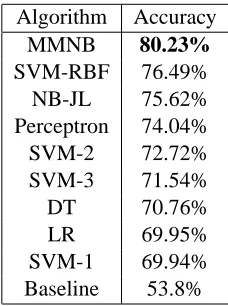
Table 2 summarizes the performance of MMNB and other algorithms as determined by 10-fold
cross-Algorithm Accuracy
MMNB 80.23%
SVM-RBF 76.49% NB-JL 75.62% Perceptron 74.04% SVM-2 72.72% SVM-3 71.54%
DT 70.76%
LR 69.95%
SVM-1 69.94% Baseline 53.8%
Table 2: Classification accuracies as determined by 10-fold cross-validation. SVM-1 uses linear kernel, SVM-2 uses quadratic kernel, SVM-3 uses cubic kernel, SVM-RBF uses RBF kernel with parameterγ = 0.1. The Decision Tree (DT)
uses binary splits. LR is logistic regression.
validation with tuning data. We compared the racies of the maximum margin model with the accu-racy of generative Na¨ıve Bayes, logistic regression and SVM as shown in Table 2. The MMNB has the highest accuracy followed by NB-JL and then SVM with RBF kernel. Even after tuning, logistic regres-sion did not reach the performance of MMNB and NB-JL.
Since MMNB is trained to maximize the mar-gin, we compared it with the Support Vector Ma-chine (linear maximum margin classifier). Counts of words were used as features (resulting in the bag of words representation7). We ran our experi-ments with linear, quadratic, cubic and RBF kernels. SVM was tuned using the validation set similarly to MMNB. We also experimented with Perceptron and Decision Tree using binary splits with reduced error-pruning, which are methods commonly used for text classification (due to lack of space, we will not de-scribe these methods and their applications, but refer the reader to Manning and Sch¨utze (1999)). Among all the known methods, the maximum margin Na¨ıve Bayes is the algorithm with the highest accuracy, suggesting that it is a competitive algorithm in re-lation extraction and text classification tasks.
7
6 Analysis of behavior of Na¨ıve Bayes, maximum margin Na¨ıve Bayes and logistic regression
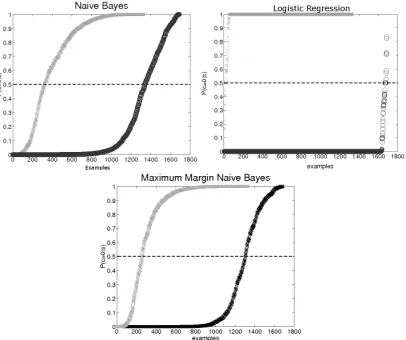
We analyzed the behavior of the parameters of the probabilistic models (Na¨ıve Bayes, MMNB and lo-gistic regression) on the training data. For each ex-ample in the training data we computed the probabil-ityP(c=noRelation|s)using the parameters from the model, and examined the probabilities assigned to examples from both classes. We show these plots in Figure 1.
Figure 1: Probability distribution ofP(c=noRelation|s)
learned by the Na¨ıve Bayes (upper left), logistic regression (up-per right) and maximum margin Na¨ıve Bayes(lower). In gray are class-conditional probabilities assigned to positive exam-ples, and in black are class-conditional probabilities assigned to negative examples.
As we see, the logistic regression discriminates between the majority of the examples by assigning extreme probabilities (0 and 1). However, there are some examples which are extremely borderline, and thus it does not generalize well on the test set. On the other had, Na¨ıve Bayes does not have such “sharp” discrimination. Maximum margin Na¨ıve Bayes has “sharper” discrimination than Na¨ıve Bayes, however the discrimination is smoother than for logistic re-gression. The examples which are more difficult to classify have probabilities that are more spread out (away from 0.5), as opposed to the case of logistic regression, which assigns these difficult examples to probability close to 0.5. This suggests that maxi-mum margin Na¨ıve Bayes, possibly has a better gen-eralization ability than both logistic regression and
Na¨ıve Bayes, however to make such a claim addi-tional experiments are needed.
7 Conclusions
The contribution of this paper is threefold. First, we addressed the important problem of identifying the presence of semantic relations between entities in text, focusing on the digital domain. We presented some encouraging results; it remains to be seen however, how this would transfer to better results in an information retrieval task. Secondly, we consid-ered a probabilistic model trained to maximize the margin, that achieved the highest accuracy for this task, suggesting that it could be a competitive algo-rithm for relation extraction and text classification in general. However in order to fully evaluate the MMNB method for relation classification it needs to be applied to other classification and or relation prediction tasks. We also empirically analyzed the behavior of the parameters learned by maximum margin model and showed that the parameters allow for better generalization power than Na¨ıve Bayes or logistic regression models. Finally, we suggested an inexpensive way of getting people to label text data via Mechanical Turk.
Acknowledgment The authors would like to
thank the reviewers for their feedback and com-ments; William Schilit for invaluable insight and help and for first suggesting using the MTurk to gather labeled data; David McDonald for help with developing survey instructions; and numerous MT workers for providing the labels.
References
Eugene Agichtein and Luis Gravano. 2000. Snowball: Extracting relations from large plain-text collections. In Proceedings of Digital Libraries.
Sara Bly, William Schilit, David McDonald, Barbara Rosario, and Ylian Saint-Hilaire. 2006. Broken ex-pectations in the digital home. In Proceedings of
Com-puter Human Interaction (CHI).
Stephen Boyd and Lieven Vandenberghe. 2004. Convex
Optimization. Cambridge University Press.
Nello Cristianini and John Shawe-Taylor. 2000. An Introduction to Support Vector Machines and Other Kernel-based Learning Methods. Cambridge
Univer-sity Press.
Joseph L. Fleiss. 1971. Measuring nominal scale
agree-ment among many raters. Psychological Bulletin,
76(5):378–382.
Yuhong Guo, Dana Wilkinson, and Dale Schuurmans. 2005. Maximum margin bayesian networks. In
Pro-ceedings of the 21th Annual Conference on Uncer-tainty in Artificial Intelligence (UAI-05), page 233.
Dan Klein and Christopher Manning. 2002. Conditional structure versus conditional estimation in nlp models. In Empirical Methods in Natural Language
Process-ing (EMNLP).
Christopher D. Manning and Hinrich Sch¨utze. 1999.
Foundations of Statistical Natural Language Process-ing. The MIT Press, June.
Andrew McCallum and Kamal Nigam. 1998. A com-parison of event models for naive bayes text classifi-cation. In AAAI-98 Workshop on Learning for Text
Categorization.
Andrew Y. Ng and Michael I. Jordan. 2001. On dis-criminative vs. generative classifiers: A comparison of logistic regression and naive bayes. In Proceedings of
Neural Information Processing Systems (NIPS), pages
841–848.
Jorge Nocedal and Dong C. Liu. 1989. On the limited memory method for large scale optimization.
Mathe-matical Programming, 3(45):503–528.
Barbara Rosario and Marti Hearst. 2005. Multi-way re-lation classification: Application to proteprotein in-teractions. In Empirical Methods in Natural Language
Processing (EMNLP).
Benjamin Taskar, Carlos Guestrin, and Daphne Koller. 2003. Max-margin markov networks. In Proceedings
of Neural Information Processing Systems (NIPS).
Luis von Ahn. 2006. Games with a purpose. Computer, 39(6):92–94.
Oksana Yakhnenko, Adrian Silvescu, and Vasant
Honavar. 2005. Discriminatively trained markov
model for sequence classification. In Proceedings of
International Conference on Data Mining (ICDM).
Dmitry Zelenko, Chinatsu Aone, and Anthony
Richardella. 2003. Kernel methods for relation
extraction. In Proceedings of Empirical Methods in