An Effective Hybrid Machine Learning Approach for Coreference
Resolution
Feiliang Ren
Natural Language Processing Lab
College of Information Science and
En-gineering
Northeastern University, P.R.China
Jingbo Zhu
Natural Language Processing Lab
College of Information Science and
En-gineering
Northeastern University, P.R.China
[email protected]
Abstract
We present a hybrid machine learning ap-proach for coreference resolution. In our method, we use CRFs as basic training model, use active learning method to gen-erate combined features so as to make ex-isted features used more effectively; at last, we proposed a novel clustering algorithm which used both the linguistics knowledge and the statistical knowledge. We built a coreference resolution system based on the proposed method and evaluate its perform-ance from three aspects: the contributions of active learning; the effects of different clustering algorithms; and the resolution performance of different kinds of NPs. Ex-perimental results show that additional per-formance gain can be obtained by using ac-tive learning method; clustering algorithm has a great effect on coreference resolu-tion’s performance and our clustering algo-rithm is very effective; and the key of coreference resolution is to improve the performance of the normal noun’s resolu-tion, especially the pronoun’s resolution.
1
Introduction
Coreference resolution is the process of determin-ing whether two noun phrases (NPs) refer to the same entity in a document. It is an important task in natural language processing and can be classi-fied into pronoun phrase (denoted as PRO) resolu-tion, normal noun phrase (denoted as NOM) reso-lution, and named noun phrase (denoted as NAM) resolution. Machine learning approaches recast this
problem as a classification task based on con-straints that are learned from an annotated corpus. Then a separate clustering mechanism is used to construct a partition on the set of NPs.
Previous machine learning approaches for coreference resolution (Soon et al, 2001; Ng et al, 2002; Florian et al, 2004, etc) usually selected a machine learning approach to train a classification model, used as many as possible features for the training of this classification model, and finally used a clustering algorithm to construct a partition on the set of NPs based on the statistical data ob-tained from trained classification model. Their ex-perimental results showed that different kinds of features had different contributions for system’s performance, and usually the more features used, the better performance obtained. But they rarely focused on how to make existed features used more effectively; besides, they proposed their own clustering algorithm respectively mainly used the statistical data obtained from trained classification model, they rarely used the linguistics knowledge when clustering different kinds of NPs. Also, there were fewer experiments conducted to find out the effect of a clustering algorithm on final system’s performance.
In this paper, we propose a new hybrid machine learning method for coreference resolution. We use NP pairs to create training examples; use CRFs as a basic classification model, and use active learn-ing method to generate some combined features so as to make existed features used more effectively; at last, cluster NPs into entities by a novel cascade clustering algorithm.
sys-tem in detail. Section 3 is our experiments and dis-cussions. And at last, we conclude our work in sec-tion 4.
2
Coreference Resolution
There are three basic components for a coreference resolution system that uses machine learning ap-proach: the training set creation, the feature selec-tion, and the coreference clustering algorithm. We will introduce our methods for these components respectively as follows.
2.1 Training Set Creation
Previous researchers (Soon et al., 2001, Vincent Ng et al., 2002, etc) took different creation strate-gies for positive examples and negative examples. Because there were no experimental results showed that these kinds of example creation meth-ods were helpful for system’s performance, we create both positive examples and negative exam-ples in a unified NP pair wise manner.
Given an input NP chain of an annotated docu-ment, select a NP in this NP chain from left to right one by one, and take every of its right side’s NP, we generate a positive example if they refer to the same entity or a negative example if they don’t refer to the same entity. For example, there is a NP chain n1-n2-n3-n4 found in document, we will generate following training examples: (n1-n2,±1 ), (n1-n3, ±1 ), (n1-n4, ±1 ), (n2-n3, ±1 ), (n2-n4, ), and (n3-n4, ). Where denotes that this is a positive example, and denotes that this is a negative example.
1
± ±1 +1
1 −
2.2 Feature Sets
In our system, two kinds of features are used. One is atomic feature, the other is combined feature. We define the features that have only one genera-tion condigenera-tion as atomic features, and define the union of some atomic features as combined fea-tures.
2.2.1 Atomic Features
All of the atomic features used in our system are listed as follows.
String Match Feature (denoted as Sm): Its possi-ble values are exact, left, right, included, part, alias, and other. If two NPs are exactly string matched, return exact; if one NP is the left sub-string of the other, return left; if one NP is the right
substring of the other, return right; if all the char-acters in one NP are appeared in the other but not belong to set {left, right}, return included; if some (not all) characters in one NP are appeared in the other, return part; if one NP is the alias of the other, return alias; if two NPs don’t have any common characters, return other.
Lexical Similarity Features (denoted as Ls):
compute two NP’s similarity and their head words’ similarity using following formula 1.
1 2 1 2
1 2
2 (
( , )
( ) ( )
SameChar n n Sim n n
Len n Len n
, )
× =
+ (1)
Here means the common
characters’ number in and ; is the
total characters’ number in . ( ,1 2) SameChar n n
1
n n2 Len ni( )
ni
Edit Distance Features (denoted as Ed): compute two NP’s edit distance and their head words’ edit distance (Wagner and Fischer, 1974), and the pos-sible values are true and false. If the edit distance of two NPs (or the head words of these two NPs) are less than or equal to 1, return true, else return false.
Distance Features (denoted as Dis): distance be-tween two NPs in words, NPs, sentences, para-graphs, and characters.
Length Ratio Features (denoted as Lr): the length ratio of two NPs, and their head words. Their pos-sible values belong to the range(0,1].
NP’s Semantic Features (denoted as Sem): the
POSs of two NPs’ head words; the types of the two NPs (NAM, NOM or PRO); besides, if one of the NP is PRO, the semantic features will also include this NP’s gender information and plurality infor-mation.
Other Features (denoted as Oth): whether two
NPs are completely made up of capital English characters; whether two NPs are completely made up of lowercase English characters; whether two NPs are completely made up of digits.
2.2.2 Combined Features Generated by
Ac-tive Learning
some extra in-house analysis tools such as proper name parser, chunk parser, rule-based shallow coreference resolution parser, and so on (Hal Daume III, etc, 2005; R.Florian, etc, 2004; Vincent Ng, etc, 2002; etc). Although we also collected some aliases and abbreviations, the amounts are very small compared with previous researchers’. We hope we can make up for this by making ex-isted features used more effectively by active learning method.
Formally, active learning studies the closed-loop phenomenon of a learner selecting actions or mak-ing queries that influence what data are added to its training set. When actions or queries are selected properly, the data requirements for some problems decrease drastically (Angluin, 1988; Baum & Lang, 1991). In our system, we used a pool-based active learning framework that is similar as Manabu Sas-sano (2002) used, this is shown in figure 1.
Figure 1: Our Active Learning Framework In this active learning framework, an initial clas-sifier is trained by CRFs [1] that uses only atomic features, and then two human teachers are asked to correct some selected wrong classified examples independently. During the process of correction, without any other available information, system only shows the examples that are made up of fea-tures to the human teachers; then these two human teachers have to use the information of some atomic features’ combinations to decide whether two NPs refer to the same entity. We record all these atomic features’ combinations that used by both of these human teachers, and take them as combined features.
For example, if both of these human teachers correct a wrong classified example based on the knowledge that “if two NPs are left substring
1
http://www.chasen.org/~taku/software/CRF++/
matched, lexical similarity feature is greater than 0.5, I think they will refer to the same entity”, the corresponding combined feature would be de-scribed as: “Sm(NPs)-Ls(NPs)”, which denotes the human teachers made their decisions based on the combination information of “String Match Fea-tures” and “Lexical Similarity Features”.
Figure 2: Selection Algorithm
1. Select all the wrong classified examples whose CRFs’ probability belongs to range [0.4, 0.6] 2. Sort these examples in decreasing order. 3. Select the top m examples
In figure 1, “information” means the valuable data that can improve the system’s performance after correcting their classification. The selection algorithm for “informative” is the most important component in an active learning framework. We designed it from the degree of correcting difficulty. We know 0.5 is a critical value for an example’s classification. For a wrong classified example, the closer its probability value to 0.5, the easier for us to correct its classification. Following this, our se-lection algorithm for “informative” is designed as shown in figure 2.
1. Build an initial classifier
2. While teacher can correct examples based on feature combinations
a) Apply the current classifier to training ex-amples
b) Find m most informative training examples c) Have two teachers correct these examples
based on feature combinations
d) Add the feature combinations that are used by both of these two teachers to feature sets in CRFs and train a new classifier.
When add new combined features won’t lead to a performance improvement, we end active learn-ing process. Totally we obtained 21 combined fea-tures from active learning. Some of them are listed in table 1.
Table 1: Some Combined Features Sm(NPs)-Sm(HWs)-Ls(NPs)-Ls(HWs)
Sm(NPs)-Sm(HWs)-Ls(NPs) Sm(NPs)-Sm(HWs)-Ls(HWs) Sm(NPs)-Sm(HWs)-Lr(NPs)-Lr(HWs)
Sm(NPs)-Sm(HWs)-Lr(NPs) Sm(NPs)-Sm(HWs)-Sem(HW1)-Sem(HW2)
Sm(NPs)-Sm(HWs)-Sem(NP1)-Sem(NP2) Sm(NPs)-Sm(HWs)-Lr(HWs) ……
And at last, we take all the atomic features and the combined features as final features to train the final CRFs classifier.
2.3 Clustering Algorithm
Formally, let
{
:
be NPs in a docu-ment. Let us define the set ofNPs whose types are all NAMs; define the set of NPs whose types are
all NOMs; define the set of
NPs whose types are all PROs. Let be the map from NP index
i
to entity index1
}
partially-established entities before clustering ,
and , the set of the
partially-established entities. Let be the
(1
)
Given that has been formed before
cluster-ing , can take two possible actions:
if , then the active NP is said to link
compute the link probability, where
t
, is 1iff links with ; the random variable
A
is theindex of the partial entity to which
m
is linking.(
=
1|
E m A
k,
k,
=
t
)
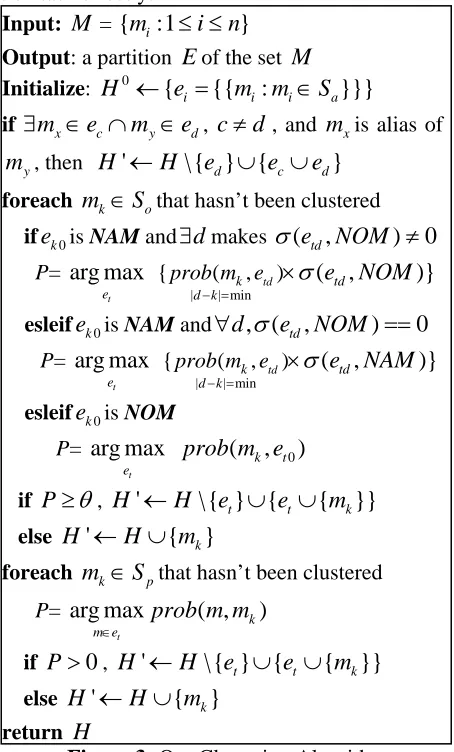
Our clustering algorithm is shown in figure 3. The basic idea of our clustering algorithm is that NAMs, NOMs and PROs have different abilities starting an entity. For NAMs, they are inherent antecedents in entities, so we start entities based on them first.
For NOMs, they have a higher ability of acting as antecedents in entities than PROs, but lower than NAMs. We cluster them secondly, and add a NOM in an existed entity as long as their link probability is higher than a threshold. And during the process of the link probabilities computations,
we select a NP in an existed entity carefully, and take these two NPs’ link probability as the link probability between this NOM and current entity. The selection strategy is to try to make these link probabilities have the greatest distinction.
And for PROs, they have the lowest ability of acting as antecedents in entities, most of the time, they won’t be antecedents in entities; so we cluster them into an existed entity as long as there is a non-zero link probability.
3
Experiments and Discussions
Our experiments are conducted on Chinese EDR (Entity Detection and Recognize) &EMD (Entity Mention Detection) corpora from LDC. These cor-pora are the training data for ACE (Automatic Content Extraction) evaluation 2004 and ACE evaluation 2005. These corpora are annotated and can be used to train and test the coreference resolu-tion task directly.
Figure 3: Our Clustering Algorithm
Input:
M
={
m
i:1
≤ ≤
i
n
}
foreach
m
k∈
S
othat hasn’t been clustered ife
k0is NAM and∃dmakesσ
(
e
td,
NOM
)
≠
0
In ACE 2004 corpus, there are two types of documents: paper news (denoted as newswire) and broadcast news (denoted as broadca); for ACE 2005 corpus, a new type added: web log docu-ments (denoted as weblogs). Totally there are 438 documents in ACE 2004 corpus and 636 docu-ments in ACE 2005 corpus. We randomly divide these two corpora into two parts respectively, 75% of them for training CRFs model, and 25% of them for test. By this way, we get 354 documents for training and 84 documents for test in ACE 2004 corpus; and 513 documents for training and 123 documents for test in ACE 2005 corpus.
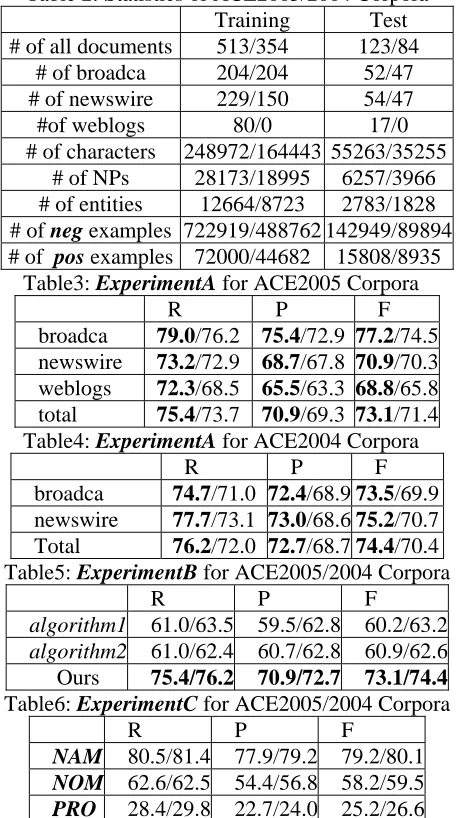
Some statistics of ACE2005 corpus and ACE2004 corpus are shown in table 2.
Our experiments were classified into three groups. Group 1 (denoted as ExperimentA) is de-signed to evaluate the contributions of active learn-ing for the system’s performance. We developed two systems for ExperimentA, one is a system that used only the atomic features for CRFs training and we took it as a baseline system, the other is a system that used both the atomic features and the combined features for CRFs training and we took it as our final system. The experimental results are shown in table 3 and table 4 for different corpus respectively. Bold font is the results of our final system, and normal font is the results of baseline system. Here we used the clustering algorithm as described in figure 3.
Group 2 (denoted as ExperimentB) is designed to investigate the effects of different clustering al-gorithm for coreference resolution. We imple-mented another two clustering algorithms: algo-rithm1 that is proposed by Ng et al. (2002) and algorithm2 that is proposed by Florian et al. (2004). We compared the performance of them with our clustering algorithm and experimental results are shown in table 5.
Group 3 (denoted as ExperimentC) is designed to evaluate the resolution performances of different kinds of NPs. We think this is very helpful for us to find out the difficulties and bottlenecks of coreference resolution; and also is helpful for our future work. Experimental results are shown in table 6.
In ExperimentB and ExperimentC, we used both atomic features and combined features for CRFs classification model training. And in table5, table6 and table7, the data before “/” are experi-mental results for ACE2005 corpus and the data
after “/” are experimental results for ACE2004 corpus.
In all of our experiments, we use recall, preci-sion, and F-measure as evaluation metrics, and de-noted as R, P, and F for short respectively.
Table 2: Statistics of ACE2005/2004 Corpora
Training Test
# of all documents 513/354 123/84 # of broadca 204/204 52/47 # of newswire 229/150 54/47
#of weblogs 80/0 17/0
# of characters 248972/164443 55263/35255 # of NPs 28173/18995 6257/3966 # of entities 12664/8723 2783/1828 # of neg examples 722919/488762 142949/89894 # of pos examples 72000/44682 15808/8935
Table3: ExperimentA for ACE2005 Corpora
R P F
broadca 79.0/76.2 75.4/72.9 77.2/74.5 newswire 73.2/72.9 68.7/67.8 70.9/70.3 weblogs 72.3/68.5 65.5/63.3 68.8/65.8 total 75.4/73.7 70.9/69.3 73.1/71.4 Table4: ExperimentA for ACE2004 Corpora
R P F
broadca 74.7/71.0 72.4/68.9 73.5/69.9 newswire 77.7/73.1 73.0/68.6 75.2/70.7 Total 76.2/72.0 72.7/68.7 74.4/70.4 Table5: ExperimentB for ACE2005/2004 Corpora
R P F
algorithm1 61.0/63.5 59.5/62.8 60.2/63.2 algorithm2 61.0/62.4 60.7/62.8 60.9/62.6 Ours 75.4/76.2 70.9/72.7 73.1/74.4
improvement at anytime. Active learning method provides us a way that makes this combined fea-tures’ selection process goes in a proper manner. Generally, a system can obtain an obvious per-formance improvement after several active learn-ing iterations. We still noticed that the contribu-tions of active learning for different kinds of documents are different. In ACE04 corpus, both kinds of documents’ performance obtained almost equal improvements; in ACE05 corpus, there is almost no performance improvement for newswire documents, but broadcast documents’ performance and web log documents’ performance obtained greater improvements. We think this is because for different kinds of documents, they have different kinds of correcting rules (these rules refer to the combination methods of atomic features) for the wrong classified examples, some of these rules may be consistent, but some of them may be con-flicting. Active learning mechanism will balance these conflicts and select a most appropriate global optimization for these rules. This can also explain why ACE04 corpus obtains more performance im-provement than ACE05 corpus, because there are more kinds of documents in ACE05 corpus, and thus it is more likely to lead to rule conflicts during active learning process.
Experimental results in table 5 show that if other experimental conditions are the same, there are obvious differences among the performances with different clustering algorithms. This surprised us very much because both algorithm1 and algo-rithm2 worked very well in their own learning frameworks. We know R.Florian et al. (2004) first proposed algorithm2 using maximum entropy model. Is this the reason for the poor performance of algorithm2 and algorithm1? To make sure this, we conducted other experiments that changed the CRFs model to maximum entropy model [2] with-out changing any other conditions and the experi-mental results are shown in table 7.
The experimental results are the same: our clus-tering algorithm achieved better performance. We think this is mainly because the following reason, that in our clustering algorithm, we notice the fact that different kinds of NPs have different abilities of acting as antecedents in an entity, and take dif-ferent clustering strategy for them respectively,
2
http://homepages.inf.ed.ac.uk/s0450736/maxent_toolkit.html
this is obvious better than the methods that only use statistical data.
Table7: ExperimentB for ACE2005/2004 Corpora with ME Model
R P F
algorithm1 48.9/48.3 44.2/50.3 46.4/49.3 algorithm2 57.4/59.5 52.3/61.4 54.7/60.4 Ours 68.1/69.8 65.7/72.6 66.9/71.2
We also noticed that the experimental results with maximum entropy model are poorer than with CRFs model. We think this maybe because that the combined features are obtained under CRFs model, thus they will be more suitable for CRFs model than for maximum entropy model, that is to say these obtained combined features don’t play the same role in maximum entropy model as they do in CRFs model.
Experimental results in table 6 surprised us greatly. PRO resolution gets so poor a performance that it is only about 1/3 of the NAM resolution’s performance. And NOM resolution’s performance is also pessimistic, which reaches about 80% of the NAM resolution’s performance. After analyses we found this is because there is too much confusing information for NOM’s resolution and PRO’s reso-lution and system can hardly distinguish them cor-rectly with current features description for an ex-ample. For example, in a Chinese document, a NOM “总统” (means president) may refer to a person A at sometime, but refer to person B at an-other time, and there is no enough information for system to distinguish A and B. It is worse for PRO resolution because a PRO can refer to any NAM or NOM from a very long distance, there is little in-formation for the system to distinguish which one it really refers to. For example, two PROs that both of whom are “他” (means he) , one refers to person A, the other refers to person B, even our human can hardly distinguish them, not to say the system.
Fortunately, generally there are more NAMs and NOMs in a document, but less PROs. If they have similar amounts in a document, you can image how poor the performance of the coreference reso-lution system would be.
4
Conclusions
features to make existed features used more effec-tively; and we also proposed an effective clustering algorithm that used both the linguistics knowledge and the statistical knowledge. Experimental results show that additional performance gain can be ob-tained by using active learning method, clustering algorithm has a great effect on coreference resolu-tion’s performance and our clustering algorithm is very effective. Our experimental results also indi-cate the key of coreference resolution is to improve the performance of the NOM resolution, especially the PRO resolution; both of them remain chal-lenges for a coreference resolution system.
Acknowledgments
We used the method proposed in this paper for Chinese EDR (Entity Detection and Recognition) task of ACE07 (Automatic Content Extraction 2007) and achieved very encouraging result.
And this work was supported in part by the Na-tional Natural Science Foundation of China under Grant No.60473140; the National 863 High-tech Project No.2006AA01Z154; the Program for New Century Excellent Talents in University No.NCET-05-0287; and the National 985 Project No.985-2-DB-C03.
Reference
Andrew Kachites McCallum and Kamal Nigam, 1998. Employing EM and pool-based active learning for text classification. In Proceedings of the Fifteenth In-ternational Conference on Machine Learning, pp 359-367
Cohn, D., Grahramani, Z., & Jordan, M.1996. Active learning with statistical models. Journal of Artificial Intelligence Research, 4. pp 129-145
Cynthia A.Thompson, Mary Leaine Califf, and Ray-mond J.Mooney. 1999. Active learning for natural language parsing and information extraction. In Pro-ceedings of the Seventeenth International Conference on Machine Learning, pp 406-414
Hal Daume III and Daniel Marcu, 2005, A large-scale exploration of effective global features for a joint en-tity detection and tracking model. Proceedings of HLT/EMNLP, 2005
http://www.nist.gov/speech/tests/ace/ace07/doc, The ACE 2007 (ACE07) Evaluation Plan, Evaluation of the Detection and Recognition of ACE Entities, Val-ues, Temporal Expressions, Relations and Events
John Lafferty, Andrew McCallum, and Fernando Pereira. 2001. Conditional random fields: Probabilis-tic models for segmenting and labeling sequence data. In International Conference on Machine Lear-ingin(ICML01)
Lafferty, J., McCallum, A., & Pereira, F. 2001. Condi-tional random fields: Probabilistic models for seg-menting and labeling sequence data. Proc. ICML
Manabu Sassano. 2002. An Empirical Study of Active Learning with Support Vector Machines for Japanese Word Segmentation. Proceeding of the 40th Annual Meeting of the Association for Computational Lin-guistics (ACL), 2002, pp 505-512
Min Tang, Xiaoqiang Luo, Salim Roukos.2002. Active Learning for Statistical Natural Language Parsing. Proceedings of the 40th Annual Meeting of the Asso-ciation for Computational Linguistics (ACL), 2002, pp.120-127.
Pinto, D., McCallum, A., Lee, X., & Croft, W.B. 2003. combining classifiers in text categorization. SIGIR’ 03: Proceedings of the Twenty-sixth Annual Interna-tional ACM SIGIR Conference on Research and De-velopment in Information Retrieval.
Radu Florian, Hongyan Jing, Nanda Kambhatla and Imed Zitouni, “Factoring Complex Models: A Case Study in Mention Detection”, in Procedings of the 21st International Conference on Computational Lin-guistics and 44th Annual Meeting of the ACL, pages 473-480, Sydney, July 2006.
R Florian, H Hassan et al. 2004. A statistical model for multilingual entity detection and tracking. In Proc. Of HLT/NAACL-04, pp1-8
Sha, F., & Pereira, F. 2003. Shallow parsing with condi-tional random fields. Proceedings of Human Lan-guage Technology, NAACL.
Simon Tong, Daphne Koller. 2001. Support Vector Ma-chine Active Learning with Applications to Text Classification. Journal of Machine Learning Re-search,(2001) pp45-66.
V.Ng and C.Cardie. 2002. Improving machine learning approaches to coreference resolution. In Proceedings of the ACL’02, pp.104-111.