Active Learning Strategies for Support Vector Machines,
Application to Temporal Relation Classification
Seyed Abolghasem Mirroshandel
?,†Gholamreza Ghassem-Sani
?Alexis Nasr
† ?Computer Engineering Department, Sharif university of Technology, Tehran, Iran
†
Laboratoire d’Informatique Fondamentale de Marseille- CNRS - UMR 6166
Universit´e Aix-Marseille, Marseille, France
([email protected], [email protected], [email protected])
Abstract
Temporal relations between events is a valu-able source of information which can be used in a large number of natural language pro-cessing applications such as question answer-ing, summarization, and information extrac-tion. Supervised temporal relation classifica-tion requires large corpora which are difficult, time consuming, and expensive to produce. Active learning strategies are well-suited to reduce this effort by efficiently selecting the most informative samples for labeling. This paper presents novel active learning strategies based on support vector machines (SVM) for temporal relation classification. A large num-ber of empirical comparisons of different ac-tive learning algorithms and various kernel functions in SVM shows that proposed active learning strategies are effective for the given task.
1 Introduction
The identification of temporal relations between events, in texts, is a valuable information for many natural language processing (NLP) tasks, such as summarization, question answering, and informa-tion extracinforma-tion. In quesinforma-tion answering, one expects the system to answer questions such as “when an event occurred”, or “what is the chronological or-der of some desired events”. In text summarization, especially in the multi-document type, knowing the order of events is important for correctly merging related information.
Most existing algorithms for temporal relation learning are supervised, they rely on manual
annota-tions of corpora. Producing such annotated corpora has shown to be a time consuming, hard, and expen-sive task (Mani et al., 2006). In this paper we ex-plore active learning techniques as a way to control and speed up the annotation process.
In the active learning framework, the learner has control over choosing the instances that will consti-tute the training set. A typical active learning algo-rithm begins with a small number of annotated data, and selects one or more informative instances from a large set of unlabeled instances, named the pool. The chosen instance(s) are then labeled and added to other annotated data, and the model is updated with this new information. These steps are repeated until at least one termination condition is satisfied.
While there have been numerous applications of active learning to NLP researches (Settles and Craven, 2008; Xu et al., 2007), it has not been ap-plied, to our knowledge, to temporal relation classi-fication.
This paper presents a novel active learning strat-egy for SVM-based classification algorithm. The proposed algorithm considers three measures: un-certainty,representativeness, anddiversityto select the instances that will be annotated. The method we propose is generic, it could be applied to any SVM based classification problem. Temporal rela-tion classificarela-tion has been selected, in this paper, for illustration purpose. Our experiments show that state-of-the-art results can be reproduced with a sig-nificantly smaller part of training data.
of existing active learning methods. Our proposed method will be presented in Section 4. Section 5 briefly presents the characteristics of the corpora that we have used. Section 6 demonstrates the evaluation of the proposed algorithm. Finally, Section 7 con-cludes the paper and presents some possible future work.
2 Temporal Relation Classification with
SVM
For a given ordered pair (x1, x2), where x1 and x2 are time expressions or events, a temporal
in-formation processing system identifies the type of relation that temporally links x1 to x2. For
ex-ample in “If all the debt is converted (event1) to
common, Automatic Data will issue(event2)about
3.6 million shares; last Monday(time1), the
com-pany had (event3) nearly 73 million shares
out-standing.”, taken from documentwsj 0541of Time-Bank (Pustejovsky et al., 2003), there are two tem-poral relations between pairs(event1, event2)and (time1, event3). The task of a temporal relation
ex-traction system is to automatically tag these pairs with relations BEFORE and INCLUDES, respec-tively.
Several researchers have focused on temporal re-lation learning (Chklovski and Pantel, 2005; Lapata and Lascarides, 2006; Bethard et al., 2007; Cham-bers et al., 2007; Bethard and Martin, 2008; Mir-roshandel and Ghassem-Sani, 2010; Puscasu, 2007) among which SVM has shown good performances. In this section, we describe two of the most success-ful SVM-based methods.
Inderjeet Mani was the first to propose an SVM-based temporal relation classification model which is based on a linear kernel (Mani et al., 2006). His system (referred to as (kM ani)) uses five temporal
attributes that have been tagged in the standard cor-pora (Pustejovsky et al., 2003) plus the string of words that constitute the events, as well as their part of part of speech tags.
The other successful SVM-based temporal classi-fication method uses a polynomial convolution tree kernel, named argument ancestor path distance ker-nel (AAPD), and outperforms Mani’s method (Mir-roshandel et al., 2010). In this model, the algorithm adds event-event syntactic properties to the simple
event features described above. In order to use syn-tactic properties, a convolution tree kernel is applied to the parse trees of sentences containing event pairs. Through this process, useful syntactic features can be gathered for classification by SVM. The two ker-nels are then polynomially combined.
3 Active Learning
Supervised methods usually need a large number of annotated samples in the training phase. In most applications including temporal relation classifica-tion, the preparation of such samples is a hard, time consuming, and expensive task (Mani et al., 2006). On the other hand, all these annotated samples may not be useful, because some samples contain lit-tle (or even no) new information. Active learning algorithms overcome this problem by adding only the most informative instances labeled by an oracle (e.g., a human expert) to the learning model. Three scenarios have been proposed for the selection of in-stances: 1) membership query synthesis, 2) stream-based selective sampling, and 3) pool-stream-based sam-pling (Settles, 2010).
In membership query synthesis, the model it-self generates some instances rather than using real-world unlabeled instances (Angluin, 2004).
In stream-based selective sampling, instances are presented in a stream and the learner decides, based on its specific control measure, whether or not to query its label (Atlas et al., 1990; Cohn et al., 1994). In pool based sampling, which is the scenario that we have chosen), a large number of unlabeled in-stances are collected to form thepoolU. The algo-rithm begins with a small number of labeled data
L, and then chooses one or more informative in-stances fromU. The chosen instance(s) are labeled and added toL. A new model is then learned and the process iterated (Lewis and Gale, 1994).
3.1 Sample Selection Strategies
den-sity weighted methods (Settles, 2010).
Uncertainty sampling is the simplest and the most commonly used selection strategy. In this strategy, instances for which the prediction of the label is the most uncertain are selected by the learner (Lewis and Gale, 1994).
In query by committee, there is a committee of models trained on the current labeled dataLbased on different hypotheses. For each unlabeled in-stance, committee models vote for their label. The most informative instance is one with the largest dis-agreement on the votes (Seung et al., 1992). In the expected model change, the most informative in-stance is the one which causes the most change to the model (Settles et al., 2008). In expected error re-duction, the learner selects instances which reduce expected error of model as much as possible (Roy and McCallum, 2001). In density weighted meth-ods, selected instances must be both uncertain and representative in order to decrease the effect of out-liers which may cause some problems especially in uncertainty sampling and query by committee strate-gies (Settles and Craven, 2008).
4 Proposed Algorithm
In this section, we present an active learning method based on SVM. There have been other efforts in using active learning in combination with SVM (Brinker, 2003; Xu et al., 2007), our contribution is the design of new uncertainty measures used for sample selection. In addition, the way representa-tiveness and diversity measures are computed and combined are novel.
The algorithm is pool-based. At each iteration,k
(k ≥ 1) instances are selected from a poolU. To select the more informative instance(s), three mea-sures are used: uncertainty, representativenessand
diversity. In the next subsections, we begin with an overview of multi-class classification with SVM, then introduce our three measures and describe the active learning algorithm.
4.1 Multi-class classification
In SVM binary classification, positive and negative instances are linearly partitioned by a hyper-plane (with maximum marginal distance to instances) in the original or a higher dimensional feature space.
In order to classify a new instance x, its distance
to the hyper-plane is computed andxis assigned to
the class that corresponds to the sign of the com-puted distance. The distance between instance x
and hyper-planeH, supported by the support vectors x1. . . xl, is computed as follows (Han and Kamber,
2006):
d(x, H) = l
X
k=1
ykαkxkxT +b0 (1)
whereyk is the class label of support vector xk; αk and b0 are numeric parameters that are
deter-mined automatically.
For multi-class classification with m classes, in one-versus-one case, a set H of m(m−1)
2
hyper-planes, one for every class pair is defined. The hyper-plane that separates classiandjwill be noted Hi,j. We noteHi ⊂ Hthe set of them−1
hyper-planes that separate classifrom the others.
In order to classify a new instancex, its distance to each hyper-plane Hi,j is computed andx is
as-signed to class i or j. At the end of this process,
for every instancex, every classi has accumulated
a certain number of votes, noted Vi(x) (number of
time a classifier has attributed the classito instance x). The final class ofx, notedC(x)will be the one
that has accumulated the highest number of votes.
C(x) = arg max 1≤i≤m
Vi(x) (2)
4.2 Uncertainty
Uncertainty is one of the most important measures of informativeness of an instance. If the learner is uncertain about an instance, that shows that the learning model is not able to deal with the instance properly. As a result, knowing the correct label of this uncertain instance will improve the quality of learning model.
Four measures of uncertainty are presented below, the first and second are based on distances while the third and fourth are based on the result of the vote procedure.
4.2.1 Nearest to One Hyper-Plane (NOH)
Uncertainty of an instancexis defined here as the
distance to its closest class separating hyper-planes.
ϕ(x) = min H∈HC(x)|
d(x, H)| (3)
4.2.2 Nearest to All Hyper-Planes (NAH) NAH defines the uncertainty of instancexas the
sum of its distances to all its class separating hyper-planes.
ϕ(x) = X H∈HC(x)
|d(x, H)| (4)
4.2.3 Least Votes Margin (LVM)
LVM estimates the uncertainty of an instance by
the difference between the two highest votes for this instance.
ϕ(x) =Vi(x)−Vj(x) (5)
whereiis the class that has collected the highest
number of votes andjthe class that has collected the
second higher number of votes.
4.2.4 Votes Entropy (VE)
VE is based on the entropy of the distribution of
the vote outcome:
ϕ(x) =− X 1≤i≤m
P(Vi(x)) logP(Vi(x)) (6)
whereP(Vi(x))is simply estimated as its relative
frequencyVi(x)/m.
4.3 Representativeness
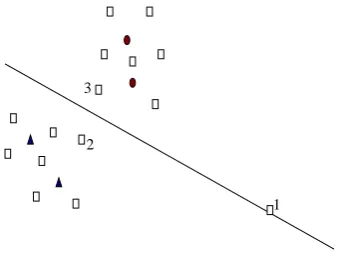
Representativeness is another important measure for choosing samples in active learning. In figure 1, sample 1 is the nearest instance to decision bound-ary, it is therefore the instance that will be selected using uncertainty criterion. But it should be clear that this sample is not appropriate for selection, an-notation, and addition to the training data, because it is in fact an outlier and non representative instance.
1 2
3
Figure 1: The weakness of uncertainty measure for deal-ing with outliers. Circles and triangles represent labeled instances while squares represent unlabeled instances.
This simple example shows that uncertainty mea-sure alone is not suited to fight against outliers and noisy samples. In order to prevent the learner to se-lect such instances, a representativeness measureψ
is used. It simply computes the average distance be-tween an instance and all other instances in the pool:
ψ(x) = 1 N
X
x0∈U
dist(x, x0) (7)
whereN is the number of instances in the pool,
anddistis the distance between two samples which can be computed by simply applying a kernel func-tion on them:
dist(xi, xj) =kernel(xi, xj) (8)
As it is shown in equation 7, the samples which are more similar to other samples of the pool will be considered to be more representative.
In order to take into account representativeness in the active learning algorithm, the distance be-tween every sample pairs of the pool must be com-puted. This computation is a costly process, but these distances can be computed only once for the whole active learning algorithm. Algorithm 1 de-scribes how representativeness and uncertainty mea-sures have been combined.
4.4 Diversity
12 3
4 5 6 8
7
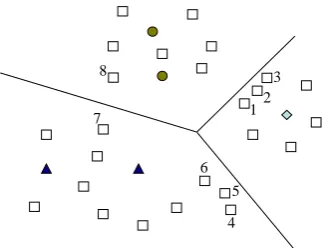
Figure 2: The necessity of applying diversity measure to select samples from the whole problem space.
and it might be interesting, in order to better cover the problem space, to select instances that are differ-ent from each other. This is done by taking diversity into account.
Figure 2 illustrates the effect of considering the diversity measure on a simple problem. In this prob-lem, the learner chooses 4 instances for each
iter-ation. Based on uncertainty and representativeness measures, samples1,2,3, and5should be selected.
However,1,2and3are very similar, and only one of
such samples may be enough for learning. Besides, selecting7and8will lead to a better covering of the
problem space.
In our algorithm, diversity is taken into account after uncertainty and representativeness were. First,
BI instances are chosen, based on uncertainty and
representativeness. A distance matrix is then con-structed, based on the distance measure of equa-tion 8. TheBI instances are then grouped intoBF
(BF < BI) clusters, using hierarchical clustering
and the centroid of each cluster is selected for label-ing. This process is explained in algorithm 1.
4.5 Proposed Algorithm
The pseudo-code of our active learning algorithm is shown in Algorithm 1. This algorithm first trains the model based on the initial labeled data, and ap-plies a combination of uncertainty and representa-tiveness measures to select BI samples from the
pool. Then hierarchical clustering is applied to the extracted samples to select BF most diverse
sam-ples. Chosen samples are then labeled and added to the training labeled set. This process is iterated until
Algorithm 1THE PROPOSED ACTIVE LEARNING α: Uncertainty coefficient
L: Labeled set U: Unlabeled pool
ϕ(x): Uncertainty measure ψ(x): Representativeness measure
BI: Initial query batch size BF: Final query batch size
whiletermination condition is not satisfieddo θ=train(L);TI =∅;
fori= 1toBI do
// Find most uncertain and representative in-stance
ˆ
x= arg maxx∈U[αϕ(x) + (1−α)ψ(x)]; TI =TI∪ {xˆ};
end for
Apply Hierarchical clustering onTI to extract
setTF ofBF diverse samples;
U =U − TF;
L=L ∪ TF;
end while
at least one termination condition is satisfied. In our experiments, the algorithm stops when all instances of the pool were selected and labeled.
Our algorithm may seem much more costly than the original SVM algorithm. However, it is easy to show, similar to (Brinker, 2003), that it only multi-ply by a coefficient ofN/BF (Nis the final number
of labeled instances) the total computational com-plexity of original SVM.
5 Corpus Description
Two standard corpora were used for our expri-ments: TimeBank (v. 1.2)(Pustejovsky et al., 2003) and Opinion (www.timeml.org). TimeBank is composed of 183 newswire documents and 64 077 words, and Opinion comprises 73
docu-ments with 38 709 words. These two datasets
have been annotated with TimeML (Pustejovsky et al., 2004). There are 14 temporal relation types
(SIMULTANEOUS,IDENTITY, BEFORE,AFTER,
IBEFORE, IAFTER, INCLUDES, IS INCLUDED,
DURING, DURING INV, BEGINS, BEGUN BY,
relation types, which contains only the following six temporal relations:
SIMULTANEOUS ENDS BEGINS BEFORE IBEFORE INCLUDES
In order to convert14relations into6, the inverse relations were omitted (e.g.,BEFOREandAFTER), and IDENTITY and SIMULTAENOUS, as well as
IS INCLUDED and DURING were collapsed, re-spectively.
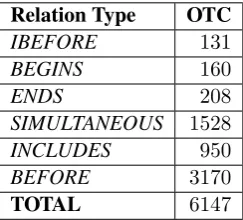
Relation Type OTC
IBEFORE 131
BEGINS 160
ENDS 208
SIMULTANEOUS 1528
INCLUDES 950
BEFORE 3170
TOTAL 6147
Table 1: The normalized TLink class distribution in OTC.
In our experiments, as in several previous work, we merged the two datasets to generate a single corpus called OTC. Table 1 shows the normalized TLink class distribution (only for Event-Event rela-tions) for OTC corpora.
6 Experimental Results
The algorithm described above was evaluated on OTC corpus with our four uncertainty measures with and without representativeness and diversity. We used random instance selection (i.e., passive learn-ing) as the baseline strategy.
Several kernels can be used for such experiments. As explained in section 2, we decided to use the ker-nel proposed in (Mani et al., 2006), which we will refer to as Mani’s kernel, and the Argument Ances-tor Path Distance (AAPD) polynomial kernel pro-posed in (Mirroshandel et al., 2010). AAPD polyno-mial is the state of the art pattern-based algorithm, which exclusively combines gold standard features of events and grammatical structures of sentences.
All evaluations are based on a5-fold cross valida-tion. The original corpora was randomly partitioned into5parts, out of which, a single part was retained
for testing the model, and the remaining4parts were
used for the training and applying our instance se-lection strategies. This process was then repeated
5 times (the folds), with each of the5 parts being
used exactly once as the test data. To perform the experiments, we started from initial labeled set with
100 randomly selected samples, and in each
itera-tion,25samples were selected, labeled, and added
to the previously labeled set.
6.1 Uncertainty Measure Alone
Figures 3 and 4 show the result of applying our four uncertainty measures for “instance selection” in OTC, using Mani’s (Figure 3) and AAPD kernels (Figure 4).
OTC, Mani Kernel
50 52 54 56 58 60 62 64
100 700 1300 1900 2500 3100 3700 4300 4900
Number of instances queried
Accuracy
Random NOH NAH LVM VE
Figure 3: Learning curves for different uncertainty in-stance selection strategies applied to OTC using Mani’s kernel.
OTC, AAPD Kernel
54 56 58 60 62 64 66
100 700 1300 1900 2500 3100 3700 4300 4900 Number of instances queried
Accuracy
Random NOH NAH LVM VE
Figure 4: Learning curves for different uncertainty in-stance selection strategies applied to OTC using AAPD kernel.
based measures have outperformed distance based ones. Among the two distance based measures,NAH
led to better results thanNOH, showing that
averag-ing (aggregation) over the distances to the different separating hyperplanes is more robust than taking into account only the distance to the closest one.
The two vote based methods led to very close re-sults, which seems to indicate that the system usu-ally hesistates between two classes (and not more) when trying to classify an instance.
6.2 Combining Uncertainty and Representativeness Measures
Representativeness has been introduced in order to fight against outliers. Such outliers have two differ-ent origins. The first one is data sparseness: some temporal relation events are poorely represented in the data. Eliminating such instances will degrade the results on the corresponding class but will introduce less noise in the data. The second origin of outliers is the difficulty of problem, even for human anno-tators (Pustejovsky et al., 2003). This causes some mistakes in annotation and generates some outliers.
OTC, Mani Kernel
-0.4 0 0.4 0.8 1.2 1.6 2
100 700 1300 1900 2500 3100 3700 4300 4900
Number of instances queried
Accuracy Change
NOH NAH LVM VE
Figure 5: Accuracy improvement when adding represen-tativeness measure to the uncertainty instance selection in Mani’s kernel.
In the second series of experiments, we combined a representativeness measure with different uncer-tainty instance selection strategies to tackle outliers’ side effects. In our different experiments, the best value for uncertainty coefficient (α) was0.65.
Fig-ure 5 (resp. 6) shows the accuracy improvement when adding representativeness to uncertainty with Mani’s (resp. AAPD) kernel. We have chosen to
OTC, AAPD Kernel
-0.4 0 0.4 0.8 1.2 1.6 2
100 700 1300 1900 2500 3100 3700 4300 4900
Number of instances queried
Accuracy Change
NOH NAH LVM VE
Figure 6: Accuracy improvement when adding represen-tativeness measure to the uncertainty instance selection in AAPD kernel.
represent just the improvement rather than the learn-ing accuracy, because the learnlearn-ing curves were not easy to compare.
The results show that distance based measures are more sensitive to outliers than vote based ones. Fig-ures 5 and 6 also show that the representativeness measure has less impact on AAPD kernel than it has on Mani’s kernel. This is because AAPD kernel is more resistant to outliers than Mani’s kernel.
OTC, Mani Kernel
-0.1 0 0.1 0.2 0.3 0.4 0.5
100 700 1300 1900 2500 3100 3700 4300 4900
Number of instances queried
Accuracy Change
NOH NAH LVM VE
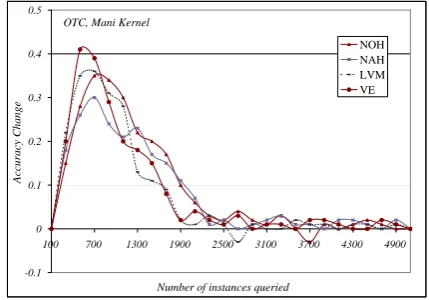
Figure 7: Accuracy improvement when adding diversity in the instance selection with Mani’s kernel.
6.3 Combining Uncertainty,
Representativeness and Diversity
In the last series of experiments, diversity was added to the instance selection procedure. In each iteration, first80instances of the pool were selected by
mea-OTC, AAPD Kernel
-0.1 0 0.1 0.2 0.3 0.4 0.5
100 700 1300 1900 2500 3100 3700 4300 4900
Number of instances queried
Accuracy Change
NOH NAH LVM VE
Figure 8: Accuracy improvement when adding diversity in the instance selection with AAPD kernel.
sures. Next, a hierarchical clustering method was used to select the final 25instances. The accuracy improvement, as it is shown in Figures 7 and 8, is moderate.
The reasons why introducing diversity did not have a greater impact on the results is not clear. That may be due to the way diversity was introduced in our model. It could also come from the distribution of the data: if instances that are both unreliable and representative are not close to each other, selecting instances that are different from each other for better coverage of the problem space is not an issue. More work has to be done to investigate that point.
The final learning curves, when uncertainty, rep-resentativeness, and diversity were all considered, are shown in figures 9 and 10. As shown, vote-based uncertainty measures still obtain better results than distance based measures.
7 Conclusion
In this paper, we have addressed the problem of ac-tive learning based on support vector machines for temporal relation classification. Three different kind of measures have been used for selecting the most informative instances: uncertainty, representative-ness and diversity. The results showed that the three measures improved the learning curve although di-versity had a moderate effect.
Future work will focus on three points, the first one is trying other sample selection strategies, as query by committee, the second will focus on com-bining the two families of uncertainty measures that
we have proposed: distance based and vote based. The third one is about diversity. As mentioned above, we do not know if this phenomenon is not well handeled by the model or if it is not an issue for the problem at hand.
OTC, Mani Kernel
50 52 54 56 58 60 62 64
100 700 1300 1900 2500 3100 3700 4300 4900 Number of instances queried
Accuracy
Random NOH NAH LVM VE
Figure 9: Learning curves for combined uncertainty, rep-resentative and diversity measures with Mani’s kernel.
OTC, AAPD Kernel
54 56 58 60 62 64 66
100 700 1300 1900 2500 3100 3700 4300 4900 Number of instances queried
Accuracy
Random NOH NAH LVM VE
Figure 10: Learning curves for combined uncertainty, representative and diversity measures with AAPD kernel.
Acknowledgement
This work has been funded by the French Agence Nationale pour la Recherche, through the project SEQUOIA (ANR-08-EMER-013).
References
D. Angluin. 2004. Queries revisited. Theoretical Com-puter Science, 313(2):175–194.
queries and selective sampling. InAdvances in neu-ral information processing systems 2, pages 566–573. Morgan Kaufmann Publishers Inc.
S. Bethard and J.H. Martin. 2008. Learning semantic links from a corpus of parallel temporal and causal re-lations. In Proceedings of the 46th Annual Meeting of the Association for Computational Linguistics on Human Language Technologies: Short Papers, pages 177–180. Association for Computational Linguistics. S. Bethard, J.H. Martin, and S. Klingenstein. 2007.
Find-ing temporal structure in text: Machine learnFind-ing of syntactic temporal relations. International Journal of Semantic Computing, 1(4).
K. Brinker. 2003. Incorporating diversity in ac-tive learning with support vector machines. In MA-CHINE LEARNING-INTERNATIONAL WORKSHOP THEN CONFERENCE-, volume 20, pages 59–66. N. Chambers, S. Wang, and D. Jurafsky. 2007.
Classify-ing temporal relations between events. InProceedings of the 45th Annual Meeting of the ACL on Interactive Poster and Demonstration Sessions, pages 173–176. Association for Computational Linguistics.
T. Chklovski and P. Pantel. 2005. Global path-based re-finement of noisy graphs applied to verb semantics.
Natural Language Processing–IJCNLP 2005, pages 792–803.
D. Cohn, L. Atlas, and R. Ladner. 1994. Improving gen-eralization with active learning. Machine Learning, 15(2):201–221.
J. Han and M. Kamber. 2006. Data mining: concepts and techniques. Morgan Kaufmann.
M. Lapata and A. Lascarides. 2006. Learning sentence-internal temporal relations. Journal of Artificial Intel-ligence Research, 27(1):85–117.
D.D. Lewis and W.A. Gale. 1994. A sequential algo-rithm for training text classifiers. In Proceedings of the 17th annual international ACM SIGIR conference on Research and development in information retrieval, pages 3–12. Springer-Verlag New York, Inc.
I. Mani, M. Verhagen, B. Wellner, C.M. Lee, and J. Puste-jovsky. 2006. Machine learning of temporal relations. InProceedings of the 21st International Conference on Computational Linguistics and the 44th annual meet-ing of the Association for Computational Lmeet-inguistics, pages 753–760. Association for Computational Lin-guistics.
S.A. Mirroshandel and G. Ghassem-Sani. 2010. Tem-poral Relations Learning with a Bootstrapped Cross-document Classifier. InProceeding of the 2010 con-ference on ECAI 2010: 19th European Concon-ference on Artificial Intelligence, pages 829–834. IOS Press. S.A. Mirroshandel, G. Ghassem-Sani, and
M. Khayyamian. 2010. Using Syntactic-Based
Kernels for Classifying Temporal Relations. Journal of Computer Science and Technology, 26(1):68–80. G. Puscasu. 2007. Wvali: Temporal relation
identifica-tion by syntactico-semantic analysis. InProceedings of the 4th International Workshop on SemEval, pages 484–487.
J. Pustejovsky, P. Hanks, R. Sauri, A. See, R. Gaizauskas, A. Setzer, D. Radev, B. Sundheim, D. Day, L. Ferro, et al. 2003. The timebank corpus. InCorpus Linguis-tics, volume 2003, page 40.
J. Pustejovsky, B. Ingria, R. Sauri, J. Castano, J. Littman, R. Gaizauskas, A. Setzer, G. Katz, and I. Mani. 2004. The specification language TimeML. The Language of Time: A Reader. Oxford University Press, Oxford. N. Roy and A. McCallum. 2001. Toward optimal active
learning through sampling estimation of error reduc-tion. In MACHINE LEARNING-INTERNATIONAL
WORKSHOP THEN CONFERENCE-, pages 441–
448. Citeseer.
B. Settles and M. Craven. 2008. An analysis of active learning strategies for sequence labeling tasks. In Pro-ceedings of the Conference on Empirical Methods in Natural Language Processing, pages 1070–1079. As-sociation for Computational Linguistics.
B. Settles, M. Craven, and S. Ray. 2008. Multiple-instance active learning. InIn Advances in Neural In-formation Processing Systems (NIPS. Citeseer. Burr Settles. 2010. Active Learning Literature Survey.
Technical Report Technical Report 1648, University of Wisconsin-Madison.
H.S. Seung, M. Opper, and H. Sompolinsky. 1992. Query by committee. In Proceedings of the fifth annual workshop on Computational learning theory, pages 287–294. ACM.