Generative Modeling of Coordination by Factoring
Parallelism and Selectional Preferences
Daisuke Kawahara and Sadao Kurohashi Graduate School of Informatics, Kyoto University Yoshida-Honmachi, Sakyo-ku, Kyoto, 606-8501, Japan
{dk, kuro}@i.kyoto-u.ac.jp
Abstract
We present a unified generative model of coordination that considers parallelism of conjuncts and selectional preferences. Parallelism of conjuncts, which frequently characterizes coordinate structures, is modeled as a synchronized generation process in the generative parser. Selec-tional preferences learned from a large web corpus provide an important clue for resolving the ambiguities of coordinate structures. Our experiments of Japanese dependency parsing indicate the effective-ness of our approach, particularly in the domains of newspapers and patents. 1 Introduction
Coordinate structures are a potential source of syn-tactic ambiguity in natural language. Although many methods have been proposed to resolve the ambiguities of coordinate structures, coordination disambiguation still remains a difficult problem for state-of-the-art parsers. Previous studies on coordination disambiguation used two kinds of clues:
• parallelism of conjuncts, and
• selectional preferences.
Syntactic, lexical and semantic parallelism of conjuncts is frequently observed in coordinate structures. For example, Dubey et al. (2005) em-pirically confirmed syntactic parallelism in co-ordinate structures. This clue was modeled by string matching, part-of-speech matching, num-ber agreement, semantic similarities, and so forth (Agarwal and Boggess, 1992; Kurohashi and Na-gao, 1994; Resnik, 1999; Chantree et al., 2005;
Buyko and Hahn, 2008). For instance, consider the following example:
(1) eat Caesar salad and Italian pasta
We can observe lexical or semantic parallelism
be-tweensaladandpasta, which can be automatically
detected via a thesaurus or distributional similar-ity. In addition, syntactic parallelism can be
ob-served; each conjunct has a modifier Caesar and
Italian, respectively. These types of parallelism contribute to identifying the coordinate structure
that conjoinsCaesar saladandItalian pasta.
The other clue is selectional preferences, such
as eat in the above example. Since eat is likely
to havesaladandpastaas its objects, it is
plausi-ble thatsaladandpastaare coordinated. Such
se-lectional preferences of predicates are thought to support the construction of coordinate structures, and were used in Japanese dependency parsing by Kawahara and Kurohashi (2008). Selectional pref-erences of nouns (noun-noun modifications) were used by Resnik (1999), Nakov and Hearst (2005) and Kawahara and Kurohashi (2008). For exam-ple, let us see the following examples:
(2) a. mail and securities fraud
b. corn and peanut butter
In (2a), the coordination ofmailandsecuritiesis
guided by the estimation thatmail fraudis a salient
compound nominal phrase. In (2b), on the
con-trary, the coordinate structure that conjoins corn
andpeanut butteris led becausecorn butteris not a familiar concept.
Each clue has been empirically proven to be ef-fective for coordination disambiguation. However, a unified approach that combines both clues has not been explored comprehensively. In this pa-per, we propose a unified framework for
nation disambiguation by incorporating both the clues into a generative parser. To capture syntac-tic parallelism of conjuncts, we formulate the gen-erative process of pre-modifiers of conjuncts in a synchronized manner. In the above example, the
generation process ofCaesar from salad is
syn-chronized with that ofItalianfrompasta. An
in-terpretation of an unbalanced coordinate structure without synchronization (e.g., “Caesar salad and Italian”) is penalized. Lexical parallelism, which
is a tendency that some words, such assalad and
pasta, are likely to be coordinated, is also modeled within the generative model.
In this paper, we focus on the Japanese lan-guage. A synchronization-based model of coor-dination disambiguation is integrated into a fully-lexicalized Japanese generative parser (Kawahara and Kurohashi, 2008). For the selectional pref-erences, we use case frames and statistics of noun-noun modifications that are automatically extracted from large raw corpora. Our method can resolve coordinate structures with parallelism on the basis of the synchronized generative model, and can also handle unlike coordinate structures using selectional preferences.
The remainder of this paper is organized as fol-lows. Section 2 summarizes previous work re-lated mainly to parsing models with coordination disambiguation. Section 3 briefly overviews the Japanese language and coordination ambiguity in Japanese. Section 4 illustrates our idea and de-scribes our model in detail. Section 5 is devoted to our experiments. Finally, section 6 gives the con-clusions.
2 Related Work
Resnik (1999) and van Noord (2007) incorpo-rated parallelism and selectional preferences into coordination disambiguation or parsing. Resnik (1999) integrated semantic similarities and noun-noun modifications into voting or decision trees to disambiguate the scope ambiguities of nomi-nal compounds “n1 and n2 n3.” He did not in-tegrate this method into parsing, but applied it to an independent task. Van Noord (2007) proposed a MaxEnt model of Dutch parsing that incorpo-rated selectional preferences learned from a large corpus. He used various features in the MaxEnt model including some features that capture paral-lelism. This indirect treatment of parallelism is different from our generative model that explicitly
factors parallelism.
Several other studies have considered paral-lelism in parsing models. Charniak and John-son (2005) incorporated some features of syntac-tic parallelism in coordinate structures into their MaxEnt reranking parser. K¨ubler et al. (2009) used a reranking parser with automatically de-tected scope possibilities to improve German pars-ing. As for a generative parser, Dubey et al. (2006) proposed an unlexicalized PCFG parser that modi-fied PCFG probabilities to condition the existence of a coordinate structure. Hogan (2007) proposed a generative lexicalized parser that considered the symmetry of part-of-speech tags and phrase cate-gories of conjuncts, which is more shallow infor-mation than our synchronization model. She also used cooccurrence statistics of conjunct heads, which are similar to our modeling of lexical paral-lelism, but her model did not use selectional pref-erences.
Kurohashi and Nagao (1994) proposed a rule-based method of Japanese dependency parsing that included coordination disambiguation. Their method first detects coordinate structures in a sen-tence using dynamic programming, and then de-termines the dependency structure of the sentence under the constraints of the detected coordinate structures. Shimbo and Hara (2007) and Hara et al. (2009) considered many features for coordina-tion disambiguacoordina-tion and automatically optimized their weights, which were heuristically determined in Kurohashi and Nagao (1994), by using a dis-criminative learning model.
3 Japanese Grammar and Coordinate Structure
3.1 Japanese Grammar
Let us first briefly introduce Japanese grammar. The structure of a Japanese sentence can be de-scribed well by the dependency relation between
bunsetsus. A bunsetsu is a basic unit of depen-dency, consisting of one or more content words and the following zero or more function words. A
bunsetsucorresponds to a base phrase in English andeojeol in Korean. The Japanese language is
head-final, that is, abunsetsudepends on another
bunsetsuto its right (but not necessarily the adja-centbunsetsu).
For example, consider the following sentence:1
(alla-(3) ane-to
(went to school with (my) sister)
This sentence consists of threebunsetsus. The
fi-nalbunsetsu,itta, is a predicate, and the other bun-setsus, ane-to and gakkou-ni, are its arguments.
Their endings, to and ni, are postpositions that
function as case markers.
3.2 Coordinate Structure in Japanese
Coordinate structures in Japanese are roughly classified into two types. The first type is the nom-inal coordinate structure.
(4) nagai
long enpitsu-pencil-CNJto
keshigomu-wo
eraser-ACC
katta
bought
(bought a long pencil and an eraser)
The other type is the predicative coordinate structure, in which two or more predicates form a coordinate structure.
(married her and bought a house)
For both of these types, we can detect the pos-sibility of a coordinate structure by looking for a
coordination key bunsetsu that contains to, -shi, comma and so forth. That is to say, the left and right sides of a coordination key bunsetsu consti-tute possible pre- and post-conjuncts, and the key bunsetsu is located at the end of the pre-conjunct.
For the evaluation of our method, which is de-scribed in section 5, we use analyzed corpora that are annotated on the basis of the annotation criteria of the Kyoto University Text Corpus (Kurohashi
and Nagao, 1998).2 Under this annotation criteria,
the lastbunsetsuin a pre-conjunct depends on the
lastbunsetsu in a post-conjunct, as shown in the dependency trees of Figure 1.
4 Our Method
4.1 Idea
Consider, for example, the following sentence. tive),GEN(genitive),CMI(comitative),CNJ(conjunction) and
TOP(topic marker).
(prayed (for) health of pope and peace of Tibet)
In this sentence, the coordination key “to” is a
co-ordinate conjunction.3 The coordinate structure
in example (6) has four possible scopes. Among these, two structures are illustrated in Figure 1. In this figure, our parser generates the constituent words according to the arrows.
First, let us describe the effect of selectional
preferences and lexical parallelism. In (a),
two coordinated arguments, kenkou (health) and
heiwa (peace), are generated from the verb
in-otta(prayed), and are eligible as accusative words
of the verb inotta (prayed). Kenkou (health) is
also generated from its coordinated head heiwa
(peace). This generation is plausible because peo-ple often say this coordinated pair. In (b), the
heads of conjuncts,kenkou(health) andtibet, are
generated from the noun heiwa (peace). This is
not appropriate because we are not referring to the
nominal compound “kenkou-no heiwa” (peace of
health).Kenkou(health) is also generated from its
coordinated head tibet, but this generation has a
low probability because this coordination is mean-ingless and rare.
These judgments are determined based on selectional preferences of predicates including nouns and lexical parallelism. As resources for considering these factors, we use automatically compiled case frames, and cooccurrences of noun-noun modifications and coordinated noun-nouns.
Second, syntactic parallelism of conjuncts is also effective for coordination disambiguation.
In (a), after the conjunct heads, kenkou (health)
and heiwa (peace), are generated, the
modi-fier in the pre-conjunct, houou (pope), is
gen-erated. In this generation, the generative
prob-ability of a genitive case from kenkou (health),
P(A(GEN)= Y|health), is considered. Note that
A(CASE)={Y,N} is a binary function that
re-turns Y if a case slotCASE is filled with an
!"#"#$%"& !"!#$%&'(
'(%'"#$)"& )#*+,)$-'.(
)*+()$%"& ,/0#,$%&'(
!(*,-$,"& !#*1#$2--(
*%"))-& !3*4#5( !"#$
!!"!"#$%!& '#$%&'#% !!!()($'#$%&'#( "#$%
!!"!"#$%!& '#$%&$("&!"#$%!&% !!!'()$''#$%&$( "#$%
!"#"#$%"& !"!#$%&'(
'(%'"#$)"& )#*+,)$-'.(
)*+()$%"& ,/0#,$%&'(
!(*,-$,"& !#*1#$2--( !%#$
*%"))-& !3*4#5(
!!"!"#$%!& '#$%&'#%
!!!()($'#$%&'#( "#$%
!!"!"#$%!$ &#$%&#'"
'!"#$%!(%
!!"#$%#""&$'# $%%&
!!"#$%&""'($)# $%%&!!!"#$%&""'#$*## %'(&
!!"#$%""&%'(%# $%&'
!!"#$%&""'#$(## $%&'!!!"#$%&""&)*#&# (&)'
&'()*+,(-."/-,(!
(,(0&'()*+,(-."/-,(!
12(2+"/-,($%'$ &232)/-,("3$4+252+2()2&!
12(2+"/-,($%'$ 326-)"3$4"+"3323-&7!
Figure 1: Two possible dependency and coordinate structures with some generative probabilities. The rounded rectangles represent conjuncts of coordinate structures.
gument; otherwise, it returns N. Subsequently, the
modifier in the post-conjunct, tibet, is generated.
This generation includes the synchronous
gener-ation of a genitive case from heiwa(peace) with
the probability P(A(GEN)=Y|peace, Ac(GEN)=Y),
which is conditioned on the previously generated genitive case of the pre-conjunct. Since syntactic parallelism is preferred in coordinate structures, this probability has a larger value than other
prob-abilities P(A(GEN)=Y|peace) without
coordina-tion and P(A(GEN)=Y|peace, Ac(GEN)=N)
with-out synchronization.
In (b), P(A(GEN=N)|tibet, Ac(GEN)=Y) means
that nothing is generated from tibet, whereas
the head of the pre-conjunct has a genitive
case. This probability has a small value
be-cause of non-synchronization (unbalanced coordi-nate structure).
4.2 Resources
As the resources of selectional preferences to support coordinate structures, we use automati-cally constructed case frames and cooccurrences of noun-noun modifications. As a parser for ex-tracting these resources, we use the Japanese
de-CS examples
ga I:18, person:15, craftsman:10,· · ·
yaku(1) wo bread:2484, meat:1521, cake:1283,· · · (bake) de oven:1630, frying pan:1311,· · · yaku(2) ga teacher:3, government:3, person:3,· · ·
(have wo fingers:2950
difficulty) ni attack:18, action:15, son:15,· · ·
ga maker:1, distributor:1 yaku(3) wo data:178, file:107, copy:9,· · ·
(burn) ni R:1583, CD:664, CDR:3,· · · ..
. ... ...
Table 1: Acquired case frames ofyaku. “CS”
in-dicates case slots, such asga (NOM),wo (ACC), ni
(DAT) andde (LOC). Example words are expressed
only in English due to space limitation. The num-ber following each word denotes its frequency.
pendency parser, KNP,4 which is also used as a
base model in the following sections.
4.2.1 Automatically Constructed Case Frames
We employ automatically constructed case frames (Kawahara and Kurohashi, 2006). This section outlines the method for constructing the case frames.
A large corpus is automatically parsed, and case
frames are constructed from predicate-argument examples in the resulting parses. The problems of automatic case frame construction are syntac-tic and semansyntac-tic ambiguities. That is to say, the parsing results inevitably contain errors, and verb senses are intrinsically ambiguous. To cope with these problems, case frames are gradually con-structed from reliable predicate-argument exam-ples.
First, predicate-argument examples that have no syntactic ambiguity are extracted, and they are dis-ambiguated by a pair consisting of a verb and its closest case component. Such pairs are explicitly expressed on the surface of text, and are thought to play an important role in sentence meanings. For instance, examples are distinguished not by
verbs (e.g.,yaku(bake/broil/have difficulty)), but
by pairs (e.g., pan-wo yaku (bake bread),
niku-wo yaku (broil meat), and te-wo yaku (have dif-ficulty)). Predicate-argument examples are aggre-gated in this way, and yield basic case frames.
Thereafter, the basic case frames are clustered to merge similar case frames. For example, since
pan-wo yaku(bake bread) andniku-wo yaku(broil meat) are similar, they are clustered. The similar-ity is measured by using a distributional thesaurus based on the study described in Lin (1998).
By using this gradual procedure, we constructed case frames from a web corpus. The case frames were obtained from approximately 1.6 billion sen-tences extracted from the web. They consisted of 43,000 predicates, and the average number of case frames for a verb was 22.2. In Table 1, some ex-amples of the resulting case frames of the verb
yakuare listed.
4.2.2 Cooccurrences of Noun-noun Modifications
Adnominal nouns have selectional preferences to nouns, and thus this characteristic is useful for coordination disambiguation. We collect depen-dency relations between nouns, which have the
form of “N1-no N2” (N2 of N1), from automatic
parses of a large corpus. We performed this extrac-tion using the web corpus of 1.6 billion sentences, and obtained 55.5 million unique dependency rela-tions. We keep a cooccurrence frequency for each relation.
4.2.3 Cooccurrences of Coordinated Nouns
Some nouns are likely to be coordinated. We use this characteristic as lexical parallelism. We
col-lect cooccurrences of coordinated nouns from au-tomatic parses of a large corpus. We extracted 54.1 million unique noun pairs from the web corpus of 1.6 billion sentences.
4.3 Our Model
We employ the probabilistic generative model of dependency and case structure analysis (Kawahara and Kurohashi, 2008) as a base model. This base model resolves coordination ambiguities only on the basis of selectional preferences of predicates and nouns on which conjuncts depend. To cap-ture syntactic parallelism, we integrate the syn-chronized generation process into the base model. Lexical parallelism is also factored within the gen-eration of pre-conjuncts of coordinate structures.
Our model assigns a probability to each
possi-ble dependency structure, T, and case structure,
L, of the input sentence, S, and outputs the
de-pendency and case structure that have the highest probability. In other words, the model selects the
dependency structureTbestand the case structure
Lbestthat maximize the probability P(T, L|S)or
The last equation follows from the fact thatP(S)
is constant.
In the model, a clause (or predicate-argument structure) is considered as a generation unit and the input sentence is generated from the root of the
sentence. The probability P(T, L, S) is defined
as the product of the probabilities of generating
clausesCias follows:
P(T, L, S) = ∏Ci∈SP(Ci|Ch), (2)
whereChis the modifying clause ofCi. Since the
Japanese language is head final, the main clause at the end of a sentence does not have a modifying
head; we account for this by assumingCh=EOS
(End Of Sentence).
The probabilityP(Ci|Ch)is defined in a
study and that in our study are the generative prob-ability of case slots and the generative probprob-ability of argument nouns. We describe these two proba-bilities in the following sections.
4.3.1 Generative Probability of Case Slot
In the base model, the generative probability of case slots is defined as follows:
P(A(sj) ={Y,N}|CFl), (3)
where CFl is a case frame; sj is a case slot of
the case frameCFl; andA(sj) is a binary
func-tion that returns Y if a case slotsjis filled with an
argument; otherwise, N.
In our model, if the target predicate or noun does not constitute a coordinate structure, we use the probability (3) for the case slot generation. If the target predicate or noun constitutes a co-ordinate structure and has a pre-conjunct, we use the following modified probability that depends on whether the same case slot of a pre-conjunct is filled.
P(A(sj) ={Y,N}|CFl, Ac(sj)={Y,N}),(4)
whereAc(sj)represents the situation of the same
case slot of the pre-conjunct.
In practice, to avoid the data sparseness prob-lem, we interpolate this probability, which is ditioned on case frames, with the probability con-ditioned on predicates in the same manner as in Collins (1999).
4.3.2 Generative Probability of Argument Nouns
In the base model, the generative probability of ar-gument nouns in a clause is defined as the product of the generative probability of an argument noun Pnjk:
filled in the case slotsjand its coordinated nouns.
The generative probability of an argument noun is given as follows:
Pnjk =P(njk|CFl, sj). (6) In our model, the direct argument noun filled in
the case slotsj is generated with the above
prob-ability. The coordinated nouns, which have no di-rect dependency relation to the predicate, are gen-erated with the following probability:
P0njk = √
P(njk|CFl, sj)×P(njk|njh,CNJ), (7)
# of
sents. #coord.of # of wordsin coord.
newspaper 1,000 630 14.7
patent 1,000 1,264 14.8
web 759 453 11.4
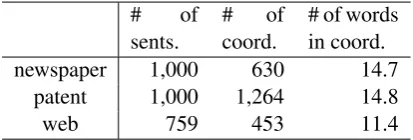
Table 2: Statistics of three test sets: the number of sentences, the number of coordinate structures and the average number of words that constitute a coordinate structure. Since a sentence can contain more than one coordinate structure, the number of coordinate structures in the patent set is larger than the number of sentences.
wherenjhis a head ofnjk, which constitutes a
co-ordinate structure (designated asCN J) withnjh.
For instance, in Figure 1, the probability of
gen-eratingkenkou(health) andheiwa(peace) from the
verbinoru(pray) is written as follows:5 6
P(peace|CFpray,ACC)× p
P(health|CFpray,ACC)×P(health|peace,CNJ).
This probability is estimated on the basis of the cooccurrence data of coordinated nouns described in section 4.2.3.
4.4 Practical Issue
The proposed model considers all the possible de-pendency structures including coordination ambi-guities. To reduce this high computational cost, we introduced the CKY framework to the search (Eisner, 1996).
5 Experiments
5.1 Experimental Settings
We evaluated the dependency structures that were output by our proposed model. The necessary lex-ical resources for this parser, which include case frames, statistics of noun-noun modifications and coordinated nouns, and lexical parameters of our model, were acquired from automatic parses of 1.6 billion Japanese sentences crawled from the web (Kawahara and Kurohashi, 2006).
5In the probabilities in Figure 1, “pray” is used instead of “CFpray” for simplicity.
pref (baseline) pref+parallelism improve
newspaper all 7,356/8,248 (89.2%) 7,398/8,248 (89.7%) 0.5%∗∗
coordination key 1,226/1,592 (77.0%) 1,251/1,592 (78.6%) 1.6%∗∗
coordination scope 2,291/2,631 (87.1%) 2,320/2,631 (88.2%) 1.1%∗∗
patent all 9,758/11,318 (86.2%) 9,852/11,318 (87.0%) 0.8%∗∗
coordination key 1,839/2,528 (72.7%) 1,887/2,528 (74.6%) 1.9%∗∗
coordination scope 3,776/4,573 (82.6%) 3,839/4,573 (83.9%) 1.3%∗∗
web all 4,563/5,114 (89.2%) 4,584/5,114 (89.6%) 0.4%∗∗
coordination key 893/1,125 (79.4%) 906/1,125 (80.5%) 1.1%∗
coordination scope 1,242/1,462 (85.0%) 1,257/1,462 (86.0%) 1.0%∗
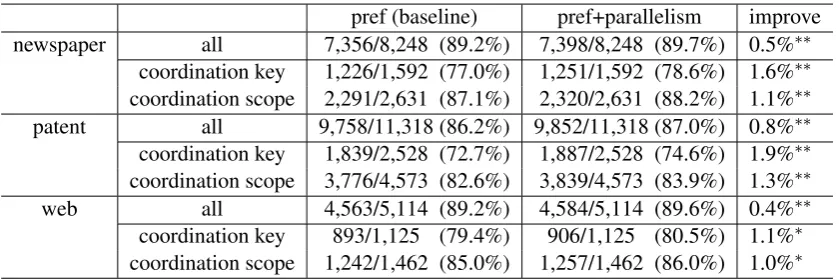
Table 3: Dependency accuracies of “pref” (baseline) and “pref+parallelism” (proposed) in the domains
of newspapers, patents and web. ** and * represent statistically significant with p < 0.01 and with
p <0.05, respectively.
The parameters related to unlexical types were calculated from a training part of the Kyoto Uni-versity Text Corpus. The Kyoto UniUni-versity Text Corpus is syntactically annotated in dependency formalism, and consists of 40K Japanese newspa-per sentences. The training part is the remaining part excluding the test 1,000 sentences that are de-scribed below.
To evaluate the effectiveness of our model, our experiments were conducted using three test sets: newspaper set, patent set and web set. Table 2 lists some statistics of these test sets. As the newspaper set, we randomly extracted 1,000 sentences from the Kyoto University Text Corpus. The patent set consists of 1,000 sentences drawn from 2004’s
patent filings of the domain of “Microbe/Ferment.”
The web set consists of 759 sentences from the web, which are not included in the raw corpus of 1.6 billion sentences. This web set is the same as the test set used in previous studies. All the test sets follow the annotation criteria of the Ky-oto University Text Corpus. As the input of our experiments, all the test sets were automatically segmented and tagged using the JUMAN
morpho-logical analyzer.7
We used the probabilistic generative model of dependency and case structure analysis (Kawahara and Kurohashi, 2008) as a baseline system for the purpose of comparison. This parser resolves co-ordination ambiguities based only on selectional preferences. We use the above-mentioned case frames in the baseline parser, which also requires automatically constructed case frames.
7http://nlp.ist.i.kyoto-u.ac.jp/EN/index.php?JUMAN
5.2 Evaluation
We evaluated the dependency structures analyzed by the proposed model and the baseline model. The dependency structures obtained were evalu-ated with regard to unlabeled dependency accu-racy — the proportion of correct dependencies out of all dependencies.
Table 3 lists the dependency accuracies. In this table, “pref” represents the baseline model, which is the probabilistic parser of dependency and case structure with only selectional prefer-ences, and “pref+parallelism” represents our pro-posed model. “all” represents the overall depen-dency accuracies. The proposed model signifi-cantly outperformed the baseline system in all the
sets (McNemar’s test;p <0.01).
In Table 3, the dependency accuracies are
fur-ther classified into coordination key and
coordi-nation scope. Coordination key means the
de-pendency accuracy of coordination keybunsetsus,
which possibly lead coordinate structures. Coor-dination scope means the dependency accuracy of
bunsetsusinside coordinate structures of the man-ual annotation.
5.3 Discussions
In the newspaper and patent sets, in particular, the accuracies of both coordination key and coordina-tion scope were improved by 1.1% to 1.9%. These improvements were conduced by the considera-tion of syntactic and lexical parallelism. In the web set, the accuracies of coordination related de-pendencies were less improved than those of the newspaper and patent sets.
rep-??
(a) seikentantousyatoshite-no chikara-to syusyo-no ninki ryomen-ga aru-ga ... person in political power-GEN competence-CNJ prime minister-GEN popularity both-NOM have (have the competence as the person in political power and the popularity of the prime minister, ...)
??
(b) Yokozuna-toshite hatsu-no honbasyo-wo mukae, kousutato-wo kiritai Takanohana. sumo champion-as first-GEN tournament-ACC confront good start-ACC want to make Takanohana (Takanohana who confronts a regular tournament and wants to make a good start as a sumo champion, ...)
??
(c) kodoseicho-ga tsuzuki, keizai-ga kanetsu, bukkajoshoritsu-wa saiaku-ninatta high growth-NOM continue economy-NOM overheat percentage change in prices-TOP become worst
(high growth continues, economy is overheated, and percentage change in prices becomes the worst)
Figure 2: Improved examples. The dotted lines represent the results of “pref,” and the solid lines,
which are correct dependencies, represent the analysis of “pref+parallelism.” The underlinedbunsetsus
represent coordination keybunsetsus.
resent the analysis performed using the proposed method, “pref+parallelism.” These sentences are incorrectly analyzed by the baseline but correctly analyzed by the proposed method. For example, in
sentence (a), the head of
seikentantousyatoshite-no (person in political power-GEN) was correctly
judged aschikara-to(competence-CNJ). This is
be-cause the two genitive (GEN) bunsetsus were
syn-chronously generated to prefer syntactic paral-lelism.
The proposed model did not largely outperform the baseline in the web set. One of the reasons of this result was due to weak parallelism in the web set. We found that coordinate structures in the newspaper and patent sets tend to have greater syntactic parallelism than those in the web set. The average number of words that constitute a co-ordinate structure in the newspaper set was 14.7 and that in the patent set was 14.8, whereas that in the web set was 11.4, as shown in Table 2. There-fore, it was hard to show substantial improvement by considering such weak parallelism of coordi-nate structures in the web set.
In order to compare our results with a discrim-inative dependency parser, we input the patent set and the web set into an SVM-based Japanese de-pendency parser, CaboCha (Kudo and Matsumoto,
2002),8 which was trained using the Kyoto
Uni-versity Text Corpus.9 Its dependency accuracies
were 86.3% (9,770/11,320) for the patent set and 88.7% (4,534/5,114) for the web set, which are
8http://chasen.org/˜taku/software/cabocha/
9We did not input the newspaper set into CaboCha, be-cause it is included in the training corpus used in CaboCha.
lower than those of our proposed model. This low performance can be attributed to the lack of sufficient consideration of both parallelism and selectional preferences, as mentioned in Sassano (2004). Another cause of the low performance is the out-of-domain training corpus. This SVM-based parser was trained on a newspaper corpus, while the test sets were obtained from patent fil-ings and the web because tagged corpora of these domains that are large enough to train a supervised parser are not available. In other words, our pro-posed model achieved a good performance on the patent set without using in-domain corpora.
6 Conclusion
References
Rajeev Agarwal and Lois Boggess. 1992. A simple but useful approach to conjunct identification. In Pro-ceedings of ACL1992, pages 15–21.
Ekaterina Buyko and Udo Hahn. 2008. Are morpho-syntactic features more predictive for the resolution of noun phrase coordination ambiguity than lexico-semantic similarity scores? InProceedings of COL-ING2008, pages 89–96.
Francis Chantree, Adam Kilgarriff, Anne de Roeck, and Alistair Wills. 2005. Disambiguating coordi-nations using word distribution information. In Pro-ceedings of RANLP2005.
Eugene Charniak and Mark Johnson. 2005. Coarse-to-fine n-best parsing and maxent discriminative reranking. InProceedings of ACL2005, pages 173– 180.
Michael Collins. 1999. Head-Driven Statistical Mod-els for Natural Language Parsing. Ph.D. thesis, University of Pennsylvania.
Amit Dubey, Patrick Sturt, and Frank Keller. 2005. Parallelism in coordination as an instance of syn-tactic priming: Evidence from corpus-based mod-eling. InProceedings of Human Language Technol-ogy Conference and Conference on Empirical Meth-ods in Natural Language Processing, pages 827– 834.
Amit Dubey, Frank Keller, and Patrick Sturt. 2006. In-tegrating syntactic priming into an incremental prob-abilistic parser, with an application to psycholinguis-tic modeling. InProceedings of COLING-ACL2006, pages 417–424.
Jason M. Eisner. 1996. Three new probabilistic mod-els for dependency parsing: An exploration. In Pro-ceedings of COLING-96, pages 340–345.
Kazuo Hara, Masashi Shimbo, Hideharu Okuma, and Yuji Matsumoto. 2009. Coordinate structure analy-sis with global structural constraints and alignment-based local features. In Proceedings of ACL-IJCNLP2009, pages 967–975.
Deirdre Hogan. 2007. Coordinate noun phrase disam-biguation in a generative parsing model. In Proceed-ings of ACL2007, pages 680–687.
Daisuke Kawahara and Sadao Kurohashi. 2006. Case frame compilation from the web using high-performance computing. In Proceedings of LREC2006.
Daisuke Kawahara and Sadao Kurohashi. 2008. Coor-dination disambiguation without any similarities. In Proceedings of COLING2008, pages 425–432.
Sandra K¨ubler, Erhard Hinrichs, Wolfgang Maier, and Eva Klett. 2009. Parsing coordinations. In Pro-ceedings of EACL2009, pages 406–414.
Taku Kudo and Yuji Matsumoto. 2002. Japanese de-pendency analysis using cascaded chunking. In Pro-ceedings of CoNLL2002, pages 29–35.
Sadao Kurohashi and Makoto Nagao. 1994. A syn-tactic analysis method of long Japanese sentences based on the detection of conjunctive structures. Computational Linguistics, 20(4):507–534.
Sadao Kurohashi and Makoto Nagao. 1998. Building a Japanese parsed corpus while improving the parsing system. InProceedings of LREC1998, pages 719– 724.
Dekang Lin. 1998. Automatic retrieval and cluster-ing of similar words. In Proceedings of COLING-ACL98, pages 768–774.
Preslav Nakov and Marti Hearst. 2005. Using the web as an implicit training set: Application to struc-tural ambiguity resolution. InProceedings of HLT-EMNLP2005, pages 835–842.
Philip Resnik. 1999. Semantic similarity in a taxon-omy: An information-based measure and its appli-cation to problems of ambiguity in natural language. Journal of Artificial Intelligence Research, 11:95– 130.
Manabu Sassano. 2004. Linear-time dependency anal-ysis for Japanese. InProceedings of COLING2004, pages 8–14.
Masashi Shimbo and Kazuo Hara. 2007. A discrim-inative learning model for coordinate conjunctions. InProceedings of EMNLP-CoNLL2007, pages 610– 619.