Transductive Minimum Error Rate Training for Statistical Machine
Translation
Yinggong Zhao1∗, Shujie Liu2, Yangsheng Ji1, Jiajun Chen1, Guodong Zhou3 1State Key Laboratory for Novel Software Technology at Nanjing University
Nanjing 210093, China
{zhaoyg,jiys,chenjj}@nlp.nju.edu.cn
2School of Computer Science and Technology, Harbin Institute of Technology Harbin, China
3School of Computer Science and Technology, Soochow University Suzhou, China
Abstract
This paper investigates parameter adap-tation in Statistical Machine Transla-tion(SMT). To overcome the parameter bias-estimation problem with Minimum Error Rate Training(MERT), we extend it under a transductive learning framework, by iteratively re-estimating the parame-ters using both development and test da-ta, in which the translation hypotheses of the test data are used as pseudo ref-erences. Furthermore, in order to over-come the over-training and unstableness problems respectively in employing such pseudo references, a termination criterion using a hyper-parameter and a Minimum Bayes Risk(MBR)-based hypothesis se-lection method are proposed in our work. Experimental results show that the trans-ductive MERT method could yield signif-icant performance improvements over a strong baseline on a large-scale Chinese-to-English translation task.
1 Introduction
Machine translation (MT) is the automatic trans-lation from one natural language into another us-ing computer, while SMT is an approach to MT that is characterized by the use of machine learn-ing methods (Lopez, 2008). Nowadays, SMT is usually built on a log-linear model (Och and Ney, 2002), which can be abstracted into two steps: the
∗
Part of this work is done during the first author’s intern-ship at Microsoft Research Asia.
first one is model training, i.e., learning features from large collection of bilingual parallel corpus; and the other is parameter estimation, in which the feature weight is tuned on an independent devel-opment dataset.
More specifically, for each source sentence f,
we search for its final translatione∗among all
pos-sible translations based on the following equation:
P(e∗|f) = arg max
e P r(e|f) (1)
Under the log-linear model, the posterior proba-bilityP r(e|f)can be decomposed as:
P r(e|f) =pλ(e|f)
= exp(
PM
m=1(λm·hm(e, f)))
P
e0exp(PMm=1(λm·hm(e0, f)))
(2)
where eachhm(e, f)is a feature function andλm
is the corresponding weight for m=1,. . . ,M. In SMT, there are three sections of data: the training data for feature estimation, the develop-ment data for weight tuning, and the test data for final evaluation. However, these three parts may belong to different domains, leading to distribu-tion variadistribu-tions, which indicates that the features and weights learned from the data may be bias-estimated. As a result, the adaptation for features and their corresponding weights are both impor-tant issues in SMT.
In this article we focus on the latter issue, i.e., the model parameter adaptation. From the view-point of machine learning, development data is la-beled data used for parameter learning, while test data is unlabeled and applied for evaluation. In
the previous works of transductive learning(Liu et al., 2010; Chan and Ng, 2007), the unlabeled da-ta can be used to improve the model training so as to tackle the bias-estimation problem. Under such framework, the weight learned on both devel-opment and test dataset, in which the test dataset is constructed using n-best translations as pseudo references, moves towards the test data with reg-ularization of development data, which alleviates the overtraining in normal MERT and matches the test data better.
The remainder of this paper is structured as fol-lows: Related works on model adaptation in SMT are presented in Section 2, and our transductive MERT is proposed in Section 3. Experimental re-sults are shown in Section 4, followed by conclu-sions and future work in the last section.
2 Related Work
Model adaptation in SMT has attracted increasing attentions in recent years. As mentioned in the previous section, corresponding to the two steps in SMT pipeline, there are two directions for adapta-tions.
The first one is feature adaptation, which tries to build model (translation model & language model) that could fit the development or test dataset better. This direction includes data selection (L¨u et al., 2007; Hildebrand et al., 2005) and data weighting (Foster and Kuhn, 2007; Matsoukas et al., 2009). However, efficiency is the main obstacle for these methods (esp. data selection approach) since mod-el building is time consuming.
The second direction is model parameter adap-tation, which includes the transductive MERT method we propose in this article. Nevertheless, little attention has been paid to this direction to date. Mohit et al (2009) tried to build a classifier to predict whether or not a phrase is difficult. The language model weight is then adapted for each phrase segment based on this difficulty. In Li et al (2010), a related subset of development dataset is extracted for given test dataset. The test dataset is then translated under weight learned on this subset. Besides, Sanchis-Trilles and Casacuber-ta (2010) propose Bayesian adapCasacuber-tation for weight optimization based on a small amount of labeled test data, which is not necessary in our work.
The most similar previous work with ours is U-effing et al (2007), who also propose a transduc-tive learning framework for SMT. However, our
method is different from their in the following three aspects:
Firstly, our method focuses on model parameter adaptation, while Ueffing et al (2007) pays atten-tion to feature adaptaatten-tion. In their work, the ing model is rebuilt by combining original train-ing data with n-best translation outputs of devel-opment and test data, in order to overcome the da-ta sparseness problem. In contrast, we try to solve the parameter bias-estimated problem using the in-formation of both development and test data.
Secondly, the parameter adaptation problem is more complicated in SMT, since overtraining is serious due to the limited size of development da-ta. In this work, we use hyper-parameter to indi-cate the overtraining in the estimation step.
Finally, our method is more efficient than adap-tation on the translation & language model. In U-effing et al.(2007), training model building is nec-essary for each round, which is time consuming. By comparison, the running time is much short-er for our method, since no model building is re-quired, although it is still longer than simple one-pass translation under baseline.
3 Transductive MERT for Machine Translation
3.1 Minimum Error Rate Training
In SMT, given a development dataset containing source sentences F1S with corresponding
refer-ence translationsRS
1, the purpose of MERT (Och,
2003) is to find a set of parameters λM1 which
optimizes an automated evaluation metric (e.g., BLEU) under a log-linear model:
ˆ
λM1 = arg min
λM
1
S
X
s=1
(Err(Rs,Eˆ(Fs;λM1 ))) (3)
in which the number of errors in sentenceEis
ob-tained by comparing it with a reference sentence
Rusing functionErr(R, E)and
ˆ
E(Fs;λM1 ) = arg max
E S
X
s=1
(λmhm(E, Fs)) (4)
Algorithm 1MERT for SMT
Input:Development data :{FS
1 ,RS1,C1S}
Setλ= init-weight andC1S={}
TranslateF1Sand get N-Best listLS1 whileCS
1 !=C1SSLS1 do C1S=C1SSLS1
Updateλusing translation candidatesC1S
TranslateFS
1 using λto generate N-Best list LS1
end while
3.2 Transductive MERT
The basic idea of transductive learning is to use predicted labels from unlabeled data to improve learning performance. Based on the this assump-tion and normal MERT method, our transductive MERT (T-MERT) works as follows: Firstly, the feature weight is estimated on the developmen-t dadevelopmen-ta widevelopmen-th references. Tesdevelopmen-t dadevelopmen-tasedevelopmen-t is developmen-then developmen- trans-lated using current weight. For each source sen-tence of test data, its 4-best translations are used as pseudo references. The feature weight is fur-ther re-estimated based on both the development dataset and the test dataset with pseudo references. Meanwhile, the pseudo references of test dataset are replaced in each round, while the development dataset is fixed throughout the procedure. The w-hole process runs M rounds so that we could get M different results, which are used in the hypothesis selection step (discussed in section 3.4).
As shown in Algorithm 2, the T-MERT algo-rithm could be divided into two loops: in the out-er loop (outout-er-translation step), the test dataset is translated under current weight and new pseudo labeled test dataset is constructed; while in inner loop (inner-MERT step), the parameter weight is learned from the combined dataset. Meanwhile, there still remains two problems in algorithm 2: when the loop will terminate in inner-MERT step, and how we can select final hypothesis from the multiple results for test dataT. These two issues
will be discussed respectively in following parts of this section.
3.3 Stop Criterion
In MERT, the loop terminates until the perfor-mance converges. While in T-MERT, the weight would be overtrained to the pseudo references of the test data, which could not guarantee that the translations obtained in each iteration are good
e-Algorithm 2Transductive MERT for SMT
Input: Development data{DS
1,RS1,C1S}, Test
data{T1W}, total round M
LetL={D1S,R1S,C1S}andU={T1W}
Do MERT based onLand get weightλ
LetC1S={}
TranslateU underλand get N-Best listN1W fori= 1toM do
Select 4-best translations to buildU˜W
1 from N1W
Let L = {{DS
1, R1S, C1S}
S {TW
1 , U˜1W, N1W}}
Setλ= init-weight repeat
Translation Land get N-Best translations LBS1+W
LetL=LSLB1S+W
UpdateλonL
untilCertain condition satisfies(Section 3.3) TranslateU underλand get N-Best listNW
1 ,
in which we select 1-best translation asTi
end for
Select final translation(Section 3.4) from collec-tionsTi(i=1, . . . , M)
nough. Here we introduce a hyper-parameterHto
indicate the overtraining. In each inner round i, let
SDi stands for the BLEU score of
developmen-t dadevelopmen-taD, SpTi represents the BLEU score of test
dataT under pseudo references andSDpTi
indi-cates the BLEU score of combined datasetL, then we define the hyper-parameterHias follows:
Hi =
SDi
SDi−1 ·
exp SpTi SpTi−1 ·
exp SDpTi SDpTi−1 (5)
Here,Hi represents the relative improvement
be-tween the performance of inner round i and that of the previous round. A smallerHi value indicates
the inner-MERT turns to be converged on com-bined dataset L, showing that the weight would
be overtrained. Due to the fact that the test dataset owns no references, we cannot attain its BLEU s-core in each round. As an alternative, we could only obtainSDi, SpTi andSDpTi, as shown in
T-MERT, we observe that the performance is al-ways the best when the inner-MERT terminates as
Hireaches peak1.
3.4 Hypothesis Selection with Minimum Bayes Risk(MBR)
From T-MERT algorithm, we can get M different results from M outer-translation rounds. Due to in-trinsic property and the randomness in MERT, the results from outer-translation step of T-MERT are not quite stable, making the hypotheses selection a necessity.
According to (Ehling et al., 2007), for each source sentence with N different translations, we could select the final translation based on the fol-lowing Minimum Bayes Risk principal:
ˆ
e= arg min
e {
X
e0
(P r(e0|f)·(1−BLEU(e0, e)))}
(6) Here P r(e0|f) denotes the posterior probability
for translatione0 andBLEU(e0, e)represents the
sentence-level BLEU score fore0usingeas
refer-ence.
However, since the translation hypotheses are generated under different groups of weights, the corresponding posterior probability is no longer comparable. Here we simplify this problem un-der the assumption that all available translations are generated equally. Then equation 6 could be converted into:
ˆ
e= arg min
e {
X
e0
(1−BLEU(e0, e))} (7)
Based on equation 7, we can select the hypoth-esis from the collections of translations efficient-ly. And the primary purpose of using MBR se-lection in this work is to stabilize the translation performance, as we select final result using only sentence-level BLEU scores between different hy-potheses.
4 Experimental Results
4.1 Experimental Setup
In the experiments, we re-implement a hierar-chical phrase-based decoder based on (Chiang, 2005). The word alignment is trained by GIZA++ under an intersect-diag-grow heuristics refinemen-t. The plain phrases are extracted from all bilin-gual training data available from LDC, includ-ing LDC2002E18, LDC2003E07, LDC2003E14,
1And we find that in experiments, hyper-parameterH
[image:4.595.336.492.104.159.2]iof the second round is always maximal.
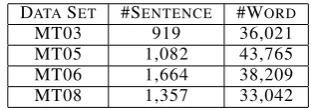
Table 1: Statistics on development and test data sets.
DATASET #SENTENCE #WORD
MT03 919 36,021
MT05 1,082 43,765
MT06 1,664 38,209
MT08 1,357 33,042
LDC2004E12, LDC2004T08, LDC2005E83, C2005T06, LDC2005T10, LDC2006E26, LD-C2006E34, LDC2006E85, LDC2006E92, and LDC2007T09, which consists in total of about 8.5M sentence pairs while hierarchical rules are only extracted from selected data sets, includ-ing LDC2003E14, LDC2003E07, LDC2005T10, LDC2006E34, LDC2006E85, and LDC2006E92, which contain about 467K sentence pairs. We build the 5-gram language model on the English section of all bilingual training data together with the Xinhua portion of the English Gigaword cor-pus.
The development and test dataset pairs are selected from NIST2003 (MT03), NIST2005 (MT05), NIST2006 (MT06) and NIST2008 (MT08). The data statistics are shown in Table 1. In the experiments, all translation results are mea-sured in case-insensitive BLEU scores (Papineni et al., 2002).
4.2 Results under Transductive MERT
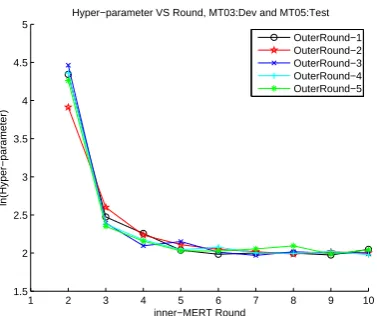
Figure 1 and Figure 2 show the hyper-parameter
H(iternumber) for each iteration in the 10-round
inner-MERT step. In both figures, MT03 is de-velopment dataset while MT05 & MT08 are test datasets. We find that the hyper-parameterH
al-ways reaches the peak at the 2nd iteration, show-ing fast convergence durshow-ing parameter estimation on the combination of development data and pseu-do labeled test data. Similar phenomenon could also be observed on other dataset pairs.
fa-vor those incorrectly generated translation refer-ences, which makes the overtraining more serious and hurts the final performance. By applying the hyper-parameter as the stop metric, we could con-trol the learning procedure to avoid the overtrain-ing.
We can also review the roles that the develop-ment and test datasets play in the procedure of avoiding over-training. The reason for that we transductively generate translations as pseudo ref-erences for test data is that we expect the estima-tion procedure biases towards the test data when incorporated in the learning procedure. Mean-while, the development data also plays an impor-tant role in the learning process. Because develop-ment data owns true references, it acts as a regular-ization term to ensure that the feature weight will not excessively biased toward the test data with generated pseudo references in the learning pro-cedure.
1 2 3 4 5 6 7 8 9 10
1.5 2 2.5 3 3.5 4 4.5 5
inner−MERT Round
ln(Hyper−parameter)
Hyper−parameter VS Round, MT03:Dev and MT05:Test
OuterRound−1 OuterRound−2 OuterRound−3 OuterRound−4 OuterRound−5
Figure 1: Hyper-parameter of 10 inner-MERT loops under 5 outer-translation rounds(OutRound-i) in T-MERT algorithm(without MBR), MT03:Dev and MT05:Test.
Based on the above discussion, we also compare results under different rounds for inner-MERT to verify the role of the hyper-parameter. As shown in figure 3(MT03 development and MT05 test) and figure 4(MT03 development and MT08 test), the results under T-MERT with 2-rounds inner-MERT are always best among different rounds, which is close to the baseline in figure 3 and much better in figure 4. Here the baseline for the test dataset is translated under weight learned from normal MERT on the development data, and re-mains constant for the following parts. For both
1 2 3 4 5 6 7 8 9 10
1.5 2 2.5 3 3.5 4 4.5 5 5.5 6
ln(Hyper−parameter)
Hyper−parameter VS Round, MT03:Dev and MT08:Test
inner−MERT Round
OuterRound−1 OuterRound−2 OuterRound−3 OuterRound−4 OuterRound−5
Figure 2: Hyper-parameter of 10 inner-MERT loops under 5 outer-translation rounds in T-MERT algorithm(without MBR), MT03:Dev and MT08:Test.
figures, we observe that 1-round inner-MERT is not sufficient to learn the weight well, while inner-MERT using more than 2 rounds leads to signifi-cant overtraining, which is consistent with the re-sults obtained from the hyper-parameter.
0 5 10 15 20
0.26 0.28 0.3 0.32 0.34 0.36 0.38
Round
BLEU
Different Rounds Transductive MERT under MT03:DEV and MT05:TEST
[image:5.595.318.509.76.238.2]1−round 2−round 3−round 4−round baseline
Figure 3: Results under T-MERT algorith-m(without MBR) with fixed inner-MERT loops from 1 to 4, 20 outer-translation rounds, and base-line. MT03:Dev and MT05:Test.
[image:5.595.85.274.357.515.2] [image:5.595.314.509.425.585.2]s-0 5 10 15 20 0.16
0.18 0.2 0.22 0.24 0.26 0.28 0.3 0.32
Round
BLEU
Different Rounds Transductive MERT under MT03:DEV and MT08:TEST
[image:6.595.315.507.77.238.2]1−round 2−round 3−round 4−round baseline
Figure 4: Results under T-MERT algorith-m(without MBR) with fixed inner-MERT loops from 1 to 4, 20 outer-translation rounds, and base-line. MT03:Dev and MT08:Test.
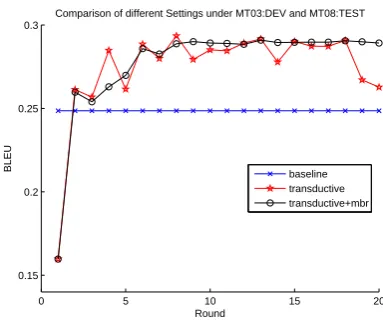
election proposed in section 3.4 to choose a suit-able hypothesis, and the corresponding results are shown in figure 5 and figure 6. It could be found that as the number of outer-translation rounds in-creases, the algorithm generates more groups of translation outputs, from which the performance under MBR selection turns to be more and more stable.
0 5 10 15 20
0.345 0.35 0.355 0.36 0.365 0.37 0.375 0.38
Round
BLEU
Comparison of different Settings under MT03:DEV and MT05:TEST
baseline transductive transductive+mbr
Figure 5: Result of baseline,T-MERT under 2 inner-MERT rounds without and with MBR selec-tion. MT03:DEV and MT05:Test.
The above parts discuss two solutions for the problems we encounter in the transductive MERT, i.e., the inner-MERT stop criterion and MBR s-election. We further evaluate our method (under 2 round inner-MERT and MBR selection) on all
0 5 10 15 20
0.15 0.2 0.25 0.3
Round
BLEU
Comparison of different Settings under MT03:DEV and MT08:TEST
baseline transductive transductive+mbr
Figure 6: Result of baseline,T-MERT under 2 inner rounds without and with MBR selection. MT03:DEV and MT08:Test.
dataset pairs, which is any pair of MT03, MT05, MT06 and MT08. The final results are shown in table 2, from which we observe that for the dataset pair MT03 and MT05 the result under T-MERT is close to baseline, while for the pair MT03 and MT08, the improvement is significant in both di-rections. The result is similar with the observa-tion on these evaluaobserva-tion datasets, i.e., MT03 and MT05 are under similar distribution, while MT03 and MT08 are quite different. Generally speaking, MT03 and MT05 are both composed of only news data, while MT06 and MT08 are consisted of news and web-blog data. As we know, the news data is significantly different from the web-blog data. We can find that our method could achieve significant improvement on 9 of total 12 dataset pairs, indicat-ing that the distribution variation between dataset pairs is quite a common phenomenon. For dataset-s under dataset-similar didataset-stribution, the badataset-seline perfor-mance is close to oracle, which means that poten-tial space for improvement under the adaptation is limited; while for datasets that are quite differen-t, there is much room for further increase in per-formance, since the baseline weight estimated on development is seriously biased for the test.
[image:6.595.83.274.80.236.2] [image:6.595.76.274.464.625.2]Table 2: Results of baseline and T-MERT under MBR Selections for different dataset pairs. Here symbol ↑shows that the improvement is significant,↓indicates decrease is significant, and|means no significant changes
DEV MT03 MT05 MT06 MT08
TEST BASELINE T-MERT BASELINE T-MERT BASELINE T-MERT BASELINE T-MERT
MT03 0.3914 0.3933(|) 0.3861 0.3908(|) 0.3731 0.3830(↑) 0.3586 0.3704(↑) MT05 0.3733 0.3739(|) 0.3687 0.3724(|) 0.3592 0.3700(↑) 0.3414 0.3576(↑) MT06 0.3358 0.3582(↑) 0.3344 0.3569(↑) 0.3636 0.3579(↓) 0.3504 0.3653(↑) MT08 0.2486 0.2892(↑) 0.2543 0.2755(↑) 0.2774 0.2768(|) 0.2929 0.2809(↓)
each round is close to baseline, making it possible for the selection performance to be slightly higher than baseline, while for others the result in each round is lower than baseline. However, we do not hope that our method could be significantly better than baseline in this case, as baseline performance is also the oracle performance for the test dataset. We assume that we know the development and the test datasets are distinct in advance before apply-ing the T-MERT algorithm.
5 Conclusion and Future Work
In this paper, we investigate the parameter adap-tation issue in SMT. In particular, a transductive MERT algorithm is proposed to better explore both development and test datasets. Besides, a hyper-parameter is proposed to control the over-training problem in the parameter estimation step and a Minimum Bayes Risk (MBR)-based hypoth-esis selection method is adopted to stabilize the fi-nal performance. Compared with a state-of-the-art baseline, our method achieves significant and sus-tainable improvement.
In future, we plan to incorporate better hypothe-sis selection algorithms to choose high quality sen-tences from the test dataset, since sensen-tences with bad translations would bring side effect during the learning procedure. Besides, we plan to further in-vestigate the mechanism of transductive MERT in boosting the performance of SMT.
Acknowledgments
We thank Ning Xi and Shujian Huang for their meaningful suggestions. We would also like to thank the anonymous reviewers for their help-ful comments. This work is supported by the National Natural Science Foundation of China (No.61003112) and the National Fundamental Re-search Program of China (2010CB327903)
References
Yee S. Chan and Hwee T. Ng. 2007. Domain adapta-tion with active learning forword sense
disambigua-tion. InIn Proceedings of the 45th Annual Meeting
of the Association of Computational Linguistics, pp. 49–56, Prague, Czech Republic, 2007.
David Chiang. 2005. A hierarchical phrase-based model for statistical machine translation. InIn Pro-ceedings of the 2010 Conference on Empirical Meth-ods in Natural Language Processing, pp. 263–270, Ann Arbor, 2005.
Nicola Ehling, Richard Zens and Hermann Ney. 2007.
Minimum bayes risk decoding for bleu. InIn
Pro-ceedings of the ACL 2007 Demo and Poster Session-s, pp. 101–104, Prague, 2007.
George Foster and Roland Kuhn. 2007.
Mixture-model adaptation for smt. In In Proceedings of
the Second ACL Workshop on Statistical Machine Translation, Prague, Czech Republic, 2007.
Almut Silja Hildebrand, Matthias Eck, Stephan Vo-gel and Alex Waibel. 2005. Adaptation of the translation model for statistical machine translation based on information retrieval. InIn Proceedings of
EAMT, Budapest, Hungary, 2005.
Philipp Koehn. 2004. Statistical significance tests for
machine translation evaluation. In In Proc. of the
Conference on Empirical Methods in Natural Lan-guage Processing, pp. 160–167, 2004.
Mu Li, Yinggong Zhao, Dongdong Zhang and Ming Zhou. 2010. Adaptive development data selection for log-linear model in statistical machine
transla-tion. In In Proceedings of the 23rd International
Conference on Computational Linguistics (Coling 2010), pp. 662–670, Beijing, 2010.
Yang Liu, Steve Hanneke and Jaime Carbonell. 2010. A theory of transfer learning with applications to active learning. Technical report, Machine Learn-ing Department, Carnegie Mellon University, New Brunswick, MA, 2010.
Adam Lopez. 2008. Statistical machine translation.
ACM Computing Surveys, 40(3), 2008.
training data selection and optimization. InIn Pro-ceedings of the 2007 Joint Conference on Empirical Methods in Natural Language Processing, pp. 343– 350, Czech Republic, 2007.
Spyros Matsoukas and Antti-Veikko I. Rosti and Bing Zhang. 2009. Discriminative corpus weight estima-tion for machine translaestima-tion. InIn Proc. of the Con-ference on Empirical Methods in Natural Language Processing, pp. 160–167, 2009.
Behrang Mohit, Frank Liberato and Rebecca Hwa. 2009. Language model adaptation for difficult to translate phrases. InIn Proceedings of the 13th An-nual Conference of the EAMT, pp. 160–167, 2009.
Franz Och. 2003. Minimum error rate training in sta-tistical machine translation. InIn Proceedings of the 41th Annual Meeting of the Association for Compu-tational Linguistics (ACL), Sapporo, Japan, 2003.
Franz Och and Hermann Ney. 2002. Discriminative training and maximum entropy models for
statisti-cal machine translation. In In Proceedings of the
40th Annual Meeting of the Association for Compu-tational Linguistics (ACL), pp. 295–302, Philadel-phia, 2002.
Kishore Papineni, Salim Roukos, Todd Ward, and Wei-Jing Zhu. Bleu: a method for automatic evaluation
of machine translation. In In Proceedings of the
40th Annual Meeting of the Association for Compu-tational Linguistics (ACL), pp. 311–318, Philadel-phia, 2002.
German Sanchis-Trilles and Francisco Casacuberta. 2010. Log-linear weight optimisation via bayesian adaptation in statistical machine translation. In In Proceedings of the 23rd International Conference on Computational Linguistics (Coling 2010), pp. 662– 670, Beijing, 2010.
Nicola Ueffing, Gholamreza Haffari and Anoop Sarkar. 2007. Transductive learning for statistical machine
translation. In In Proceedings of the 45th Annual