The Language Resource Life Cycle: Towards a Generic Model for
Creating, Maintaining, Using and Distributing Language Resources
Georg Rehm
DFKI GmbH Berlin, Germany [email protected]Abstract
Language Resources (LRs) are an essential ingredient of current approaches in Linguistics, Computational Linguistics, Language Technology and related fields. LRs are collections of spoken or written language data, typically annotated with linguistic analysis information. Different types of LRs exist, for example, corpora, ontologies, lexicons, collections of spoken language data (audio), or collections that also include video (multimedia, multimodal). Often, LRs are distributed with specific tools, documentation, manuals or research publications. The different phases that involve creating and distributing an LR can be conceptualised as alife cycle. While the idea of handling the LR production and maintenance process in terms of a life cycle has been brought up quite some time ago, a best practice model or common approach can still be considered a research gap. This article wants to help fill this gap by proposing an initial version of a genericLanguage Resource Life Cyclethat can be used to inform, direct, control and evaluate LR research and development activities (including description, management, production, validation and evaluation workflows).
Keywords:LR infrastructures and architectures, Metadata, Standards for LRs, Life cycle
1.
Introduction
Language Resources are an essential ingredient of current research and development approaches in Linguistics, Com-putational Linguistics, Language Technology and related fields. The respective methodologies usually involve the ap-plication of statistical machine learning techniques to vast amounts of data in order to train engines, generate models, create tools or to address novel, data-driven research ques-tions, among others.
Generally speaking, Language Resources are collections of spoken or written language data (including audio and video), typically, but not necessarily, annotated with linguistic anal-ysis information. There are different types of Language Re-sources such as corpora, ontologies, lexicons, collections of spoken language data (audio), or collections that also in-clude video (multimedia, multimodal). Often, Language Resources are distributed with specific tools, documenta-tion, manuals or research publications.
In order to ensure a certain level of sustainability and in-teroperability, standards and best practice approaches are used for many resources – either as is or including modi-fications – for the annotation of various linguistic analysis levels or metadata concerning the formal description of the whole resource. There are many cases in which resources have become popular and proven valuable for the research community. In these cases a resource often serves as the basis of additional research that explores related or maybe even completely different areas by extending the resource with additional language data or with additional linguistic analysis levels that have not been in scope with regard to the research question the resource was originally created for. The different phases that involve, among others, creating and distributing a Language Resource can be
conceptu-alised as alife cycle. While the idea of handling the
Lan-guage Resource production and maintenance process in terms of a life cycle has been brought up quite some time ago, a best practice model or common approach can still
be considered a research gap. According to the FLaReNet Strategic Language Resource Agenda and several other re-cent reports and assessments, the Computational Linguis-tics and Language Technology communities have a demand for a reference model for resource development, “includ-ing the language resource life cycle” based on the obser-vation that the “management of the life cycle of language resource creation has been largely overlooked in our com-munity” (Calzolari et al., 2011) (p. 15).
This contribution wants to help fill this gap by proposing an
initial version of a genericLanguage Resource Life Cycle
that can be used to inform, direct, control and evaluate re-search and development work (including description, man-agement, production, validation and evaluation workflows) in the fields of Computational Linguistics, Language Tech-nologies, Digital Humanities and others. The proposed Lan-guage Resource Life Cycle is based on the analysis and gen-eralisation of relevant publications as well as the author’s own previous research activities and experience. Section 2. discusses related work. Section 3. provides a brief de-scription of the seven phases of the initial version of the Language Resource Life Cycle. The following Section 4. briefly discusses several potential benefits of the life cycle. Section 5. concludes the article with an outlook on future work.
2.
Related Work
Aspects of life cycles of Language Resources have been pro-posed in previous work by language resource distribution institutions and agencies, platform and infrastructure initia-tives, as well as research and development projects carried out in academic institutions, research centres or companies. The notion of resource life cycles has also found its way into
textbooks such as, for example,Natural Language
Process-ing with Python(Bird et al., 2009) (Chapter 11, “Managing
Linguistic Data”), where the authors explain technical and
practical aspects of the concept based on the phasesdata
cycle can continue after the publication of a corpus because
it ismodified/enriched during the course of research.
Addi-tionally, a language resource is to be described using stan-dardised metadata such as, for example, OLAC.
More detailed processes and additional phases are provided by (van Veenendaal et al., 2013) who discuss the approach developed in the STEVIN programme. The life cycle de-scribed there is mostly concerned with the requirements and processes of the large-scale joint research and development effort STEVIN, including the centrally organised distribu-tion of Language Resources. The five phases used in this
life cycle areacquisition,management,maintenance,
distri-butionandsupport services. The specific focus –
manage-ment of many resources instead of the creation of one spe-cific resource – of this life cycle becomes apparent already
in the first phase:acquisitiondoes not refer to language data
but to the actual ownership and intellectual property rights (IPR) of a resource, which is, of course, vital to ensure its
long-term accessibility. This phase also includes the
evalu-ation and validevalu-ationof a resource through external parties
to gauge a resource’s quality and sustainability; here, data is validated against XML schemas, documentation is checked and software is tested. The other phases refer to storing and backing up resources on servers (management), prepar-ing distribution versions and regularly performprepar-ing checks if
a resource needsmaintenance, making resources available
through a web shop as a downloadable file or through other media based on open or commercial license agreements
(dis-tribution), as well assupport services.
In META-SHARE (Piperidis et al., 2014) a similar yet dif-ferent scenario with regard to the description of resources with metadata is used: META-SHARE functions as an open resource exchange infrastructure, i. e., when making exist-ing language resources available through META-SHARE, the resources are being described with the built-in metadata editor, which implements the metadata schema that was pre-pared for META-SHARE specifically. Several automatic procedures exist to transform existing metadata descriptions based on commonly used formats into the META-SHARE format. META-SHARE does not support a full language resource life cycle yet.
(Wittenburg et al., 2010) concentrate on technical require-ments that focus upon e-science functionalities and the long-term preservation of resources. Among them are the proper definition of the objects that are the basic units of manage-ment including PIDs, checksums and high-quality metadata as well as the aggregation of such objects in arbitrary ways to enable researchers to combine multiple resources in ex-periments. Data survival and authenticity are to be provided through proper bitstream management and safe replication as well as the use of open standards, especially with regard to the syntax and semantics of the used annotation formats, which are to be registered in schema and concept reposito-ries.
Yet another set of aspects is discussed by (Nicolas et al., 2010) who describe the main guidelines of the Victoria project. The authors concentrate on aspects such as improv-ing the efficiency of collaborative annotation work, usimprov-ing established frameworks and resources as well as licenses that are fit for purpose.
In any life cycle of digital resources, the application of stan-dards on as many levels as possible is an essential aspect (licensing, IPR, data formats, annotation formats, metadata, querying, storage etc.). With regard to the description of re-sources with metadata, ISOcat CMDI foresees the data
ele-ment “LifeCycleStatus”1that provides an “indication of the
status in the life cycle of a resource”, for example, “planned, development, released, production, withdrawn, retired, su-perseded, archived”. As the explanation of this data ele-ment shows, the scope of this eleele-ment is beyond language resources proper: “Tools are often released according to dif-ferent status, development versions and productive versions are common [...], for other language resources the release is the end of the development process. Hence, the status cor-responds to the life cycle model of the resource type. The examples selected should be general enough to be usable in various contexts.”
3.
The Language Resource Life Cycle
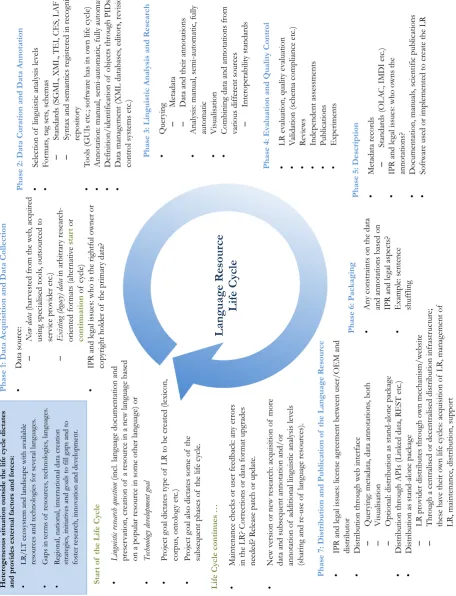
Based on the analysis of these relevant publications and pre-vious research and development experience by the author, e. g., (Wörner et al., 2006; Schmidt et al., 2006; Rehm et al., 2008b; Rehm et al., 2008c; Lehmberg et al., 2007; Rehm et al., 2008a; Rehm et al., 2009; Piperidis et al., 2014; Rehmet al., 2014), a comprehensiveLanguage Resource Life
Cy-cleis proposed. The author’s own contributions highlight
best practice insights and specific aspects of selected phases of the proposed life cycle, the initial version of which is
shown in Figure 1.2 The life cycle consists of a set of
exter-nal factors and forces, the interexter-nal project context (i. e., the goal and objective of the Language Resource development project) and seven individual phases:
• External Context and LR/LT Ecosystem and Land-scape
• Internal Project Context – Start of the Language Re-source Life Cycle
• Phase 1: Data Acquisition and Data Collection
• Phase 2: Data Curation and Data Annotation
• Phase 3: Linguistic Analysis and Research
• Phase 4: Evaluation and Quality Control
• Phase 5: Description
• Phase 6: Packaging
• Phase 7: Distribution and Publication of the Langauge Resource
The start of the life cycle is marked or initiated by a specific
linguistic research question or project(including areas such
as language documentation and language preservation) or a
1http://www.isocat.org/rest/dc/3818
2The author would like to thank the anonymous reviewer who
pointed out a similar life cycle for research data: http://www.
data-archive.ac.uk/create-manage/life-cycle. The
technology development goal; the linguistic research ques-tion also includes the possible creaques-tion of a resource in a new language based on a popular resource in some other language (such as, for example, WordNet spawning cousins in other languages). A focus on the linguistic research as-pect would entail, naturally, a focus on Phase 3 (the actual Linguistic Analysis and Research with aspects such as, for instance, querying and visualisation), while a focus on tech-nology development would concentrate, rather, on the fully automatic annotation of vast amounts of language data (in-cluding a qualitative evaluation of the created annotations and a validation of the created markup structures with re-gard to one or more schemas); this also includes the fully automated generation of language resources with the help of Language Resource factories. An alternative starting point is foreseen in Phase 1 for the specific situation when exist-ing data or legacy data that might be years or even decades old, is to be processed and transformed into a sustainable language resource. The life cycle typically ends with the distribution and publication of a language resource; this in-cludes making a resource available by download or, for ex-ample, as Linked Open Data through an API. However, the life cycle can continue if maintenance checks or user feed-back result in minor updates or when a new version of an already existing resource needs to be prepared. Such an ex-tension process would necessitate another iteration through the life cycle.
In addition to minor updates, there can be another reason for another iteration: in order to add a new annotation layer, i. e., to extend an existing language resource with new, ad-ditional analysis information by adding one or more levels of linguistic analysis or description. Such an extension or evolution of a language resource is also tightly intertwined with the concepts of recycling and reuse. Connected to this issue is the aspect of provenance of the added analysis in-formation (which organisation added the inin-formation with the help of which tool or service and based on which scien-tific approach etc.) and properly documenting these aspects, i. e., the resource’s processing and analysis history, in cor-responding metadata descriptions. These must also include, for all annotation layers, notes on the legal situation and availability of the annotation layers (including the primary research data, of course).
This conceptualisation into different phases provides a gen-eralised view. It is evident that different individual instan-tiations of actually preparing, curating and analysing a lan-guage resource call for slightly different organisations into phases and sub-phases. For example, persistent identifi-cation and data management (Phase 2) could also be in Phase 1 in some concrete life cycles; likewise, metadata-based documentation (Phase 5) could also be needed al-ready in Phase 2.
This initial version of the Language Resource Life Cycle can be conceptualised as both a generic and idealised con-ceptualisation: working on different types of language re-sources and from different perspectives, having specific goals and objectives in mind, each with their own respec-tive requirements, results in either slightly or significantly different organisations or instantiations of the life cycle in phases or sub-phases. For example, a resource does not
nec-essarily have to be described with metadata in Phase 5 – this process could also be initiated in an earlier phase, however, it should be finished before packaging (Phase 6) and dis-tributing a resource (Phase 7).
Furthermore, this is not the only life cycle to be considered when discussing the preparation of language resources be-cause there is a close connection between the general scien-tific evolution of the whole field and the conceptualisation as depicted in the Language Resource Life Cycle. Similar life cycles exist with regard to the technological progres-sion of basically all areas that relate to phases of the life cy-cle: there is research (and also more and more standardisa-tion activities) around the topics of markup languages, meta-data descriptions, querying engines, visualisations, IPR and copyright legislation and so on. If their individual pull forces – created through new versions of standards or soft-ware – are strong enough, these external factors are able to trigger a new life cycle iteration for a certain language resource: if a new major version of a tag-set has been re-leased by the organisation that maintains it, this new version should, ideally, also be applied to all resources annotated us-ing this tag-set so that they are not considered obsolete for making use of a deprecated annotation format.
Research and development activities on and around lan-guage resources cannot be discussed and evaluated in iso-lation. This is why the Language Resource Life Cycle also references, in the upper left hand corner of Figure 1, the highly heterogeneous context and situation outside the life cycle proper that exerts forces and provides factors to the actual initiation and implementation of the life cycle in con-crete projects. Among these are the LR/LT ecosystem and the overall landscape of available resources and technolo-gies for one or more languages. Highly relevant are gaps in terms of these resources and technologies as well as re-gional, national and international resource, technology and data creation strategies, initiatives and goals to fill these gaps and to foster research, innovation and development, often related to one or more specific languages.
how language resources are created, produced, described, annotated, evaluated, extended, distributed (including the concrete phases, sub-phases and names used to refer to these different phases).
5.
Summary and Conclusions
This article presents a generic, common approach of a Lan-guage Resource Life Cycle, which conceptualises the differ-ent phases that involve creating, maintaining and distribut-ing a language resource. Accorddistribut-ing to the FLaReNet Strate-gic Language Resource Agenda and other recent reports, our community has a strong demand for a language resource life cycle and reference model, based on the observation that the “management of the life cycle of language resource cre-ation has been largely overlooked in our community” (Cal-zolari et al., 2011) (p. 15).
Future work will include a more thorough specification of the Language Resource Life Cycle, including the prepara-tion of an abstract and generic formal model of the life cycle (including a machine- and human-readable XML-based seri-alisation format) that takes all major metadata schemes used in the community into account. We will also take a closer look at which factors can cause a language resource slowly to decay or to become obsolete over the years and how to ad-dress these issues (for example, through standardised meta-data and annotation formats, by making them highly visi-ble and building up communities around language resources etc.).
Acknowledgments
The author would like to thank the two anonymous review-ers for their helpful comments. The author would also like to thank Bettina Kluge (University of Hildesheim, Ger-many) and Stelios Piperidis (R. C. Athena, Greece) for valu-able comments on an earlier version of this paper.
Bibliographical References
Victoria Arranz et al., editors. (2010). Proceedings of the LREC 2010 Workshop Language Resources: From Storyboard to
Sus-tainability and LR Lifecycle Management, Valletta, Malta, May.
http://workshops.elda.org/lrslm2010/.
Bird, S., Klein, E., and Loper, E. (2009). Natural Language Pro-cessing with Python – Analyzing Text with the Natural
Lan-guage Toolkit. O’Reilly.http://www.nltk.org/book3/.
Calzolari, N., Bel, N., Choukri, K., Mariani, J., Monachini, M., Odijk, J., Piperidis, S., Quochi, V., and Soria, C. (2011). Final FLaReNet Deliverable: Language Resources for the Future – The Future of Language Resources: The Strategic Language Resource Agenda, September. http://www.flarenet.eu/
sites/default/files/FLaReNet_Book.pdf.
Lehmberg, T., Chiarcos, C., Rehm, G., and Witt, A. (2007). Rechtsfragen bei der Nutzung und Weitergabe linguistischer Daten. In Georg Rehm, et al., editors,Datenstrukturen für lin-guistische Ressourcen und ihre Anwendungen – Data Structures for Linguistic Resources and Applications: Proceedings of the
Biennial GLDV Conference 2007, pages 93–102. Gunter Narr,
Tübingen.
Nicolas, L., Molinero, M. A., Sagot, B., Formoso, N. F., and Castro, V. V. (2010). Creating and maintaining language re-sources: the main guidelines of the Victoria project. In Ar-ranz and van Eerten (ArAr-ranz and van Eerten, 2010), pages 6–9.
http://workshops.elda.org/lrslm2010/.
Piperidis, S., Papageorgiou, H., Spurk, C., Rehm, G., Choukri, K., Hamon, O., Calzolari, N., del Gratta, R., Magnini, B., and Gi-rardi, C. (2014). META-SHARE: One year after. In Proceed-ings of the 9th Language Resources and Evaluation Conference
(LREC 2014), Reykjavik, Iceland, May.
Rehm, G., Eckart, R., Chiarcos, C., and Dellert, J. (2008a). Ontology-Based XQuery’ing of XML-Encoded Language Re-sources on Multiple Annotation Layers. In Proceedings of the 6th Language Resources and Evaluation Conference
(LREC 2008), Marrakech, Morocco, May.
Rehm, G., Santini, M., Mehler, A., Braslavski, P., Gleim, R., Stubbe, A., Symonenko, S., Tavosanis, M., and Vidulin, V. (2008b). Towards a Reference Corpus of Web Genres for the Evaluation of Genre Identification Systems. In Proceedings of the 6th Language Resources and Evaluation Conference
(LREC 2008), Marrakech, Morocco, May.
Rehm, G., Schonefeld, O., Witt, A., Lehmberg, T., Chiarcos, C., Bechara, H., Eishold, F., Evang, K., Leshtanska, M., Savkov, A., and Stark, M. (2008c). The Metadata-Database of a Next Generation Sustainability Web-Platform for Language Re-sources. InProceedings of the 6th Language Resources and
Evaluation Conference (LREC 2008), Marrakech, Morocco,
May.
Rehm, G., Schonefeld, O., Witt, A., Hinrichs, E., and Reis, M. (2009). Sustainability of Annotated Resources in Linguistics: A Web-Platform for Exploring, Querying and Distributing Lin-guistic Corpora and Other Resources. Literary and Linguistic
Computing, 24(2):193–210. Selected papers from Digital
Hu-manities 2008.
Rehm, G., Uszkoreit, H., Dagan, I., Goetcherian, V., Dogan, M. U., Mermer, C., Váradi, T., Kirchmeier-Andersen, S., Stickel, G., Jones, M. P., Oeter, S., and Gramstad, S. (2014). An Update and Extension of the META-NET Study “Europe’s Languages in the Digital Age”. InProceedings of the Work-shop on Collaboration and Computing for Under-Resourced
Languages in the Linked Open Data Era (CCURL 2014),
Reyk-javik, Iceland, May.
Schmidt, T., Chiarcos, C., Lehmberg, T., Rehm, G., Witt, A., and Hinrichs, E. (2006). Avoiding Data Graveyards: From Hetero-geneous Data Collected in Multiple Research Projects to Sus-tainable Linguistic Resources. InProceedings of the E-MELD 2006 Workshop on Digital Language Documentation: Tools
and Standards – The State of the Art, East Lansing, Michigan,
June.
van Veenendaal, R., van Eerten, L., Cucchiarini, C., and Spyns, P. (2013). The Dutch-Flemish HLT Agency: Managing the Life-cycle of STEVIN’s Language Resources. In Peter Spyns et al., editors,Essential Speech and Language Technology for Dutch:
Results by the STEVIN-programme, Theory and Applications
of Natural Language Processing, pages 381–394. Springer. Wittenburg, P., Ringersma, J., Trilsbeek, P., Elbers, W., and
Broeder, D. (2010). Resource Lifecycle Management: Chang-ing Cultures. In Arranz and van Eerten (Arranz and van Eerten, 2010), pages 14–18.http://workshops.elda.org/
lrslm2010/.
Wörner, K., Witt, A., Rehm, G., and Dipper, S. (2006). Mod-elling Linguistic Data Structures. In B. Tommie Usdin, editor,
Proceedings of Extreme Markup Languages 2006, Montréal,