Universal Dependencies for Persian
*Mojgan Seraji, **Filip Ginter, *Joakim Nivre
*Uppsala University, Department of Linguistics and Philology, Sweden **University of Turku, Department of Information Technology, Finland*[email protected] **[email protected]
Abstract
The Persian Universal Dependency Treebank (Persian UD) is a recent effort of treebanking Persian with Universal Dependencies (UD), an ongoing project that designs unified and cross-linguistically valid grammatical representations including part-of-speech tags, morphological features, and dependency relations. The Persian UD is the converted version of the Uppsala Persian Dependency Treebank (UPDT) to the universal dependencies framework and consists of nearly 6,000 sentences and 152,871 word tokens with an average sentence length of 25 words. In addition to the universal dependencies syntactic annotation guidelines, the two treebanks differ in tokenization. All words containing unsegmented clitics (pronominal and copula clitics) annotated with complex labels in the UPDT have been separated from the clitics and appear with distinct labels in the Persian UD. The treebank has its original syntactic annota-tion scheme based on Stanford Typed Dependencies. In this paper, we present the approaches taken in the development of the Persian UD.
Keywords:Universal Dependencies, Persian, Treebank
1.
Introduction
In the past decade, the development of numerous depen-dency parsers for different languages has frequently been benefited by the use of syntactically annotated resources, or treebanks (B¨ohmov´a et al., 2003; Haverinen et al., 2010; Kromann, 2003; Foth et al., 2014; Seraji et al., 2015; Vincze et al., 2010). However, treebanks only exist for a small number of languages, and considering the number of 7,000+ languages in the world,1 a large number of lan-guages still lack treebanks.
Due to the diverse typologies and grammatical structures that exist across languages, treebanks are created with dif-ferent annotation schemes. These annotation variations can further be explained by different linguistic theories and the syntactic annotations that treebank developers select based on their own preferences (Nivre, 2015). These dissimilari-ties in annotation schemes often have an impact on syntac-tic parsers, which means that the results are not comparable across languages. McDonald et al. (2013) enumerate sev-eral issues for natural language parsing when treebanks are labeled with different annotation schemes.
This has brought many researchers and developers in nat-ural language processing to the conclusion that having a common standard and cross-linguistically valid annotation scheme would favor parsing research. Recently, there have been a number of initiatives for developing data sets with cross-linguistically consistent annotation scheme for mor-phological and syntactic structures. These efforts have re-sulted in the emergence of the Stanford Typed Dependen-cies Representation (de Marneffe et al., 2006; de Marneffe and Manning, 2008), the Google Universal Part-of-Speech Tagset (Petrov et al., 2012), and Interset interlingua for morphosyntactic features used in the HamleDT treebank collection (Zeman, 2008; Zeman et al., 2012). The most recent effort is the Universal Dependencies (UD), which more or less combine all the earlier efforts in this regard. In
1
http://www.bbc.co.uk/languages/guide/languages.shtml
this paper, we present how we adapt the Universal Depen-dencies to Persian by converting the Uppsala Persian De-pendency Treebank (UPDT) (Seraji, 2015) to the Persian Universal Dependencies (Persian UD). First, we briefly de-scribe the Universal Dependencies and then we present the morphosyntactic annotations used in the extended version of the Persian UD.
2.
Universal Dependencies
Universal Dependencies (UD) is an ongoing project that aims to facilitate multilingual parser development, cross-lingual learning, and research on parsing with a perspective of language structure and usage. In pursuing this goal, the project focuses on the development of cross-linguistically consistent syntactic annotations in the treebanks, for a large number of languages. The fundamental idea underlying this project is to discover the common and universal cat-egories across languages as well as the language-specific ones. In other words, while the annotation scheme in UD stipulates a consistent annotation of similar constructions across languages, it also allows language-specific exten-sions or omisexten-sions when necessary. This means that when some language-specific constructions cannot be covered by the scheme introduced in the UD, the scheme can be ex-tended by new dependency relations for that specific lan-guage.
Bogy
nsubj dobj/pc
rā acc
دیسوب
root
and cc
with
prep
bounce
pobj
one num
امیپاوه
pobj
on
prep
punct kissed
وید
ار و
اب
تسج
کی یور
plane دیرپ ردام
ش
mother-her/his jumpedconj
.
Bogy
nsubj dobj
rā acc
دیسوب
root
and cc
with
case
bounce
nmod
one nummod
امیپاوه
nmod
on
case
punct kissed
وید
ار و
اب تسج
کی یور plane
دیرپ
. ردام
mother jumped
conj
.
ش
nmod:possher/his
.
[image:2.595.78.511.72.305.2]UPDT Annotation UD Annotation
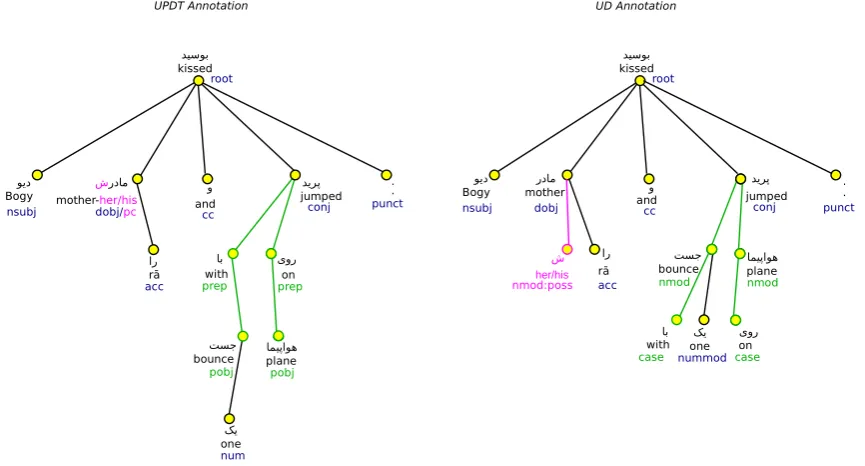
Figure 1: A comparative syntactic annotation for a Persian sentence in the UPDT and UD. To make the figure more readable, glosses have been simplified as follows: mother-her/his = mother-pc.3sg, kissed = kiss.past.3sg, jumped = jump.past.3sg.
Gloss: Bogy mother-pc.3sg r¯a kiss.past.3sg and with one bounce on plane jump.past.3sg.
Translation: The bogy kissed her/his mother and jumped on the plane with one bounce.
3.
Persian Universal Dependencies
The Persian Universal Dependencies (Persian UD) is the converted version of the Uppsala Persian Dependency Tree-bank (UPDT)2 (Seraji, 2015) to the UD framework. The treebank has its original annotation scheme based on Stan-ford Typed Dependencies (de Marneffe et al., 2006; de Marneffe and Manning, 2008). The scheme was extended for Persian to include the language-specific syntactic rela-tions that could not be covered by the primary scheme de-veloped for English. The treebank consists of nearly 6000 sentences from written text with large domain variations, in terms of different genres (containing newspaper articles, fictions, technical descriptions, and documents about cul-ture and art)3 and tokenization. The variations in the
to-kenization are due to the orthographic variations of com-pound words, fixed expressions, and different types of cli-tics in the language. In the UPDT, only fixed expressions delimited with whitespace are handled as distinct tokens. Fixed expressions in attached forms and different types of unsegmented clitics such as pronominal and copula clitics are not separated from their head word. In other words, these cases have not been treated at morphological level,
2The treebank is open source and freely avail-able in CoNLL-format and can be downloaded from http://stp.lingfil.uu.se/∼mojgan/UPDT.html
3
The treebank data is extracted from the open source, val-idated Uppsala Persian Corpus (UPC), which is currently the largest freely available corpus of Persian. The corpus consists of 2,704,028 tokens and annotated with part-of-speech tags and morphological features. For a comprehensive description of the corpus pertaining to the tokenization and morphological annota-tion see Seraji (2015, Chapter 3)
but annotated with special labels at the syntactic level in-stead. The syntactic annotation of the UPDT has been done semi-automatically using MaltParser (Nivre et al., 2006) in a bootstrapping scenario. All sentences have been manu-ally validated.
When converting the UPDT to the Persian UD, all words containing unsegmented clitics (pronominal and copula cli-tics) annotated with complex labels in the UPDT, were sep-arated from the clitics and received distinct labels in the Persian UD. Figure 1 illustrates the differences between the two treebanks for a Persian sentence. In this exam-ple, the direct object (dobj) in the UPDT consists of the wordmother and the possessive pronominal cliticher/his
(colored in pink), marked with the labeldobj/pc. This la-bel in the UPDT annotation is defined as a complex lala-bel (cf. Seraji, 2015) and is used to denote the main function
dobjand an additional (pronominal clitic)pcelement. By contrast, the pronominal clitic her/hisin the UD annota-tion is separated from its head wordmother and is placed as its dependent instead, labeled with nominal modifier in possessive construction (nmod:poss). The two treebanks further differ in the handling of head nodes in prepositional phrases. The prepositionswithandonin the UPDT func-tions as heads of prepositional phrases with the dependency relationprep, while in the UD annotation they are treated as dependents of the nouns (or the prepositional objects)
UPDT UD
ADJ ADJ
ADJ CMPR ADJ ADJ INO ADJ ADJ SUP ADJ
ADV ADV
ADV COMP ADV
ADV I ADV
ADV LOC ADV ADV NEG ADV ADV TIME ADV CLITIC PART
CON CONJ and SCONJ
DELM PUNCT
DET DET
FW X
INT INTJ
N PL NOUN
N SING NOUN N VOC NOUN
NUM NUM
P ADP
PREV ADP
PRO PRON
V AUX AUX
V IMP VERB
V PA VERB
V PP VERB
[image:3.595.104.238.74.400.2]V PRS VERB V SUB VERB
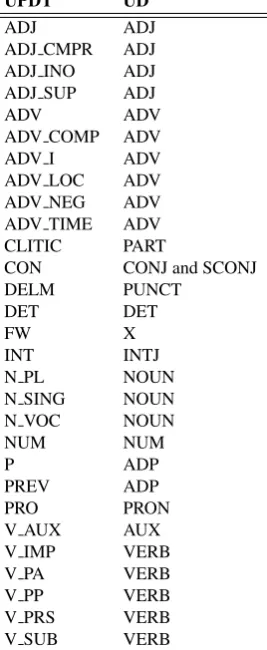
Table 1: Mapping from the UPDT to the Google Universal Part-of-Speech Tagset in the UD.
3.1.
Morphological Representation
Morphological representations in UD provide information about lemmas (lemma is the basic or canonical form of a word), part-of-speech tags (part-of-speech is the gram-matical category of a word), and morphological features (a grammatical feature of a word is the characteristic or prop-erty of the grammatical category of the word such as gen-der, number, tense, etc.).
Since lemmas are language dependent, a clear representa-tion of those is not specifically defined in the UD frame-work. Thus, the lemma field is normally determined by language-specific dictionaries. For Persian this field has not yet been filled and the work is still in progress.
A list of 17 coarse-grained part-of-speech tags, based on the Google Universal Part-of-Speech Tagset (Petrov et al., 2012), is defined in UD to cover the part-of-speech cate-gories across languages. The UPDT is annotated with 29 part-of-speech tags with morphological information. These tags were straightforwardly mapped to 15 part-of-speech tags of the total 17 tags in the UD. The mapped tags are listed in Table 1.
It is worth noting that the universal part-of-speech tags in the UD, contrary to the UPDT, have distinct tags for coordi-nating conjunctions and subordicoordi-nating conjunctions. These tags are presented asCONJfor coordinating conjunctions, and SCONJ for subordinating conjunctions. In the con-version of the UPDT to the Persian UD all the tagsCON
were automatically traced and received the corresponding UD tags based on their dependency relations. For instance, the tag CON, for tokens with the dependency relationscc
(coordination) andmwe(multi-word expressions), was con-verted to the tagCONJand the rest received the tagSCONJ. Furthermore, in the automatic processing, we added multi-ple rules for rewriting the rest of the coarse-grained part-of-speech tags.
In the current release of the Persian UD, all the morpho-logical features have been included based on those intro-duced in the UD’s universal features to further distinguish lexical and grammatical characteristics of words that could not have been covered by the part-of-speech tags. Adding lemma is still a work in progress.
3.2.
Syntactic Representation
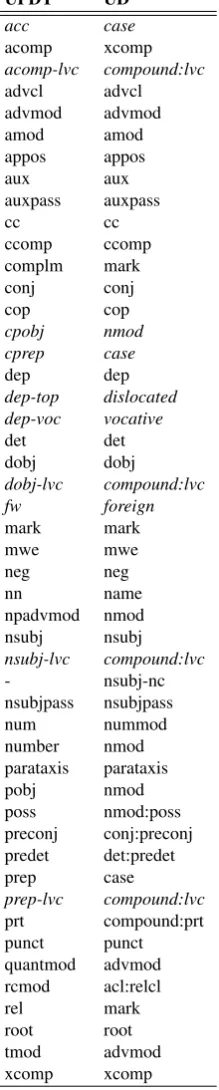
The syntactic annotation scheme in UD is based on the Uni-versal Stanford Dependencies (de Marneffe et al., 2014) and consists of 40 dependency relations that are intended to broadly capture various dependency relations between words. The underlying principle of the scheme is that dependencies hold between content words, while function words attach to the content word they further specify. Since UPDT has its original annotation scheme based on Stanford Typed Dependencies with a language-specific variant for Persian, it already follows this assumption. However, there are two exceptions where the old scheme chooses function words as heads: prepositions in preposi-tional phrases, and copula verbs that have a preposipreposi-tional phrase as their complement. These exceptions have been revised in the Universal Stanford Dependencies and now the scheme consistently keeps content words as heads. The UPDT consists of a total of 96 dependency relations, of which 48 are used for basic relations (including 10 new ad-ditions to the STD) and 48 for complex relations. Complex relations are assigned to words containing unsegmented cl-itics. The conversion of the UPDT to the Persian UD has been carried out semi-automatically. In this process, we have used scripts tailored for Persian to separate different types of clitics from their host. Furthermore, we used an-other conversion script for reversing the head and depen-dent relations in the prepositional modifier (prep) and ob-ject of a preposition (pobj). Subsequently we added differ-ent rules for rewriting the dependency labels. Those sen-tences that have in any case been involved in the conversion process, have manually been checked and validated. This basically covers all sentences containing any form of clitics and prepositional phrases.
UPDT UD
acc case
acomp xcomp
acomp-lvc compound:lvc
advcl advcl advmod advmod amod amod appos appos
aux aux
auxpass auxpass
cc cc
ccomp ccomp complm mark conj conj
cop cop
cpobj nmod
cprep case
dep dep
dep-top dislocated dep-voc vocative
det det
dobj dobj
dobj-lvc compound:lvc
fw foreign
mark mark
mwe mwe
neg neg
nn name
npadvmod nmod nsubj nsubj
nsubj-lvc compound:lvc
- nsubj-nc nsubjpass nsubjpass num nummod number nmod parataxis parataxis pobj nmod poss nmod:poss preconj conj:preconj predet det:predet prep case
prep-lvc compound:lvc
[image:4.595.117.227.75.622.2]prt compound:prt punct punct quantmod advmod rcmod acl:relcl rel mark root root tmod advmod xcomp xcomp
Table 2: Mapping from the UPDT to the dependency rela-tions in the UD.
The total number of dependency relations in the Persian UD is 44, consisting of 37 univeral dependencies and 7 language-specific relations. The language-specific relations include: relative clause modifier acl:relcl, predeterminer
det:predet, light verb construction compound:lvc, phrasal particle compound:prt, preconjunction conj:preconj, the genetive modifier nmod:poss, non-canonical subject
nsubj:nc. Apart from the relationnsubj:nc, the rest of the language-specific relations presented in the Persian UD
function the same as their UPDT counterparts but under different relation names. The relationnsubj:ncwas intro-duced by spliting the pronominal clitics in the Persian UD to mark non-canonical subjects. Non-canonical subjects normally appear in form of pronominal clitics attached to the preverbal elements of the light verbs. For instance the compound verb
àYÓ
@
ñ k
(gloss: well come-inf,translation: to like, to welcome) in the following sentence is used with the non-canonical subject -am (pronominal clitic in first person singular):
. YK
@ú× Õæ ñ k à
@ P@ áÓ
man
I
az
of
¯an
that
xoˇs-am
well-pc.1sg
mi-¯ay-ad
cont-come.pres-3sg
.
.
I like that.
In the syntactic status of a non-canonical subject, in con-trast to canonical subject, the preverbal element in the LVC agrees with person and number instead of the light verb, and the light verb always remains in third singular. In the above example, although the first person singular (I / pc) has no access to canonical verbal agreement, it still func-tions as the syntactic subject.
4.
Conclusion
In this paper we presented the Universal Dependencies for Persian, which still is a work in progress. This is the re-cent effort of treebanking Persian based on a universal mor-phosyntactic annotation scheme, called Universal Depen-dencies. The treebank is available under an open license at
www.universaldependencies.org.
5.
Acknowledgements
We would like to thank Carina Jahani and Forogh Hashabeiky for their continued support and guidance in the Persian grammar. We are extremely thankful to all the UD’s contributors for their efforts and collaborations. We would also like to thank the three anonymous reviewers for their comments.
References
B¨ohmov´a, Alena, Jan Hajiˇc, Eva Hajiˇcoc´a, and Barbora Hladk´a (2003). “The Prague dependency treebank”. In:
Treebanks. Springer Netherlands, pp. 103–127.
de Marneffe, Marie-Catherine, Timothy Dozat, Natalia Silveira, Katri Haverinen, Filip Ginter, Joakim Nivre, and Christopher D. Manning (2014). “Universal Stan-ford Dependencies: A cross-linguistic typology”. In:
Proceedings of the 9th International Conference on Language Resources and Evaluation (LREC 2014), pp. 4585–4592.
de Marneffe, Marie-Catherine and Christopher D. Manning (2008). “The Stanford Typed Dependencies Represen-tation”. In: Proceedings of the COLING’08 Workshop on Cross-Framework and Cross-Domain Parser Evalu-ation, pp. 1–8.
Foth, Kilian, Arne K¨ohn, Niels Beuck, and Wolfgang Men-zel (2014). “Because size does matter: The Hamburg de-pendency treebank”. In:Proceedings of the 9th Interna-tional Conference on Language Resources and Evalua-tion (LREC ’14), pp. 2326–2333.
Haverinen, Katri, Timo Viljanen, Veronika Laippala, Samuel Kohonen, Filip Ginter, and Tapio Salakoski (2010). “Treebanking Finnish”. In: Proceedings of the 9th International Workshop on Treebanks and Linguis-tic Theories (TLT ’10), pp. 79–90.
Kromann, Matthias T. (2003). “The Danish Dependency Treebank and the DTAG Treebank Tool”. In: Proceed-ings of the 2nd Workshop on Treebanks and Linguistic Theories (TLT 2003), pp. 217–220.
McDonald, Ryan, Joakim Nivre, Yvonne Quirmbach-brundage, Yoav Goldberg, Dipanjan Das, Kuzman Ganchev, Keith Hall, Slav Petrov, Hao Zhang, Os-car T¨ackstr¨om, Claudia Bedini, N´uria Bertomeu, and Castell´o Jungmee Lee (2013). “Universal Dependency Annotation for Multilingual Parsing”. In:Proceeding of the 51st Annual Meeting of the Association for Compu-tational Linguistics (Volume 2: Short Papers, pp. 92–97. Nivre, Joakim (2015). “Towards a Universal Grammar for Natural Language Processing”. In:Computational Lin-guistics and Intelligent Text Processing. Ed. by Alexan-der Gelbukh. Springer, pp. 3–16.
Nivre, Joakim, Johan Hall, and Jens Nilsson (2006). “Malt-Parser: A Data-Driven Parser-Generator for Dependency Parsing”. In:Proceedings of the 5th International Con-ference on Language Resources and Evaluation (LREC), pp. 2216–2219.
Petrov, Slav, Dipanjan Das, and Ryan McDonald (2012). “A Universal Part-of-Speech Tagset”. In: Proceedings of the Eight International Conference on Language Re-sources and Evaluation (LREC ’12), pp. 2089–2096. Seraji, Mojgan (2015). “Morphosyntactic Corpora and
Tools for Persian”. PhD Thesis. Studia Linguistica Up-saliensia 16.
Seraji, Mojgan, Bernd Bohnet, and Joakim Nivre (2015). “ParsPer: A Dependency Parser for Persian”. In: Pro-ceedings of the 3rd International Conference on Depen-dency Linguistics (DepLing ’15), pp. 300–309.
Vincze, Veronika, D´ora Szauter, Attila Alm´asi, Gy¨orgy M´ora, Zolt´an Alexin, and J´anos Csirik (2010). “Hungar-ian Dependency Treebank”. In: Proceedings of the 7th Conference on International Language Resources and Evaluation (LREC ’10), pp. 1855–1862.
Zeman, Daniel (2008). “Reusable Tagset Conversion Us-ing Tagset Drivers”. In:Proceedings of the 6th Interna-tional Conference on Language Resources and Evalua-tion (LREC’08), pp. 213–218.
Zeman, Daniel, David Mareˇcek, Martin Popel, Loganathan Ramasamy, Jan ˇStˇep´anek, Zdenˇek ˇZabokrtsk´y, and Jan Hajiˇc (2012). “HamleDT: To Parse or Not to Parse?” In: Proceedings of the 8th International Conference