Chinese Segmentation and New Word Detection
using Conditional Random Fields
Fuchun Peng, Fangfang Feng, Andrew McCallum
Computer Science Department, University of Massachusetts Amherst 140 Governors Drive, Amherst, MA, U.S.A. 01003
{fuchun, feng, mccallum}@cs.umass.edu
Abstract
Chinese word segmentation is a difficult, im-portant and widely-studied sequence modeling problem. This paper demonstrates the abil-ity of linear-chain conditional random fields (CRFs) to perform robust and accurate Chi-nese word segmentation by providing a prcipled framework that easily supports the in-tegration of domain knowledge in the form of multiple lexicons of characters and words. We also present a probabilistic new word detection method, which further improves performance. Our system is evaluated on four datasets used in a recent comprehensive Chinese word seg-mentation competition. State-of-the-art perfor-mance is obtained.
1 Introduction
Unlike English and other western languages, many Asian languages such as Chinese, Japanese, and Thai, do not delimit words by white-space. Word segmentation is therefore a key precursor for lan-guage processing tasks in these lanlan-guages. For Chi-nese, there has been significant research on find-ing word boundaries in unsegmented sequences (see (Sproat and Shih, 2002) for a review). Un-fortunately, building a Chinese word segmentation system is complicated by the fact that there is no standard definition of word boundaries in Chinese.
Approaches to Chinese segmentation fall roughly into two categories: heuristic dictionary-based methods and statistical machine learning methods. In dictionary-based methods, a predefined dictio-nary is used along with hand-generated rules for segmenting input sequence (Wu, 1999). However these approaches have been limited by the imsibility of creating a lexicon that includes all pos-sible Chinese words and by the lack of robust sta-tistical inference in the rules. Machine learning ap-proaches are more desirable and have been success-ful in both unsupervised learning (Peng and Schuur-mans, 2001) and supervised learning (Teahan et al., 2000).
Many current approaches suffer from either lack
of exact inference over sequences or difficulty in in-corporating domain knowledge effectively into seg-mentation. Domain knowledge is either not used, used in a limited way, or used in a complicated way spread across different components. For example, the N-gram generative language modeling based ap-proach of Teahan et al (2000) does not use domain knowledge. Gao et al (2003) uses class-based lan-guage for word segmentation where some word cat-egory information can be incorporated. Zhang et al (2003) use a hierarchical hidden Markov Model to incorporate lexical knowledge. A recent advance in this area is Xue (2003), in which the author uses a sliding-window maximum entropy classifier to tag Chinese characters into one of four position tags, and then covert these tags into a segmentation using rules. Maximum entropy models give tremendous flexibility to incorporate arbitrary features. How-ever, a traditional maximum entropy tagger, as used in Xue (2003), labels characters without considering dependencies among the predicted segmentation la-bels that is inherent in the state transitions of finite-state sequence models.
en-tropy classifiers), and with great flexibility to view the observation sequence in terms of arbitrary, over-lapping features, with long-range dependencies, and at multiple levels of granularity. These beneficial properties suggests that CRFs are a promising ap-proach for Chinese word segmentation.
New word detection is one of the most impor-tant problems in Chinese information processing. Many machine learning approaches have been pro-posed (Chen and Bai, 1998; Wu and Jiang, 2000; Nie et al., 1995). New word detection is normally considered as a separate process from segmentation. However, integrating them would benefit both seg-mentation and new word detection. CRFs provide a convenient framework for doing this. They can pro-duce not only a segmentation, but also confidence in local segmentation decisions, which can be used to find new, unfamiliar character sequences sur-rounded by high-confidence segmentations. Thus, our new word detection is not a stand-alone process, but an integral part of segmentation. Newly detected words are re-incorporated into our word lexicon, and used to improve segmentation. Improved seg-mentation can then be further used to improve new word detection.
Comparing Chinese word segmentation accuracy across systems can be difficult because many re-search papers use different data sets and different ground-rules. Some published results claim 98% or 99% segmentation precision and recall, but these ei-ther count only the words that occur in the lexicon, or use unrealistically simple data, lexicons that have extremely small (or artificially non-existant) out-of-vocabulary rates, short sentences or many num-bers. A recent Chinese word segmentation competi-tion (Sproat and Emerson, 2003) has made compar-isons easier. The competition provided four datasets with significantly different segmentation guidelines, and consistent train-test splits. The performance of participating system varies significantly across dif-ferent datasets. Our system achieves top perfor-mance in two of the runs, and a state-of-the-art per-formance on average. This indicates that CRFs are a viable model for robust Chinese word segmentation.
2 Conditional Random Fields
Conditional random fields (CRFs) are undirected graphical models trained to maximize a conditional probability (Lafferty et al., 2001). A common special-case graph structure is a linear chain, which corresponds to a finite state machine, and is suitable for sequence labeling. A linear-chain CRF with pa-rametersΛ = {λ1, ...}defines a conditional proba-bility for a state (label) sequencey = y1...yT (for
example, labels indicating where words start or have
their interior) given an input sequencex=x1...xT
(for example, the characters of a Chinese sentence) to be
PΛ(y|x) = Z1 x
exp à T
X
t=1 X
k
λkfk(yt−1, yt,x, t)
!
,
(1)
whereZxis the per-input normalization that makes the probability of all state sequences sum to one;
fk(yt−1, yt,x, t) is a feature function which is
of-ten binary-valued, but can be real-valued, andλkis
a learned weight associated with feature fk. The
feature functions can measure any aspect of a state transition,yt−1→yt, and the entire observation
se-quence, x, centered at the current time step,t. For example, one feature function might have value 1 when yt−1 is the state START,yt is the state
NOT-START, andxtis a word appearing in a lexicon of
people’s first names. Large positive values for λk
indicate a preference for such an event; large nega-tive values make the event unlikely.
The most probable label sequence for an inputx,
y∗ = arg max
y PΛ(y|x),
can be efficiently determined using the Viterbi al-gorithm (Rabiner, 1990). An N-best list of label-ing sequences can also be obtained uslabel-ing modi-fied Viterbi algorithm and A* search (Schwartz and Chow, 1990).
The parameters can be estimated by maximum likelihood—maximizing the conditional probability of a set of label sequences, each given their cor-responding input sequences. The log-likelihood of training set{(xi, yi) :i= 1, ...M}is written
LΛ=X
i
logPΛ(yi|xi)
=X
i
à T X
t=1 X
k
λkfk(yt−1, yt,x, t)−logZxi
!
.
Traditional maximum entropy learning algorithms, such as GIS and IIS (della Pietra et al., 1995), can be used to train CRFs. However, our implemen-tation uses a quasi-Newton gradient-climber BFGS for optimization, which has been shown to converge much faster (Malouf, 2002; Sha and Pereira, 2003). The gradient of the likelihood is∂PΛ(y|x)/∂λk=
X
i,t
fk(yt−1, yt(i),x(i), t)
−X i,y,t
CRFs share many of the advantageous properties of standard maximum entropy classifiers, including their convex likelihood function, which guarantees that the learning procedure converges to the global maximum.
2.1 Regularization in CRFs
To avoid over-fitting, log-likelihood is usually pe-nalized by some prior distribution over the parame-ters. A commonly used prior is a zero-mean Gaus-sian. With a Gaussian prior, log-likelihood is penal-ized as follows.
LΛ= X
i
logPΛ(yi|xi)−
X
k λ2
k
2σ2
k
(2)
whereσk2is the variance for feature dimensionk. The variance can be feature dependent. However for simplicity, constant variance is often used for all features. We experiment an alternate version of Gaussian prior in which the variance is feature de-pendent. We bin features by frequency in the train-ing set, and let the features in the same bin share the same variance. The discounted value is set to be
λk
dck/Me×σ2 where ck is the count of features,M is
the bin size set by held out validation, anddaeis the ceiling function. See Peng and McCallum (2004) for more details and further experiments.
2.2 State transition features
Varying state-transition structures with different Markov order can be specified by different CRF feature functions, as determined by the number of output labelsyexamined together in a feature func-tion. We define four different state transition feature functions corresponding to different Markov orders. Higher-order features capture more long-range de-pendencies, but also cause more data sparseness problems and require more memory for training. The best Markov order for a particular application can be selected by held-out cross-validation.
1. First-order: Here the inputs are examined in the context of the current state only. The feature functions are represented as f(yt,x).
There are no separate parameters for state tran-sitions.
2. First-order+transitions: Here we add parame-ters corresponding to state transitions. The fea-ture functions used aref(yt,x), f(yt−1, yt).
3. Second-order: Here inputs are examined in the context of the current and previous states. Fea-ture function are represented asf(yt−1, yt,x).
4. Third-order: Here inputs are examined in the context of the current, and two previous states. Feature function are represented as
f(yt−2, yt−1, yt,x).
3 CRFs for Word Segmentation
We cast the segmentation problem as one of se-quence tagging: Chinese characters that begin a new word are given the START tag, and characters in the middle and at the end of words are given the NONSTARTtag. The task of segmenting new, un-segmented test data becomes a matter of assigning a sequence of tags (labels) to the input sequence of Chinese characters.
Conditional random fields are configured as a linear-chain (finite state machine) for this purpose, and tagging is performed using the Viterbi algo-rithm to efficiently find the most likely label se-quence for a given character sese-quence.
3.1 Lexicon features as domain knowledge
One advantage of CRFs (as well as traditional max-imum entropy models) is its flexibility in using ar-bitrary features of the input. To explore this advan-tage, as well as the importance of domain knowl-edge, we use many open features from external re-sources. To specifically evaluate the importance of domain knowledge beyond the training data, we di-vide our features into two categories: closed fea-tures and open feafea-tures, (i.e., feafea-tures allowed in the competition’s “closed test” and “open test” respec-tively). The open features include a large word list (containing single and multiple-character words), a character list, and additional topic or part-of-speech character lexicons obtained from various sources. The closed features are obtained from training data alone, by intersecting the character list obtained from training data with corresponding open lexi-cons.
Many lexicons of Chinese words and characters are available from the Internet and other sources. Besides the word list and character list, our lexicons include 24 lists of Chinese words and characters ob-tained from several Internet sites1 cleaned and aug-mented by a local native Chinese speaker indepen-dently of the competition data. The list of lexicons used in our experiments is shown in Figure 1.
3.2 Feature conjunctions
Since CRFs are log-linear models, feature conjunc-tions are required to form complex, non-linear de-cision boundaries in the original feature space. We
1http://www.mandarintools.com,
noun (e.g.,, ) verb (e.g.,ü) adjective (e.g.,ù, ) adverb (e.g.,!, ¹) auxiliary (e.g.,, Ò) preposition (e.g.,ó) number (e.g.,, ) negative (e.g.,X, :) determiner (e.g.,Ç, , Y) function (e.g.Ñ, ?) letter (English character) punctuation (e.g., # $) last name (e.g.,K) foreign name (e.g.,) maybe last-name (e.g.,¸, [) plural character (e.g.,È, ¢) pronoun (e.g.,, ·, Æ) unit character (e.g.,G, Ç) country name (e.g.,¥, ) Chinese place name (e.g.,®) organization name title suffix (e.g.,, Ê) title prefix (e.g.,, ) date (e.g.,#, Û, )
Figure 1: Lexicons used in our experiments
C−2: second previous character in lexicon
C−1: previous character in lexicon
C1: next character in lexicon
C2: second next character in lexicon
C0C1: current and next character in lexicon
C−1C0: current and previous character in lexicon
C−2C−1: previous two characters in lexicon
C−1C0C1: previous, current, and next character in the lexicon
Figure 2: Feature conjunctions used in experiments
use feature conjunctions in both the open and closed tests, as listed Figure 2.
4 Probabilistic New Word Identification Since no vocabulary list could ever be complete, new word (unknown word) identification is an im-portant issue in Chinese segmentation. Unknown words cause segmentation errors in that these out-of-vocabulary words in input text are often in-correctly segmented into single-character or other overly-short words (Chen and Bai, 1998). Tradi-tionally, new word detection has been considered as a standalone process. We consider here new word detection as an integral part of segmentation, aiming to improve both segmentation and new word detec-tion: detected new words are added to the word list lexicon in order to improve segmentation; improved segmentation can potentially further improve new word detection. We measure the performance of new word detection by its improvements on seg-mentation.
Given a word segmentation proposed by the CRF, we can compute a confidence in each segment. We detect as new words those that are not in the existing word list, yet are either highly confident segments, or low confident segments that are surrounded by high confident words. A confidence threshold of 0.9 is determined by cross-validation.
Segment confidence is estimated using con-strained forward-backward (Culotta and McCal-lum, 2004). The standard forward-backward algo-rithm (Rabiner, 1990) calculatesZx, the total
like-lihood of all label sequencesygiven a sequencex.
Constrained forward-backward algorithm calculates
Zx0, total likelihood of all paths passing through a constrained segment (in our case, a sequence of characters starting with a STARTtag followed by a few NONSTART tags before the next START tag).
The confidence in this segment is then Z 0
x
Zx, a real
number between 0 and 1.
In order to increase recall of new words, we con-sider not only the most likely (Viterbi) segmen-tation, but the segmentations in the top N most likely segmentations (an N-best list), and detect new words according to the above criteria in allN
segmentations.
Many errors can be corrected by new word de-tection. For example, person name “Ç” hap-pens four times. In the first pass of segmentation, two of them are segmented correctly and the other two are mistakenly segmented as “Ç ” (they are segmented differently because Viterbi algorithm decodes based on context.). However, ”Ç” is identified as a new word and added to the word list lexicon. In the second pass of segmentation, the other two mistakes are corrected.
5 Experiments and Analysis
To make a comprehensive evaluation, we use all four of the datasets from a recent Chinese word seg-mentation bake-off competition (Sproat and Emer-son, 2003). These datasets represent four different segmentation standards. A summary of the datasets is shown in Table 1. The standard bake-off scoring program is used to calculate precision, recall, F1, and OOV word recall.
5.1 Experimental design
Since CTB and PK are provided in the GB encod-ing while AS and HK use the Big5 encodencod-ing, we convert AS and HK datasets to GB in order to make cross-training-and-testing possible. Note that this conversion could potentially worsen performance slightly due to a few conversion errors.
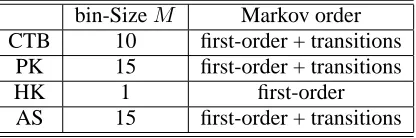
We use cross-validation to choose Markov-order and perform feature selection. Thus, each training set is randomly split—80% used for training and the remaining 20% for validation—and based on vali-dation set performance, choices are made for model structure, prior, and which word lexicons to include. The choices of prior and model structure shown in Table 2 are used for our final testing.
Corpus Abbrev. Encoding #Train words #Test Words OOV rate (%)
UPenn Chinese Treebank CTB GB 250K 40K 18.1
Beijing University PK GB 1.1M 17K 6.9
Hong Kong City U HK Big 5 240K 35K 7.1
[image:5.612.85.525.75.140.2]Academia Sinica AS Big 5 5.8M 12K 2.2
Table 1: Datasets statistics
bin-SizeM Markov order CTB 10 first-order + transitions
PK 15 first-order + transitions
HK 1 first-order
[image:5.612.82.290.187.256.2]AS 15 first-order + transitions
Table 2: Optimal prior and Markov order setting
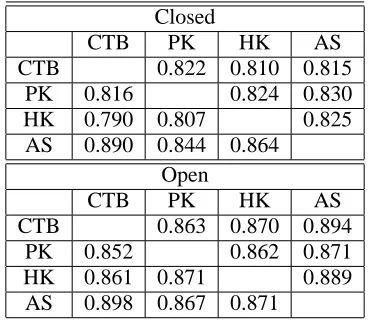
in Section 3.1. In addition, we conduct cross-dataset tests, in which we train on one dataset and test on other datasets.
5.2 Overall results
Final results of CRF based segmentation with new word detection are summarized in Table 3. The up-per part of the table contains the closed test results, and the lower part contains the open test results. Each entry is the performance of the given metric (precision, recall, F1, andRoov) on the test set.
Closed
Precision Recall F1 Roov
CTB 0.828 0.870 0.849 0.550 PK 0.935 0.947 0.941 0.660 HK 0.917 0.940 0.928 0.531 AS 0.950 0.962 0.956 0.292
Open
Precision Recall F1 Roov
[image:5.612.83.287.453.615.2]CTB 0.889 0.898 0.894 0.619 PK 0.941 0.952 0.946 0.676 HK 0.944 0.948 0.946 0.629 AS 0.953 0.961 0.957 0.403
Table 3: Overall results of CRF segmentation on closed and open tests
To compare our results against other systems, we summarize the competition results reported in (Sproat and Emerson, 2003) in Table 4. XXc and XXo indicate the closed and open runs on dataset XX respectively. Entries contain the F1 perfor-mance of each participating site on different runs, with the best performance in bold. Our results are
in the last row. Column SITE-AVGis the average F1 performance over the datasets on which a site re-ported results. Column OUR-AVGis the average F1 performance of our system over the same datasets.
Comparing performance across systems is diffi-cult since none of those systems reported results on all eight datasets (open and closed runs on 4 datasets). Nevertheless, several observations could be made from Table 4. First, no single system achieved best results in all tests. Only one site (S01) achieved two best runs (CTBc and PKc) with an av-erage of 91.8% over 6 runs. S01 is one of the best segmentation systems in mainland China (Zhang et al., 2003). We also achieve two best runs (ASo and HKc), with a comparable average of 91.9% over the same 6 runs, and a 92.7% average over all the 8 runs. Second, performance varies significantly across dif-ferent datasets, indicating that the four datasets have different characteristics and use very different seg-mentation guidelines. We also notice that the worst results were obtained on CTB dataset for all sys-tems. This is due to significant inconsistent segmen-tation in training and testing (Sproat and Emerson, 2003). We verify this by another test. We randomly split the training data into 80% training and 20% testing, and run the experiments for 3 times, result-ing in a testresult-ing F1 of 97.13%. Third, consider a comparison of our results with site S12, who use a sliding-window maximum entropy model (Xue, 2003). They participated in two datasets, with an average of 93.8%. Our average over the same two runs is 94.2%. This gives some empirical evidence of the advantages of linear-chain CRFs over sliding-window maximum entropy models, however, this comparison still requires further investigation since there are many factors that could affect the perfor-mance such as different features used in both sys-tems.
ASc ASo CTBc CTBo HKc HKo PKc PKo SITE-AVG OUR-AVG
S01 93.8 88.1 88.1 90.1 95.1 95.3 91.8 91.9
S02 87.4 91.2 89.3 87.2
S03 87.2 82.9 88.6 92.5 87.8 93.6
S04 93.9 93.7 93.8 94.4
S05 94.2 73.2 89.4 85.6 91.5
S06 94.5 82.9 92.4 92.4 90.6 91.9
S07 94.0 94.0 94.6
S08 90.4 95.6 93.6 93.8 93.4 94.0
S09 96.1 94.6 95.4 94.9
S10 83.1 90.1 94.7 95.9 91.0 90.8
S11 90.4 88.4 87.9 88.6 88.8 93.6
S12 95.9 91.6 93.8 94.2
[image:6.612.99.519.71.256.2]95.6 95.7 84.9 89.4 92.8 94.6 94.1 94.6 92.7
Table 4: Comparisons against other systems: the first column contains the 12 sites participating in bake-off competition; the second to the ninth columns contain their results on the 8 runs, where a bold entry is the winner of that run; column SITE-AVGcontains the average performance of the site over the runs in which it participated, where a bold entry indicates that this site performs better than our system; column OUR-AVG is the average of our system over the same runs, where a bolded entry indicates our system performs better than the other site; the last row is the performance of our system over all the runs and the overall average.
source as training due to different segmentation policies, with an exception on CTB where mod-els trained on other datasets perform better than the model trained on CTB itself. This is due to the data problem mentioned above. Overall, CRFs perform robustly well across all datasets.
From both Table 3 and 5, we see, as expected, improvement from closed tests to open tests, indi-cating the significant contribution of domain knowl-edge lexicons.
Closed
CTB PK HK AS
CTB 0.822 0.810 0.815
PK 0.816 0.824 0.830
HK 0.790 0.807 0.825
AS 0.890 0.844 0.864 Open
CTB PK HK AS
CTB 0.863 0.870 0.894
PK 0.852 0.862 0.871
HK 0.861 0.871 0.889
[image:6.612.92.276.503.663.2]AS 0.898 0.867 0.871
Table 5: Crossing test of CRF segmentation
5.3 Effects of new word detection
Table 6 shows the effect of new word detection on the closed tests. An interesting observation is
CTB PK HK AS
w/o NWD 0.792 0.934 0.916 0.956 NWD 0.849 0.941 0.928 0.946
Table 6: New word detection effects: w/o NWD is the results without new word detection and NWD is the results with new word detection.
that the improvement is monotonically related to the OOV rate (OOV rates are listed in Table 1). This is desirable because new word detection is most needed in situations that have high OOV rate. At low OOV rate, noisy new word detection can result in worse performance, as seen in the AS dataset.
5.4 Error analysis and discussion
Several typical errors are observed in error anal-ysis. One typical error is caused by inconsistent segmentation labeling in the test set. This is most notorious in CTB dataset. The second most typi-cal error is in new, out-of-vocabulary words, espe-cially proper names. Although our new word detec-tion fixes many of these problems, it is not effective enough to recognize proper names well. One solu-tion to this problem could use a named entity ex-tractor to recognize proper names; this was found to be very helpful in Wu (2003).
here in the form domain-knowledge-providing lex-icons. However, obtaining these lexicons is not a trivial matter. The quality of lexicons can affect the performance of CRFs significantly. In addition, compared to simple models like n-gram language models (Teahan et al., 2000), another shortcoming of CRF-based segmenters is that it requires signifi-cantly longer training time. However, training is a one-time process, and testing time is still linear in the length of the input.
6 Conclusions
The contribution of this paper is three-fold. First, we apply CRFs to Chinese word segmentation and find that they achieve state-of-the art performance. Second, we propose a probabilistic new word de-tection method that is integrated in segmentation, and show it to improve segmentation performance. Third, as far as we are aware, this is the first work to comprehensively evaluate on the four benchmark datasets, making a solid baseline for future research on Chinese word segmentation.
Acknowledgments
This work was supported in part by the Center for In-telligent Information Retrieval, in part by The Cen-tral Intelligence Agency, the National Security Agency and National Science Foundation under NSF grant #IIS-0326249, and in part by SPAWARSYSCEN-SD grant number N66001-02-1-8903.
References
K.J. Chen and M.H. Bai. 1998. Unknown Word Detec-tion for Chinese by a Corpus-based Learning Method. Computational Linguistics and Chinese Language Processing, 3(1):27–44, Feburary.
A. Culotta and A. McCallum. 2004. Confidence Esti-mation for InforEsti-mation Extraction. In Proceedings of Human Language Technology Conference and North American Chapter of the Association for Computa-tional Linguistics(HLT-NAACL).
S. della Pietra, V. della Pietra, and J. Lafferty. 1995. In-ducing Features Of Random Fields. IEEE Transac-tions on Pattern Analysis and Machine Intelligence, 19(4).
J. Gao, M. Li, and C. Huang. 2003. Improved Source-Channel Models for Chinese Word Segmentation. In Proceedings of the 41th Annual Meeting of Associa-tion of Computaional Linguistics (ACL), Japan. J. Lafferty, A. McCallum, and F. Pereira. 2001.
Condi-tional Random Fields: Probabilistic Models for Seg-menting and Labeling Sequence Data. In Proceedings of the 18th International Conf. on Machine Learning, pages 282–289.
R. Malouf. 2002. A Comparison of Algorithms for Max-imum Entropy Parameter Estimation. In Sixth Work-shop on Computational Language Learning (CoNLL).
J. Nie, M. Hannan, and W. Jin. 1995. Unknown Word Detection and Segmentation of Chinese using Statis-tical and Heuristic Knowledge. Communications of the Chinese and Oriental Languages Information Pro-cessing Society, 5:47–57.
F. Peng and A. McCallum. 2004. Accurate Informa-tion ExtracInforma-tion from Research Papers using Condi-tional Random Fields. In Proceedings of Human Language Technology Conference and North Amer-ican Chapter of the Association for Computational Linguistics(HLT-NAACL), pages 329–336.
F. Peng and D. Schuurmans. 2001. Self-Supervised Chi-nese Word Segmentation. In F. Hoffmann et al., ed-itor, Proceedings of the 4th International Symposium of Intelligent Data Analysis, pages 238–247. Springer-Verlag Berlin Heidelberg.
L. Rabiner. 1990. A Tutorial on Hidden Markov Mod-els and Selected Applications in Speech Recognition. In Alex Weibel and Kay-Fu Lee, editors, Readings in Speech Recognition, pages 267–296.
R. Schwartz and Y. Chow. 1990. The N-best Algorithm: An Efficient and Exact Procedure for Finding the N most Likely Sentence Hypotheses. In Proceedings of IEEE International Conference on Acoustics, Speech, and Signal Processing (ICASSP).
F. Sha and F. Pereira. 2003. Shallow Parsing with Con-ditional Random Fields. In Proceedings of Human Language Technology Conference and North Amer-ican Chapter of the Association for Computational Linguistics(HLT-NAACL).
R. Sproat and T. Emerson. 2003. First International Chi-nese Word Segmentation Bakeoff. In Proceedings of the Second SIGHAN Workshop on Chinese Language Processing.
R. Sproat and C. Shih. 2002. Corpus-based Methods in Chinese Morphology and Phonology. In Proceed-ings of the 19th International Conference on Compu-tational Linguistics (COLING).
W. J. Teahan, Y. Wen, R. McNab, and I. H. Wit-ten. 2000. A Compression-based Algorithm for Chi-nese Word Segmentation. Computational Linguistics, 26(3):375–393.
A. Wu and Z. Jiang. 2000. Statistically-Enhanced New Word Identification in a Rule-Based Chinese System. In Proceedings of the Second Chinese Language Pro-cessing Workshop, pages 46–51, Hong Kong, China. Z. Wu. 1999. LDC Chinese Segmenter.
http://www.ldc.upenn.edu/ Projects/ Chinese/ seg-menter/ mansegment.perl.
A. Wu. 2003. Chinese Word Segmentation in MSR-NLP. In Proceedings of the Second SIGHAN Work-shop on Chinese Language Processing, Japan. N. Xue. 2003. Chinese Word Segmentation as
Charac-ter Tagging. InCharac-ternational Journal of Computational Linguistics and Chinese Language Processing, 8(1). H. Zhang, Q. Liu, X. Cheng, H. Zhang, and H. Yu.