Using Dialogue Representations for Concept-to-Speech
Generation
C h r i s t i n e H. N a k a t a n i
J e n n i f e r C h u - C a r r o l l
A b s t r a c t
We present an implemented concept-to-speech (CTS) syst@n'~J tl~at offers original proposals for certain couplings-oi r dialogue computation with prosodic computation. Specifically, the semantic in- terpretation, task modeling and dialogue strategy modules in a working spoken dialogue system are used to generate prosodic features to better convey the meaning of system replies. The new CTS system embodies and extends theoretical work on intona- tional meaning in a more general, robust and rigor- ous way than earlier approaches, by reflecting com- positional aspects of both dialogue and intonation interepretation in an original computational frame- work for prosodic generation.
1 I n t r o d u c t i o n
Conversational systems that use speech as the input and output modality are often realized by architec- tures that decouple speech processing components from language processing components. In this pa- per, we show how speech generation can be more closely coupled with the dialogue manager of a work- ing mixed-initiative spoken dialogue system. In par- ticular, we use representations from the semantic in- terpretation, task model and dialogue strategy mod- ules to better communicate the meaning of system replies through prosodically appropriate synthetic speech.
While dialogue prosody has been a topic of much study, our implemented concept-to-speech (CTS) system offers original proposals for specific couplings of dialogue computation with prosodic computation. Further, it embodies and extends theoretical work on intonational meaning in a more general, robust and rigorous way than earlier CTS systems, in an architecture that reflects compositional aspects of dialogue and intonation interpretation.
2
T h e o r e t i c a l F o u n d a t i o n s
In this work, we implement and extend the com- positional theory of intonational meaning proposed by Pierrehumbert and Hirschberg (1986; 1990), who sought to identify correspondences between the
Bell Laboratories, Lucent Technologies
600 Mountain Avenue
Murray Hill, NJ 07974 USA
{chn I
j encc}©research, bell-labs, com
Grosz and Sidner (1986) computational model of dis- course interpretation and Pierrehumbert's prosodic grammar for American English (1980).
In the present work, certain aspects of the orig- inal theories are modified and adapted to the ar- chitecture of the dialogue system in which the CTS component is embedded. Below, we present the im- portant fundamental definitions and principles of in- tonation underlying our CTS system.
2.1 I n t o n a t i o n a l S y s t e m
In our CTS system, the prosodic elements that are computed are based on the intonational system of Pierrehumbert (1980), who defined a formal lan- guage for describing American English intonation using the following regular grammar:
Inton Phrase ---~ (Interm Phrase) + Bndry Tone Interm Phrase ~ (Pitch Acc)+ Phrase Ace
Major phrases, or inlonational phrases, are made up of one or more minor phrases, or inlermediale phrases. Melodic movements in intermediate and intonational phrases are in turn expressed by three kinds of tonal elements. These include six pilch ac- cents: a low pitch excursion (L*), a high pitch excur- sion (H*), or a combination of both low and high ex- cursions (L*+H, L+H*, H*+L, It+L*); two phrase accents: a high (H-) or low (L-) tonal target that guides the interpolation of the melodic contour from final pitch accent to intermediate phrase ending; and two boundary lones: a high (H%) or low (L%) tonal target that guides interpolation from phrase accent to intonational phrase ending.
2.2 I n t o n a t i o n a l M e a n i n g
Theoretical work on intonational meaning has at- tempted to relate the grammatical elements of Pier- rehumbert's system - - pitch accent, phrase accent and boundary tone, to interpretive processes at dif- ferent levels of discourse and dialogue structure.
MIMIC:
User: MIMIC:
User: MIMIC:
hello this is mimic the movie information system how can I help you
where in hoboken is october sky playing
october sky is playing at hoboken cinema in hoboken can I help you with anything else
when is it playing there
october sky is playing at hoboken cinema in hoboken at 3:45pm, 5:50pm, 7:lOpm, and lOpm can i help you with anything else
Figure 1: A MIMIC dialogue.
In later work, pitch accent type was said to express whether the accented information was in- tended by the speaker to be "predicated" or not by the hearer (Pierrehumbert and Hirschberg, 1990). Nompredicated-~forernation was said to bear low- star accentuation (L*-, L*+H, H+L*), while predi- cated information would be marked by high-star ac- cents (H*, L+H*, H*+L). The theory further stated that L*+H conveys uncertainty or lack of speaker commitment to the expressed propositional content, while L+H* marks correction or contrast. The com- plex accent, H*+L, was said to convey that an infer- ence path was required to support the predication; usage of H+L* similarly was said to imply an in- ference path, but did not suggest a predication of a mutual belief. Finally, phrase accents and bound- ary tones were said to reflect aspects of discourse structure.
3
S y s t e m s F o u n d a t i o n s
Our task is to improve the communicative compe- tence of a spoken dialogue agent, by making re- course to our knowledge of intonational meaning, di- alogue processing and relations between the two. Of course, a worthwhile CTS system must also outper- form out-of-the-box text-to-speech (TTS) systems that may determine prosodic mark-up in linguisti- cally sophisticated ways. As in (Nakatani, 1998), we take the prosodic output of an advanced research system that implements the Pierrehumbert theory of intonation, namely the Bell Labs TTS system, as our baseline experimental system to be enhanced by CTS algorithms. We embed the CTS system in MIMIC, a working spoken dialogue system repre- senting state-of-the-art dialogue management prac- tices, to develop CTS algorithms that can be eventu- ally realistically evaluated using task-based perfor- mance metrics.
3.1 D i a l o g u e System: M i x e d - I n i t i a t i v e M o v i e I n f o r m a t i o n C o n s u l t a n t ( M I M I C )
The dialogue system whose baseline speech gen- eration capabilities we enhance is the Mixed- Initiative Movie Information Consultant (MIMIC) (Chu-Carroll, 2000). MIMIC" provides movie list-
ing information involving knowledge about towns, theaters, movies and showtimes, as demonstrated in Figure 1. MIMIC currently utilizes template- driven text generation, and passes on text strings to a stand-alone TTS system. In the version of MIMIC enhanced with concept-to-speech capabili- ties, MIMIC-CTS, contextual knowledge is used to modify the prosodic features of the slot and filler material in the templates; we are currently integrat- ing the algorithms in MIMIC-CTS with a grammar- driven generation system. Further details of MIMIC are presented in the relevant sections below, but see (Chu-Carroll, 2000) for a complete overview.
3.2 T T S : T h e Bell Labs S y s t e m
For default prosodic processing and speech synthe- sis realization, we use a research version of the Bell Labs TTS System, circa 1992 (Sproat, 1997), that generates intonational contours based on Pier- rehumbert's intonation theory (1980), as described in (Pierrehumbert, 1981). Of relevance is the fact that various pitch accent types, phrase accent and boundary tones in Pierrehumbert's theory are di- rectly implemented in this system, so that by gener- ating a Pierrehumbert-style prosodic transcription, the work of the CTS system is done. More pre- cisely, MIMIC-CTS computes prosodic annotations that override the default prosodic processing that is performed by the Bell Labs TTS system.
To our knowledge, the intonation component of the Bell Labs TTS system utilizes more linguistic knowledge to compute prosodic annotations than any other unrestricted TTS system, so it is reason- able to assume t h a t improvements upon it are mean- ingful in practice as well as in theory.
4
MIMIC's Concept-to-Speech
C o m p o n e n t
(MIMIC-CTS)
highlight. MIMIC's task model in turn determines
how to prosodically highlight selected information, based on the pragmatic properties of the system reply. MIMIC's dialogue strategy selection process informs various choices in prosodic contour and ac- centing that convey logico-semantic aspects of mean- ing, such as contradiction.
4.1 H i g h l i g h t i n g I n f o r m a t i o n u s i n g S e m a n t i c R e p r e s e n t a t i o n s
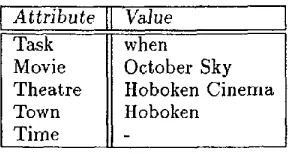
MIMIC employs a statistically-driven semantic in- terpretation engine to "spot" values for key at- tributes that make up a valid MIMIC query in a robust fashion) To simplify matters, for each ut- terance, MIMIC computes an attribute-value ma- trix (AVM)-~epresentation, identifying important pieces of information for accomplishing a given set of tasks. The AVM created from the following ut- terance, "When is October Sky playing at Hoboken Cinema in Hoboken?", for example, is given in Fig- ure 2.
Attribute 11 Value
TaskMovie Theatre Town Time
when October Sky Hoboken Cinema Hoboken
Figure 2: Attribute Value Matrix (AVM), computed by MIMIC's semantic interpreter.
Attribute names and attribute values are critical to the task at hand. In MIMIC-CTS, attribute names and values that occur in templates are typed,
so that MIMIC-CTS can highlight these items in the following way:
1. All lexical items realizing attribute values are accented.
2. Attribute values are synthesized at a slower speaking rate.
3. Attribute values are set off by phrase bound- aries.
4. Attribute names are always accented.
These modifications are entirely rule-based, given a list of attribute names and typed attribute values.
1 Specifically, MIMIC uses an n-dimensional call router front-end (Chu-Carroll, 2000), which is a generalization of the vector-based call-routing paradigm of semantic interpre- tation (Chu-CarroU and Carpenter, 1999); that is, instead of
d e t e c t i n g one concept per utterance, MIMIC's semantic in- terpretation engine detects multiple (n) concepts or classes conveyed by a single utterance, by using n call touters in parallel.
Even such minimal use of dialogue information can make a difference. For example, changing the default accent for the following utterance highlights the kind of information that the system is seeking, instead of highlighting the semantically vacuous main verb, like: 2
Default TTS: what movie would you LIKE
MIMIC-CTS: what MOVIE would you like
4.2 C o n v e y i n g I n f o r m a t i o n S t a t u s u s i n g t h e Task M o d e l
MIMIC performs a set of information-giving tasks, i.e. what, where, when, location, that are concisely defined by a task model. MIMIC processes the AVM for each utterance and then evaluates whether it should perform a database query based on the task specifications given in Figure 3. The task mode] defines which attribute values must be filled in (Y), must not 56 filled in (N), or may optionally
be filled in (-), to "license" a database query action. If no task is "specified" by the current AVM state,
Task Movie Theater Town
Figure 3: Task Specifications for MIMIC.
MIMIC employs various strategies to progress toward a complete and valid t a s k specification. For example, in response to the follgwing user utterance, MIMIC initiates an information-seeking subdialogue to instantiate the theater attribute value to accomplish a when task:
User: when is october sky playing in hoboken
MIMIC-CTS: what THEATER would you like
To better convey the structure of the task model, which is learned by the user through interaction with the system, we define four information statuses based on properties of the task model, which align on a scale of given and new in the following order:
[image:3.612.133.280.319.396.2] [image:3.612.364.541.329.397.2]OLD INFERRABLE KEY HEARER-NEW
[given] [new]
KEY information is that which i s necessary to formulate a valid database query, and is exchanged and (implicitly or explicitly) confirmed between the system and user. INFERRABLE information is not explicitly exchanged between the system and
2In the examples, small capitalization denotes a word is
Task Specification Status
Required (Y) Optional (-) Not allowed (N)
Information Status Pitch Accent
KEY L+H*
INFERRABLE/OLD L * + H / L * HEARER-NEW H*
Table 1: Highlighting relevance of information based on task model (and discourse history).
User: MIMIC:
where in montclair is analyze this playing
a n a l y z e t h i s is p l a y i n g a t w e l h n o n t t h e a t r e a n d c l e a r v i e w s s c r e e n i n g z o n e i n m o n t c l a i r
ANALYZE THIS is PLAYING at WELLIMONT THEATER
LWH* LWH* L* - H* H* L-H%
CLEARVIEWS SCREENING ZONE in MONTCLAIR
~= - H* H* H* L-H% LWH* L-L%
and
Figure 4: Above, dialogue excerpt of MIMIC performing a where task. Below, the modified version of the bold-faced reply string, generated by MIMIC-CTS.
user, but is derived by MIMIC's limited inference engine that seeks to instantiate as many attribute values as possible. For instance, a theater name may be inferred given a town name, if there is only one theater in the given town. OLD information is inherited from the discourse history, based on updating rules relying on confidence scores for attribute values. HEARER-NEW information (c.f. (Prince, 1988)) is that which is requested by the user, and constitutes the only new information on the scale. But note that KEY information, while given, is still clearly in discourse focus, along with HEARER-NEW information.
The next step is to map the information statuses, ordered from given to new, to a scale of pitch accent, or accent melodies, ordered from given to new as follows:
L* L * ÷ H L + H * H*
&ivan]
[new]
Table 1 summarizes this original mapping of infor- mation statuses to pitch accent melodies, and Fig- ure 4 illustrates the use of this mapping in an ex- ample. It obeys the general principle of Pierrehum- bert and Hirschberg's work, that low tonality sig- nifies discourse givenness and high tonality signifies discourse newness, but extends this principle beyond its vague definition in terms of predication of mutual beliefs. Instead, the principle is operationalized here in a practically motivated manner that is consistent with and perhaps illuminating of the theory.
4.3 A s s i g n i n g " D i a l o g u e P r o s o d y " u s i n g D i a l o g u e S t r a t e g i e s
As in earlier CTS systems, special logico-semantic relations, such as contrast or correction, are effec- tively conveyed in MIMIC-CTS by prosodic cues. In MIMIC-CTS, however, these situations are not stip- ulated in an ad hoc manner, but can be determined to a large degree by MIMIC's dialogue strategy se- lection process that identifies appropriate dialogue acts to realize a dialogue goal. a
For example, the dialogue act ANSWER may be selected to achieve the dialogue goal of providing an answer to a successful user query, while the dialogue act NOTIFYFAILURE may be performed to achieve the dialogue goal of providing an answer in situations where no movie listing in the database matches the user query. T h e template associated with the di- alogue act, NOTIFYFAILURE, when compared with t h a t for ANSWER, contains an additional negative auxiliary associated with the key attribute responsi- ble for the query failure, in an utterance conveying a contradiction in beliefs between the user and system (namely, the presupposition on the part of the user t h a t the query can be satisfied).
Theoretical work on intonational interpretation leads us to prosodically mark the negative auxil- iary, as well as the associated focus position (Rooth, 1985). We choose to mark the negative auxiliary not
with the L + H * pitch accent to convey correction, while marking the material in the associated focus position with the L*+H pitch accent to convey (the
[image:4.612.171.467.73.125.2] [image:4.612.111.528.172.263.2]User: MIMIC:
where is the corruptor playing in cranford t h e c o r r u p t o r is n o t p l a y i n g in c r a n f o r d
the corruptor is playing at lincoln cinemas in arlington
THE CORRUPTOR is NOT playing in CRANFORD
L+H* L+H* LWH* !H* L*+H L-H%
Figure 5: Above, dialogue excerpt of MIMIC performing a NOTIFYFAILURE dialogue act. Below, the modified version of the bold-faced reply string, generated by MIMIC-CTS. Note the diacritic "!" denotes a
downstepped
accent (see (Pierrehumbert, 1980)).
system's) lack of commitment to the (user's) pre- supposition at hand. Finally, the NOTIFYFAILURE dialogue act is conveyed by assigning the so-called rise-fall-risd-cbntfadiction contour, L*+tt L-H%, to the utterance-at large (c.f. (Hirschberg and Ward, 1991)). An example generated by MIMIC-CTS ap- pears in Figure 5. Note that pitch accent types for the remaining attribute values are assigned using the task model, as described in section 4.2. Thus in Fig- ure 5, the movie title is treated as KEY information, marked by the L+H* pitch accent.
MIMIC-CTS contains additional prosodic rules for logical connectives, and clarification and confir- mation suhdialogues.
5
R e l a t e d W o r k
Although a number of earlier CTS systems have captured linguistic phenomena that we address in our work, the computation of prosody from dialogue representations is often not as rigorous, detailed or complete as in MIMIC-CTS. Further, while several systems use given/new information status to decide whether to accent or deaccent a lexical item, no sys- tem has directly implemented general rules for pitch accent type assignment. Together, MIMIC-CTS's computation of accentuation, pitch accent type and dialogue prosody constitutes the most general and complete implementation of a compositional theory of intonational meaning in a CTS system to date.
Nevertheless, elements of a handful of previ- ous CTS systems support the approaches taken in MIMIC-CTS toward conveying semantic, task and dialogue level meaning. For example, the Di- rection Assistant system (Davis and Hirschberg, 1988) mapped a hand-crafted route grammar to a discourse structure for generated directions. The discourse structure determined accentuation, with deaccenting of discourse-old entities realized (by lex- ically identical morphs) in the current or previous discourse segment. Other material was assigned ac- centuation based on lexical category information, with the exception that certain contrastive cases of accenting, such as
left
versusright,
were stipulated for the domain.Accent assignment in the SUNDIAL travel infor-
mation system (House and Yond, 1990) also relied on discourse and task models. Mutually known en- tities, said to be in
negative focus,
were deaccented; entities in the current task space, inreferring focus,
received (possibly contrastive) accenting; and enti- ties of the same type as a previously mentioned ob- ject, were classified-as in either
referring
oremphatic
focus, depending on the dialogue act~ in the cases of corrective situations or repeated system-intitiated queries, the contrasting or corrective items were em- phatically accented.
The BRIDGE project on speech generation (Zacharski etal., 1992) identified four main factors affecting accentability: linear 0rder, lexical category, semantic weight and givenness. In r e l a t e d w o r k (Monaghan, 1994), word accentability was quanti- tatively scored by hand-crafted rules based on infor- mation status, semantic focus and Word class. The givenness hierarchy of Gundel and'colleagues (1989), which associates lexical forms of expression with in- formation statuses, was divided into four intervals, with scores assigned to each. A binary semantic fo- cus score was based on whether the word occurred in the
topic
orcomment
of a sentence. Finally, lex- ical categories determined word class scores. These scores were combined, and metrical phonological rules then referred to final acce'ntability scores to assign a final accenting pattern.To summarize, all of the above CTS systems em- ploy either hand-crafted or heuristic techniques for representing semantic and discourse focus informa- tion. Further, only SUNDIAL makes use of dialogue acts.
6
C o n c l u s i o n a n d F u t u r e W o r k
ent sources: MIMIC-CTS, MIMIC operating with default Bell Labs TTS, and a professional voice talent who read the dialogue scripts in context. This corpus-based assessment - - comparing the prosody of CTS-generated, TTS-generated, and hu- man speech, will enable more domain-dependent tuning of the MIMIC-CTS algorithms, as well as the refinement of general prosodic patterns for linguis- tic structures, such as lists and conjunctive phrases. Ultimately; the value of MIMIC-CTS must be mea- sured based on its contribution to overall task pefor- mance by real MIMIC users. Such a study is under design, following (Chu-Carroll and Nickerson, 2000). In conclusion, we have shown how prosodic com- putation can be conditioned on various dialogue representations, for robust and domain-independent CTS synthesis. -While some rules for prosody as- signment depend on the task model, others must be tied closely to the particular choices of content in the replies, at the level of dialogue goals and dia- logue acts. At this level as well, however, linguis- tic principles of intonation interpretation can be ap- plied to determine the mappings. In sum, the lesson learned is that a unitary notion of "concept" from which we generate a unitary prosodic structure, does not apply to state-of-the-art spoken dialogue gener- ation. Instead, the representation of dialogue mean- ing in experimental architectures, such as MIMIC's, is compositional to some degree, and we take advan- tage of this fact to implement a compositional theory of intonational meaning in a new concept-to-speech system, MIMIC-CTS.
R e f e r e n c e s
Jennifer Chu-Carroll and Bob Carpenter. 1999. Vector:based natural language call routing. Com- putational Linguistics, 25(3):361-388.
Jennifer Chu-Carroll and Jill S. Nickerson. 2000. Evaluating automatic dialogue strategy adapta- tion for a spoken dialogue system. In Proceed- ings of the 1st Conference of the North Ameri- can Chapter of the Association for Computational Linguistics, Seattle.
Jennifer Chu-Carroll. 2000. Mimic: an adaptive mixed initiative spoken dialogue system for infor- mation queries. In Proceedings of the 6th Con- ference on Applied Natural Language Processing,
Seattle.
J. R. Davis and :l. Hirschberg. 1988. Assigning into- national features in synthesized spoken directions. In Proceedings of the 26th Annual Meeting of the Association for Computational Linguistics, pages 187-193, Buffalo.
Barbara Grosz and Candace Sidner. 1986. Atten- tion, intentions, and the structure of discourse.
Computational Linguistics, 12(3):175-204.
J. Gundel, N. Hedberg, and R. Zacharski. 1989. Givenness, implicature and demonstrative expres- sions in English discourse. In Proceedings of CLS- 25, Parasession on Language in Context, pages 89-103. Chicago Linguistics Society.
Julia Hirschberg and Janet Pierrehumbert. 1986. The intonational structuring of discourse. In Pro- ceedings of the 2~lh Annual Meeting of the Asso- ciation for Computational -Linguistics, New York. J. Hirschberg and G. Ward. 1991. The influence of
pitch range, duration, amplitude, and spectral fea- tures on the interpretation of l * + h I h%. Journal of Phonetics.
Jill House and Nick Youd. 1990. Contextually ap- propriate intonation in speech synthesis. In Pro- ceedings of the European Speech Communication Association Workshop on Speech Synthesis, pages 185-188, Autrans.
A. I. C. Monaghan. 1,994. Intonation accent place- ment in a concept-to-dialogue system. In Proceed- ings of the ESCA/IEEE Workshop on Speech Syn- thesis, pages 171-174, New Paltz, NY.
C. H. Nakatani. 1998. Constituent-based accent prediction. In Proceedings of the 36th Annual Meeting of the Association for Computational Linguistics, Montreal.
J. Pierrehumbert and J. Hirschberg. 1990. The meaning of intonational contours in the interpre- tation of discourse. In Intentions in Communica- tion. MIT Press, Cambridge, MA.
Janet Pierrehumbert. 1980. The Phonology and Phonetics of English Intonation. Ph.D. thesis, Massachusetts Institute of Technology, Septem- ber. Distributed by the Indiana University Lin- guistics Club.
J. Pierrehumbert. 1981. Synthesising intonation.
Journal of the Acoustical Society of America,
70(4):985-995.
Ellen Prince. 1988. The ZPG letter: subjects, defi- niteness, and information status. In S. Thompson and W. Mann, editors, Discourse Description: Di- verse Analyses of a Fund Raising Text. Elsevier Science Publishers, Amsterdam.
Mats Rooth. 1985. Association with Focus. Ph.D. thesis, University of Massachusetts, Amherst MA. Richard Sproat, editor. 1997. Multilingual Text- to-Speech Synthesis: The Bell Labs Approach.
Kluwer Academic, Boston.