Object Boundary Detection and Segmentation using SuperPixel
Based color and Spatial Features
M.Muthu poochendu Ratha,ME-Final Year
Department of Computer Science and Engineering Dr.Sivanthi Aditanar College of Engineering
Tiruchendur [email protected]
T.Saravana Kumar,Associate Professor
Department of Computer science and Engineering Dr.Sivanthi Aditanar College of Engineering
Tiruchendur
Abstract- Superpixel segmentation partitions a picture into perceptually coherent segments of Comparable size, namely, superpixel .It is changing a fundamental pre-processing step for various computer vision tasks because super pixels significantly reduce the number of inputs and supply a purposeful illustration for feature extraction. Experiments on a acknowledge segmentation dataset show that our methodology can efficiently manufacture super pixels that adhere with the object boundaries better than the current progressive way. We introduce a novel algorithm that clusters pixels in the combined seven dimensional colours and image plane space to efficiently generate compact, nearly uniform super pixels. The simplicity of our approach makes it extraordinary simple to use a parameter specifies the number of super pixels and the efficiency of the algorithm makes its very Sensible.
Keywords :Superpixel , Image Segmentation , Pre-processing,Adaption
1.INTRODUCTION
Superpixels give a convenient primitive from that to calculate native image features. They capture redundancy within the Image and greatly scale of succeeding image process tasks. Its need tried more and more useful for applications like depth estimation, image segmentation, skeletonization, body model estimation, and object localization. For superpixels to be helpful they need to be quick, simple to use, and manufacture high quality segmentations. Sadly, most progressive
Superpixel [1] strategies do not meet of these necessities. As we are going to demonstrate, they typically suffer from a high machine value, poor quality segmentation, inconsistent size and shape, or contain multiple difficult-to-tune parameters.For different applications, the generation of needs to satisfy specific needs. Though it's onerous to outline universal criteria for all superpixel segmentation algorithms, the commonly accepted performance metrics are,
The boundaries of superpixels ought to adhere well to the object boundaries specified pixels on the item boundaries area unit recalled as several as potential.
The boundaries of superpixels mustn't wing across different objects within the image. Superpixels ought to share similar sizes and regular shapes.
This metric guarantees sensory activity consistency and facilitates the subsequent method, e.g., feature extraction.
The procedure potency is additionally a vital issue since superpixel segmentation is typically used for pre-processing.
2. RELATED WORK
Superpixel segmentation algorithms will be usually classified into two classes specifically,
A). Graph-based methods B). Gradient-based methods.
A. Graph-Based Superpixel Segmentation Methods
These strategies may be further divided into the subsequent classes:
(a)Graph-cut-based:
Superpixel segmentation is achieved through minimizing the value of cuts on the image graph. The fore most far-famed graph-cut-based technique is that the Normalized Cuts [2] (NC) algorithmic program. NC is well known for its capability of manufacturing superpixels with smart boundary adherence and regular shapes. However, the computational complexity for NC is extraordinary high. Entropy Rate Superpixel (ERS) calculates the entropy rate from the cut prices on the graph, at the side of balance term, to come up with superpixels.Its disadvantage lies within the irregular shapes of superpixels.
(b)Boundary evolution:
Instead of assignment the best labels to pixels, superpixel Lattices (Lattice) [3] and Superpixels Extracted via Energy-Driven Sampling (SEEDS) [4] solve the segmentation downside by seeking the best boundaries of superpixels. Lattice generates superpixels by adding vertical and horizontal boundaries incrementally, whereas SEEDS iteratively evolves superpixel boundaries employing a hill-climbing based mostly methodology.
(c)Energy optimization:
Algorithms during this class acquire their optimum results by planning completely different energy functions. An energy minimization framework is developed and any extended accentuation either on regular shapes (EOpt0) or on higher boundary adherence (EOpt1). Nevertheless, these algorithms don’t have any express management over the amount of superpixels, and their procedure prices area unit comparatively high. A period of time Coarse-to-Fine Topology-Preserving (CFTP) superpixel segmentation methodology is projected in[5] .The energy perform of CFTP is developed using Markov random field. Besides, lazy random walk is exploited to construct the energy perform for superpixel segmentation.
B. Gradient-Based Superpixel Segmentation
Methods
For the gradient-based strategies, pixels are square measure iteratively clustered on the directions that the gradients modification most quickly, and at lost they are sorted into superpixels. These schemes square measure typically sorted into the subsequent sorts:
(a)Mode shift:
Mean shift [6],[7], medoid shift[8],
And fast Shift [9] square measure samples of mode shifting methods. They generate superpixels via seeking the modes of the underlying superpixel densities. QS has comparatively higher performance and runs abundant quicker than different two strategies. The drawback of those mode-seeking strategies is that the lack of compactness, leading to irregular shapes of superpixels.
(b) Geodesic superpixel:
Methods during this category are projected considering the geodesic structures of pictures. Among them, Turbo Pixel (TP) [10] dilates superpixel seeds employing a geometric-flow-based curve constraint, generating superpixels with regular shapes. However, TP endures low boundary adherence whereas it is time-consuming. The centre of mass voronoi tessellation is computed to provide superpixels in (Mslic) [11].
(c)Clustering-based:
VCells [12], Simple Linear Iterative
Clustering (SLIC)[13] and Linear Spectral Clustering (LSC)[14] square measure are three representatives for clustering-based ways. They can manufacture superpixels with similar sizes and regular shapes. VCells makes use of the edge-weighted centre of mass Voronoi tessellations to produce superpixels. The shapes of superpixels deform in order that they can match native structures of pictures. SLIC is time-efficient. LSC makes use of spectral clustering technique to realize the world wide best answer, leading to any improvement on boundary adherence. However, these three algorithms utilize solely colour and spatial features and hence their performance is cut once the colour feature is insufficient.
3. PROPOSED METHODOLOGY
Integrating the new feature illustration and discriminability measure, we have a tendency to elaborate a content-adaptive superpixel (CAS) segmentation algorithmic program.
Usually speaking, CAS is predicated on a changed linear clustering algorithmic program. It incorporates color, spatial, contour, and texture options into a holistic distance live. And it's ready to adapt the weights of various options considering the precise image contents. Given associate degree input image I, first, the color, spatial, contour, and texture options of every set square measure extracted.
Additional significantly, we have a tendency to use the image gradient to cipher the contour feature and WLD to get the texture feature. Then, the discriminability of various options square
measure evaluated victimization the projected Discriminability measure.
cluster centers area unit uniformly sampled from a grid division of the image.
Finally, the agglomeration method stops once a
Set range (Iter) of iterations. Another distinction with the standard K-means agglomeration is that the element assignment task in CAS is restricted in a very pre-defined looking window, however not over the complete image. The aim of such a constraint is to cut back the process price moreover on improve the compactness of superpixels
The elaborate implementation of CAS is summarized. Given the initial weights of options, pixels area unit appointed to their nearest centers. Then, the discriminabilityof options area unit evaluated and also the weights of options are adapted consequently. In every iteration, the 3 sub-problems, namely, the reassignment drawback, the center of mass adjustment drawback, and also the weight adaption drawback, area unit solved severally. The stopping criterion is about as a hard and fast variety (Iter) of iteration. In our experiments, Iter is about to ten. Once the stopping criterion is happy, the labels of pixels area unit additional processed to enforce the property within superpixels.
4.FEATUREREPRESENTATION
Existing superpixel segmentation ways rely critically on color and spatial feature to ensure perceptually consistent superpixels with compact shapes. As delineate in it’s exhausting to induce a correct segmentation result just using these 2 options, particularly in regions with low color contrast. So as to enhance the separating ability, we propose a new feature illustration for superpixel segmentation that incorporates a lot of sturdy native characteristics of pictures. The
proposed feature illustration inherently embraces color, spatial, contour, and texture options to enhance its process ability in handling totally different image instances. Specifically,
each picture element is painted by a seven dimension feature vector.
p = [l, a, b, x, y, g, u] T, wherever [l, a, b] T measures the color property of a element, [x, y]T is that the spatial feature, g and u area unit the contour and texture options, severally.
A. Color and Spatial Features
Many superpixel segmentation algorithms calculate color distinction in CIELAB color area. This color space provides a distance live to characterize the uniform changes of the human perceived colors exploitation the geometrician distance between 2 color pixels. Following this idea, we also exploit the CIELAB color area.
In addition to the color feature, spatial feature is used to enforce compactness of superpixels.
The spatial feature is represented by [x; y]T where x and y are the vertical and horizontal coordinates of a pixel on the image.
B.Contour Feature
In specific, once pixelsshare extraordinarily similar c olors, the color and spatial options area unit inadequate to tell apart them. To solve this downside, our new feature illustration exploits more study native Characteristics of pictures. An intuitive plan is to create use of the native contour feature to differentiate the pixels that area unit unable to be properly clustered exploitation simply the color and spatial options. During this paper, we have a tendency to exploit the image gradient to provide the contour feature g.
Image gradient
Image gradient measures the directional intensity changes of a picture, and its magnitude is achieved by the sq. root of the add of the square directional signal changes. We represent image gradient, and calculate it in lightness domain since human eyes area unit terribly sensitive to lightness changes.
C.Texture Feature
Natural pictures could also be either untextured or rough-textured. For the untextured image, contour feature is a lot of helpful, whereas for the rough-textured image, texture feature is a lot of discriminating.
Now, we tend to use WLD to construct the Texture feature u.
5. CLUSTERING-BASED DISCRIMINABILITY
MEASURE
We propose a live to judge the discriminability of different options supported this partition of pixels. The principle is that the options with smaller total of within-cluster variances are a lot of discriminative, whereas the options with larger total of within-cluster variances are less discriminative.
It is inadequate to directly add up the higher than feature distances while not considering their importance. Previous clustering-based superpixel segmentation ways [13], determine the importance of various options by manually setting mounted weight parameters for the concerned options. However, on the one hand, it's a nontrivial work to line reasonable weights for various options (always tedious and time-consuming). On the opposite hand, these weights square measure rigid
the property of specific image, then to regulate the operational focus consequently.
6. PERFORMANCE OF FEATURE
DISCRIMINABILITY MEASURE
Firstly, we tend to compare CAS with its chronic version (DCAS) that doesn't exploit the feature discriminability measure. We tend to gift each quantitative and visual comparison to demonstrate the effectiveness of the projected feature discriminabiliy lives are,
(a).Quantitative Comparison (b).Visual Comparison.
(a)Quantitative Comparisons
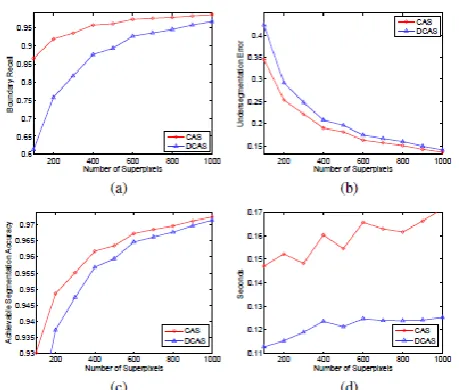
Fig.(a) illustrates the applied mathematics comparisons between CAS and DCAS on the BSDS500dataset. The amount of superpixels, K, in every check image, is set to one hundred, 200 ...1000, severally. It may be observed that BR, UE, and ASA area unit all well improved, mean while, the process value of CAS is slightly beyond DCAS.The quantitative results are greatly improved by adopting the feature discriminability measure once K is tiny, and finally the performance of CAS and DCAS have gotten nearer as K will increase.
Fig. a: Quantitative evaluation of CAS and DCAS on BSDS500.
(a) Boundary Recall (BR). (b) Under segmentation Error (UE). (c) Achievable Segmentation Accuracy (ASA). (d)
Runtime.
(b)Visual Comparisons
Fig.(b) depicts some visual comparisons between CAS and DCAS. For various image contents, DCAS doesn't contemplate the importance of various features, leading to terribly similar boundaries
on numerous image instances. Meanwhile, CAS takes the discriminability of various options into thought, thus, it will perpetually believe the options that
show sensible discriminability supported this
image partition, whereas reducing the unwelcome influence of using the options with relative poor discriminability.
As a result, CAS produces nearly straight superpixel boundaries on the primary column, moderate twisting superpixel boundaries on the second column, and pretty twisting superpixel boundaries on the third column. the primary image is sort of clean while not fine-grained structure, thus, each CAS and DCAS manufacture terribly straight superpixel boundaries. The second image has several slender branches such the superpixel boundaries from CAS are twisting on these branches. within the in the meantime, the third image has wealthy structure and step by step color changes among totally different objects, and CAS conjointly obtains higher boundary
adherence on the boundaries of the leaf and therefore the grasshopper.
Fig.b: Visualization of CAS and DCAS on BSDS500 when K=100. First column: image without fine-grained structure, straight superpixel boundaries; second column: image with slender branches, moderate twisting super pixel boundaries; third column: image with rich structure and gradually colour changes, pretty twisting superpixel boundaries.
7. PROCESSING PERFORMANCE
As same, superpixel segmentation is often used as a pre-processing step in image segmentation applications and different connected fields like prominence detection and image parsing. Note that the employment of superpixels rather than pixels shouldn't decrease the performance of resultant process. so as to check the effectiveness of exploitation superpixel segmentation as a preprocessing step, we tend to assume exploitation a perfect classifier on the superpixels.
The perfect classifier will assign every superpixel
[image:4.595.314.535.368.458.2] [image:4.595.42.272.440.635.2]We compare the performance of CAS with vcells, QSandSLIC once K=400.
FIG.c: Visualization of the maximum pre-processing performance using different superpixel segmentation algorithms on four datasets when K=400.
8. CONCLUSION
In this paper, we tend to develop a content-adaptive superpixel segmentation methodology. The strategy adopts are placement feature illustration that utilizes color, contour, texture, and spatial feature to gift a strong characterization of the input image. We tend to plan a feature discriminability live to judge the segmentation capability of every sort of options for the image. Supported the feature illustration and discriminability live, a content-adaptive clustering algorithmic program is any designed for accomplishing the superpixel segmentation task. Significantly, we tend to modify the weights of various feature in associatedegree repetitive and Adaptive man ner in step with their discriminability on the present partition of pixels for various image instances, resulting additional correct and affordable distance Live to discriminate pixels on natural pictures. Experimental results demonstrated the benefits of our algorithmic program over different state of-the-art superpixel segmentation algorithms. In the future, thanks to the power of CAS, it's rather appealing to use it to pre-process pictures in varied computer vision tasks such the
effectiveness of applications will be improved. Besides, there also are opportunities to any improve the performance of CAS. As an example, since pictures have completely different regional properties, it would be fascinating to develop domestically adaptative ways that assign totally completely different completely weights of feature on different native regions of a picture to suit the necessities from specific applications.
REFERENCES
[1] X. Ren and J. Malik, “Learning a classification model for segmentation,”in Proc. IEEE Int. Conf. Comput. Vis. IEEE, 2003, pp. 10–17.
[2] J. Shi and J. Malik, “Normalized cuts and image segmentation,” IEEETrans. Pattern Anal. Mach. Intell., vol. 22, no. 8, pp. 888–905, 2000.
[3] A. P. Moore, J. Prince, J. Warrell, U. Mohammed, and G. Jones, “Superpixel lattices,” in Proc. IEEE Conf. Comput. Vis. Pattern Recog.IEEE, 2008, pp. 1–8.
[4] M. Van den Bergh, X. Boix, G. Roig, B. de Capitani, and L. Van Gool,“SEEDS: Superpixels extracted via energy-driven sampling,” in Proc.Eur. Conf. Comput. Vis. Springer, 2012, pp. 13–26.
[5] J. Yao, M. Boben, S. Fidler, and R. Urtasun, “Real-time coarse-to-fine topologically preserving segmentation,” in Proc. IEEE Conf. Comput. Vis. Pattern Recog., 2015, pp. 2947–2955.
[6] Y. Cheng, “Mean shift, mode seeking, and clustering,” IEEE Trans.Pattern Anal. Mach. Intell., vol. 17, no. 8, pp. 790–799, 1995.
[7] D. Comaniciu and P. Meer, “Mean shift: A robust approach toward feature space analysis,” IEEE Trans. Pattern Anal. Mach. Intell., vol. 24, no. 5, pp. 603–619, 2002.
[8] Y. A. Sheikh, E. A. Khan, and T. Kanade, “Mode-seeking by medoidshifts,”in Proc. IEEE Int. Conf. Comput. Vis. IEEE, 2007, pp. 1–8.
[9] A. Vedaldi and S. Soatto, “Quick shift and kernel methods for mode seeking,” in Proc. Eur. Conf. Comput. Vis. Springer, 2008, pp. 705–718.
[10] A. Levinshtein, A. Stere, K. N. Kutulakos, D. J. Fleet, S. J. Dickinson, and K. Siddiqi, “Turbo pixels: Fast superpixels using geometric flows,” IEEE Trans. Pattern Anal. Mach. Intell., vol. 31, no. 12, pp. 2290–2297, [11] Y.-J. Liu, C.-C. Yu, M.-J. Yu, and Y. He, “Manifold
SLIC: A fast method to compute content-sensitive superpixels,” in Proc. IEEE Conf. Comput. Vis. Pattern Recog., 2016, pp. 651–659.2009
[12] J. Wang and X. Wang, “VCells: Simple and efficient superpixels using edge-weighted centroidal Voronoi tessellations,” IEEE Trans. Pattern Anal. Mach. Intell., vol. 34, no. 6, pp. 1241–1247, 2012.