Application-driven automatic subgrammar extraction
R e n a t e H e n s c h e l C e n t r e for C o g n i t i v e Science 2 B u c c l e u c h P l a c e , E d i n b u r g h , U K
( h e n s c h e l © c o g s c i . ed. ac. uk)
J o h n
B a t e m a nL a n g u a g e a n d C o m m u n i c a t i o n R e s e a r c h U n i v e r s i t y of S t i r l i n g , S t i r l i n g , U K
(j . a. bat e m a n ~ s t ir. ac. uk)
A b s t r a c t
The space and run-time requirements of broad coverage grammars appear for many applications unreasonably large in relation to the relative simplicity of the task at hand. On the other hand, handcrafted de- velopment of application-dependent gram- mars is in danger of duplicating work which is then difficult to re-use in other contexts of application. To overcome this problem, we present in this paper a procedure for the automatic extraction of application-tuned consistent subgrammars from proved large- scale generation grammars. The proce- dure has been implemented for large-scale systemic grammars and builds on the for- mal equivalence between systemic gram- mars and typed unification based gram- mars. Its evaluation for the generation of encyclopedia entries is described, and di- rections of future development, applicabil- ity, and extensions are discussed. 1
1 I n t r o d u c t i o n
Although we have reached a situation in computa- tional linguistics where large coverage grammars are well developed and available in several formal tra- ditions, the use of these research results in actual applications and for application to specific domains is still unsatisfactory. One reason for this is that large-scale grammar specifications incur a seemingly unnecessarily large burden of space and processing time that often does not stand in relation to the simplicity of the particular task. The usual alterna- tives for natural language generation to date have been the handcrafted development of application or 1This work was partially supported by the DAAD through grant D/96/17139.
sublanguage specific grammars or the use of tem- plate based generation grammars. In (Busemann, 1996) both approaches are combined resulting in a practical small generation grammar tool. But still the grammars are handwritten or, if extracted from large grammars, must be adapted by hand. In gen- eral, both - the template and the handwritten ap- plication grammar approach - compromise the idea of a general NLP system architecture with reusable bodies of general linguistic resources.
We argue that this customization bottleneck can be overcome by the automatic extraction of application-tuned consistent generation subgram- mars from proved given large-scale grammars. In this paper we present such an automatic subgram- mar extraction tool. The underlying procedure is valid for grammars written in typed unification for- malisms; it is here carried out for systemic grammars within the development environment for text gener- ation KPML (Bateman, 1997). The input is a set of semantic specifications covering the intended appli- cation. This can either be provided by generating a predefined test suite or be automatically produced by running the particular application during a train- ing phase.
The paper is structured as follows. First, an al- gorithm for automatic subgrammar extraction for arbitrary systemic grammars will be given, and sec- ond the application of the algorithm for generation in the domain of 'encyclopedia entries' will be illus- trated. To conclude, we discuss several issues raised by the work described, including its relevance for typed unification based grammar descriptions and the possibilities for further improvements in genera- tion time.
mined by its function in the communicative context. This functional orientation has lead to the creation of detailed linguistic resources that are character- ized by an integrated treatment of content-related, textual and pragmatic aspects. Computational in- stances of systemic grammar are successfully em- ployed in some of the largest and most influen- tial text generation projects--such as, for example, PENMAN (Mann, 1983), COMMUNAL (Fawcett and Tucker, 1990), TECHDOC (KSsner and Stede, 1994), Drafter (Paris and Vander Linden , 1996), and Gist (Not and Stock, 1994).
For our present purposes, however, it is the for- mal characteristics of systemic grammar and its im- plementations that are more important. Systemic grammar assumes multifunctional constituent struc- turesrepresentable as feature structures with corefer- ences. As shown in the following function structure example for the sentence "The people that buy sil- ver love it.", different functions can be filled by one and the same constituent:
clause
Senser: [-~ nominal-group
Deictic: det [ Spelling: "the" ] Thing: noun [ Spelling: "people" ] Qualifier: dependent-clause
[Spelling: ]
"that buy silver" Process:
/initeJ_ SpeUing:
"love"] Phenomenon: 2~] nominal-group[ SpeUing: "it" ]
Subject: D Theme: ["i']
Directcomplement: [7]
Given the notational equivalence of HPSG and systemic grammar first mentioned by (Carpenter, 1992) and (Zajac, 1992), and further elaborated in (Henschel, 1995), one can characterize a systemic grammar as a large type hierarchy with multiple (conjunctive and disjunctive) and multi-dimensional inheritance with an open-world semantics. The basic element of a systemic g r a m m a r - - a so-called
system--is a type axiom of the form (adopting the notation of CUF (DSrre et al., 1996)):
e n t r y = t y p e _ l I t y p e _ 2 I . . . I t y p e _ n . where type1 to typen are exhaustive and disjoint sub- types of type entry, entry need not necessarily be a single type; it can be a logical expression over types formed with the connectors AND and oR. A sys- temic grammar therefore resembles more a type lat- tice than a type hierarchy in the HPSG tradition. In
systemic grammar, these basic type axioms, the sys- tems, are named; we will use entry(s) to denote the left-hand side of some named system s, and out(s) to denote the set of subtypes {type1, type2, ..., type,}-
the output of the system. The following type ax- ioms taken from the large systemic English grammar NXGI~L (Matthiessen, 1983) shall illustrate the nature of systems in a systemic grammar:
nominal_group = class_name [ individual_name. nominal_group = wh_nominal [ nonwh_nominal.
(OR class_name wh_nominal) = singular [ plural.
The meaning of these type axioms is fairly obvi- ous: Nominal groups can be subcategorized in class- names and individual-names on the one hand, they can be subcategorized with respect to their WH- containment into WH-containing nominal-groups and nominal-groups without WH-element on the other hand. The singular/plural opposition is valid for class-names as well as for WH-containing nomi- nal groups (be they class or individual names), but not for individual-names without WH-element.
Systemic types inherit constraints with respect to appropriate features, their filler types, coreferences and order. Here are the constraints for some of the types defined above:
nominal-group [Thing: noun] class-name [Thing: common-noun,
Deictic: top]
individual-name [Thing: proper-noun] wh-nominal [Wh: top]
Universal principles and rules are in systemic grammar not factored out. The lexicon contains stem forms and has a detailed word class type hi- erarchy at its top. Morphology is also organized as a monotonic type hierarchy. Currently used imple- mentations of SFG are the PENMAN system (Pen- man Project, 1989), the KPML system (Bateman,
1997) and WAG-KRL (O'Donnell, 1994).
choosers--these
are decision trees associated with each system of the g r a m m a r which control the se- lection of an appropriate subtype during traversal. Choosers should be seen as a practical means of en- abling applications (including text planners) to in- teract with the g r a m m a r using purely semantic spec- ifications even though a fully specified semantic the- ory may not yet be available for certain important areas necessary for coherent, fluent text generation. They also serve to enforce deterministic choice an i m p o r t a n t property for practical generation (cf. (Re- iter, 1994)).The basic form of a chooser node is as follows. (ask
query
(answer1 actions)
(answer2 actions)
...)
T h e nodes in a chooser are queries to the seman- tics, the branches contain a set of actions including embedded queries. Possible chooser actions are the following:
( sk query (..) ... (..))
( c h o o s e
type)
( i d e n t i f y
function concept)
( c o p y h u bfunctionl functionP)
A choose action of a chooser explicitly selects one of the o u t p u t types of its associated system. In general, there can be several paths through a given chooser that lead to the selection of a single grammatical type: each such path corresponds to a particular configuration of semantic properties sufficient to mo- tivate the grammatical type selected. Besides this ( c h o o s e
type),
choosers serve to create a binding be- tween given semantic objects and grammatical con- stituents to be generated. This is performed by the action ( i d e n t i f yfunction concept).
Because of the multifunctionality assumed for the constituent struc- ture in systemic grammar, two grammatical func- tions can be realized by one and the same constituent with one and the same underlying semantics. T h e action ( e o p y h u bfunctionl function2)
is responsible for identifying the semantics of both grammatical functions.Within such a framework, the first stage of sub- g r a m m a r extraction is to ascertain a representative set of grammatical types covering the texts for the intended application. This can be obtained by run- ning the text generation system within the appli- cation with the full unconstrained grammar. All grammatical types used during this training stage are collected to form the backbone for the subgram- mar to be extracted. We call this cumulative type set the
goal-types.
The list of
goal-types
then gives the point of depar- ture for the second stage, the automatic extraction of a consistent subgrammar,goal-types
is used as a fil- ter against which systems (type axioms) are tested. Types not ingoal-types
have to be excised from the subgrammar being extracted. This is carried out for the entries of the systems in a preparatory step. We assume that the entries are given in disjunctive normal form. First, every conjunction containing a type which is not ingoal-types
is removed. Af- ter this deletion of unsatisfiable conjunctions, ev- ery type in an entry which is not ingoal-types
is removed. T h e restriction of the outputs of every system to thegoal-types
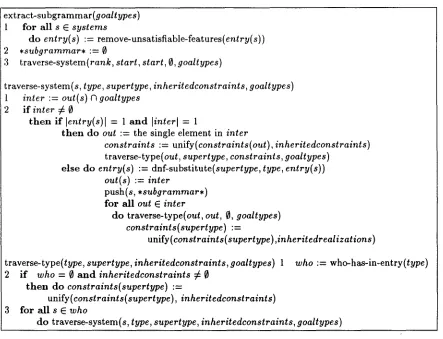
is done during a simulated depth-first traversal through the entire grammati- cal type lattice. T h e procedure works on the type lattice with the revised entries. Starting with the most general typestart
(and the most general sys- tem calledrank
which is the system withstart as
en- try), a hierarchy traversal looks for systems which al- though restricted to the type setgoal-types
actually branch, i.e. have more than one type in their out- put. These systems constitute the new subgrammar. In essence, each grammatical system s is examined to see how m a n y of its possible subtypes inout(s)
are used within the target grammar. Those types which are not used are excised from the subgram- mar being extracted. More specific types that are dependent on any excised types are not considered further during the traversal. G r a m m a t i c a l systems where there is only a single remaining unexcised sub- type collapse to form a degenerated pseudo-system indicating that no grammatical variation is possible in the considered application domain. For example, in the application described in section 3 the systemindicative = declarative I interrogative. collapses into
indicative = declarative.
extract-subgrammar(goaltypes)
1 f o r all
s E systems
d o
entry(s)
:=remove-unsatisfiable-features(entry(s))
2 .subgrammar.
:= 03 traverse-system(rank, start, start, O,goaltypes)
traverse-system(s,
type, supertype, inheritedconstraints, goaltypes)
1
inter
:=out(s) A goaltypes
2 i f
inter # 0
t h e n i f
lentry(s)l
= 1 a n dlinterl = 1
t h e n d o
out
:= the single element ininter
constraints
:=unify(constraints(out), inheritedconstraints)
traverse-type(out, supertype, constraints, goaltypes)
e l s e d o
entry(s)
:=dnf-substitute( supertype, type, entry(s))
out(s)
:=inter
push(s,
*subgrammar* )
f o r a l l
out E inter
d o
traverse-type(out, out, 0, goaltypes)
constraints( supertype )
:=unify ( constraint s( supert ype ) ,in herit edr eal i z at ions )
traverse-type(type, supertype, inheritedconstraints, goaltypes) 1 who
:=who-has-in-entry(type)
2 i f
who = 0
a n dinheritedconstraints # 0
t h e n d o
constraints(supertype) :=
unify( constraints( supertype), inheritedconstraints)
3 f o r
all s E who
d o traverse-system(s,
type, supertype, inheritedconstraints, goaltypes )
Figure 1: S u b g r a m m a r extraction algorithm
t h a t a m a x i m a l type is reached which is not in
goal-
types,
chooser actions have to be raised too. T h e number ofgoal-types
is then usually larger than the number of the types in the extracted s u b g r a m m a r because all pseudotypes ingoal-types
are excised.As the recursion criteria in the traversal, we first simply look for a system which has the actual type in its revised entry regardless of the fact if it occurs in a conjunction or not. This on its own, however, oversimplifies the real logical relations between the types and would create an inconsistent s u b g r a m m a r . T h e problem is the conjunctive inheritance. If the current type occurs in an entry of another system where it is conjunctively bound, a deeper traversal is in fact only licensed if the other types of the con- junctions are chosen as well. In order to perform such a traversal, a breadth traversal with compila- tion of all crowns of the lattice (see (A~t-Kaci et al., 1989)) would be necessary. In order to avoid this po- tentially c o m p u t a t i o n a l l y very expensive operation, but not to give up the consistency of the subgram- mar, the implemented s u b g r a m m a r extraction pro- cedure sketched in Figure 1 maintains all systems
with complex entries (be they conjunctive or disjunc- tive) for the s u b g r a m m a r even if they do not really branch and collapse to a single-subtype system. 2 A related approach can be found in (O'Donnell, 1992) for the extraction of smaller systemic s u b g r a m m a r s for analysis.
If the lexicon is organized as or under a com- plex type hierarchy, the extraction of an application- tuned lexicon is carried out similarly. This has the effect t h a t closed class words are removed from the lexicon if they are not covered in the application do- main. Open class words belonging to word classes not covered by the s u b g r a m m a r type set are re- moved. Some applications do not need their own lex- icon for open class words because they can be linked to an externally provided domain-specific thesaurus (as is the case for the examples discussed below). In this case, a sublexicon extraction is not necessary.
[image:4.612.89.532.75.414.2]3 A p p l i c a t i o n f o r t e x t t y p e ' l e x i c o n b i o g r a p h i e s '
The first trial application of the automatic subgram- mar extraction tool has been carried out for an in- formation system with an o u t p u t component that generates integrated text and graphics. This in- formation system has been developed for the do- main of art history and is capable of providing short biography articles for around l0 000 artists. The underlying knowledge base, comprising half a mil- lion semantic concepts, includes automatically ex- tracted information from 14 000 encyclopedia ar- ticles from McMillans planned publication "Dictio- nary of Art" combined with several additional infor- mation sources such as the G e t t y "Art and Archi- tecture Thesaurus"; the application is described in detail in (Kamps et al., 1996). As input the user clicks on an artist name. T h e system then performs content selection, text planning, text and diagram generation and page layout automatically. Possible o u t p u t languages are English and German.
The g r a m m a r necessary for short biographical articles is, however, naturally much more con- strained than that supported by general b r o i l - coverage grammars. There are two main reasons for this: first, because of the relatively fixed text type "encyclopedia biography" involved, and sec- ond, particularly in the example information system, because of the relatively simple nature of the knowl- edge b a s e - - t h i s does not support more sophisticated text generation as might appear in full encyclopedia articles. W i t h o u t extensive empirical analysis, one can already state that such a gram:mar is restricted to main clauses, only coordinative complex clauses, and temporal and spatial prepositional phrases. It would probably be possible to produce the generated texts with relatively complex templates and aggre- gation heuristics: but the full grammars for English and G e r m a n available in K P M L already covered the required linguistic phenomena.
The application of the automatic s u b g r a m m a r ex- traction tool to this scenario is as follows.
In the training phase, the information system runs with the full generation grammar. All grammatical types used during this stage are collected to yield the cumulative type set
goal-types.
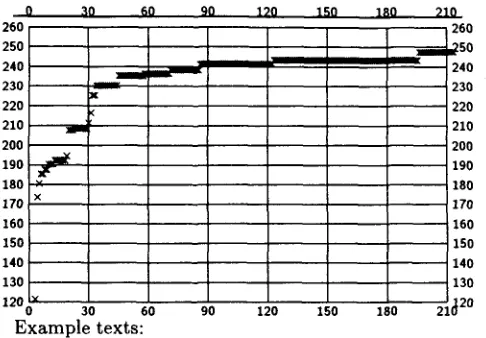
How many text examples must be generated in this phase depends on the relative increase of new infi)rmation (occur- rence of new types) obtained with every additional sentence generated. We show here the results for two related text types: 'short artist biographies' and 'artist biography notes'.Figure 2 shows the growth curve for the type set
0 ~0
260 250 240
2 3 0 x
220 <
210 200 190 180 170 x 160 150 1 4 0 130
1200x 30 60
Example texts:
60 90 120 150 1RO 210
260 50
~ 1 1 ~ 1 1 1 ~ ~ m m mllll~
90 120 150 180
Roger Hilton was an English painter. He was born at Northwood on 23 March 1911, and he died at BotaUack on 23 February 1975. He studied at Slade School in 1929 - 1931. He cre- ated "February - March 1954", "Grey figure", "Oi yoi yoi" and "June 1953 (deep cadmium)". Anni Albers is American, and she is a tex- tile designer, a draughtsman and a print- maker. She was born in Berlin on 12 June 1899. She studied art in 1916 - 1919 with Brandenburg. Also, she studied art at the Kunstgewerbeschule in Hamburg in 1919 - 1920 and the Bauhaus at Weimar and Dessan in 1922 - 1925 and 1925 - 1929. In 1933 she settled in the USA. In 1933 - 1949 she taught at Black Mountain College in North Carolina.
230 220 210 200 190 180 170 160 150 140 130 20
Figure 2: Cumulative type use with sentences from the short biography text type
[image:5.612.293.536.71.240.2]n 220
2 1 0
200
190
180 170
160 150 ×
140
130
120 0
"~N 60 QN l ~ n 1 Kn i an '~ln = 220
" ~ 200
190 180
170
160 150
140
130 20 30 60 '90 120 150 180
Example text:
Nathan Drake was an English painter. He was born at Lincoln in 1728, and he died at York on 19 February 1778.
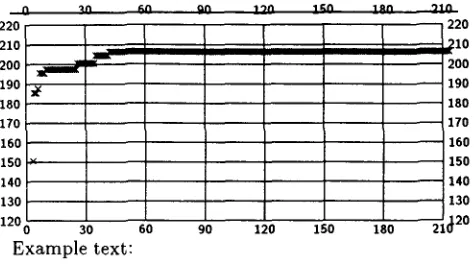
Figure 3: Cumulative type use with sentences from the note biography text type
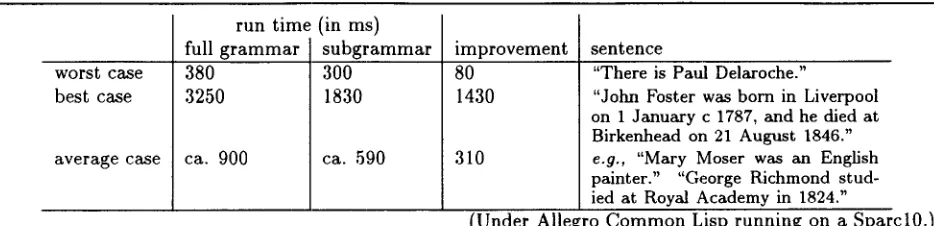
from 55%-75% of that of the full grammar (see Ta- ble 1)--in most cases, therefore, less than one sec- ond with the regular KPML generation environment (i.e., unoptimized with full debugging facilities resi- dent).
The generation times are indicative of the style of generation implemented by KPML. Clause types with more subtypes are likely to cause longer pro- cessing times than those with fewer subtypes. When there are in any case fewer subtypes available in the full grammar (as in the existential shown in Ta- ble 1), then there will be a less noticeable improve- ment compared with the extracted grammar. In ad- dition, the run times reflect the fact that the number of queries being asked by choosers has not yet been maximally reduced in the current evaluation. Noting the cumulative set of inquiry responses during the training phase would provide sufficient information for more effective pruning of the extracted choosers. The second example shows similar improvements. The very short biography entry is appropriate more for figure headings, margin notes, etc. The cumu- lative type use graph is shown in Figure 3. With this 'smaller' text type, the cumulative use stabilizes very quickly (i.e., after 39 sentences) at 205 types. This remained stable for a test set of 500 sentences. Extracting the corresponding subgrammar yields a grammar involving only 101 types, which is 7% of the original grammar. Sentence generation time is accordingly faster, ranging from 40%-60% of that of the full grammar. In both cases, it is clear that the size of the resulting subgrammar is dramatically re- duced. The generation run-time is cut to 2/3. The run-time space requirements are cut similarly. The
processing time for subgrammar extraction is less than one minute, and is therefore not a significant issue for improvement.
4 C o n c l u s i o n s a n d d i s c u s s i o n
In this paper, we have described how generation re- sources for restricted applications can be developed drawing on large-scale general generation grammars. This enables both re-use of those resources and pro- gressive growth as new applications are met. The grammar extraction tool then makes it a simple task to extract from the large-scale resources specially tuned subgrammars for particular applications. Our approach shows some similarities to that proposed by (Rayner and Carter, 1996) for improving parsing performance by grammar pruning and specialization with respect to a training corpus. Rule components are 'chunked' and pruned when they are unlikely to contribute to a successful parse. Here we have shown how improvements in generation performance can be achieved for generation grammars by removing parts of the grammar specification that are not used in some particular sublanguage. The extracted gram- mar is generally known to cover the target sublan- guage and so there is no loss of required coverage.
Another motivation for this work is the need for smaller, but not toy-sized, systemic grammars for their experimental compilation into state-of-the-art feature logics. The ready access to consistent sub- grammars of arbitrary size given with the automatic subgrammar extraction reported here allows us to investigate further the size to which feature logic representations of systemic grammar can grow while remaining practically usable. The compilation of the full grammar NIGEL has so far only proved possible for CUF (see (Henschel, 1995)), and the resulting type deduction runs too slowly for practical applica- tions.
[image:6.612.82.319.72.207.2]improvement sentence
worst case 80
best case 1430
average case
run time (in ms) full g r a m m a r subgrammar
380 300
3250 1830
ca. 900 ca. 590 310
"There is Patti Delaroche."
"John Foster was born in Liverpool on 1 January c 1787, and he died at Birkenhead on 21 August 1846." e.g., "Mary Moser was an English painter." "George Richmond stud- ied at Royal Academy in 1824."
(Under Allegro C o m m o n Lisp running on a Sparcl0.)
Table 1: Example run times for "short artist biographies"
out is only that entailed by the type lattice, It is also possible however to maintain a record of the classificatory inquiry responses that are used in a subgrammar: responses that do not occur can then motivate further reductions in the choosers that are kept in the extracted grammar. Evaluation of the improvements in performance that these strategies bring are in progress.
One possible benefit of not pruning the chooser de- cision trees completely is to provide a fall-back posi- tion for when the input to the generation component in fact strays outside of that expected by the target- ted subgrammar. Paths in the chooser decision tree that do not correspond to types in the s u b g r a m m a r can be maintained and marked explicitly as 'out of bounds' for that subgrammar. This provides a se- mantic check that the semantic inputs to the genera- tor remain within the limits inherent in the extracted subgrammar. If it sufficiently clear that these lim- its will be adhered to, then further extraction will be free of problems. However if the demands of an application change over time, then it is also possible to use the semantic checks to trigger regeneration with the full grammar: this offers improved average throughput while maintaining complete generation. Noting exceptions can also be used to trigger new s u b g r a m m a r extractions to adapt to the new appli- cations demands. A number of strategies therefore present themselves for incorporatiug g r a m m a r ex- traction into the application development cycle.
Although we have focused here on run-time im- provements, it is clear that the g r a m m a r extraction tool has other possible uses. For example, the ex- istence of small grammars is one i m p o r t a n t contri- bution to providing teaching materials. Also, the ability to extract consistent subcomponents should make it more straightforward to combine g r a m m a r fragments as required for particular needs. Further validation in both areas forms part of our ongoing re- search. Moreover, a significantly larger reduction of
the type lattice can be expected by starting not from the cumulative set of goal-types for the g r a m m a r re- duction, but from a detailed protocol of jointly used types for every generated sentence of the training corpus. A clustering technique applied to such a protocol is under development.
Finally, the proposed procedure is not bound to systemic g r a m m a r and can also be used to extract c o m m o n typed unification subgrammars. Here, however, the gain will probably not be as remark- able as in systemic grammar. T h e universal prin- ciples of, for example, an HPSG cannot be excised. HPSG type hierarchies usually contain mainly gen- eral types, so that they will not be affected sub- stantially. In the end, the degree of improvement achieved depends on the extent to which a g r a m m a r explicitly includes in its type hierarchy distinctions that are fine enough to vary depending on text type.
R e f e r e n c e s
Hassan Ai't-Kaci, Robert Boyer, Patrick Lincoln, and Roger Nasr. 1989. Efficient implementation of lat- tice operations. A CM Transactions on Programming Languages and Systems, 11(1):115 - 146.
John A. Bateman, 1997. KPML Development Envi- ronment: multilinguai linguistic resource development and sentence generation. German National Center for Information Technology (GMD), Institute for in- tegrated publication and information systems (IPSI), Darmstadt, Germany, January. (Release 1.1). Stephan Busemann. 1996. Best-first surface realization.
In Proceedings o] the 8th. International Workshop on Natural Language Generation (INLG '96), pages 101- 110, Herstmonceux, England, June.
Bob Carpenter. 1992. The Logic of Typed Feature Struc- tures. Cambridge University Press, Cambridge, Eng- land.
[image:7.612.56.523.80.193.2]maschineile Sprachverarbeitung (IMS), Universitht Stuttgart, Germany.
Robin P. Fawcett and Gordon H. Tucker. 1990. Demon- stration of GENESYS: a very large, semantically based systemic functional grammar. In 13th. International Conference on Computational Linguistics (COLING-
90), volume I, pages 47 - 49, Helsinki, Finland.
Michael A.K. Halliday. 1985. An Introduction to Func-
tional Grammar. Edward Arnold, London.
Renate Henschel. 1995. Traversing the Labyrinth of Fea- ture Logics for a Declarative Implementation of Large Scale Systemic Grammars. In Suresh Manandhar, ed- itor, Proceedings of the CLNLP 95. April 1995, South Queens ferry.
Thomas Kamps, Christoph Hiiser, Wiebke M/Shr, and Ingrid Schmidt. 1996. Knowledge-based information acess for hypermedia reference works: exploring the spread of the bauhaus movement. In Maristella Agosti and Alan F. Smeaton, editors, Information retrieval
and hypertext, pages 225-255. Kluwer Academic Pub-
fishers, Boston/London/Dordrecht.
William C. Mann. 1983. An overview of the PENMAN text generation system. Technical Report ISI/RR-83- 114, USC/Information Sciences Institute, Marina del Rey, CA.
Christian M.I.M. Matthiessen. 1983. Systemic grammar in computation: the Nigel case. In Proceedings of the First Annual Conference of the European Chapter of the Association for Computational Linguistics.
Elena Not and Oliviero Stock. 1994. Automatic gen- eration of instructions for citizens in a multilingual community. In Proceedings of the European Language
Engineering Convention, Paris, France, July.
Michael O'Donnell. 1992. Prototype Electronic Dis- course Analyzer (EDA) Reference Guide, Computa- tional Processes I: Parser. Technical report, Fujitsu Limited, Tokyo, Japan. (Internal report of project carried out at Fujitsu Australia Ltd., Sydney, Project Leader: Guenter Plum, Document Engineering Cen- tre).
Michael O'Donnell. 1994. Sentence analysis and genera-
tion: a systemic perspective. Ph.D. thesis, University
of Sydney, Department of Linguistics, Sydney, Aus- tralia.
C~cile L. Paris and Keith Vander Linden. 1996.
DRAFTER: an interactive support tool for writing mul- tifingual instructions. IEEE Computer.
Penman Project. 1989. PENMAN documentation: the Primer, the User Guide, the Reference Manual, and the Nigel manual. Technical report, USC/Information Sciences Institute, Marina del Rey, California. Manny Rayner and David Carter. 1996. Fast parsing
using pruning and grammar specialization. In Pro- ceedings of A CL '96.
Ehud Reiter. 1994. Has a consensus NL generation ar- chitecture appeared, and is it psychologically plausi- ble? In Proceedings of the 7th. International Work-
shop on Natural Language generation ( I N L G W '9~),
pages 163-170, Kennebunkport, Maine.
Dietmar RSsner and Manfred Stede. 1994. Generat- ing multifingual documents from a knowledge base: the TECHDOC project. In Proceedings of the 15th. International Conference on Computational Linguis-
tics
(CoLING
94), volume I, pages 339 - 346, Kyoto,Japan.
R~mi Zajac. 1992. Inheritance and constraint-based grammar formalisms. Computational Linguistics,