The Effect of Dependency Representation Scheme on Syntactic Language
Modelling
Sunghwan Mac Kim Department of Computing
Macquarie University Sydney, NSW 2109, Australia [email protected]
John K Pate Department of Computing
Macquarie University Sydney, NSW 2109, Australia
Mark Johnson Department of Computing
Macquarie University Sydney, NSW 2109, Australia [email protected]
Abstract
There has been considerable work on syn-tactic language models and they have ad-vanced greatly over the last decade. Most of them have used a probabilistic context-free grammar (PCFG) or a dependency grammar (DG). In particular, DG has at-tracted more and more interest in the past years since dependency parsing has achieved great success. While much work has evaluated the effects of different de-pendency representations in the context of parsing, there has been relatively little in-vestigation into them on a syntactic lan-guage model. In this work, we conduct the first assessment of three dependency representations on a transition-based de-pendency parsing language model. We show that the choice of dependency rep-resentation has an impact on overall per-formance from the perspective of language modelling.
1 Introduction
Syntactic language models have been successfully applied to a wide range of domains such as speech recognition, machine translation, and disfluency detection. Althoughn-gram based language mod-els are the most widely used due to their simplic-ity and efficacy, they suffer from a major draw-back: they cannot characterise the long-range rela-tions between words. A syntactic language model, which exploits syntactic dependencies, can incor-porate richer syntactic knowledge and information through syntactic parsing. In particular, syntactic structure leads to better performance of language model compared to traditional n-gram language models (Chelba and Jelinek, 2000). Most of the syntactic language models have used a probabilis-tic context-free grammar (PCFG) (Roark, 2001;
Charniak, 2001) or a dependency grammar (DG) (Wang and Harper, 2002; Gubbins and Vlachos, 2013) in order to capture the surface syntactic structures of sentences.
Researchers have shown an increased interest in dependency parsing and it has increasingly been recognised as an alternative to constituency pars-ing in the past years. Accordpars-ingly, various repre-sentations and associated parsers have been pro-posed with respect to DG. DG describes the syn-tactic structure of a sentence in terms of head-dependent relations between words. Unlike con-stituency models of syntax, DG directly models relationships between pairs of words, which leads to a simple framework that is easy to lexicalise and parse with. Moreover, a DG-based, particularly transition-based, parser is fast and even achieves state-of-the-art performance compared to the other grammar-based parsers. It is therefore suitable for identifying syntactic structures in incremental cessing, which is a useful feature for online pro-cessing tasks such as speech recognition or ma-chine translation.
The aim of this study is to explore different de-pendency representations and to investigate their effects on the language modelling task. There are publicly available converters to generate depen-dencies. Ivanova et al. (2013) investigated the ef-fect of each dependency scheme in terms of pars-ing accuracy. Elmpars-ing et al. (2013) evaluated four dependency schemes in five different natural lan-guage processing (NLP) applications. However, to our knowledge, no previous work has investigated the effect of dependency representation on a syn-tactic language model.
settings and a series of results are presented in Sec-tion 5. Finally, conclusions and direcSec-tions for fu-ture work are given in Section 6.
2 Related Work
A number of studies have been conducted on de-pendency representations in NLP tasks. Several constituent-to-dependency conversion schemes have been proposed as the outputs of the convert-ers (Johansson and Nugues, 2007; de Marneffe and Manning, 2008; Choi and Palmer, 2010; Tratz and Hovy, 2011). Previous work has evaluated the effects of different dependency representations in various NLP applications (Miwa et al., 2010; Popel et al., 2013; Ivanova et al., 2013; Elming et al., 2013). A substantial literature has exam-ined the impact of combining DG with another di-verse grammar representation, particularly in the context of parsing (Sagae et al., 2007; Øvrelid et al., 2009; Farkas and Bohnet, 2012; Kim et al., 2012).
Many works on syntactic language models have been carried out using phrase structures. Chelba and Jelinek (2000) experiment with the applica-tion of syntactic structure in a language model for speech recognition. Their model builds the syntactic trees incrementally in a bottom-up strat-egy while processing the sentence in a left-to-right fashion and assigns a probability to every word sequence and parse. The model is very close to the arc-standard model that we investigate in this paper. Roark (2001) implements an incremental top-down and left-corner parsing model, which is used as a syntactic language model for a speech recognition task. The model effectively exploits rich syntactic regularities as features and achieves better performance than ann-gram model. Char-niak (2001) describes a syntactic language model based on immediate-head parsing, which is called a Trihead model and empirically shows that the Trihead model is superior to both a trigram base-line and two previous syntactic language models.
Wang and Harper (2002) present a syntac-tic DG-based language model (SuperARV) for speech recognition. Multiple knowledge sources are tightly integrated based on their constraint DG but SuperARV does not construct explicit syntac-tic dependencies between words. Nonetheless, it achieves better perplexity than both a baseline tri-gram and other syntactic language models. Re-cently, Gubbins and Vlachos (2013) showed how
to use unlabelled and labelled dependency gram-mar language models to solve the Sentence Com-pletion Challenge set (Zweig and Burges, 2012). Their models performed substantially better than n-gram models.
3 Alternative Dependency Representations
Previous work has defined different dependency schemes, and provided software tools for convert-ing the syntactic constituency annotations of ex-isting treebanks to dependency annotations. We experiment with the following three schemes for the language modelling task.
• LTH: The LTH dependency scheme is ex-tracted from the automatic conversion of Penn Treebank using the LTH converter (Jo-hansson and Nugues, 2007).1 The converter has a lot of options that generate linguis-tic variations in dependency structures and it was configured to produce a functional rather than lexical DG in this study.
• P2M: The P2M scheme is obtained by run-ning the Penn2Malt converter (Nivre, 2006)2 based on a standard set of head rules. This converter was deprecated by the LTH con-verter but it is still used to make a comparison with previous results.
• STD: The STD scheme is used in the Stanford parser (de Marneffe and Manning, 2008)3, which comes with a converter. In this study, the Penn Treebank was converted to Stanford basic dependencies for projective dependency parsing.
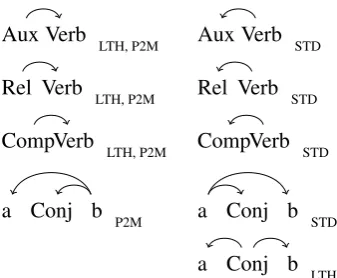
The syntactic representations differ in system-atic ways as shown in Figure 1. For instance, aux-iliaries take the lexical verb as a dependent in all schemes except for STD, where the lexical verb is the head of a VP. In addition to the typological dif-ferences, there is rich variation in dependency la-bels with respect to the schemes. The STD scheme has 49 dependency labels, which is the largest set
1
http://nlp.cs.lth.se/software/ treebank_converter/
2
http://w3.msi.vxu.se/˜nivre/research/ Penn2Malt.html
3http://nlp.stanford.edu/software/
Aux Verb LTH, P2M Aux Verb STD
Rel Verb LTH, P2M Rel Verb STD
CompVerb LTH, P2M CompVerb STD
a Conj b P2M a Conj b STD
[image:3.595.98.267.60.199.2]a Conj b LTH
Figure 1: Auxiliaries, relative/subordinate clauses and coordination in the DG schemes.
of dependency labels used here. The LTH depen-dencies are defined by 22 label types, whereas the P2M scheme employs 12 labels. The fine-grained set of dependency labels in STD allows a more precise expression of grammatical relations. For instance, the labeladv(unclassified adverbial) in LTH can be expressed using either advcl (adver-bial clause modier) oradvmod(adverbial modier) in STD. We evaluate the dependency schemes by incorporating them into a language model archi-tecture in the experiments.
4 A Dependency Parsing Language Model
In this section we describe our syntactic language model in terms of parsing and language mod-elling. Using the theoretical framework for gen-erative transition-based dependency parsing intro-duced by Cohen et al. (2011), we propose a gener-ative version of the arc-standard model that defines probability distributions over transitions and finds the most probable ones given stack features.
4.1 Generative Dependency Parsing Model
Following Nivre (2008), a transition-based depen-dency parsing model is defined as a tuple S = (C, T, I, Ct), where C is a set of configurations,
T is a set of permissible transitions,I is an initial-isation function, andCtis a set of terminal
config-urations. A transition sequence for a sentence is a sequence of configurations where each non-initial configuration is obtained by applying a transition to a previous configuration. A configuration is a triple(α, β, A), whereα is stack,β is queue and Ais a set of dependency arcs. The stackαstores partially processed words and the queueβrecords the remaining input words, respectively. The
func-tion I maps a sentence to an initial configuration with emptyαandA, andβ containing the words of the sentence. The setCthas a terminal
config-uration, whereα contains a single word andβ is empty.
The arc-standard model has three distinct types of transitions as follows:
• Shiftpw(SHpw): move the first itemiin the queue onto the stack and predict POSp and wordwfor the item
• Left-Arcl(LAl): combine the top two items i, jon the stack and predict a dependency la-bellover an arcj →i
• Right-Arcl(RAl): combine the top two items i, j on the stack and predict a depen-dency labellover an arci→j
This model processes the input sentence from left to right in a bottom-up fashion using three transitions. A parse tree is incrementally derived through the transition sequence. In particular,
Shift predicts the next POSpand word win the queue with a probabilityP(Shift, p, w), which is a probability both of theShift transition and the POS/word prediction.
The probability of a parse tree is defined as the product of the probabilities of transitions in Eq (1).
P(π) =
2n−1
Y
i=1
P(ti|αi−1, Ai−1) (1)
whereπis a parse tree, nis the number of words in a sentence andtis a transition such thatt∈T.
More specifically, transitions are conditioned on topmost stack items and in particular, the probabil-ity ofShift is defined as follows:
P(Shif tpw|α, A)
= P(Shif t|α, A)·P(p|Shif t, α, A)
·P(w|p, Shif t, α, A) (2)
This factored generative approach alleviates the effect of sparsity. More specifically, first a rela-tively coarse-grainedShiftis predicted given stack features and then we predict a fine-grained POS tag for the transition. Then a more fine-grained prediction of a word is made for the POS to fur-ther decompose theShift prediction.
contrast, Left-Arc and Right-Arc are predicted in unlabelled dependency parsing without consid-ering the dependency label. For instance, as ex-plained in Section 3, 22 dependency labels are in the LTH scheme and thus 45 combinations of tran-sitions and labels are jointly learned and predicted including theShifttransition, which does not have a label, in the labelled parsing model. Note that the probability ofShift transition is estimated in a factored fashion as described above.
The above probabilities are subject to the fol-lowing normalisation condition, namely the sum of all transition probabilities should be one:
X
p∈P X
w∈W
P(Shif tpw|α, A) + X
l∈L
P(Lef t-Arcl|α, A)
+X
l∈L
P(Right-Arcl|α, A) = 1
where P and W stand for predefined POS tag and word vocabularies, respectively. Lis a set of dependency labels corresponding to each depen-dency scheme.
4.2 Beam Search
Our parsing model maintains a beam contain-ing multiple configurations. To allow the parser to consider configurations with expensive early moves but cheap late moves, we sort our config-urations by a figure-of-merit (FOM) that adjusts a configuration’s probability with heuristics about. The beam search runs in each word position using a separate priority queue. A priority queue con-tains configurations that have been constructed by the same numbers of Shift, and the same or dif-ferent numbers ofLeft-Arc orRight-Arc transi-tions. An initial configuration is inserted into the first priority queue corresponding to the first word position and then the algorithm loops until all figurations have terminal conditions. Each con-figuration is populated off the queue and updated by applying each of permissible transitions to the current configuration. The updated configuration is pushed onto the corresponding queue with re-spect to the number ofShift. The configurations in each priority queue are ranked according to the
FOMs. The ranked configurations are discarded if they fall outside the beam. Looping continues for the current word position until the queue is empty. For the configurations in the final queue, we com-pute the probability of an input sentence by sum-ming over all their probabilities.
Configurations in the same queue cover differ-ent amounts of the input string since they could have different numbers ofLeft-ArcorRight-Arc. The configurations are not comparable to each other in terms of their probabilities. For this rea-son, we propose a FOM to penalise the case where the stack has more items. To this end, the
FOM incorporates the probability cost of the re-ductions that will be required to reduce all the items on the stack. An estimate of the proba-bility of reductions uses a rough approximation
1/(4L)m,Lis the number of labels (if the scheme is unlabelled,L=1) andm is the number of stack items. The FOM is estimated by multiplying the probability of a configuration by the predicted probability of reducing every stack item.
4.3 Random Forest Model for Word Distribution
The probability of a word in Eq (2) is calculated from the word RF model. The training procedure of our RF model is similar to that of Xu and Je-linek (2007). The growing algorithm starts with a root node and a decision tree is constructed by splitting every node recursively from the root node through a two-step splitting rule. Node splitting terminates when each node triggers a stopping rule in order to avoid overfitting.
We overcome data sparsity by first observing that a decision tree essentially provides a hierar-chical clustering of the data, since each node splits the data. We linearly interpolate the distributions of the leaf nodes recursively with their parents, ul-timately backing off to the root node. The interpo-lation parameters should be sensitive to the counts in each node so that we back off only when the more specific node does not have enough obser-vations to be reliable. However, giving each node of each decision tree its own interpolation param-eter would itself introduce data sparsity problems. We instead use Chen’s bucketing approach (Chen and Goodman, 1996) for each tree level, in which nodes on the same level are grouped into buckets and one interpolation parameter is estimated for each bucket. The first step is to divide up the nodes on the same level into bins based on Chen’s scores. We then use the EM algorithm to find the optimal interpolation parameter for all the nodes in each bucket using heldout data.
pre-S1p, S2p, S3p POS
S1w, S2w, S3w word
S1lp, S2lp POS of left-most child
S1rp, S2rp POS of right-most child
S1lw, S2lw word of left-most child
S1rw, S2rw word of right-most child
[image:5.595.87.281.61.154.2]S1∗ll, S2∗ll Label of left-most child S1∗rl, S2∗rl Label of right-most child
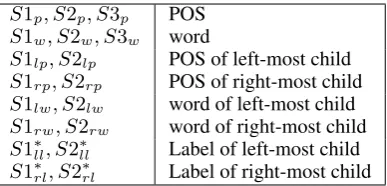
Table 1: Conditioning stack features, where Si represents the ith item on the stack (S1 is a top-most stack item). Note that dependency label fea-tures are only used in labelled parsing.∗
diction, as in Eq (3):
P(w|p, Shif t, α, A)
= 1
m
m
X
t=1
Pj(w|p, Shif t, α, A) (3)
wheremdenotes the total number of decision trees andPj(w|·) is the probability of the wordw cal-culated by thejthdecision tree.
[image:5.595.316.518.376.575.2]The word probability is calculated conditioned on the stack features of the current configuration. Table 1 shows the stack features that are used in our RF model. Our unlabelled parsing model es-timates the conditional probabilities of the word, given 14 different features. The labelled parsing model uses four additional label-related features.
4.4 Maximum Entropy Model for Transition/POS Distribution
Conditional ME models (Berger et al., 1996) are used as another classifier in our parsing-based lan-guage model together with RF. The probability of a transition or a POS tag in Eq (2) is calculated from the corresponding transition ME or POS ME model. For instance, the probability of Shift is calculated as shown in Eq (4).
PM E(Shif t|α, A) (4)
= 1
Z(α, A)exp(λ·f(α, A, Shif t))
where f(α, A, Shif t) denotes feature functions that return non-zero values if particular stack items appear in(α, A)and the transition is Shift. λis the corresponding real-valued weight vector, and more informative features receive weights further from zero.Z(α, A) =P
t∈Texp(λ·f(α, A, t))is
the partition function that ensures the distribution is properly normalised. The feature weightsλare
tuned to maximise the regularised conditional like-lihood of the training data. It is equivalent to the minimisation of the regularised negative log con-ditional likelihood:
ˆ
λ= argmin
λ
(−X i
logPλ(yi|xi) +
X
j
λ2j
2σ2j) (5)
where P
jλ2j/2σj2 is a Gaussian prior
regu-lariser that reduces overfitting by penalising large weights. In practice, we use a single parameterσ instead of having a different parameterσifor each
feature.
In this work we use the limited memory BFGS (L-BFGS) algorithm (Liu and Nocedal, 1989), which is an efficient numerical optimisation algo-rithm, to find the optimal feature weightsλ. In theˆ ME model, we rely on two kinds of features: (1) atomic features from Table 1, and (2) conjunctive features that are combinations of the atomic fea-tures. The feature templates are shown in Table 2.
Type Features
Unigram S1p, S2p, S3p, S1w, S2w, S3w S1lp, S2lp, S1rp, S2rp S1lw, S2lw, S1rw, S2rw S1∗ll, S2
∗
ll, S1
∗
rl, S2
∗
rl
Bigram S1w◦S1p, S2w◦S2p, S3w◦S3p S1w◦S2w, S1p◦S2p
S1p◦S1lp, S2p◦S2lp S1p◦S1rp, S2p◦S2rp S1w◦S1∗ll, S1w◦S1∗rl S1p◦S1∗ll, S1p◦S1∗rl S2w◦S2∗ll, S2w◦S2∗rl S2p◦S2∗ll, S2p◦S2∗rl
Trigram S1p◦S2p◦S3p, S1p◦S2w◦S2p S1w◦S2w◦S2p, S1w◦S1p◦S2p S1w◦S1p◦S2w, S2p◦S2lp◦S1p S2p◦S2rp◦S1p, S2p◦S1p◦S1lp S2p◦S1p◦S1rp, S2p◦S2lp◦S1w S2p◦S2rp◦S1w, S2p◦S1w◦S1lp
Fourgram S1w◦S1p◦S2w◦S2p
Table 2: Stack feature templates of the ME model.
4.5 Language Model
A generative parsing model assigns a joint probabilityP(π, s) for a parse tree π and an in-put sentence s. The probability of a sentence P(s)is computed by summing over all parse trees, P(s) = P
πP(π, s). Therefore, our generative
125 130 135 140 145 150 155 160
1 2 4 8 16 32 40
Perp
lexi
ty
Number of DTs (Beam=100)
Unlabelled LTH Unlabelled P2M Unlabelled STD Labelled LTH Labelled P2M Labelled STD
(a) a fixed beam size 100
125 130 135 140 145 150 155 160
1 10 20 50 100
Perp
lexi
ty
Beam size (DT=200)
Unlabelled LTH Unlabelled P2M Unlabelled STD Labelled LTH Labelled P2M Labelled STD
[image:6.595.89.530.75.227.2](b) a fixed number of decision trees 40
Figure 2: Perplexity results trained and tested on WSJ.
74 76 78 80 82 84 86 88 90
1 2 4 8 16 32 40
Perp
lexi
ty
Number of DTs (Beam=100)
Unlabelled LTH
Unlabelled P2M
Unlabelled STD
Labelled LTH
Labelled P2M
Labelled STD
(a) a fixed beam size 100
74 76 78 80 82 84 86 88 90
1 10 20 50 100
Perp
lexi
ty
Beam size (DT=200)
Unlabelled LTH Unlabelled P2M Unlabelled STD Labelled LTH Labelled P2M Labelled STD
(b) a fixed number of decision trees 40
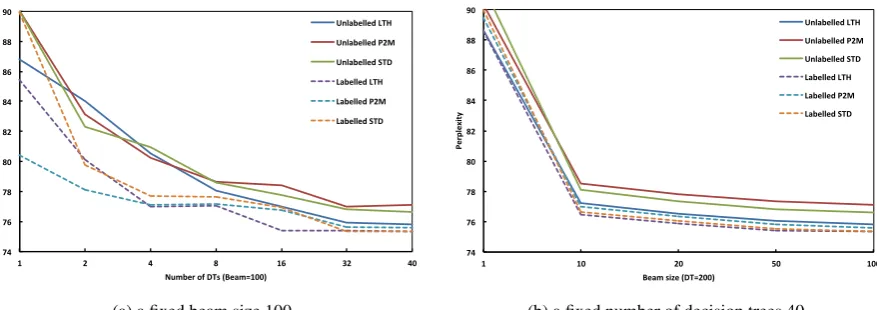
Figure 3: Perplexity results trained and tested on Switchboard.
5 Experiments
5.1 Experimental Settings
We empirically evaluate the effects of three dency schemes (LTH, P2M, STD) on our depen-dency language models in terms of perplexity and word error rate (WER). Several experiments are conducted varying the number of decision trees and the beam size on each dependency scheme. Each dependency language model uses a maxi-mum beam size of 100, and up to 40 decision trees are generated for the RF classifier. We train the transition/POS ME classifiers using 400 iterations with no frequency cutoff for features and σ for the Gaussian prior is set to 1. Our experiments use three evaluation datasets for unlabelled and la-belled dependency language models.
Perplexity Results trained and tested on WSJ: Most of the syntactic language models (Roark, 2001; Charniak, 2001; Xu and Jelinek, 2007;
Wang and Harper, 2002) were evaluated on the Wall Street Journal (WSJ) section of the Penn Treebank (Marcus et al., 1993) in terms of per-plexity. The WSJ is speechified by following the conventions of previous work. All punctuation is removed, words are lowercased, and numbers are replaced by a symbol N. All words outside the vo-cabulary limit (10,000 words) are mapped to a spe-cial UNK symbol. Sections 0-20 are used as the training set, sections 21-22 as the heldout set, and sections 23-24 for testing.
[image:6.595.87.526.282.437.2]are removed from constituent trees prior to con-verting to dependency structure. We applied three converters on the cleaned version of Switchboard to obtain three dependency schemes. The vocab-ulary consists of all the words in the training data and contains 13,706 word types.
WER Results trained on WSJ and tested on HUB1: We performed a small speech recogni-tion evaluarecogni-tion on n-best lists from the DARPA ’93 HUB1 test setup. A real task-based evalua-tion would be worthwhile besides perplexity since previous studies found that lower perplexity does not necessarily mean lower WER in their models (Roark, 2001; Wang and Harper, 2002; Xu and Jelinek, 2007). The HUB1 corpus consists of 213 sentences taken from the WSJ with a total of 3,446 words. The corpus is provided along with a lattice trigram model, which is trained on approximately 40 million words with a vocabulary of 20 thou-sand words. We used the A* decoding algorithm of SRILM to extract 50-best lists from the lattices measuring the lattice trigram and acoustic scores. The average number of candidates is roughly 21.7 in the lists. The WER of the lattice trigram model is 13.7% and the oracle WER, which is the low-est WER to the references, is 7.9% for the 50-blow-est lists. There are token discrepancies between the Penn Treebank and the HUB1 lattices for contrac-tions, possessives and numbers.4 For simplicity, we do not speechify the numbers (i.e., not expand them into text), whereas we follow previous work in dealing with the discrepancies of contractions or possessives. We use the Penn Treebank tokenisa-tion, which separates clitics from their base word (i.e. ‘can’t’ is represented as ‘ca n’t’), for training and running our models. Two tokens of treebank format are then combined into one to be aligned with gold standard word sequences for the WER evaluation. Our trained models were used with the same training data (1 million words) and vocab-ulary as in the above perplexity experiments on WSJ. We followed Roark (2001) in multiplying the language model scores by 15 before interpo-lating them with the acoustic model scores.
5.2 Experimental Results
The Effects of Decision Trees and Beam Search: To illustrate the effects of decision trees and beam size, we plot perplexity that corresponds to each
4For instance, “Bill ’scarisn ’tworth$100” vs. “Bill’s
carisn’tworthone hundred dollars”.
scheme. As can be seen from Figure 2a, the per-plexities are improved for all schemes using more decision trees. Perplexity reductions of two la-belled schemes (LTH, STD) are relatively large except for labelled P2M, and particularly the per-plexities drop sharply up to random forests of size 8 for labelled LTH. On the other hand, the per-plexities of unlabelled schemes are decreased at a sluggish pace and they are more insensitive to the number of decision trees. As Figure 2b illus-trates, the general shape of the perplexity curves drops quickly as beam size increases from 1 to 10, and then to flatten as beam size increases further. We do not obtain much benefit if the beam size is larger than 10. Figure 3 shows the perplexity re-sults on Switchboard for different numbers of de-cision trees and variable beam sizes as on WSJ. We can observe the positive effects of these two parameters (random forest size and beam search) with respect to perplexity. Figure 3b shows similar trends to the WSJ perplexities, which are dramat-ically reduced up to a beam size of 10, and then level out. The perplexity trends in Figure 3a are quite different, showing that unlabelled schemes have a gentle slope over numbers of decision trees. The number of decision trees has a relatively high impact on the performance of unlabelled schemes on Switchboard.
Performance Comparison: Table 3 presents the perplexity and WER results of unlabelled and la-belled schemes for LTH, P2M and STD. We can see that labelled LTH achieves the lowest plexities, whereas unlabelled P2M and STD per-form the worst overall. For labelled schemes we observe their superior performance compared to unlabelled schemes in terms of perplexity. The perplexity results indicate that dependency labels improve the performance of a dependency lan-guage model. In particular, labelled STD has the largest perplexity reduction (3.2%) compared to unlabelled STD, which yields the worst perplexity on WSJ. Overall, LTH outperforms both P2M and STD regardless of unlabelled or labelled scheme in terms of perplexity. Although the WERs are not significantly different across the different meth-ods, unlabelled P2M leads to the best performance (14.6%), whereas labelled P2M is the worst per-forming scheme (15.1%).5 Labelled LTH and
5
Models WSJ Perplexity SWBD Perplexity HUB1 WER
[image:8.595.73.298.60.128.2]Unlabelled LTH 128.84 75.81 14.8 Unlabelled P2M 131.12 77.09 14.6 Unlabelled STD 133.18 76.61 14.7 Labelled LTH 126.97 75.33 14.9 Labelled P2M 130.45 75.59 15.1 Labelled STD 128.96 75.34 14.7
Table 3: Perplexities and WERs of unlabelled and labelled LTH, P2M and STD schemes. We mea-sured their performance on WSJ, Switchboard and HUB1 datasets.
STD perform roughly on par with unlabelled LTH and STD, respectively.
Analysis and Discussion: Our results indicate that the choice of dependency representation af-fects the performance of the syntactic language model. One thing to note is that it is hard to tell what scheme is overall best in our experi-ments. An interesting observation is that the de-pendency labels are somewhat ineffective for the speech recognition task in contrast to perplexity evaluation. The results demonstrate that each eval-uation measure tends to have its own preferred scheme. For instance, the LTH scheme is preferred for the perplexity evaluation, whereas STD is ferred under WER. Our finding is in line with pre-vious work, which claims that a task-based eval-uation does not correlate well with a theoretical evaluation (Rosenfeld, 2000; Jonson, 2006; Och et al., 2004; Miwa et al., 2010; Elming et al., 2013; Smith, 2012). They commonly claim that lower perplexity does not necessarily mean lower WER, and the relation between two measures is clearly not transparent. Miwa et al. (2010) found that STD performs better for event extraction, whereas LTH outperforms STD in terms of parsing accuracy.
5.3 Comparison with Previous Work
In this section, we compare our model to previ-ous work discussed in the literature. As baselines, we use two influential models, namely a modi-fied Kneser-Ney (mKN) trigram model (Chen and Goodman, 1998) and Charniak’s Trihead language model (Charniak, 2001).6 The two models were
6
The mKN is still considered one of the best smooth-ing methods forn-gram language models and the Trihead model achieves the better perplexity and WER compared to Chelba’s and Roark’s models (Lease et al., 2005). Moreover, there is no significant difference between Chelba’s SLM and Wang’s SuperARV in terms of WER although the SuperARV even obtains a much lower perplexity (Wang and Harper, 2002). For these reasons, we think that Charniak’s model is the strongest competitor among syntactic language models.
Models Perplexity WER
mKN trigram 148.65 17.2
Trihead 131.40 15.0
Unlabelled LTH 128.84 14.8 Labelled LTH 126.97 14.9
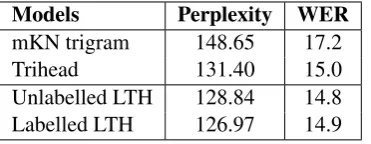
Table 4: Perplexity and WER comparisons with previous work.
trained with the same training data and vocabulary on WSJ as mentioned in Section 5.1. The SRILM toolkit (Stolcke, 2002) was used to build the tri-gram mKN smoothed language model.
The performance of the two baselines in Table 4 was measured conducting the same test proce-dures on WSJ and HUB1. Our perplexities and WERs were selected from the previous sections for the LTH scheme, which performs well uni-formly. It is shown that both unlabelled and la-belled LTH schemes significantly improve upon the mKN baseline in terms of WER. The WER im-provement of LTH over the Trihead model is not statistically significant, although the LTH scheme achieves better perplexity than Trihead regardless of dependency labels.
6 Conclusion and Future Work
[image:8.595.326.512.62.134.2]model.
Acknowledgments
We would like to thank the reviewers for their thoughtful comments and suggestions.
References
Adam L. Berger, Vincent J. Della Pietra, and Stephen A. Della Pietra. 1996. A Maximum En-tropy Approach to Natural Language Processing. Computational Linguistics, 22(1):39–71.
Eugene Charniak. 2001. Immediate-Head Parsing for Language Models. In Proceedings of 39th Annual Meeting of the Association for Computational Lin-guistics, pages 124–131, Toulouse, France.
Ciprian Chelba and Frederick Jelinek. 2000. Struc-tured language modeling. Computer Speech & Lan-guage, 14(4):283–332.
Stanley F. Chen and Joshua Goodman. 1996. An Empirical Study of Smoothing Techniques for Lan-guage Modeling. In Arivind Joshi and Martha Palmer, editors, Proceedings of the Thirty-Fourth Annual Meeting of the Association for Computa-tional Linguistics, pages 310–318, San Francisco. Morgan Kaufmann Publishers.
Stanley F. Chen and Joshua Goodman. 1998. An Empirical Study of Smoothing Techniques for Lan-guage Modeling. Technical Report TR-10-98, Cen-ter for Research in Computing Technology, Harvard University.
Jinho D Choi and Martha Palmer. 2010. Robust constituent-to-dependency conversion for English. InProceedings of 9th Treebanks and Linguistic The-ories Workshop (TLT), pages 55–66.
Shay B. Cohen, Carlos G´omez-Rodr´ıguez, and Giorgio Satta. 2011. Exact Inference for Generative Proba-bilistic Non-Projective Dependency Parsing. In Pro-ceedings of the 2011 Conference on Empirical Meth-ods in Natural Language Processing, pages 1234– 1245, Edinburgh, Scotland, UK, July. Association for Computational Linguistics.
Marie-Catherine de Marneffe and Christopher D. Man-ning. 2008. The Stanford Typed Dependencies Rep-resentation. In Coling 2008: Proceedings of the workshop on Cross-Framework and Cross-Domain Parser Evaluation, pages 1–8, Manchester, UK, Au-gust.
Jakob Elming, Anders Johannsen, Sigrid Klerke, Emanuele Lapponi, Hector Martinez Alonso, and Anders Søgaard. 2013. Down-stream effects of tree-to-dependency conversions. InProceedings of the 2013 Conference of the North American Chap-ter of the Association for Computational Linguistics:
Human Language Technologies, pages 617–626, At-lanta, Georgia, June. Association for Computational Linguistics.
Rich´ard Farkas and Bernd Bohnet. 2012. Stacking of Dependency and Phrase Structure Parsers. In Pro-ceedings of COLING 2012, pages 849–866, Mum-bai, India, December. The COLING 2012 Organiz-ing Committee.
Joseph Gubbins and Andreas Vlachos. 2013. De-pendency Language Models for Sentence Comple-tion. InProceedings of the 2013 Conference on Em-pirical Methods in Natural Language Processing, pages 1405–1410, Seattle, Washington, USA, Oc-tober. Association for Computational Linguistics.
Angelina Ivanova, Stephan Oepen, and Lilja Øvrelid. 2013. Survey on parsing three dependency represen-tations for English. In51st Annual Meeting of the Association for Computational Linguistics Proceed-ings of the Student Research Workshop, pages 31– 37, Sofia, Bulgaria, August. Association for Com-putational Linguistics.
Richard Johansson and Pierre Nugues. 2007. Ex-tended constituent-to-dependency conversion for English. InProceedings of the 16th Nordic Confer-ence on Computational Linguistics (NODALIDA).
Mark Johnson and Eugene Charniak. 2004. A TAG-based noisy channel model of speech repairs. In Proceedings of the 42nd Annual Meeting of the As-sociation for Computational Linguistics, pages 33– 39.
Rebecca Jonson. 2006. Generating Statistical Lan-guage Models from Interpretation Grammars in Di-alogue Systems. In Proceedings of 11th Confer-ence of the European Association of Computational Linguistics, pages 57–65. The Association for Com-puter Linguistics.
Sunghwan Mac Kim, Dominick Ng, Mark Johnson, and James Curran. 2012. Improving Combinatory Categorial Grammar Parse Reranking with Depen-dency Grammar Features. InProceedings of COL-ING 2012, pages 1441–1458, Mumbai, India, De-cember. The COLING 2012 Organizing Committee.
Matthew Lease, Eugene Charniak, and Mark Johnson. 2005. Parsing and its Applications for Conversa-tional Speech. InIEEE International Conference on Acoustics, Speech, and Signal Processing (ICASSP), volume 5, pages 961–964.
Dong C. Liu and Jorge Nocedal. 1989. On the Limited Memory BFGS Method for Large Scale Optimiza-tion. Math. Program., 45(3):503–528, December.
Makoto Miwa, Sampo Pyysalo, Tadayoshi Hara, and Jun’ichi Tsujii. 2010. Evaluating Dependency Rep-resentations for Event Extraction. In Proceedings of the 23rd International Conference on Computa-tional Linguistics (Coling 2010), pages 779–787, Beijing, China, August. Coling 2010 Organizing Committee.
Joakim Nivre. 2006. Inductive dependency parsing. Springer.
Joakim Nivre. 2008. Algorithms for Deterministic In-cremental Dependency Parsing. Computational Lin-guistics, 34(4):513–553.
Franz Josef Och, Daniel Gildea, Sanjeev Khudan-pur, Anoop Sarkar, Kenji Yamada, Alex Fraser, Shankar Kumar, Libin Shen, David Smith, Kather-ine Eng, Viren Jain, Zhen Jin, and Dragomir Radev. 2004. A Smorgasbord of Features for Statistical Machine Translation. In Daniel Marcu Susan Du-mais and Salim Roukos, editors,HLT-NAACL 2004: Main Proceedings, pages 161–168, Boston, Mas-sachusetts, USA, May 2 - May 7. Association for Computational Linguistics.
Lilja Øvrelid, Jonas Kuhn, and Kathrin Spreyer. 2009. Cross-framework parser stacking for data-driven de-pendency parsing. Traitement Automatique des Langues (TAL) Special Issue on Machine Learning for NLP, 50(3):109–138.
Martin Popel, David Mareˇcek, Jan ˇStp´anek, Daniel Ze-man, and Zdnk ˇZabokrtsk´y. 2013. Coordination Structures in Dependency Treebanks. In Proceed-ings of the 51st Annual Meeting of the Association for Computational Linguistics (Volume 1: Long Pa-pers), pages 517–527, Sofia, Bulgaria, August. As-sociation for Computational Linguistics.
Brian Roark. 2001. Probabilistic top-down parsing and language modeling. Computational Linguistics, 27(2):249–276.
Ronald Rosenfeld. 2000. Two decades of statistical language modeling: where do we go from here? Proceedings of the IEEE, 88(8):1270–1278, Aug.
Kenji Sagae, Yusuke Miyao, and Jun’ichi Tsujii. 2007. HPSG Parsing with Shallow Dependency Constraints. In Proceedings of the 45th Annual Meeting of the Association of Computational Lin-guistics, pages 624–631, Prague, Czech Republic, June. Association for Computational Linguistics.
Noah A. Smith. 2012. Adversarial Evalua-tion for Models of Natural Language. CoRR, abs/1207.0245.
Andreas Stolcke. 2002. SRILM - an extensible lan-guage modeling toolkit. InProceedings of the Inter-national Conference on Spoken Language Process-ing, pages 901–904.
Stephen Tratz and Eduard Hovy. 2011. A Fast, Accu-rate, Non-Projective, Semantically-Enriched Parser. In Proceedings of the 2011 Conference on Empiri-cal Methods in Natural Language Processing, pages 1257–1268, Edinburgh, Scotland, UK, July.
Wen Wang and Mary P. Harper. 2002. The Su-perARV Language Model: Investigating the Effec-tiveness of Tightly Integrating Multiple Knowledge Sources. InProceedings of the 2002 Conference on Empirical Methods in Natural Language Process-ing, pages 238–247. Association for Computational Linguistics, July.
Peng Xu and Frederick Jelinek. 2007. Random forests and the data sparseness problem in language model-ing. Computer Speech & Language, 21(1):105–152.