Proceedings of the 27th International Conference on Computational Linguistics, pages 571–583 571
Deep Enhanced Representation for
Implicit Discourse Relation Recognition
Hongxiao Bai1,2, Hai Zhao1,2,∗
1Department of Computer Science and Engineering,
Shanghai Jiao Tong University, Shanghai, China
2Key Laboratory of Shanghai Education Commission for Intelligent Interaction
and Cognitive Engineering, Shanghai Jiao Tong University, Shanghai, China
[email protected], [email protected]
Abstract
Implicit discourse relation recognition is a challenging task as the relation prediction without explicit connectives in discourse parsing needs understanding of text spans and cannot be easily derived from surface features from the input sentence pairs. Thus, properly representing the text is very crucial to this task. In this paper, we propose a model augmented with different grained text representations, including character, subword, word, sentence, and sentence pair levels. The proposed deeper model is evaluated on the benchmark treebank and achieves state-of-the-art accuracy with greater than 48% in 11-way andF1 score greater than 50% in 4-way classifications for the first time according to our best knowledge.
1 Introduction
Discourse parsing is a fundamental task in natural language processing (NLP) which determines the structure of the whole discourse and identifies the relations between discourse spans such as clauses and sentences. Improving this task can be helpful to many downstream tasks such as machine trans-lation (Li et al., 2014), question answering (Jansen et al., 2014), and so on. As one of the important parts of discourse parsing, implicit discourse relation recognition task is to find the relation between two spans without explicit connectives (e.g., but, so, etc.), and needs recovering the relation from semantic understanding of texts.
The Penn Discourse Treebank 2.0 (PDTB 2.0) (Prasad et al., 2008) is a benchmark corpus for discourse relations. In PDTB style, the connectives can be explicit or implicit, and one entry of the data is separated into Arg1andArg2, accompanied with a relation sense. Since the release of PDTB 2.0 dataset, many methods have been proposed, ranging from traditional feature-based methods (Lin et al., 2009; Pitler et al., 2009) to latest neural-based methods (Qin et al., 2017; Lan et al., 2017). Especially through many neural network methods used for this task such as convolutional neural network (CNN) (Qin et al., 2016b), recursive neural network (Ji and Eisenstein, 2015), embedding improvement (Wu et al., 2017), attention mechanism (Liu and Li, 2016), gate mechanism (Chen et al., 2016), multi-task method (Lan et al., 2017), the performance of this task has improved a lot since it was first introduced. However, this task is still very challenging with the highest reported accuracy still lower than 50% due to the hardness for the machines to understand the text meaning and the relatively small task corpus.
In this work, we focus on improving the learned representations of sentence pairs to address the im-plicit discourse relation recognition. It is well known that text representation is the core part of state-of-the-art deep learning methods for NLP tasks, and improving the representation from all perspective will benefit the concerned task.
The representation is improved by two ways in our model through three-level hierarchy. The first way is embedding augmentation. Only with informative embeddings, can the final representations be bet-ter. This is implemented in our word-level module. We augment word embeddings with subword-level
∗
Corresponding author. This paper was partially supported by National Key Research and Development Program of China (No. 2017YFB0304100), National Natural Science Foundation of China (No. 61672343 and No. 61733011), Key Project of National Society Science Foundation of China (No. 15-ZDA041), The Art and Science Interdisciplinary Funds of Shanghai Jiao Tong University (No. 14JCRZ04).
embeddings and pre-trained ELMo embeddings. Subwords coming from unsupervised segmentation demonstrate a better consequent performance than characters for being a better minimal representation unit. The pre-trained contextualized word embeddings (ELMo) can make the embeddings contain more contextual information which is also involved with character-level inputs. The second way is a deep residual bi-attention encoder. Since this task is about classifying sentence pairs, the encoder is imple-mented in sentence and sentence-pair levels. A deeper model can support richer representations but is hard to train, especially with a small dataset. So we apply residual connections (He et al., 2016) to each module for facilitating signal propagation and alleviating gradient degradation. The stacked encoder blocks make the single sentence representation richer and bi-attention module mixes two sentence rep-resentations focusingly. With introducing richer and deeper representation enhancement, we report the deepest model so far for the task.
Our representation enhanced model will be evaluated on the benchmark PDTB 2.0 and demonstrate state-of-the-art performance to verify its effectiveness.
This paper is organized as follows. Section 2 reviews related work. Section 3 introduces our model. Section 4 shows our experiments and analyses the results. Section 5 concludes this work.
2 Related Work
After the release of Penn Discourse Treebank 2.0, many works have been made to solve this concerned task. Lin et al. (2009) is the first work who considered the second-level classification of the task by empirically evaluating the impact of surface features. Feature based methods (Pitler et al., 2009; Zhou et al., 2010; Chen et al., 2015; Li et al., 2016) mainly focused on using linguistic, or semantic features from the discourse units, or the relations between unit pairs and word pairs. Zhang et al. (2015) is the first one who modeled this task using end-to-end neural network and gained great performance improvement. Neural network methods also used by lots of works (Zhang et al., 2016; Cai and Zhao, 2016) for better performance. Since then, a lot of methods have been proposed. Braud and Denis (2015) found that word embeddings trained by neural networks is very useful to this task. Qin et al. (2016a) augmented their system with character-level and contextualized embeddings. Recurrent networks and convolutional networks have been used as basic blocks in many works (Ji et al., 2016; R¨onnqvist et al., 2017; Qin et al., 2016b). Ji and Eisenstein (2015) used recursive neural networks. Attention mechanism was used by Liu and Li (2016), Cai and Zhao (2017) and others. Wu et al. (2016) and Lan et al. (2017) applied multi-task component. Qin et al. (2017) utilized adversarial nets to migrate the connective-based features to implicit ones.
Sentence representation is a key component in many NLP tasks. Usually, better representation means better performance. Plenty of work on language modeling has been done, as language modeling can supply better sentence representations. Since the pioneering work of Bengio et al. (2006), neural lan-guage models have been well developed (Mikolov and Zweig, 2012; Williams et al., 2015; Kim et al., 2016). Sentence representation is directly handled in a series of work. Lin et al. (2017) used self attention mechanism and used matrix to represent sentence, and Conneau et al. (2017) used encoders pre-trained on SNLI (Bowman et al., 2015) and MultiNLI (Williams et al., 2017).
Different from all the existing work, for the first time to our best knowledge, this work is devoted to an empirical study on different levels of representation enhancement for implicit discourse relation classification task.
3 Model
3.1 Overview
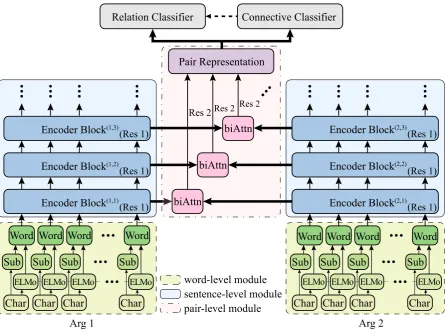
Figure 1 illustrates an overview of our model, which is mainly consisted of three parts: word-level module, sentence-level module, and pair-level module. Token sequences of sentence pairs (Arg1 and
Sub Sub Sub Sub Word Word Word Word
Encoder Block(1,1)
Encoder Block(1,2)
Encoder Block(1,3)
ELMo ELMo ELMo ELMo
Char
Char Char Char
Encoder Block(2,1)
Encoder Block(2,2)
Encoder Block(2,3)
Sub Sub Sub Sub
Word Word Word Word
ELMo ELMo ELMo ELMo
Char
Char Char Char
biAttn
Res 2 Res 2 Res 2
biAttn
biAttn
Pair Representation
Relation Classifier Connective Classifier
Arg 1 Arg 2
word-level module sentence-level module pair-level module
(Res 1)
(Res 1)
(Res 1)
(Res 1)
(Res 1)
[image:3.595.77.523.61.397.2](Res 1)
Figure 1: Model overview.
module, and concatenated to pair representation, which is finally sent to classifiers which are multiple layer perceptrons (MLP) with softmax. The model details are given in the rest of this section.
3.2 Word-Level Module
An inputed token sequence of lengthNis encoded by the word-level module into an embedding sequence
(e1,e2,e3,· · · ,eN). For each embedded tokenei, it is concatenated from three parts,
ei = [ewi ; esi; eci]∈Rde (1)
ew
i ∈Rdw is pre-trained word embedding for this token, and is fixed during the training procedure. Our experiments show that fine-tuning the embeddings slowed down the training without better performance. esi ∈ Rds is subword-level embedding encoded by subword encoder. ec
i ∈ Rdc is contextualized word embedding encoded by pre-trained ELMo encoders, whose parameters are also fixed during training. Subword is merged from single-character segmentation and the input of ELMo encoder is also character.
Subword Encoder
Character-level embeddings have been used widely in lots of works and its effectiveness is verified for out-of-vocabulary (OOV) or rare word representation. However, character is not a natural minimal unit for there exists word internal structure, we thus introduce a subword-level embedding instead.
Sub
Conv1 + max Conv2 + max
Sub Highway
Concat
[image:4.595.214.382.64.225.2]Sub
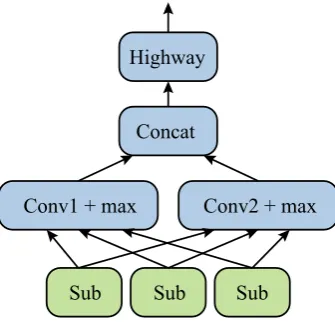
Figure 2: Subword encoder.
For each word, the subword-level embedding is encoded by a subword encoder as in Figure 2. Firstly, the subword sequence (of length n) of the word is mapped to subword embedding sequence
(se1,se2,se3,· · ·,sen) (after padding), which is randomly initialized. Then K (we empirically set
K=2) convolutional operationsConv1, Conv2,· · · , ConvKfollowed by max pooling operation are ap-plied to the embedding sequence, and the sequence is padded before the convolutional operation. For the
i-th convolution kernelConvi, suppose the kernel size is ki, then the output ofConvi on embeddings
sej tosej+ki−1is
Cj = tanh
Convi[sej :sej+ki−1]
The final output ofConviafter max pooling is
ui =maxpool(C1, · · · , Cj, · · ·, Cn)
Finally, theKoutputs are concatenated,
u= [u1; u2; · · ·; uK]∈Rds
to feed a highway network (Srivastava et al., 2015),
g = σ(WguT +bg)∈Rds
esi = gReLU(WhuT +bh) + (1−g)u
∈ Rds (2)
wheregdenotes the gate, andWg ∈Rds×ds,bg ∈Rds,Wh ∈Rds×ds,bh ∈Rds are parameters. is
element-wise multiplication. The above Eq. 2 gives the subword-level embedding for thei-th word.
ELMo
For the pre-trained ELMo encoder, the output is the result of the last two biLSTM layers. Supposeci is the character sequence ofi-th word in a sentence, then the encoder output is
[· · · ,h0i,· · ·; · · · ,hi1,· · ·] =ELM o(· · · ,ci,· · ·)
whereh0i andh1i denote the outputs of first and second layers of ELMo encoder fori-th word. Following Peters et al. (2018), we use a self-adjusted weighted average ofh0i,h1i,
s=sof tmax(w)∈R2
h=γ 1 X
j=0
sjhji ∈Rd 0 c
whereγ ∈ Randw ∈ R2 are parameters tuned during training andd0cis the dimension of the ELMo encoder’s outputs. Then the result is fed to a feed forward network to reduce its dimension,
eci =WchT +bc∈Rdc (3)
Wc∈Rd 0
c×dc andb
c∈Rdcare parameters. The above Eq. 3 gives ELMo embedding for thei-th word.
3.3 Sentence-Level Module
The resulting word embeddingsei(Eq. 1) are sent to sentence-level module. The sentence-level module is composed of stacked encoder blocks. The block in each layer receives output of the previous layer as input and sends output to next layer. It also sends its output to the pair-level module. Parameters in different layers are not the same.
We consider two encoder types, convolutional type and recurrent type. We only use one encoder type in one experiment.
For the sentence-level module for different arguments (Arg1andArg2), many previous works used same parameters to encode different arguments, that is, one encoder for two type arguments. But as indi-cated by Prasad et al. (2008),Arg1andArg2may have different semantic perspective, we thus introduce argument-aware parameter settings for different arguments.
Conv Conv Conv Conv
GLU GLU GLU GLU
[image:5.595.314.516.497.584.2]Res 1
Figure 3: Convolutional encoder block.
FFN
biGRU
FFN FFN FFN
Res 1
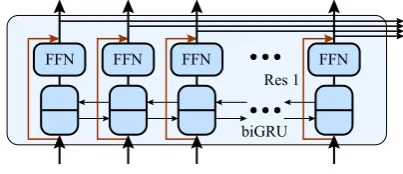
Figure 4: Recurrent encoder block.
Convolutional Encoder Block
Figure 3 is the convolutional encoder block. Suppose the input for the encoder block is xi (i =
1,· · · , N), then xi ∈ Rde. The input is sent to a convolutional layer and mapped to output yi =
[Ai Bi] ∈ R2de. After the convolutional operation, gated linear units (GLU) (Dauphin et al., 2016) is
applied, i.e.,
zi =Aiσ(Bi)∈Rde
[image:5.595.80.283.497.583.2]Recurrent Encoder Block
Similar to the convolutional one, recurrent encoder block is shown in Figure 4. The inputxi is encoded by a biGRU (Cho et al., 2014) layer first,
yi=biGRU(xi)∈R2de
then this is sent to a feed forword network,
zi =WryTi +br ∈Rde (4)
Wr ∈R2de×de andbr ∈Rde are parameters. There is also a similar residual connection (Res 1) in the
block, sozi+xifor alli= 1,· · · , N is the final output of the recurrent encoder block.
3.4 Pair-Level Module
Through the sentence-level module, the word representations are contextualized, and these contextual-ized representations of each layer are sent to pair-level module.
Suppose the encoder block layer number is l, and the outputs ofj-th block layer forArg1 andArg2
arevj1,vj2 ∈RN×de, each row of which is the embedding for the corresponding word. N is the length
of word sequence (sentence). Each sentence is padded or truncated to let all sentences have the same length. They are sent to a bi-attention module, the attention matrix is
Mj = (F F N(vj1))vj2 T
∈RN×N
F F N is a feed froward network (similar to Eq. 4) applied to the last dimension corresponding to the word. Then the projected representations are
wj2=sof tmax(Mj)v2j ∈RN ×de
wj1=sof tmax(MTj)vj1∈RN×de
where thesof tmaxis applied to each row of the matrix. We apply 2-max pooling on each projected representation and concatenate them as output of thej-th bi-attention module
oj = [top2(wj1); top2(w
j
2)]∈R4de
The number of max pooling operation (top-2) is selected from experiments and it is a balance of more salient features and less noise. The final pair representation is
o= [o1,o2,· · ·,ol]∈R4lde (5)
Since the output is concatenated from different layers and the outputs of lower layers are sent directly to the final representation, this also can be seen as residual connections (Res 2). Then the output as Eq. 5 is fed to an MLP classifier with softmax. The parameters for bi-attention modules in different levels are shared.
3.5 Classifier
4 Experiments1
Our model is evaluated on the benchmark PDTB 2.0 for two types of classification tasks.
PDTB 2.0 has three levels of senses: Level-1 Class, Level-2Type, and Level-3 Subtypes. The first level consists of four major relation Classes: COMPARISON, CONTINGENCY, EXPANSION, and TEMPORAL. The second level contains 16 Types.
All our experiments are implemented by PyTorch2. The pre-trained ELMo encoder is from AllenNLP toolkit (Gardner et al., 2017)3.
4.1 11-way Classification
Dataset Setup
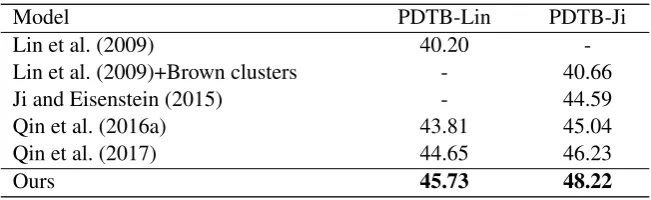
Following the settings of Qin et al. (2017), we use two splitting methods of PDTB dataset for comprehen-sive comparison. The first is PDTB-Lin (Lin et al., 2009), which uses section 2-21, 22 and 23 as training, dev and test sets respectively. The second is PDTB-Ji (Ji and Eisenstein, 2015), which uses section 2-20, 0-1, and 21-22 as training, dev and test sets respectively. According to Ji and Eisenstein (2015), five relation types have few training instances and no dev and test instance. Removing the five types, there remain 11 second level types. During training, instances with more than one annotated relation types are considered as multiple instances, each of which has one of the annotations. At test time, a prediction that matches one of the gold types is considered as correct. All sentences in the dataset are padded or truncated to keep the same 100-word length.
Model Details
For the results of both splitting methods, we share some hyperparameters. Table 1 is some of the shared hyperparameter settings. The pre-trained word embeddings are 300-dimword2vec(Mikolov et al., 2013) pre-trained from Google News4. Sodw = 300, ds = 100, dc = 300, then for the final embedding (ei),
de = 700. For the encoder block in sentence-level module, kernel size is same for every layer. We use AdaGrad optimization (Duchi et al., 2011).
The encoder block layer number is different for the two splitting methods. The layer number for PDTB-Ji splitting method is 4, and the layer number for PDTB-Lin splitting method is 5.
Hyperparameter Value Hyperparameter Value
BPE merge operation num. 1k classifier layer num. 1 subword embedding dim. (ds) 50 embedding dropout 0.4
subword CNN kernel num. 2 encoder block dropout 0.4
subword CNN kernel size [2, 3] classifier dropout 0.3
reduced ELMo embedding dim. 300 learning rate 0.001
encoder block type Conv. batch size 64
encoder block kernel size 5
Table 1: Shared hyperparameter settings. Before dimension reducing, the dimension of pre-trained ELMo embedding is 1024.
Results
Compared to other recent state-of-the-art systems in Table 2, our model achieves new state-of-the-art performance in two splitting methods with great improvements. As to our best knowledge, our model is the first one that exceeds the 48% accuracy in 11-way classification.
1The code for this paper is available athttps://github.com/diccooo/Deep_Enhanced_Repr_for_IDRR 2http://pytorch.org/
3
http://allennlp.org/
Model PDTB-Lin PDTB-Ji
Lin et al. (2009) 40.20
-Lin et al. (2009)+Brown clusters - 40.66
Ji and Eisenstein (2015) - 44.59
Qin et al. (2016a) 43.81 45.04
Qin et al. (2017) 44.65 46.23
[image:8.595.136.462.61.161.2]Ours 45.73 48.22
Table 2: Accuracy (%) comparison with others’ results on PDTB 2.0 test set for 11-way classification.
Analysis Ablation Study
To illustrate the effectiveness of our model and the contribution of each module, we use the PTDB-Ji splitting method to do a group of experiments. For the baseline model, we use 4 layer stacked convo-lutional encoder blocks without the residual connection in the block with only pre-trained word embed-dings. We only use the output of the last layer and the output is processed by 2-max pooling without attention and sent to the relation classifier and connective classifier. Without the two residual connec-tions, using 4 layers may be not the best for baseline model but is more convenient to comparison.
Firstly, we add modules from high level to low level accumulatively to observe the performance im-provement. Table 3 is the results, which demonstrate that every module has considerable effect on the performance.
Then we test the effects of the two residual connections on the performance. The results are in Table 4. The baseline+means baseline + bi-attention, i.e., the second row of Table 3. We find that Res 1 (residual connection in the block) is much more useful than Res 2 (residual connection for pair representation), and they work together can bring even better performance.
Level Model Performance
- baseline 41.48
pair + bi-attention 42.25
sentence + Res 46.29
word + subword 47.03
word + ELMo 48.22
Table 3: Accumulatively performance test result.
Model Performance
baseline+ 42.25
baseline++ Res 1 45.33
baseline++ Res 2 43.57
[image:8.595.321.512.426.494.2]baseline++ Res 1 + Res 2 46.29
Table 4: The effects of residual connections.
Without ELMo (the same setting as 4-th row in Table 3), our data settings is the same as Qin et al. (2017) whose performance was state-of-the-art and will be compared directly. We see that even without the pre-trained ELMo encoder, our performance is better, which is mostly attributed to our better sentence pair representations.
Subword-Level EmbeddingFor the usefulness of subword-level embedding, we compare its perfor-mance to a model with character-level embedding, which was ever used in Qin et al. (2016a). We use the same model setting as the4-th row of Table 3, and then replace subword with character sequence. The subword embedding augmented result is47.03%, while the character embedding result is46.37%, which verifies that the former is a better input representation for the task.
Parameters for Sentence-Level ModuleAs previously discussed, argument specific parameter set-tings may result in better sentence-level encoders. We use the model which is the same as the third row in Table 3. If shared parameters are used, the result is45.97%, which is lower than argument specific pa-rameter settings (46.29%). The comparison shows argument specific parameter settings indeed capture the difference of argument representations and facilitate the sentence pair representation.
Figure 5.
43.50 43.00 42.50 44.00 44.50 45.00
Acc (%) 45.5046.00
46.50
recurrent type convolutional type 1
layer number
2 3 4 5 6
Figure 5: Effects of block type and layer number.
The results in the figure show that both types may reach similar level of top accuracies, as the order of word is not important to the task. We also try to add position information to the convolutional type encoder, and receive a dropped accuracy. This further verifies the order information does not matter too much for the task. For most of the other numbers of layers, the recurrent type shows better, as the number of layers has an impact on the window size of convolutional encoders. When convolutional type is used, the training procedure is much faster, but choosing the suitable kernel size needs extra efforts.
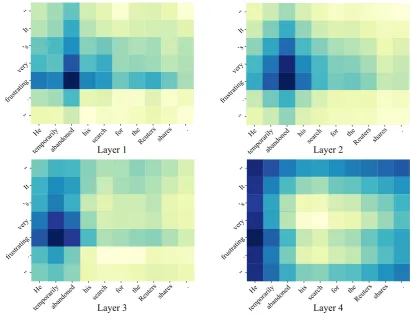
Bi-Attention
“
It
’s
very
frustrating.
”
He
temporarilyabandoned his
search for theReuters shares .
“
It
’s
very
frustrating.
”
He
temporarilyabandoned his
search for theReuters shares .
“
It
’s
very
frustrating.
”
He
temporarilyabandoned his
search for theReuters shares .
“
It
’s
very
frustrating.
”
He
temporarilyabandoned his
search for theReuters shares .
Layer 1 Layer 2
[image:9.595.91.503.386.704.2]Layer 3 Layer 4
Figure 6: Attention visualization.
sentence border. This is because the window size is bigger for higher layers, and the convolutional kernel may have higher weights on words at the window edge.
4.2 Binary and 4-way Classification
SettingsFor the first level classification, we perform both 4-way classification and one-vs-others binary classification. Following the settings of previous works, the dataset splitting method is the same as PDTB-Ji without removing instances. The model uses 5 block layers with kernel size 3, other details are the same as that for 11-way classification on PDTB-Ji.
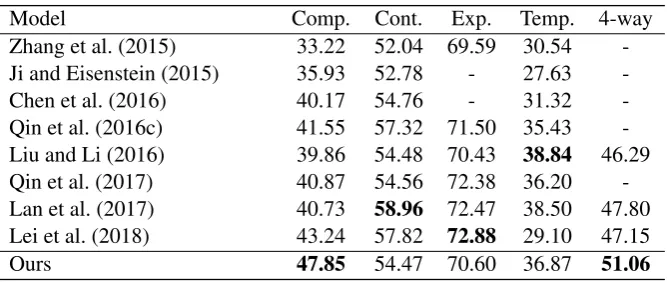
ResultsTable 5 is the result comparison on first level classification. For binary classification, the result is computed byF1 score (%), and for 4-way classification, the result is computed by macro averageF1
score (%). Our model gives the state-of-the-art performance for 4-way classification by providing anF1
score greater than 50% for the first time according to our best knowledge.
Model Comp. Cont. Exp. Temp. 4-way
Zhang et al. (2015) 33.22 52.04 69.59 30.54
-Ji and Eisenstein (2015) 35.93 52.78 - 27.63
-Chen et al. (2016) 40.17 54.76 - 31.32
-Qin et al. (2016c) 41.55 57.32 71.50 35.43
-Liu and Li (2016) 39.86 54.48 70.43 38.84 46.29
Qin et al. (2017) 40.87 54.56 72.38 36.20
-Lan et al. (2017) 40.73 58.96 72.47 38.50 47.80
Lei et al. (2018) 43.24 57.82 72.88 29.10 47.15
[image:10.595.133.467.237.378.2]Ours 47.85 54.47 70.60 36.87 51.06
Table 5:F1score (%) comparison on binary and 4-way classification.
5 Conclusion
In this paper, we propose a deeper neural model augmented by different grained text representations for implicit discourse relation recognition. These different module levels work together and produce task-related representations of the sentence pair. Our experiments show that the model is effective and achieve the state-of-the-art performance. As to our best knowledge, this is the first time that an implicit discourse relation classifier gives an accuracy higher than 48% for 11-way and anF1 score higher than 50% for
4-way classification tasks.
References
Yoshua Bengio, Holger Schwenk, Jean-S´ebastien Sen´ecal, Fr´ederic Morin, and Jean-Luc Gauvain. 2006. Neural
probabilistic language models. InInnovations in Machine Learning: Theory and Applications, pages 137–186.
Berlin, Heidelberg.
Samuel R. Bowman, Gabor Angeli, Christopher Potts, and Christopher D. Manning. 2015. A large annotated
corpus for learning natural language inference. InProceedings of the 2015 Conference on Empirical Methods
in Natural Language Processing (EMNLP), pages 632–642, Lisbon, Portugal, September.
Chlo´e Braud and Pascal Denis. 2015. Comparing word representations for implicit discourse relation
classifica-tion. InProceedings of the 2015 Conference on Empirical Methods in Natural Language Processing (EMNLP),
pages 2201–2211, Lisbon, Portugal, September.
Deng Cai and Hai Zhao. 2016. Neural Word Segmentation Learning for Chinese. InProceedings of the 54th
Annual Meeting of the Association for Computational Linguistics (ACL), pages 409–420, Berlin, Germany, August.
Changge Chen, Peilu Wang, and Hai Zhao. 2015. Shallow discourse parsing using constituent parsing tree. In
Proceedings of the Nineteenth Conference on Computational Natural Language Learning (CoNLL) - Shared Task, pages 37–41, Beijing, China, July.
Jifan Chen, Qi Zhang, Pengfei Liu, Xipeng Qiu, and Xuanjing Huang. 2016. Implicit discourse relation detection
via a deep architecture with gated relevance network. In Proceedings of the 54th Annual Meeting of the
As-sociation for Computational Linguistics (ACL) (Volume 1: Long Papers), pages 1726–1735, Berlin, Germany, August.
Kyunghyun Cho, Bart van Merrienboer, Caglar Gulcehre, Dzmitry Bahdanau, Fethi Bougares, Holger Schwenk, and Yoshua Bengio. 2014. Learning phrase representations using RNN encoder–decoder for statistical machine
translation. In Proceedings of the 2014 Conference on Empirical Methods in Natural Language Processing
(EMNLP), pages 1724–1734, Doha, Qatar, October.
Alexis Conneau, Douwe Kiela, Holger Schwenk, Lo¨ıc Barrault, and Antoine Bordes. 2017. Supervised learning of universal sentence representations from natural language inference data. InProceedings of the 2017 Conference on Empirical Methods in Natural Language Processing (EMNLP), pages 670–680, Copenhagen, Denmark, September.
Yann N. Dauphin, Angela Fan, Michael Auli, and David Grangier. 2016. Language modeling with gated convolu-tional networks. arXiv preprint arXiv:1612.08083.
John Duchi, Elad Hazan, and Yoram Singer. 2011. Adaptive subgradient methods for online learning and
stochas-tic optimization. The Journal of Machine Learning Research, 12:2121–2159.
Matt Gardner, Joel Grus, Mark Neumann, Oyvind Tafjord, Pradeep Dasigi, Nelson Liu, Matthew Peters, Michael Schmitz, and Luke Zettlemoyer. 2017. AllenNLP: A deep semantic natural language processing platform.
Kaiming He, Xiangyu Zhang, Shaoqing Ren, and Jian Sun. 2016. Deep residual learning for image recognition. InIEEE Conference on Computer Vision and Pattern Recognition (CVPR), pages 770–778, Las Vegas, USA.
Shexia He, Zuchao Li, Hai Zhao, Hongxiao Bai, and Gongshen Liu. 2018. Syntax for semantic role labeling, to be, or not to be. InProceedings of the 56th Annual Meeting of the Association for Computational Linguistics (ACL) (Volume 1: Long Papers), Melbourne, Australia, July.
Peter Jansen, Mihai Surdeanu, and Peter Clark. 2014. Discourse complements lexical semantics for non-factoid answer reranking. InProceedings of the 52nd Annual Meeting of the Association for Computational Linguistics (ACL), pages 977–986, Baltimore, Maryland, June.
Yangfeng Ji and Jacob Eisenstein. 2015. One vector is not enough: Entity-augmented distributed semantics for discourse relations. Transactions of the Association for Computational Linguistics (TACL), 3:329–344.
Yangfeng Ji, Gholamreza Haffari, and Jacob Eisenstein. 2016. A latent variable recurrent neural network for
discourse-driven language models. InProceedings of the 2016 Conference of the North American Chapter of
the Association for Computational Linguistics: Human Language Technologies (NAACL:HLT), pages 332–342, San Diego, California, June.
Yoon Kim, Yacine Jernite, David Sontag, and Alexander Rush. 2016. Character-aware neural language models. InThirtieth AAAI Conference on Artificial Intelligence (AAAI), pages 2741–2749, Phoenix, USA.
Man Lan, Jianxiang Wang, Yuanbin Wu, Zheng-Yu Niu, and Haifeng Wang. 2017. Multi-task attention-based neural networks for implicit discourse relationship representation and identification. InProceedings of the 2017 Conference on Empirical Methods in Natural Language Processing (EMNLP), pages 1299–1308, Copenhagen, Denmark, September.
Kenton Lee, Luheng He, and Luke Zettlemoyer. 2018. Higher-order coreference resolution with coarse-to-fine
inference. InProceedings of the 2018 Conference of the North American Chapter of the Association for
Com-putational Linguistics: Human Language Technologies (NAACL:HLT), New Orleans, Louisiana.
Wenqiang Lei, Yuanxin Xiang, Yuwei Wang, Qian Zhong, Meichun Liu, and Min-Yen Kan. 2018. Linguistic properties matter for implicit discourse relation recognition: Combining semantic interaction, topic continuity and attribution. InThirty-Second AAAI Conference on Artificial Intelligence (AAAI), New Orleans, USA.
Junyi Jessy Li, Marine Carpuat, and Ani Nenkova. 2014. Assessing the discourse factors that influence the quality
of machine translation. In Proceedings of the 52nd Annual Meeting of the Association for Computational
Zhongyi Li, Hai Zhao, Chenxi Pang, Lili Wang, and Huan Wang. 2016. A constituent syntactic parse tree based
discourse parser. InProceedings of the Twentieth Conference on Computational Natural Language Learning
(CoNLL) - Shared Task, pages 60–64, Berlin, Germany, August.
Ziheng Lin, Min-Yen Kan, and Hwee Tou Ng. 2009. Recognizing implicit discourse relations in the Penn
Dis-course Treebank. InProceedings of the 2009 Conference on Empirical Methods in Natural Language
Process-ing (EMNLP), pages 343–351, Singapore, August.
Zhouhan Lin, Minwei Feng, Cicero Nogueira dos Santos, Mo Yu, Bing Xiang, Bowen Zhou, and Yoshua Bengio.
2017. A structured self-attentive sentence embedding. InInternational Conference on Learning
Representa-tions (ICLR).
Yang Liu and Sujian Li. 2016. Recognizing implicit discourse relations via repeated reading: Neural networks
with multi-level attention. InProceedings of the 2016 Conference on Empirical Methods in Natural Language
Processing (EMNLP), pages 1224–1233, Austin, Texas, November.
Tomas Mikolov and Geoffrey Zweig. 2012. Context dependent recurrent neural network language model. In
Spoken Language Technology (SLT) Workshop, pages 234–239.
Tomas Mikolov, Ilya Sutskever, Kai Chen, Greg S Corrado, and Jeff Dean. 2013. Distributed representations of words and phrases and their compositionality. InAdvances in Neural Information Processing Systems 26, pages 3111–3119.
Matthew E. Peters, Mark Neumann, Mohit Iyyer, Matt Gardner, Christopher Clark, Kenton Lee, and Luke
Zettle-moyer. 2018. Deep contextualized word representations. In Proceedings of the 2018 Conference of the
North American Chapter of the Association for Computational Linguistics: Human Language Technologies (NAACL:HLT), New Orleans, Louisiana.
Emily Pitler, Annie Louis, and Ani Nenkova. 2009. Automatic sense prediction for implicit discourse relations in
text. InProceedings of the Joint Conference of the 47th Annual Meeting of he Association for Computational
Linguistics and the 4th International Joint Conference on Natural Language Processing (ACL-IJCNLP), pages 683–691, Suntec, Singapore, August.
Rashmi Prasad, Nikhil Dinesh, Alan Lee, Eleni Miltsakaki, Livio Robaldo, Aravind K Joshi, and Bonnie L Webber.
2008. The Penn Discourse TreeBank 2.0. InProceedings of the Sixth conference on International Language
Resources and Evaluation (LREC-2008), pages 2961–2968, Marrakech, Morocco, May.
Lianhui Qin, Zhisong Zhang, and Hai Zhao. 2016a. Implicit discourse relation recognition with context-aware
character-enhanced embeddings. InProceedings of the 26th International Conference on Computational
Lin-guistics (COLING): Technical Papers, pages 1914–1924.
Lianhui Qin, Zhisong Zhang, and Hai Zhao. 2016b. Shallow discourse parsing using convolutional neural network. InProceedings of the Twentieth Conference on Computational Natural Language Learning (CoNLL) - Shared Task, pages 70–77, Berlin, Germany, August.
Lianhui Qin, Zhisong Zhang, and Hai Zhao. 2016c. A stacking gated neural architecture for implicit discourse
relation classification. In Proceedings of the 2016 Conference on Empirical Methods in Natural Language
Processing (EMNLP), pages 2263–2270, Austin, Texas, November.
Lianhui Qin, Zhisong Zhang, Hai Zhao, Zhiting Hu, and Eric Xing. 2017. Adversarial connective-exploiting networks for implicit discourse relation classification. InProceedings of the 55th Annual Meeting of the Asso-ciation for Computational Linguistics (ACL) (Volume 1: Long Papers), pages 1006–1017, Vancouver, Canada, July.
Samuel R¨onnqvist, Niko Schenk, and Christian Chiarcos. 2017. A recurrent neural model with attention for the
recognition of Chinese implicit discourse relations. In Proceedings of the 55th Annual Meeting of the
Asso-ciation for Computational Linguistics (ACL) (Volume 2: Short Papers), pages 256–262, Vancouver, Canada, July.
Rico Sennrich, Barry Haddow, and Alexandra Birch. 2016. Neural machine translation of rare words with subword
units. In Proceedings of the 54th Annual Meeting of the Association for Computational Linguistics (ACL)
(Volume 1: Long Papers), pages 1715–1725, Berlin, Germany, August.
Rupesh Kumar Srivastava, Klaus Greff, and J¨urgen Schmidhuber. 2015. Training very deep networks. arXiv
Will Williams, Niranjani Prasad, David Mrva, Tom Ash, and Tony Robinson. 2015. Scaling recurrent neural
network language models. In IEEE International Conference on Acoustics, Speech and Signal Processing
(ICASSP), pages 5391–5395, South Brisbane, Queensland, Australia.
Adina Williams, Nikita Nangia, and Samuel R. Bowman. 2017. A broad-coverage challenge corpus for sentence understanding through inference. arXiv preprint arXiv:1704.05426.
Changxing Wu, Xiaodong Shi, Yidong Chen, Yanzhou Huang, and Jinsong Su. 2016. Bilingually-constrained synthetic data for implicit discourse relation recognition. InProceedings of the 2016 Conference on Empirical Methods in Natural Language Processing (EMNLP), pages 2306–2312, Austin, Texas, November.
Changxing Wu, Xiaodong Shi, Yidong Chen, Jinsong Su, and Boli Wang. 2017. Improving implicit discourse
relation recognition with discourse-specific word embeddings. InProceedings of the 55th Annual Meeting of
the Association for Computational Linguistics (ACL) (Volume 2: Short Papers), pages 269–274, Vancouver, Canada, July.
Biao Zhang, Jinsong Su, Deyi Xiong, Yaojie Lu, Hong Duan, and Junfeng Yao. 2015. Shallow convolutional neural network for implicit discourse relation recognition. InProceedings of the 2015 Conference on Empirical Methods in Natural Language Processing (EMNLP), pages 2230–2235, Lisbon, Portugal, September.
Zhisong Zhang, Hai Zhao, and Lianhui Qin. 2016. Probabilistic graph-based dependency parsing with
convo-lutional neural network. In Proceedings of the 54th Annual Meeting of the Association for Computational
Linguistics (ACL), pages 1382–1392, Berlin, Germany, August.