R. Dale et al. (Eds.): IJCNLP 2005, LNAI 3651, pp. 245–256, 2005. © Springer-Verlag Berlin Heidelberg 2005
Xinghua Fan1, 2 and Maosong Sun1
1 State Key Laboratory of Intelligent Technology and Systems,
Tsinghua University, Beijing 100084, China
[email protected], [email protected] 2 State Intellectual Property Office of P.R. China, Beijing, 100088, China
Abstract. The entity and relation recognition, i.e. (1) assigning semantic classes to entities in a sentence, and (2) determining the relations held between entities, is an important task in areas such as information extraction. Subtasks (1) and (2) are typically carried out sequentially, but this approach is problematic: the errors made in subtask (1) are propagated to subtask (2) with an accumulative effect; and, the information available only in subtask (2) cannot be used in sub-task (1). To address this problem, we propose a method that allows subsub-tasks (1) and (2) to be associated more closely with each other. The process is performed in three stages: firstly, employing two classifiers to do subtasks (1) and (2) in-dependently; secondly, recognizing an entity by taking all the entities and rela-tions into account, using a model called the Entity Relation Propagation Dia-gram; thirdly, recognizing a relation based on the results of the preceding stage. The experiments show that the proposed method can improve the entity and re-lation recognition in some degree.
1 Introduction
The entity and relation recognition, i.e. assigning semantic classes (e.g., person, or-ganization and location) to entities in a sentence and determining the relations (e.g., born-in and employee-of) that hold between entities, is an important task in areas such as information extraction (IE) [1] [2] [3] [4], question answering (QA) [5] and story comprehension [6]. In a QA system, many questions concern the specific entities in some relations. For example, the question that “Where was Poe born?” in TREC-9 asks for the location entity in which Poe was born. In a typical IE task in constructing a job database from unstructured texts, the system are required to extract many mean-ingful entities like titles and salary from the texts and to determine how these entities are associated with job positions.
subtask (2) cannot be used for subtask (1). For example, if we feel difficult to determine whether the entity X is a person or not, but we can determine that there exists a relation born-in between X and China easily, it is obvious that we can claim that X must be a person.
To address the problems described above, this paper presents a novel approach which allows subtasks (1) and (2) to be linked more closely together. The process is separated into three stages. Firstly, employing two classifiers to perform subtasks (1) and (2) independently. Secondly, recognizing an entity by taking all the entities and relations into account using a particularly designed model called the Entity Relation Propagation Diagram. And, thirdly, recognizing a relation based on the results of the preceding step.
The rest of the paper is organized as follows. Section 2 defines the problem of en-tity and relation recognition in a formal way. Section 3 describes the proposed method of recognizing entity and relation. Section 4 gives the experimental results. Section 5 is the related work and comparison. Section 6 is conclusions.
2 The Problem of Entity and Relation Recognition
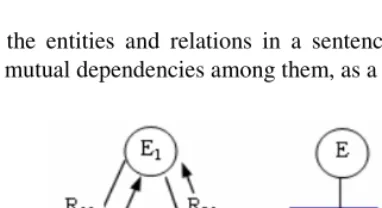
[image:2.512.119.310.321.425.2]Conceptually, the entities and relations in a sentence can be viewed, while taking account of the mutual dependencies among them, as a labeled graph in Fig. 1.
Fig. 1. Concept view of the entities and relations among them
Definition 1 (Entity). An entity can be a single word or a set of consecutive words with a predefined boundary. A sentence is a linked list, which consists of words and entities. Entities in a sentence are denoted as E1, E2 … according to their order, with
values ranging over a set of entity class CE. For example, the sentence in Fig. 2 has three entities: E1= “Dole”, E2= “Elizabeth” and E3= “Salisbury, N.C.”. Note that it is
[image:3.512.98.333.150.185.2]not easy to determine the entity boundaries [7]. Here we assume that it has been solved and its output serves as the input to our model.
Fig. 2. A sentence that have three entities
Definition 2 (Relation). In this paper, we only consider the relation between two entities. An entity pair (Ei, Ej) represents a relation Rij from entity Ei and Ej, where Ei
is the first argument and Ej is the second argument. Relation Rij takes its value that
ranges over a set of relation class CR. Note that (Ei, Ej) is an ordered pair, and there
exist two relations Rij =(Ei, Ej) and Rji =(Ej, Ei) between entities Ei and Ej.
Definition 3 (Class). The class of an entity or relation is its decision attribute, which is one of the predefined class set and is unknown before being recognized. We denote the sets of predefined entity class and relation class as CE and CR respectively. CE has one special element other-ent, which represents any unlisted entity class. For algo-rithmic reasons, we suppose all elements in CE are mutually exclusive. Similarly, CR also has one special element other-rel, which represents that the two involved entities are irrelevant or their relation class is undefined. For algorithmic reasons, we suppose all elements in CR are mutually exclusive. In fact, because the class of an entity or a relation is only a label that we want to predict, if an entity or a relation have more than one labels simultaneously, to satisfy the constraint that all elements in CE or CR are mutually exclusive, we can separate it into several cases and construct several predefined entity class sets and relation class sets.
The classes of entities and relations in a sentence must satisfy some constraints. For example, if the class of entity E1, which is the first argument of relation R12, is a
loca-tion, then the class of relation R12 cannot be born-in because the class of the first
ar-gument in relation R12 has to be a person.
Definition 4 (Constraint). A constraint is a 5-tuple (R, , , R, )
2 1
ε
α α ε
ε . The symbols are defined as follows. R∈CR represents the class of relation R.
ε
1,ε
2∈CE repre-sents the classes of the first argument Ei and the second argument Ej in the relation Rrespectively. αR∈[0,1] is a real number that represents a joint conditional probability distribution }Pr{ 1, 2|R
R ε ε
Definition 5 (Observation). We denote the observations of an entity and a relation in a sentence as OE and OR respectively. OE or OR represent all the “known” local attrib-utes of an entity or a relation, e.g., the spelling of a word, parts of speech, and semantic related attributes acquired from external resources such as WordNet. The observations OE and OR can be viewed as a random event, and Pr{OE}=Pr{OR}≡1 because OE and OR in a sentence are known.
Based on the above definitions, the issue of entity and relation recognition can be described in a formal way as follows. Suppose in a sentence, the set of entity is {E1,
E2 … En}, the set of relation is {R12, R21, R13, R31, …, R1n, Rn1, …, Rn-1,n, Rn,n-1}, the
predefined sets of entity class and relation class are CE ={e1, e2, … em} and C R
={ r1,
r2, … rk} respectively, the observation of entity Ei is OiE, and the observation of
rela-tion Rij is R ij
O . n, m and k represent the number of entity, the number of the prede-fined entity class and the number of the predeprede-fined relation class respectively. The problem is to search the most probable class assignment for each entity and each relation of interest, given the observations of all entities and relations. In other words, the problem is to solve the following two equations, using two kinds of constraint knowledge αR ,αε and the interaction among entities and relations.
} O , O , , O , O , , O , O , O , , O , O | e Pr{E max arg
e= d i = d 1E 2E L nE 12R R21L 1nR n1R L Rn-1,n n,Rn-1 (1)
} O , O , , O , O , , O , O , O , , O , O | r Pr{R max arg
r= d ij = d 1E 2E L nE 12R R21 L 1nR n1R L Rn-1,n n,Rn-1 (2)
In (1), d =1, 2, …, m, and in (2), d=1, 2, …, k.
3 The Proposed Method
Because the class assignment of a single entity or relation depends not only on local attributes itself, but also on those of all other entities and relations, the equations (1) and equation (2) cannot be solved directly. To simplify the problem, we present the following method consisting of three stages. Firstly, employ two classifiers to perform entity recognition and relation recognition independently. Their outputs are the condi-tional probability distributions Pr{E| OE} and Pr{R|OR}, given the corresponding observations. Secondly, recognize an entity by taking account of all entities and rela-tions, as computed in the previous step. This is achieved by using the model Entity Relation Propagation Diagram (ERPD). And, recognize a relation based on the results of the second step at last.
In this paper, we concentrate on the processes at the second and the third stages, as-suming that the process at the first stage is solved and its output are given to us as input. At the second stage, the aim of introducing ERPD is to estimate the conditional probability distribution Pr{E|ERPD} given the constraint αR in Definition 5 and
the sets {Pr{E |OEi}
i } and {Pr{R |O } Rij
ij } (i, j=1,…,n), as computed at the first
⎪⎩ ⎪ ⎨ ⎧ ≤ = > = = θ θ RV ERPD} | e Pr{E max arg RV } O | e Pr{E max arg e d d E d d i i i (3)
where θ is a threshold determined by the experiment. RV∈ [0, 1] is a real number, called the reliable value, representing the belief degree of the output of the entity recognizer at the first stage. Suppose the maximum value of the conditional probabil-ity distribution Pr{E|OE} is Vm and the second value is Vs, RV is defined as:
s m s m V V V V RV + − = (4)
The reason of introducing RV is due to a fact that only for ambiguous entities, it is effective by taking the classes of all entities in a sentence into account. “Reliable Value” measures whether an entity is ambiguous.
At the third stage, the basic idea of recognizing a relation is to search the probable relation given its observation, under a condition of satisfying the constraints imposed by the results of entity recognition at the second stage. The relation recognition equa-tion (2) becomes the equaequa-tion (5).
R R k
k Pr{R r |O } W max
arg
r= = ×
⎪⎩ ⎪ ⎨ ⎧ = > = 0 } ε , ε | Pr{r if 0 0 } ε , ε | Pr{r if 1 W 2 1 2 1 R (5)
where ε1,ε2 is the results of entity recognition at the second stage, Pr{r|ε1,ε2} is constraint knowledge αε in Definition 4, and WR is the weight of the constraint
knowledge.
In the following sections, we present ERPD and two algorithms to estimate the conditional probability distributionPr{E|ERPD} .
3.1 The Entity Relation Propagation Diagram
To represent the mutual dependencies among entities and relations, a model named the Entity Relation Propagation Diagram that can deal with cycles, similar to the Causality Diagram [8][9] for the complex system fault diagnosis, is developed for entity and relation recognition.
The classes of any two entities are dependent on each other through the relations between them, while taking account of the relations in between. For example, the class of entity Ei in Fig. 3 (a) depends on the classes of relations Rji between entities
Ei and Ej, and the classes of relations Rij and Rji depend on the classes of entities
Ei and Ej. This means that we can predict the class of a target entity according to the
Fig. 3. Illustration of relation reaction
Definition 6 (Relation Reaction Intensity). We denote the relation reaction intensity from entity Ei to entity Ej as Pij, which represents the ability that we guess the class of
Ej if we know the class of its neighboring entity Ei and the relation Rij between them.
The relation reaction intensity could be modeled using a condition probability distri-bution Pij=Pr {Ej |Ei}.
The element pijklof Pij represents the conditional probability Pr {Ej=el |Ei=ek}:
∑
= = = = = = = = = = N 1t i k
t ij l j k i t ij k i l j kl ij } e Pr{E } r R | e E , e }Pr{E r Pr{R } e E | e E Pr{ p
according to Definition 5: } O | r Pr{R } r Pr{R R ij t ij t
ij= = = ,Pr{E e } Pr{E e |O }
E i k i k
i= = =
Then, we have:
} O | e Pr{E } r R | e E , e }Pr{E O | r Pr{R N 1
t i k Ei
t ij l j k i R ij t ij kl ij
∑
= = = = = = = p (6)where rt∈CR, N is the number of relations in relation class set. In equation (6),
} r R | e E , e
Pr{Ei = k j = l ij= t represents the constraint knowledge
α
R among entitiesand relations. Pr{R r |OR}
ij t
ij= and Pr{E e |O } E i k
i= represent the outputs at the
first stage.
Definition 7 (Observation Reaction Intensity). We denote the observation reaction intensity as the conditional probability distribution Pr{E|OE}
of an entity class, given the observation, which is the output at the first stage.
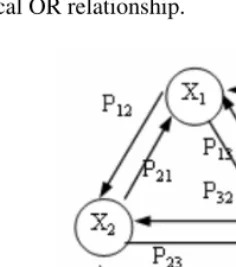
variable to another event variable represents the relation reaction intensity in Defini-tion 6. And, the linkage event variable from a basic event to the corresponding event variable represents the observation reaction intensity in Definition 7. All arcs pointing to a node are in a logical OR relationship.
Fig. 4. Illustration of the Entity Relation Propagation Diagram
Now, we present two algorithms to compute the conditional probability distribu-tionPr{E|ERPD}, one is based on the entity relation propagation tree, and the other is the directed iteration algorithm on ERPD.
3.2 The Entity Relation Propagation Tree
The Entity Relation Propagation Tree (ERPT). is a tree decomposed from an ERPD, which represents the relation reaction propagation from all basic events to each event variable logically. Each event variable in the ERPD corresponds to an ERPT. For example, the ERPT of X1 in Fig. 4 is illustrated in Fig. 5. The symbols
used in the ERPT are defined as follows. The root of the tree, denoted as Circle, is an event variable corresponding to the event variable in the ERPD. A leaf of the tree, denoted as Box, is a basic event corresponding to the basic event in the ERPD. The middle node of the tree, denoted as Diamond, is a logical OR gate variable, which is made from an event variable that has been expanded in the ERPD, and, the label in Diamond corresponds to the label of the expanded event variable. The directed arc of the tree corresponds to the linkage event variable in the ERPD. All arcs pointing to a node are in a logical OR relationship. The relation between the directed arc and the node linked to it is in logical AND relationship.
Fig. 5. Illustration of the entity relation propagation tree
Rule BreakLoop. An event variable cannot propagate the relation reaction to itself. Rule 1 is derived from a law commonsense - one can attest that he is sinless. When such a loop is encountered, the descendant event variable, which is same as the head event variable of the loop, is treated as a null event variable, together with its connected link-age event variable to be deleted.
Compute the Conditional Probability Distribution in an ERPT. After an ERPD is decomposed into entity relation propagation trees, the conditional probability distribu-tionPr{E|ERPD} becomes Pr{E|ERPT} . When an event variable Xi has more than one input, these inputs will be in logic OR relationship, as defined in the ERPD. Since these inputs are independent, there exists such a case that one input causes Xi to be an
instance k i
X while another input causes Xi to be an instanceX , this would be impos-li
sible because k i
X and l i
X are exclusive. In the real world, the mechanism, in which
i
X can response to more than one independent input properly, is very complicated and may vary from one case to another. To avoid this difficulty, a basic assumption is introduced.
Assumption. When there is more than one input to Xi, each input will contribute a
possibility to Xi. For each input, its contribution to this possibility equals to the
prob-ability that it causes Xi directly, as if the other inputs do not exist. The final possibility
that Xi occurs is the sum of the possibilities from all inputs.
Suppose an event variable X has m inputs, and the probability distributions of all linkage event variables, linked basic events or event variables are Pi and Pr {Xi}
re-spectively, i=1,2…m. Based on the above assumption, the formula for computing the probability distribution of X can be derived as:
) } Pr{X
} Pr{X P
Norm( }
Pr{X } Pr{X
m
1
i n
i 1 i i
n 1
∑
= ⎥⎥
⎥
⎦ ⎤
⎢ ⎢ ⎢
⎣ ⎡ × =
⎥ ⎥ ⎥
⎦ ⎤
⎢ ⎢ ⎢
⎣ ⎡
M
where, Norm () is a function that normalizes the vector in {}, and n is the state number of X.
So, the probability distribution Pr{E|ERPT}of the variable X in the correspond-ing ERPT can be computed in the followcorrespond-ing steps. Firstly, to find the middle node sequence in the corresponding ERPT in the depth-first search; secondly, according to the sequence, for each middle node, equation (7) is applied to compute its probability distribution. In this procedure, the previous results can be used for the latter computation.
3.3 The Directed Iteration Algorithm on ERPD
The idea is to compute the probability distribution of the event variable on the ERPD directly, without decomposing the ERPD to some ERPTs. The aim is to avoid the computational complexity of using ERPT. This is achieved by adopting an iteration strategy, which is the same as that used in the loopy belief network [10].
The Directed Iteration Algorithm. is as follows: Firstly, only take the basic event as input, and initialize each event variable according to formula (7), i.e., assigning an initialized probability distribution to each event variable. Secondly, take the basic event and the probability distributions of all neighboring nodes computed in the pre-vious step as input, and iterate to update the probability distributions of all nodes in ERPD in parallel according to formula (7). Thirdly, if none of the probability distribu-tion of all nodes in ERPD in successive iteradistribu-tions changes larger than a small thresh-old, the iteration is said to converge and then stops.
4 Experiments
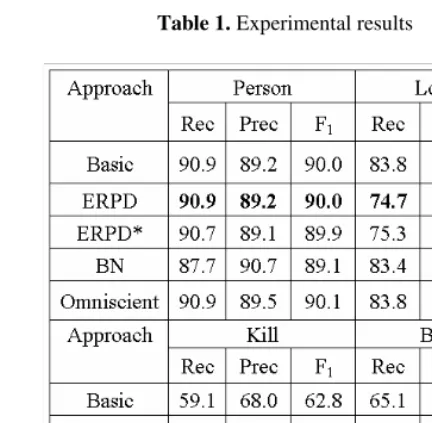
Dataset. The dataset in our experiments is the same as the Roth’s dataset “all” [11], which consists of 245 sentences that have the relation kill, 179 sentences that have the relation born-in and 502 sentences that have no relations. The predefined entity classes are other-ent, person and location, and the predefined relation classes are other-rel, kill and born-in. In fact, we use the results at the first stage in our method as the input, which are provided by W. Yih.
Experiment Design. We compare five approaches in the experiments: Basic, Omnis-cient, ERPD, ERPD* and BN. The Basic approach, which is a baseline, tests the per-formance of the two classifiers at the first stage, which are learned from their local attributes independently. The Omniscient approach is similar to Basic, the only defer-ence is that the classes of entities are exposed to relation classifier and vice versa. Note that it is certainly impossible to know the true classes of an entity and a relation in advance. The BN is the method based on the belief network, -- we follow the BN method according to the description in [11]. The ERPD is the proposed method based on ERPT, and the ERPD* is the proposed method based on the directed iteration algorithm. The threshold of RV is 0.4.
improve the precision, which is thought of being more important than the recall for the task of recognizing entity; 3) the relation recognition can be improved if we can improve the entity recognition, as indicated by the comparisons of Basic, ERPD and Omniscient; 4) the proposed method can improve the relation recognition, and it per-formance is almost equal to that of BN; 5) the perper-formance of ERPD and ERPD* is almost equal, so the directly iteration algorithm is effective.
Table 1. Experimental results
5 Related Work and Comparison
Targeting at the problems mentioned above, a method based on the belief network has been presented in [11], in which two subtasks are carried out simultaneously. Its pro-cedure is as follows: firstly, two classifiers are trained for recognizing entities and relations independently and their outputs are treated as the conditional probability distributions for each entity and relation, given the observed data; secondly, this in-formation together with the constraint knowledge among relations and entities are represented in a belief network [12] and are used to make global inferences for all entities and relations of interest. This method is denoted BN in our experiments.
Although BN can block the error propagation from the entity recognizer to the rela-tion classifier as well as improve the relarela-tion recognirela-tion, it cannot make use of the information, which is only available in relation recognition, to help entity recognition. Experiments show that BN cannot improve entity recognition.
entity and relation. It can represent the mutually dependences between entities and relations by introducing relation reaction intensity, and can deal with a loop without the limitation of directed acyclic diagram (DAG) in the belief network. At the same time, the proposed method can merge two kinds of constraint knowledge (i.e.
ε
α
αRand in Definition 4), but the method based on belief network can only use . αε Finally, the proposed method has a high computation efficiency while using the di-rected iteration algorithm.
6 Conclusions
The subtasks of entity recognition and relation recognition are typically carried out sequentially. This paper proposed an integrated approach that allows the two subtasks to be performed in a much closer way. Experimental results show that this method can improve the entity and relation recognition in some degree.
In addition, the Entity Relation Propagation Diagram (ERPD) is used to figure out the dependencies among entities and relations. It can also merge some constraint knowledge. Regarding to ERPD, two algorithms are further designed, one is based on the entity relation propagation tree, the other is the directed iteration algorithm on ERPD. The latter can be regarded as an approximation of the former with a higher computational efficiency.
Acknowledgements
We would like to express our deepest gratitude to Roth D. and Yih W. for making their dataset available for us. The research is supported in part by the National 863 Project of China under grant number 2001AA114210-03, the National Natural Sci-ence Foundation of China under grant number 60321002, and the Tsinghua-ALVIS Project co-sponsored by the National Natural Science Foundation of China under grant number 60520130299 and EU FP6.
References
1. Chinchor, N. MUC-7 Information Extraction Task Definition. In Proceeding of the Sev-enth Message Understanding Conference (MUC-7), Appendices, 1998.
2. Califf, M. and Mooney, R. Relational Learning of Pattern-match Rules for Information Extraction. In Proceedings of the Sixteenth National Conference on Artificial Intelligence and Eleventh Conference on Innovative Applications of Artificial Intelligence, 328-334, Orlando, Florida, USA, AAAI Press, 1999.
3. Freitag, D. Machine Learning for Information Extraction in Informal Domains. Machine learning, 39(2/3): 169-202, 2000.
4. Roth, D. and Yih, W. Relational Learning via Prepositional Algorithms: An Information Extraction Case Study. In Proceedings of the Seventeenth International Joint Conference on Artificial Intelligence, 1257-1263, Seattle, Washington, USA, Morgan Kaufmann, 2001. 5. Voorhees, E. Overview of the Trec-9 Question Answering Track. In The Ninth Text
6. Hirschman, L., Light, M., Breck, E. and Burger, J. Deep Read: A Reading Comprehension System. In Proceedings of the 37th Annual Meeting of Association for Computational Lin-guistics, 1999.
7. Abney, S.P. Parsing by Chunks. In S. P. Abney, R. C. Berwick, and C. Tenny, editors, Principle-based parsing: Computation and Psycholinguistics, 257-278. Kluwer, Dordrecht, 1991.
8. Xinghua Fan. Causality Diagram Theory Research and Applying it to Fault Diagnosis of Complexity System, Ph.D. Dissertation of Chongqing University, P.R. China, 2002. 9. Xinghua Fan, Zhang Qin, Sun Maosong, Huang Xiyue. Reasoning Algorithm in
Multi-Valued Causality Diagram, Chinese Journal of Computers, 26(3), 310-322, 2003. 10. Murphy, K., Weiss, Y., and Jordan, M. Loopy Belief Propagation for Approximate
Infer-ence: An empirical study. In Proceeding of Uncertainty in AI, 467-475, 1999.
11. Roth, D. and Yih, W. Probability Reasoning for Entity & Relation Recognition. In Pro-ceedings of 20th International Conference on Computational Linguistics (COLING-02), 835-841, 2002.