Probabilistic Models for Korean Morphological Analysis
Do-Gil Lee and Hae-Chang Rim Dept. of Computer Science & Engineering
Korea University
1, 5-ka, Anam-dong, Seongbuk-gu Seoul 136-701, Korea
dglee, [email protected]
Abstract
This paper discusses Korean morpho-logical analysis and presents three probabilistic models for morphological analysis. Each model exploits a distinct linguistic unit as a processing unit. The three models can compensate for each other’s weaknesses. Contrary to the previous systems that depend on man-ually constructed linguistic knowledge, the proposed system can fully automat-ically acquire the linguistic knowledge from annotated corpora (e.g. part-of-speech tagged corpora). Besides, with-out any modification of the system, it can be applied to other corpora having different tagsets and annotation guide-lines. We describe the models and present evaluation results on three cor-pora with a wide range of conditions.
1 Introduction
This paper discusses Korean morphological anal-ysis. Morphological analysis is to break down an Eojeol1into morphemes, which is the smallest meaningful unit. The jobs to do in morphological analysis are as follows:
Separating an Eojeol into morphemes
Assigning the morpho-syntactic category to each morpheme
1
Eojeol is the surface level form of Korean and is the spacing unit delimited by a whitespace.
Restoring the morphological changes to the original form
We have to consider some difficult points in Ko-rean morphology: there are two kinds of ambigu-ities (segmentation ambiguity and part-of-speech ambiguity). Moreover, morphological changes to be restored are very frequent. In contrast to part-of-speech (POS) tagging, morphological analysis is characterized by producing all the (grammati-cally) regal interpretations. Table 1 gives exam-ples of morphological analysis for Eojeols
“na-neun” and “gam-gi-“na-neun”.
Previous works on morphological analysis de-pends on manually constructed linguistic knowl-edge such as morpheme dictionary, morphosyn-tactic rules, and morphological rules. There are two major disadvantages in this approach:
Construction of the knowledge base is time-consuming and labor-intensive. In addition, storing every word in a lexicon is impossi-ble so the previous approch suffers from the unknown word problem.
There is a lack of portability. Because the re-sults produced by a morphological analyzer are limited to the given tagset and the anno-tation guidelines, it is very difficult to apply the system to other tagsets and guidelines.
Table 1: Examples of morphological analysis
na-neun gam-gi-neun
na/np+neun/jx ‘I am’ gam-gi/pv+neun/etm ‘be wound’
na/pv+neun/etm ‘to sprout’ gam-gi/nc+neun/jx ‘a cold is’
nal/pv+neun/etm ‘to fly’ gam/pv+gi/etn+neun/jx ‘to wash is’
Although constructing such corpora also requires a lot of efforts, the amount of annotated corpora is increasing every year. Secondly, regardless of tagsets and annotation guidelines, it can be applied to any training data without modification. Finally, it can provide not only analyzed results but also their probabilities by the probabilistic models. In Korean, no attempt has been made at probabilistic approach to morphological analysis. Probabilities enable the system to rank the results and to provide the probabilities to the next module such as POS tagger.
2 Related works
Over the past few decades, a considerable number of studies have been made on Korean morpho-logical analysis. The early studies concentrated on the algorithmic research. The following ap-proaches belong to this group: longest matching algorithm, tabular parsing method using CYK al-gorithm (Kim, 1986), dictionary based approach (Kwon, 1991), two-level morphology(Lee, 1992), and syllable-based approach (Kang and Kim, 1994).
Next, many studies have been made on im-proving the efficiency of the morphological an-alyzers. There have been studies to reduce the search space and implausible interpretations by using characteristics of Korean syllables (Kang, 1995; Lim et al., 1995).
There have been no standard tagset and anno-tation guideline, so researchers have developed methods with their own tagsets and guidelines. The Morphological Analysis and Tagger Evalua-tion Contest (MATEC) took place in 1999. This is the first trial about the objective and relative eval-uation of morphological analysis. Among the par-ticipants, some newly implemented the systems and others converted the existing systems’ results through postprocessing steps. In both cases, they reported that they spent much effort and argued
the necessity of tuning the linguistic knowledge. All the systems described so far can be con-sidered as the so called dictionary and rule based approach. In this approach, the quality of the dic-tionary and the rules govern the system’s perfor-mance.
The proposed approach is the first attempt to probabilistic morphological analysis. The aim of the paper is to show that this approach can achieve comparable performances with the previous ap-proaches.
3 Probabilistic morphological analysis model
Probabilistic morphological analysis generates all the possible interpretations and their probabilities for a given Eojeol . The probability that a given Eojeol is analyzed to a certain interpretation is represented as . The interpretation is made up of a morpheme sequence and its corresponding POS sequence as given in Equa-tion 1.
(1)
In the following subsections, we describe the three morphological analysis models based on three different linguistic units (Eojeol, mor-pheme, and syllable2).
3.1 Eojeol-unit model
For the Eojeol-unit model, it is sufficient to store the frequencies of each Eojeol (surface level form) and its interpretation acquired from the POS tagged corpus3.
The probabilities of Equation 1 are estimated by the maximum likelihood estimator (MLE) us-ing relative frequencies in the trainus-ing data.
2In Korean written text, each character has one syllable.
We do not distinguish between character and syllable in this paper.
3
The most prominent advantage of the Eojeol-unit analysis is its simplicity. As mentioned be-fore, morphological analysis of Korean is very complex. The Eojeol-unit analysis can avoid such complex process so that it is very efficient and fast. Besides, it can reduce unnecessary results by only producing the interpretations that really appeared in the corpus. So, we also expect an im-provement in accuracy.
Due to the high productivity of Korean Eojeol, the number of possible Eojeols is very large so storing all kinds of Eojeols is impossible. There-fore, using the Eojeol-unit analysis alone is unde-sirable, but a small number of Eojeols with high frequency can cover a significant portion of the entire ones, thus this model will be helpful.
3.2 Morpheme-unit model
As discussed, not all Eojeols can be covered by the Eojeol-unit analysis. The ultimate goal of morphological analysis is to recognize every mor-pheme within an Eojeol. For these reasons, most previous systems have used morpheme as a pro-cessing unit for morphological analysis.
The morpheme-unit morphological analysis model is derived as follows by introducing lexi-cal form:
(2)
whereshould satisfy the following condition:
where is a set of lexical forms that can be de-rived from the surface form . This condition means that among all possible lexical forms for a given ( ), the only lexical form is deter-ministically derived from the interpretation .
(3)
(4)
(5)
Equation 3 assumes the interpretation and the surface form are conditionally independent given the lexical form . Since the lexical form
is underlying in the morpheme sequence 4,
4
A lexical form is just the concatenation of morphemes.
the lexical formcan be omitted as in equation 4. In Equation 5, the left term denotes “the morphological restoration model”, and the right
“the morpheme segmentation and POS assignment model”.
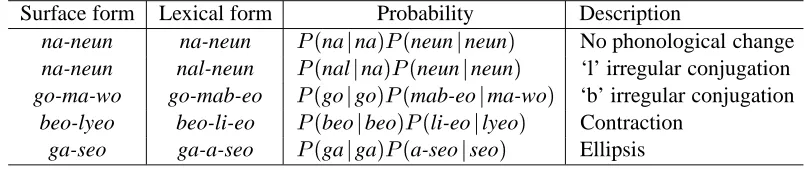
We describe the morphological restoration model first. The model is the probability of the lexical form given a surface form and is to encode the probability that the substrings between the surface form and its lexical form correspond to each other. The equation of the model is as fol-lows:
th substrings of the surface form and the lexical form, respectively.
We call such pairs of substrings “morpholog-ical information”. This information can be ac-quired by the following steps: If a surface form (Eojeol) and its lexical form are the same, each syllable pair of them is mapped one-to-one and extracted. Otherwise, it means that a morpholog-ical change occurs. In this case, the pair of two substrings from the beginning to the end of the mismatch is extracted. The morphological infor-mation is also automatically extracted from train-ing data. Table 2 shows some examples of apply-ing the morphological restoration model.
Now we turn to the morpheme segmentation and POS assignment model. It is the joint prob-ability of the morpheme sequence and the tag se-quence.
are pseudo tags to indicate the beginning and the end of Eojeol, re-spectively. We introduce the
symbol to
reflect the preference for well-formed structure of a given Eojeol. The model is represented as the well-known bigram hidden Markov model (HMM), which is widely used in POS tagging.
Table 2: Examples of applying the morphological restoration model
Surface form Lexical form Probability Description
na-neun na-neun nana neunneun No phonological change na-neun nal-neun nalna neunneun ‘l’ irregular conjugation go-ma-wo go-mab-eo gogo mab-eoma-wo ‘b’ irregular conjugation
beo-lyeo beo-li-eo beobeo li-eolyeo Contraction ga-seo ga-a-seo gaga a-seoseo Ellipsis
approaches are included in the lexical
probabil-ity
and the transition probability
One of the most difficult problems in morphologi-cal analysis is the unknown word problem, which is caused by the fact that we cannot register every possible morpheme in the dictionary. In English, contextual information and suffix information is helpful to estimate the POS tag of an unknown word. In Korean, the syllable characteristics can be utilized. For instance, a syllable “eoss” can only be a pre-final ending.
The syllable-unit model is derived from Equa-tion 4 as follows:
(8)
where is the syllable sequence of the lexical form, and is its corresponding syllable tag sequence.
In the above equation, is the same as that of the morpheme-unit model (Equation 6), we use the morpheme-unit model’s result as it is. The right term is referred to as “the POS assignment model”.
The POS assignment model is to assign the syllables to thesyllable tags:
(9)
In Equation 10, when is less than or equal to zero,
s and
s denote the pseudo syllables and the pseudo tags, respectively. They indicate the beginning of Eojeol. Analogously,
and
denote the pseudo syllables and the pseudo tags to indicate the end of Eojeol, respectively.
Two Markov assumptions are applied in Equa-tion 10. One is that the probability of the current syllable
conditionally depends only on the pre-vious two syllables and two syllable tags. The other is that the probability of the current syllable tag
conditionally depends only on the previous syllable, the current syllable, and the previous two syllable tags. This model can consider broader context by introducing the less strict independent assumption than the HMM.
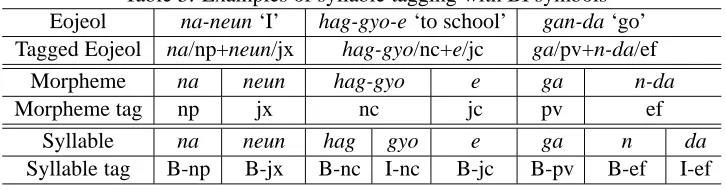
In order to convert the syllable sequenceand the syllable tag sequence to the morpheme se-quenceand the morpheme tag sequence, we can use two additional symbols (“B” and “I”) to indicate the boundary of morphemes: a “B” de-notes the first syllable of a morpheme and an “I” any non-initial syllable. Examples of syllable-unit tagging with BI symbols are given in Table 3.
4 Experiments
4.1 Experimental environment
For evaluation, three data sets having different tag sets and annotation guidelines are used: ETRI POS tagged corpus, KAIST POS tagged corpus, and Sejong POS tagged corpus. All experiments were performed by the 10-fold cross-validation. Table 4 shows the summary of the corpora.
Table 4: Summary of the data
Corpus ETRI KAIST Sejong
# of Eojeols 288,291 175,468 2,015,860
# of tags 27 54 41
Table 3: Examples of syllable tagging with BI symbols Eojeol na-neun ‘I’ hag-gyo-e ‘to school’ gan-da ‘go’
Tagged Eojeol na/np+neun/jx hag-gyo/nc+e/jc ga/pv+n-da/ef
Morpheme na neun hag-gyo e ga n-da
Morpheme tag np jx nc jc pv ef
Syllable na neun hag gyo e ga n da
Syllable tag B-np B-jx B-nc I-nc B-jc B-pv B-ef I-ef
Answer inclusion rate (AIR) is defined as the
number of Eojeols among whose results con-tain the gold standard over the entire Eojeols in the test data.
Average ambiguity (AA) is defined as the
aver-age number of returned results per Eojeol by the system.
Failure rate (FR) is defined as the number of
Eojeols whose outputs are not produced over the number of Eojeols in the test data.
1-best tagging accuracy (1A) is defined as the
number of Eojeols of which only one inter-pretation with highest probability per Eojeol is matched to the gold standard over the en-tire Eojeols in the test data.
There is a trade-off between AIR and AA. If a system outputs many results, it is likely to in-clude the correct answer in them, but this leads to an increase of the ambiguity, and vice versa. The higher AIR is, the better the system. The AIR can be an upper bound on the accuracy of POS taggers. On the contrary to AIR, the lower AA is, the better the system. A low AA can re-duce the burden of the disambiguation process of the POS tagger. Although the 1A is not used as a common evaluation measure for morphological analysis because previous systems do not rank the results, ProKOMA can be evaluated by this mea-sure because it provides the probabilities for the results. This measure can also be served as a base-line for POS tagging.
4.2 Experimental results
To investigate the performance and the effective-ness of the three models, we conducted several tests according to the combinations of the mod-els. For each test, we also performed the
exper-iments on the three corpora. The results of the experiments are listed in Table 5. In the table, “E”, “M”, and “S” mean the Eojeol-unit analysis, the morpheme-unit analysis, and the syllable-unit analysis, respectively. The columns having more than one symbol mean that each model performs sequentially.
According to the results, when applying a sin-gle model, each model shows the significant dif-ferences, especially between “E” and “S”. Be-cause of low coverage of the Eojeol-unit analy-sis, “E” shows the lowest AIR and the highest FR. However, it shows the lowest AA because it pro-duces the small number of results. On the con-trary, “S” shows the highest AA but the best per-formances on AIR and FR, which is caused by producing many results.
Most previous systems use morpheme as a processing unit for morphological analysis. We would like to examine the effectiveness of the proposed models based on Eojeol and syllable. First, compare the models that use the Eojeol-unit analysis with others (“M” vs. “EM”, “S” vs. “ES”, and “MS” vs. “EMS”). When applying the Eojeol-unit analysis, AA is decreased, and AIS and 1A are increased. Then, compare the mod-els that use the syllable-unit analysis with others (“E” vs. “ES”, “M” vs. “MS”, and “EM” vs. “EMS”). When applying the syllable-unit anal-ysis, AIR and 1A are increased, and FR is de-creased. Therefore, both models are very useful when compared the morpheme-unit model only.
Table 5: Experimental results according to the combination of the processing units
Data Measure E M S EM ES MS EMS
ETRI
Answer inclusion rate (%) 54.65 93.87 98.91 94.16 98.81 97.09 97.22 Average ambiguity 1.23 2.63 6.95 2.10 4.46 2.95 2.41 Failure rate (%) 45.21 3.81 0.06 3.67 0.06 0.06 0.06 1-best accuracy (%) 51.66 83.49 89.98 86.41 91.22 86.15 88.92
KAIST
Answer inclusion rate (%) 57.43 94.29 98.36 94.41 98.25 96.97 97.02 Average ambiguity 1.26 1.84 6.05 1.57 3.80 2.16 1.89 Failure rate (%) 42.40 3.73 0.06 3.67 0.06 0.06 0.06 1-best accuracy (%) 54.22 87.51 90.02 89.18 91.02 89.50 91.12
Sejong
Answer inclusion rate (%) 67.79 90.96 99.38 92.17 99.33 96.60 97.09 Average ambiguity 1.29 2.35 6.60 1.82 3.52 2.72 2.17 Failure rate (%) 32.13 5.94 0.02 5.21 0.02 0.02 0.02 1-best accuracy (%) 64.64 83.86 91.56 87.00 92.96 88.72 91.16
Table 6: Performances of two systems participated in MATEC 99
(Lee et al., 1999)’s system (Song et al., 1999)’s system
Answer inclusion rate (%) 98 92
Average ambiguity 4.13 1.75
seen, the Lee et al. (1999)’s system is better than ProKOMA in terms of AIS, but it generates too many results (with higher AA).
5 Conclusion
We have presented and described the new prob-abilistic models used in our Korean morpholog-ical analyzer ProKOMA. The previous systems depend on manually constructed linguistic knowl-edge such as morpheme dictionary, morphosyn-tactic rules, and morphological rules. The system, however, requires no manual labor because all the information can be automatically acquired by the POS tagged corpora. We also showed that the sys-tem is portable and flexible by the experiments on three different corpora.
The previous systems take morpheme as a pro-cessing unit, but we take three kinds of propro-cessing units (e.g. Eojeol, morpheme, and syllable). Ac-cording to the experiments, we can know that the Eojeol-unit analysis contributes efficiency and ac-curacy, and the syllable-unit analysis is robust in the unknown word problem and also contributes accuracy. Finally, the system achieved compara-ble performances with the previous systems.
References
S.-S. Kang and Y.-T. Kim. 1994. Syllable-based model for the Korean morphology. In Proceedings
of the 15th International Conference on Computa-tional Linguistics, pages 221–226.
S.-S. Kang. 1995. Morphological analysis of Ko-rean irregular verbs using syllable characteristics. Journal of the Korea Information Science Society, 22(10):1480–1487.
S.-Y. Kim. 1986. A morphological analyzer for Korean language with tabular parsing method and connectivity information. Master’s thesis, Dept. of Computer Science, Korea Advanced Institute of Science and Technology.
H.-C. Kwon. 1991. Dictionary-based morphological analysis. In Proceedings of the Natural Language Processing Pacific Rim Symposium, pages 87–91.
S.-Z. Lee, B.-R. Park, J.-D. Kim, W.-H. Ryu, D.-G. Lee, and H.-C. Rim. 1999. A predictive morpho-logical analyzer, a part-of-speech tagger based on joint independence model, and a fast noun extractor. In Proceedings of the MATEC 99, pages 145–150.
S.-J. Lee. 1992. A two-level morphological analy-sis of Korean. Master’s theanaly-sis, Dept. of Computer Science, Korea Advanced Institute of Science and Technology.
H.-S. Lim, S.-Z. Lee, and H.-C. Rim. 1995. An ef-ficient Korean mophological analysis using exclu-sive information. In Proceedings of the 1995 In-ternational Conference on Computer Processing of Oriental Languages, pages 255–258.