1398
Interaction-Aware Topic Model for Microblog Conversations through
Network Embedding and User Attention
Ruifang He1,2,∗, Xuefei Zhang1,2,∗, Di Jin1,2,†, Longbiao Wang1,2, Jianwu Dang1,2,3, Xiangang Li4
1School of Computer Science and Technology, Tianjin University, Tianjin, China 2Tianjin Key Laboratory of Cognitive Computing and Application, Tianjin, China
3Japan Advanced Institute of Science and Technology, Ishikawa, Japan 4AI Labs, Didi Chuxing, Beijing, China
{rfhe,jindi,longbiao wang}@tju.edu.cn,[email protected] [email protected],[email protected]
Abstract
Traditional topic models are insufficient for topic extraction in social media. The existing meth-ods only consider text information or simultaneously model the posts and the static characteristics of social media. They ignore that one discusses diverse topics when dynamically interacting with different people. Moreover, people who talk about the same topic have different effects on the topic. In this paper, we propose an Interaction-Aware Topic Model (IATM) for microblog con-versations by integrating network embedding and user attention. A conversation network linking users based on reposting and replying relationship is constructed to mine the dynamic user be-haviours. We model dynamic interactions and user attention so as to learn interaction-aware edge embeddings with social context. Then they are incorporated into neural variational inference for generating the more consistent topics. The experiments on three real-world datasets show that our proposed model is effective.
1 Introduction
The prosperity of microblog platforms, such as Twitter1and Sina Weibo2brings the large scale, noisy and user-generated short posts. Automatically extracting topics in social media aims to reveal thematic information of the underlying collection, which can be used in summarization (Zhuang et al., 2016), hashtag recommendation (Li et al., 2016b), response generation (Xing et al., 2017) and so on.
The conventional topic models, like Latent Dirichlet Allocation (LDA) (Blei et al., 2003), infer the hidden topics based on word co-occurrences in documents. They could not be directly transferred in social media due to the data sparsity and the noise of short texts.
The existing relevant researches can be roughly categorized into: (1) Methods exploit the content of short texts by aggregation strategy (Mehrotra et al., 2013) or modeling word-pair co-occurrence (Yan et al., 2013). (2) Models incorporating with word embedding try to deeply understand the posts by repre-sentation learning (Sridhar, 2015; Hu and Tsujii, 2016), yet they ignore the social context of microblog messages. Essentially, social media content and network structures influence each other (Bi et al., 2014), the only content analysis is insufficient. (3) (Li et al., 2016a; Chen and Ren, 2017) take into account the content and static characteristics of network structures to deduce topics. However, they ignore dynamic user behaviours.
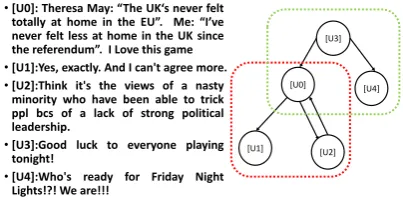
Actually, a user may talk about various topics when interacting with diverse neighbours in a social network. For instance, Fig. 1(a) shows two conversation trees, where [U0] communicates with [U1] and [U2] about the topic of United Kingdom European Union membership referendum, while [U0] talks a game with [U3]. Hence, we need to infer topics according to the interactions between users. Moreover, although [U0] and [U1] argue about the same topic, [U0] contains salient content in topic description, e.g., UK, EU, referendumwhile the reply of [U1] is nothing but simply response to [U0], e.g.,Yes, agree.
This work is licensed under a Creative Commons Attribution 4.0 International License. License details: http:// creativecommons.org/licenses/by/4.0/
* Indicates equal contribution.
†Corresponding author.
1
https://twitter.com
Theresa May: "The UK's never felt totally at home in the EU" Me: "I've never felt less at home in
the UK since the referendum"
Yes, exactly. And I can't believe how
quickly it's changed.
Think it's the views of a nasty minority who have been able to trick ppl bcs
of a lack of strong political leadership. Feel like we've regressed a lot. My pops observed that it's somewhat reminiscent of the 1970s shortly
after he arrived here. Good luck to
everyone playing tonight! Who's ready for Friday Night Lights!?! We are!!!! I Love this game [UO] [U1] [U2] [U0] [U3] [U0] [U4]
Game Brexit Referendum
(a) Two conversation trees. [Ui]: thei-th user; Arrow lines: reposting/replying relations.
•[U0]: Theresa May: “The UK‘s never felt totally at home in the EU”. Me: “I’ve never felt less at home in the UK since the referendum”. I Love this game
•[U1]:Yes, exactly. And I can't agree more.
•[U2]:Think it's the views of a nasty minority who have been able to trick ppl bcs of a lack of strong political leadership.
•[U3]:Good luck to everyone playing tonight!
•[U4]:Who's ready for Friday Night Lights!?! We are!!!
[U3]
[U0]
[U1] [U2] [U4]
[image:2.595.308.510.70.171.2](b) An example of a conversation network. The green box shows the topic about a game; The red one exhibits the topic of Brexit referendum.
Figure 1: A conversation network is transformed from two conversation trees.
Thus, it is intuitive that during the topic extraction of United Kingdom European Union membership referendum, [U0] is more important than [U1]. Thedynamic interactionsanddiverse user attention
on the topic provide us heuristic insights for topic extraction.
Note that conversation trees can be transformed into conversation networks through user relations, as illustrated in the Fig. 1. Inspired by network embedding and social user behaviour researches, we propose anInteractionAwareTopicModel (IATM) integrating dynamic interactions and various effects of users on the topic. The contributions are as follows.
• We propose a novel Interaction-Aware Topic Model (IATM) for microblog conversations, which simultaneously considers social media content and network topology.
• Our method models dynamic interactions and various effects of users, and encodes them as interaction-aware edge embeddings through network embedding and user attention.
• The deeper edge representations are employed in neural variational inference for generating the more consistent topics.
• The experiments verify that the proposed IATM is effective. Dynamic user behaviours are useful for topic extraction of short texts in social media.
2 Related Work
Previous researches for topic extraction in social media can be mainly classified into two aspects.
2.1 Focusing on Content Information
They depend on pure content to generate document-topic distribution and topic-word distribution. (1)
2.2 Integrating Content and Network Structure information
This kind of researches considers social content and network structures together, including followship and repostship. (1)Followship Based. Lim et al.(2013) jointly model the text and user-follower net-work during topic inference. Yet the appearance ofZombie Fanspurchased by those who would like to increase their influence, disturbs the followship network. (2) Repostship Based. LeadLDA (Li et al., 2016a) generates words according to topic dependencies derived from conversation trees by differentiat-ing messages from leader and follower. Leader is the post that contains salient and new information in topic description while follower is the post that simply responds to its reposted or replied messages. Chen and Ren (2017) propose ForumLDA to infer topics by distinguishing response messages from relevant and irrelevant to the original post.
However, due to the zombie fans in followship network, or exploring the static characteristics in re-postship network, these methods ignore the dynamic user behaviours latent in reciprocal interactions between users. Therefore we emphasize on exploring whether user interactions and user attention can help topic generation in social media.
2.3 Network Embedding and Neural Variational Inference
The further researches (Perozzi et al., 2014; Tu et al., 2017) about network embedding make it possible to suitably model the dynamic user behaviours. Meanwhile, comparing with topic models based on word embedding, Miao et al. (2017) and Srivastava and Sutton (2017) apply topic model with neural variational inference (Kingma and Welling, 2014) on traditional long documents, which consistently produces the better topics. A small change in the document will produce a small change in topics. Yet they have not taken into account sparse and noisy texts and network structures in social media.
Therefore, we model dynamic user behaviours and content information as interaction-aware edge embeddings, which combine network embedding and user attention. Further, they are incorporated into variational auto-encoder for topic extraction in social media, which can produce the more consistent and precise topics.
3 Interaction-Aware Topic Model
The large scale short and noisy texts in social media bring the more serious data sparseness and incon-sistency in topics. Yet the dynamic user behaviours also provide us opportunities. Here, we propose two hypotheses and explore whether they are useful for topic extraction.
H1: Dynamic Interactions. One discusses various topics with different people.
H2: User Attention. Users who debate the same topic have diverse effects on the topic.
We need to construct a conversation network, shown in Fig. 1(b), transformed from conversation trees.
3.1 Conversation Network
Conversation networks are transformed from conversation trees through user relations, which are ex-hibited in Fig. 1(b). We first give the basic notations and definitions of a conversation network. Given G= (V, E, T), whereV is the set of vertices,E ⊆V ×V is the edges between vertices andT denotes text information of vertices. Each vertexv ∈ V represents a user and every edgee(u,v) ∈E stands for the reposting or replying relationship between two vertices(u, v). To solve the sparsity of short texts, we aggregate all the messages posted by the same user, including the original and the reposting messages3. Text information of the unique vertex v ∈ V is the messagesMv = (w1, w2, ..., wn), wherenis the count of words inMv.
In order to illustrate the proposed IATM model, we firstly give two definitions:
D1: Edge Embedding. The edge embeddingefor every edgee(u,v)is acquired by concatenating the vertex embeddingsuandv. It encodes user representations with respect to various neighbours.
D2: Interaction-aware Edge Embedding. It models the various effects ofuandvon a topic via user attention mechanism, and makes edge embedding as an interaction-aware style.
3.2 Model
v
u u v
Convolution Convolution Mutual Attention
SG
Attention
[image:4.595.212.386.97.422.2]Model Dynamic Interactions Model User Attention Topics Generation
Figure 2: The IATM framework.
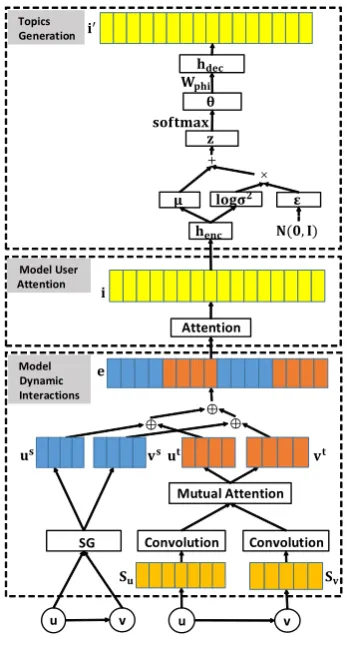
The proposed IATM framework is shown in Fig. 2. The generative process of IATM mainly includes three parts: (1) model dynamic interactions, (2) model user attention and (3) topics generation. A basis of three parts is that each word is represented as a low dimensional, continuous and real-valued vector, also known as word embedding (Mikolov et al., 2013c). Given text information of a vertexv, we take the embeddingwi∈Rd
0
for each word to obtain embedding sequence asSv = (w1,w2, ...,wn). Here, d0indicates the dimension of word embeddings.
3.2.1 Model Dynamic Interactions
Corresponding to the assumption H1, a specific vertex should have its own diverse points with distinct neighbours, which leads to different edge embeddings.
To make full use of network structures and associated text information, we encode each vertexvas a concatenation of a structure-based embeddingv(s)and a text-based embeddingv(t), and get the vertex embeddingv=v(s)⊕v(t)(v∈Rd).
Structure-based Embedding. We adopt a neural language model (SkipGram, or SG for short) (Mikolov et al., 2013a) forv(s). To maximize the probability of a node’s neighbourhood co-occurrence, we define the objective function of structure-based embeddings as follows
Ls =−log X
−k≤j≤k
p(v(s)i+j|v(s)i ) (1)
thesoftmaxfuction
p(v(s)i+j|v(s)i ) = exp((v
(s) i+j)
T
v(s)i )
P|V|
t=1exp((v
(s)
t )
T
v(s)i )
. (2)
In this way, nodes with similar neighbours share the similar structure-based embeddings.
Text-based Embedding. To discover the thematic information of the vertex pair in an edge, we utilize mutual attention (Santos et al., 2016; Tu et al., 2017) to obtain text-based embeddings, which allows the pooling operation to be aware of the topic of an edgee(u,v). To some extent, content information from a vertex can directly affect the text-based embedding of the other vertex, and vice versa.
Convolutional neural network (CNN) has gained great performance on the textual information encod-ing (Chen et al., 2015; Wang et al., 2017). Given the embeddencod-ing sequenceSv, we conduct convolution operation overSvwithin thei-th window as follows
xi =C·(Sv)i:i+l−1+b (3)
where C ∈ Rd×(l×d
0)
is a convolution matrix, b is the bias vector and window size is l. The same operation is also onSu. The outputs of convolution,P∈ Rd×m andQ ∈ Rd×nwheremandnmean
the length ofSuandSvrespectively, are as the input of mutual attention layer to compute the correlation matrixF.
F=relu(PTAQ)(F∈Rm×n) (4)
A ∈ Rd×dis a matrix to be learned by the neural network and we emlpoyreluas activation function. Note that, the elementFi,j ∈Fis the pair-wise correlation score of the hidden vectorsPiandQj.
Then, we employ the mean-pooling along rows and columns ofFto generate pooling vectors by
gi(p) =mean(Fi,1, ...,Fi,n) g(q)j =mean(F1,j, ...,Fm,j). (5)
The pooling vectors ofPandQare obtained as
g(p)= (g(p)1 , ..., gm(p))T g(q)= (g(q)1 , ..., gn(q))T. (6)
Next, thesof tmaxfunction is operated ong(p)andg(q)to get the mutual attentive vectorsa(p)anda(q). For instance, thei-th element of mutual attentive vectora(p)is computed as
a(p)i = exp(g (p)
i )
Pm
t=1exp(g (p)
t )
. (7)
Finally, we get the text-based embeddings u(t) and v(t) by u(t) = Pa(p) andv(t) = Qa(q). The objective function of text-based embeddings is as
Lt(e) =αlogp(v(t)|u(t)) +βlogp(v(t)|u(s)) +γlogp(v(s)|u(t)) (8)
whereα,β andγ control the weights of corresponding parts. Similarly, we employsof tmaxfunction for calculating the conditional probabilities in Eq. (8) as in Eq. (2).
Edge Embedding. Here, we obtain the vertex embeddings u andvby u = u(s)⊕u(t) andv = v(s)⊕v(t). In this way, we operatee=u⊕vto get the edge embeddinge∈R2dfore
(u,v), which is dynamic context-aware.
3.2.2 Model User Attention
is computed by conductingsof tmaxfunction on the edge embeddinge. To formulate, thei-th element ofa(e)is computed as
a(e)i = P2dexp(ei) t=1exp(et)
. (9)
After that, through combining topic information of the vertex-pair in an edge with user attention on the topic, we obtain interaction-aware edge embeddingi ∈ R2d by using element-wise product asi = (e1a
(e)
1 , ...,e2da (e) 2d).
3.2.3 Topics Generation
Neural variational inference (Miao et al., 2017) approximates the posterior of a generative model with a variational distribution parameterized by a neural network, which consistently generates the better topics. With respect to social media, we input the interaction-aware edge embedding, which is encoded with dynamic user behaviours and content information, into variational auto-encoder. To formulate, suppose dˆis a document, w is a word in dˆand the number of topics is K. Here, we adopt neural variational inference to infer the multinomial document-topic distributionθdˆ = (p(t1|dˆ), ..., p(tK|dˆ)) and topic-word distributionφw = (p(w|t1), ..., p(w|tK)), wheretiis thei-th topic.
Document-topic distribution. Precisely, given the interaction-aware edge embeddingi, we first en-code it to a hidden space as
henc =relu(W(ih)i+b(ih)) (10)
whereW(ih)andb(ih)are the parameters of the neural network. Then the Gaussian parametersµdˆand σ2ˆ
dcan be obtained as
µdˆ=W(hµ)henc+b(hµ) log(σd2ˆ) =W(hσ)henc+b(hσ). (11)
The latent semantic vectorz∈RKcan be calculated using the reparameterization trick asz=µ ˆ
d+×σdˆ where∼ N(µ0, σ02)is the prior Gaussian distribution. The hyper-parametersµ0andσ02is set to a zero mean and unit variance Gaussian. Here we pass the Gaussian random vectorz through the sof tmax function to parameterize the multinomial document-topic distributionθdˆ.
Topic-word distribution. The conventional topic models compute the conditional probabilityp(w|dˆ)
as
p(w|dˆ) =φw×(θdˆ)T. (12)
Therefore, we compute the topic-word distributionφwas the parameter of neural network by
hdec=sof tmax(φw×(θdˆ)T). (13)
Thereafter, a new interaction-aware edge embeddingi0is generated as
i0 =relu(W(hi)hdec+b(hi)) (14)
whereW(hi)andb(hi)are the parameters of neural network. The objective for this part is as
Lθ,φ(e) =Eq(θ,z|i)[logp(i|z, θ, φ)]−DKL[q(θ,z|i)||p(θ|µdˆ, σd2ˆ)] (15)
where the variational distributionq(θ,z|i)approximates the true posteriorp(θ|µdˆ, σd2ˆ)through Kullback-Leibler divergence.
3.3 Model Training
We need to minimize the overall objective function as
L=Ls+ X
e∈E
(Lt(e) +Lθ,φ(e)). (16)
4 Experiments
4.1 Datasets
We obtain the datasets shown in Tab. 1 based on the original microblog corpus used by Li et al., (2016a). They collected the posts of 50 frequent hashtags during May 1 -July 31, 2014 through Sina Weibo hashtag-search API4. Then they split the whole corpus into 3 datasets and each month represented a datasets. We further deal with the original datasets as follows: 1) Remove the posts whose length is less than 3 words or that have no poster username; 2) Filter users who have no reposting or replying relation-ship; 3) Aggregate all the original and the reposting posts from the same user to form text information of a user vertex.
Month #Users #Reposting
May 8907 10435 June 19293 25962 July 16990 20971
Table 1: Statistics of Datasets.
4.2 Evaluation Metrics
In previous work, a popular metric for topic model, perplexity, is evaluated based on the likelihood of held-out documents. Nonetheless, Chang et al. (2009) have proved that higher likelihood of held-out documents doesn’t necessarily correspond to human perception of semantically coherent topics. Instead-ly, we follow (Mimno et al., 2011) to calculate the coherence score of a topic given the topN words as
C= 1
K · K X
k=1 N X
i=2 i−1 X
j=1
logD(w
k
i, wkj) + 1
D(wjk) (17)
wherewki refers to thei-th word in topickranked by topic distribution over words, D(wki, wkj)stands for the count of documents wherewikandwjkco-occur,and D(wkj)indicates the number of documents that contain wordwjk. In this paper, a document is the aggregated text of a user.
4.3 Baselines
To validate whether two assumptions mentioned in Section 3 are useful for topic extraction, we compare the proposed IATM with the following state-of-the-art baselines and its two variants:
Text Analysis Only:
(1) SATM (Quan et al., 2015) combines the aggregation of short texts and topic inference into an unified model.
(2)BTM (Yan et al., 2013) directly models the word co-occurrence patterns in the whole corpus. (3)LCTM(Hu and Tsujii, 2016) uses word embeddings pretrained by a log-linear word2vec model5 to deduce topics for tackling the data sparsity.
Text and Stucture Analysis:
(4)LeadLDA (Li et al., 2016a) generates words according to topic dependencies derived from con-versation trees.
(5) ForumLDA(Chen and Ren, 2017) models the generation of topics by discriminating response messages relevant or irrelevant to the original post.
Two Variants:
(6) IATM (-interaction)is the IATM without dynamic interactions between users, which just takes text information into account and also uses neural variational inference to deduce topics.
4
http://open.weibo.com/wiki/2/search/topics
(7) IATM (-user attention)considers the interactions between users, but not the various effects of users on the topic.
4.4 Experiment Settings
The hyperparameters of SATM, BTM, LCTM, LeadLDA and ForumLDA are set according to the best hyperparameters reported in their original papers. We run Gibbs samplings (in SATM, BTM, LCT-M, LeadLDA and ForumLDA) with 1000 iterations to ensure convergence. For IATM (-interaction) and IATM (-user attention), the parameter settings are kept the same as IATM. Here, we set the vertex embed-ding dimensiondas 200. We take the hyperparameters which achieve the best performance on datasets via an small grid search over combinations of the initial learning rate [0.001,0.0001], α ∈ [0.1,1], β ∈[0.1,1]andγ ∈ [0.1,1]. Finally, learning rate is set as 0.001,αas 1.0,β as 0.3 andγ as 0.3. The other parameters are initialized by randomly sampling from normal distributionN(1.0,0.32).
4.5 Performance Evaluation
Model N = 10 KN = 15= 50 N = 20 N = 10 KN= 100= 15 N = 20
SATM -76.10 -190.38 -341.22 -76.07 -190.48 -341.46
BTM -79.27 -181.95 -326.77 -79.58 -183.00 -319.28
LCTM -70.91 -165.37 -296.36 -58.65 -140.10 -261.40
LeadLDA -53.91 -138.53 -258.38 -58.15 -141.34 -261.65
ForumLDA -55.76 -129.57 -231.90 -55.84 -132.23 -236.89
IATM (-interaction) -60.33 -145.98 -274.08 -64.26 -152.74 -280.40
[image:8.595.105.498.444.568.2]IATM (-user attention) -57.77 -126.06 -240.66 -59.57 -131.79 -233.54 IATM -43.34 -112.64 -228.27 -47.32 -121.46 -219.96
Table 2: Coherence scores on May. Higher is better.
Model N = 10 KN = 15= 50 N = 20 N = 10 KN= 100= 15 N = 20
SATM -31.04 -24.30 -58.39 -29.74 -22.02 -55.00
BTM -78.79 -179.99 -321.74 -75.77 -176.13 -315.43
LCTM -91.72 -208.75 -367.76 -81.88 -181.57 -323.16
LeadLDA -63.54 -150.18 -278.19 -72.07 -169.80 -309.40
ForumLDA -78.22 -140.46 -229.62 -82.33 -160.46 -258.72
IATM (-interaction) -74.61 -180.84 -340.83 -67.29 -161.30 -301.66
IATM (-user attention) -69.75 -147.53 -234.73 -61.34 -148.01 -280.06
IATM -46.69 -113.09 -213.61 -59.11 -133.96 -225.48
Table 3: Coherence scores on June. Higher is better.
Model N = 10 KN = 15= 50 N = 20 N = 10 KN= 100= 15 N = 20
SATM -128.28 -254.45 -431.88 -128.68 -254.74 -432.01
BTM -73.26 -172.43 -313.12 -76.10 -176.67 -320.70
LCTM -72.78 -160.08 -275.58 -63.56 -137.36 -238.31
LeadLDA -70.40 -157.83 -268.23 -59.75 -130.83 -226.62
ForumLDA -89.16 -215.47 -396.20 -89.96 -213.59 -386.65
IATM (-interaction) -93.59 -224.17 -409.84 -91.96 -233.86 -396.22
IATM (-user attention) -61.60 -144.75 -251.46 -57.00 -127.57 -227.81 IATM -50.75 -119.48 -212.26 -46.80 -110.27 -204.35
[image:8.595.102.499.616.742.2]Following (Li et al., 2016a; Yan et al., 2013), we set the number of topics to 50 (K = 50) and 100
(K = 100).K = 50is to match the count of hashtags andK= 100is much larger than the real number
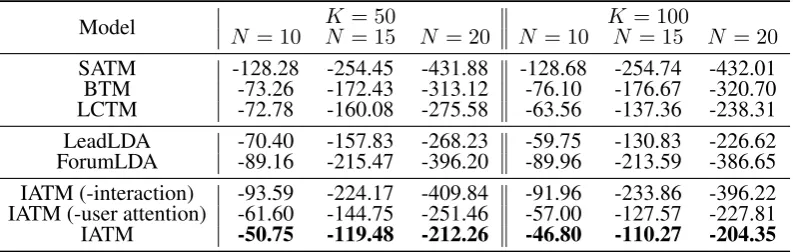
of topics. As shown in Tab. 2, 3 and 4, we evaluate the topN =10, 15, 20 words of K = 50 and
K = 100. From these tables, we have the following overall observations:
(1)What call for special attention is that, SATM exhibits the unstable performance on various datasets. Specifically, SATM performs poorly on May, the worst on July and the best on June. It may be ascribed to its heavy reliance on the number of pseudo-documents. On the contrary, IATM has a stable performance and is only outperformed by SATM on June.
(2)Topic models that analyze text and structures perform better than the ones with only text excep-t SATM on June. Iexcep-t indicaexcep-tes excep-thaexcep-t considering excep-texexcep-ts and sexcep-trucexcep-tures excep-togeexcep-ther is necessary due excep-to excep-their reciprocal influence in a social network.
(3) Our proposed IATM achieves crucial improvement in comparison with all the baselines on May and July, and it gives the greater coherence scores than the other baselines expect SATM on June. The reasons are two-fold: 1) It effectively identifies topics via simultaneously considering social media con-tent and network topology. 2) It further produces interaction-aware edge embedding as a deeper edge representation combined dynamic user interactions and user attention.
Assumptions K= 50, N = 20 K= 100, N = 20
Dynamic Interactions 27.32% 22.13% User Attention 9.91% 11.87%
Table 5: The effects of two hypotheses by comparing IATM with its two variants.
To further evaluate the effectiveness of two assumptions, we compare IATM with its two variants, observations are as follows:
(4)IATM (-interaction) gives the worst coherence scores. The reason is that it has no consideration of social context. After introducing dynamic interactions, IATM (-user attention) obtains the considerable improvement. Moreover, IATM outperforms IATM (-user attention) on three datasets whatever different number of topics. It demonstrates the effectiveness of dynamic interactions (H1) and user attention (H2).
(5) For each component, we compute the average growth percentage under top N = 20 words of
K = 50andK= 1006in comparison of IATM and two variants. Seen from Tab. 5, two hypotheses are
both useful for topic extraction in social media, and dynamic interactions modeling has greater influence than user attention.
4.6 Case Study
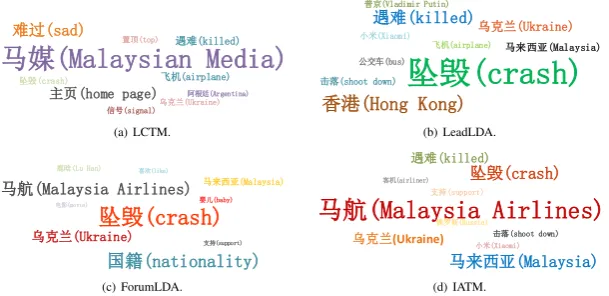
To get an intuitive understanding of extracted topics, we design an experiment to visualize the top 10 words about “MH17 Crash” induced by the different models when K = 50, shown in Fig. 3. Due to “MH17 Crash” is included in the July dataset, LCTM gives the highest coherence score among the models of text analysis only. Then we choose LCTM, LeadLDA and ForumLDA as the competitors of our proposed method due to the limited space. Note that, individual words accompany with diverse font sizes. The larger the font size is, the more relevant the word is to the topic. We have the following observations from Fig. 3:
(1)As for LCTM based on word embeddings, “Malaysian Media” is the top one key word and “killed”, “crash”, “sad” and “Ukraine” is correlated to the topic. However, it mistakenly groups “Argentina lose the World Cup”, which co-occurs with “sad” and “Argentina”. Compared with LeadLDA, ForumLDA and IATM, LCTM performs the worst. It further testifies that the analysis of texts and structures in a social network is necessary due to their relevance in social media.
(2)With respect to LeadLDA, which distinguishes every message from leader and follower, “crash” is the top one key word and “killed”, “Ukraine”, “shoot down” and “Malaysia” is related to the topic. However, “bus” is falsely aggregated, which is relevant to the bus explosion in Guangzhou. Maybe it is
马媒(Malaysian Media)
难过(sad)主页(home page)
飞机(airplane)
信号(signal)
阿根廷(Argentina)
坠毁(crash)
遇难(killed) 置顶(top)
乌克兰(Ukraine)
(a) LCTM.
坠毁(crash)
香港(Hong Kong)遇难(killed)乌克兰(Ukraine)
马来西亚(Malaysia)
击落(shoot down) 普京(Vladimir Putin)
飞机(airplane) 小米(Xiaomi)
公交车(bus)
(b) LeadLDA.
坠毁(crash)
国籍(nationality)
马航(Malaysia Airlines)
乌克兰(Ukraine)
马来西亚(Malaysia)
鹿晗(Lu Han)
婴儿(baby)
喜欢(like)
电影(movie)
支持(support)
(c) ForumLDA.
马航(Malaysia Airlines)
乌克兰(Ukraine) 小米(Xiaomi) 俄罗斯(Russia)
击落(shoot down) 客机(airliner)
支持(support)
遇难(killed)
坠毁(crash)
马来西亚(Malaysia)
[image:10.595.149.454.65.213.2](d) IATM.
Figure 3: Word clouds describing “MH17 Crash” of different models. Each word cloud represents the similar topic generated by the corresponding model with top 10 words. English translations for the original Chinese words are inside the brackets.
because it wrongly recognizes the reposting message about the bus explosion in Guangzhou as a leader message.
(3)ForumLDA differentiates reposting messages from relevant and irrelevant response posts. It gener-ates the top one key word “crash”, and “Malaysia Airlines”, “Ukraine”, “Malaysia” and “nationality” are correlated to the topic. However, “Lu Han” and “movie” about a movie starring Lu Han, are mistakenly mixed. Perhaps it is because no prior knowledge is given to ensure the validity of relevance distinction.
(4) The top words generated by IATM, “Malaysia Airlines”, “Malaysia”, “crash” and “Ukrain”, are related to the topic. Moreover, some detailed information “airliner” is also produced. Nevertheless, the generated “Xiaomi” is not relevant to the topic. We check the corpus and find that there are lots of posts tagged one hashtag, but expressing the other topic. For instance, someone makes product promotion of “Xiaomi” by utilizing the hot event “MH17 Crash”. This belongs to a spam message.
5 Conclusion and Future Work
We propose an Interaction-Aware Topic Model (IATM) for microblog conversations through integrating dynamic interactions and various user attention. Our method not only makes full use of content and structure information in social media, but also keeps the better consistency of generated topics by vari-ational auto-encoder. We model user behaviours through transforming conversation trees into network. Further interaction-aware embeddings produced by adding diverse effects of different users on a topic, encode the content and structure information of two neighbour users. This helps to incorporate the con-versation context, and is easy to absorb user attention. Then it is plugged in neural variational inference to generate topics. Experiments on three real-world microblog datasets demonstrate that the proposed IATM is effective.
Yet lots of people would like to utilize hot events to have a product promotion and post some irrelevant messages. These spams damagingly affect the performance of IATM. In the future, we will unify spam posts separation during topics deduction.
Acknowledgments
The work was supported by National Natural Science Foundation of China (61472277, 61772361, 61771333). We would like to thank anonymous reviewers for the valuable and detailed comments and suggestions.
References
David M Blei, Andrew Y Ng, and Michael I Jordan. 2003. Latent dirichlet allocation. Journal of Machine Learning Research, 3(Jan):993–1022.
Jonathan Chang, Sean Gerrish, Chong Wang, Jordan L Boyd-Graber, and David M Blei. 2009. Reading tea leaves: How humans interpret topic models. InAdvances in Neural Information Processing Systems, pages 288–296.
Chaotao Chen and Jiangtao Ren. 2017. Forum latent dirichlet allocation for user interest discovery. Knowledge-Based Systems, 126:1–7.
Yubo Chen, Liheng Xu, Kang Liu, Daojian Zeng, Jun Zhao, et al. 2015. Event extraction via dynamic multi-pooling convolutional neural networks. In Proceedings of the 53rd Annual Meeting of the Association for Computational Linguistics and the 7th International Joint Conference on Natural Language Processing, pages 167–176.
Liangjie Hong and Brian D Davison. 2010. Empirical study of topic modeling in twitter. InProceedings of the 1st Workshop on Social Media Analytics, pages 80–88.
Weihua Hu and Junichi Tsujii. 2016. A latent concept topic model for robust topic inference using word embed-dings. InThe 54th Annual Meeting of the Association for Computational Linguistics, pages 380–386.
Diederik Kingma and Jimmy Ba. 2015. Adam: A method for stochastic optimization. Proceedings of the Inter-national Conference on Learning Representations.
Diederik P Kingma and Max Welling. 2014. Auto-encoding variational bayes. InProceedings of the International Conference on Learning Representations.
Jing Li, Ming Liao, Wei Gao, Yulan He, and Kam-Fai Wong. 2016a. Topic extraction from microblog posts using conversation structures. InProceedings of the 54th Annual Meeting of the Association for Computational Linguistics.
Yang Li, Ting Liu, Jing Jiang, and Liang Zhang. 2016b. Hashtag recommendation with topical attention-based lstm. InProceedings of the 26th International Conference on Computational Linguistics.
Kar Wai Lim, Changyou Chen, and Wray L. Buntine. 2013. Twitter-Network Topic Model: A full Bayesian treatment for social network and text modeling. InAdvances in Neural Information Processing Systems: Topic Models Workshop, pages 1–5.
Hengyang Lu, Lu-Yao Xie, Ning Kang, Chong-Jun Wang, and Jun-Yuan Xie. 2017. Don’t forget the quantifiable relationship between words: Using recurrent neural network for short text topic discovery. InProceedings of the 31st AAAI Conference on Artificial Intelligence, pages 1192–1198.
Rishabh Mehrotra, Scott Sanner, Wray Buntine, and Lexing Xie. 2013. Improving lda topic models for microblogs via tweet pooling and automatic labeling. InProceedings of the 36th International ACM SIGIR Conference on Research and Development in Information Retrieval, pages 889–892.
Yishu Miao, Edward Grefenstette, and Phil Blunsom. 2017. Discovering discrete latent topics with neural varia-tional inference. InProceedings of the 34th International Conference on Machine Learning.
Tomas Mikolov, Kai Chen, Greg Corrado, and Jeffrey Dean. 2013a. Efficient estimation of word representations in vector space. CoRR, abs/1301.3781, abs/1312.6114.
Tomas Mikolov, Ilya Sutskever, Kai Chen, Greg S Corrado, and Jeff Dean. 2013b. Distributed representations of words and phrases and their compositionality. InAdvances in Neural Information Processing Systems, pages 3111–3119.
Tomas Mikolov, Wen-tau Yih, and Geoffrey Zweig. 2013c. Linguistic regularities in continuous space word representations. InProceedings of the 2013 Conference of the North American Chapter of the Association for Computational Linguistics: Human Language Technologies, volume 13, pages 746–751.
David Mimno, Hanna M Wallach, Edmund Talley, Miriam Leenders, and Andrew McCallum. 2011. Optimiz-ing semantic coherence in topic models. In Proceedings of the Conference on Empirical Methods in Natural Language Processing, pages 262–272.
Xiaojun Quan, Chunyu Kit, Yong Ge, and Sinno Jialin Pan. 2015. Short and sparse text topic modeling via self-aggregation. In Proceedings of the 24th International Joint Conference on Artificial Intelligence, pages 2270–2276.
Cicero Dos Santos, Ming Tan, Bing Xiang, and Bowen Zhou. 2016. Attentive pooling networks. CoRR, ab-s/1602.03609.
Vivek Kumar Rangarajan Sridhar. 2015. Unsupervised topic modeling for short texts using distributed representa-tions of words. InProceedings of the 1st Workshop on Vector Space Modeling for Natural Language Processing, pages 192–200.
Akash Srivastava and Charles Sutton. 2017. Autoencoding variational inference for topic models. Proceedings of the International Conference on Learning Representations.
Nitish Srivastava, Geoffrey E Hinton, Alex Krizhevsky, Ilya Sutskever, and Ruslan Salakhutdinov. 2014. Dropout: a simple way to prevent neural networks from overfitting. Journal of Machine Learning Research, 15(1):1929– 1958.
Jian Tang, Ming Zhang, and Qiaozhu Mei. 2013. One theme in all views: modeling consensus topics in multiple contexts. In Proceedings of the 19th ACM SIGKDD International Conference on Knowledge Discovery and Data Mining, pages 5–13.
Cunchao Tu, Han Liu, Zhiyuan Liu, and Maosong Sun. 2017. Cane: Context-aware network embedding for relation modeling. InProceedings of the 55th Annual Meeting of the Association for Computational Linguistics, volume 1, pages 1722–1731.
Xuepeng Wang, Kang Liu, and Jun Zhao. 2017. Handling cold-start problem in review spam detection by jointly embedding texts and behaviors. InProceedings of the 55th Annual Meeting of the Association for Computa-tional Linguistics, volume 1, pages 366–376.
Chen Xing, Wei Wu, Yu Wu, Jie Liu, Yalou Huang, Ming Zhou, and Wei-Ying Ma. 2017. Topic aware neural response generation. InProceedings of the 31st AAAI Conference on Artificial Intelligence, pages 3351–3357.
Xiaohui Yan, Jiafeng Guo, Yanyan Lan, and Xueqi Cheng. 2013. A biterm topic model for short texts. In Proceedings of the 22nd International Conference on World Wide Web, pages 1445–1456.
Wayne Xin Zhao, Jing Jiang, Jianshu Weng, Jing He, Ee-Peng Lim, Hongfei Yan, and Xiaoming Li. 2011. Comparing twitter and traditional media using topic models. InProceedings of the 33rd European Conference on Information Retrieval, pages 338–349.