Automatic Annotation of Semantic Term Types in the Complete ACL
Anthology Reference Corpus
Anne-Kathrin Schumann, Héctor Martínez Alonso
ProTechnology GmbH, Dresden, Germany, Thomson Reuters Labs, Toronto, Canada [email protected], [email protected]
Abstract
In the present paper, we present an automated tagging approach aimed at enhancing a well-known resource, the ACL Anthology Reference Corpus, with semantic class labels for more than 20,000 technical terms that are relevant to the domain of computational linguistics. We use state-of-the-art classification techniques to assign semantic class labels to technical terms extracted from several reference term lists. We also sketch a set of research questions and approaches directed towards the integrated analysis of scientific corpora. To this end, we query the data set resulting from our annotation effort on both the term and the semantic class level level.
Keywords:semantic labeling, terminology, history of science
1.
Introduction
Science changes continually: While certain research top-ics may be in a state of stagnation or decline, other re-search fronts move forward rapidly. However, even “dor-mant” (Menard, 1971) science can regain importance if new data is produced or methods are developed to tackle unresolved research problems. Scientific thought exhibits intricate evolutionary patterns (Fleck, 1980) and paradigm change (Kuhn, 1962) can affect the structure and outline of a whole discipline.
The availability of large collections of digitized scientific text enables systematic studies of the processes that drive scientific development. Recent years have seen a no-table increase in quantitative studies of scientific text col-lections, e. g. Hall et al. (2008), Gupta and Manning (2011), Michaelis et al. (2013), Mariani et al. (2014), Babko-Malaya et al. (2015), Schumann and QasemiZadeh (2015b), Asooja et al. (2016), Francopoulo et al. (2016), Schumann (2016), Heyer et al. (2016).
The present study is a contribution to this research strand. Our work centers on the use of semantic labeling tech-niques for the automatic enhancement of a small corpus of manual term and semantic class annotations. The ulti-mate goal of our work, however, is to use this information as one feature in the profiling of scientific papers, commu-nities, and disciplines. In using semantic class labels as one source of information, we take a macro- rather than a micro-perspective: While individual words and terms are certainly indicators of scientific trends and developments, it is necessary to relate them to more coarse-grained cate-gories for an overall view of a scientific discipline. Seman-tic class annotations allow us to answer detailed questions about the evolution of computational linguistics over time. The data set described in this paper is made available to the research community1.
2.
Motivation and Related Work
The present investigation is conceptually related to earlier studies dedicated to the lexical analysis of diachroniccor-1
https://github.com/anetschka/ complingterm.
pora. Since the well-known work by Hall et al. (2008), topic modeling has been widely employed in the analysis of diachronic data. Topic modeling, however, has the dis-advantage that it is ignorant to the concept of domain rele-vance. Topics, therefore, have to be painstakingly inferred post-hoc from word sets, and it is not straightforward which conclusions can be made on the basis of a topic model. Later work has shown that interesting insights can be ob-tained even with relatively simple methods of analysis, if the domain terminology is used as a clean, high-quality lexical representation of the data (Schumann and Qasemi-Zadeh, 2015b; Schumann, 2016; Heyer et al., 2016). The present study continues this line of research by relating individual terminological units to coarse-grained semantic classes. In particular, by adding semantic class informa-tion to existing knowledge about terminological units, we enable multi-dimensional queries of the data. On the basis of terminological and semantic class information, we can, for example, ask not only which terms have been trend-ing in computational ltrend-inguistics at a given time, but we can study the evolution of various sub-fields of computa-tional linguistics and check which associations individual terms form within these sub-fields. This does, however, not prevent us from “drilling down” to the level of individual terms, but, if necessary, we can also take a more coarse-grained perspective by “zooming out” from there, as in tra-ditional OLAP-style2analyses. In sum, we believe that our
approach provides two types of added value if compared to earlier research:
• The lexical basis of our investigation has a sound ter-minological foundation. The lexical items analyzed are not random words, but they have been identified as relevant by subject-matter experts.
• We add a second level of analysis and thus provide the means for more expressive queries of the data.
Technically, our study is related to well-established lines of work in taxonomy enrichment and domain knowledge-base population (Montoyo et al., 2001; Bergamaschi et al., 2007;
2
Extraction (Section 3.2.)
ACL2 1,686 instances
Aggregation
(Section 3.3.) 1,4900 types
Training (Section 3.4.)
Classification
ACL terms 22,980 labels
(Complingterm)
Figure 1: Flowchart representation of the semantic annota-tion process.
Pekar and Staab, 2003; Ruiz-Casado et al., 2007; Popescu et al., 2008; Ji and Grishman, 2011) in that we aim at the automatic type-based estimation of the semantic class of words or word sequences. Inspired by this family of ap-proaches, we label each term, which is a specialized nomi-nal expression of length one or more, with a semantic class.
3.
Data Preparation and Semantic Labeling
We work on the ACL Anthology Reference Corpus (ACL ARC) in its first version (Bird et al., 2008). This corpus contains more than 10,000 scholarly articles from the com-putational linguistics domain that were published between 1965 and 2006.We also use two additional data sets that have been created on the basis of the ACL ARC. In particular, we use a list of technical terms (ACL RD-TEC 1.0, termedACL1) that was created by means of automatic term extraction (Q. Zadeh and Handschuh, 2014). More specifically, the term list was created with the help of several term extractors, and each term candidate was then manually validated by the main curator of the resource. This process resulted in more than 20,000 specialized terms that were deemed valid.
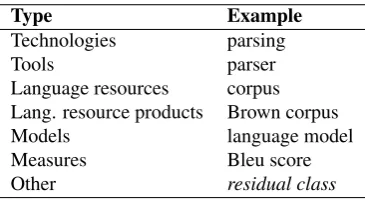
In our experiments, the ACL1 term list is used to identify all known terms. Moreover, we use a set of in-line, double-blind term and semantic class annotations (ACL RD-TEC 2.0, termedACL2) provided on a subset of abstracts from the ACL ARC (QasemiZadeh and Schumann, 2016). These annotations were created by two human annotators in a multi-step process that resulted in both term span and se-mantic class annotations, following annotations guidelines that differentiate between seven semantic classes, as shown in Table 1. We use these high-quality annotations to train our classification models. Figure 1 provides a graphical representation of our work-flow for data preparation and annotation. Data flows from green input data ellipses to gray output data ellipses are represented with dashed lines. Blue boxes represent major work steps in the process and are explained in the sections to follow.
3.1.
Data Preparation Work-flow
Annotation instances from ACL2 can be divided into 3 cat-egories:
• Perfect matches: identical term spans marked by both annotators
Type Example
Technologies parsing
Tools parser
Language resources corpus Lang. resource products Brown corpus
Models language model
Measures Bleu score
Other residual class
Table 1: Semantic classes in ACL2.
• Partial matches: overlapping, but not identical term spans
• Annotation conflicts: term spans marked by only one of the two annotators
Each instance has at least one semantic class assigned to it, but in all categories multiple (conflicting) class assign-ments can occur. Table 1 shows which semantic classes have been annotated in ACL2 (see Schumann and Qasemi-Zadeh (2015a) for details). We have prepared our training and test data as follows:
1. We extracted reliable annotation instances from ACL2. This is explained in more detail in Section 3.2. 2. We created consistentannotation typesby aggregating annotation instances by their term lemmas. We rela-beled a part of the annotations and merged the original semantic classes into larger containers. This proce-dure is explained in Section 3.3.
3. We merged both term lists (ACL1+2) to create a max-imal term list and identified term occurrences in the whole ACL ARC.
4. The classifier is described in Section 3.4.
3.2.
Extraction of Reliable Annotation Instances
From ACL2, we extracted all consensual annotations, that is, term occurrences that were annotated by both annota-tors with the same span and semantic class: Among the 4,849 manual annotation instances, 2,583 share exactly the same span, being complete matches of each other. Among those, 1,686 also share the same semantic class. Appendix A shows how these terms are distributed over the different publication years in the data set and how many abstracts were annotated for each year.
description) or “error characters”. Such units are, indeed, characteristic of academic language and should not be ig-nored. However, with the heavy skew observed, the ACL2 data set seems hardly usable for automatic prediction.
3.3.
Conversion of Annotation Instances to
Annotation Types
Since our work was aimed at creating a reliable set of se-mantic term type annotations, instance annotations from ACL2 had to be converted to annotation types. We did this by grouping the 1,686 perfect matches from ACL2 by their term lemmas, arriving at 1,490 annotation types. All “other” attributions were then reconsidered and, if neces-sary, relabeled manually. The main goal of this step was to arrive at a more even class distribution in the training data and, most notably, a smaller residual class. Since in the ACL2 data identical lemmas can have diverging semantic labels in different annotation instances, re-annotation with the aim of producing consistency with respect to other an-notationinstancesseemed justified. All relabellings were discussed by both authors of this paper. If necessary, ACL papers from the corpus were analyzed in detail. Then, to deal with very tiny classes, we merged the 7 semantic classes originally annotated in ACL2 into 4 larger classes, namely:
• Mathematics: This class contains the Models and Measures classes from ACL2.
• Technologies: This is the superclass of the ACL2 classes Technologies and Tools.
• Linguistics: This class contains terms with a linguis-tic background, that is the Language resources and Language resource products classes from ACL2 along with a relevant share of relabeled “other” instances.
• Interdisciplinary: After the re-annotation, what is left of the “other” class now contains general, higher-level interdisciplinary terms that nevertheless bear ter-minological weight.
The 4 classes were formed by merging conceptually sim-ilar tiny classes to form larger and slightly more general classes. Figure 2 provides a graphical overview of the se-mantic classes before and after merging. Green boxes rep-resent the 7 semantic classes that were manually annotated in ACL2. These were merged into 4 coarse-grained classes for more reliable automatic prediction (blue boxes). The tree in Figure 2 is also labeled with example terms from ACL23. As a result of our restructuring of the data, the
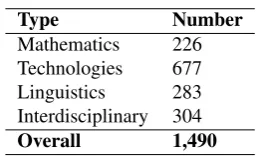
bulk of the purely linguistic terms has been moved to the Linguistics class. What remains in Interdisciplinary can now be related to technicalities of the scientific process and to scientific discourse. Examples of the Interdisciplinary class are terms such as “speech-act indirectness”, “np-hard problem”, or “telephone communication”. Table 2 gives an overview of the training data resulting from our prepara-tory work. The table shows that our efforts have produced a more even class distribution. Classes with very few in-stances have been merged with larger classes.
3
Note that due to our work-flow, we have access to both coarse-grained and fine-grained (ACL2) semantic information for the 1,490 training terms. For all remaining terms we have coarse-grained semantic labels.
Table 2: Term type distribution in training data
3.4.
Automatic prediction
In order to assign a semantic class to the unlabeled terms extracted from ACL1, we have implemented a logistic-regression classifier trained on the annotated data (ACL2). We have performed feature selection using ten-fold cross-validation. The resulting classifier uses the following fea-tures:
1. BoW: Identity of the term headword. If the term is longer than one word, we treat all words from the sec-ond as a bag of words (BoW). In this way, we give the headword of the term a special treatment, which makes it easier to identify as a trigger term for a cer-tain class.
2. Length: The length of the term in number of words, and the proportion of capitalized characters. These features help identify multi-word expressions and de-termine whether they are terminological units, or whether they are acronyms.
3. Brown: The Brown clusters (Brown et al., 1992) from the full ACL corpus for the words in the term. Brown clusters group words in a corpus according to their im-mediate surrounding bi-grams and provide good fea-tures to estimate semantic classes.
4. Embeddings: The average word embedding for all words in the term. We use embeddings from the ACL corpus with 100 dimensions and a word window of 5. Using embeddings allows us to incorporate dis-tributional information of words involved in a term that is larger in scope than the information captured by Brown clusters.
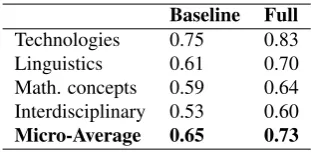
5. WordNet: The number of senses in WordNet (Miller, 1995) for the term headword, as well as the list of se-mantic types (e.g. noun.cognition) for these senses. The intuition behind these features is that more poly-semous words are more likely to be the head of terms, and by including their possible coarse-grained senses it becomes easier to characterize their semantic class. We have used ten-fold cross-validation during development to determine which classifier setup was more robust. How-ever, the classifier we used to actually tag the corpus is trained on the full dataset. In this way, the scores we pro-vide are a conservative estimate of the actual performance of the classifier. Table 3 shows the performance of the clas-sifier in terms of F1 score for the chosen clasclas-sifier, which uses all the features listed, and a comparison baseline that only usesBoW.
Terms
Mathematics
Measures character and word error rate
Models block unigram model
Technologies
Technologies bootstrapping approach
Tools IDUS (Intelligent Document Understanding System)
Linguistics
Language resources test corpus
Language resource products Roget’s Thesaurus
Interdisciplinary
Other disambiguation process
Figure 2: Taxonomic representation of the semantic categories used for training data preparation. Leaves in the tree are example terms extracted from ACL2 data.
Baseline Full
Technologies 0.75 0.83
Linguistics 0.61 0.70
Math. concepts 0.59 0.64
Interdisciplinary 0.53 0.60 Micro-Average 0.65 0.73
Table 3: F1 classification scores.
best individual score. The rather fuzzy in terms of distri-bution and lexically very varied Interdisciplinary class ex-hibits the lowest score. Conversely, the Technologies class is easier to identify because it is often made up of longer expressions and tends to show frequent, informative words likesystem.
It is not straightforward to compare our classification re-sult to the outcome of other annotation efforts, not only because there are only few such efforts, but also because annotation evaluation scenarios vary considerably. How-ever, QasemiZadeh and Schumann (2016) provide a de-tailed analysis of their manual annotation of the same data set. They report class-wise IAA scores that range between 0.44 (for the Model class, compare Figure 2) and 0.83 (for the Tool class, which is easily identifiable, but too small for classification, compare Appendix A), respectively. This shows that in manual annotation, too, class parameters in-fluence annotation quality. The overall quality of our au-tomatic classification, therefore, seems reasonably close to that of the current manual annotation benchmark. It must be noted, however, that the score reported by QasemiZadeh and Schumann (2016) is a combined score for both term identification and semantic class assignment.
We also performed a manual analysis of a small subset of the predictions, namely a 30-term subset for each of the four classes. Out of thirty examples of the Technolo-gies category, we only would relabel one (“bottom-up ap-proach”) as part of Interdisciplinary. In the predictions for
Linguistics, we find the false positive “electronic mail”, which should be a Technology. This mis-prediction is a result of the WordNet feature providing the super-sense noun.communicationto the word “mail”. The Mathematics category ends up being the label of choice for all expres-sions with the word “model” as a headword (“IBM Mod-els 1-2”). “Model” is a fairly polysemous word that could yield terms of any category, but the frequency and the an-notation preference for labeling them as terms in Mathe-matics enforces this bias. The Interdisciplinary class does indeed contain more noise, and has many terms that should belong to the Linguistics category (“simultaneous speech” or “subject-object relation”). We attribute the permeation between these two classes to some of the features that give account for polysemy, as both Linguistics and Interdisci-plinary contain more words with numerous possible senses, in addition to being the classes with highest word variety in terms of type–token ratio. Our manual analysis corrobo-rates that Technologies is by far the most reliable label of our predictions. Appendix B shows some of the examples that underwent the manual analysis just described. For each term, the table shows the classification probabilities given by our classifier for the four possible classes. The value for the resulting class is highlighted in bold.
4.
Analysis of Resulting Data Set
4.1.
Structure
1965– 1970– 1975– 1980– 1985– 1990– 1995– 2000– 0
0.5 1 1.5·10
6
5-year periods
Annotated
terms
Overall
Technologies
Mathematics
Interdisciplinary
Linguistics
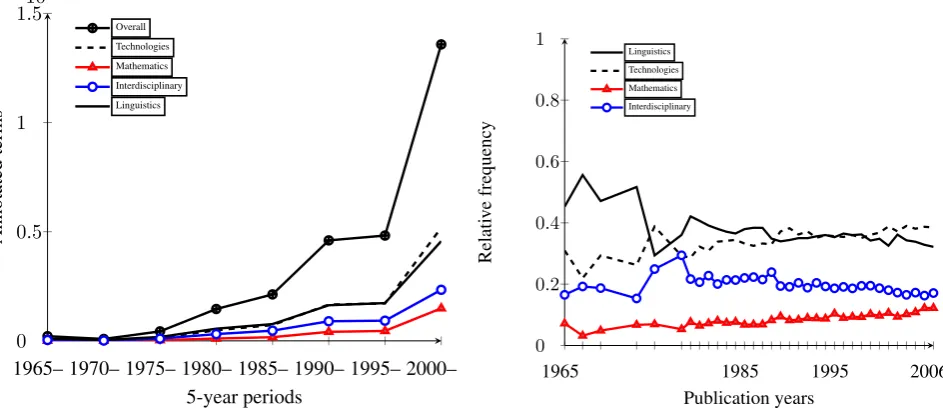
(a) Number of term occurrences with semantic label over time.
1965 1985 1995 2006
0 0.2 0.4 0.6 0.8 1
Publication years
Relati
v
e
frequenc
y
Linguistics
Technologies
Mathematics
Interdisciplinary
(b) Relative importance of semantic classes over time.
Figure 3: Classification results: annotated terms and semantic classes over time.
4.2.
Querying the Data
As pointed out earlier, we maintain that semantic class an-notations facilitate the analysis of scientific text corpora. In the last section of this paper, we, therefore, sketch some of the research questions that can be tackled through multi-dimensional analyses involving both the term and the se-mantic class level.
One of the most prominent properties of the ACL data as a whole is its exponential growth over time. This find-ing is supported by Figure 3a which plots the number of known and semantically labeled terms over time periods of 5 years. The tendency of scientific disciplines to grow ex-ponentially has been described already by Menard (1971) and it is, indeed, a property that informs all studies on the ACL data. Figure 3b plots the classification results over time, when class-wise term counts are normalized by the number of all terms per year. Thus, the plot shows the rel-ative importance of each semantic class over the course of the publication period. The probably most prominent trend in this plot is that Linguistics and Technologies, over the years, switch ranks, with Linguistics slightly losing impor-tance and Technology mentions becoming more frequent. We also observe a slight, but steady increase in the relative frequency of terms referring to mathematical concepts. To check whether our dataset allows us to ask more specific questions about the development of computational linguis-tics, we set up a simple database holding information about both terms, their semantic classes and term occurrences across all publication years. We have used this database to extract frequency data that was further analyzed with the following techniques:
• We used word rank comparisons to identify “trending” terms, that is, lexical units that gain importance in a given period, as proposed by Schumann and Qasemi-Zadeh (2015b). The method is based on the
compari-1986–1989 2000–2006
tree measure
formalism language model
user model f-measure
representations n-gram domain model distribution discourse model f-score
measure n-grams
perplexity nist
language model translation model projection parse tree
Table 4: Mathematics terms with high positive frequency rank shifts in two different time intervals. In both cases, frequency counts were compared to frequency counts from the preceding time interval.
son of two ranked word lists for consecutive time pe-riods and identifies lexical units that undergo a strong positive rank shift, that is, words that exhibit an “up-wards” movement in the transition from one time pe-riod to the next.
• We used frequency and productivity scores to analyze individual terms’ life cycles, as proposed by Schu-mann (2016). In this approach, productivity is formal-ized in terms of entropy, that is, a base term with many and frequently used related multi-word units is consid-ered particularly productive. Unlike simple frequency analysis, this approach helps, for instance, to differen-tiate between short-term tendencies and longer-term trends.
distribution measure
1986–1989 1990–1996 1986–1989 1990–1996
distribution distribution measure measure
probability distribution probability distribution distance measure f-measure
gaussian distribution uniform distribution similarity measure similarity measure binomial distribution joint distribution evaluation measure evaluation measure class distribution normal distribution association measure distance measure probability distribution matrix frequency distribution confidence measure statistical measure
binomial distribution theoretic measure f measure
distributional similarity cosine measure
prior distribution precision measure
gaussian distribution association measure
. . . .
Table 5: Top terms matching “distribution” and “measure” in two time periods. Terms are sorted by their frequencies.
instance, we counted the occurrences of terms pertaining to Mathematics in 4 time intervals: 1980-1985, 1986-1989, 1996-1999, and 2000-2006. Using the rank comparison technique, we could then contrast different methodologies and models that were popular in computational linguistics research at different times. Table 4 exemplifies this by giv-ing an overview of the terms with the highest positive fre-quency rank shifts from Mathematics for two different time intervals.
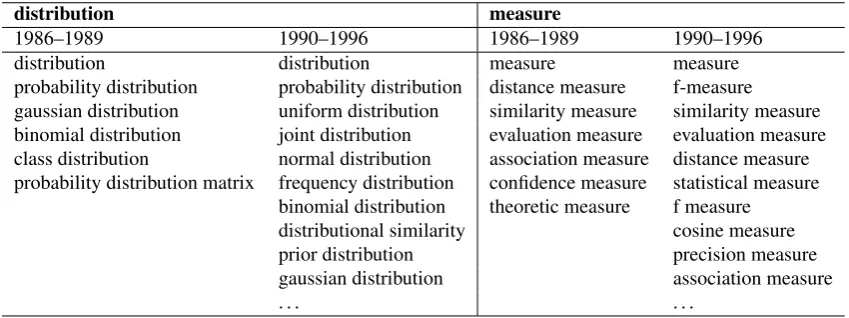
On the basis of the comparison exemplified in Table 4, it seems relatively easy to contrast explicit, knowledge-based or abstract modeling in the 1980s with scoring and statisti-cal analysis, approaches that were prominently used in the later time period. However, the table also seems to indi-cate that there is nothing disruptive about this change in the Mathematics class. Rather, concepts like “measure” or “language model” seem to have kept gaining impor-tance, whereas other concepts seem to have stagnated. This claim can easily be substantiated by querying our database for frequencies and collocations containing terms such as “feature”, “distribution”, “measure”, or “model”. These terms exhibit strong productivity increases, that is, a grow-ing number of related multi-word units, in the 1980s and a continuous increase in frequency over the complete pe-riod of time under study. This means that these terms, at the time of their rise, did not necessarily denote completely novel concepts, but they have found new fields of applica-tion or new ways were found to build and apply such mod-els, features, etc. In this sense, terms like “distribution” or “measure” can be hypothesized to constitute motors of sci-entific innovation. Table 5 details the results of example queries for the terms “distribution” and “measure” for only two time periods, namely 1986–1989 and 1990–1995. The rise in productivity for the two terms over this short time period seems rather strong, however, as claimed before, the examples illustrate a scientific evolution rather than a dis-ruptive change. It is an interesting task to identify the area of computational linguistics that has initiated this develop-ment, and with the rich data set presented here, it seems actually feasible to solve this task.
By repeating the analysis for the Technologies class we were able to highlight some interesting technological trends that have been prominent in computational linguistics over
the last decades. For the 1990–1995 interval, for instance, the ranks shift analysis highlights the following trends: the use of WordNet as a lexical resource, the use of finite-state transducers for complex analysis tasks, work on word sense disambiguation, but also on part-of-speech tagging and other kinds of linguistic annotation, to mention only the most prominent items in our result list. Techniques used are not purely statistical, as highlighted by terms such as “lexi-cal rule” or “heuristic”.
For the 2000–2006 period, many of the lexical units high-lighted by the rank shifts analysis in Technologies are re-lated to recent work on the use of machine learning in com-putational linguistics, e. g. terms such as “classifier” or “feature”. However, ontologies have also gained impor-tance and the 2000–2006 slice of Technologies includes novel lexical units such as “ontology learning”, “ontol-ogy acquisition”, or “ontol“ontol-ogy induction”. Annotation, both manual and automatic, remains an important topic and FrameNet is introduced as a new resource. The growing use of the term “NLP” and the rise of statistical machine translation seem to constitute other important tendencies.
5.
Conclusion
per-form this analysis on a more fine-grained level and search for interesting phenomena in actual subfields of computa-tional linguistics. We have also shown that the analysis of mere frequency and productivity information allows us to identify some of the concepts that have in the past served as motors of innovation, such as the concepts “measure” and “distribution”. In the future we hope to develop an inte-grated methodology that will be able to reliably relate terms and groups of terms to specific time periods and subfields and to trace scientific innovations back to the nuclei from which they originated.
6.
Bibliographical References
Asooja, K., Bordea, G., Vulcu, G., and Buitelaar, P. (2016). Forecasting Emerging Trends from Scientific Literature. InProceedings of the 10th International Conference on Language Resources and Evaluation (LREC 2016). Eu-ropean Language Resources Association.
Babko-Malaya, O., Seidel, A., Hunter, D., HandUber, J. C., Torrelli, M., and Barlos, F. (2015). Forecasting Tech-nology Emergence from Metadata and Language of Sci-entific Publications and Patents. In Proceedings of the 15th International Conference on Scientometrics and In-formetrics (ISSI 2015). Bo˘gaziçi Universitesi.
Bergamaschi, S., Bouquet, P., Giazomuzzi, D., Guerra, F., Po, L., and Vincini, M. (2007). An Incremental Method for the Lexical Annotation of Domain Ontologies. Inter-national Journal on Semantic Web and Information Sys-tems (IJSWIS), 3(3):57–80.
Bird, S., Dale, R., Dorr, B., Gibson, B., Joseph, M., Kan, M.-Y., Lee, D., Powley, B., Radev, D., and Tan, Y. F. (2008). The ACL Anthology Reference Corpus: A Ref-erence Dataset for Bibliographic Research in Compu-tational Linguistics. InProceedings of the 6th Interna-tional Conference on Language Resources and Evalua-tion (LREC 2008). European Language Resources Asso-ciation.
Brown, P. F., Desouza, P. V., Mercer, R. L., Pietra, V. J. D., and Lai, J. C. (1992). Class-Based n-gram Mod-els of Natural Language. Computational Linguistics, 18(4):467–479.
Codd, E., Codd, S. B., and Salley, C. T. (1993). Pro-viding OLAP (On-Line Analytical Processing) to User-Analysts: An IT Mandat. Technical report, E.F. Codd & Associates.
Fleck, L. (1980). Entstehung und Entwicklung einer wis-senschaftlichen Tatsache. Einführung in die Lehre vom Denkstil und Denkkollektiv. Suhrkamp, Frankfurt am Main. First edition in 1935, Benno Schwabe & Co., Basel.
Francopoulo, G., Mariani, J., and Paroubek, P. (2016). Predictive Modeling: Guessing the NLP Terms of To-morrow. InProceedings of the 10th International Con-ference on Language Resources and Evaluation (LREC 2016). European Language Resources Association. Gupta, S. and Manning, C. D. (2011). Analyzing the
Dy-namics of Research by Extracting Key Aspects of Sci-entific Papers. In Proceedings of the 5th International Joint Conference on Natural Language Processing
(IJC-NLP 2011). Asian Federation of Natural Language Pro-cessing.
Hall, D., Jurafsky, D., and Manning, C. D. (2008). Study-ing the History of Ideas UsStudy-ing Topic Models. In Con-ference on Empirical Methods in Natural Language Pro-cessing. Association for Computational Linguistics. Heyer, G., Kantner, C., Niekler, A., Overbeck, M., and
Wiedemann, G. (2016). Modeling the dynamics of do-main specific terminology in diachronic corpora. In Pro-ceedings of 12th International conference on Terminol-ogy and Knowledge Engineering (TKE 2016).
Ji, H. and Grishman, R. (2011). Knowledge Base Popu-lation: Successful Approaches and Challenges. In Pro-ceedings of the 49th Annual Meeting of the Association for Computational Linguistics (ACL 2011). Association for Computational Linguistics.
Kuhn, T. S. (1962). The Structure of Scientific Revolutions. University of Chicago Press.
Mariani, J., Paroubek, P., Francopoulo, G., and Hamon, O. (2014). Rediscovering 15 Years of Discoveries in Lan-guage Resources and Evaluation: The LREC Anthology Analysis. InProceedings of the 9th International Con-ference on Language Resources and Evaluation (LREC 2014). European Language Resources Association. Menard, H. W. (1971). Science: Growth and Change.
Har-vard University Press, Cambridge, Mass.
Michaelis, J. R., Mcguiness, D. L., Chang, C., and Babko-Malaya, O. (2013). Towards explanation of scientific and technological emergence. In IEEE/ACM Interna-tional Conference on Advances in Social Networks Anal-ysis and Mining 2013.
Miller, G. A. (1995). WordNet: a lexical database for En-glish.Communications of the ACM, 38(11):39–41. Montoyo, A., Palomar, M., and Rigau, G. (2001).
Word-Net Enrichment with Classification Systems. In Pro-ceedings of WordNet and Other Lexical Resources: Ap-plications, Extensions and Customisations Workshop. The Second Meeting of the North American Chapter of the Association for Computational Linguistics (NAACL 2001). Association for Computational Linguistics. Pekar, V. and Staab, S. (2003). Word classification based
on combined measures of distributional and semantic similarity. InProceedings of the 10th Conference of the European Chapter of the Association for Computational Linguistics (EACL 2003). Association for Computational Linguistics.
Popescu, A., Grefenstette, G., and Moëllic, P. A. (2008). Gazetiki: Automatic Creation of a Geographi-cal Gazetteer. InProceedings of the 8th ACM/IEEE-CS Joint Conference on Digital libraries. ACM.
Q. Zadeh, B. and Handschuh, S. (2014). The ACL RD-TEC: A dataset for Benchmarking Terminology Extrac-tion and ClassificaExtrac-tion in ComputaExtrac-tional Linguistics. In Proceedings of the 4th International Workshop on Com-putational Terminology (Computerm). Association for Computational Linguistics and Dublin City University. QasemiZadeh, B. and Schumann, A.-K. (2016). The ACL
Proceedings of the Tenth International Conference on Language Resources and Evaluation (LREC 2016). Eu-ropean Language Resources Association (ELRA). Ruiz-Casado, M., Alfonseca, E., and Castells, P. (2007).
Automatising the learning of lexical patterns: An appli-cation to the enrichment of WordNet by extracting se-mantic relationships from Wikipedia. Data & Knowl-edge Engineering, 61(3):484–499.
Schumann, A.-K. and QasemiZadeh, B. (2015a). The ACL RD-TEC Annotation Guideline: A Reference Dataset for the Evaluation of Automatic Term Recognition and Clas-sification. Technical report.
Schumann, A.-K. and QasemiZadeh, B. (2015b). Tracing Research Paradigm Change Using Terminological Meth-ods: A Pilot Study on “Machine Translation” in the ACL Anthology Reference Corpus. InProceedings of 11th ternational Conference on Terminology and Artificial In-telligence. CEUR Workshop Proceedings.
Year Lang. resources Lang. resource products Measures Models Other Technologies Tools Sum Abstracts
1978 0 0 0 0 36 4 0 40 3
1980 0 0 0 1 12 9 2 24 5
1982 0 0 0 0 16 11 4 31 3
1984 0 0 0 2 37 17 1 57 5
1986 0 0 0 1 91 10 2 104 7
1988 6 0 0 4 40 23 3 76 12
1990 14 1 2 0 52 25 0 94 11
1992 8 9 4 2 75 60 6 164 19
1994 5 1 2 6 88 57 4 163 16
2001 4 0 18 14 89 88 4 217 18
2003 26 0 18 29 158 111 4 346 29
2005 17 0 20 12 89 64 2 204 23
2006 7 1 11 2 95 44 6 166 20
Overall 87 12 75 73 878 523 38 1,686 171
Appendix A: Time distribution of semantic classes in ACL2 (perfectly matching instances).
Term Technologies Linguistics Interdisciplinary Mathematics
general-to-specific learning 0.97 0.00 0.03 0.00
spoken document categorization 0.74 0.25 0.01 0.00
arabic stemmer 0.89 0.05 0.06 0.00
constraint propagation algorithm 0.97 0.00 0.00 0.03
token processing 0.98 0.00 0.01 0.01
standard grammar textbook 0.40 0.54 0.03 0.02
pre-discourse meaning 0.02 0.88 0.09 0.01
korean language 0.01 0.96 0.02 0.01
case particle 0.13 0.78 0.03 0.05
prosody 0.08 0.52 0.36 0.04
knowledge editing 0.30 0.00 0.69 0.00
multilingual information exchange 0.31 0.00 0.68 0.01
simultaneous speech 0.18 0.12 0.69 0.01
subject-object relation 0.01 0.28 0.67 0.05
categorisation research 0.46 0.03 0.50 0.00
homomorphism 0.08 0.17 0.31 0.44
IBM Models 1-2 0.09 0.00 0.02 0.88
time complexity 0.00 0.00 0.39 0.61
bigram distribution modelling 0.27 0.00 0.00 0.73
likelihood reestimation 0.43 0.00 0.00 0.57