Computer-assisted Speaker Diarization: How to Evaluate Human Corrections
Broux Pierre-Alexandre
1,2, Doukhan David
2, Petitrenaud Simon
1, Meignier Sylvain
1, Carrive Jean
21: Computer Science Laboratory Le Mans University (LIUM - EA 4023), Le Mans, France 2: French National Audiovisual Institute (INA), Paris, France
[email protected], [email protected], [email protected], [email protected], [email protected]
Abstract
In this paper, we present a framework to evaluate the human corrections of a speaker diarization. We propose four elementary actions to correct the diarization and an automaton to simulate the correction sequence. A metric is described to evaluate the correction cost. The framework is evaluated using French broadcast news drawn from the REPERE corpus.
Keywords:Speaker diarization, annotation, Human-Computer Interaction (HCI), evaluation
1.
Introduction
The work presented in this paper has been realized to cope with some needs of the French National Audiovisual In-stitute (INA). INA is a public institution in charge of the preservation and the promotion of French audiovisual her-itage. The promotion task partly relies on the annotation of audiovisual document collections. The annotation consists in enriching the documents with summaries, keywords or participant names in order to satisfy the complex queries elaborated by INA customers or researchers within media databases.
However, due to the increasing number of documents and the limited number of annotators, many documents remain undocumented or only partly documented. The informa-tion provided by the annotainforma-tion greatly varies according to the kind of archives: the broadcast news is usually finely annotated, while the other programs such as games, docu-mentaries, variety shows or reality shows are much less an-notated. Thus, enterprises owning large undocumented or partly documented collections such as INA need to exploit their resources even better. One of the solutions to facilitate the annotation and improve the access to its documents is to use automatic speech and speaker recognition technolo-gies as proposed in Charhad et al. (2005; Ordelman et al. (2009; Vallet et al. (2016).
The speaker diarization task is a necessary pre-processing step for speaker identification (Bonastre et al., 2000) or speech transcription (Anguera et al., 2012) in broadcast shows. The speaker diarization and speaker identification tasks allow to determine « who spoke when ». Speaker di-arization systems are generally based on unsupervised seg-mentation and clustering methods, in charge of estimating the number of speakers, and splitting the audio stream into labeled speech segments assigned to anonymous speakers. However, state-of-the-art speaker diarization systems are still not sufficiently accurate to be employed into most of INA’s applications, mainly because of the wide variety of INA’s collections. The variety relates to the time period (from the end of the nineteenth century to nowadays), the type of broadcast or the recording conditions. For these various reasons, human interventions are most of the time required to obtain robust annotations.
Entirely manual annotation of speech cannot be a reason-able solution as it is a very expensive process. Indeed, nine hours are required to perform the manual annotation corre-sponding to one hour of spontaneous speech (speech tran-scription and speaker identity) (Bazillon et al., 2008). Thus, a human annotator should be assisted by an automatic sys-tem to be efficient.
In this paper, we propose a framework to experiment hu-man assisted diarization methods. More precisely, the aims are to build an automaton which simulates the annotator corrections and to propose a metric to evaluate these cor-rections.
In this paper, firstly, we present the state of the art in the field of annotation in speech or speaker recognition sys-tems. Then, we propose an overview of a human assisted diarization system and we propose a new metric to evaluate such systems. In the following part, we describe the human actions used to correct the diarization. Before concluding, we measure the duration of each action to build the pro-posed metric and we evaluate an oracle system based on the automaton.
2.
Related work
the correction of a diarization system reducing the number of human interventions. In that paper, the annotator only corrects speaker clustering errors and the segmentation was assumed to be perfect. More precisely, the input of our system was a segmentation obtained from the ground truth and a hierarchical agglomerative clustering was applied to this segmentation. These last two papers are focused on the correction of clustering errors and forget the segmentation errors. Moreover, the authors unfoundedly assumed that every kind of correction has the same cost. This assump-tion is not judicious, since each correcassump-tion requires specific actions from the annotator. These actions require different mental efforts, a different physical effort and provides a dif-ferent result. For example, it can be assumed that it is easier to change the speaker label (with the use of an exhaustive list of potential speakers) than to create a new speaker label, since it is not provided and the annotator may need much time to find it.
3.
Human assisted diarization system
In this section, we propose an overview of a human assisted diarization system as well as a new metric to evaluate such systems.
[image:2.595.53.288.368.579.2]3.1.
Description of the system
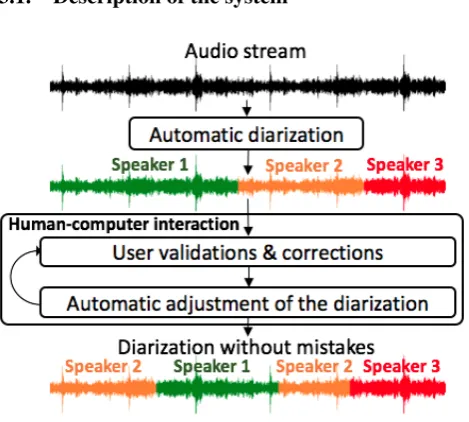
Figure 1: Architecture of a diarization system assisted by the human
Figure 1 presents the architecture of a diarization system assisted by a human. It is composed of two main parts. The first one consists in providing an automatic diarization from an audio stream. An initial segmentation of the stream is then obtained. The second one consists of asking a human to correct the output of the first part. Each human correction is in turn taken into account by a system which improves the diarization, generally making easier the remaining actions of the annotator. According to the target, the annotator can achieve corrections for the clustering task and/or the seg-mentation task. At the end of the process, the diarization error rate (DER (NIST, 2003; Galibert, 2013)) is expected to have decreased thanks to human and system corrections. It is recalled that the DER is the fraction of speaking time
which is not attributed to the correct speaker by using the best matching between speaker labels of the references and the hypotheses.
3.2.
Experimental framework
From the framework presented in the preceding section, several rules have been defined:
1. the annotator is simulated by an automaton and does not make any error (it is a noiseless automaton);
2. the annotator corrects the show from the beginning to the end in temporal order so as to validate the auto-matic annotation done a posteriori;
3. only the current speech turn can be corrected by the annotator.
The noiseless automaton rule allows to avoid the complex random modeling of the error according to the annotator. Moreover, this natural simplification allows to have a docu-ment without any error at the end of the correction process and thus a DER equals to 0%.Correcting from the begin-ning to the end is supposed to help the annotator under-standing and improving the correction. This rule and the last one are experimental conditions chosen to facilitate our problem. They can be questioned thereafter.
3.3.
Proposed metric: HCIQ
Since the DER measures the quality of a diarization (NIST, 2003), it is not relevant to evaluate human interactions. A new metric similar to the Keystroke Saving used in word prediction for people with communication difficulty (Wood and Lewis, 1996) is proposed. We called it Human-Computer Interaction Quantity (HCIQ). This metric esti-mates the human intervention cost for the diarization cor-rection. The HCIQ can be computed both for assisted sys-tems and syssys-tems where a human corrects the diarization alone. Furthermore, as well as the DER, the HCIQ can be computed for each recording or for a set of audio/video recordings. It is defined by the formula:
HCIQ=
K
X
i=1
wini,
where the indexi corresponds to a correction action type in the interface,wiis its associated cost,ni the number of times the annotator has applied this action type and K is the number of different action types.
The lower the HCIQ measure, the lower the correction du-ration of the annotation will be. By the way, it allows to compare different assisted diarization systems in a objec-tive way.
The HCIQ measure, in its current form, does not allow to compare different corpora. In order to resolve it, we pro-pose the following formula:
HCIQn=
HCIQ
d ,
ratio of the number of corrections to do for a unit of time. For a given corpus, when HCIQn increases, the amount of corrections increases also.
The HCIQ is close to others metrics that assess the amount of effort needed to correct a given kind of errors. For in-stance, the word error rate (WER (McCowan et al., 2004)) estimates the number of incorrect words in a transcription and the translation edit rate (TER (Snover et al., 2006)), which is derived from the WER, assesses the number of corrections needed for a human to reach the reference trans-lation.
4.
Annotator and assisted diarization tools
In this section, we describe the annotation software and the authorized correction actions which we used to correct a diarization.
4.1.
Annotation software: Transcriber
To choose the human actions needed to the correction, we relied onTranscriber, a reference software in speech tran-scription and annotation.
This software allows to cut an audio stream into segments. Each segment corresponds to a speech zone and is labeled with a speaker name. This label may be enriched by in-formation such as the gender or the native language of the speaker.
In Transcriber, the segmentation actions are "Create a boundary", "Delete a boundary" and "Move a boundary". The "Create a boundary" action adds a boundary by cutting a segment into two pieces, the "Delete a boundary" action merges two consecutive segments and the "Move a bound-ary" action moves the boundary of a segment. Concern-ing the clusterConcern-ing actions,Transcriberoffers the "Create a speaker label" and "Change the speaker label" actions. The former allows to create a new speaker label for the current segment whereas the latter allows to change the speaker la-bel.
4.2.
Correction actions
In order to facilitate the creation of a simulated annotator, the series of actions will be deterministic. No action can be substituted by a set of actions providing the same cor-rection. One of theTranscriberactions does not fulfill this criterion. The "Move a boundary" action can be replaced by the two following actions: "Create a boundary" and "Delete a boundary".
To sum up, we kept two actions for modifying the segment boundaries and two actions for modifying the labels. By combining these actions, we can describe all the corrections in a unique way. Finally, the four selected actions used in the HCIQ metric are :
• "Create a boundary",
• "Delete a boundary",
• "Create a speaker label",
• "Change the speaker label".
5.
Experiments
In this section, we present the corpus used for our experi-ments, the measure of the action duration in order to build the proposed metric and the evaluation of an oracle system based on the automaton.
5.1.
Corpus
The experiments have been applied on TV recordings from the 2013 evaluation campaign of the challenge ANR-REPERE1. The TV shows come from two French channels
(BFM and LCP). They are mainly composed of talk shows and new broadcasts.
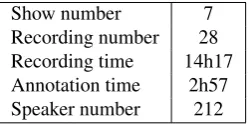
[image:3.595.361.486.224.286.2]Show number 7 Recording number 28 Recording time 14h17 Annotation time 2h57 Speaker number 212
Table 1: REPERE test 2013 description
Table 1 describes the corpus used in the experiments. The corpus is balanced : it contains spontaneous and prepared speech. It is made up of street interviews, debates and infor-mation shows but only a part of the data is annotated (Kahn et al., 2012).
5.2.
Measure of the action duration
According to Arora et al. (2009), three variables can di-rectly affect the assessment of the action duration: the in-terface, the annotator and the annotated document. So as to obtain an accurate assessment, each of these variables is studied.
5.2.1. The interface
The assessment of action duration varies according to the used interface. The more ergonomic it is, the more a user quickly annotates and the more the annotation time de-creases. Transcriber offers good ergonomics. In Tran-scriber, a human generally cuts the audio stream by putting boundaries on speaker changes, silences or breaths. In our framework, only speaker changes are useful and are anno-tated.
5.2.2. The annotator
The annotation time varies according to the experience the annotator can have both in annotation itself and in the an-notation software. If a person is used to annotate, he or she will effective and the annotation will take little time. Moreover, people frequently using an annotation software correct more quickly than people discovering it. Therefore, there are two possible strategies to measure the action du-ration:
1. using the average of time of annotators having the same experience;
2. using the average of time of annotators having several experiences.
The former one allows to obtain specific time which can be useful in accordance with the aim. The latter one, that we chose in our experiments, offers global time covering different annotator profiles with variable expertise levels. Unfortunately, this time is constrained by the annotator pro-files which we have at our disposal.
5.2.3. The annotated document
As far as speech is concerned, the audio documents can mainly be separated in three groups: telephone, meeting and (radio/TV) show. These three groups essentially varies according to two points: the audio stream quality and the spontaneous degree. The spontaneous degree is correlated with the disfluency number. When the degree is high, the disfluency number is also high and the clauses are more un-grammatical. The spontaneous degree implies various phe-nomena such as overlapped speech, false starts, etc. (Bazil-lon et al., 2008; Dufour et al., 2009). When the signal quality is low, it is more difficult to annotate. Furthermore, when the spontaneous degree is high due to the overlapped speech, it is more complicated to determine who speaks when, and then it is more difficult to annotate. The signal quality and the spontaneous degree have consequences on the human annotation time (Bazillon et al., 2008). There-fore, two strategies can also be conceivable:
1. annotating various documents;
2. annotating specific documents.
We choose the latter strategy. Thus the documents to anno-tate are good audio quality with a low spontaneous degree. This choice allows to facilitate the measure of annotation time.
5.2.4. Evaluation
In section 4.2., we selected four correction actions. Now, we propose a method to estimate the average duration of each action, in the framework we defined previously. The history of mouse clicks and keyboard strokes inTranscriber permits to indirectly determine the successive actions and to precisely assess the duration of each action. To record this detailed log file, we had to modify the Transcriber code. A log file input, i.e. a mouse click or a keyboard stroke, contains three types of information : the click or the stroke time, the active module name and a comment (figure 2). The module identifies an element of the user in-terface whereas the comment gives accurate details on the event in progress.
The log file itself is not enough to determine the actions in an automatic way. Indeed, the annotator can make some mistakes or take a break during the annotation session. To solve this problem, the recording of the user screen is man-ually segmented into one or several actions thanks to the log file. Thus the measured duration accurately correspond to the actual actions.
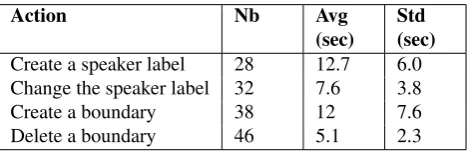
In accordance with 5.2.3., only the regions with few sponta-neous speech and without overlapping speech are annotated to assess the annotation time for each action. Table 2 shows the results of the duration of actions.
[image:4.595.304.543.68.239.2]The most time consuming actions are the ones consisting to "Create a speaker label" and "Create a boundary", with an
Figure 2: Example of a log file
Action Nb Avg
(sec)
Std (sec) Create a speaker label 28 12.7 6.0 Change the speaker label 32 7.6 3.8
Create a boundary 38 12 7.6
Delete a boundary 46 5.1 2.3
Table 2: Duration of actions - 20 min of REPERE test 2013 data. Nb: Number of occurrences; Avg: Average duration; Std: Standard deviation.
average of about 12-13 seconds.The first action requires to enter a speaker label (and possibly other speaker meta data), while the second action requires to look and listen to the signal to detect the speaker boundary. Moreover, it is gen-erally necessary to listen to the signal several times to place a new boundary. The action called "Change the speaker la-bel" has an average of 7.6 seconds. Thanks to a contextual window, it consists in selecting the correct speaker label in a drop-down list. Looking for a label in a drop-down list takes a less mental effort compared to the boundary cre-ation. The fastest action is the "Delete a boundary" ac-tion. It requires to stop listening when a false boundary is detected and to delete it by a simple keyboard key com-bination. Correcting an error is in reality built upon three phases:
1. detecting the presence of an error;
2. finding the place of the error;
3. correcting the error.
Each action duration in table 2 represents the sum of the time of these three phases. However, these durations do not take into account the listening time.
5.3.
Evaluation of an oracle system
The simulated annotator relies on two types of information to determine whether a correction is required at timet:
• the correspondence between the reference segment (ground truth) and the hypothesis segment;
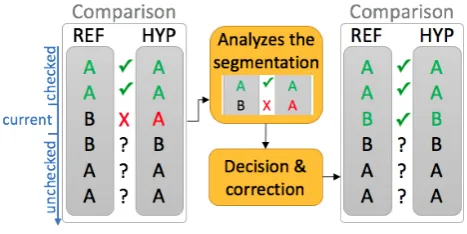
[image:4.595.306.540.264.340.2]Figure 3: Illustration of the simulated annotator
If there is at least one discordance in the diarization at timet
between the reference and the hypothesis, the simulated an-notator firstly corrects the segmentation errors and then the speaker clustering errors (figure 3). After each correction, the system can run a diarization system on the unchecked part (segments with start time> t) by taking into consid-eration the already checked segments (segments with end time≤t).
Without segmentation errors, the clustering correction is easy to set up (Broux et al., 2016). The segmentation cor-rection is more difficult, the simulated annotator needs to deal with the accuracy of the reference boundaries. To solve this problem, a tolerance of more or less 250 ms is gener-ally applied to the boundaries of the reference segments for the DER computation. We applied the same tolerance to avoid the numerous and generally useless corrections. So before the assessment of the potential discordance between the reference and the hypothesis, any hypothesis boundary belonging to a tolerance area is moved in order to be aligned with the reference boundary.
The simulated annotator becomes an oracle system when no automatic adjustment is performed as corrections. The oracle system evaluation is reported in table 3. The HCIQ of the test corpus is 331.6 minutes and corresponds to the sum of all duration estimations (table 3). The input tion of the oracle is provided by the full-automatic diariza-tion system described in Meignier and Merlin (2010). The DER of the input diarization is 13.80%.
Action Nb D (min)
[image:5.595.306.540.166.241.2]Create a speaker label 295 62.4 Change the speaker label 463 58.7 Create a boundary 986 197.2 Delete a boundary 156 13.3
Table 3: Correction for the oracle system - REPERE test 2013. Nb: Number of occurrences; D: duration estimation (Avg duration×number of occ.)
The occurrence number of the segmentation actions is about one and a half greater than the clustering action num-ber (respectively 1142 and 758). Segmentation corrections represent about 65% of the total correction time (210.5 min-utes). The "Create a boundary" action is the most costly action, since it corresponds to about 52% of the overall cor-rections. For an audio recording of 2h57 (177 min), an an-notator will take 3h17 (197.2 min) to create boundaries.
If the simulated annotator only corrects the clustering er-rors, the DER is 5.59% at the end of the correction process. These 5.59% errors are due to the wrong segmentation. This result shows that segmentation errors and clustering errors approximately contribute to 40% and 60% respec-tively of the DER. Compararespec-tively, the segmentation errors correspond to the main correction cost in terms of HCIQ.
Corpus HCIQ
(min)
AT (min)
HCIQn
ESTER test 2003 477.2 592 0.81 ESTER test 2009 482.0 430 1.12 ETAPE test 2012 793.7 418 1.90 REPERE test 2013 331.6 177 1.87
Table 4: Comparison of HCIQnobtained from corrections of the oracle system on several corpora. AT: annotation time
Table 4 compares the HCIQnof the REPERE test 2013 cor-pus to others. It shows that the REPERE corcor-pus is one of the corpora which requires the most corrections for a unit of time since it needs on average 1.87 minutes of human cor-rections for 1 minute of audio signal. Moreover, it demon-strates that the ETAPE and REPERE corpora, being mainly more composed of spontaneous speech (false starts, repeti-tion, overlapped speech, interjections, etc (Bazillon et al., 2008)) than the ESTER corpora, are enhanced with high HCIQn.
6.
Conclusions
In this paper, we proposed a framework to assess any inter-active system of diarization taking into account the human corrections. The combination of four actions permits to de-scribe the correction steps in a single way. We proposed a metric used to precisely determine the duration of each ac-tion in order to assess the cost of the human-computer in-teractions. The evaluation of an oracle system on REPERE test 2013 shows that segmentation corrections take longer than the clustering corrections. The results of the oracle demonstrates the importance of segmentation errors on the HCIQ and the DER as well. The correction of segmentation errors increases the HCIQ measure whereas it affects the DER in a negligible way. Only the correction of clustering errors directly decreases the DER measure. Future work will be focus on the development of an embedded speaker diarization system to reduce the correction time. Then, a study will be done to determine how to call a human with parsimony (i.e. in some parts of the document) by having a sufficient annotation of the document for a targeted ap-plication. The input diarization system will be modified as well, in particular the segmentation step.
7.
Bibliographical References
[image:5.595.53.288.569.631.2]Arora, S., Nyberg, E., and Rosé, C. P. (2009). Estimating annotation cost for active learning in a multi-annotator environment. In Proceedings of the NAACL HLT 2009 Workshop on Active Learning for Natural Language Processing, pages 18–26. Association for Computational Linguistics.
Barras, C., Geoffrois, E., Wu, Z., and Liberman, M. (2001). Transcriber: development and use of a tool for assist-ing speech corpora production. Speech Communication, 33(1):5–22.
Bazillon, T., Estève, Y., and Luzzati, D. (2008). Transcrip-tion manuelle vs assistée de la parole préparé et spon-tanée. Revue TAL.
Bonastre, J.-F., Delacourt, P., Fredouille, C., Merlin, T., and Wellekens, C. (2000). A speaker tracking sys-tem based on speaker turn detection for nist evalua-tion. In Acoustics, Speech, and Signal Processing, 2000. ICASSP’00. Proceedings. 2000 IEEE International Conference on, volume 2, pages II1177–II1180. IEEE. Broux, P.-A., Doukhan, D., Petitrenaud, S., Meignier, S.,
and Carrive, J. (2016). An active learning method for speaker identity annotation in audio recordings. In 1st International Workshop on Multimodal Media Data Analytics (MMDA), In conjuction with the 22nd European Conference on Artificial Intelligence (ECAI). Budnik, M., Poignant, J., Besacier, L., and Quénot, G.
(2014). Automatic propagation of manual annotations for multimodal person identification in tv shows. In Content-Based Multimedia Indexing (CBMI), 2014 12th International Workshop on, pages 1–4. IEEE.
Charhad, M., Moraru, D., Ayache, S., and Quénot, G. (2005). Speaker identity indexing in audio-visual documents. In Content-Based Multimedia Indexing (CBMI2005).
Dufour, R., Jousse, V., Estève, Y., Béchet, F., and Linarès, G. (2009). Spontaneous speech characteriza-tion and deteccharacteriza-tion in large audio database. SPECOM, St. Petersburg.
Galibert, O. (2013). Methodologies for the evaluation of speaker diarization and automatic speech recognition in the presence of overlapping speech. In INTERSPEECH, pages 1131–1134.
Kahn, J., Galibert, O., Quintard, L., Carré, M., Giraudel, A., and Joly, P. (2012). A presentation of the repere chal-lenge. In Content-Based Multimedia Indexing (CBMI), 2012 10th International Workshop on, pages 1–6. IEEE. McCowan, I. A., Moore, D., Dines, J., Gatica-Perez, D., Flynn, M., Wellner, P., and Bourlard, H. (2004). On the use of information retrieval measures for speech recog-nition evaluation. Technical report, IDIAP.
Meignier, S. and Merlin, T. (2010). Lium spkdiarization: an open source toolkit for diarization. In CMU SPUD Workshop, volume 2010.
NIST. (2003). The rich transcription spring 2003 (RT-03S) evaluation plan. http://www.itl.nist.gov/ iad/mig/tests/rt/2003-spring/docs/
rt03-spring-eval-plan-v4.pdf, February.
Ordelman, R., De Jong, F., and Larson, M. (2009). En-hanced multimedia content access and exploitation
us-ing semantic speech retrieval. In Semantic Computus-ing, 2009. ICSC’09. IEEE International Conference on, pages 521–528. IEEE.
Snover, M., Dorr, B., Schwartz, R., Micciulla, L., and Makhoul, J. (2006). A study of translation edit rate with targeted human annotation. In Proceedings of association for machine translation in the Americas, vol-ume 200.
Vallet, F., Uro, J., Andriamakaoly, J., Nabi, H., Derval, M., and Carrive, J. (2016). Speech trax: A bottom to the top approach for speaker tracking and indexing in an archiving context. In Proceedings of the Tenth International Conference on Language Resources and Evaluation (LREC). European Language Resources As-sociation (ELRA).
Wittenburg, P., Brugman, H., Russel, A., Klassmann, A., and Sloetjes, H. (2006). Elan: a professional framework for multimodality research. In Proceedings of LREC, volume 2006, page 5th.