A Statistical Constraint Dependency Grammar (CDG) Parser
Wen Wang
Speech Technology and Research Lab SRI International
Menlo Park, CA 94025, U.S.A.,
Mary P. Harper
Electrical and Computer Engineering Purdue University
West Lafayette, IN 47907-1285, U.S.A.,
Abstract
CDG represents a sentence’s grammatical structure as assignments of dependency relations to func-tional variables associated with each word in the sentence. In this paper, we describe a statistical CDG (SCDG) parser that performs parsing incre-mentally and evaluate it on the Wall Street Jour-nal Penn Treebank. Using a tight integration of multiple knowledge sources, together with distance modeling and synergistic dependencies, this parser achieves a parsing accuracy comparable to several state-of-the-art context-free grammar (CFG) based statistical parsers using a dependency-based eval-uation metric. Factors contributing to the SCDG parser’s performance are analyzed.
1 Introduction
Statistical parsing has been an important focus of recent research (Magerman, 1995; Eisner, 1996; Charniak, 1997; Collins, 1999; Ratnaparkhi, 1999; Charniak, 2000). Several of these parsers gen-erate constituents by conditioning probabilities on non-terminal labels, part-of-speech (POS) tags, and some headword information (Collins, 1999; Rat-naparkhi, 1999; Charniak, 2000). They utilize non-terminals that go beyond the level of a sin-gle word and do not explicitly use lexical fea-tures. Collins’ Model 2 parser (1999) learns the distinction between complements and adjuncts by using heuristics during training, distinguishes com-plement and adjunct non-terminals, and includes a probabilistic choice of left and right subcate-gorization frames, while his Model 3 parser uses gap features to model wh-movement. Charniak (Charniak, 2000) developed a state-of-the-art sta-tistical CFG parser and then built an effective lan-guage model based on it (Charniak, 2001). But his parser and language model were originally de-signed to analyze complete sentences. Among the statistical dependency grammar parsers, Eisner’s (1996) best probabilistic dependency model used unlabeled links between words and their heads, as
well as between words and their complements and adjuncts. However, the parser does not distinguish between complements and adjuncts or model wh-movement. Collins’ bilexical dependency grammar parser (1999) used head-modifier relations between pairs of words much as in a dependency grammar, but they are limited to relationships between words in reduced sentences with base NPs.
Our research interest focuses on building a high quality statistical parser for language modeling. We chose CDG as the underlying grammar for several reasons. Since CDGs can be lexicalized at the word-level, a CDG parser-based language model is an important alternative to CFG parser-based models, which must model both non-terminals and termi-nals. Furthermore, the lexicalization of CDG parse rules is able to include not only lexical category in-formation, but also a rich set of lexical features to model subcategorization and wh-movement. By us-ing CDG, our statistical model is able to distus-inguish between adjuncts and complements. Additionally, CDG is more powerful than CFG and is able to model languages with crossing dependencies and free word ordering.
In this paper, we describe and evaluate a statisti-cal CDG parser for which the probabilities of parse prefix hypotheses are incrementally updated when the next input word is available, i.e., it parses in-crementally. Section 2 describes how CDG repre-sents a sentence’s parse and then defines a Super-ARV, which is a lexicalization of CDG parse rules used in our parsing model. Section 3 presents the parsing model, while Section 4 motivates the eval-uation metric used to evaluate our parser. Section 5 presents and discusses the experimental results.
2 CDG Parsing
roles that are assigned role values, each comprised of a label indicating the grammatical role of the word and its modifiee (i.e., the position of the word it is modifying when it takes on that role). Consider the role value assigned to the governor role (denoted
G) of you,np-2. The labelnpindicates the gram-matical function of you when it is governed by its head in position2. Every word in a sentence must have a governor role with an assigned role value. Need roles are used to ensure that the grammatical requirements of a word are met (e.g., subcategoriza-tion).
The SuperARV of the word "did": Category: Verb
Features: {verbtype=past, voice=active, inverted=yes, gapp=yes,mood=whquestion,agr=all}
}
need role constraints}
Figure 1: An example of a CDG parse and the Super-ARV of the word did in the sentence what did you learn. PX and MX([R]) represent the position of a word and its modifiee (for role R), respectively.
Note that CDG parse information can be easily lexicalized at the word level. This lexicalization is able to include not only lexical category and syn-tactic constraints, but also a rich set of lexical fea-tures to model subcategorization and wh-movement without a combinatorial explosion of the parametric space (Wang and Harper, 2002). CDG can distin-guish between adjuncts and complements due to the use of need roles (Harper and Helzerman, 1995), is more powerful than CFG, and has the ability to model languages with crossing dependencies and free word ordering (hence, this research could be applicable to a wide variety of languages).
An almost-parsing LM based on CDG has been developed in (Wang and Harper, 2002). The un-derlying hidden event of this LM is a SuperARV. A SuperARV is formally defined as a four-tuple for a word, hC, F, (R, L, U C, M C)+, DCi, where C is the lexical category of the word,F ={F name1
=F value1,. . . , F N amef = F V aluef}is a
fea-ture vector (whereF nameiis the name of a feature
andF valueiis its corresponding value),DC
repre-sents the relative ordering of the positions of a word and all of its modifiees, (R, L, UC, MC)+ is a list of one or more four-tuples, each representing an ab-straction of a role value assignment, where R is a role variable, Lis a functionality label, U C repre-sents the relative position relation of a word and its dependent, and M C encodes some modifiee con-straints, namely, the lexical category of the modifiee for this dependency relation. The gray box of Figure 1 presents an example of a SuperARV for the word did. From this example, it is easy to see that a Su-perARV is a join on the role value assignments of a word, with explicit position information replaced by a relation that expresses whether the modifiee points to the current word, a previous word, or a subse-quent word. The SuperARV structure provides an explicit way to organize information concerning one consistent set of dependency links for a word that can be directly derived from a CDG parse. Super-ARVs encode lexical information as well as syntac-tic and semansyntac-tic constraints in a uniform represen-tation that is much more fine-grained than part-of-speech (POS). A sentence tagged with SuperARVs is an almost-parse since all that remains is to spec-ify the precise position of each modifiee. SuperARV LMs have been effective at reducing word error rate (WER) on wide variety of continuous speech recog-nition (CSR) tasks, including Wall Street Journal (Wang and Harper, 2002), Broadcast News (Wang et al., 2003), and Switchboard tasks (Wang et al., 2004).
3 SCDG Parser
3.1 The Basic Parsing Algorithm
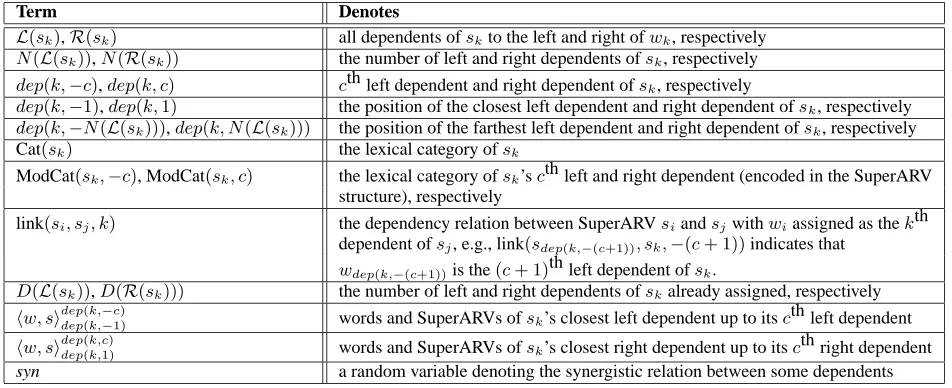
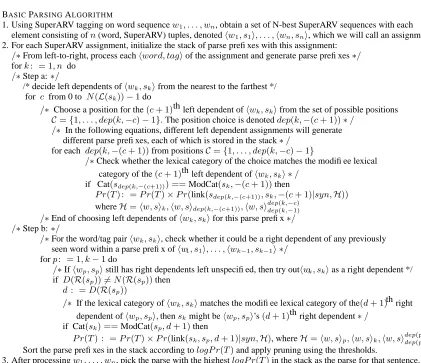
Our SCDG parser is a probabilistic generative model. It can be viewed as consisting of two com-ponents: SuperARV tagging and modifiee determi-nation. These two steps can be either loosely or tightly integrated. To simplify discussion, we de-scribe the loosely integrated version, but we imple-ment and evaluate both strategies. The basic parsing algorithm for the loosely integrated case is summa-rized in Figure 2, with the algorithm’s symbols de-fined in Table 1. In the first step, the top N-best SuperARV assignments are generated for an input sentence w1, . . . , wn using token-passing (Young
et al., 1997) on a Hidden Markov Model with tri-gram probabilistic estimations for both transition and emission probabilities. Each SuperARV se-quence for the sentence is represented as a sese-quence of tuples: hw1, s1i, . . . ,hwn, sni, where hwk, ski
represents the word wk and its SuperARV
ranked in non-increasing order by tag assignment probability.
During the second step, the modifiees are statis-tically specified in a left-to-right manner. Note that the algorithm utilizes modifiee lexical category con-straints to filter out candidates with mismatched lex-ical categories. When processing the wordwk, k =
1, . . . , n, the algorithm attempts to determine the
left dependents of wk from the closest to the
far-thest. The dependency assignment probability when choosing the(c+ 1)th left dependent (with its
posi-tion denoteddep(k,−(c+ 1))) is defined as:
P r(link(sdep(k,−(c+1)), sk,−(c+ 1)|syn,H))
whereH=hw, sik,hw, sidep(k,−(c+1)),hw, si
dep(k,−c)
dep(k,−1).
The dependency assignment probability is con-ditioned on the word identity and SuperARV assignment of wk and wdep(k,−(c+1)) as well as
all of the c previously chosen left dependents
hw, sidepdep((k,k,−−c1)) forwk. A Boolean random variable
syn is used to model the synergistic relationship between certain role pairs. This mechanism allows us to elevate, for example, the probability that the subject of a sentence wi is governed by a tensed
verb wj when the need role value ofwj points to
wi as its subject. Thesynvalue for a dependency
relation is determined heuristically based on the lexical category, role name, and label information of the two dependent words. After the algorithm statistically specifies the left dependents for wk,
it must also determine whether wk could be the
(d+ 1)th right dependent of a previously seen word
wp, p= 1, . . . , k−1(whereddenotes the number
of already assigned right dependents of wp), as
shown in Figure 2.
After processing wordwkin each partial parse on
the stack, the partial parses are re-ranked according to their updated probabilities. This procedure is it-erated until the top parse in the stack covers the en-tire sentence. For the tightly coupled parser, the Su-perARV assignment to a word and specification of its modifiees are integrated into a single step. The parsing procedure, which is completely incremen-tal, is implemented as a simple best-first stack-based search. To control time and memory complexity, we used two pruning thresholds: maximum stack depth and maximum difference between the log proba-bilities of the top and bottom partial parses in the stack. These pruning thresholds are tuned based on the tradeoff of time/memory complexity and pars-ing accuracy on a heldout set, and they both have hard limits.
Note the maximum likelihood estimation of de-pendency assignment probabilities in the basic loosely coupled parsing algorithm presented in Fig-ure 2 is likely to suffer from data sparsity, and the estimates for the tightly coupled algorithm are likely to suffer even more so. Hence, we smooth the prob-abilities using Jelinek-Mercer smoothing (Jelinek, 1997), as described in (Wang and Harper, 2003; Wang, 2003).
3.2 Additions to the Basic Model
Some additional features are added to the basic model because of their potential to improve SCDG parsing accuracy. Their efficacy is evaluated in Sec-tion 5.
Modeling crossing dependencies: The basic
pars-ing algorithm was implemented to preclude cross-ing dependencies; however, it is important to allow them in order to model wh-movement in some cases (e.g., wh-PPs).
Distance and barriers between dependents:
Be-cause distance between two dependent words is an important factor in determining the modifiees of a word, we evaluate an alternative model that adds distance, ∆dep(k,±(c+1)),k to H in Figure 2.
Note that ∆dep(k,±(c+1)),k represents the distance
between positiondep(k,±(c+ 1))andk. To avoid data sparsity problems, distance is bucketed and a discrete random variable is used to model it. We also model punctuation and verbs based on prior work. Like (Collins, 1999), we also found that verbs appear to act as barriers that impact modifiee links. Hence, a Boolean random variable that rep-resents whether there is a verb between the depen-dencies is added to condition the probability esti-mations. Punctuation is treated similarly to coordi-nation constructions with punctuation governed by the headword of the following phrase, and heuris-tic questions on punctuation were used to provide additional constraints on dependency assignments (Wang, 2003).
Modifiee lexical features: The SuperARV
struc-ture employed in the SuperARV LM (Wang and Harper, 2002) uses only lexical categories of mod-ifiees as modifiee constraints. In previous work (Harper et al., 2001), modifiee lexical features were central to increasing the selectivity of a CDG. Hence, we have developed methods to add ad-ditional relevant lexical features to modifiee con-straints of a SuperARV structure (Wang, 2003).
4 Parsing Evaluation Metric
Table 1:Definitions of symbols used in the basic parsing algorithm.
Term Denotes
L(sk),R(sk) all dependents ofskto the left and right ofwk, respectively
N(L(sk)),N(R(sk)) the number of left and right dependents ofsk, respectively
dep(k,−c),dep(k, c) cth left dependent and right dependent ofsk, respectively
dep(k,−1),dep(k,1) the position of the closest left dependent and right dependent ofsk, respectively
dep(k,−N(L(sk))),dep(k, N(L(sk))) the position of the farthest left dependent and right dependent ofsk, respectively Cat(sk) the lexical category ofsk
ModCat(sk,−c), ModCat(sk, c) the lexical category ofsk’scth left and right dependent (encoded in the SuperARV structure), respectively
link(si, sj, k) the dependency relation between SuperARVsiandsjwithwiassigned as thekth dependent ofsj, e.g., link(sdep(k,−(c+1)), sk,−(c+ 1))indicates that
wdep(k,−(c+1))is the(c+ 1)th left dependent ofsk.
D(L(sk)),D(R(sk))) the number of left and right dependents ofskalready assigned, respectively hw, sidep(k,−c)
dep(k,−1) words and SuperARVs ofsk’s closest left dependent up to itscth left dependent
hw, sidepdep((k,ck,1)) words and SuperARVs ofsk’s closest right dependent up to itscth right dependent syn a random variable denoting the synergistic relation between some dependents
can either convert the CDG parses to CFG brack-eting and then use PARSEVAL, or convert the CFG bracketing generated from the gold standard CFG parses to CDG parses and then use a metric based on dependency links. Since our parser is trained using a CFG-to-CDG transformer (Wang, 2003), which maps a CFG parse tree to a unique CDG parse, it is sensible to evaluate our parser’s accuracy us-ing gold standard CDG parse relations. Further-more, in the 1998 Johns Hopkins Summer work-shop final report (Hajic et al., 1998), Collins et al. pointed out that in general the mapping from de-pendencies to tree structures is one-to-many: there are many possible trees that can be generated for a given dependency structure since, although gen-erally trees in the Penn Treebank corpus are quite flat, they are not consistently “flat.” This variability adds a non-deterministic aspect to the mapping from CDG dependencies to CFG parse trees that could cause spurious PARSEVAL scoring errors. Addi-tionally, when there are crossing dependencies, then no tree can be generated for that set of dependen-cies. Consequently, we have opted to use a trans-former to convert CFG trees to CDG parses and de-fine a new dependency-based metric adapted from (Eisner, 1996). We define role value labeled
pre-cision (RLP) and role value labeled recall (RLR)
on dependency links as follows:
RLP = correct modifiee assignments
number of modifiees our parser found
RLR = correct modifiee assignments
number of modifiess in the gold test set parses
where a correct modifiee assignment for a word
wi in a sentence means that a three-tuple hrole id,role label,modifiee word positioni (i.e., a role value) for wi is the same as the three-tuple
role value for the corresponding role id ofwiin the
gold test parse. This differs from Eisner’s (1996) precision and recall metrics which use no label in-formation and score only parent (governor) assign-ments, as in traditional dependency grammars. We will evaluate role value labeled precision and recall on all roles of the parse, as well as the governor-only portion of a parse. Eisner (Eisner, 1996) and Lin (Lin, 1995) argued that dependency link eval-uation metrics are valuable for comparing parsers since they are less sensitive than PARSEVAL to sin-gle misattachment errors that may cause significant error propagation to other constituents. This, to-gether with the fact that we must train our parser using CDG parses generated in a lossy manner from a CFG treebank, we chose to use RLP and RLR to compare our parsing accuracy with several state-of-the-art parsers.
5 Evaluation and Discussion
trans-BASICPARSINGALGORITHM
1. Using SuperARV tagging on word sequencew1, . . . , wn, obtain a set of N-best SuperARV sequences with each element consisting ofn(word, SuperARV) tuples, denotedhw1, s1i, . . . ,hwn, sni, which we will call an assignment. 2. For each SuperARV assignment, initialize the stack of parse prefixes with this assignment:
/∗From left-to-right, process eachhword, tagiof the assignment and generate parse prefixes∗/ fork: = 1, n do
/∗Step a:∗/
/* decide left dependents ofhwk, skifrom the nearest to the farthest */ for c from 0 to N(L(sk))−1do
/∗ Choose a position for the(c+ 1)th left dependent ofhwk, skifrom the set of possible positions C={1, . . . , dep(k,−c)−1}.The position choice is denoteddep(k,−(c+ 1))∗/
/∗ In the following equations, different left dependent assignments will generate different parse prefixes, each of which is stored in the stack∗/
for each dep(k,−(c+ 1))from positionsC={1, . . . , dep(k,−c)−1}
/∗Check whether the lexical category of the choice matches the modifiee lexical category of the(c+ 1)th left dependent ofhwk, ski ∗/
if Cat(sdep(k,−(c+1))) ==ModCat(sk,−(c+ 1))then
P r(T) : =P r(T)×P r(link(sdep(k,−(c+1)), sk,−(c+ 1)|syn,H))
whereH=hw, sik,hw, sidep(k,−(c+1)),hw, si
dep(k,−c)
dep(k,−1)
/∗End of choosing left dependents ofhwk, skifor this parse prefix∗/
/∗Step b:∗/
/∗For the word/tag pairhwk, ski, check whether it could be a right dependent of any previously seen word within a parse prefix ofhw1, s1i, . . . ,hwk−1, sk−1i ∗/
forp: = 1, k−1do
/∗Ifhwp, spistill has right dependents left unspecified, then try outhwk, skias a right dependent */ if D(R(sp))=6 N(R(sp))then
d: =D(R(sp))
/∗ If the lexical category ofhwk, skimatches the modifiee lexical category of the(d+ 1)th right dependent ofhwp, spi,thenskmight behwp, spi’s(d+ 1)th right dependent∗/
if Cat(sk) ==ModCat(sp, d+ 1)then
P r(T) : =P r(T)×P r(link(sk, sp, d+ 1)|syn,H), whereH=hw, sip,hw, sik,hw, sidepdep((p,dp,1)) Sort the parse prefixes in the stack according tologP r(T)and apply pruning using the thresholds.
3. After processingw1, . . . , wn, pick the parse with the highestlogP r(T)in the stack as the parse for that sentence.
Figure 2: The basic loosely coupled parsing algorithm. Note the algorithm updates the probabilities of parse prefix hypotheses incrementally when processing each input word.
formed into CDG annotations using a CFG-to-CDG transformer (Wang, 2003). Note that the sound-ness of the CFG-to-CDG transformer was evaluated by examining the CDG parses generated from the transformer on the Penn Treebank development set to ensure that they were correct given our grammar definition.
5.1 Contribution of Model Factors
First, we investigate the contribution of the model additions described in Section 3 to parse accuracy. Since these factors are independent of the coupling between the SuperARV tagger and modifiee spec-ification, we investigate their impact on a loosely integrated SCDG parser by comparing four models: (1) the basic loosely integrated model; (2) the ba-sic model with crossing dependencies; (3) model 2 with distance and barrier information; (4) model 3 with SuperARVs augmented with additional modi-fiee lexical feature constraints. Each model uses a
trigram SuperARV tagger to generate 40-best Su-perARV sequences prior to modifiee specification. Table 2 shows the results for each of the four models including SuperARV tagging accuracy (%) and role value labeled precision and recall (%). Allowing crossing dependencies improves the overall parsing accuracy, but using distance information with verb barrier and punctuation heuristics produces an even greater improvement especially on the longer sen-tences. The accuracy is further improved by the ad-ditional modifiee lexical feature constraints added to the SuperARVs. Note that RLR is lower than RLP in these investigations possibly due to SuperARV tagging errors and the use of a tight stack pruning threshold.
Table 2: Results on Section 23 of the WSJ Penn
Tree-bank for four loosely-coupled model variations. The
evaluation metrics, RLR and RLP, are our
dependency-based role value labeled precision and recall. Note:
Model (1) denotes the basic model, Model (2) de-notes (1)+crossing dependencies, Model (3) dede-notes (2)+distance (punctuation) model, and Model (4) denotes (3)+modifiee lexical features.
Models ≤40 words (2,245 sentences)
Tagging governor only all roles
Acc. RLP RLR RLP RLR
(1) 94.7 90.6 90.3 86.8 86.2 (2) 95.0 90.7 90.5 87.0 86.5 (3) 95.7 91.1 90.9 87.4 87.0 (4) 96.2 91.5 91.2 88.0 87.4
Models ≤100 words (2,416 sentences)
Tagging governor only all roles
Acc. RLP RLR RLP RLR
(1) 94.0 89.7 89.3 86.0 85.5 (2) 94.2 89.9 89.6 86.2 85.8 (3) 94.7 90.4 90.2 86.8 86.3 (4) 95.4 90.9 90.5 87.5 86.8
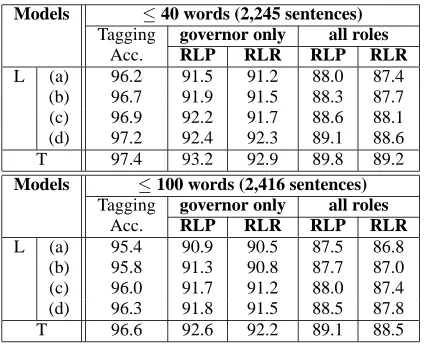
from Table 2, the most accurate model so far. We also evaluate whether a tight integration of left-to-right SuperARV tagging and modifiee specifica-tion produces a greater parsing accuracy than the best loosely coupled counterpart. Table 3 shows the SuperARV tagging accuracy (%) and role value labeled precision and recall (%) for each model. Consistent with our intuition, a stronger SuperARV tagger and a larger search space of SuperARV se-quences produces greater parse accuracy. However, tightly integrating SuperARV prediction with mod-ifiee specification achieves the greatest overall ac-curacy. Note that SuperARV tagging accuracy and parse accuracy improve in tandem, as can be seen in Tables 2 and 3. These results are consistent with the observations of (Collins, 1999) and (Eis-ner, 1996). It is important to note that each of the factors contributing to improved parse accuracy in these two experiments also improved the word pre-diction capability of the corresponding parser-based LM (Wang and Harper, 2003).
5.2 Comparing to Other Parsers
Charniak’s state-of-the-art PCFG parser (Charniak, 2000) has achieved the highest PARSEVAL LP/LR when compared to Collins’ Model 2 and Model 3 (Collins, 1999), Roark’s (Roark, 2001), Ratna-parkhi’s (Ratnaparkhi, 1999), and Xu & Chelba’s (Xu et al., 2002) parsers. Hence, we will com-pare our best loosely integrated and tightly inte-grated SCDG parsers to Charniak’s parser. Ad-ditionally, we will compare with Collins’ Model
Table 3: Results on Section 23 of the WSJ Penn Tree-bank comparing models that utilize different SuperARV taggers and N-best sizes with the tightly coupled imple-mentation. Note L denotes Loose coupling and T de-notes Tight coupling. Also (a) dede-notes trigram, 40-best; (b) denotes trigram, 100-best; (c) denotes 4-gram, 40-best; (d) denotes 4-gram, 100-best.
Models ≤40 words (2,245 sentences)
Tagging governor only all roles
Acc. RLP RLR RLP RLR
L (a) 96.2 91.5 91.2 88.0 87.4 (b) 96.7 91.9 91.5 88.3 87.7 (c) 96.9 92.2 91.7 88.6 88.1 (d) 97.2 92.4 92.3 89.1 88.6 T 97.4 93.2 92.9 89.8 89.2
Models ≤100 words (2,416 sentences)
Tagging governor only all roles
Acc. RLP RLR RLP RLR
L (a) 95.4 90.9 90.5 87.5 86.8 (b) 95.8 91.3 90.8 87.7 87.0 (c) 96.0 91.7 91.2 88.0 87.4 (d) 96.3 91.8 91.5 88.5 87.8 T 96.6 92.6 92.2 89.1 88.5
2 since it makes the complement/adjunct distinc-tion and Model 3 since it handles wh-movement (Collins, 1999). Charniak’s parser does not explic-itly model these phenomena.
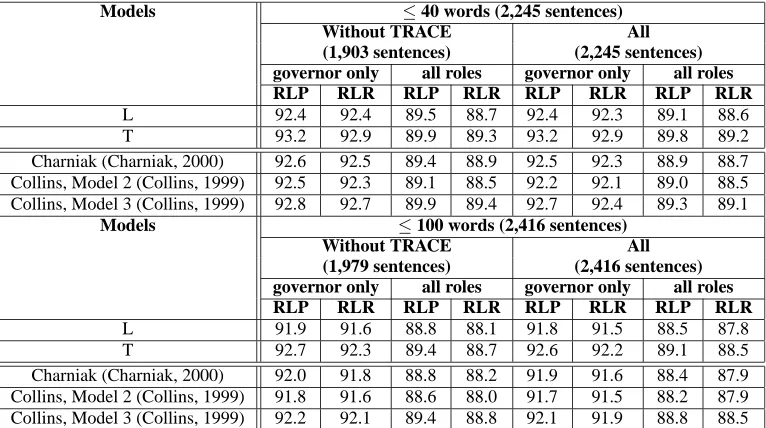
Among the statistical CFG parsers to be com-pared, only Collins’ Model 3 produces trees with information about wh-movement. Since the trans-former uses empty node information to transform the CFG parse trees to CDG parses, the accuracy of Charniak’s parser and Collins’ Model 2 may be slightly reduced for sentences with empty nodes. Hence, we compare results on two test sets: one that omits all sentences with traces and one that does not. As can be seen in Table 4, our tightly coupled parser consistently produces an accuracy that equals or ex-ceeds the accuracies of the other parsers, with one exception (Collins’ Model 3), regardless of whether the test set contains sentences with traces.
Table 4: Evaluation of five models on Section 23 sentences with and without traces: L denotes the best loosely coupled CDG parser and T the tightly coupled CDG parser.
Models ≤40 words (2,245 sentences)
Without TRACE All
(1,903 sentences) (2,245 sentences)
governor only all roles governor only all roles
RLP RLR RLP RLR RLP RLR RLP RLR
L 92.4 92.4 89.5 88.7 92.4 92.3 89.1 88.6 T 93.2 92.9 89.9 89.3 93.2 92.9 89.8 89.2 Charniak (Charniak, 2000) 92.6 92.5 89.4 88.9 92.5 92.3 88.9 88.7 Collins, Model 2 (Collins, 1999) 92.5 92.3 89.1 88.5 92.2 92.1 89.0 88.5 Collins, Model 3 (Collins, 1999) 92.8 92.7 89.9 89.4 92.7 92.4 89.3 89.1
Models ≤100 words (2,416 sentences)
Without TRACE All
(1,979 sentences) (2,416 sentences)
governor only all roles governor only all roles
RLP RLR RLP RLR RLP RLR RLP RLR
L 91.9 91.6 88.8 88.1 91.8 91.5 88.5 87.8 T 92.7 92.3 89.4 88.7 92.6 92.2 89.1 88.5 Charniak (Charniak, 2000) 92.0 91.8 88.8 88.2 91.9 91.6 88.4 87.9 Collins, Model 2 (Collins, 1999) 91.8 91.6 88.6 88.0 91.7 91.5 88.2 87.9 Collins, Model 3 (Collins, 1999) 92.2 92.1 89.4 88.8 92.1 91.9 88.8 88.5
CFG parsers may loose accuracy from the CFG-to-CDG transformation, similarly to Collins’ experi-ment reported in (Hajic et al., 1998), we also trans-formed our CDG parses to Penn Treebank style CFG parse trees and scored them using PARSE-VAL. On the WSJ PTB test set, Charniak’s parser achieved 89.6% LR and 89.5% LP, Collins’ Model 2 and 3 obtained 88.1% LR and 88.3% LP and 88.0% LR and 88.3% LP, while the tightly coupled CDG parser obtains 85.8% LR and 86.4% LP. It is im-portant to remember that this score is impacted by two lossy conversions, one for training and one for testing.
We have conducted a non-parametric Monte Carlo test to determine the significance of the differ-ences between the parsing accuracy results in Table 3 and Table 4. We found that the difference between the tightly and loosely coupled SCDG parsers is sta-tistically significant, as well as the difference be-tween the SCDG parser and Charniak’s parser and Collins’ Model 2. Although the difference between our parser and Collins’ Model 3 is not statistically significant, our parser represents a first attempt to build a high quality SCDG parser, and there is still room for improvement, e.g., better handling of bar-riers (including punctuation) and employing more sophisticated search and pruning strategies.
This paper has presented a statistical implemen-tation of a CDG parser, which is both genera-tive and highly lexicalized. With a framework of tightly integrated, multiple knowledge sources,
model distance, and synergistic dependencies, we have achieved a parsing accuracy comparable to the state-of-the-art statistical parsers trained on the Wall Street Journal Penn Treebank corpus. However, more work must be done to build a parser model capable of coping with speech disfluencies present in spontaneous speech. We also intend to investi-gate a hybrid parser that combines the generality of a CFG with the specificity of a CDG.
References
E. Charniak. 1997. Statistical parsing with a context-free grammar and word statistics. In Proceedings of the Fourteenth National Conference on Artificial In-telligence.
E. Charniak. 2000. A Maximum-Entropy-Inspired
Parser. In Proceedings of the First Annual Meeting of the North American Association for Computational Linguistics.
E. Charniak. 2001. Immediate-head parsing for lan-guage models. In Proceedings of ACL’2001.
M. Collins. 1999. Head-Driven Statistical Models for Natural Language Parsing. Ph.D. thesis, University of Pennsylvania.
J. M. Eisner. 1996. An empirical comparison of prob-ability models for dependency grammar. Technical report, University of Pennsylvania, CIS Department, Philadelphia PA 19104-6389.
to constraint dependency parsing for spoken language processing. Computer Speech and Language. M. P. Harper, W. Wang, and C. M. White. 2001.
Ap-proaches for learning constraint dependency grammar from corpora. In Proceedings of the Grammar and Natural Language Processing Conference, Montreal, Canada.
F. Jelinek. 1997. Statistical Methods For Speech Recog-nition. The MIT Press.
D. Lin. 1995. A dependency-based method for evaluat-ing broad-coverage parsers. In Proceedevaluat-ings of the In-ternational Joint Conference on Artificial Intelligence, pages 1420–1427.
D. M. Magerman. 1995. Statistical decision-tree models for parsing. In Proceedings of the 33rd Annual Meet-ing of the Association for Computational LMeet-inguistics, pages 276–283.
A. Ratnaparkhi. 1999. Learning to parse natural
lan-guage with maximum entropy models. Machine
Learning, 34:151–175.
B. Roark. 2001. Probabilistic top-down parsing
and language modeling. Computational Linguistics, 27(2):249–276.
W. Wang and M. P. Harper. 2002. The SuperARV lan-guage model: Investigating the effectiveness of tightly integrating multiple knowledge sources. In Proceed-ings of Conference of Empirical Methods in Natural Language Processing.
W. Wang and M. P. Harper. 2003. Language model-ing usmodel-ing a statistical dependency grammar parser. In Proceedings of International Workshop on Automatic Speech Recognition and Understanding.
W. Wang, M. P. Harper, and A. Stolcke. 2003. The ro-bustness of an almost-parsing language model given errorful training data. In ICASSP 2003.
W. Wang, A. Stolcke, and M. P. Harper. 2004. The use of a linguistically motivated language model in con-versational speech recognition. In ICASSP 2004. W. Wang. 2003. Statistical Parsing and Language
Mod-eling based on Constraint Dependency Grammar. Ph.D. thesis, Purdue University.
P. Xu, C. Chelba, and F. Jelinek. 2002. A study on richer syntactic dependencies for structured language mod-eling. In Proceedings of ACL 2002.
![Figure 1: An example of a CDG parse and the Super-ARV of the wordPX and MX([R]) represent the position of a word and its did in the sentence what did you learn.modifi ee (for role R), respectively.](https://thumb-us.123doks.com/thumbv2/123dok_us/744415.1084954/2.595.76.293.247.422/figure-example-super-represent-position-sentence-modi-respectively.webp)