The Types and Distributions of Errors
in a Wide Coverage Surface Realizer Evaluation
Charles B. Callaway
HCRC, University of Edinburgh
2 Buccleuch Place
Edinburgh, UK
EH8 9LW
[email protected]
Abstract
Recent empirical experiments on surface realizers have shown that grammars for generation can be effectively evaluated using large corpora. Evalu-ation metrics are usually reported as single aver-ages across all possible types of errors and syntac-tic forms. But the causes of these errors are diverse, and the extent to which the accuracy of generation over individual syntactic phenomena is unknown. This article explores the types of errors, both com-putational and linguistic, inherent in the evaluation of a surface realizer when using large corpora. We analyze data from an earlier wide coverage exper-iment on the FUF/SURGEsurface realizer with the Penn TreeBank in order to empirically classify the sources of errors and describe their frequency and distribution. This both provides a baseline for fu-ture evaluations and allows designers of NLG ap-plications needing off-the-shelf surface realizers to choose on a quantitative basis.
1
Introduction
Surface realization is the process of converting the semantic and syntactic representation of a sentence or series of sen-tences into a surface form for a particular language. Most reusable deep surface realizers [Elhadad, 1991; Bateman, 1995; Lavoie and Rambow, 1997; White and Caldwell, 1998 ] have been symbolic, hand-written grammar-based systems, often based on syntactic linguistic theories such as Halliday’s [Halliday, 1976] systemic functional theory (FUF/SURGEand KPML) or Mel’cuk’s [Mel’cuk, 1988] Meaning-Text Theory (REALPRO).
However, corpus-based components, and in particular sta-tistical surface realizers [Langkilde and Knight, 1998; Ban-galore and Rambow, 2000; Ratnaparkhi, 2000; Langkilde-Geary, 2002] have focused attention on a number of problems facing symbolic NLG systems that until now have been gen-erally considered future work: large-scale, data-robust and language- and domain-independent generation. In each case, empirical evaluation plays a fundamental role in determin-ing performance at the task of surface realization and settdetermin-ing baselines for future performance evaluation.
For instance, the HALOGENstatistical realizer [Langkilde-Geary, 2002] underwent the most comprehensive evaluation of any surface realizer, which was conducted by measuring sentences extracted from the Penn TreeBank [Marcus et al., 1993], converting them into its input formalism, and then pro-ducing output strings. Using automatic metrics from machine translation then quickly produces figures for global character-istics of traits such as accuracy.
In a recent experiment, we compared the performance of HALOGEN relative to the grammar-based FUF/SURGE
surface realizer on the identical corpus and with a similar methodology [Callaway, 2003; 2004]. Although FUF/SURGE
scored higher than the HALOGENrealizer, we were interested in absolute as well as relative performance: e.g., what par-ticular grammatical rules are not well-covered by SURGE’s grammar?
While the above methodology gives an average figure for what coverage and accuracy are on a corpus like the Penn TreeBank, it describes a very wide array of errors as simple numerical averages. Thus it is impossible to know without working experience which types of realizer errors HALOGEN
is likely to make. From the perspective of syntactic analysis, statistical realizers behave as black boxes and thus there is lit-tle or no attempt made to look at incorrect sentences to trace back exactly what caused a particular error. Instead, either the language model is adjusted or a new corpus is obtained. How-ever, the grammars in symbolic realizers can also be evaluated as glass boxes, allowing the improvement of an incorrect or missing grammatical rule to also improve the generation of all other instances of the same grammatical rule in the corpus.
Those who are looking to use a surface realizer typically fall into three cases: (1) those employing one for the first time, often looking to use a well-known system, (2) those seeking to use a different surface realizer because their cur-rent realizer has undesirable operational parameters such as slowness or lack of multilingual support, and (3) those seek-ing to change realizers due to lack of grammatical coverage for their domain.
Realizer Sentences Coverage Exact Matches SS Accuracy BLEUAccuracy SURGE2.2 1192 49.5% 368 (30.9%) 0.8206 0.7350 SURGE2.3 2372 98.5% 1644 (69.3%) 0.9605 0.9321 HALOGEN 1968 82.8% 1132 (57.5%) 0.9450 0.9240
Table 1: Comparing two SURGEversions with HALOGENon 2416 sentences from Section 23 of the Penn TreeBank.
would allow a number of questions to be answered:
What types of problems might be encountered during the
experiment itself, and what are their sources?
What kinds of constructions are difficult to handle in
general, such as adverb positioning, verb argument or-dering, or very long noun phrases?
What coverage does FUF/SURGEhave for specific types
of infrequent syntactic phenomena, like indirect ques-tions or topicalizaques-tions?
What is a reasonable distribution of these errors? What data is necessary to allow one to predict if a
par-ticular surface realizer will match the expectations of a new application?
We look at these questions from two perspectives: (1) es-tablishing baselines to inform future, more detailed evalua-tions, and (2) providing information about the current state of the FUF/SURGEgrammar and morphology for those who may wish to use it as a surface realizer in a new project and need to know whether it will support the types of syntactic constructions needed in their domain.
Indeed, for some domains and genres, particular phenom-ena like direct questions may be more important than overall coverage, and thus when creating an application for those do-mains, a surface realizer should be chosen with these data for these phenomena in mind. For instance, domains involving dialogue must frequently generate sentence fragments rather than complete sentences, although this latter type is the sub-ject of the most scrutiny in surface realizer research.
To provide a foundation for answering these questions, we performed a manual analysis on a set of specific errors in sen-tences generated from the Penn TreeBank by the FUF/SURGE
surface realizer. To do this, we generated 4,240 sentences, se-lecting those which did not match the target sentence and had a high probability of being incorrect due to problems with wrong or missing syntactic rules in the grammar. Each of the resulting sentences was analyzed to determine the source of the error, and in the case of poor grammatical coverage, the missing or incorrect syntactic construction that was at fault.
We conclude that grammatical errors are actually a small part of the errors found, and in particular, four types of bad grammatical rules were responsible for almost two thirds of accuracy errors. But first we describe in more detail how sen-tences were generated from the corpus, how they are mea-sured for accuracy, and what high-level types of errors pre-vent sentences from being perfectly realized.
2
Methodology
Undertaking a large-scale evaluation for a symbolic surface realizer requires a large corpus of sentence plans. Since text
planners cannot generate either the requisite syntactic varia-tion or quantity of text, [Langkilde-Geary, 2002] developed an evaluation strategy for HALOGEN employing a substi-tute: sentence parses from the Penn TreeBank [Marcus et al., 1993], a corpus that includes texts from newspapers such as the Wall Street Journal, and which have been hand-annotated for syntax by linguists.
However, surface realizers typically have idiosyncratic in-put representations, and none use the Penn TreeBank parse representation. Thus a transformer is needed to convert the TreeBank notation into the language accepted by the sur-face realizer. As we were interested in comparing the cov-erage and accuracy of FUF/SURGEwith Langkilde’s HALO
-GEN system, we implemented a similar transformer [Call-away, 2003] to convert Penn TreeBank notation into the rep-resentation used by FUF/SURGE.
As with the HALOGENevaluation, we used Simple String Accuracy [Doddington, 2002] and BLEU [Papineni et al.,
2001] to determine the average accuracy for FUF/SURGE . To obtain a meaningful comparison, we utilized the same ap-proach as HALOGEN, treating Section 23 of the TreeBank as an unseen test set. A recent evaluation showed that the combination of the transformer and an augmented version of FUF/SURGEhad higher coverage and accuracy (Table 1) compared to both HALOGENand version 2.2 of FUF/SURGE
.
The difference between the two versions of FUF/SURGE
was especially striking, with the augmented version almost doubling coverage and more than doubling exact match ac-curacy. One example of these differences is the addition of grammatical rules for direct and indirect written dialogue, which comprise approximately 15% of Penn TreeBank sen-tences, and which is vital for domains such as written fiction. However, this evaluation method does not allow for seam-less comparisons. Inserting a transformation component be-tween the corpus and realizer means that not only is the surface realizer being evaluated, but also the accompanying transformation component itself. We were thus interested in determining what proportion of reported errors could be at-tributed to the surface realizer as opposed to the transformer or to the corpus. To do this, as well as to assist application de-signers in better interpreting the results of these formal eval-uations, we needed to identify more precisely what types of failures are involved.
Simple string accuracy less than 10 characters:
Sen-tences with very small error rates are almost always in-correct due to errors in morphology, punctuation, and capitalization. For instance, a single incorrect placement of quotation marks has a penalty of 4. Thus it made little sense to manually examine them all in the off chance a handful had true syntactic errors.
Sentences of less than 10 or more than 35 words:
Sen-tences with 9 or fewer words were extremely unlikely to contain complex syntactic constructs, and collectively had an accuracy of over 99.1%. Sentences larger than 35 words with errors typically had more than one major grammatical error, making it very difficult to determine a single “exact” cause. 96% of sentences within the range had a single grammatical cause, and the remaining 4% had only 2 syntactic errors.
Each error instance in the resulting 629 sentences was clas-sified twice: first to find the source of the error (corpus, trans-former, or grammar), and then in the case of grammatical er-rors, to note the syntactic rule that caused the error. These two classifications are discussed in the following two sections. We were not realistically able to perform a similar compar-ison for coverage errors, because out of the 4,240 sentences satisfying the second criterion of sentence length, only 17 of them did not generate some string.
3
Types of Methodological Errors
Errors in the surface realizer evaluation, which can manifest themselves either as empty sentences or as generated sen-tences which do not exactly match the target string, can arise from the corpus itself, the transformation component, or the surface realizer, which consists of the grammar, linearization rules, and the morphology component.
The corpus itself can be a source of errors due to two main reasons: (1) the corpus annotators have incorrectly analyzed the syntactic structure, for instance, attaching prepositions to the wrong head, or including grammatically impossible rules, such asNP ! VB CC VB, or (2) the parts of speech were
mistagged by the automatic POS tagger and were not cor-rected during the supervision process, as in(NP (NN pe-tition) (VBZ drives)).
Unfortunately, the corpus cannot easily be cleaned up to re-move these errors, as this significantly complicates the com-parison of results across corpus versions. We must thus sub-tract the proportion of corpus errors from the results, creating a “topline” which defines a maximum performance measure for the realizer. Manually analyzing incorrect sentences pro-duced from the corpus allows this topline to be determined with reasonable accuracy.
In addition to errors in the corpus, other types of errors originate in the transformation component, as it attempts to match TreeBank annotations with rules that produce the req-uisite input notation for the surface realization. While such transformers are highly idiosyncratic due to differing input and output notations, the following categories are abstract, and thus likely to apply to many different transformers.
Missing Tag: While there is a standardized set of tags,
the semantic subtags and coreference identifiers can
combine to create unpredictable tags, such as PP-LOC-PRD-TPC-3orPP-EXT=2.
Missing Rule: Often each of the individual tags are
rec-ognized, but no rule exists to be selected for a given ordered combination of tags, like ADVP-MNR ! RB
COMMA RB RB.
Incorrect Rule: The transformation component may
se-lect the wrong rule to apply, or the rule itself may be written incorrectly or may not have been written with all possible combinations of tag sequences in mind.
Ordering: Some phrasal elements such as adverbial
clauses can be placed in five or even six different posi-tions in the matrix clause. Choosing the wrong position will result in errors reported by the automatic accuracy metrics, as discussed in [Callaway, 2003]. An important note is that the order can be incorrect but still make sense semantically.
Finally, even given a correct input representation, a surface realizer can also produce errors during the realization pro-cess. Of the four main surface realizer functions below, only syntactic rules provide a significant source of accuracy errors from the point of view of averaged metrics:
Syntactic Rules: The grammar may be missing a
partic-ular syntactic rule or set of features, or may have been encoded incorrectly. For instance, the stock version of FUF/SURGEdid not have a rule allowing noun phrases to terminate in an adverb like “ago” as in “five years ago”, which occurs frequently in the Penn TreeBank, causing the word to be missing from the generated sentence.
Morphology: While morphological errors occasionally
appear, they are usually very small and do not contribute much to the overall accuracy score. The most com-mon problems are irregular verbs, foreign plural nouns, and the plurals of acronyms, as well as the marking of acronyms and y/u initial letters with indefinite a/an.
Punctuation: While most errors involving punctuation
marks also contribute very little statistically to the over-all score of a sentence (e.g., a missing comma), the Tree-Bank also contains combinations of punctuation like long dashes followed by quotation marks. Addition-ally, incorrect generation of mixed quotations can lead to repeated penalties when incorrectly determining the boundaries of the quoted speech, and large penalties if the multiple forms of punctuation occur at the same boundary [Callaway, 2003].
Linear Precedence: In our analysis of realizer errors,
no examples of obligatory precedence violations were found (as opposed to “Ordering” problems described above.)
4
Types of Syntactic Errors
are very broad measures which say nothing about the effec-tiveness of a surface realizer when generating individual syn-tactic constructions. The advantage of these metrics are that they are easy to compute over the entire corpus, but lose this capability when the same question is asked about particular subsets of a general corpus, such as all sentences containing an indirect question.
When performing an analysis of the types of syntactic er-rors produced by FUF/SURGEwhen given correct inputs, we found nine syntactic constructions that resulted in at least two or more sentences being generated incorrectly. The analysis allows us to conclude that FUF/SURGEis either not reliably capable or else incapable of correctly producing the following syntactic constructions (a manual analysis of all 5,383 sen-tences to find all correct instances of these constructions is impractical, although we were able to automate some corpus searches based on particular semantic tags):
Inversion: Pragmatic inversions of auxiliaries in
embed-ded questions [Green, 2001] or in any other construction besides questions, negations, and quoted speech. Thus a TreeBank sentence like “This is the best time to buy, as
was the case two years ago.” cannot be generated.
Missing verb tense: While FUF/SURGE has 36
pre-defined verb tenses, the corpus contained several in-stances of another tense: “. . . which fellow officers re-member as having been $300.”
Mixed conjunctions: Often in the Penn TreeBank the
UCP tag (unlike coordinated phrase) marks conjunctions where the constituents are not all of the same grammat-ical category, but in compound verb phrases, they are often marked as simple conjunctions of mixed types. But FUF/SURGErequires verb phrases in conjunctions to be compatible on certain clausal features with all con-stituents, which is violated in the following example: [VP ! VP CC VP COMMA SBAR-ADV] “Instead,
they bought on weakness and sold into the strength,
which kept the market orderly.”
Mixed type NP modifiers: FUF/SURGE’s NP system
as-sumes that cardinal numbers will precede adjective mod-ifiers, which will precede nominal modmod-ifiers, although the newspaper texts in the Penn TreeBank have more complex NPs than were considered during the design of the NP system: “a $100 million Oregon general obliga-tion veterans’ tax note issue”.
Direct questions: Direct questions are not very common
in newspaper text, in fact there are only 61 of them out of the entire 5,383 sentences of Sections 20–22. More complex questions involving negations and modal aux-iliaries are not handled well, for example “Couldn’t we save $20 billion by shifting it to the reserves?” though simpler questions are generated correctly.
Indirect questions: The Penn TreeBank contains a
roughly equivalent number of instances of indirect ques-tions as direct, such as “It’s a question of how much credibility you gain.” and again the reliability of gen-erating this construction depends on the complexity of the verbal clause and the question phrase.
Mixed level quotations: One of the most difficult
syntac-tic phenomena to reproduce is the introduction of sym-metric punctuation that cuts across categorial boundaries [Doran, 1998]. For instance, in the following sentence, the first pair of quote marks are at the beginning of an adverbial phrase, and the second pair are in the mid-dle, separating two of its constituents: . . . the U.S. would
stand by its security commitments “as long as there is a threat” from Communist North Korea.
Complex relative pronouns: While simple relatives
are almost always handled correctly except in certain conjunctions, complex relatives like partitive relatives (“all of which”, “some of which”), relatives of indi-rect objects or peripheral verbal arguments like locatives (“to whom”, “in which”), complex possessives (“whose $275-a-share offer”) and raised NP relatives (“. . . the swap, details of which. . . ”) were not considered when FUF/SURGEwas designed.
Topicalization: The clausal system of FUF/SURGE is
based on functional grammar [Halliday, 1976], and so does not expressly consider syntactic phenomena such as left dislocation or preposing of prepositional phrases. Thus sentences like “Among those sighing with relief was John H. Gutfreund” may generate correctly depend-ing on their clausal thematic type, likematerial or
equative.
While we present the results of a manual analysis of the data in the next section, it is important to remember that the large majority of syntactic constructions, punctua-tion and morphology worked flawlessly in the evaluapunctua-tion of FUF/SURGEas described in [Callaway, 2004]. As described earlier, almost 7 out of every 10 sentences in the unseen test set were exact matches, including punctuation and capital-ization. Additionally, most errors that did occur were in the transformation component rather than the surface realizer, as we will describe shortly. Finally, some well-studied but rare syntactic constructions did not occur in the sections of the Penn TreeBank that we examined, such as left dislocation and negative NP preposing.
5
Data Analysis
As mentioned previously, we undertook a manual analysis of Sections 20–22 of the Penn TreeBank by hand to determine specific reasons behind the failure of 629 sentences out of 4,240 that met the criteria of having between 15 and 44 words, and having a character error rate of more than 9 as determined by the SSA metric.
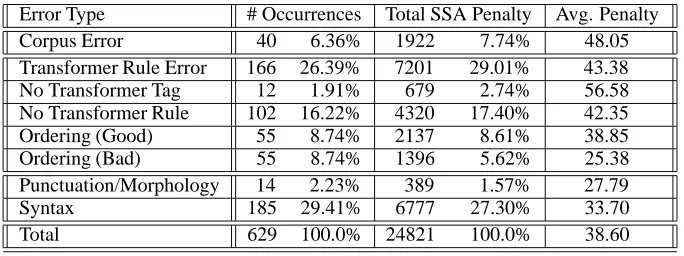
Table 2 presents the results for high-level error types as described in Section 3. It shows that the greatest proportion of errors is due to the transformation process: 390 sentences (62.0%) or 15,733 (63.4%) of the character-based accuracy error. This is expected given that the transformation compo-nent has been developed in a year or so, while FUF/SURGE
Error Type # Occurrences Total SSA Penalty Avg. Penalty Corpus Error 40 6.36% 1922 7.74% 48.05 Transformer Rule Error 166 26.39% 7201 29.01% 43.38 No Transformer Tag 12 1.91% 679 2.74% 56.58 No Transformer Rule 102 16.22% 4320 17.40% 42.35 Ordering (Good) 55 8.74% 2137 8.61% 38.85 Ordering (Bad) 55 8.74% 1396 5.62% 25.38 Punctuation/Morphology 14 2.23% 389 1.57% 27.79 Syntax 185 29.41% 6777 27.30% 33.70 Total 629 100.0% 24821 100.0% 38.60
Table 2: Distribution of 629 high-level errors in the 4,240 tested sentences from Sections 20–22.
functional description. The error rate of the Penn TreeBank annotation is a reasonably well-known quantity, and there is a specialized literature describing automatic correction meth-ods (e.g., [Dickinson and Meurers, 2003]).
One surprise though is that while the number of errors due to the ordering of floating constituents is the same, the error in accuracy is skewed to semantically acceptable interpretations. And while the distribution of the order seems like random chance, it should be remembered that there can potentially be up to 10 acceptable placements when there are multiple floating constituents. Additionally, unrecognized annotation tags seem to invoke the heaviest average penalty for any error type, but have the lowest rate of occurrence.
Some advice then for future evaluations of this type would be to systematically ensure that all tags are normalized in the corpus before writing transformation rules. Missing trans-formation rules were always single-case errors, and a large amount of effort would need to be expended to account for them, following the well-known 80/20 rule. The data in Ta-ble 3 then allows other surface realizer researchers to priori-tize their time when developing their own evaluations.
Finally, slightly over a quarter of the reduction in accuracy is due to syntactic phenomena that are not handled correctly by the surface realizer. Given that this error category is most of interest in determining which surface realizer has the nec-essary coverage for a particular domain, we investigated fur-ther the interactions between error rates and individual syn-tactic phenomena.
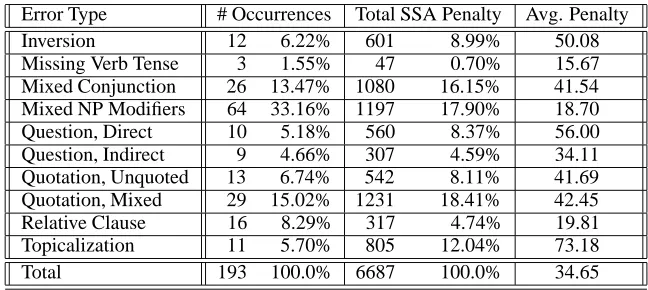
Table 3 presents the number of occurrences of errors for each of the syntactic phenomena presented in the previous section. We can see that topicalizations, direct questions and inversions were on average most likely to produce the largest error per instance, at 73.18, 56.00 and 50.08 edit distances each. The most frequent error types were mixed NP mod-ifiers, but such constructions were small enough (often in-volving only two words in switched order) that they had the second lowest SSA penalty.
Knowing the ratios of errors allows those weighing differ-ent surface realizers for a new project to select based on a number of criteria. For instance, in some domains, it may be undesirable to have the reader see a large number of surface language errors where the extent of each error is unimportant, whereas in other situations, large mistakes that completely obscure the intent of the sentence are more of a problem.
While Table 3 tells us which syntactic type is most likely to produce the largest accuracy penalty, it does not tell us which syntactic types are most frequent in the corpus, since this would require also counting all correct instances, which would be very prohibitive to do manually and inaccurate to do automatically. Knowing this quantity would be of great-est help to an NLG application designer wanting to compare surface realizers, but is difficult to do in practice.
We thus decided to look at correct instances of a small number of rare phenomena which can easily be found by searching for tags in the TreeBank. For instance, it-clefts are marked with the annotationS-CLF, of which there are 4 in the 5,383 sentences in Sections 20–22. However, by search-ing through the text representations with the regular expres-sionit is * thatandit was * that, we found an additional 2 it-clefts that were incorrectly marked (although all 6 examples were exact matches when generated by the sur-face realizer). By a similar process, we discovered 7 marked and 1 unmarked wh-clefts, which also were exact matches. A further investigation for topicalized sentences uncovered 6 instances that were correctly generated versus the 11 incor-rectly generated.
The number of errors in the Penn TreeBank annotations on these rare constructions should give pause to those who want to create statistical selection algorithms from such data, given that the signal-to-noise ratio may be very high. Additionally, all of the data presented above reflects only this corpus; spo-ken dialogue corpora may vary significantly in frequencies of topicalization and left dislocation, for example.
6
Conclusions
Error Type # Occurrences Total SSA Penalty Avg. Penalty Inversion 12 6.22% 601 8.99% 50.08 Missing Verb Tense 3 1.55% 47 0.70% 15.67 Mixed Conjunction 26 13.47% 1080 16.15% 41.54 Mixed NP Modifiers 64 33.16% 1197 17.90% 18.70 Question, Direct 10 5.18% 560 8.37% 56.00 Question, Indirect 9 4.66% 307 4.59% 34.11 Quotation, Unquoted 13 6.74% 542 8.11% 41.69 Quotation, Mixed 29 15.02% 1231 18.41% 42.45 Relative Clause 16 8.29% 317 4.74% 19.81 Topicalization 11 5.70% 805 12.04% 73.18 Total 193 100.0% 6687 100.0% 34.65
Table 3: Distribution of 193 major syntactic errors in the 4,240 tested sentences from Sections 20–22.
have established a topline and baseline performance measure for use in future comparisons between surface realizers.
References
[Bangalore and Rambow, 2000] S. Bangalore and O. Ram-bow. Exploiting a probabilistic hierarchical model for gen-eration. In COLING–2000: Proceedings of the 18th
Inter-national Conference on Computational Linguistics,
Saar-bruecken, Germany, 2000.
[Bateman, 1995] John A. Bateman. KPML: The KOMET-penman (multilingual) development environment. Technical Report Release 0.8, Institut f¨ur Integrierte Publikations- und Informationssysteme (IPSI), GMD, Darmstadt, 1995.
[Callaway, 2003] Charles B. Callaway. Evaluating coverage for large symbolic NLG grammars. In Proceedings of
the Eighteenth International Joint Conference on Artificial Intelligence, pages 811–817, Acapulco, Mexico, August
2003.
[Callaway, 2004] Charles Callaway. Wide coverage sym-bolic surface realization. In Proceedings of the 41st
An-nual Meeting of the Association for Computational Lin-guistics, pages 125–128, Barcelona, Spain, July 2004.
[Dickinson and Meurers, 2003] M. Dickinson and D. Meur-ers. Detecting errors in part-of-speech annotation. In
Pro-ceedings of the 10th Conference of the European Chapter of the ACL, Budapest, Hungary, April 2003.
[Doddington, 2002] George Doddington. Automatic eval-uation of machine translation quality using n-gram co-occurrence statistics. In Proceedings of the 2002
Confer-ence on Human Language Technology, San Diego, CA,
March 2002.
[Doran, 1998] Christine Doran. Incorporating Punctuation
into the Sentence Grammar: A Lexicalized Tree Adjoining Grammar Perspective. PhD thesis, University of
Pennsyl-vania, Philadelphia, PA, 1998.
[Elhadad, 1991] Michael Elhadad. FUF: The universal uni-fier user manual version 5.0. Technical Report CUCS-038-91, Dept. of Computer Science, Columbia University, 1991.
[Green, 2001] Georgia Green. Pragmatic motivation and exploitation of syntactic rules. Technical report, University of Illinois, http://www.linguistics.uiuc.edu/g-green/441/prmoex/index.html, 2001.
[Halliday, 1976] Michael Halliday. System and Function in
Language. Oxford University Press, Oxford, 1976.
[Langkilde and Knight, 1998] Irene Langkilde and Kevin Knight. Generation that exploits corpus-based statistical knowledge. In COLING-ACL-98: Proceedings of the Joint
36th Meeting of the ACL andthe 17th International COL-ING, pages 704–710, Montr´eal, Canada, August 1998.
[Langkilde-Geary, 2002] Irene Langkilde-Geary. An empir-ical verification of coverage and correctness for a general-purpose sentence generator. In Second International
Natu-ral Language Generation Conference, Harriman, NY, July
2002.
[Lavoie and Rambow, 1997] Benoit Lavoie and Owen Ram-bow. A fast and portable realizer for text generation sys-tems. In Proceedings of the 5th Conference on Applied
Natural Language Processing, 1997.
[Marcus et al., 1993] M. Marcus, B. Santorini, and M. Marcinkiewicz. Building a large annotated cor-pus of English: The PennTreeBank. Computational Linguistics, 26(2), 1993.
[Mel’cuk, 1988] Igor A. Mel’cuk. Dependency Syntax:
The-ory and Practice. SUNY Publications, 1988.
[Papineni et al., 2001] K. Papineni, S. Roukos, T. Ward, and W. J. Zhu. BLEU: A method for automatic evaluation of MT. Technical Report RC22176, IBM Research, New York, September 2001.
[Ratnaparkhi, 2000] Adwait Ratnaparkhi. Trainable meth-ods for surface natural language generation. In
Proceed-ings of the First North American Conference of the ACL,
Seattle, WA, May 2000.
[White and Caldwell, 1998] Michael White and Ted Cald-well. EXEMPLARS: A practical, extensible framework for dynamic text generation. In Proceedings of the Ninth
International Workshop on NLG, pages 266–275,