THE INTEGRATED METHOD FOR A SYSTEMATIC APPROACH IN DEVELOPING PRECISION FARMING SOFTWARE PRODUCT LINE
ARCHITECTURE
NORAZIAN BINTI MOHAMAD HAMDAN
THE INTEGRATED METHOD FOR A SYSTEMATIC APPROACH IN DEVELOPING PRECISION FARMING SOFTWARE PRODUCT LINE
ARCHITECTURE
NORAZIAN BINTI MOHAMAD HAMDAN
A dissertation submitted in partial fulfillment of the requirements for the award of the degree of
Master of Science (Computer Science)
Faculty of Computer Science and Information Systems Universiti Teknologi Malaysia
This dissertation is dedicated especially to my beloved mother and late father (Fatimah bt. Mohammad and Mohd. Hamdan bin Edi) and also not forgetting my
ACKNOWLEDGEMENT
First and foremost, I would like to express my utmost gratitude to Allah s.w.t for endless blessings and given me strength to during the development of this research until it has completed.
I am also heartily grateful and thankful to my supervisor Dr. Dayang Norhayati Abang Jawawi for her constant support during my study at UTM. She inspired me greatly to work in this project. Her motivations and guidance have contributed tremendously in completing the research. I have learned a lot from her and I am fortunate to have her as my mentor and supervisor.
My sincere appreciation also extends to all my fellow classmates and friends for willingness to share knowledge and provide assistance when needed. I am also grateful for the love and endless support from my family members especially my mother.
ABSTRACT
ABSTRAK
Kerumitan perisian sentiasa menjadi isu dalam pembangunan perisian, terutamanya bagi sistem dengan fungsian inovatif yang lebih besar. Satu penyelesaian untuk mengurangkan masalah kerumitan perisian adalah dengan menggunakan perisian kaedah penggunaan semula. Pada masa kini, Perisian Talian Produk adalah suatu paradigma baru untuk mengendalikan pembangunan perisian untuk perisian guna semula. Perisian Talian Produk biasanya dikaitkan dengan menggunakan kaedah pembangunan berorientasikan ciri. Walaupun terdapat banyak kaedah yang wujud untuk membangunkan Talian Produk Perisian, tidak terdapat sebarang penerangan konkrit pada proses sistematik bagi kaedah yang digunakan. Oleh itu, dalam kajian ini, integrasi tiga berorientasikan ciri perisian kaedah Talian Produk dicadangkan untuk membangunkan senibina perisian. Kaedah-kaendahnya ialah Feature-Oriented Domain Analysis (FODA), Feature-Architecture Mapping
(FArM), dan Feature Dependency Analysis (FDA). Kajian kes yang dipilih untuk
kajian ini adalah kaedah pertanian terperinci berdasarkan rangkaian pengesan tanpa wayar. Cadangan kaedah yang bersepadu menyediakan proses sistematik dengan garis panduan terperinci untuk reka bentuk senibina perisian. Senibina perisian untuk kajian kes ini dibangunkan dengan menggunakan kaedah bersepadu yang dicadangkan. Kaedah bersepadu yang dicadangkan telah dinilai dengan kaedah FArM dan mempunyai kelebihan yang tinggi kerana kaedah bersepadu mengandungi analisis domain dan mekanisma dipertingkatkan untuk mengendalikan kebergantungan ciri. Apabila dibandingkan kaedah Feature-Oriented Reuse Method (FORM), terdapat sedikit perbezaan, tetapi kaedah bersepadu menyediakan pemetaan
TABLE OF CONTENTS
CHAPTER TITLE PAGE
DECLARATION ii
DEDICATION iii
ACKNOWLEDGMENT iv
ABSTRACT v
ABSTRAK vi
TABLE OF CONTENTS vii
LIST OF TABLES xi
LIST OF FIGURES xii
LIST OF ABBREVIATIONS xv
1 INTRODUCTION
1.1 Introduction 1
1.2 Problem Background 5
1.3 Problem Statement 14
1.4 Research Aim 15
1.5 Research Objectives 15
1.5 Research Scope 16
1.6 Significance of the Study 16
1.7 Organisation of the Report 17
2 LITERATURE REVIEW
2.1 Introduction 18
2.2 Overview of Precision Farming 18
2.3.1 Precision Agriculture Monitoring Framework
Based Greenhouse 23
2.3.2 Lofar Agro Project: An Implementation of
WSN in Precision Farming 26
2.3.3 Open Architecture Precision Agriculture
Information Monitoring System 28
2.4 Software Architecture of Precision Farming
Application 30
2.4.1 WSN Based Greenhouse Management
Subsystem 33
2.4.2 Farm Management Information System 34 2.4.3 Spatial Decision Support System 36
2.5 Software Product Lines 38
2.6 Product Line Methods 41
2.7 Feature-Oriented Product Line Engineering 42 2.7.1 Feature-Oriented Domain Analysis 48 2.7.2 Feature-Oriented Reuse Method 49 2.7.3 Featured RSEB and Hyper Featured RSEB 51 2.7.4 Feature-Architecture Mapping 52 2.7.4.1 Elementary Transformations 53 2.7.4.2 Feature Model Transformations 55 2.7.4.3 Building Reference Architecture 59
2.7.5 Feature Dependency Analysis 60
2.8 Discussion and Summary 63
3 RESEARCH METHODOLOGY
3.1 Introduction 65
3.2 Research Process Flowchart 65
3.3 Conceptual Framework 68
3.4 Summary 70
4 MAPPING REQUIREMENTS INTO FEATURE
MODEL USING FEATURE-ORIENTED DOMAIN ANALYSIS METHOD
4.1 Introduction 71
4.3 Developing a Feature Model 74
4.3.1 Domain Planning 74
4.3.1.1 Domain Selection 74
4.3.1.2 Domain Scoping 75
4.3.1.3 Domain Dictionary 75
4.3.2 Feature Identification 75
4.3.2.1 Feature Extraction Based on PF Case
Studies 77 4.3.2.2 Feature Comparisons and
Categorisation 84
4.3.3 Feature Organisation 89
4.3.4 Feature Refinement 90
4.3.4.1 Extract Super-Features 90 4.3.4.2 Organise Super-Features and
Sub-Features 91
4.4 Summary 96
5 MAPPING FEATURES TO ARCHITECTURAL
COMPONENTS USING FEATURE-ORIENTED MAPPING METHOD
5.1 Introduction 97
5.2 Initial Feature Model 97
5.3 Feature-Architecture Mapping Method 99 5.3.1 Transformation 1: Non-Architecture-Related &
Quality Features 99
5.3.2 Transformation 2: Architectural Requirements 102 5.3.3 Transformation 3: Interacts Relations 102 5.3.4 Transformation 4: Hierarchy Relations 102 5.3.5 The Proposed Method for Building Reference
Architecture 108
5.3.5.1 Building Classes without Feature
Variability 109
5.3.5.2 Building Classes with Feature
Variability 112
5.4 Architecture Development 118
6 PROCESS WORK DEFINITION AND EVALUATION
6.1 Introduction 121
6.2 Software Architecture Development Process 121
6.2.1 Requirements Analysis Phase 122
6.2.2 Analysis Phase 125
6.2.3 Design Phase 127
6.3 Evaluation 130
6.3.1 Evaluation of FArM Method and the Proposed
Integrated Method 131
6.3.2 Evaluation of FORM Method and the Proposed
Integrated Method 135
6.4 Summary 138
7 CONCLUSION AND FEATURE WORK
7.1 Introduction 140
7.2 Research Conclusion 140
7.3 Research Contribution 144
7.4 Future Work 145
LIST OF TABLES
TABLE NO. TITLE PAGE
1.1 Comparison between SPL architecture design methods 7 2.1 Summary on related researches of PF based on WSN
setup 22
2.2 Requirement for greenhouse control system 24 2.3 Summary on related researches of PF software
architecture 32
2.4 Summary of feature-oriented SPL methods 45 4.1 Summary of components and their descriptions in
On-Farm Case Study 1 78
4.2 Summary of components and their descriptions in
On-Farm Case Study 2 79
4.3 Summary of components and their descriptions in
On-Farm Case Study 3 80
4.4 Summary of components and their descriptions in
Greenhouse Case Study 1 81
4.5 Summary of components and their descriptions in
Greenhouse Case Study 2 83
4.6 Summary of components and their descriptions in
Greenhouse Case Study 3 84
4.7 Summary of on-farm and greenhouses PF 85
4.8 Feature categories for PF software PL 87
6.1 Comparison criteria for methodologies evaluation 131 6.2 Comparison between FArM and the proposed FODA,
FArM, and FDA methods 132
6.3 Comparison between FORM and the proposed FODA,
LIST OF FIGURES
FIGURE NO. TITLE PAGE
1.1 Architectural approach reuse in SPL 5
1.2(a) Logical feature model of WSAN based agriculture
systems 12
1.2(b) Physical feature model of WSAN based agriculture
systems 13
2.1 Information flow 20
2.2 The PF approach on crop production 20
2.3 Greenhouse system architecture based on WSN 25
2.4 Lofar Agro setup 27
2.5 The proposed OPAIMS system architecture 28
2.6 The structure of LN node 29
2.7 The structure of gateway node 29
2.8 Proposed OPAIMS dataflow 30
2.9 Greenhouse software architecture based on WSN 33
2.10 The FMIS software architecture 34
2.11 The detailed view of application logic of the FMIS 36
2.12 The SDSS software architecture 37
2.13 Costs of developing n kinds of systems as single
systems compared to software product line 40 2.14 Time to market between single systems and software
product line 41
2.15 Historical evolution of SPL methods 42
2.16 Feature-Oriented Product Lines Methods 43 2.17 The FORM’s concept of software development 50
2.19 Product line engineering processes in FArM 52
2.20 FArM elementary transformations 53
2.21 Direct elementary transformation 54
2.22 Merge elementary transformation 54
2.23 Create elementary transformation 55
2.24 FArM transformations 56
2.25 Strategy design pattern 59
2.26 Hiding alternative features (XOR) 61
2.27 Hiding OR features 62
2.28 Hiding optional features 62
3.1 Research process flowchart 67
3.2 Conceptual framework 69
4.1 Feature model for home integration system product line 73
4.2 Feature categories 76
4.3(a) Feature model for PF software PL 93
4.3(b) Feature model for PF software PL 94
4.4 Simplified feature model of PF software PL 95
5.1 Resolution of NAR features 100
5.2 Resolution of Usability feature 101
5.3 Resolution of Security feature 101
5.4 Feature model after Transformation 1 104
5.5 Feature model after Transformation 2 105
5.6 Feature model after Transformation 3 106
5.7 Feature model after Transformation 4 107
5.8 The updated FArM product line framework 108
5.9 Field Environment Sensing class view 110
5.10 Monitor/Control class view 110
5.11 Inputs Application class view 111
5.12 Actuator Control class view 111
5.13 Authorised Access class view 112
5.14 Harvesting class view 113
5.15 Responding Strategy class view 114
5.17 Location Sensing class view 115
5.18 Database class view 116
5.19 Communication class view 116
5.20 PF reference architecture built using the proposed
method 117
5.21 PF Application PL System Architecture 119
6.1 Development process 122
6.2 Processes in Requirements Analysis phase 124
6.3 Processes in Analysis phase 126
6.4 Processes in Design phase 129
LIST OF ABBREVIATIONS
AP Access Point
DGPS Differential Global Positioning System
DSS Decision Support System
EC Electrical Conductivity
ECS Elevator Control System
FArM Feature-Architecture Mapping
FDA Feature Dependency Analysis
FeatuRSEB Featured RSEB
FMIS Farm Management Information System FODA Feature-Oriented Domain Analysis FORM Feature-Oriented Reuse Method
GIS Graphical Information System
GPRS General Packet Radio Service
GPS Global Positioning System
HyperFeatuRSEB Hyper Feature RSEB
LAN Local Area Network
LGIS LG Industrial Systems CO. Ltd MEMS Micro-Electro-Mechanical Systems
MOSAICo Modelo de Objetos de Sistemas Abertos de Informação de Campo
NIMSAD Normative Information Model-Based Systems Analysis and Design
OMG Object Management Group
OPAIMS Open Architecture Precision Agriculture Information Monitoring System
PCB Printed Circuit Board
PF Precision Farming
RF Radio Frequency
RSEB Reuse-Driven Software-Engineering Business SOSD Service-Oriented Software Development SPEM Software Process Engineering Meta-Model
SPL Software Product Line
SPLE Software Product Line Engineering SDSS Spatial Decision Support System
TCP/IP Transmission Control Protocol/Internet Protocol
UDP User Datagram Protocol
WLAN Wireless LAN
WSAN Wireless Sensor/Actuator Networks
CHAPTER 1
OVERVIEW
1.1 Introduction
Towards the 21st century, information technologies have rapidly advancing and have since been applied to many fields, including agriculture. In the past, the agricultural-related activities were performed in a traditional way involving human labors to operate equipments and machines. Farmers need to constantly visit the crop field to monitor the crop conditions and the data were measured manually crop by crop. Decisions on harvesting as well as the suitable amount of fertilisers and pesticides can only be made after gathering enough information from the crop field. The traditional way was time consuming especially if it involves monitoring large-sized crop fields. Fortunately with the advancement of information technologies, the agricultural activities were modernised by enabling automation to replace manual operations. Hardware devices like sensors are deployed on the crop field to gather and measure data, and software system is used to process the data for decision-making. As a result, the needs for human labors have been decreased and able to reduce the time it takes for data collection. This new method is known as Precision Farming (PF), or sometimes called as Precision Agriculture.
are by Pierce and Nowak (1999), who defined PF as the application of technologies and ideas to manage agricultural spatial and temporal variability in order to improve crop production and environmental quality.
PF combines two different field of expertise. First is the information technology field that includes the implementation of Wireless Sensor Networks (WSN), Global Positioning System (GPS), Graphical Information System (GIS), and Decision Support System (DSS). Among the devices used in PF are remote sensors, yield monitors, yield mappings, variable rate technologies, and such (Sudduth, 1999). Second is based on the accumulated farmers’ experiences and vast knowledge on fertilisers, pesticides, and variations in nutrient availability, crop and soil properties, root growth, and other important factors.
PF is a site-specific management, which means variations are monitored and studied at specific field which are divided into smaller areas. In order to allow for monitoring and controlling of different areas in a crop field, the setup of WSN is necessary. WSN integrates latest technologies like radio frequency (RF) transceivers, sensors, microcontrollers, and power sources (Wang et al., 2006). The implementation of WSN technology in PF helps to increase efficiency in real-time processing for environmental controlling and monitoring of factors like temperature, water, and soil chemistry, which is crucial in PF to maintain the ideal field environment of a crop. WSN is seen as a reliable technology with high potentials at present as well as in the future. As a matter of fact, there are several published papers concerning PF application using WSN. For example, Li et al. (2008) discussed on-field installation of WSN based greenhouse that employed management strategy in order to achieve such cost-effective and ecological friendly greenhouse management; Pierce and Elliott (2008) described the deployment of regional and on-farm sensor network in for two PF applications in Washington State; Camilli et al. (2007) conducted a simulation which is aimed to prove the utility of WSN in PF; and López et al. (2010) and Riquelme et al. (2009) constructed a WSN prototype for
Software system is also an important element in PF to allow the processing of collected data and to assist in decision-making. PF software system consists of modules for data acquisition, data collection, recording of data, sophisticated data processing, decision-making, complex data computations, and repository management. PF software system is constructed based on the software architecture that is designed according to the given PF software development requirements. Software architecture is a systematic structure that contains software components and description of their external properties and definition of relationships among them (Bass et al., 1998). The architecture determines two important aspects of the system; what it is and what it does. In other words, the software architectures represent the main body of a system that includes rich information like logical flows, protocols, interfaces, and processes.
The issue of complexity is quite common in computing field since a decade ago, especially in software development. Among the causes that contribute to software development complexity are customer’s demands for innovative system functionalities, many kinds of different platforms created by vendors, and the ever changing requirements by the customers. Therefore, the code size and error rates will increase and it will become difficult to maintain.
2005). Among benefits that can be obtained from software reuse are gains in productivity, gains in quality, and gains in development schedule (Mili et al., 2002). The software products that can be reused are executable code, source code, requirements specifications, designs, test data, documentation, and architectures (Mili et al., 2002).
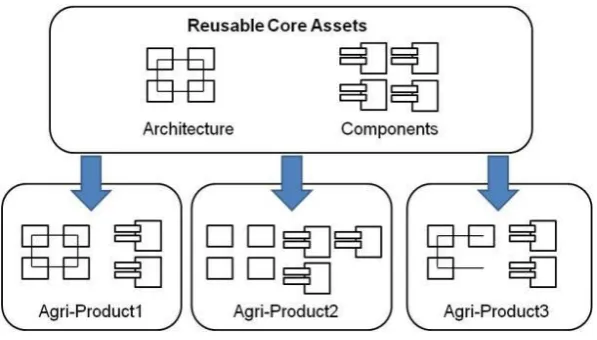
In SPLE, the software reuse approach is applied to the system family. The term “system family” refers to a set of software system with similar features that satisfy specific given requirements and are developed from a set of reusable core components in a predefined way (Pohl et al., 2005). The reusable core components, also known as core assets, contain software components and requirements, analysis, design and test artifacts, are stored in a shared repository. These core assets are made available for reuse by multiple members of the system family, with variability mechanisms. The main concept for reuse in SPLE is to exploit the commonality of core assets and manage their variability.
Figure 1.1: Architectural approach reuse in SPL (Fajar et al., 2010)
In SPLE, the most important concept is features that serve as representation of reusable components and requirements of a product line. According to Kang et al. (1990), features are known attributes of a system that are identified by the end users. The most used method for analysing a domain using features is the Feature-Oriented Domain Analysis (FODA), in which those features are constructed into a feature tree or feature model (Kang et al., 1990). The feature model is composed of a hierarchy of features, with each branch holds either mandatory, optional, or mutually exclusive conditions. The FODA method will be used to document requirements artefacts for the research. The output will be a feature model of a PF application based on Software Product Line (SPL). In order to map the requirements into architectural components, a new feature-architecture mapping method by Sochos and Matthias (2004) will be used, namely Feature-Architecture Mapping (FArM) method. In order to handle the feature variability of the software components, the FArM method will be integrated with processes in Feature Dependency Analysis (FDA) method.
1.2 Problem Background
problem is related to the issue of complexity in software development. The technical problem is involving the issues on the SPLE methods that are used for software development.
In the past, building software from scratch may be the only solution in software development. The basic development phases will start from collecting the requirements from customers and stakeholders, analysing them, and then designing the architecture or solution before implementing them into lines of codes. Nowadays, building software from scratch may not be the most convenient way because the software development has becoming more complex. Complexity can increase due to evolution of software functionalities, in which is caused by customer’s demands to add more innovative functionalities to the software (Pohl et al., 2005). As the complexity increases, the size of code will also increase. An example is the Windows Operating System, in which in 1991 Windows NT PDK 2 had 1.8 million SLOC (Cusumano and Selby, 1998) and Windows XP had 48 million SLOC (Pohl et al., 2005).
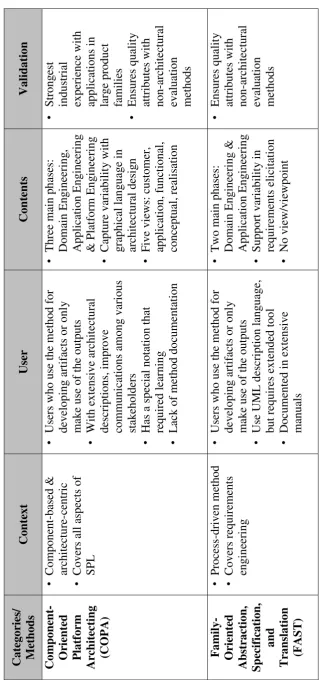
Table 1.1:
Comparison between SP
L ar chitecture desig n methods Categories/ Meth od s Con text User Con ten ts Validation Co m p on en t-Or ie nte d Pl a tf o rm Arch it ec ti n g (COPA) •
Component-based & archi
tect u re-cent ri c • C overs al l aspect s of SPL •
Users who use the m
ethod for
developing
artifa
cts or o
n
ly
make use of the outputs
• W it h e x te nsi v e archi tect u ral
descriptions, improve communications among
various
stakeholders
•
Has a spe
cial notation that
required le arnin g • L
ack of method do
cume ntation • Three m ai n ph ases: Doma in Eng inee rin g , Application Eng ine erin g & P latform En g inee rin g • Ca pture va ria b ilit y with g raphi cal l an g u ag e i n archi tect u ral desi g n • F
ive views: customer,
application, functional, concept
u al , r eal is at io n • Strong est
industrial ex
peri
ence wi
th
applications in large produ
ct fa milie s • Ensures qualit y attribute s with non-archite ctural
evaluation methods
Fa mi ly -Or ie nte d Ab stracti o n , S p eci fi cati on , and
Translation (FAS
T ) • Process-driven m ethod • Covers requir ements eng in eeri n g •
Users who use the m
ethod for
developing
artifa
cts or o
n
ly
make use of the outputs
• Use UM L desc ription lang ua ge,
but requires ex
tended too l • Docum ent ed i n ex te nsi v e manuals •
Two main phases: Doma
in Eng inee rin g & Application Eng ine erin g • Support variabilit y in re quire me nts e lic ita tion • No view/viewpoint • Ensures qualit y attribute s with non-archite ctural
F ea tu re-Or ie nte d Reu se Me th od (F OR M) • Feat ur e-ori ent ed method • Covers requir ements eng in eeri n g , archi tect u re, imple m en ta tion & process • Academ ic audi enc e •
Gives common lang
u
ag
e,
improve communication bet
w een cust om ers & en g ine ers • Has speci al not at ion t h at required le arnin g •
Has provided spe
cial
g
u
idelines
•
Two main phases: Doma
in Eng inee rin g & Application Eng ine erin g • Support variabilit y in re quire me nts e lic ita tion • Three archi te ct ural
models (or viewpoints): subs
y stem, proc ess, module • Ensures qualit y attribute s with non-archite ctural
evaluation methods
Co m p on en t-Base d Applic ation Develop m en t (K ob rA ) •
Component-based method
• Covers requir ements eng in eeri n g , archi tect u re, imple m en ta tion & process • S o ft ware en g in eers & de si g n ers • Use commonl y kno wn standards like UM L • Use UM L desc ription lang ua ge,
but requires ex
tended too l • Docum ent ed i n ex te nsi v e manuals •
Two main phases: Doma
in Eng inee rin g & Application Eng ine erin g • Ca pture va ria b ilit y with g raphi cal l an g u ag e i n archi tect u ral desi g n • No view/viewpoint • Ensures qualit y attribute s with non-archite ctural
evaluation methods
Quality- dr ive n Arch it ec tu re
Design and qualit
y
Analysis (QADA)
• Qual it y -d ri v en & archi tect u re-cent ri c approach • R epresent s i n te rf ac e between r equirem ents eng in eeri n g & archi tect u re desi g n , but
cannot be conside
red as sy st em at ic approa ch to g at h er & anal y se requirements •
Users who use the m
ethod for
developing
artifa
cts or o
n
ly
make use of the outputs
• Use commonl y kno wn standards like I E E E -Std-1471-200 0 • Use UM L desc ription lang ua ge,
but requires ex
tended too
l
•
L
ack of method do
cume ntation • Three m ai n ph ases: C ont ex t Anal y si s, C oncept u al & C onc ret e Desig n , Qualit y Evaluation • Ca pture va ria b ilit y with g raphi cal l an g u ag e i n archi tect u ral desi g n • F our viewpoint: structural, behaviou r, deplo y ment, development • Qua lit y of d esig n is va lida te
d with a
scenari
o
-b
ased
evaluation in two methods: concept
u
al
&
concret
Feature-oriented approach is one of methods to implement SPLE, which manipulates features of software system and then are plotted into a feature model (Kang et al., 1990). The most cited and used feature-oriented method is FODA (Kang et al., 1990). The main motive of using FODA is to implement domain analysis. There are detailed guidelines documented by the authors in order to implement domain analysis in a systematic manner (Lee et al., 2002). The guidelines are retrieved based on the authors’ experiences with feature modeling on previous projects like electronic bulletin board systems, private branch exchange, and elevator control software. The authors concluded that feature modeling using FODA was insightful, effective, and efficient for discovering commonality and variability of domain applications. Therefore, the FODA method is useful for Analysis phase in software development. In order to continue with Design and Implementation phases, FODA method is extended to FORM (Kang et al., 1998). However, one obvious weakness of FORM is that it does not provide concrete description on processes to map features to architectures. FORM does not focus on providing a clear transition between feature model and architecture, instead only concretising the FODA processes of analysis and design from a marketing perspective.
In 1999, the initial FORM method was used in building the core part of Elevator Control System (ECS) for LG Industrial Systems CO. Ltd. (LGIS) (Choi et al., 1999). The development of ECS using initial FORM method was a success. After
Feature-Architecture Mapping (FArM) method was introduced by Sochos and Matthias (2004) that claimed to have stronger mapping of feature model to architecture compare to FORM. The mapping is done in two phases, which are Transform Feature Model and Building Reference Architecture phases. Transform Feature Model phase contains four transformations that are done iteratively. Building Reference Architecture phase is implemented in parallel with each transformation in order to derived architectural components. Thereby, FArM method provides more systematic processes and is able to map features to architectures stronger that FORM. FArM involves only in the Design and Implementation phases of software development. The authors suggested the use of FODA method for Analysis phase. It is the best choice to use FODA because it has detailed documentation of processes needed for domain analysis. Although both methods are feature-oriented, some set of guidelines is needed in order to transform the feature model so that it can be used as input for designing architecture using FArM. This is because the feature model built using FODA is in four layers, but the feature model required in FArM is in single hierarchical structure. FArM does not provide processes for transforming four-layer feature model to single layer.
12
F
igure 1.2
(a):
L
o
g
ic
al
f
eat
ure m
odel
o
f W
S
AN based a
g
ri
cul
tu
re s
y
st
em
s
(Faj
ar
et
al
.
, 2010)
(Refer l
eg
end in F
ig
u
re
1
13
F
igure 1.2
(b):
P
h
y
si
cal
f
eat
ure m
odel
o
f W
S
AN based a
g
ri
cul
tu
re s
y
st
em
s
(Faj
ar
et
al
.
1.3 Problem Statement
There are two main problems in this research that need to be solved, which are software complexity and suitable SPL methods to be used. The problem with software complexity is how to handle the issues like changes of requirements during software development, finding the suitable mechanism for handling feature variability, and the artifacts that can be reused. The second problem is in selecting the suitable methods for SPL development. The context of suitable methods refers to the methods that provide step-by-step processes and have sufficient documentation on the methods. There may be some methods that cover all aspects of software development like FORM, but it does not provide step-by-step processes and concrete description on mapping features to architecture. Some methods only cover the analysis aspect of software development like FODA, and some covers design and implementation aspect like FArM. Some methods like FDA only cover the feature variability issues in designing software architecture. The decision to integrate these methods may be a wise decision, but this may require a certain platform or transition phases in order to integrate them.
Therefore, in order to achieve the objectives and to handle the problems that have been discussed in Section 1.2, the study will be carried out to answer the following questions:
1. How to determine which requirements are suitable for developing PF software PL?
2. How to transform the feature model built using FODA so that it can be suitable input for FArM to process?
3. How the integrated FArM and FDA methods can be used for handling feature variability?
1.4 Research Aim
The research is aimed to provide systematic processes and guidelines for developing software architecture. Several existing PF overall system and software architectures that are based on WSN are studied, and then a detailed study is conducted on their elements, features, functionalities, limitations, and abilities. The investigation on software architecture will lead to the process of extracting requirements that will later transformed into features. The features will be represented using feature model using FODA method that will be mapped onto architectural elements using FArM method. FDA method will be used for mapping the feature variability.
1.5 Research Objectives
There are four main objectives that need to be achieved upon the completion of the study.
1. To perform domain analysis by collecting and studying the requirements of PF application and transformed them into features to create a feature model.
2. To integrate FODA and FArM methods by transforming feature model in a way that it can be input for FArM transformations.
3. To enhance the feature variability mechanism in the initial FArM method by integrating it with FDA method.
1.6 Research Scope
In order to keep the research within achievable boundary, the conduct of the research is restricted to the following scopes:
1. Analysis and investigation of the study in order to extract requirements are limited to six case studies of existing PF overall system and software architecture.
2. The research only involves the Analysis and Design phases of software development.
3. The use of FODA method is restricted for domain analysis.
4. The FArM method will be used for mapping the feature model onto architectural components.
5. The processes in FDA method that are going to be integrated with FArM method are limited for handling the feature variability.
1.7 Significance of the Study
1.8 Organisation of Report
REFERENCES
Atkinson, C., Bayer, J., Bunse, C., Kamsties, E., Laitenberger, O., Laqua, R., Muthig, D., Paech, B., Wüst, J., and Zettel, J., 2002. Component-Based Product Line Engineering with UML. Addison-Wesley.
Auernhammer, H., 2001. Precision Farming - the Environmental Challenge. Elsevier: Computers and Electronics in Agriculture. 30 (1-3). 31-43.
Baggio, A., 2005. Wireless Sensor Network in Precision Agriculture. Workshop on Real-World Wireless Sensor Networks.
Bass, L., Clements, P., and Kazman, R., 1998. Software Architecture In Practice. Addison-Wesley.
Boellert, K., 2002. Object-Oriented Development of Software Product Lines for the Serial Production of Software Systems. Doctor Philosophy.
Bosch, J., 2000. Design & Use of Software Architectures - Adopting and Evolving a Product Line Approach. Addison-Wesley.
Camilli, A., Cugnasca, C. E., Saraiva, A. M., Hirakawa, A. R., and Correa, P. L.P., 2007. From Wireless Sensors to Field Mapping: Anatomy of An Application for Precision Agriculture. Elsevier: Computers and Electronics in Agriculture. 58. 25-36.
Charvat, K., Holy, S., Gnip, P., and Sida, A., 2003. Precision Farming Through Internet and Mobile Communication. Proceedings International Congress IT in Agriculture.
Chaudhary, D. D., Nayse, S. P., and Waghmare, L. M., 2011. Application of Wireless Sensor Networks for Greenhouse Parameter Control in Precision Agriculture. International Journal of Wireless & Mobile Networks. 3.
Feature-Oriented Reuse Method and CASE Tools. Proceedings of the 1999 IEEE International Symposium on Computer Aided Control System Design.
Cox, S., 2002. Information Technology: The Global Key to Precision Agriculture and Sustainability. Elsevier: Computers and Electronics in Agriculture. 36 (2-3). 93-111.
Cusumano, M., and Selby, R., 1998. Microsoft Secrets: How the World's Most Powerful Software Company Creates Technolog, Shapes Market, and Manages
People.
Fajar, M., Nakanishi, T., Tagashira, S., and Fukuda, A., 2010. Introducing Software Product Line Development for Wireless Sensor/Actuator Network Based Agriculture Systems. Proceedings of Bogor Agricultural University's Seminars. Frakes, W. B., and Kang, K., 2005. Software Reuse Research: Status and Future.
IEEE Transactions on Software Engineering. 31.
Gomaa, H., 2005. Designing Software Product Lines with UML: From Use Cases to Pattern-Based Software Architectures. Addison-Wesley
Griss, M., Favaro, J. and d'Alessandro, M., 1998. Integrating Feature Modeling with the RSEB. Proceedings of the Fifth International Conference on Software Reuse.
Hwang, J., Shin, C., and Yoe, H., 2010. Study on Agricultural Environment Monitoring Server System Using Wireless Sensor Network. Selected Papers from the 11th International Workshop of Knowledge Management and
Acquisition for Smart Systems and Services.
Jacobson, I., Christerson, M., Jonsson, P., and Oevergaard, G., 1992. Object-Oriented Software Engineering: A Use-Case Driven Approach.
Addison-Wesley.
Jayaratna, N., 1994. Understanding and Evaluating Methodologies: NIMSAD - A Systematic Framework. McGraw Hill.
Kang, K. C., Cohen, S. G., Hess, J. A., Novak, W. E., and Peterson, A. S., 1990. Feature-Oriented Domain Analysis (FODA): Feasibility Study. [Technical
Report]. Carnegie Mellon University, Software Engineering Institute. CMU/SEI-90-TR-21.
Kang, K. C., Kim, S., Lee, J., Kim, K., Shin, E., and Huh, M., 1998. FORM: A Feature-Oriented Reuse Method with Domain-Specific Reference Architectures. Annals Of Software Engineering. 5 (1). 143-168.
Kang, K. C., Lee, J., and Donohoe, P., 2002. Feature-Oriented Product Line Engineering. IEEE Software. 19(4). 58-65.
Kheong, L. S., and Jayaratna, N., 2009. Framework for Structuring Learning in Problem-Based Learning.
Khosla, R., 2008. Opening ceremony presentation. The 9th International Conference on Precision Agriculture. July 20-23rd.
Larman, C., 2004. Applying UML and Patterns: Introduction to OOAD & Iterative
Development. (3rd ed.). Prentice Hall, 2004.
Lee, K., and Kang, K. C., 2004. Feature Dependency Analysis for Product Line Component Design. Software Reuse: Methods, Techniques and Tools.
Lee, K., Kang, K. C., Chae, W., and Choi, B. W., 2000. Feature-Based Approach to Object-Oriented Engineering of Applications for Reuse. Software-Practice and Experience.
Lee, K., Kang, K. C., and Lee J., 2002. Concepts and Guidelines of Feature Modeling for Product Line Software Engineering. Software Reuse: Methods, Techniques, and Tools. 2319.
Lewis, K. A., and Bardon, K. S. A., 1998. Computer-Based Informal Environmental Management System for Agriculture. Environmental Modelling & Software. Li, X., Deng, Y., and Ding, L., 2008. Study on Precision Agriculture Monitoring
Framework Based on WSN. International Conference on Anti-Counterfeiting, Security, and Identification (2008 ASID). 182-185 .
López, J. A., Soto, F., Iborra, A., Sánchez, P., and Suardíaz, J., 2010. Design and Implementation of a Wireless Sensor Network for Precision Horticulture. Sensor Applications, Experimentation, and Logistics. 29.
Mandal, S. K., 2006. Precision Farming Approaches for Small-Farm Agriculture: Scope and Prospect. Conference Proceedings of Map India 2006 on Agriculture.
McBratney, A., Whelan, B., Ancev, T., and Bouma, J., 2005. Future Directions of Precision Agriculture. Precision Agriculture. 7-23.
Meister, J., 2006. Product-Driver Development of Software Product Lines Applied on an Example of Analytical Software. Doctor Philosophy.
Mellon University Carnegie. Software Product Line. [Online]. Software Engineering Institute (SEI). Available at: http://www.sei.cmu.edu/productlines/index.html. Mili, H., Mili, A., Yacoub, S., and Addy, E., 2002. Reuse-Based Software
Engineering: Techniques, Organization, and Controls. (1st ed.).
Wiley-Interscience.
Nikkilä, R., Seilonen, I., and Koskinen, K., 2010. Software Architecture for Farm Management Information Systems in Precision Agriculture. Computers and Electronics in Agriculture. 70. 328-336.
OMG, 2008. System Modeling Language Specification. [Technical Report]. Object Management Group.
Ossher, H., and Tarr, P., 2001. Multi-Dimensional Separation of Concerns and the Hyperspace Approach. Software Architectures and Components Technology. Kluwer Academic Publishers.
Pierce, F.J., and Elliott, T.V., 2008. Regional and On-Farm Wireless Sensor Networks for Agricultural Systems in Eastern Washington. Elsevier: Computers and Electronics in Agriculture. 32-43.
Pierce, F. J., and Nowak, P., 1999. Aspects of Precision Agriculture. Advances in Agronomy. 1-85.
Pohl, K., Böckle, G., and Linden, F. V. D., 2005. Software Product Line Engineering: Foundations, Principles, and Techniques. Springer-Verlag Berlin
Heidelberg.
Riquelme, J. A. L., Soto, F., Suardiaz, J, Sanchez, P., and Iborra, A., 2009. Wireless Sensor Networks for Precision Horticulture in Southern Spain. Computers and Electronics in Precision Agriculture. 68. 25-35.
Robert, P. C., 1993. Characterisation of Soil Conditions at the Field Level for Soil Specific Management. 60. 57-72.
Robert, P. C., 1999. Precision Agriculture: Research Needs and Status in the USA. Precision Agriculture, 99 Proceedings of the 2nd European Conference on
Precision Agriculture. Edited by Staīord, J. V. (Sheĸeld Academic Press
Robert, P. C., 2002. Precision Agriculture: A Challenge for Crop Nutrition Management. Plant and Soil. 247. 143-149.
Robert, P., Rust, R., and Larson, W., 1994. Site-Specific Management for Agricultural Systems. Proceedings of the 2nd International Conference on Precision Agriculture. Madison.
Shibusawa, S., 2001. Precision Farming: Approaches for Small-Scale Farms. Proc. 2nd IFAC-CIGR Workshop on Intelligent Control for Agricultural
Applications. Bali, Indonesia. 22-27.
Sochos, P., 2007. The Feature-Architecture Mapping Method for Feature-Oriented Development of Software Product Lines. Doctor Philosophy.
Sochos, P., and Riebisch, M., 2004. Feature-Oriented Development of Software Product Line: Mapping Feature Models to the Architecture. 3263. 23-42.
Sochos, P., Riebisch, M., and Philippow, I., 2006. The Feature-Architecture Mapping (FArM) Method for Feature-Oriented Development of Software Product Lines. Stafford, J. V., 2000. Implementing Precision Agriculture in the 21st Century.
[Keynote paper]. Journal of Agricultural Engineering Research. 76. 267-275. Streitferdt, D., 2003. Family-Oriented Requirements Engineering. Doctor
Philosophy.
Sudduth, K. A., 1999. Engineering Technologies for Precision Farming. International Seminar on Agricultural Machinery Technology for Precision
Farming.
Tian-en, C., Li-ping, C., Yunbin, G., and Yanji, W., 2009. Spatial Decision Support System for Precision Farming Based on GIS Web Service. International Forum on Information Technology and Applications.
Tizzei, L. P., and Rubira, C. M. F., Public Health Complaint Software Product Line. Wang, N., Zhang, N., and Wang, M., 2006. Wireless Sensors in Agriculture and
Food Industry - Recent Development and Future Perspective. Computers and Electronics in Agriculture. 1-14.
Wang, Y., Wang, Y., Xu, L., and Qi, X., 2009. OPAIMS: Open Architecture Precision Agriculture Information Monitoring System. Proceedings of the 2009 International Conference on Compilers, Architecture and Synthesis for
Embedded Systems. 233-240.