THE IMPLEMENTATION OF INTEGRATED SOFTWARE FOR TRAINING AND MEASURING CREATIVITY
Tan Choon Keong1, Prof. Dr. Baharuddin Bin Aris2 and Dr. Jamaluddin Bin Harun2
1 School of Education and Social Development, Universiti Malaysia Sabah, Sabah 2 Department of Educational Multimedia, Faculty of Education, Universiti Teknologi
Malaysia, Johor
Abstract
Every one of us has the potential to tap our own inner creative abilities and to make original and valued choices in our lives. The growing interest and concern in tapping creativity has prompted many researches on creativity to be undertaken in a number of countries, particularly Malaysia. This paper explored the use of Information and Communication Technology (ICT) as an important tool for fostering and assessing the creative potentials of a person. The researcher implemented an integrated system on 97 university undergraduates who would be potential teachers in the near future. Could computer be used to measure the creativity traits of a person? Could they improve their respective creative potentials? How did creativity improve? The research found that the assessment of creativity traits such as fluency, flexibility, elaboration and originality using computer was valid and possible using definitions and algorithms adapted from Torrance’s TTCT and Guilford’s Alternative Task (Torrance & Ball, 1984; Guilford, 1977). It was also found that 85 out of the 97 subjects managed to improve their respective fluency, flexibility, elaboration and originality scores in the posttest. The improvement of their creative potentials was pinpointed to the effective implementation of the Morphological Analysis Method in the brainstorming activities (pretest and posttest). The successful knowledge acquirement of the creativity technique by the subjects was due to the lively and effective delivery of multimedia training modules on the MA Method. It was recommended that the MA Method be adapted for repeated uses on any academic curriculums in schools or universities/colleges to improve the creative potentials of a person on long term basis.
1.0 Introduction
A lot of people tend to think that of a “creative person” as eccentric or may be “insane” (of the ways he handles things unusually). The communities perceive such people as creative due to the outcomes of their hard work; solving problems in a novel, yet appropriate way. These anomalies have prompted the author to be motivated to examine the causes of creativity and how creativity can be fostered, nurtured or improved by using the latest all important tool of productivity, multimedia.
The crucial question is whether Information and Communication Technology (ICT) can help making the job of creativity assessment easier and faster and at the same time plays its role in fostering creativity? Conventional methods using manually drawn graphics are time-consuming process in term of assignment of scores to the tests (if it is not in objective format).
integrated system was carefully planned, designed, developed and tested on a group of university undergraduates for its effectiveness and reliability in evaluating creative potentials of a person.
1.1 Research questions
This research was designed to examine and answer the following questions:
1. In what ways could ICT (multimedia) help to improve creativity?
2. What components of creativity were used to indicate creativity improvement? 3. How did the creative potentials of a person improve?
2.0 Review of Literature
2.1 The use of multimedia for training creativity
Creativity is often known as a characteristic that a person possesses, a product or outcome that is regarded as original, and a process by which an unusual, novel or suitable outcome or solution is obtained. Creativity involves the exercise of imagination. Creativity can be examined in a form of:
• product or behaviour (Besemer & Treffinger, 1981)
• personality (Gardner, 1983)
• thinking and learning styles (Sternberg, 1985)
• environmental and social psychological settings such as motivation and work place (Amabile, 1982; 2006) and social-economic factors
• creativity processes were such as thinking processes (cognition and meta-cognition)
• stages of creativity (Csikszentmihalyi, 1996; Loveless, 2002; Mansfield & Busse, 1981; Shneiderman, 2000; 2002a; 2002b)
For example: Shneiderman’s Model: Collect, Relate, Create, Donate
Numerous researchers argued that creativity could be taught and increased (Cropley, 2001; Davis, 1999; Houtz, 2003; Treffinger & Isaksen, 2001; Onda, 1994; Torrance & Safter, 1999). In this research, multimedia courseware that upholds the principles of multimedia of self-access, self-directed and self-paced was used in creativity training. According to Schwier and Misanchuk (1993), multimedia courseware must have interactive learning components and practices that come with responses and suitable feedbacks. Carefully designed multimedia courseware that are consistent with how people learn, can aid learner greatly (Liou, 1994; Mayer, 1997, 1999a, 1999b).
Animation is also a highly effective tool for illustrating a concept (Roblyer, 2003). The purposely-created motion can also illustrate processes and real-life or virtual environment. Animations are processed in the visual or pictorial channel (Mayer, 2003). But, unfortunately, learners can only able to mentally activate for about ten seconds of the animation at any one time.
2.2 The training and assessment of creativity
This research used brainstorming and the Morphological Analysis (MA) Method in fostering creativity. Brainstorming was an activity that encouraged lateral thinking and a great contributor to creativity and innovations because it gathered all ideas (without pre-judging any of them) into a solution-bank for the next stages of the creativity process (Muttagi, 1981; Rawlinson, 2004; Vidal et al., 2004). The running of brainstorming is usually based the principles of:
• Criticism was ruled out
• Freewheeling was welcomed
• Quantity was wanted
• Combination and improvement were sought
The creation of a relaxed and judgement-free atmosphere would encourage the flow of ideas which would be severely impeded if participants were allowed to convey their judgement on each idea (Majaro, 1988). To ensure all ideas were accepted, the power of imagination was highly encouraged. In other words, the brainstorming session might produce any idea that could solve the problem, be it wild, insane, practical or even impractical idea.
With the growth of online services, brainstorming activities had gone online with a new term known as brainlining (combines the words ‘brainstorming’ and ‘online’) (Proctor, 1999). In this research, an ‘asynchronous’ (offline) type of brainstorming was created (Binder & Binder, 2007) to be used together with the MA Method. The morphological box or morphological matrix was created by Dr Fritz Zwicky, a Swiss astrophysicist based at the California Institute of Technology (Michalko, 1991) and it could generate a very large number of solution concepts for a problem under investigation (Roy, 2004).
It worked through the processes of breakdown and association (Roy, 2004). For example, if there is a problem called “Future transportation”. It would be broken down into two variables; type and power. The “type” variable has “ground, air, space” components while the “power” variable has “petrol, electric, solar, battery” components. The association of “ground” and “solar” sub-variables could result in the new idea of “solar-powered robot transport machine”. Theoretically, this MA matrix is capable of producing 3 x 4 or 12 ideas (two-dimensional analysis). However, multi-dimensional MA would result unlimited ideas, possibly millions of ideas of which Aleinikov (2002) termed as the “mega-creativity” stage.
encouraged the breakdown of a problem into easily approachable components and thereby increased the possibilities of getting more solutions and hence increased the fluency of ideas production (Aleinikov, 2002; Rawlinson, 2004).
The focus of this research was to measure the creativity traits of the subjects in term of fluency, elaboration, flexibility and originality. The criterion for the assessment of the creative potentials of a person used in this research was based on Table 1.
Table 1 Scoring criteria for creativity constructs and creativity index
Creativity components
Scoring criteria Score awarded
Fluency (F) The number of different ideas
that one can produce 1 point for each idea Elaboration (E) Richness of detail in the ideas
that one produces
1 point for each creative elaboration
Flexibility (FX) The number of categories of ideas that one produces
1 point for each category
Originality (O) The uniqueness of the ideas that one produces as
compared to the whole sample
Between 1% and 5% = 1 point
If 1% = 2 points
(adapted and adopted for use in this research from Torrance & Ball, 1984; Guilford, 1977)
3.0 Methodology, Sampling and Procedure
This research used the quasi-experiment design utilizing the one-group pretest-posttest design by Campbell and Stanley, (1963) (in Levine and Parkinson, 1994; Bernard, 2000). The population of this research was all final year undergraduates (N = 172) of the education faculty of a public university in the state of Sabah, Malaysia. Based on the sampling size table provided by Bartlett et al., (2001), the minimum sample size required by this research was estimated to be 94 subjects (n = 94). To solve problem of absentees, the names of 110 subjects were ticked randomly from the name list supplied by the faculty. Finally, only 97 subjects from two academic disciplines (TESL and Science) managed to participate in the experiment. The procedure of research was based on the following:
• Briefing by lab facilitator (10 minutes)
• Pretest (5 minutes)
• The treatment (MA Method): multimedia modules (30 to 40 minutes)
• Posttest (5 minutes)
• Post-experiment Survey
The instrument used for the assessment of creativity was the Creativity Assessment System embedded in the integrated system. The chosen topic for the pretest and posttest was “Future Transportation in Malaysia”. The principle of creativity measurement purely lied with divergent thinking and hence ‘the number of ideas produced’ contributed to the fluency component. For example, 10 ideas contributed brought 10 creativity scores for a person’s creativity indicator (fluency). There was no right or wrong answers for the topic. The principle of creativity stated that there was no such thing as ‘wrong idea’ because all ideas were accepted.
In this research, content validity for the “question” was solved with the verification by a local creativity researcher from another public university. It was only the difficulty level of the question that might bring problems because difficult brainstorming topic would not bring many ideas. In this research, the topic chosen utilized general knowledge and therefore a lot of ideas were expected.
In term of reliability of the Creativity Assessment System, it was found to be reliable because the calculations for the four creativity components (fluency, flexibility, elaboration and originality) were done via the implemented algorithms programmed strictly based on the criteria defined in Table 1. In addition, the pilot run of the integrated system showed that the anticipated results tallied 100% correctly with manually calculated results.
Another instrument was the post experiment survey to find out more about difficulties faced in the experiment, views and perceptions. Their answers helped to explain certain behavioural characteristics or phenomena that were detected after analysing the quantitative data. The post experiment survey had 6 questions.
4.0 Findings and Discussion
4.1 Improving creative potentials via multimedia
The training modules used in this research contained all the five multimedia components. They were text, graphics, audio, video and animation. The multimedia modules used in this research were complete with definitions, explanations, examples (in multimedia format especially animations) related to the creativity techniques employed. Besides that, practices with guided solutions were also included in the system. This was to enforce scaffolding or knowledge enhancement that acted as support and guidance to problem solving that could be beyond the possession of the current knowledge (the MA Method) (Rogoff, 1990).
respective creativity scores in the posttest after going through the training modules which indicated that to a certain extent, the training was successful.
4.2 Had the creative potentials of the subjects improved?
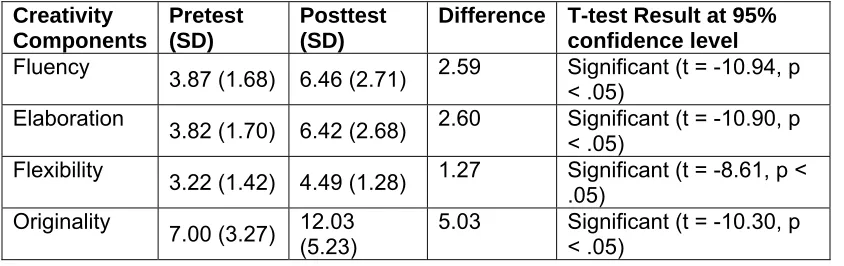
Many researchers believed and to a certain extent proved that the creative potentials of a person could improve (Cropley, 2001; Davis, 1999; Houtz, 2003; Treffinger & Isaksen, 2001; Onda, 1994; Torrance & Safter, 1999). In this research, did the 97 subjects improve their respective creative potentials? The research findings on the creativity achievement for the subjects was summarised in Table 2.
From Table 2, we could see that there was an increase in means in every creativity component. The differences in the means were all tested with t-test and the result also indicated significance for all the components at 95% confidence level. This proved that the subjects had improved their creativity scores in the posttest. How did they manage to increase their creativity scores in the posttest? This could be traced back to the increased number of ideas the subjects posted to the system. There was an increase of 252 ideas in the posttest’s ideas bank from 375 ideas (pretest) to 627 ideas (posttest).
Table 2 Summary of creativity achievement: Comparisons of means
Creativity Components
Pretest (SD)
Posttest (SD)
Difference T-test Result at 95% confidence level Fluency
3.87 (1.68) 6.46 (2.71) 2.59 Significant (t = -10.94, p < .05) Elaboration 3.82 (1.70) 6.42 (2.68) 2.60 Significant (t = -10.90, p
< .05)
Flexibility 3.22 (1.42) 4.49 (1.28) 1.27 Significant (t = -8.61, p < .05)
Originality
7.00 (3.27) 12.03 (5.23) 5.03 Significant (t = -10.30, p < .05)
The MA Method succeeded in improving the skills of the subjects to enhance ideas generations in the posttest. As creativity experts put it, the more ideas a person could generate meant that the more innovations would be able to be accomplished as suggested by the divergent thinking process as explained in the Structure of Intelligence Model (Guilford, 1967; 1977). This view was also supported by DeBono (1990) who reiterated that lateral thinking (divergent thinking) was an effective method for enhancing creativity and problem solving.
The post-experiment survey which was administered after the completion of the posttest also showed the following results:
• Can MA Method help you to contribute more ideas? (97.9% subjects said ‘Yes’)
• Morphology Analysis organised my thoughts on ideas (74.2% subjects said ‘Yes’)
• Morphology Analysis is systematic and easy to use (63.9% subjects said ‘Yes’)
• The MA's matrix item intersections kept me in focus on ideas (75.3% subjects said ‘Yes’)
In examining the opinions of the subjects on whether the MA Method helped them in contributing more ideas, 95 subjects or 97.9% agreed so. Why was this so? As explained earlier, the MA Method was a matrix bordered by the x-axis and y-axis. The intersection of two sub-variables of the matrix helped the subjects to think of the ideas.
For example, the intersection between “ground’ sub-variable on the y-axis and “soul” sub-variable on the x-axis resulted with the idea; “bed transport” (refer Figure 1). This idea sounded crazy, mad and illogical but in the ‘suspend judgement’ principle practised in brainstorming technique, it was allowed and accepted by the system. Who might know that in the future, some geniuses might take this idea seriously and go on to design and invent it, so that when we wake up from our sleep we had reached our desired destination. Sounds crazy, huh? But, this was just creativity!
Figure 1 Screen shot of the morphology matrix in the posttest
75.3% or 73 subjects also of the opinion that MA was not only easy to use but also helped the user to keep focus on only thinking of the required type of idea only. When the subjects were focus in thoughts, thinking was quite systematic and organised. This opinion was again supported by 74.2% of them (72 subjects). In other words, when thoughts were not organized (as in the pretest) they were forced to search for ideas randomly at all possible places mentally and the MA Method did a great favour by helping them to keep focused and concentrated via the respective intersections of the matrix.
5.0 Recommendation
As the MA Method utilizing the matrix in creative problem solving was proved effective in this research, it was therefore recommended that this method could be adapted to suit academic activities (in schools or universities/colleges) that require brainstorming for ideas. The repeated uses of this technique would be able to improve the creative potentials of a person in the long term.
6.0 Conclusion
The conclusion for this research was that the creativity technique, MA Method was able to stimulate brainstorming and proven to be able to produce more ideas than before. However, it must be noted that this achievement was only able to succeed if judgement of ideas was delayed or suspended as recommended by brainstorming experts (DeBono, 1990; Rawlinson, 2004). The multimedia training was also successful in departing precise and useful information on the correct use of the MA Method. I would conclude that the improvement of creativity of the subjects was due to the combinations of right learning attitude of the subjects towards learning the MA Method, the effective roles of the MA matrix and the successful completion of both pretest and posttest by the sample subjects.
References
Aleinikov, A.G. (2002). Megacreativity: 5 steps to thinking like a genius. Ohio: Walking Stick Press, 44 – 63
Amabile, T. (1982). Social Psychology of Creativity: A Consensual Assessment Technique. Journal of Personality and Social Psychology, 43, 997-1013
Amabile, T.M. (2006). Sweat the Small Stuff: Factors Influencing Creativity and Motivation in the Workplace. Arthur Rock Center for Entrepreneurship. Available:
http://www.hbs.edu/entrepreneurship/newbusiness/story2.html Retrieved on 3
September 2005
Bernard, H.R. (2000). Social Research Methods. Sage Publications Inc, 118 – 122 Besemer, S. and Treffinger, D. J. (1981). Analysis of creative products: review and
synthesis. Journal of Creative Behavior, 15, 158-178
Binder, J.C. & Binder, J. (2007). Global Project Management: Communication, Collaboration and Management across Borders. Gower Publishing Ltd, 118 – 120.
Cropley, A. J. (2001). Creativity in education and learning: A guide for teachers and educators. London, UK: Kogan Page Limited.
Csikszentmihalyi, M. (1996). Creativity: Flow and the Psychology of Discovery and Invention. New York: HarperCollins.
Davis, G. A. (1999). Creativity is forever (4th Ed.). Dubuque, IA: Kendall/Hunt Publishing Company.
DeBono, E. (1990), Lateral Thinking. London: Penguin
Gardner, H. (1983). Frames of Mind: The Theory of Multiple Intelligences. New York: Basic Books.
Guilford, J. P. (1967). The nature of human intelligence. New York: McGraw-Hill.
Guilford, J .P. (1977). Way beyond the IQ. Buffalo, NY: the Creative Education Foundation, Inc, 160
Houtz, J. C. (2003). The educational psychology creativity. In Houtz, J. C. (Ed.). The educational psychology of creativity. CresskillNJ: Hampton Press, Inc, 3-24
Levine, G. and Parkinson, S. (1994). Experimental Methods in Psychology. Lawrence Erlbaum Associates, 59 – 65
Liou, H. C. (1994). Practical Considerations for Multimedia Courseware Development: An EFL IVD Experience. CALICO Journal, 11(3), 47-74
Loveless, A.M. (2002). Literature Review in Creativity, New Technologies and
Learning. A Report for NESTA Futurelab.
http//www.nestafuturelab.org/reviews/cr01.htm. Retrieved on 05 October 2005 Majaro, S. (1988). The Creative Gap: Managing Ideas for Profit. London: Longman Mansfield, R. S. and Busse, T. V. (1981). The psychology of creativity and discovery:
Scientists and their work. Chicago: Nelson-Hall Inc.
Mayer, R.E. (1997). Multimedia Learning: Are We Asking The Right Questions? Educational Psychologist, 32, 1 – 19
Mayer, R.E. (1999a). Multimedia Aids to Problem-Solving Transfer. International Journal of Educational Research, 31, 611 – 623
Mayer, R.E. (1999b). Research-Based Principles for the Design of Instructional Messages. Document Design, 1, 7 – 20
Mayer, R.E. (2003). The Promise of Multimedia Learning: Using the Same Instructional Design Methods across Different Media. Learning and Instruction: The Journal of The European Association for Research on Learning and Instruction, April, 13(2). Michalko, M. (1991). Thinkertoys: A Handbook of Business Creativity for the 90’s. Ten
Speed Press, 42, 109 – 110, 117
Muttagi, P. K. (1981). Effect of brainstorming on creativity. Indian Journal of Social Work, 42, 41–53
Onda, A. (1994). Development of creative education. Tokyo: Koseisya-koseikaku. Proctor, T. (1999). Creative problem solving for managers. Routledge, 124 – 126. Rawlinson, J.G. (2004). Creative thinking and brainstorming. Jaico Publishing House, 1
– 35, 107 – 118
Roblyer, M.D. (2003). Integrating Educational Technology into Teaching (3rd ed.). Pearson Education Inc, Merrill Prentice Hall.
Rogoff, B. (1990). Apprenticeship in thinking: Cognitive development in social context. New York: Oxford University Press
Roy, R. (2004). Creativity and Concept Design. Publisher: Open University Worldwide L,105
Shneiderman, B. (2000). Supporting Creativity with Powerful Composition Tools for Artifacts and Performances. In Proceedings of the 33rd Hawaii International Conference on System Sciences. IEEE Computer Society.
Shneiderman, B. (2002a). Leonard’s Laptop: Human Needs and the New Computing Technologies. Cambridge, MA: MIT Press.
Shneiderman, B. (2002b). Creativity Support Tools. Communications of the ACM, 45(10) 116-120
Sternberg, R. J. (1985). Beyond IQ: A triarchic theory of human intelligence. Cambridge: Cambridge University Press.
Torrance, E. P. and Ball, O. E. (1984). Torrance tests of creative thinking streamlined (revised) manual, Figural A and B.Bensenville, IL: Scholastic Testing Service. Torrance, E. P. and Safter, T. H. (1999). Making the creative leap beyond. Buffalo, NY:
The Creative Education Foundation Press.
Treffinger, D. J. and Isaksen, S. G. (2001). Teaching for creative learning and problem solving. In Costa, A. L. (Ed.). Developing mind: A resource book for teaching thinking (3rd Ed.) Alexandria, VA: Association for Supervision and Curriculum Development, 442-445
Vidal, R., Mullet, E. and Gomez-senent, E. (2004). Effectiveness of the means of expression in creative problem-solving in design groups. Journal of Engineering Design, 15(3), 285 – 298