(E.18)
Patterns of Physics problem-solving among secondary school students A metacognitive perspective
Fatin Aliah Phang binti Abdullah
New Hall, University of Cambridge, Faculty of Education, University of Cambridge.
Abstract
Recent work suggests that metacognitive skills play a vital role in problem-solving. Yet, there are only a few studies looking specifically into the role of metacognitive skills in Physics problem-solving, especially among the secondary school students. The research discussed here is an attempt to investigate the patterns of Physics problem-solving among Key Stage 4 (14-16 years old) students in Cambridge through the lens of metacognition using Grounded Theory. In order to match the students with “real” problems (i.e. that are difficult for them but solvable), 148 students from 5 schools were given a Physics Problems Test (PhyPT) consists of 6-8 Physics “problems” and followed by 2 questions to measure the level of difficulty of each problem. Later, 22 students were selected as theoretical sample (at different stages of the research) to undergo a session of individual problem-solving using thinking-aloud and observation by the researcher, followed by retrospective semi-structured interviews. In order to reach the theoretical saturation point, a few more problems were constructed to match the level of difficulty and conceptual understanding of these selected students. The thinking-aloud was being recorded, transcribed and coded using the constant comparative method of Grounded Theory. The analysis of the thinking-aloud protocols was supported by the analyses of data from the interviews, observations using video and analysis of answer sheets. The data analyses further suggested a few hypotheses to look in detail in order to generate more concrete pattern of Physics problem-solving. The repetition of the research in different format of problems and cycles of data collection-analysis produced two problem-solving patterns among the students. The saturated patterns suggest that students show different approaches when facing easy questions and difficult problems. The easy-question pattern is quite consistent and “expert-like” while more metacognitive skills are shown in the difficult-problem patterns. Students resort to means-end, trial-and-error and guessing strategies when facing with difficult problems. While in the easy-questions, the students are more likely to tell the concept involved and search for equation that is relevant to the questions due to the familiarity of the students with the questions. This suggests that training in doing particular types of exercise can help students in answering the questions easily, however, this doesn’t mean that students have good problem-solving skills. In solving difficult problems, metacognitive skills help students to understand the problems and check the error by making sense of the answers obtained. Hence, it is a good practice for students to self-talk while solving a difficult Physics problem to improve the problem-solving.
Keywords: Physics problem-solving, secondary school, metacognition, thinking-aloud protocols.
1. Introduction
In 1994, a contemporary science philosopher, Karl Popper (1999) published a book in German entitled “All life is Problem Solving” suggesting that we can never escape from solving problems in our lives as problems arise together with life. This may be an arguable axiom, nonetheless it suggested the importance of problem-solving, especially in Physics education (Larkin & Reif, 1979; Bolton & Ross, 1996).
According to Bascones et al. (1985), “learning Physics is equated with developing problem-solving abilities, and achievement is measured by the number of problems which a student has correctly solved on a test.” (p.253). In the 2005 UK A-Levels Examinations, while most of the subjects’ pass rates increased, Physics was one of the three subjects (French and German) that decreased by 2% (Ross, 2005). Comparing the latest results of UK GCSE (General Certificate of Secondary Education) - 2006 and 2007, Biology and Chemistry showed improvement (2.3% and 0.7% respectively), in term of the percentage of students obtaining A* to C (BBC News, 2006 & 2007). However, Physics remained the same although research on Physics problem-solving has begun at least 47 years ago (Garrett, 1986).
Although a few researchers (e.g., Savage & Williams, 1990; Heller & Heller, 1995; etc.) have tried to introduce various kinds of Physics problem-solving models, the success of these models has yet to be reported. Furthermore, most of these models are designed for university-level Physics.
2. Constructivism and Physics Education
Watts & Pope (1989) suggested that constructivism is a practical theory that would shape the school Physics curriculum. From the perspective of pedagogical theory, constructivism provides a framework that enables teachers to view students as active learners who construct their knowledge upon the previous knowledge. The most important element of a constructivist view in education is that each student already has his/her own prior knowledge about certain concepts before entering the classroom. Hence, Ernest (1996) suggested that teachers need to be sensitive towards the students’ prior knowledge.
In the case of teaching Physics problem-solving from the constructivists view, it is essential to understand how the students solve Physics problems before a more effective teaching method can be designed. Unfortunately, many of the studies in Physics problem-solving were focusing on the successful solvers or Physics expert such as professors, lecturers, graduates and university students in Physics (Simon & Simon, 1978; Larkin & Reif, 1979; Chi et al, 1981; Robertson, 1990; Kuo, 2004, to name a few). It is very common for researchers to investigate the model or pattern of problem-solving among these Physics experts and draw the conclusion that if the school students who are considered as novices can achieve the similar pattern, the students will become proficient problem-solvers as well.
From the constructivists view, it is not a good pedagogical practice to ‘force’ the students to accept a problem-solving model if they already have their own methods that are more suitable for them. In addition, without understanding how the students solve Physics problems using limited Physics knowledge and experience compared to the Physics experts, it is difficult to build on their previous experience. Hence, there is a need to investigate more in-depth the pattern of Physics problem-solving among these so-called novices.
3. Metacognitive Skills and Problem-Solving
There has been a shift in the theories used to explain general problem-solving, from behaviourism to cognition or information processing model (Mayer, 1991). At present, problem-solving can be viewed from the perspective of metacognition introduced by Flavell (1976).
However, after three decades, the term metacognition has evolved and become difficult to define because there are many different interpretations of metacognition (Manning & Payne, 1996). When a new journal entitled “Metacognition and Learning” was first published, the first paper presented by the editor, Veenman, et al. (2006) raised more questions than answers about the definition of metacognition compare to other similar concepts such as self-regulation, theory of mind, etc.
Therefore, in this paper, metacognition is defined to as knowledge and cognition about cognitive phenomena (Flavell, 1979). It includes the knowledge of general cognitive strategies, and knowledge about monitoring, evaluating and regulating these strategies (Jausovec, 1994). Examples like an individual who decided to jot down one particular point by thinking that he/she might forget about it, according to Flavell (1976) is a form of metacognition.
Thus, there is a need for an in-depth investigation of how secondary school students solve Physics problems from the perspective of metacognition.
4. Research Design
In order to carry out an in-depth investigation in an area which is almost unknown, a qualitative, open-ended yet generalisable method is needed. Grounded Theory (Glaser & Strauss, 1967) stands out from the rest of the qualitative methods because it does not just fulfil the criteria above but also offers essential thinking tools (e.g., coding, constant comparative analysis, theoretical sampling, etc.) to generate patterns through its rigid and systematic analysis procedures (Strauss & Corbin, 1990).
This study can be divided into six phases: 1. Pilot-testing;
2. Selecting sample; 3. In-depth investigation; 4. Data analysis;
5. Refine research; and 6. Writing.
Phase 1 is to establish Physics Problem Test (PhyPT) which contains 6-8 Physics questions that are suitable for Key Stage 4 students (14-16 years old). It also consists of two questionnaires following each question to determine the level of difficulty and familiarity of the students, so that a theoretical sample can be chosen from among 148 students using PhyPT in Phase 2 by matching students with real Physics problems (difficult yet solvable). This is because difficulty is one of the important criteria to ensure that students are solving problems not answering questions or doing exercise. As difficulty is relative to each individual (Gil-Perez, et al., 1990), not all the Physics questions designed will be real problems to all the students.
In Phase 3, 25 students were asked to do thinking-aloud while solving the Physics problems individually. Thinking-aloud is a low-cost research technique that elicits cognitive processes where the informant is asked to speak out (not describe) their thoughts while doing a task (Ericsson & Simon, 1980). They were given sufficient training before data was collected to ensure that the thinking-aloud became an automated process and cognitive effort would be fully directed towards solving the problems.
The thinking-aloud was recorded using a digital video camera and transcribed into thinking-aloud protocol for further analysis together with observation field notes, analysis of answer sheets and a retrospective interview to further understand the cognitive and metacognitive processes of the students.
In Phase 4, the process of data analysis using Grounded Theory started from open-coding, axial-coding to selective-axial-coding (refer Strauss & Corbin, 1990). These were further scrutinised using the constant comparative method (Glaser & Strauss, 1967) until there were no more new categories, in another words the analysis has reached the state of theoretical saturation and a new theory/pattern was established. If this was not achieved, further data collection using a theoretical sample and refined method design in Phase 5 would be carried out bring the researcher back to Phase 1. The present study involved three stages of research design, data collection and analysis. It should be noted that these phases did not happen in a sequence. While some were repeated, others occurred concurrently, in particular Phase 3 and 4.
5. Data analysis
interview, Eddie’s impression was that three out of the four questions had been difficult while Fiona only found two hard. As a result, Eddie only solved three and Fiona two of the four problems.
5.1 Eddie
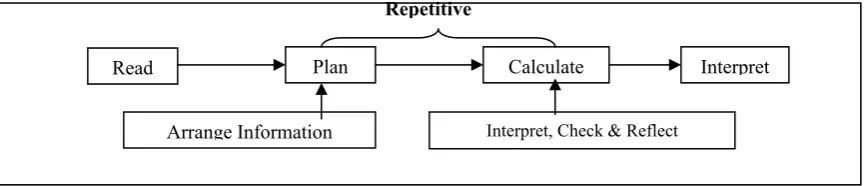
In each protocol, after Eddie had read the problems, he started to make tentative plans to solve the first parts of the problems (refer Appendix A, Problem 1: lines 12-15; Problem 2: 9-13; Problem 3: 7-12). He would then carry out his tentative plans, either calculating or arranging information, and then proceeded to make the next plan (Problem 1: 26-27; Problem 2: 19; 25-27; Problem 3: 22-23; 47-51). He ended his calculations with an interpretation of his final answer that he derived (Problem 1: 41; Problem 2: 31-45; Problem 3: 147-152).
In Problem 2 and 3, he constantly checked his answers and reflected upon his current situation of problem-solving process. When asked why he did so in the retrospective interview, he said that it was because he felt that his answers were not very logical. In Problem 2, he repeated “100 metres in 20 seconds” 3 times (Problem 2: 35-41) because he was unsure of the meaning of this mathematical answer. In Problem 3, whenever he obtained a mathematical answer, he stopped to check and reflect upon it (Problem 3: 29-31; 36-42; 92-104; 122-135). The pattern of Physics problem-solving for Eddie can be summarised as shown in Figure 1.
Figure 1: Pattern of Physics problem-solving for Eddie.
In addition, Eddie showed many metacognitive elements in planning, checking and reflecting his answers and calculations. Table 1 shows examples of the metacognitive statements in Problem 3. More metacognitive statements were found in the most difficult problem (Problem 3), when he was unsure of his answer, Just check that now if I got that different from the first time. And when he was sure of the checking, he said, Yeah so I think I got that right.
Table 1: Examples of metacognitive statements of Eddie in Problem 3.
In the step of… Thinking-aloud protocol
Planning 10 Well I’ll try to find the common one
11 Which is I’ll do 2 multiply by 3 which equals 6 22 So, I’ll convert 6 minutes into hours
23 It would be easier
(see also examples in lines 50-51; 59-60; 86) Checking 36 Seems too much
37 To be able to do in 1 hour
38 That’s definitely too much to do that in 1 hour 99 So it doesn’t make sense
100 So I’m just got to go back to the stage where Reflecting 29 It seems quite a lot to me
30 Per hour
31 But I think I’ve got it 32 So I’ll carry on also in lines 96; 132-134.
Metacognition seemed to help Eddie to stop and think about his answer and recheck it. Were the problem to be difficult, he would be more careful in reading the problem, take more time in interpreting the meaning of the answer and check to see if it made sense.
Read Plan
Arrange Information Interpret, Check & Reflect
Calculate
Repetitive
5.2 Fiona
In the case of Fiona, after she had read the problems, she started to interpret the meanings (Appendix B, Problem 1: 9-13; Problem 2: 7-12). Indeed, she tried to understand the meanings of the problems before she started to plan (Problem 1: 11-15; Problem 2: 7-11) and then executed the plan. In both of the problems, she identified an equation and rearranged the variables to find the intended variable (the time) (Problem 1: 17-29; Problem 2: 26-29).
Next, she calculated and then checked her answers (Problem 1: 39-44; Problem 2: 40-45). The checking helped her to identify errors or think of another way to solve the problem. From the analysis of her answer sheet for Problem 1, she tried two ways to ensure that she used the correct equation (in full terms and in symbols) and two ways to calculate “Jenny’s” time (100/5.4 and 100/(100/18.5)). Hence, she had the ability to think of another way to solve the same problem. In the interview, when her solution was being questioned, she quickly suggested another solution. Below is an extract of the interview after she solved Problem 2:
Why did you look for speed when the question is asking for time?
Cause, because using speed you can find out time. I think, I just remember it. Cause, um, well probably if you work it out, 9000 divided by 800 and then, um timed that by 2 and 9000 divided by 900 and then times 3.
Fiona constantly checked her answers during calculations (Problem 1: 55-60; 76-81; 98-99). Finally, she ended her problem-solving by interpreting the meaning of the final answer to ensure that it made sense to her which she confirmed during the interview. Figure 2 illustrates Fiona’s pattern of Physics problem-solving.
Figure 2: Pattern of Physics problem-solving for Fiona.
Fiona demonstrated great deal of metacognitive statements when she was checking and reflecting her answers (see Table 2). In Problem 1, she could not make sense of the time taken by ‘Cynthia’ (see Problem 1 in Appendix B) who Fiona thought was the fastest runner among the three runners because ‘Cynthia’ had the smallest value calculated in a question before it. After double-checked the answer in Problem 1, she finally realised that her mistake lied in the fact that she did not put the unit of “speed” for the answers in the question before it, which caused her to think that the values were time. She said,
108 Ou! 109 Jenny
110 No, um
111 Sophia
112 If I write down the unit I would have understood it
Table 2: Examples of metacognitive statements of Fiona in Problem 1.
In the step of… Thinking-aloud protocol
Reflecting 36 To make it more accurate you have to do 43 Oh, no, that would be right
44 Ok, um
45 So I’ll do the same for Sophia
(see also in 72; 78-80; 95; 102-103; 111; 119 in Appendix B) Checking 41 I’m not sure if that right
42 I’m gonna do it again 55 I think I’ve done this wrong 56 Cause
57 Um 58 I got a
59 Cynthia takes the most amount of time 60 Which is wrong
63; 65-67; 76; 81; 85-87; 98-99. Read Interpret
Arrange Equation
Check & Reflect Calculate
5.3 A more general pattern
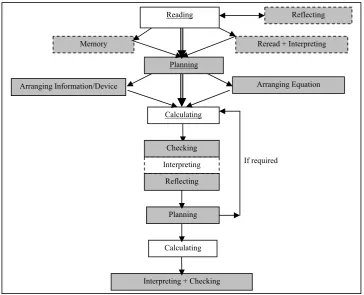
By comparing the patterns of all the students, a more general pattern of Physics problem-solving can be generated as shown in Figure 3. A simplified pattern of problem-solving can be considered as reading the problem, followed by planning and finally calculation (denoted by double-lined arrows). These are the three parts of the pattern that have been obtained from all the students. It can be interpreted as a linear pattern of the problem-solving.
Figure 3: A general pattern of Physics problem-solving of the students.
Metacognitive elements are found at several steps in the pattern represented in Figure 3 (denoted by shaded-boxes). Appendix C provides a complete list of problem-solving processes and metacognitive skills in each process. This list is constructed through the rigorous coding and constant comparative method of Grounded Theory.
The use of memory, a metacognitive skill is exemplified by the students trying to match the problems with previous experience using the key words or features of the problems. Almost all the students showed metacognitive statements during planning and goals setting. They thought about what to do and used “if…then” sentence structure in this step (e.g.: Eddie, see Appendix A – Problem 2: 10-13). In the step of interpreting, metacognitive skills play a role in self-questioning about the meanings, trying to make sense and looking for a logical reason for the mathematical answer.
In the step of checking, metacognitive skills play a role in identifying errors and ambiguities in the calculations and answers. While in the step of reflecting, the students stopped and tried to monitor the progress of problem-solving and understand the current situation by self-questioning or pondering. In the final step of problem-solving, metacognitive skills helped the student to check the final answer by reminding him/herself to do the checking. From this study, metacognitive skills can be defined as the skills employed to think of one’s thinking which are explicit during self-questioning.
6. Conclusion
From this study, many students have demonstrated metacognitive skills in Physics problem-solving in most of the crucial steps of problem-problem-solving. The ability to monitor, regulate and evaluate
Calculating
Arranging Equation Reading
Memory
Reflecting
Planning
Checking
Interpreting
Reflecting
Planning
Calculating
Interpreting + Checking
Reread + Interpreting
Arranging Information/Device
their mental processes in Physics problem-solving among the students showed that students applied higher order thinking skill. The students under studied had varying degree of achievement in Physics, yet they produced similar patterns of Physics problem-solving. The mastery of Physics knowledge really differentiated the quality of the solutions generated from their problem-solving processes. In general, these so-called novices have competent problem-solving skills in facing Physics problems in school. They use heuristic strategy like trial-and-error to reach a solution and always try to refer back to their experience in problem-solving to help them.
It is hoped that this research can provide new insights into how secondary school students solve Physics problems, especially if metacognition is taken into account. Finally, it would be of interest to carry out further instructional design on improving the students’ problem-solving skills and metacognitive skills based on this deeper understanding of how the students go about finding solutions to Physics problems.
References
Bascones, J., V. Novak & J.D. Novak (1985). ‘Alternative instructional systems and the development of problem-solving skills in physics.’ European Journal of Science Education 7(3): 253-261. BBC New (2006). Retrieved 29 May 2008, from
http://news.bbc.co.uk/1/shared/bsp/hi/education/06/exam_results/gcse_fc/html/all_subjects .stm
BBC News (2007). Retrieved 29 May 2008, from http://news.bbc.co.uk/1/shared/bsp/hi/education/07/exam_results/gcse_fc/html/all_subjects
.stm
Bolton, J. & S. Ross (1996). ‘Developing student physics problem-solving skills.’ Physics Education:
176-185.
Chi, M.T.H., P.J. Feltovich & R. Glaser (1981). ‘Categorization and representation of physics problems by experts and novices.’ Cognitive Science 5:121-152.
Ericsson, K.A., & H.A. Simon (1980). ‘Verbal reports as data.’ Psychological Review 87: 215-251. Ernest, P. (1996). ‘Varieties of constructivism: their metaphors, epistemologies and pedagogical
implications.’ In: P.F.W. Preece(ed.) Perspective on constructivism. 73-92. Exeter: University of Exeter School of Education.
Flavell, J.H. (1976). ‘Metacognitive aspects of problem solving.’ In: L.B. Resnick(ed.), The nature of intelligence, 231-235. NJ: Lawrence Erlbaum Associates.
Flavell, J.H., (1979). ‘Metacognition and cognitive monitoring – A new area of cognitive-developmental inquiry.’ American Psychology 34: 906-911.
Garrett, R. M. (1986). Problem-solving in science education. Studies in Science Education, 13, 70-95. Gil-Perez, D., A. Dumas-Carre, M. Caillot & J. Martinez Torregrosa (1990). ‘Paper and pencil
problem solving in the physical sciences as a research activity.’ Studies in Science Education, 18, 137-151.
Glaser, B.G. & A.L. Strauss (1967). The discovery of grounded theory – Strategies for qualitative research. London: Weidenfeld & Nicolson.
Goos, M., P. Galbraith & P. Renshaw (2002). ‘Socially mediated metacognition: Creating collaborative zones of proximal development in small group problem solving.’ Educational Studies in Mathematics 49: 193-223.
Heller, K. & P. Heller (1995). The competent problem solver, a strategy for solving problems in physics, Calculus version. 2nd ed. Minneapolis: Mcgraw-Hill.
Henderson, C., K. Heller, P. Heller, V. Kuo & E. Yerushalmi (2001). ‘Instructors’ ideas about problem solving –Setting goals.’ Paper presented at the Physics Education Research Conference, July 25-26, in NY, US.
Husen, T., & T.N. Postlethwaite (1994). The international encyclopaedia of education (Vol. 8). 2nd ed. Oxford: Pergamon.
Kramarski, B., Z.R. Mevarech & M. Arami (2002). ‘The effects of metacognitive instruction on solving mathematical authentic tasks.’ Educational Studies in Mathematics 49: 225-250.
Kuo, V. (2004). ‘An explanatory model of physics faculty conceptions about the problem-solving process.’ Ph.D. diss., University of Minnesota.
Larkin, J.H. & F. Reif (1979). ‘Understanding and teaching problem-solving in physics.’ European Journal of Science Education 1(2): 191-203.
Manning, B.H., & B. D. Payne (1996). Self-talk for teachers and students. Needham Heights, MA: Allyn and Bacon.
Mayer, R. E. (1991). Thinking, problem solving, cognition. (2 ed.). New York: W. H. Freeman and Company.
Mestre, J.P. (2001). ‘Implication of research on learning.’ Physics Education, 36(1): 44-51.
Phang, F.A. (2006). ‘The patterns of Physics Problem-solving from the perspective of metacognition’ M.Phil. diss., University of Cambridge, UK.
Popper, K. (1999). Camiller, P. (translator). All life is about problem solving. London: Routledge. Reinhold, R., & M. Freudenreich (2003). ‘Learning with simulations and their effect on problem
solving in the domain of physics.’ Paper presented at the National Association for Research in Science Teaching (NARST) Annual Meeting, March 22-26, in Philadelphia, US.
Robertson, W.C. (1990). ‘Detection of cognitive structure with protocol data: Predicting performance on physics transfer problems.’ Cognitive Science, 14:253-280.
Ross, T. (2005, 18 August 2005). More a grades than ever at A-level. Retrieved 1 December 2005, from http://education.independent.co.uk/news/article306734.ece
Savage, M. & J. Williams (1990). Mechanics in action-modelling and practical investigations. Cambridge: Cambridge University Press.
Schoenfeld, A.H. (1992). ‘Learning to think mathematically: Problem solving, metacognition and sense-making in mathematics.’ In: D. Grouws(ed.), Handbook for research on mathematics teaching and learning, 334-370. NY: Macmillan.
Simon, D.P., & H.A. Simon (1978). ‘Individual differences in solving physics problems.’ In: R.S. Siegler(ed.), Children Thinking: What Develop? 325-348. NJ: Lawrence Erlbaum Associates. Strauss, A.L. & J.M. Corbin (1990). Basic of qualitative research: Grounded theory procedures and
techniques. Thousand Oaks: Sage Publications.
Swanson, H. L. (1990). ‘Influence of metacognitive knowledge and aptitude on problem solving.’
Journal of Educational Psychology 82(2): 306-314.
Veenman, M.V.J., B. van Hout-Wolters & P. Afflerbach (2006). ‘Metacognition and learning: conceptual and methodological considerations.’ Metacognition and Learning 1(1): 3-14.
Watts, M. & M. Pope (1989). ‘Thinking about thinking, learning about learning: constructivism in physics education.’ Physics Education 24: 326-331.
Appendix A – Thinking-aloud protocol of Eddie
Problem 1
1 Jenny is the winner of a 100 metre race
2 Sophia is the winner of a 800 metre race
3 And Cynthia is the winner of 500 metre race in your school 4 They all claim they are the
fastest runner in the school 5 Jenny use 18 and a half seconds
to finish the race 6 Sophia 144 seconds 7 And Cynthia 500 seconds 8 So tell me who is the fastest 9 Jenny does 100 metres in 18.5 10 Sophia does 800 metres in 144 11 And Cynthia 15 hundred metres
in 500 seconds 12 So I’ll divide
13 To find how fast they all run per metre
14 I divide
15 All of the time by how far they run
16 So
17 Jenny run a 100 metres and got 18 and a half
18 Seconds 19 So 20 Per metre
21 She… It would take her 22 Um
23 18 and a half seconds per 100 metres
24 It would be 25 (go get calculator) 26 Well, I change my mind
27 I decide to that I’m gonna find how quick they all run in 100 metres
28 So Jenny runs a 100 metres in 18.5 seconds
29 If Sophia run 800 metres in a 144 seconds
30 I do it 144 divided by 800 31 Equal 0.18
32 To 18 seconds 33 And
34 Cynthia 35 Runs
36 1500 metres in 500 seconds 37 So
38 I divided 500 by 1500 39 To get 0.3 recurring 40 Which is 33 seconds
41 So I think Sophia is the fastest runner
Problem 2
1 The record of the 100 metres 2 By 4 relay
3 In your school is 89.9 seconds 4 Jenny is the first runner in your
team
5 Followed by Cynthia and Sophia
6 If they all run at their usual speed in question number 2 7 You as the last runner how fast
should you run at least to beat 0.1 seconds of the record 8 Um
9 Well, I’m thinking again 10 If I find out
11 How long each of them takes to run their 100 metres
12 I’ll be able to find out the remaining time which is the time I have to run
13 And then go 0.1 faster to beat it 14 So
15 I’ve got Jenny running in 18.5 seconds
16 Sophia in 18 17 And Cynthia in 33.3 18 So
19 If I’m taking out away from 89.9
20 89.9 take away 18.5 21 Take away 18 22 Take away 33.3 23 Leaving with 20.1 24 So
25 I know that if I want to beat the record
26 I need to do it in 20 seconds 27 So I should run
28 Mm…
29 I should run a 100 metres in 20 seconds
30 So
31 I should run 32 I’ve got
33 To beat the record I must run 34 20
35 I must run a 100 metres in 20 seconds
36 So
37 A 100 metres in 20 seconds 38 10 metres every 2 seconds 39 So
40 20
41 A 100 metres in 20 seconds 42 I have to run 10 metres in 2
seconds
43 And 1 metre in 0.2 seconds
Problem 3
1 You can cycle 800 metres in 2 minutes
2 Your friend can cycle 900 metres in 3 minutes
3 In a 9 kilometres race you want to finish it at the same time with your friend
4 If your friend starts cycling at 8.30 am
5 What time should you start cycling to reach the finishing line together
6 …
7 Try to find out
8 I can cycle 800 metres in 2 minutes and my friend 900 metres in 3 minutes
9 So
10 Well I’ll try to find the common one
11 Which is I’ll do 2 multiply by 3 which equals 6
12 And find how far we can both cycle in 6 minutes
13 So I’ll do 800 multiple by 3 14 Which is 2400
15 So I can go 2400 metres in 6 minutes
16 And my friend can go 17 900
18 Times 2
19 1800 metres in 6 minutes 20 So
21 My friend starts cycling at 8.30 am
22 So, I’ll convert 6 minutes into hours
23 It would be easier 24 So I multiply that by 10 25 And multiply that by 10
26 So every hour my friend can cycle 18000 kilometres
27 Yup 28 18000
29 It seems quite a lot to me 30 Per hour
31 But I think I’ve got it 32 So I’ll carry on 33 And I can cycle 34 24000 kilometres 35 Per hour 36 Seems to much
37 To be able to do in 1 hour 38 That’s definitely too much to do
that in 1 hour 39 Oh, it’s 18 40 It’s metres 41 Not kilometres
42 Yeah
43 18000 metres per hour and 24000 metres per hour
44 Um 45 So 46 Ok
47 So if he is doing 18 kilometres per hour
48 And I’m doing 24 49 And he is leaving at 8.30 50 Well I’ll
51 See how long it takes him until finish
52 So
53 If you does 24000 metres per hour
54 And a 1000 metres in a kilometre
55 24000 divided by a 1000 56 Nop, 18000 divided by 1000 57 Um
58 He starts cycling at 8.30 59 And I’m doing
60 Just find out how long it takes him
61 He got to go 9 kilometres 62 And if he can do 63 18000 metres in an hour
64 Then he can do 18000 divided by a 1000 kilometres an hour 65 So he can do 18 kilometres an
hour
66 And if the race is 9 kilometres 67 Then 9 is half of 18
68 So I divide an hour by 30 69 Which is 15 minutes
70 So it’s gonna take him 15 mintes
71 So he is gonna finish at 8.45 am 72 Now, me
73 I go 24000 metres per hour 74 So I go 24 kilometres per hour 75 So
76 If it is 9 kilometres 77 24 divided by 9 78 Which is 79 2.6 80 2.7 81 So
82 The 24 kilometres in an hour 83 I cycle 9 kilometres
84 So 85 20…
86 So I’m trying to find out how long it would take me to do 9 kilometres
87 So do 24 kilometres in one hour 88 24 divided by 9
89 Which is round to 2.7 90 So then I do
91 2.7 kilometres 92 Wait
93 24 kilometres an hour
94 9 kilometres it would take me 27 minutes
95 That’s took him
96 I’m confused myself now cause I
97 It’s taking me longer 98 But I cycle quicker per hour 99 So it doesn’t make sense 100 So I’m just got to go back to the
stage where 101 Right
102 He can do 18000 metres every hour
103 No
104 Which way is the question now 105 I can do 18000 metres every
hour
106 Which means 107 I can do
108 If there is a 1000 metres in a kilometres
109 To find out how many kilometres you can do in an hour
110 I divide 18000 by 1000 111 It’s 18
112 Yes
113 So I can do 18 kilometres per hour
114 If the race is 9 kilometres 115 I divide
116 Well a half of 18
117 You do 18 kilometres in an hour
118 You do 9 kilometres in half of that time
119 Which is 30 minutes 120 So I think
121 I’ll be done at 9 am
122 Just check that now if I got that different from the first time 123 He’s going at 18 kilometres per
hour
124 Divided that by 2 you get 9 125 Divided an hour by 2 and you
get 30 minutes
126 Yeah so I think I got that right 127 So I get there at 9
128 It’s gonna take me until 9 am 129 If my friend starts cycling at
8.30 130 He… 131 Well
132 Well, I’m thinking he 133 Well
135 The back way will take me 30 minutes
136 Now he starts cycling at 8.30 137 And
138 If he can go 24000 kilometres per hour
139 It would take him 140 He can go
141 Sorry 24 kilometres an hour 142 It would take him 26 143 27 minutes to round it up 144 To do the 9 kilometres 145 So I say I would have to leave 146 I’ll do 30 takes away 27
147 Cause 30 is how long it takes me
148 And 27 is how long it takes him 149 So I need to leave 3 minutes
before him
Appendix B – Thinking-aloud protocol of Fiona
Problem 1
1 The record of the 100 metres time 4 relay
2 Each run 100 metres
3 In your school is 89.9 seconds 4 Jenny in question number 2 is
the first runner in your team 5 Followed by Cynthia and
Sophia
6 If they all run at their usual speed as in question number 2 7 As the last
8 You as the last runner
9 How fast should you run to beat 0.1 second of the record
10 0.1 fast second faster than the record
11 So 12 Ok
13 They each run 100 metres 14 Then
15 The speed in metre per second 16 And
17 Speed equals distance divided by time
18 Then 19 Um 20 Um
21 The time equals distance divided by speed
22 So that means the time equals 23 Um
24 Distance divided by speed 25 Wait
26 Speed times time equal distance 27 So
28 Yeah
29 Time equals distance divided by speed
30 A… 31 So
32 A 100 divided 5.4 33 Well
34 Divided 35 Well
36 To make it more accurate you have to do
37 100 over 18.5 to get the answer for Jenny from question 2 38 So
39 And that equals 40 18.5
41 I’m not sure if that right 42 I’m gonna do it again 43 Oh, no, that would be right 44 Ok, um
45 So I’ll do the same for Sophia
46 Sophia is 100 divided by 5.5 recurring
47 So 48 Um 49 18
50 And then Cynthia 51 Will be 100 divided by 3 52 Which equals to 33 53 …
54 Point
55 I think I’ve done this wrong 56 Cause
57 Um 58 I got a
59 Cynthia takes the most amount of time
60 Which is wrong 61 Cause she is the fastest 62 Um
63 Maybe got formula wrong 64 To write the formula 65 Cause I need
66 Speed equals distance over time 67 But then you can move that 68 Speed times time equal distance 69 And then
70 Divided both side by speed 71 Get time equals distance
divided by speed
72 I’m not sure what is wrong 73 …
74 I’m not sure 75 …
76 Maybe this one is wrong (no. 2) 77 Um
78 I think that was fine 79 Um
80 I think
81 Or maybe I could try doing from the information I got here 82 1500
83 Um
84 Divided by 15 is 100
85 So if I divided this with 15 as well
86 I would get the seconds to take it to run 100 metres
87 I’ll try that 88 So for Cynthia 89 It would be 90 500 divided by 15 91 Which is 33.3 92 And Jenny 93 Would be 94 18.5
95 I’m getting the same answer 96 Sophia is
97 144 divided by 800 98 On no
99 That’s wrong 100 144 divided by 800 101 18
102 I don’t know
103 I can’t understand why it doesn’t work
104 From here it seems like Cynthia is the fastest (no. 2)
105 But from this one (no. 3) 106 Seems like Sophia is the fastest 107 Because she run 100 metres
using the least amount of time 108 Ou!
109 Jenny 110 No, um 111 Sophia
112 If I write down the unit I would have understood it
113 Ok
114 So I’ll finish that 115 So
116 Ok I add them up 117 I get
118 33.3 to 18.5 to 18 119 Which go 120 69.8 seconds 121 Um
122 So 123 If I
124 Take that from 89.9 125 I get
126 20.1 127 Um
128 That would be the time I would be running
Problem 2
1 You can cycle 800 metres in 2 minutes
2 Your friend can cycle 900 metres in 3 minutes
3 In a 9 kilometre race
4 You want to finish at the same time with your friend
5 If your friend starts cycling at 8.30 am
6 What time should you start cycling to reach the finishing line together
7 Ok 8 Um 9 So your
10 Your friend can cycle 900 metres in 3 minutes
11 You can cycle 800 metres in 2 minutes
12 So I think I need to work out with the speed
13 So 800 divided by 2 is 400 metres per minute
14 And 900 divided by 3 is 15 Um
16 300 metres per minute 17 So
18 Um
19 What time should you start cycling to reach the finishing line
20 Um
21 How long is the race 22 Ou, 9 kilometres 23 Right
24 So 9 kilometres 25 Times 26 Speed equals
27 Speed equal distance over time 28 So
29 Time equals distance over speed
30 So um
31 800 divided by 400 32 No um
33 9 kilo 34 9000 35 That’s metre 36 Divided by 400 is 37 Um
38 20.5
39 And that’s you
40 And then 9000 divided by 300 41 Is
42 27 I think 43 I sort of check it 44 No, 30 45 Ok 46 So
47 A… ok 48 So 49 30 50 So
51 Take from 30 minutes 52 It takes you 22.5 53 So therefore 54 30 take
55 30 take 22.5 is the difference 56 Which would be 7.5
57 And then
58 So you need to leave 7.5 minutes later than him
59 So the time you need to start cycling is
Appendix C – List of problem-solving processes and metacognitive skills
Category Sub-category
Metacognition Description Example*
Reading 1 - cognitive, understand
the question, usually the first reading
If you are cycling from you house to the school which is 3 km away in a velocity of 5 m/s what is the latest time you should start cycling if you don’t
Reading 2 Monitor
understanding/goal Reflect understanding
read (usually second reading) the question to further understand and find some clues (including the goal)
I just need to read through again Fran wears a slipper with the total area that touches the beach is 90 cm2
Reading 3 Checking answer with Checking 4 And so
To beat 0.1 seconds
Reading 4 Regulating plan with Analysing 2 In a 9 kilometre race
You want to finish the same time as your friend
If my friend starts cycling at 8.30
Reading – the question
Reading 6 Monitor
understanding with Analysing 9 Ian’s weight is 68.25 Write that down 68.25 kg
Jane’s weight is 38.5 kg Kate’s weight
Is 52.5 kg
Reflecting 1 Monitor memory remembering the question (as done or not done before, task
Oh I think I know this question because I remember it
Reflecting 2 Regulating problem-solving process Reflecting answer
Realise mistake (make
correction) That’s probably better thing to do than
Reflecting 3 Reflecting on task Difficulty of the problem (Task variable) EOL
So this is very mathematical
Reflecting – on the question
Reflecting 4 Reflecting on person About ownself
(personal variable) Oh I don’t know I don’t think I can do this cause I have to
Analysing 1 Monitoring related
concept searching for the possible concept [time, distance]
To make the smallest impression You have to have the lowest weight Because you are not exerting much force on the ground
Analysing 2 Monitoring and
regulating concepts show rewordingunderstanding the question by in own words [which means] representation
So if I just do a diagram here
Analysing 3 Monitoring understanding
the variables to match
the possible equation/formula
So 9000 metres Um
In 5 metres a second Which um
Time is
Analysing 4 Monitoring problem-solving process
the current situation [I got, I have] what I’ve done so far (calculated/interpreted not directly from the
So now I’ve got
How long it would take them In second to run
Analysing – what could be done
Analysing 7 Monitoring goal/plan analysing goal, how to reach the goal
So you want the Same depth So you want the
Analysing 8 Reflecting on planning/answer
error/mistake Ok that does not make any sense Cause
She obviously took more than 0.3 seconds to do that
Analysing 9 Monitoring
understanding key information(variable) Writing down or underline or circle the key information
Analysing
12 Regulating understanding converting into something easy Oh in a 9 km race So that’s how many metres That would be 9000
Planning 1 Regulating plan/goal determining the goal And we’ll find who has the fastest d
Planning 2 Monitoring
understanding and then regulating plan
Analysing 3 and then do algebra (Arranging 2the equation)
So that’s speed equals distance over time
So do the distance divided by that
Planning 3 Regulating plan know exactly what to
do next Know what to do And now I want to divide
Planning 4 Reflecting plan (Trial & Error) say what to do next unsurely, do whatever that seems logical
But I’ll just do it anyway
Planning 5 Regulating
plan/subgoal determining the subgoal(s) I will find out what my new record first
Planning 6 Reflecting plan Monitoring problem-solving processing
improve the plan (another way)
Ok it’s a different way of doing it now
Planning 8 Monitoring
understanding Need to arrange the information (Analysing 9)
Um I write down each of their names and their speeds
Planning – what need to be done
Planning 9 Regulating plan Converting into
something easy Minute could be converted into second
Calculating 1
- simply just calculation (cognitive)
Doing calculation
Calculating 2
Checking answer calculate and at the same time do Checking
1500 divided by 500 is 3 m/s so Yeah
So 3 m/s
Calculating 3
Monitoring
problem-solving process with Justifying So it’s 1500 times 4 because It’s 1500 and it takes 4 seconds So that’s 6000 metres
Calculating – carry out the plan
Calculating 5
Monitoring problem-solving process
Emphasis on the units (cause checking)
Equal em 69.8 seconds Second
Answering
1 - answering the question or reach the goal Stating the answer
Answering
– the question Answering
2
Monitoring
problem-solving process reaching subgoal, restating the answer That’s Sophia and Cynthia
Interpretin g 2
Checking answer the meaning of the answer [that would be s per fast]
So I am cycling faster than them
Interpretin Reflecting answer logic of the answer That can’t be right
Interpretin g – give another meaning
Interpretin
g 4 Reflecting answer Put in the units to understand the meaning What you call Seconds
Checking 1 Checking answer simply just look back
again (recap) I think that’s right (Nick 4)
Checking 2 Checking equation checking the logic of
the equation arrangement Checking Equation Checking – go through again, either answers, steps, plans, etc.
Checking 3 Checking answer checking the answer by
Interpreting
Checking 4 Monitoring goal Reading to see if the goal is achieved as required by the question
Yeah I think that’s right
Put them in order from the deepest to the shallowest
Checking 5 Reflecting plan checking the
plan/analysis 144 divided by 800 or is it the other way I hi k i ’ h
Checking 6 Checking
answer/plan checking the steps, go back and do again Make calculation again using the same way to check the answer or steps
Checking 7 FOK FOK, turn back and h k
Sense a mistake
Checking 8 Checking answer another way of
calculation to check Checking using another way
Checking 9 Checking answer Monitoring problem-solving process
Reading 2 if misread or miss the clue/cue of the question
Go back and read the important part of the question to follow the calculation
Testing – think of a plan and check if it’s working
Testing 1 Checking plan Arrange the equation
and try if it works So I’m going to do trial and error
Justifying Justifying 1 Reflecting Using because/cause to justify the reason to do something or thinking in such a way
This is because...
*The examples when quoted out of the protocols lose their contexts hence may not appear to be as the descriptions.