ABSTRACT
PATTERSON, BLAIN ANTHONY. Cryptography: Decoding Student Learning. (Under the direction of Karen Keene.)
Cryptography is a content field of mathematics and computer science, developed to
keep information safe both when being sent between parties and stored. In addition to
this, cryptography can also be used as a powerful teaching tool, as it puts mathematics
in a dramatic and realistic setting. It also allows for a natural way to introduce topics
such as modular arithmetic, matrix operations, and elementary group theory. This thesis
reports the results of an analysis of students’ thinking and understanding of
cryptog-raphy using both the SOLO taxonomy and open coding as they participated in task
based interviews. Students interviewed were assessed on how they made connections to
various areas of mathematics through solving cryptography problems. Analyzing these
interviews showed that students have a strong foundation in number theoretic concepts
such as divisibility and modular arithmetic. Also, students were able to use
probabil-ity intuitively to make sense of and solve problems. Finally, participants’ SOLO levels
ranged from Uni-structural to Extended Abstract, with Multi-Structural level being the
most common (three participants). This gives evidence to suggest that students should
be given the opportunity to make mathematical connections early and often in their
academic careers. Results indicate that although cryptography should not be a required
course by mathematics majors, concepts from this field could be introduced in courses
©Copyright 2016 by Blain Anthony Patterson
Cryptography: Decoding Student Learning
by
Blain Anthony Patterson
A thesis submitted to the Graduate Faculty of North Carolina State University
in partial fulfillment of the requirements for the Degree of
Master of Science
Mathematics Education
Raleigh, North Carolina
2016
APPROVED BY:
Karen Hollebrands Molly Fenn
Karen Keene
DEDICATION
BIOGRAPHY
Blain Anthony Patterson was born on May 7, 1991 in Salem, Ohio. He grew up in the
small town of Wellsville, Ohio. Blain graduated from Youngstown State University with
a B.S. degree in Mathematics Education in 2014. Directly after graduating, he entered
the M.S. in Mathematics Education at North Carolina State University.
Blain originally intended to teach high school mathematics somewhere near his
home-town in Ohio. After meeting the love of his life, Sarah Elizabeth Ritchey, Blain had a
change of heart and decided that graduate school was in his future. After applying to
several graduate programs in both mathematics and mathematics education, he decided
that NCSU was a perfect fit.
Blain plans to enroll in the Ph.D. program in Mathematics Education at North
Car-olina State University for the spring 2016 semester. His interests focus on how
under-graduate students learn upper level mathematics, such as Linear and Abstract Algebra,
Number Theory, Probability, and Real Analysis.
Blain has always had a passion for teaching and mathematics. His long term goal
is to be a university professor and teach mathematics at a teaching-focused college. So
far, North Carolina State University has provided him with the skills to become a better
ACKNOWLEDGEMENTS
I would like to thank my advisor Dr. Karen Keene, for her support from the time I
entered the program until completion of this project. Her guidance and expertise have
been an essential part of my success at North Carolina State University. I look forward
to working with her in the future. Also, I would like to thank Dr. Karen Hollebrands and
Dr. Molly Fenn for their suggestions and willingness to serve as committee members.
I would like to thank my father, Dorman Jeff Patterson II, for always believing in me
and pushing me to strive for excellence. I know without a doubt I would not be where
I am today without the constant love, patience, guidance, and support of my father. He
has always put my needs before his own and continues to do so to this day.
I would like to thank my best friend, Sarah Elizabeth Ritchey for making me a better
teacher, learner, and person. She has been by my side throughout my entire graduate
school journey. Sarah is the one that convinced me that graduate school was right for
me. She has guided me down a path of success and happiness. We are an unstoppable
TABLE OF CONTENTS
LIST OF TABLES . . . vii
LIST OF FIGURES . . . viii
Chapter 1 Introduction . . . 1
1.1 What is Cryptography? . . . 1
1.2 Definitions and Examples . . . 2
1.3 Why Cryptography? . . . 11
Chapter 2 Literature Review . . . 13
2.1 SOLO Taxonomy . . . 13
2.2 Abstract Algebra . . . 18
2.3 Linear Algebra . . . 21
2.4 Number Theory . . . 24
2.5 Probability . . . 26
2.6 Algorithms . . . 30
Chapter 3 Methods . . . 32
3.1 Research Questions . . . 32
3.2 Setting . . . 32
3.3 Participants . . . 33
3.4 Recruitment Procedure . . . 34
3.4.1 Qualitative Studies . . . 34
3.4.2 Task-Based Interviews . . . 35
3.4.3 Interview Protocol . . . 36
3.4.4 Rationale for Protocol Questions . . . 38
3.5 Analysis . . . 38
Chapter 4 Results . . . 41
4.1 Student A . . . 41
4.1.1 Introduction . . . 41
4.1.2 Problem Solving . . . 42
4.1.3 Analysis . . . 46
4.2 Student B . . . 46
4.2.1 Introduction . . . 46
4.2.2 Problem Solving . . . 47
4.2.3 Analysis . . . 52
4.3 Student C . . . 53
4.3.1 Introduction . . . 53
4.3.3 Analysis . . . 60
4.4 Student D . . . 61
4.4.1 Introduction . . . 61
4.4.2 Problem Solving . . . 61
4.4.3 Analysis . . . 65
4.5 Student E . . . 65
4.5.1 Introduction . . . 65
4.5.2 Problem Solving . . . 66
4.5.3 Analysis . . . 70
4.6 Student F . . . 71
4.6.1 Introduction . . . 71
4.6.2 Problem Solving . . . 71
4.6.3 Analysis . . . 77
4.7 Student G . . . 77
4.7.1 Introduction . . . 77
4.7.2 Problem Solving . . . 78
4.7.3 Analysis . . . 82
4.8 Summary . . . 82
Chapter 5 Conclusion . . . 86
5.1 Interpretation of Results . . . 86
5.2 Limitations . . . 88
5.3 Implications of the Study . . . 89
5.4 Future Research . . . 89
5.5 Conclusions . . . 90
Chapter 6 References . . . 91
Appendices . . . 95
Appendix A Interview Protocol . . . 96
Appendix B Answer Sheets . . . 98
Appendix C Solutions . . . 101
Appendix D Student Work . . . 102
LIST OF TABLES
Table 2.1 SOLO Levels . . . 15
Table 2.2 Index of Coincidence . . . 28
Table 3.1 Student Demographics . . . 33
Table 3.2 SOLO Rubric . . . 40
Table 4.1 Student SOLO Classification . . . 83
LIST OF FIGURES
Figure 1.1 Vigenere cipher with DOG as keyword. . . 4
Figure 1.2 Caesar cipher with a shift of 4. . . 4
Figure 1.3 Cipher wheel. . . 5
Figure 1.4 Public-key cryptography. . . 7
Figure 1.5 Elliptic curve. . . 8
Figure 1.6 Elliptic curve secant addition. . . 9
Figure 1.7 Elliptic curve tangent addition. . . 10
Figure 1.8 Elliptic curve vertical addition. . . 10
Figure 2.1 SOLO Taxonomy Pyramid. . . 17
Figure 2.2 Frequency distribution of the alphabet. . . 27
Figure 2.3 Euclidean algorithm for 1559 and 650. . . 30
Figure 4.1 Student A assigning numbers to letters. . . 42
Figure 4.2 Student A using an affine cipher with a= 10 and b= 0. . . 43
Figure 4.3 Student A using a Caesar cipher with 3 as the key. . . 43
Figure 4.4 Student A assigning numbers to letters. . . 44
Figure 4.5 Student A using a brute force method. . . 45
Figure 4.6 Student A using a factor tree. . . 46
Figure 4.7 Student B setting up a Hill cipher. . . 47
Figure 4.8 Student B multiplying matrices modulo 26. . . 48
Figure 4.9 Student B summarizes his work. . . 48
Figure 4.10 Student B using 1 as the key. . . 49
Figure 4.11 Student B displaying all possible keys. . . 50
Figure 4.12 Student B decrypting using various keys. . . 50
Figure 4.13 Student B reducing the total number of divisors. . . 51
Figure 4.14 Student B factors 8911 as 8911 = 7×1273. . . 51
Figure 4.15 Student B repeats his algorithm for 1273. . . 52
Figure 4.16 Student C assigning numbers to letters. . . 54
Figure 4.17 Student C encrypting use the one-time pad. . . 55
Figure 4.18 Student C displaying the ciphertext. . . 55
Figure 4.19 Student C using 25 as a key. . . 56
Figure 4.20 Student C listing possible two letter combinations. . . 57
Figure 4.21 Student C displaying the plaintext GOWOLFPACK. . . 57
Figure 4.22 Student C approximating √8911. . . 58
Figure 4.23 Student C dividing 8911 by 7. . . 59
Figure 4.24 Student C checking 7 and 11 as factors . . . 59
Figure 4.25 Student C displaying the prime factorization of 8911. . . 60
Figure 4.27 Student D using frequency analysis. . . 62
Figure 4.28 Student D decrypting using a Caesar cipher. . . 63
Figure 4.29 Student D checking small prime divisors of 8911. . . 64
Figure 4.30 Student D checking small prime divisors of 1273. . . 64
Figure 4.31 Student D checking small prime divisors of 67. . . 65
Figure 4.32 Student E using a Vigenere cipher with keyword GO. . . 66
Figure 4.33 Student E assigning numbers to letters. . . 67
Figure 4.34 Student E using 1 as they key. . . 67
Figure 4.35 Student E decrypting using various keys. . . 68
Figure 4.36 Student E using the Pollard Rho factoring algorithm with n = 8911. . 69
Figure 4.37 Student E factors 8911 as 8911 = 7×1273. . . 69
Figure 4.38 Student E using the Pollard Rho factoring algorithm with n = 1273. . 70
Figure 4.39 Student E factors 8911 as 8911 = 7×19×67. . . 70
Figure 4.40 Student F assigning numbers to letters. . . 72
Figure 4.41 Student F using an Affine cipher with a= 3 andb = 5. . . 72
Figure 4.42 Student F attempting to decrypt with 1 as a key. . . 73
Figure 4.43 Student F attempting to decrypt with various keys. . . 74
Figure 4.44 Student F testing prime divisors of 8911. . . 74
Figure 4.45 Student F factoring 8911 as 8911 = 7×1273. . . 75
Figure 4.46 Student F testing prime divisors of 1273. . . 76
Figure 4.47 Student F displaying the prime factorization of 8911. . . 77
Figure 4.48 Student G assigning numbers to letters. . . 79
Figure 4.49 Student G encrypting the message NCSU. . . 79
Figure 4.50 Student G summarizes her work. . . 79
Figure 4.51 Student G shifting the alphabet by 17. . . 80
Figure 4.52 Student G shifting the alphabet by 17. . . 80
Figure 4.53 Student G checking for small prime divisors of 8911. . . 81
Figure 4.54 Student G checking for small prime divisors of 1273. . . 81
Figure 4.55 Student E factors 8911 as 8911 = 7×19×67. . . 82
Figure D.1 Student A problem 6. . . 103
Figure D.2 Student A problem 7. . . 104
Figure D.3 Student A problem 8. . . 105
Figure D.4 Student B problem 6. . . 106
Figure D.5 Student B problem 7. . . 107
Figure D.6 Student B problem 8. . . 108
Figure D.7 Student C problem 6. . . 109
Figure D.8 Student C problem 7. . . 110
Figure D.9 Student C problem 8. . . 111
Figure D.10 Student D problem 6. . . 112
Figure D.11 Student D problem 7. . . 112
Figure D.13 Student D problem 8 continued. . . 113
Figure D.14 Student E problem 6. . . 114
Figure D.15 Student E problem 7. . . 115
Figure D.16 Student E problem 8. . . 116
Figure D.17 Student F problem 6. . . 117
Figure D.18 Student F problem 7. . . 118
Figure D.19 Student F problem 8. . . 119
Figure D.20 Student G problem 6. . . 120
Figure D.21 Student G problem 7. . . 121
Chapter 1
Introduction
In this chapter, I discuss the importance of cryptography for both security and
peda-gogical reasons and provide the background and significance for the study. I begin by
introducing some important concepts and definitions.
1.1
What is Cryptography?
Cryptography is often thought of as the practice and study of the techniques and
al-gorithms for secure communication. It is used on a daily basis, for keeping information
safe (Kahn, 1997). For example, anytime someone pays for some good or service online,
their credit card information is encrypted and decrypted using advanced algorithms that
are part of the cryptography. It can be described as the intersection of mathematics,
computer science, and electrical engineering (Singh, 1999).
Cryptography has a rich history. As a society, humans have been trying to keep
messages secret from the beginning of time. In fact, historians have discovered cryptic
hi-eroglyphics from around 2000 B.C (Kahn, 1997). Julius Caesar used a substitution cipher
to keep messages secret (Kahn, 1997). Eventually, complex machines, like the Enigma
age had surfaced, more complex methods arose. With the abundance of history related
to cryptography available, an entire class could be devoted to studying this material.
1.2
Definitions and Examples
Encryption is the process of converting a message to something unintelligible (Kahn,
1997). The message we are converting is referred to as the plaintext and the message
that we get after converting and should be unintelligible is theciphertext (Kahn, 1997).
The inverse of encryption is referred to as decryption, where one converts ciphertext to
plaintext (Kahn, 1997). Acipher can be defined as a set of techniques and algorithms that
createencryption anddecryption methods (Kahn, 1997). Ciphers can bemono-alphabetic
orpoly-alphabetic.Mono-alphabetic can be thought of as a bijective function, where each
letter is uniquely mapped to another letter (Kahn, 1997). Note that a letter can be
mapped to itself.Poly-alphabetic ciphers may map the same letter to two different letters
(Kahn, 1997). In order to decrypt ciphertext, one needs to use a key. Cryptosystems can
be defined as the set of all possible plaintexts, ciphertexts, keys, and algorithms (Kahn,
1997). We define an algorithm as a well defined process with a finite number of steps.
Finally,cryptanalysis is the study of methods for cracking encryption algorithms without
a key (Kahn, 1997).
In addition to jargon associated with cyrptography, one must also consider notation.
The goal is to send messages securely. Keeping this in mind, the two parties who are
communicating should not make an intruder’s job any easier. This may be done by
removing all forms of punctuation, spaces, and capitalizing all letters (Kahn, 1997).
Removing punctuation simplifies the process, by not having to assign numbers to periods,
there are only a small amount of words of a given size. Similarly, capitalizing all letters
will make breaking the cipher more difficult for the attacker. For example, sending the
message “I need help!” instead of INEEDHELP is not wise, since there are only a small
amount of words that are one letter in length.
What are some examples of ciphers? The Caesar cipher is one of the oldest ciphers
recorded. Julius Caesar used this particular cipher to encrypt messages of military
signifi-cance (Kahn, 1997). This cipher consists of shifting each letter in the alphabet to another
letter by first converting each letter to a number. A is assigned to 0, B is assigned to 1, C
is assigned to 2, and so on. Once each letter is represented by a number,x, the formula for encryption is Ek(x) =x+k mod 26 and decryption is Dk(x) =x−k mod 26. Modular
arithmetic uses 26 as the divisor, since there are 26 letters in the alphabet.
Another elementary cipher is the Vigenere cipher. Similar to the Caesar cipher, letters
are shifted by a key (number). However, instead of just a single number as the key,
messages are shifted by a key word. This makes the Vigenere cipher poly-alphabetic. For
example, supposed the key word is DOG. Note that D, O, and G are the fourth, fifteenth,
and seventh letters of the alphabet respectively. This implies we the first letter of the
plaintext will be shifted by 4, the second letter by 15, and the third letter by 7. The
plaintext will most likely be longer than 3 letters or the size of the key word in general.
If this is the case, the process repeats. In other words, the fourth letter will be shifted by
4, the fifth by 15, the sixth by 7 and so on.
An example will make this concept more concrete. Suppose MEETATDAWN is the
Figure 1.1: Vigenere cipher with DOG as keyword.
This implies that M will be shifted by 4, the first E will be shifted by 15, the second
E will be shifted by 7, and so on. This will result in a ciphertext of PSKWOZGOCQ.
Decryption would happen in a similar manner, by using the same key.
These first two examples are called shift ciphers, since each letter in the plaintext is
shifted by a key to create the ciphertext. Although these methods are not used today in
the practical sense, they offer a great place to start. Modular arithmetic is an elementary
topic. In fact, students do modular arithmetic in grade school without realizing it.
Because of the elementary knowledge needed, shift ciphers are very accessible to
students. In particular, the Caesar cipher offers multiple representations. One can view
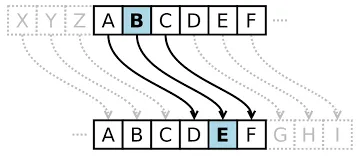
this cipher using Figure 1.2.
Figure 1.2: Caesar cipher with a shift of 4.
If a student is more algebraically inclined, they may favor the following formulas for
encryption and decryption.
Students that are consider tactile learners may choose to use a cipher wheel shown in
Figure 1.3.
Figure 1.3: Cipher wheel.
If students have a sufficient background in linear algebra, the Hill cipher can be
discussed. Created by Lester S. Hill in 1929, the Hill cipher was the first poly-alphabetic
cipher which was practical to operate on more than three symbols at once (Singh, 1999).
In fact, the Hill cipher of dimension 6 was done mechanically using a system of gears and
chains (Kahn, 1997).
To encrypt using the Hill cipher, one must first convert letters to numbers using the
standard assignment (A is assigned to 0, B is assigned to 1, C is assigned to 2, and so
on). Once the plaintext is converted to numbers, the key matrix is chosen. In order for
decryption to be possible, the key matrix must be invertible modulo 26. In other words,
the determinant must be an integer that has an inverse modulo 26. The sender converts
the plaintext to n ×1 column vectors, where n is the dimension of the key matrix. To decrypt, one simply multiplies by the inverse of the key matrix.
Consider the following example. Suppose the plaintext is CAT, where C corresponds
following. x= 2 0 19
Now suppose the key matrix is below.
K =
1 0 0
2 13 0
3 4 1
Notice that the determinant of K is 13, which has an inverse modulo 26. To encrypt, we compute the following.
Kx =
1 0 0
2 13 0
3 4 1
2 0 19 = 2 4 25 =y
Therefore the ciphertext is CEZ. To decrypt, one must compute K−1y mod 26≡ x,
to recover the plaintext vector, x. Because matrix theory is a part of linear algebra, a strong foundation in that content area would be extremely useful for a student studying
cryptography to have.
Advancing to more recent work, modern cryptography methods are primarily
public-key systems. This means that the sender and receiver each have their own public-key, which are
related to a public key through computations (Kahn, 1997). The security of public-key
cryptography relies on the fact that the computations required to break the cipher is
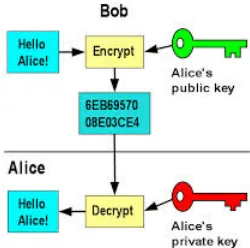
the cipher could not be broken in a reasonable amount of time. The general scheme of
public key cryptography can be seen in Figure 1.4.
Figure 1.4: Public-key cryptography.
The RSA algorithm is the most widely used public-key cryptosystem today. Created
by Ron Rivest, Adi Shamir and Leonard Adleman in 1978, this encryption method takes
advantage of the difficulty of factoring large composite integers (Kahn, 1997). With a
powerful computer, multiplying two large prime numbers is computationally feasible.
However, recovering the prime factors of a composite number takes the most powerful
computers a great deal of time (Kahn, 1997).
To encrypt a message with RSA, one must choose two “large” prime numbers p and
q and compute n =pq. Then choose a numbere, such that the greatest common divisor of eand (p−1)(q−1) is 1. The key (n, e) are made public, but pand q are kept private. In order for an adversary to break this cipher, this must factor n as n = pq, which is computationally infeasible.
Other examples of public-key cryptography include Diffie-Hellman, Cramer-Shoup,
ElGamal, and elliptic curve (Kahn, 1997). Although these methods are much more
mathematics, including algebra, number theory, probability, and geometry.
One of the most accessible of these methods to students may be elliptic curve
cryp-tography. An elliptic curve is a curve in the plane of the form y2 = x3+Ax+B, with
the condition that x3+AX+B has distinct roots (Abraham, Kapoor, and Singh, 2008);
elliptic curves are also symmetric about thex-axis. Figure 1.5 shows a graph of an elliptic curve
Figure 1.5: Elliptic curve.
For computational purposes, these curves exists over finite fields, rather than all real
numbers. For example, letE be an elliptic curve over the integers mod 2. This implies that
A andB must be 1 or 0 and the only possible points on the curve are (0,0),(1,0),(0,1),
and (1,1). However, not all these points need be on the curve.
With each elliptic curve comes an algebraic structure, where two points can be added
in any order, each point has and inverse, there exists an identity point (the point at
infinity), and the associative property holds. Therefore, the points on an elliptic curve
form an abelian group (Abraham, Kapoor, and Singh, 2008). However to actually add
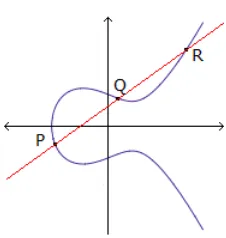
In order to add two points, P and Q, on an elliptic curve one most construct the line between those two points. If line P Qgoes through the curve at a different point, R, one must construct the line perpendicular to the x-axis that goes through R. The point where this line intersects the curve isP +Q (Abraham, Kapoor, and Singh, 2008). This can be seen in Figure 1.6.
Figure 1.6: Elliptic curve secant addition.
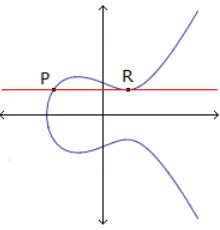
Figure 1.7: Elliptic curve tangent addition.
Finally, if two points are symmetric about thex-axis, the line the goes through these points will not intersect the curve at a third point. Since the points on the elliptic curve
form a group, the result must be another point on the curve. This point is called the point
at infinity, denoted byO. This point will be on any vertical line (Abraham, Kapoor, and Singh, 2008). This can be seen in Figure 1.8.
Figure 1.8: Elliptic curve vertical addition.
Clearly, to understand utilize elliptic curves for cryptography purposes, one must have
a firm grasp on fundamental geometric concepts. It may be the case that students have
understand geometric concepts can give the researcher much need insight about their
ability to solve particular cryptography problems and vice versa.
1.3
Why Cryptography?
Cryptography is a field of mathematics associated with applications. Aside from security,
one application is teaching. Cryptography is a very engaging subject. It puts mathematics
in a dramatic setting, which can make it extremely engaging for students of all ages.
Children are fascinated by intrigue and adventure. “More is at stake than a grade on a
test: if you make a mistake, your agent will be betrayed” someone using cryptography to
send secret codes might say (Koblitz, 1997).
Additionally, cryptography enables students to discover mathematical concepts and
techniques on their own. The thrill of discovery can be highly motivating for students of
all ability levels. “After many hours the youngsters finally develop a method to break a
cryptosystem, then they will be more likely to appreciate the power and beauty of the
mathematics that they have uncovered” (Koblitz, 1997). Also, due to the uncertainty of
cryptography problems, students may be less likely to maintain the notion that every
problem in mathematics can be solve with a formula.
Finally, cryptography allows for interdisciplinary study (Koblitz, 1997). Mathematical
concepts like functions, inverses, modular arithmetic, and group theory are heavily used.
In addition to these, students can cross into other fields such as statistics and linguistics.
For example, a common way to break a code is to use the concept of frequency analysis.
This means that students would attempt to see if certain letters always represent other
letters based on their frequency (Koblitz, 1997). This strategy takes both statistical
Cryptography can be used to teach mathematics to students of all ages. One can learn
how to send and receive secret messages at a very young age. Once the proper foundation
has put down, students can start to formalize encryption and decryption with algebraic
formulas. Finally, once students are exposed to mathematical theory, they can start to
analyze the strengths and weaknesses of various cryptosystems. Cryptography can be a
highly motivating topic for students. Students are engaged in problems where they must
pull information from various areas of mathematics, as well as their personal experiences.
Due to the engaging nature of cryptography, I want to investigate the following
re-search questions.
1. How does studying cryptography enable students to use their understanding of
different advanced mathematical content?
2. What different SOLO levels do students exhibit when they are solving cryptography
problems?
In this paper, I first synthesize literature on the SOLO taxonomy and student learning
of abstract algebra, linear algebra, number theory, probability, and algorithms. Then I
will discuss the research methods used including the setting, participants, recruitment
procedure, the interview protocol, and analysis. Next I will discuss the results of the
Chapter 2
Literature Review
In this chapter, I discuss how students learn various areas of mathematics used in
cryp-tography. This includes abstract algebra, linear algebra, number theory, probability, and
algorithms. Also I present the SOLO Taxonomy, which will be used to assess student
understanding.
2.1
SOLO Taxonomy
One way I will study student understanding of advanced mathematics is through the
structure of observed learning outcomes (SOLO) taxonomy framework. Developed by
John B. Biggs and K. Collis in 1982, this framework provides a hierarchy for student
understanding of a particular subject. This particular framework was chosen because of
its simple, yet elegant way of assessing student understanding. According to Biggs and
Collis, (1982) “The SOLO taxonomy provides a simple and robust way of describing how
learning outcomes grow in complexity from surface to deep understanding.” The SOLO
taxonomy is made up of five modes (Sensori-motor, Ikonic, Concrete Symbolic, Formal,
Extended Abstract).
Modes are related to various age groups. The Sensori-motor mode occurs soon after
birth, where a person reacts to the physical environment (Biggs and Collis, 1982). At
age two, one reaches the Ikonic mode, which is characterized by internalization of actions
in the form of images (Biggs and Collis, 1982). Concrete Symbolic occurs around age
six. Here a person would think through a symbol system such as language and number
systems (Biggs and Collis, 1982). In the Formal mode, which occurs around age 15,
one considers more abstract concepts (Biggs and Collis, 1982). Finally, Post Formal
is reached around age 22. Those in this mode are about to question or challenge the
fundamental structure of theories or disciplines (Biggs and Collis, 1982). For each given
mode, a person’s understanding can be categorized in one of the five stages of the SOLO
taxonomy.
Students functioning in Pre-structural are only requiring pieces of unconnected
in-formation, with little to no organization. Common behaviors associated with this stage
includes avoiding or repeating the question being asked. If the student does engage in
the problem, an incorrect process may be used, leading to irrelevant confusion (Chick,
1998). One can move into Uni-structural once a simple or obvious connection is made,
however this is the only focus of the student. Students functioning in this stage apply a
single process or concept, often resulting in an invalid conclusion (Chick, 1998). Once the
Multi-structural stage is reached, students have made a number of connections. However,
students may fail to synthesize information, which may indicate cognitive performance
below that required for a successful solution (Chick, 1998). If a student reaches the
Relational level, various aspects have become one and the student sees how the parts
combine to make a whole. In other words, students are starting to see the “big picture.”
1998). Students functioning in this level have an adequate understanding of the given
subject area. Finally, in the Extended Abstract level, students can generalize and
trans-fer knowledge to a diftrans-ferent subject area or take knowledge from a diftrans-ferent area to solve
a problem. Extended Abstract responses are structurally similar to Relational responses,
but here students use concepts from outside the domain of assumed knowledge. “In this
taxonomy, the structure of the learned outcome occurs within each of Piaget’s stages of
cognitive development. More specifically, the three SOLO levels in the middle, namely,
Uni-structural, Multi-structural and Relational, fall within the same stage whereas the
extended abstract extends the level of abstraction into the next stage becoming the
Uni-structural level of that next stage (Jurdak and Mouhayar, 2013).” Table 2.1 summarizes
the SOLO levels.
Table 2.1: SOLO Levels
SOLO Level Description
Pre-structural No connections.
Uni-structural Single connection.
Multi-structural Multiple connections.
Relational Parts as a whole.
Extended Abstract Knowledge transfer.
It is also essential to describe how students transition from one stage to the next.
When transitioning from Pre-structural to Uni-Structural, a student may attempt to
Multi-structural, one may attempt to handle multiple connections, but no significant progress
is made. During the transition from Multi-structural to Relational, a student may
rec-ognize several aspects of the problem, but fail to reconcile them. Finally, a transition
from Relational to Extended Abstract can be observed by seeing students make progress
towards a firm conclusion. Although participants in this study will be only be categorized
in the five main categories, these transitions allow for the researcher to better analyze
student understanding.
A key assumption made regarding this framework is that each level incorporates the
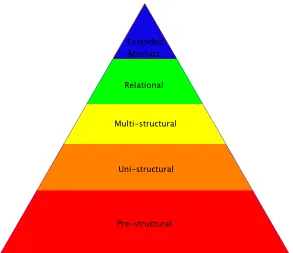
previous levels, then extends understanding. One can think of the SOLO taxonomy as
a pyramid, where each level provides a foundational support for the next. Since the
researcher often is asking questions that are open ended and have various entry points,
this allows for students to be categorized in any of the five stages. Figure 2.1 shows the
Figure 2.1: SOLO Taxonomy Pyramid.
When posing questions in task-based interviews, one must keep in mind that
partic-ular questions may limit the SOLO level of possible solutions (Biggs and Collis, 1982).
For example, the question “What is public key cryptography?” would best require a
pre-structural response. However, posing tasks such as “Encrypt the plaintext WOLF using
an encryption method of your choice. Discuss the strengths and weaknesses of the chosen
encryption method,” may allow for various SOLO levels. This is because students could
do anything from not responding to using an encryption method that is outside the scope
of the course. The interviewer must create questions that allow for a large range of SOLO
level responses, which provides an efficient tool for measuring student understanding of
2.2
Abstract Algebra
Abstract algebra is a foundational part of the field of cryptography. In fact, one can
even think of cryptography as “applied abstract algebra.” If this is the case, then
un-derstanding how students think about abstract algebra is essential to the analysis of
student understanding of cryptography. abstract algebra is often the first time students
are faced with high levels of abstraction. Research has been done to analyze how levels
of abstraction can be reduced while not sacrificing mathematical rigidity.
According to Hazzan (1999), abstraction level can be interpreted three different ways:
1. Abstraction level as the quality of the relationships between the object of thought
and the thinking person.
2. Abstraction level as a reflection of the process-object duality.
3. Abstraction level as the degree of complexity of the concept of thought.
The first interpretation of abstraction stems from the idea that whether something
is abstract or concrete is not inherent of the object, but the relationship that one has
with the object (Wilensky, 1991). This implies that abstraction can vary for each person
and object based on the previous connections between the two. The closer one is to an
object, the more connections one will have, hence the object will become less abstract
and more concrete (Hazzan, 1999). Using this perspective, one can correlate students’
mental processes with their tendency to make unfamiliar problems more familiar, i.e.
making the transition from abstract to concrete (Hazzan, 1999). This process is quite
common in Abstract Algebra when students use what they know about various numbers
The abstraction level can also be view using process-object duality. To discuss this
duality, it is essential that one distinguishes between process conception and object
con-ception.“Process conception implies that one regards a mathematical object as a potential
rather than an actual entity, which comes into existence upon request in a sequence of
actions” (Sfard, 1991). A mathematical concept becomes an object when the concept is
conceived as one entity. Therefore, for a given mathematical idea, it is first conceived
as a process, which is less abstract, then becomes an object (Hazzan, 1999). Students
can reduce abstraction level by perceiving mathematical ideas as processes rather than
objects. The mental process that allows students to transition from process conception
to object conception was coined reflective abstraction by Piaget (Hazzan, 1999).
Finally, level of abstraction can be interpreted as the degree of complexity of the
concept of thought. This viewpoint hinges on the assumption that the more compound
an entity is, the more abstract it is (Hazzan, 1999). Students can reduce abstraction this
way by substituting a less complex, but related idea for a more complex one (Hazzan,
1999). For example, a student trying to decrypt a message may start by only examining
one letter at a time to determine what type of cipher was used. In an Algebra course,
a student may replacing an entire group with a single element to attempt to reduce the
abstraction level (Hazzan, 1999).
Knowing when students are attempting to reduce abstraction and how they are going
about this process can give one insight about which level of understanding the student is
at. Therefore, this enables a way to place students in a given stage based on their need
and ability to reduce levels of abstraction.
One can also consider instructional strategies for improving the understanding of
var-ious abstract concepts. According to Dubinsky et al. (1994), the following are strategies
1. Going through the Action-Process-Object-Schema Steps
2. Computer Activities and Team Work to Clear Up Misconceptions
3. Meeting Prerequisites
4. Finding Alternatives to Linear Sequencing
Dubinsky et al. (1994) asks “How can we get students to take a specific step in the
development of a particular concept? In particular, what methods can be used to help
students to interiorize actions to construct processes, to reverse or coordinate processes to
construct other processes, to encapsulate processes, to construct objects, and to
thema-tize collections of processes and objects into schemas?” Dubinsky et al. have experienced
success in this regard by creating computer-based tasks to foster the constructing of
pro-cesses and objects and by having students work cooperatively. Regardless of the strategies
used, Dubinsky et al. suggest that students should reflect on their actions independently
or as a class.
Misconceptions may happen in any mathematics class. However, teachers must help
students clear up these misconceptions or at least make them aware that they have fallen
into them. The use of group work may be one solution (Dubinsky, Dautermann, Leron,
and Zazkis, 1994). Students tend to be more likely to seriously consider contradictions
presented by their classmates than ones presented by their teacher. When an instructor
claims something is or is not true, it is convention to simply accept what is said as truth
(Dubinsky, Dautermann, Leron, and Zazkis, 1994).
It is essential that students have a deep understanding of sets and functions before
entering an abstract algebra class (Dubinsky, Dautermann, Leron, and Zazkis, 1994). Sets
and functions play an integral role in the concepts of one-to-one, onto, and isomorphism.
to have a deeper understanding of various algebraic structures (Dubinsky, Dautermann,
Leron, and Zazkis, 1994).
It is natural to present mathematics in a simple linear sequence. However, Jerome
Bruner prosed that a spiral curriculum is a suitable replacement (Dubinsky, Dautermann,
Leron, and Zazkis, 1994). This is done under the assumption that any mathematical topic
can be taught in a rigorous way at any age. Fundamental mathematical concepts can be
taught a young age, then revisited over the years, adding levels of sophistication and
rigor. Dubinsky et al. believes that instructors should use abstract algebra as a way to
revisit concepts such as sets and functions. This way, abstract algebra can be taught
through concepts students are familiar with, but have not quite mastered.
2.3
Linear Algebra
One of the first poly-alphabetic ciphers students can learn after the Vigenere cipher is
the Hill cipher. The Hill cipher encrypts messages by using an n ×n matrix that has an inverse modulo 26. In order for students to encrypt, decrypt, and codebreak the Hill
cipher, they must have a strong foundation in linear algebra. In this section, I provide
some background on student learning of linear algebra.
Although most mathematics majors take a linear algebra course, the courses often
focus on computation and procedural knowledge. Although these skills are important for
encryption and decryption, students often forget the procedures and algorithms (Dorier
and Sierpinska, 2001) so focusing on the concepts that support the procedures and
al-gorithms is important. For example, if a student forgets the formula for the inverse of a
2×2 matrix, if they had a conceptual understanding of where the formula came from,
In addition to its use in classical cryptography, linear algebra tends to show up in
pure and applied mathematics, computer science, engineering, physics, and other
sci-ences. Clearly this is an important subject for many mathematics and science majors.
According to Dorier (2002) , the two main issues of teaching and learning linear algebra
are Epistemological Specificity and Cognitive Flexibility (Dorier, 2002).
Other difficulties which students are faced with when learning linear algebra is the
variety of languages, semiotic registers or representation, points of view, and settings
through which the objects of linear algebra can be represented (Dorier, 2002). According
to Hillel (2000), there are three basic languages associated with linear algebra.
1. Abstract Language
2. Algebraic Language
3. Geometric Language
This can be an issue if the instructor switches from one representation to the next
without any notice. Often students are confused the most when the language is switched
from the abstract to the algebraic. With each of these languages comes a corresponding
mode of thinking (Hillel, 2000).
1. Analytic-Structural
2. Analytic-Arithmetic
3. Synthetic-Geometric
It is essential that students can effectively use multiple representations of objects
when studying mathematics. In fact in any mathematical activity, representations are
represented (Dorier, 2002). For example vectors can be represented graphically by arrows,
by rows or columns of coordinates, or symbolically as abstract elements of a vector space.
In order to reduce levels of abstraction some have considered a more geometric
ap-proach to linear algebra. The goal is to overcome some of the abstractions by giving more
concrete meaning to concepts through geometric figures. However a problem quickly
ar-rises when one relies too much on the geometry of linear algebra. Geometry is limited to
three dimensions, therefore various concepts have limited representations in a geometric
setting.
Also, if students learn linear algebra in a heavy geometric setting, they can have
a difficult time going back to more general and abstract cases. One example is that
students may struggle to imagine a linear transformation that would not be a geometric
transformation.
However, some students may use the geometric ideas to their advantage when
ap-propriate. In fact being able to decide when a geometric representation should be used
or not displays a high level of understanding of the subject. “It seems that the use of
geometrical representations or language is very likely to be a positive factor, but it has
to be controlled and used in a context where the connection is made explicit.”
Additionally, some have proposed a greater use of technology in the linear algebra
classroom. In fact, according to Dikovic (2007), every linear algebra instructor should
consider the following questions.
1. Why do some students learn more mathematics than other students in the same
class?
2. What can linear algebra teachers do to enrich or replace traditional lecturing in
3. What contribution of technology could be in the fields of experimenting,
observa-tion, and discussing?
4. How many reasons are there, for yes or no, for example for use of graphics calculators
for computing matrix inversion or for solving linear systems?
Dikovic (2007) suggests Maple, MATLAB, or Mathematica for their very powerful,
numerous functions. These functions include but are not limited to instantaneous numeric
and symbolic calculation, data collection and analysis, modeling, presenting two and three
dimensional graphics, and application development.
Hillel and et al. also suggest the use of Cabri, a dynamic geometry program, to
teach and learn linear algebra. Hillel and et al. believe that by using Cabri, students can
overcome the obstacle of formalism associated with vector spaces. Assuming the meaning
of various mathematical objects are well represented by the computer representations,
students can study vector spaces geometrically, rather than analytically (Hillel, Trgalova,
and Sierpinska, 1999). One must note that these geometric representations are limited to
two and three dimensions, so other representations must be considered (Dorier, 2002).
2.4
Number Theory
Number theory is often thought of as the purest form of mathematics (Cambell and
Zazkis, 2002). This is a classical subject that contains several beautiful and elegant proofs.
However, in recent years new light has been shed on number theory, specifically on
its application to modern cryptography. Public key systems, such as RSA, rely heavily
RSA so effective. Additionally, foundational number theoretic concepts such as modular
arithmetic, divisibility, and primality are powerful tools to the field of cryptography.
What makes number theory even more important is its integration within
mathe-matics from elementary school through college (Cambell and Zazkis, 2002). It is very
common that elementary school students learn about different number systems, long
di-vision with and without remainders, and prime numbers (Cambell and Zazkis, 2002).
These topics are all rooted in number theory (Cambell and Zazkis, 2002). According to
The National Council of Teachers of Mathematics (NCTM), in pre-K through grade 2,
all students should be able to “develop a sense of whole numbers and represent and use
them in flexible ways, including relating, composing, and decomposing numbers, (NCTM,
2015).” These number theoretic concepts continue in grades 3 through 5, where NCTM
(2015) claims all students should be able to “recognize equivalent representations for the
same number and generate them by decomposing and composing numbers” and “describe
classes of numbers according to characteristics such as the nature of their factors.” In
grades 6 through 8 all students should be able to “use factors, multiples, prime
factoriza-tion, and relatively prime numbers to solve problems” and “develop meaning for integers
and represent and compare quantities with them,” according to NCTM (2015). NCTM
(2015) then explicitly states all students should be able to use “number-theory arguments
to justify relationships involving whole numbers” in grades 9 through 12.
Aside from these standards, number theory can help students make the transition
from arithmetic to algebra, by enabling students to develop better understandings of
the abstract conceptual structure of whole numbers and integers (Wagner, 2012).
Addi-tionally number theory has algebraic characteristics similar to variables (Wagner, 2012).
Therefore studying concepts such as number systems, division, and primality can develop
Unfortunately, these concepts are forgotten after years of not engaging in them
(Cam-bell and Zazkis, 2002). Although high school students know what a remainder is and how
to find one, they most likely have not been introduced to the formal concept of modular
arithmetic. Cambell and Zazkis (2002) found that for preservice teachers, this poses a
serious problem. Their understanding of the concept of number is not where it should
be.
Additionally students that are required to take a number theory or modern
alge-bra course often struggle with elementary number theory concepts (Cambell and Zazkis,
2002). Students tend to solve problems in a procedural manner rather than conceptual. In
particular, students encounter difficulties when they are faced with problems that have a
wide range of strategies or representations (Cambell and Zazkis, 2002). For example,
stu-dents may face difficulties when attempting to link divisibility to factorization (Cambell
and Zazkis, 2002).
2.5
Probability
Studying cryptography requires keen intuitions about when particular methods are going
to work and when they are not. Instead of relying on intuition alone, probabilistic methods
are introduced. For example, suppose that students are asked to break a code, knowing
that it has been encrypted using a substitution cipher. Students can use the fact that
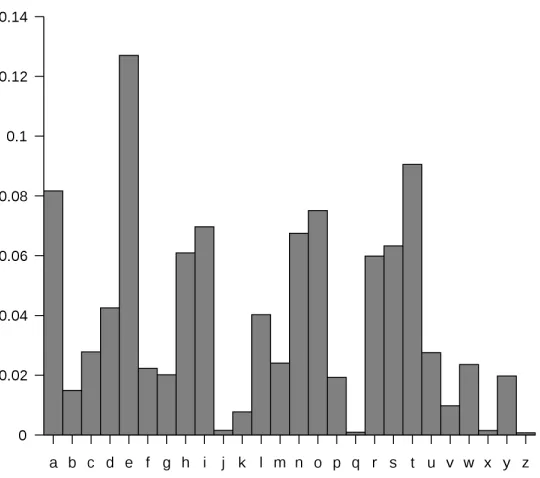
certain letters appear more often than others. Figure 2.2 shows the frequency distribution
Figure 2.2: Frequency distribution of the alphabet.
With this information in mind, students can make predictions about the plaintext
based on the ciphertext. For example, if a student is faced with a string of ciphertext
where the letter J is most common, they may assume that J represents a vowel. This
is because in the English language, vowels appear more frequently than consonants,
with the exception of the letter T. However, frequency analysis is only effective when
a substitution cipher was used. How can one decide which type if cipher was used to
encrypt the plaintext?
The Index of Coincidence can be an efficient tool in determining whether a given
cipher is mono-alphabetic or poly-alphabetic (Kahn, 1997). Index of Coincidence refers
the the probability of choosing the same letter twice in a string of letters and is given by
IC =
Z P
i=A
fi(fi −1)
where fi is the number of times the letter i appears for i = A, B, . . . , Z and N is
the number of letters in the ciphertext. Luckily, Index of Coincidence values have been
computed for various languages.
If all letters are equally likely, the Index of Coincidence would be approximately 0.038 (Singh, 1999). However, in the English language certain letters appear more frequently
such as the letter E, which appears approximately 13 percent of the time. This yields a
higher Index of Coincidence for English, approximately 0.067 (Singh, 1999). The Index of Coincidence for various languages can be seen in Table 2.2.
Table 2.2: Index of Coincidence
Language Index of Coincidence
English 0.067 Russian 0.068 Spanish 0.075 Portuguese 0.075 Italian 0.075 French 0.078 German 0.079 Random 0.038
When a cipher is mono-alphabetic, the Index of Coincidence does not change, since
the same letter frequencies exist. When the Index of Coincidence is closer to random,
appropriate attack can be used.
The use of probability and statistics is an integral part of solving cryptography
prob-lems. However, many students have a lack of experience with probability, often only
studying this subject once. This begs the question, “How can we enable students to
un-derstand probability?” To answer this question, one must consider the following three
perspectives.
1. Building on the firm basis of students’ sound intuitions (Faulk, 1992).
2. Conventional teaching of probability does not establish enough connections between
the intuitions of the leaner and the mathematical theory (Borovcnik, 1991).
3. Intuitions are the product of personal experience (Fischbein, 1987).
Clearly, intuitions are important in learning probability. The learning of
probabil-ity should start with these intuitions, changing them as new knowledge is acquired by
the student. This can be done by developing secondary intuitions to create the link
be-tween the students’ preconceptions and the theory. However, it is essential to clear up
misconceptions as early as possible. Due to personal experiences, students may continue
to believe something is true, even when the mathematics say otherwise. For example, a
student may say that they understand that flipping a coin several times has the same
probability for heads each toss. However, after getting four tails in a row, students may
feel that that getting heads on the next toss is now more likely. According to Fischbein
(1987), “One of the fundamental tasks of mathematical education ... is to develop in
stu-dents the capacity to distinguish between intuitive beliefs, intuitive feelings and formally
2.6
Algorithms
One can think of cryptography as the intersection of mathematics and computer science.
Although the complex encryption methods require rigorous mathematical theory, heavy
computation must be done in real world problems. This requires both theory and
applica-tion of computer science. In particular, it is essential that one has a deep understanding
of algorithms, including representations, syntax, and time to run given algorithms.
An algorithm is defined to be a well defined process that requires a finite amount of
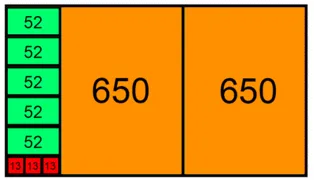
steps. One may view algorithms either graphically or using standard syntax. Figure 2.3
shows a graphical view of the Euclidean algorithm for 1599 and 650.
Figure 2.3: Euclidean algorithm for 1559 and 650.
This is an alternative to writing out the algorithm using symbolic notation, as seen
1599 = 650×2 + 299
650 = 299×2 + 52
299 = 52×5 + 39
52 = 39×1 + 13
39 = 13×3 + 0
According to Byrne, Catrambone, and Stasko (1999), students benefit from seeing
both symbolic and graphical representations of algorithms. This is because “Conceptual
knowledge about the properties of an algorithm can help a learner to carry out the
algorithm’s steps. Similarly, being able to perform the step-by-step operations of an
algorithm may assist a learner in determining the veracity of a conceptual question about
it. (Byrne, Catrambone, and Stasko, 1999)” This will ultimately give students a deeper
understanding of algorithm and how they work. Consequently, students may gain insight
on effectiveness and running time.
Algorithms are an integral part of learning cryptography, since cryptanalysis is a
major focus. After presented with a given cryptosystem, students may be asked to analyze
its security. For example, the Caesar cipher is typically the first cipher discussed in a
cryptography course. A basic algorithm to break this cipher would be to try every key
from 1 to 25. Even if this was done by hand, the maximum amount of time to break
this cipher would be 25 steps. As more complex ciphers are discussed, the algorithms to
break them become more difficult and time consuming, allowing a perfect opportunity
Chapter 3
Methods
In this chapter, I discuss the methods of data collection and analysis for this
qualita-tive study. This includes the setting of the interviews, participant demographics, and
a detailed description of the procedures used to collect and analyze the data from the
interviews.
3.1
Research Questions
1. How does studying cryptography enable students to use their understanding of
different advanced mathematical content?
2. What different SOLO levels do students exhibit when they are solving cryptography
problems?
3.2
Setting
This experiment was conducted at the end of the spring 2015 semester at a university
interviewed in a one-to-one setting for approximately one hour. Those participating in
this study did so following the 700 level mathematics course “Applications of Algebra.”
The class consisted of approximately 20 students and the material was presented using
traditional lecture, twice a week for approximately 75 minutes All of the students in the
course were either mathematics (pure, applied, eduction) or computer science majors.
Although there are many topics that could be discussed in an applied algebra course,
the professor chose to focus solely on cryptography. Topics covered in this course include
shift ciphers, the Hill cipher, exponential ciphers, RSA, ElGamal, elliptic curve ciphers,
Pollard’s method, and quadratic sieves.
3.3
Participants
All participants were either Mathematics (Pure or Applied) or Computer Science majors.
Table 3.1 below summarizes the demographics of the participants in this research study.
Table 3.1: Student Demographics
Student Gender Age Major
A Male 22 Pure Mathematics
B Male 24 Pure Mathematics
C Female 22 Computer Science
D Female 23 Applied Mathematics
E Female 24 Pure Mathematics
F Female 21 Applied Mathematics
A convenience sample was used for this project; the participants were selected based
on their willingness to participate. All students taking the course “Applications of
Alge-bra” were asked to participate by email and the first seven to respond were chosen.
3.4
Recruitment Procedure
Prior to being interviewed students were contacted through email and asked if they
would be willing to participate. Students were to sign an informed consent document,
where they agreed to the use of audio recordings and their written work in this research.
Participants’ work was kept and scanned for use in this research. All work can be found
in Chapter 4 and Appendix C.
3.4.1
Qualitative Studies
In this study, I am analyzing student interviews and work so it lends itself to the use of
qualitative research. Qualitative research emphasizes the importance of looking at
vari-ables in the natural setting in which they are found (Flick, 2009). Data can be gathered
through open ended questions and tasks that provide artifacts such as sample work and
direct quotations (Flick, 2009). Unlike in quantitative research, which attempts to
re-move the investigator from the investigation, the researcher is an integral part of the
investigation. The focus of qualitative research is to have a holistic view of what is being
studied, however there exist both advantages and disadvantages to doing qualitative
re-search. One advantage is that qualitative research provides more in depth, comprehensive
information (Flick, 2009). There is a cost, however, to gaining this information. Due to
subjectivity, establishing reliability and validity can be difficult. Additionally, it is very
3.4.2
Task-Based Interviews
Task-based interviews are a particular form of clinical interviews, and date back to the
time of Piaget. “A clinical task-based interview can be seen as a situation where the
interviewer-interviewee interaction on a task is regulated by a system of explicit and
im-plicit norms, values, are rules” (Harel and Koichu, 2007). These interviews were originally
used to gain a deeper understanding of the cognitive development of children. In
math-ematics education, task-based interviews provide a means of gaining information about
a student or group of students’ mathematical inclination. In task-based interviews, the
interviewees interact with both the interviewer and a particular task environment. This
implies that one of the most important aspects of the task-based interviews is the task
itself. If done correctly, task-based interviews can be a very effective way of analyzing
mathematical behavior. Ericsson and Simon (1993) recommend the following monologue
to promote think-aloud taking.
Tell me everything you are thinking from the time you first see the question
until you give an answer. I would like you to talk aloud constantly from the
time I present each problem until you have given your final answer to the
question. I don’t want you to try to plan out what to say or try to explain to
me what you are saying. Just act as if you are alone in the room speaking to
yourself. It is most important that you keep talking. If you are silent for any
long period of time I will ask you to talk.
If tasks are to be used in various settings, by various interviewees, it is essential
that the procedure of interviewing can be repeated. This implies that the interview
protocol needs to be explicit, so that a different interviewee can use the same task in a
many nonverbal events that effect the interview process. These could include nods, smiles,
and other use of body language. This issue makes completely standardizing task based
interviews a difficult feat.
Before the interview actually takes place, the expectations and rules must be discusses
between the interviewer and interviewee. This agreement between the two parties is
referred to as an experimental contract. These experimental contracts promote certain
types of social behavior, which in turn acts as a mediator between the subject and
knowledge of that subject. One implication of the experimental contract is that the
interviewee may try to offer the correct or preferred response, instead of their actually
thoughts. Therefore, it should be made clear that the interest is in the student’s thought
process, not a correct or incorrect answer. In the next section, I show the protocol I used
to conduct the interviews.
3.4.3
Interview Protocol
Hello, my name is Blain Patterson and I am conducting interviews for my Master’s Thesis.
I am interested in how you make connections to various areas of mathematics through
learning cryptography. I am going to ask you a series of questions. I am interested how
you think about each problem, so I would like for you to talk to me while you work. Also,
I am going to keep your work, take notes, and record audio. I am provided you with a
consent form that you must sign before the interview begins. Do you have any questions
before we start? Please answer the following questions (with time in between).
Introductory Questions
1. Why did you decide to take this course?
3. What was your favorite part of the course and why?
4. What was your least favorite part of the course and why?
5. Explain the difference between private and public key cryptography. Discuss
ad-vantages and disadad-vantages of each.
Tasks Used
6. Consider the following plaintext: NCSU.
a. Encrypt this message using a cipher of your choice.
b. Discuss the strengths and weaknesses of the cipher your choose.
7. Consider the following ciphertext: XFNFCWGRTB.
a. Decrypt this message.
b. Discuss the strengths and weaknesses of your decryption method.
8. Consider the number 8911.
a. Is it prime? Why or why not? (If student answers yes, move on to parts b and
c. Otherwise, move on to question 9.)
b. How did you determine primality?
c. Factor this number.
Closing Questions
9. What areas of mathematics did you use in this course and how were they used?
3.4.4
Rationale for Protocol Questions
The first four questions were meant to learn about the participants’ background, which
can provide insight to their problem solving abilities. Questions five through eight are
meant to directly categorize student understand into one of the five levels of the SOLO
taxonomy. Question five asks students to encrypt using any cipher of their choice and
discuss its effectiveness. This is an open ended question that allows for a wide range of
SOLO levels, since students are to choose methods using as much or as little mathematics
as needed. In a similar way, question six allows students to use any strategies they choose,
however is more limited in the possible strategies that can be implemented. Note that
students were given the opportunity to use a calculator for number eight, but were still
asked to show as much work as possible. Although they were asked to factor this specific
number, the factoring algorithm they use will vary. All three task questions allow for a
wide range of mathematics used and SOLO classifications. Once the task portion of the
interview is complete, students were asked to summarize their experience in questions
nine and ten. Audio clips were recorded and student worked was kept for the analysis.
Additionally, the researcher recorded notes while the students were answering questions
and working through problems.
3.5
Analysis
Recall that the SOLO taxonomy is being used to classify student understanding of
cryp-tography. For classification purposes, I am assuming that all students are functioning
at the Formal mode of the SOLO taxonomy. This is due to the fact that all students
participating in this study are college students.
identified when a participant used something they learned in “Applications of Algebra,”
something they learned in another course, or something they learned while studying
independently. This was done by keeping a list of concepts covered in the course and
marking when a participant used one of these concepts to solve a problem. If a concept
used was not covered in the course, I asked the student to clarify where they learned that
concept and how they used it to solve a given problem.
If a student refused to engage in the task, they were placed in the Pre-structural SOLO
level. Students who used a single relevant aspect of cryptography to solve the problems
were placed in the Uni-structural SOLO level, whereas students who used multiple
rele-vant aspects of cryptography to solve the problems were placed in the Multi-structural
SOLO level, and students who made multiple connections were placed in the
Multi-structural level. If a student used multiple aspects of cryptography together to solve
a problem, they were placed in the Relational SOLO level. Finally, students who used
knowledge outside of the scope of cryptography were placed in the Extended Abstract
SOLO level, since the Extended Abstract level of the SOLO taxonomy is associated with
making connections both in and outside a given subject area. Table 3.2 summarizes how
the understanding of cryptography for participants A through G will be classified using
Table 3.2: SOLO Rubric
SOLO Level Description
Pre-structural Inability or refusal to engage in the task.
Uni-structural Uses one relevant aspect of cryptography.
Multi-structural Uses several relevant aspects of cryptography.
Relational Uses multiple relevant aspects of cryptography together.
Extended Abstract Uses knowledge outside of the scope of cryptography.
Student work is described in Chapter 4 along with the classification of each student
in one of the five SOLO levels. Using student work, notes taken during the interview,
and audio recordings, detailed descriptions of each interview have been compiled. This
was done by transcribing each of the seven interviews and written work. I then used
a list of concepts (encryption methods, decryption methods, algorithms) discussed in
“Applications of Algebra” and marked when a participant used the various concepts. I
also made note of when a participant used a single concept, multiple concepts disjointly,
multiple concepts together, or concepts outside of cryptography. Then using the rubric
in Table 3.2, the understanding of cryptography for students A through G was placed in
Chapter 4
Results
In this chapter, results are presented including student background information (previous
coursework and interest in cryptography as shared in the interviews), a description of
the students’ responses and some related work samples, and SOLO level classification.
Students A through G have been labeled based on the order in which the interviews took
place. Each student description includes their responses to the introductory questions,
solutions to the tasks, and closing questions.
4.1
Student A
4.1.1
Introduction
Student A decided to take this this course because he felt very confident in his algebraic
thinking. “I did really well in linear and abstract algebra, so I thought it would be
inter-esting to see some applications.” Student A has taken linear algebra, abstract algebra,
and real analysis. He has yet to take course in number theory, but claims he has worked
favorite part of the course was working with error correcting codes, because he liked the
application of vector space theory. His least favorite part of the course was the elementary
ciphers, such as the Caesar and Vigenere. He felt that these could have all been covered
in the first day, so that there was more time to focus on public key cryptography.
4.1.2
Problem Solving
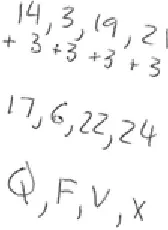
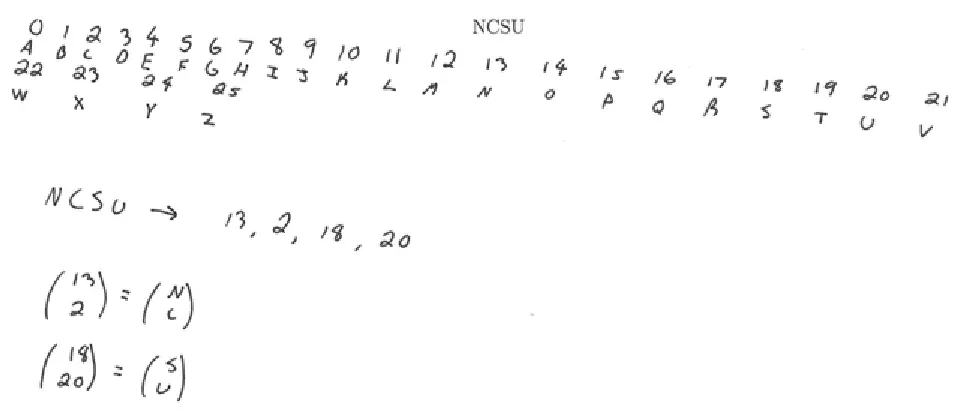
Student A started encrypting NCSU by assigning letters to numbers. However, Figure
4.1 shows that instead of starting at 0 and counting to 25, he started at 1 and counted
to 26
Figure 4.1: Student A assigning numbers to letters.
This came as a surprise, since the student had been using the former method the
entire semester. When asked about his method, student A commented “It really doesn’t
matter if I start at 1 instead of 0, I just need to make sure I do everything modulo 27.”
This lead the student to convert NCSU to 14,3,19,21.
Student A was originally going to encrypt the plaintext NCSU using an affine cipher