GRAMMAR KNOWLEDGE
NOR SILAWATI BINTI SUPIAN SURI
A project report submitted in partial fulfilment of the requirements for the award of the degree of
Master of Education in Teaching English as a Second Language (TESL)
Faculty of Education Universiti Teknologi Malaysia
DEDICATION
I dedicated this thesis to my beloved husband, Mohd Riduan Jamaluddin, and my son, Muhammad Daniel who have been my pillars of strength since the beginning of my studies.
Also, this thesis is dedicated to my mother, Halijah Mohd Saman who has been a great source of inspiration.
ACKNOWLEDGEMENT
I would like to express my deepest gratitude to Dr Fauziah Ismail for the guidance, encouragement, and useful critiques. She had supported me throughout with patience and tolerance in which without her this project report would not have been completed.
In addition, my gratitude also goes to Dr. Azian Abdul Aziz for her valuable insights as well as suggestions for me to complete my project report. I am grateful to family and friends for their continued moral support and care during the completion of this project. I am forever indebted to my husband, Mohd Riduan Jamaluddin for his understanding, endless patience and encouragement when it was most required. Special thanks to my team members, Zakiah Hanim Mohamad Toha and Suzana Mohd Suboh, for their motivation and encouragement. Their support did not go unnoticed.
ABSTRACT
ABSTRAK
TABLE OF CONTENTS
CHAPTER TITLE PAGE
DECLARATION ii
DEDICATION iii
ACKNOWLEDGEMENT iv
ABSTRACT v
ABSTRAK vi
TABLE OF CONTENTS vii
LIST OF TABLES xiii
LIST OF FIGURES xv
LIST OF ABBREVIATIONS xvi
1 INTRODUCTION
1.0 Introduction 1
1.1 Background of the Study 3 1.2 Statement of the Problem 6
1.3 Conceptual Framework 9
1.4 Research Objectives 12
1.5 Research Questions 12
1.6 Definition of Terms 13
1.6.1 Online Grammar Resources 13 1.6.2 Grammar Knowledge 13
1.6.3 Develop 14
1.6.4 Learners 14
1.7 Scope of the Study 14
1.8 Significance of the Study 15
2 LITERATURE REVIEW
2.0 Introduction 17
2.1 Computer- assisted Language Learning 18 (CALL)
2.2 Online Grammar Resources 20 2.3 Characteristics of Online 21
Grammar Resources
2.4 Advantages of Online Grammar Resources 22
2.5 Grammar Knowledge 24
2.5.1 Irregular Verbs 25
2.5.2 Conjunctions 25
2.5.3 Personal Pronouns 25
2.5.4 Prepositions of Place 26 2.6 Grammar Teaching and Learning 26 2.7 Enhancing Grammar Knowledge 27
via CALL
2.9 Conclusion 30
3 RESEARCH METHODOLOGY
3.0 Introduction 31
3.1 Research Design 31
3.2 Participants and Sampling 33
3.3 Research Instruments 34
3.3.1 Tests 35
3.3.2 Questionnaire 36 3.3.3 Semi- structured Group Interviews 37
3.4 Research Procedure 38
3.5 Data Analysis 40
3.6 Conclusion 40
4 FINDINGS AND DISCUSSION
4.0 Introduction 41
4.2 OGR in developing learners’ grammar 47 knowledge in four grammar aspects
4.2.1 OGR in developing learners’ 47 grammar knowledge of
irregular verbs
4.2.2 OGR in developing learners’ 50
grammar knowledge of conjunctions
4.2.3 OGR in developing learners’ 51 grammar knowledge of
personal pronouns
4.2.4 OGR in developing learners’ 52
grammar knowledge of prepositions of place
4.3 Learners’ attitudes and perceptions 54 on the use of OGR as a tool to develop
grammar knowledge
4.3.1 Learners’ attitudes on the use of 54 OGR as a tool to develop
4.3.2 Learners’ perceptions on the use 56
Of OGR as a tool to develop grammar knowledge
4.4 Conclusion 60
5 CONCLUSION AND RECOMMENDATIONS
5.0 Introduction 61
` 5.1 Summary of findings 61
5.2 Pedagogical implications 63 5.3 Recommendations for future research 64 5.3.1 School’s administration 64
5.3.2 Teacher 64
5.3.3 Students 65
5.4 Limitations of the study 66
5.5 Conclusion 66
REFERENCES 68
LIST OF TABLES
TABLE. NO TITLE PAGE
2.1 Stages of CALL 18
3.1 Research design of the study 32
(QUAN- QUAN- QUAL)
3.2 Methods on how research questions 34
were to be addressed
3.3 The format of a typical five- level 37
Likert item
3.4 Research procedure of the study 39
4.1 Scores for Pre test and Post test 43
4.2 Paired Samples T- test 45
4.3 Results of Pre test and Post test on 48
Irregular Verbs
4.4 Results of Pre test and Post test on 50
4.5 Results of Pre test and Post test on 51 Personal Pronouns
4.6 Results of Pre test and Post test on 52
Prepositions of Place
4.7 Learners’ attitudes on the use of OGR as 55 a tool to develop learners’ grammar
knowledge
4.8 Learners’ perceptions on the use of OGR as 57 a tool to develop learners’ grammar
LIST OF FIGURES
FIGURE NO. TITLE PAGE
1.1 Conceptual Framework of 11
LIST OF ABBREVIATIONS
ASC - Asynchronous Communication
CALL - Computer- assisted Language Learning
CBC - Community Broadband Center
CMC - Computer- Mediated Communication
EAP - English for Academic Purposes
ESP - English for Specific Purposes
ICT - Information and Communication Technology
IRC - Internet Relay Chat
KBSM - Kurikulum Bersepadu Sekolah Menengah
NBI - National Broadband Initiative
NNSs - Non native speakers
OGR - Online Grammar Resources
OR - Online Resources
PBS - Pentaksiran Berasaskan Sekolah
SSI - Semi structured Interviews
WBLL - Web- based Language Learning
LIST OF APPENDICES
APPENDIX TITLE PAGE
A1 Pre Test 74
A2 Post Test 79
B Questionnaire 83
C List of interview questions for students 84
CHAPTER 1
INTRODUCTION
1.0 Introduction
With the booming of the Internet and the World Wide Web (WWW) for more than two decades now, we have seen significant change especially in term of how we live our lives today. Trade, banking transactions, long distance communication, news, and even home security are among the eminent evidence that the Internet is part of our lives, whether we like it or not.
to see now many restaurants too, fast food chains, kopitiam outlets and even mamak stalls, are offering free Wireless Fidelity (WiFi) as a way to grab the attention of these gadget junkies. The Internet is, therefore, within our reach.
The Internet is widely used for its synchronous and asynchronous communication. Synchronous communication (SC) or „real time‟ communication is done via the Internet using the chat media (Warschauer and Healy, 1998). It gives live and interactive internet text messaging known as chat. One of the well known chat media in Malaysia is Internet Relay Chat (IRC). The IRC enables users not only to hold group communication but also one-to-one communication via private message. Asynchronous communication (ASC) is carried out through e-mail, bulletin board and newsgroup (such as SCHOOLNET). Teachers at various levels have been using e-mail as a way to promote learning such as in giving feedback (Samira, 2010). In distance courses, e-mail is used as a form of communication device (Felix, 2003). In teaching English as foreign language, the use of e-mail has created another new learning committee whereby teachers and students of different cultures can meet and discuss (see Fischer, 1998).
In the field of language, many research have been done on online language learning (Hegelheimer and Fisher, 2006; Warschauer and Meskill, 2000). It is treated as part of its umbrella, Computer Assisted Language Learning (CALL). However, not much attention is given to online resources, particularly on grammar. This study seeks to explore the impact of these online resources on learners especially in developing their grammar knowledge.
1.1 Background of the study
There has been a tremendous growth in the use of the Internet since it was first introduced in early 1990s. It has opened up new ways for people to communicate, gain new information and increase their knowledge. The internet offers plenty of reasons for teachers to integrate the Internet in language learning. It is used to promote the learning itself (Warschauer and Whittaker, 1997). Students can search for authentic materials for their projects and assignments.
In addition, there is evidence that shows students can communicate with real audience by publishing their work (Warschauer and Meskill, 2000). Publishing their work online, creating online newsletter in school or having online collaboration with other students around the globe motivates the students to put a great deal of effort on producing quality materials. This relates to students‟ perception of their own work. If they think that what they publish online as having socially and culturally relevance, then this will encourage them to write in second language.
WWW itself offers a plethora of resources. In fact, too much resource that it creates over supplying (Calverley and Shephard, 2003). The Web- based language learning materials have become among the favourite materials to be used (Nor Ashikin, 2012). This is because the supplies of the materials are endless and diverse. WWW is said to function as the virtual library (Zarlina et al, 2012). It is comparable to the traditional library. In fact, it contains source of information similar to books and prints of a library. As much as we do not conduct research on whether books and library contribute to language learning, the same goes with WWW.
vocabularies, reading and listening skills to follow instructions on the computer. Such difficulties might hamper the learner‟s interest and motivation. This is where the teacher plays the significant role. Teacher needs to provide sufficient support to prevent the students from being overwhelmed by difficulties mentioned earlier (Warschauer and Whittaker, 1997). Clarify the goals clearly before deciding which web pages are beneficial and would bring about the necessary increase in the students‟ skills (Warschauer and Whittaker, 1997). To do so, all aspects of the lesson have to be taken into consideration. Without a creative teacher to intervene, the Web cannot be its best- a convenient source of materials and communication vehicle (Felix, 2002).
Furthermore, the use of online grammar resources (OGR) is also in line with the government‟s drive to fulfil Vision 2020. Vision 2020 calls for “sustained, productivity- driven growth” that is achievable with a technologically literate workforce. It requires the transformation of the education system. One of its policies is the role and function of Information and Communications Technology (ICT) in education as a teaching and learning medium (Policy on ICT in Education Malaysia, 2010). So, OGR can be considered as a medium to implement this purpose for language teaching.
1. Rakyat Internet Centers (Pusat Internet Rakyat) and Mini Community Broadband (CBC) Centers
2. 1 Million Netbook Initiative to distribute notebooks to poor students nationwide
3. Setting up of E-Kiosks 4. CBC to the Home
5. Expansion of Cellular Coverage
(Official Portal of Malaysian CMC)
The giving of net book 1Malaysia has opened a path for the use of OGR at home. Most students have accessed to the internet at home or outside the classrooms. Therefore, OGR can be provided as additional activities to ensure students‟ participations. Students who are not confident or quiet in the class have an equal opportunity in displaying their talents and knowledge when they do the activities. So, by completing the activities, the students can print and keep the scores for future reference. This is because the interactive nature of some OGR which requires the students to complete the first level before moving on to the next one. At same time, it is a continuous learning, within and outside the classroom.
students will see grammar lessons as fun and interesting. Thus, OGR save time, energy, and cost needed to produce such grammar activities.
However, there is a constant debate on the effectiveness of these OGR particularly on students‟ learning. It is often asked whether the technologies really „work‟, that is in promoting language learning (Warschauer and Meskill, 2000). As mentioned by Felix (2005), there is a need to understand the full extent of the impact of ICT on learning. This is the issue that this study addresses.
1.2 Statement of problem
in enhancing learners‟ grammar knowledge is investigated because the OGR offer plenty of advantages to both teacher and students.
To begin with, there are two major forms of online learning (Felix, 2003). First, online learning as stands alone courses that operate as virtual classrooms. Then, there is online learning as add- on activities to classroom teaching or distance education courses in which the technology is used as a tool and meant for communication device purposes.
In this study, the online learning takes on the later form, as a means to an end, not an end in itself. Thus, to maximise the gained benefit, teacher needs to involve greatly in creating learning activities that generate plenty of linguistic and cognitive demand (Warschauer and Whittaker, 1997). The learning activities created should be able to entice the learners to learn and participate more than they intend to. The linguistic and cognitive demands, also, can be fulfilled by maximising the Internet exchanges. By integrating the activities and projects available into the curriculum as a whole, it can bring about a successful intervention from the teacher‟s part in a language classroom.
The online grammar resources (OGR) act as add- on activities in language learning. The graphic images, clear photos, sound and videos can be the pulling factors that help in grammar learning and teaching (Luu and Nguyen, 2010). They are stimulating as well as engaging. Then, the grammar lessons will become effective, interesting and motivating. Thus, the repetitive method, also known as drill- and- practice, used in the OGR is then goes unnoticeable.
being subjected to bias and judgemental feedback. These unnecessary and negative feedbacks, either from teacher or peers, are not helping in promoting language learning especially when it comes to second language. However, when the students are in front of the computer, it is a different story. They are the ones who control their own language learning.
What the students need now is to engage in appropriately directed grammar instruction using of time intensive and interactive approach (Hegelheimer, 2006). The OGR encourage the students to learn on their own provided space and time. Hence, their learning is not limited within the classrooms. There is a continuity in learning, thus, further strengthen the students‟ grammar knowledge.
In addition, by using OGR, classroom teaching and learning is not disturbed and interrupted with the teaching and learning grammar. Teacher tends to spend hours drilling on the grammar when students do not always acquire what they have been taught in the classroom (Ellis, 2006). It is said that the skills and knowledge are best acquired when students are engaged in experiential learning tasks. Goal- based problem- solving is the best example (Felix, 2002). Goal based- problem solving, also known as experiental learning tasks, offer them the opportunity to learn through self discovery. In other words, it is „learning by doing‟ (Felix, 2002). Through this approach, students are able to construct their knowledge actively. Besides, the mistakes are made in a safe environment whereby feedback is given throughout the time while they are doing the tasks. In teaching and learning, the OGR allow the students to make and to notice the mistakes by themselves. Thus, the students do not feel the pressure to do everything right but to learn that making mistakes is also part of the learning process.
short period of time. Students will not be lacking of activities to be done since they are abundant and free. It does not require them to take a lot of time to complete the task given. In fact, the OGR might entice them to do more than what they are asked to do. Subconsciously too, they are being drilling on the grammar items.
In addition, by using the interactive approach that the OGR offered, the results can be achieved almost instantly compared to the normal pen-and-paper grammar test. Thus, it has an immediate impact on students‟ motivation, whether to do or redo the exercises because some OGR requires students to master a certain level before moving on to the next level. Besides that, OGR cater the need for a pedagogical tool that can be used as reference and is an easy- to- use resources (Hegelheimer, 2006). This means that the students wish to find another alternative from the traditional textbooks and reference books. Reference books are costly and impractical because to do the grammar exercises, students do not depend on just one book. They have to get them from various resources. The situation is similar in schools in which teachers provide handouts and worksheet from various books. So, the Web pages are the „various resources‟ and „reference books‟. Moreover, in higher learning institutions, with the practices of self centered learning, students have to find their own source of knowledge. They want to find learning materials that are available twenty four hours and cost effective as well as easy to get to without them having to go to the bookstore. The OGR do just that.
OGR will be researched. Finally, an evaluation will be made on the use of OGR to teach grammar.
1.3 Conceptual framework
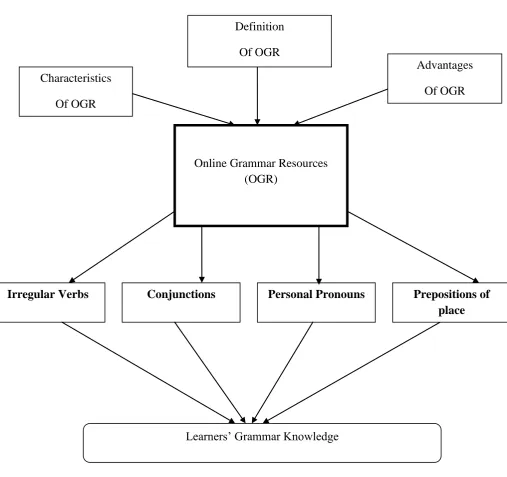
In this study, the conceptual framework is shown in Figure 1.1. This conceptual framework shows the important key concepts of this research.
The key concept in this study is online grammar resources (OGR) which include the definition of OGR, varied characteristics of OGR and advantages of OGR as resources for grammar teaching and learning.
OGR is defined as online materials that focus on grammar items. There are abundance of OGR available. However, in this context of study, three Web pages have been chosen; www.ChompChomp, www.Classroom.jc-schools.net and
www.ego4u.com. They are chosen because they are free, interactive and provide
learners with guidance. These are the main features that are important in choosing OGR.
Another key concept is the advantages of OGR as resources for grammar teaching and learning. It benefits both teacher and students in grammar learning; inside and outsides the classrooms. Furthermore, they are the ones who get the direct impact on the advantages of OGR.
Figure 1.1 Conceptual framework of the study Online Grammar Resources
(OGR)
Irregular Verbs Conjunctions Personal Pronouns Prepositions of place Characteristics
Of OGR
Advantages Of OGR
Learners‟ Grammar Knowledge Definition
1.4 Research Objectives
This study is carried out to meet the following objectives:
1 to investigate the use of online grammar resources in developing learners‟ grammar knowledge
2 to identify the learners‟ attitudes and perceptions on the use of online grammar resources as a tool to develop learners‟ grammar knowledge
1.5 Research Questions
Based on the objectives, this study asks the following questions; 1 How does the use of OGR develop learners‟ grammar knowledge?
1.6 Definition of terms
In this context of study, there are several terms and concepts that are important. They are defined as follows;
1.6.1 Online grammar resources
Online resource is a large database that consists of Web pages and document, any support software that provides useful information. They support learning and very educational in nature. In addition, online grammar resources are Web pages that contain materials on grammar aspects. They are accessible, interactive, and provide immediate feedback (Nor Ashikin, 2012; Zarlina et al, 2012). So, in the context of this study, OGR refer to Web pages that contain interactive materials on grammar items.
1.6.2 Grammar knowledge
combines words (or bits of words) in order to form longer units of meaning. Therefore, grammar is a particular analysis of the system and structure of a language, and is used to see how sentences are constructed. In English language, grammar has been considered to consist of nouns, verbs, participles, articles, pronouns, prepositions, adverbs and conjunctions (Hinkel and Fotos, 2002).
In this study, the researcher investigates four grammatical aspects. They are irregular verbs, conjunctions, personal pronouns, and prepositions of place.
1.6.3 Develop
1.6.4 Learners
In this context of study, learners are participants who participate in the study. There are a total of 27 students. They are currently studying in Form Two in a rural school located in the outskirts of Kuantan.
1.7 Scope of the study
As mentioned earlier, this study investigates the use of online grammar resources in developing learners‟ grammar knowledge. The grammar aspects, in the context of this study, refer to four grammar aspects; irregular verbs, conjunctions, personal pronouns and prepositions of place. This study also identifies the learners‟ attitudes and perceptions on the use of online grammar resources as a tool to develop their grammar knowledge.
In this study, three web pages have been chosen. They are
www.ChompChomp, www.Classroom.jc-schools.net and www.ego4u.com. These
To achieve the objectives above, 27 participants are selected. They are Form Two students studying in a school located in the outskirts of Kuantan. They consist of eleven males and sixteen females with the average of Band 4 in their English Language. The study takes about 8 weeks to be completed. A pre test is carried before the OGR are given to the students. A post test is conducted. Then, it is followed by a set of questionnaire and semi- structured group interviews to further clarify the findings. The data will be analyzed statistically and the interviews will be transcribed verbatim.
1.8 Significance of the study
There are significance effects that can be drawn from this study. First, this study encourages teachers to integrate ICT in language learning and make use of the technology available. The English Language teachers also can make informed decisions regarding the use of online grammar resources in the classroom. It is beneficial because teacher has alternatives in developing students‟ grammar knowledge using a tool that is close to the students.
authentic setting, in which further enriching and exposing them to other aspects of language besides grammar.
1.9 Conclusion
REFERENCES
Abuseileek, A. F. (2009) The effect of using an online- based course on the learning of grammar inductively and deductively. ReCALL. 21 (3): 319- 336
Alkhanak, S. A. K and Azmi, I. A. G. (2011) Information technology usage and attitudes towards online resources- Students perspective. African Journal of Business Management. 5 (7): 2582- 2589
Ally, M. (2008) Foundations of Educational Theory for Online Learning. 2nd ed. UK: Athabasca University Press.
Al- Mekhlafi, A. M. and Nagaratnam, R. P. (2011) Difficulties in Teaching and Learning Grammar in an EFL Context. International Journal of Instruction. 4 (2): 69- 92 (Retrieved at http://www.e-iji.net/dosyalar/iji_2011_2_5.pdf)
Blake, R. J. (2011) Current Trends in Online Language Learning. Annual Review of Applied Linguistics. 31: 19- 35
Calverley, G. and Shepard, K. (2003) Assisting the uptake of on-line resources: why good learning resources are not enough. Computer and Education. 41 (2003):205- 224
Chapelle, C. A., Jun, H. G and Katz, I. (2009) Language Learning Materials Worthy of Attention. In: C. A Chapelle. H. G. and Katz, I. Developing and Evaluating Language Learning Materials, Ames, IA: Iowa State University. 3- 15
Chapelle, C. A. (2010) The Spread of computer- assisted language learning. Language Teaching. 43 (1): 66- 74
Cole, R. A. (2000). Issues in Web-based pedagogy: A critical primer. Westport, CT: Greenwood Press.
Constantinescu, R. S. (2012) Learning by Playing. Using computer games in
teaching English grammar to high school students in The 8th International Scientific Conference eLearning and software for Educational Sciences. 26- 27 April.
Bucharest: University of Bucharest, Faculty of Psychology and Educational Sciences, 110- 115
Creswell, J. W. (2012) Educational Research. (4th ed.) Boston. Pearson Education. Crystal, D. (2004) Word and Deed. TES Teacher. (Retrieved at
www.davidcrystal.com/?fileid=-4142)
Ellis, R.(2006) Current Issues in the Teaching of Grammar: An SLA Perspective. TESOL QUATERLY. 40 (1): 83-107
Felix, U. (2001) The Web's Potential for Language Learning: the student's perspective. EUROCALL Journal. 13 (1): 47- 58
Felix, U. (2003) Teaching language online: Deconstructing the myths. Australian Journal of Educational Technology. 19 (1): 118- 138
Felix, U. (2005) What do meta-analyses tell us about CALL effectiveness? EUROCALL Journal. 17 (2): 269- 288
Ha, R. R and Ha, C. J. (2012) Integrative Statistics for the Social and Behavioral Sciences. UK: SAGE Publications Inc.
Hegelheimer, V. (2006) Helping ESL Writers through a Multimodal, Corpus- based, Online Grammar Resources. CALICO Journal. 24 (1): 1- 20
Hegelheimer, V. and Fisher, D. (2006) Grammar, Writing, and Technology: A Sample Technology-supported Approach to Teaching Grammar and Improving Writing for ESL Learners. CALICO Journal. 23 (2), p-p 257-279
Hinkel, Eli and Sandra Fotos, eds. (2002) New Perspectives on Grammar Teaching in Second Language Classrooms. Mahwah, NJ: Lawrence Erlbaum Associates, Publishers
Ivankova, N. V., Creswell, J. W. and Stick, S. L. (2006) Using Mixed-Methods Sequential Explanatory Design: From Theory to Practice. Field Methods. 18 (1): 3- 20
Jeyavany, E. (2008) Investigating The Esl Teachers and Students’ Attitude towards The Use Of Computer In English Language classroom. Master thesis. Universiti Teknologi Malaysia.
Kern, R. (2006) Perspectives on Learning and Teaching Languages. TESOL QUATERLY. 1 (40): 183- 210
Luu, T. T and Nguyen, T. M. D. (2010) Teaching English Grammar Through Games. Studies in Literature and Language. 7 (1): 61- 75
Nor Ashikin Yusof and Norkamruzita Saadon (2012) The Effects of Web-Based Language Learning on University Students' Grammar Proficiency. PROCEDIA Social and Behavioral Sciences. 67 (2012): 402- 408
Mehrgan, Kamran. (2012) Computer- assisted Language Learning: A Panacea for Grammar Development. Advances in English Linguistics (AEL). 1 (2): 25-29
Peters, M., Weinberg, A. and Sarma, N. (2009) From The Mouths of Canadian University Students: Web- based Information- seeking Activities for Language Teaching.Calico Journal. 28 (3): 621- 638 Available online https://calico.org/html/article_880.pdf
Potter, R. and Fuller, D. (2008) My New Teaching Partner? Using the Grammar Checker in Writing Instruction. English Journal. 98.1 (2008): 36- 41
Szafran, R. (2012) Answering Questions with Statistics. USA: SAGE Publications Inc.
Son, J. B. (2008) Using Web- based Language Learning Activities in the ESL classroom. International Journal of pedagogies and learning. 4 (4): 34- 43
Tabbert, R. (1984) Parsing the Question “Why Teach Grammar?”. The English Journal. 73 (8): 38- 42
Tashakkori, A. and Eddlie, C.(2003) Handbook of Mixed Methods in Social & Behavioral Research. USA: Sage Publications.
(http://books.google.com.my/books?id=F8BFOM8DCKoC&pg=PA228&lpg=PA228
&dq=sequential+exploratory+design,+advantages&source=bl&ots=gTgU) Ur, P. (1991) A Course in Language Teaching. Practice and Theory. Cambridge: Cambridge University Press. (Retrieved at
http://catdir.loc.gov/catdir/samples/cam034/99034082.pdf)
Van Vooren, V., Casteleyn, J. and Mottart, A. (2012) The Impact of Teachers‟ Beliefs on Grammar Instruction and Students‟ Grammar Competences. Procedia- Social and Behavioral Sciences. 69: 641- 648
Warschauer, M. (1996) Motivational aspects of using computers for writing and communication in Telecollaboration in Foreign Language Learning: Proceedings of the Hawai`i Symposium. Honolulu: University of Hawai„i, Second Language Teaching & Curriculum Center. 1- 15
Warschauer, M. and Healey, D. (1998) Computers and Language Learning: An Overview. Cambridge University Press. 31: 57- 71
Warschauer, M. and Meskill, C. (2000) Technology and Second Language Teaching. J. Rosenthal (Ed), Handbook of undergraduate second language education (303- 318). New Jersey: Lawrence Earlbaum. (Retrieve from http:// www. gse. uci. edu/person/warschauer_m/tslt.html)
Warschauer, M. (2000). “CALL for the 21st Century” IATEFL and ESADE Conference, 2 July 2000, Barcelona, Spain. (Retrieved from
http://www.gse.uci.edu/person/warschauer_m/docs/future-of-CALL.pdf)
Warschauer, M. (2004). Technological change and the future of CALL. In S. Fotos & C. Brown (Eds.), New Perspectives on CALL for Second and Foreign Language Classrooms (pp. 15-25). Mahwah, NJ: Lawrence Erlbaum Associates.
Yang, Youwen. (2010) Computer- assisted Foreign Language Teaching: Theory and Practice. Journal of Language Teaching and Research. 1 (6): 909- 912
Yip, W.M. and Kwan, C. M. (2006) Online vocabulary games as a tool for teaching and learning English cocabularies. Educational Media International. 3 (43): 233- 249
Zhang, Jianyun. (2009) Necessity of Grammar Teaching. International Education Studies. 2 (2): 184- 187