DYNAMICS OF PEER EDUCATION IN COOPERATIVE LEARNING WORKGROUPS†
Cynthia R. Haller,Department of English Victoria J. Gallagher, Department of Communication
Tracey L. Weldon, Department of English
Richard M. Felder, Department of Chemical Engineering North Carolina State University
Abstract
Many recent studies demonstrate that cooperative learning provides a variety of educational advantages over more traditional instructional models, both in general and specifically in engineering education. Little is known, however, about the interactional dynamics among students in engineering work groups. To explore these dynamics and their implications for engineering education, we analyzed work sessions of student groups in a sophomore-level chemical engineering course at North Carolina State University. Using conversation analysis as a methodology for understanding how students taught and learned from one another, we found that group members generally engaged in two types of teaching-learning interactions. In the first type, transfer-of-knowledge (TK) sequences, they took on distinct teacher and pupil roles, and in the second, collaborative sequences (CS), they worked together with no clear role differentiation. The interactional problems that occurred during the work sessions were associated primarily with TK sequences, and had to do with students who either habitually assumed the pupil's role (constant pupils) or habitually discouraged others' contributions (blockers). Our findings suggest that professors can facilitate student group interactions by introducing students to the two modes of teaching interaction so group members can effectively manage exchanges of knowledge in their work, and also by helping students distribute tasks in a way that minimizes role imbalances.
I. Introduction
Cooperative learning models are based on the premise that learning is best achieved interactively rather than through a one-way transmission process. To provide enhanced opportunity for interactive learning, students are generally encouraged to work in groups both in and out of class. Value is placed on cooperation and collaboration among students rather than on competitiveness, and an individual's learning success or failure is linked with the learning success or failure of other group members.
A key assumption of cooperative learning is that students working in groups will learn from and teach one another. In fact, both instructors and students report that structured cooperative learning improves students’ understanding of course material as well as their communication and teamwork skills [1-3]. The use of cooperative learning has specifically been advocated as a means of retaining women in engineering programs, since women tend to prefer collaborative to competitive learning. Strongly positive results have been reported for women working in collaborative teams [4, 5], although gender bias in such teams can diminish their effectiveness [6].
Despite these acknowledged benefits of cooperative learning, not much is understood about the interactional group dynamics that may lead to the success or failure of group efforts. For example, how exactly is peer teaching and learning accomplished in groups? What kinds of interactional problems can emerge as students teach and learn from one another? Finally, what can professors do to prevent, diagnose, and remedy those problems?
In this study, a multidisciplinary faculty team comprised of scholars in rhetoric, communication, sociolinguistics, and chemical engineering analyzed group interactions in the introductory chemical engineering course (material and energy balances). This article reports our principal findings and their implications regarding how professors can facilitate the process of group work in their courses.
II. Study Design
Qualitative research methods can be useful means for investigating social and cultural issues in engineering [6-8]. Conversation analysis, which examines how people use dialogue to organize joint action and construct social relations in their everyday lives, has been employed by communication, linguistics, and sociology scholars to study interactions in telephone calls, business meetings, groups of children playing, married couples' discussions and many other social contexts [9-13]. Conversation analysis thus offers the potential for investigating how students use dialogue in their workgroups to solve engineering problems.
Analysts have determined that dialogue and its development are significantly influenced by participant differences in knowledge, power, social status, situational role, gender, interpretive frameworks, and other social factors. Conversely, dialogic interaction may itself create and sustain asymmetries in power and status, which conversational participants must negotiate together. Knowledge asymmetries, for instance, in which one participant is more expert than others with respect to the conversational topic and/or the situational task affect the form, organization, and progress of dialogue [14, 15]. As conversational participants perceive asymmetries in relevant knowledge, they frequently approach these asymmetries as obstacles to be removed in order to create and/or restore mutual understanding. Asymmetries in knowledge can thus precipitate teaching sequences [16], a specialized form of dialogue in which one conversational participant undertakes to instruct another concerning some topic of relevance to the situation at hand.
Knowledge asymmetries are particularly relevant to this investigation, since cooperative learning involves the gaining, sharing and exchange of expertise among students. In student engineering groups, for example, we would expect that students would take on (and be permitted by others to take on) teacher and student roles in dialogue according to the particular distribution of knowledge and technical expertise in the group. We sought in this study to determine how engineering student groups managed teaching sequences as they accomplished their work together and how group members' differing approaches to the management of teaching sequences enhanced and/or detracted from the group learning process.
problems professional chemical engineers address in their work. The professor for this course, a long-time practitioner of cooperative learning, incorporates group work into the class period and also has students work in groups to complete weekly problem sets assigned as homework. Generally, the homework groups, which are assigned by the professor, are composed of 3-4 students. As a rule, students remain in the same homework groups for the entire semester and meet twice or more each week. (See references 3 and 17 for additional details about the cooperative learning model implemented in the course and the instructional outcomes that derive from it. )
During the 1997 fall semester, we recorded the dialogue of four groups of varying gender composition (herein referred to as Groups A, B, C, and D) as they worked on assigned group homework problems. The students in the four groups were volunteers solicited at the beginning of the semester and informed of the purpose and nature of the research. Group A was composed of three males; Group B of four females; Group C of two females and one male; and Group D of two males and two females. We analyzed transcripts of one problem-solving session from each group, with the objective of exploring the interactional dynamics of teaching and learning in the groups. Using Keppler and Luckmann's [16] research on teaching sequences as a benchmark, we identified all teaching sequences in each transcript and examined how students initiated, managed, and closed the sequences. The following two sections present the results of our analysis.
III. Learning Dynamics in Teaching Sequences
Students generally engaged in two qualitatively different types of teaching sequence in their group meetings: transfer-of-knowledge sequences (TKs) and collaborative sequences (CSs). Learning appeared to be accomplished differently in the two sequence types.
A. Transfer-of-Knowledge Sequences
TKs followed the teaching sequence pattern outlined by Keppler and Luckmann (16), exhibiting the following characteristics:
1. Participant roles in the dialogue were predominantly asymmetrical. The teacher took over the dominant role in the dialogue, taking longer turns than the pupil and controlling the topical agenda of the conversation.
2. A teacher's pauses in speaking did not lead to a loss of conversational turn. Pauses in normal, symmetrical conversation are typically places where another participant can—and often does—take a turn without interrupting [18]; in TKs, however, the teacher maintained control of turn-taking.
3. The teacher's explanation of the knowledge he/she possessed was fully, clearly, and explicitly expressed in the sequence.
4. Students' conversational turns were generally discrete from one another (i. e. , there were not many speech overlaps between students as they took turns in the dialogue), and pupils rarely interrupted one another or the teacher.
Figure 1 exemplifies the role asymmetry typical of TKs. At the opening of the sequence, John, by asking to see Stan's work, signals his willingness to allow Stan to teach him. John's pupil role at this point is still tenuous, dependent on whether or not what he sees or hears from Stan seems helpful to him. Stan, however, confidently assumes the role of teacher, passing judgment on John's approach as "useless" and explicitly describing how he himself has approached the problem. In the latter part of the sequence, we see John acquiescing to Stan's teacher role: John uses his turns in the dialogue either to affirm Stan's statements or to ask Stan for more information, but not to initiate new topics.
Figure 1. Transfer-of-knowledge teaching sequence (TK) example.
The subordination of a pupil to a teacher during a TK, however, does not mean that the pupil passively absorbs the teacher's knowledge. TKs are not monological, but dialogical—that is, the pupil must participate actively in the sequence. Indeed, if a pupil candidate does not provide dialogic feedback, the teacher typically aborts the sequence—essentially, the pupil's lack of interest is interpreted to be a rejection of the teacher candidate (Keppler and Luckmann, 1991). During teacher pauses in TK sequences, pupil(s) give feedback to the teacher regarding the pupil's understanding of the teacher's explanation. Minimal pupil responses such as "Hmm," "Ok," and "Uh-huh" are typical in TKs, as are queries about what the teacher is saying as he/she continues to teach the student. In the TK sequence in Figure 1, for example, all of John's turns either acknowledge or query Stan's explanations.
This dialogic feedback loop may explain one of the reasons that working in groups facilitates student learning. The monological stance of a professorial lecture allows for minimal pupil feedback, mostly provided by an occasional student raising a question during the lecture. If 77. John: Can I see what you did? [Note: John is asking to see the paper on which Stan has
worked the problem. He is also showing Stan his own paper, on which he has attempted to work the problem]
78. Stan: It's useless doing that. All you need to do is multiply the moles times the um kilojoules per mole, like 100 times 19.36 because if you change it into kilograms, then you change the kilojoules per mole into kilogram...kilojoules per kilogram, you're just basically getting kilojoules. That's the same thing...
79. John: Ahhh...so what'd you do?
80. Stan: I did it. I did it all out. Um, I just changed 100 moles...to, uh, kilograms going in, see three eighths..
81. John: Oh, OK, OK.
82. Stan: Then I did the 100 mole to kilogram ratio.
83. John: But isn't it, isn't it in kilojoules per mole? To start with?
84. Stan: That's why you say 100, you say 19.36 kilojoules per mole and then you, times 100 moles and then how many kilograms are in that 100 moles.
85. John: Oh.
86. Stan: That's the way to do it, but it's useless to do it like that [referring to the way John has worked the problem].... Cause it's...you're beatin' around the bush.
students misunderstand or have a question about something the professor says, they cannot clarify the issue right then without interrupting the professor, which some students are reluctant to do lest they appear either stupid or discourteous. Although in some cases students will be able to "miss" one concept being presented and yet understand other concepts the teacher presents, the nature of engineering problem-solving tends to be incremental: if students do not understand one step in a problem, chances are good that they will not be able to follow the rest of the steps in working the problem.
By contrast, in a TK sequence, student "teachers" receive feedback continuously and immediately from their "pupils." This feedback allows teachers to ascertain whether their explanations are effective and if not, modify their explanations accordingly. The chances of a pupil's understanding a problem or concept is thus automatically enhanced by the ability to query the teacher immediately at the exact point of misunderstanding, and by the high likelihood that the teacher will continue to respond to the pupil's feedback until misunderstandings have been resolved.
B. Collaborative Sequences
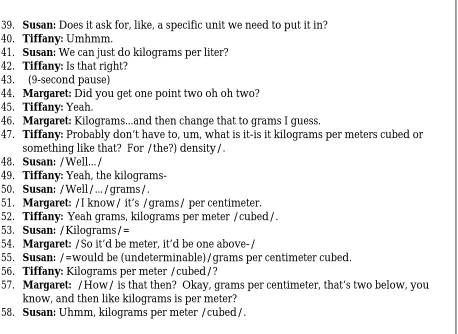
Unlike TKs, the collaborative sequences (CSs) we identified did not match Keppler and Luckmann's hierarchical turn-taking model of dialogue, nor did they exhibit turn-taking patterns typical of normal conversation. Collaborative sequences were characterized by the following:
1. Participant roles in the dialogue were predominantly symmetrical. Though knowledge was exchanged, there was no clear teacher for the sequence. Different participants contributed to the group's problem-solving, and no one participant dominated the interaction.
2. Participant turns tended to overlap considerably and simultaneous speech was common. None of the overlapping participants seemed to perceive these overlaps as interruptions, however: if they had, at least some of the overlaps would have been followed by either the interrupter or the interruptee seeking to establish/maintain their right to hold the floor.
3. Several questions could be put on the table at a given time, with responses being temporarily held in suspension. In normal turn-taking, by contrast, a question on the part of one participant is typically followed by a response on the part of another. 4. More than one student sometimes responded to a question at once.
5. The dialogue was generally fragmented, tending to contain short and incomplete phrases and clauses rather than full, clear, and explicitly expressed explanation. Students appeared to be working out the problem together in situ rather than anyone having solved the problem in advance.
problem, then chimes in to check her answer with the others and makes her own suggestion regarding units. In the rest of the excerpt, group members, speaking simultaneously, consider possibilities concerning the appropriate units to use for the answer.
Figure 2. Collaborative teaching sequence (CS) example.
Learning in CS sequences appeared to be accomplished through shared thinking rather than the knowledge transmission that characterizes TK sequences. The speech overlaps we observed in collaborative sequences gave the impression of several minds thinking out loud together—though speaking at once, they attend to one another, and the conversational goal seems to be the achievement of a joint understanding.
CS sequences provide good practice for the kind of group work students will do in engineering design settings, where an optimal solution to a problem with no unequivocally right answer must be worked out using the expertise of all group members. Gaining skill in managing CSs prepares students for the mutuality and symmetrical contribution typical of engineering groups in industry settings, where complex problems requiring input from many individuals are the rule rather than the exception.
139. Susan: Does it ask for, like, a specific unit we need to put it in?
140. Tiffany: Umhmm.
141. Susan: We can just do kilograms per liter?
142. Tiffany: Is that right?
143. (9-second pause)
144. Margaret: Did you get one point two oh oh two?
145. Tiffany: Yeah.
146. Margaret: Kilograms...and then change that to grams I guess.
147. Tiffany: Probably don’t have to, um, what is it-is it kilograms per meters cubed or
something like that? For /the?) density/. 148. Susan: /Well.../
149. Tiffany: Yeah, the
kilograms-150. Susan: /Well/.../grams/.
151. Margaret: /I know/ it’s /grams/ per centimeter.
152. Tiffany: Yeah grams, kilograms per meter /cubed/.
153. Susan: /Kilograms/=
154. Margaret: /So it’d be meter, it’d be one above-/
155. Susan: /=would be (undeterminable)/grams per centimeter cubed.
156. Tiffany: Kilograms per meter /cubed/?
157. Margaret: /How/ is that then? Okay, grams per centimeter, that’s two below, you
know, and then like kilograms is per meter? 158. Susan: Uhmm, kilograms per meter /cubed/.
C. Incidence of the Two Types of Sequences
CS sequences provide good practice for the kind of group work students will do in engineering design settings, where an optimal solution to a problem with no one right answer must be worked out using the expertise of all group members. Gaining skill in managing CSs prepares students for the mutuality and symmetrical contribution typical of engineering groups in industry settings, where complex problems requiring input from many individuals are the rule rather than the exception.
In the transcripts we examined, TKs predominated over CSs; of 54 total teaching sequences, 37 (69%) were TKs and 17 (31%) were CSs. Table 1 shows the breakdown of teaching sequence type by group. As can be seen in the table, TKs predominated over CSs in all groups except Group B, the all-female group, which had an equal number of TK and collaborative sequences (50% of each). While no statistical conclusions can be drawn from such a small sample of dialogue, the fact that the all-female group engaged in the highest percentage of collaborative sequences is consistent with other sociolinguistic research on gender and language indicating that women prefer collaborative floors (in which speaker turns overlap and participants contribute simultaneously to the ongoing interaction) to competitive floors (in which turns are taken one-at-a-time with participants competing for turns) [19, 20]. It is also consistent with the research on gender and education cited in the introductory section. Further research with a greater number of interactional samples is needed, however, to reliably determine effects of gender and gender mix on teaching sequence styles.
V. Social Dynamics in Teaching Sequences
We have thus far tabled the issue of how knowledge asymmetries affect the social dynamics of groups, focusing instead on learning dynamics. A group's management of social dynamicsis critical, however, often determining whether or not a group can successfully work together. What instructor who uses group work has not heard students complain of other group members not pulling their weight or trying to have everything their own way, or of students feeling that they do all the work in their groups? Paying attention to the ways students manage teaching sequences can illuminate how they negotiate shifting power dynamics.
We found that certain interactional management patterns in teaching sequences tended to create interpersonal tensions and interfere with optimal group functioning. While many types of interactional problems surfaced, we will restrict our discussion to two of the most blatant: the constant pupil and the blocker.
A. The Constant Pupil
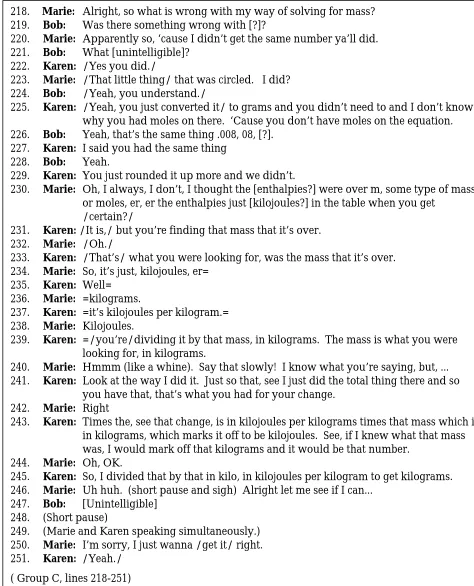
of teacher for problems both of them had already successfully solved. Additionally, some concepts had to be explained several times to Marie before she was satisfied with the answer.
Figure 3. Example of constant pupil imbalance
218. Marie: Alright, so what is wrong with my way of solving for mass?
219. Bob: Was there something wrong with [?]?
220. Marie: Apparently so, ‘cause I didn’t get the same number ya’ll did.
221. Bob: What [unintelligible]?
222. Karen: /Yes you did./
223. Marie: /That little thing/ that was circled. I did?
224. Bob: /Yeah, you understand./
225. Karen: /Yeah, you just converted it/ to grams and you didn’t need to and I don’t know
why you had moles on there. ‘Cause you don’t have moles on the equation.
226. Bob: Yeah, that’s the same thing .008, 08, [?].
227. Karen: I said you had the same thing
228. Bob: Yeah.
229. Karen: You just rounded it up more and we didn’t.
230. Marie: Oh, I always, I don’t, I thought the [enthalpies?] were over m, some type of mass
or moles, er, er the enthalpies just [kilojoules?] in the table when you get /certain?/
231. Karen: /It is,/ but you’re finding that mass that it’s over.
232. Marie: /Oh./
233. Karen: /That’s/ what you were looking for, was the mass that it’s over.
234. Marie: So, it’s just, kilojoules, er=
235. Karen: Well=
236. Marie: =kilograms.
237. Karen: =it’s kilojoules per kilogram.=
238. Marie: Kilojoules.
239. Karen: =/you’re/dividing it by that mass, in kilograms. The mass is what you were
looking for, in kilograms.
240. Marie: Hmmm (like a whine). Say that slowly! I know what you’re saying, but, ...
241. Karen: Look at the way I did it. Just so that, see I just did the total thing there and so
you have that, that’s what you had for your change. 242. Marie: Right
243. Karen: Times the, see that change, is in kilojoules per kilograms times that mass which is
in kilograms, which marks it off to be kilojoules. See, if I knew what that mass was, I would mark off that kilograms and it would be that number.
244. Marie: Oh, OK.
245. Karen: So, I divided that by that in kilo, in kilojoules per kilogram to get kilograms.
246. Marie: Uh huh. (short pause and sigh) Alright let me see if I can...
247. Bob: [Unintelligible]
248. (Short pause)
249. (Marie and Karen speaking simultaneously.)
250. Marie: I’m sorry, I just wanna /get it/ right.
251. Karen: /Yeah./
In the teaching sequence in Figure 3, for instance, Karen and Bob struggle to explain the problem to Marie. In lines 218-229, Karen attempts to explain that Marie's answer to the problem is actually correct except that Marie did an unnecessary conversion. Marie is not satisfied, however (line 230). Karen tries again to explain (lines 230-239), but Marie's inability to give the correct units (line 234-239) and her request for Karen to slow down (line 240) show that she has not yet understood Karen’s point. Karen next tries showing Marie how she (Karen) has worked the problem (lines 240-245); however, it is clear that Marie is still struggling with understanding the problem despite Karen's three times attempts to explain it (lines 246-251). Karen (and Bob's) growing impatience is obvious to Marie, who feels a need to apologize for her slowness at the end of the passage.
Had Marie taken the role of teacher in a higher proportion of teaching sequences, it is less likely that the others would have grown impatient, since they would have been benefiting from Marie's expertise on other problems in a give-and-take manner. However, Marie acted as teacher in only 1 of 15 teaching sequences in the group's meeting. Even that sequence was problematic because Marie's infrequent service as teacher seems to have eroded other group members' trust in her. Karen, another group member, took over the teaching reins from Marie during that sequence (the third member, Bob, was the pupil) even though Marie was actually correct in what she was saying.
A Constant Pupil can frustrate other group members, causing them to feel slowed down and/or to feel that the Constant Pupil is not pulling his/her own weight. It is also not easy being the Constant Pupil. Marie had to contend with esteem issues arising from being the weakest member of the group, which she did in a few ways. For one thing, she compensated for her lack of dominance in teaching sequences by taking a more dominant role than the others in off-task discussions. At times she defended herself outright from being patronized. At one point, when Karen began to overexplain a concept, Marie made a point of letting Karen know that she (Karen) didn't need to go into so much detail, thereby putting Karen in a position of having to apologize to Marie. Similarly, at the end of the meeting, Bob insisted that Marie (who was scribe that week) take home copies of his work to refer to as she wrote up the problem set (he did not trust her to do it correctly). Marie defended herself by lashing out at him, claiming she was not a "dumbass."
B. The Blocker
Figure 4. Example of blocker problem.
456. Sarah: Do we know how to find the heat of vaporization of a mixture?
457. Gavin: /Um=/
458. Colleen: /Yeah./
459. Gavin: It would just be the sums of the heats of vaporization of the individual
components, wouldn’t it? Well (pause) yeah of the whole thing, like the way it’s defined.
460. Sarah: Or actually never mind, I’m finding (indeterminate)=
461. Colleen: Okay.
462. Sarah: I’m trying to fill out this chart.
463. Gavin: Right, I um, well how did you label, how do they want the (garbled) the pressure
inside of the, of the evaporator, that doesn’t make much sense. 464. Sarah: Yeah, I didn’t know (pause) all I did was I had it just like that and I...
465. Gavin: Yeah, I, I drew it inside.
466. Sarah: Yeah, I mean I don’t know. I guess I could do that drawing inside, but I didn’t
know exactly what that meant, just like I didn’t know you could assume liquid additivity, for the, additivity for the liquid mixture, what that has to do with anything.
467. Gavin: Well like, if you don’t assume liquid additivity, then um like (pause) if the, um,
that’s like, that’s like saying you don’t assume the volumes are added different. So like, that’s like saying that you could take a milliliter of water and a milliliter of ethanol and get 1.8 milliliters of mixture.
468. Sarah: Beer /soup/
469. Gavin: /Which is,/ which can really happen with certain liquids, maybe not those two.
470. Sarah: Right.
471. Gavin: But you’re assuming that one plus one equals two with liquid volumes when
you’re doing that.
472. (Pause)
473. Sarah: But again I don’t know, I mean, I didn’t use that anywhere, like in my process...
474. Gavin: Well you don’t have to use it, but if you don’t have that then like you don’t know
that um (pause) it just messes up your liquid calculations if you don’t have that established, like if you, well you can’t do them the way that you’re doing them here, I don’t know how you would do them.
475. Sarah: You mean like with the balancing? /Assuming that=/
476. Gavin: /Yeah its/
477. Sarah: =N oh equals N one plus N two, that type thing?
478. Gavin: Yeah, somewhere in there, I don’t know, I haven’t done it yet so I don’t know
exactly where but I know that somewhere in there...
479. Sarah: Then I had started to label it like that, but this is really similiar to that problem on
the exam, excuse me, that Peter and I had done and on the exam I had done it that way, and they didn’t take any points off, so it’s like well I’m just gonna keep it that way for now then.
It is entirely possible that Sarah's method of solving the problem was viable and Gavin's ideas were not; however, Sarah's interactional behavior in this instancewas counterproductive to group functionality, whether the group ended up getting the "right" answer or not. She asked for help, then refused it. Rather than focusing on the issue and working through the differences of opinion she and Gavin had concerning how to do the problem, she simply asserted that her opinion was correct and continued to solve the problem her way. The dismissiveness of some of her comments likely made others feel she was not receptive to their participation.
VI. Implications for Engineering Education
Dialogic patterns in both modes of group learning (TKs and CSs) assist students in understanding and applying engineering concepts. Interactional problems, however, such as imbalances in teacher-pupil role-playing (the Constant Pupil) and individual resistance to group contributions (the Blocker), can diminish the effectiveness of cooperative learning. In this section, we consider what professors can do to minimize, diagnose, and remedy such problems.
A. Minimizing Interactional Problems in Cooperative Learning
The optimal approach to facilitation of group work is to prevent interactional problems from occurring. Unfortunately, there is no way to avoid the asymmetries in knowledge and ability among group members that give rise to many of the problems, and even if there were a way, avoiding the asymmetries would not necessarily be desirable. Knowledge asymmetries are frequently the very factor that sparks cooperative teaching and learning in the group, and standard references on cooperative learning advise instructors to form teams that are heterogeneous in ability [1]. What the instructor can do is establish conditions that minimize the impact of interactional problems on group functioning, alert students to the types of problems they might encounter, and equip them with tools to deal with those problems. Several specific suggestions follow.
• Consider issues of gender mix when assigning groups. Several studies of cooperative learning indicate that setting up engineering groups to include only one female jeopardizes the female's chances of a full participatory role in the group [2, 4, 8, 21]. The highly limited data in our study suggest that gender mix may also affect students' choice of teaching modes. More research with a greater number of groups could shed light on this matter.
• Make group work worthwhile. Group work imposes significant and unfamiliar time demands on students: time spent attending meetings and explaining things to teammates that they perceive might be better spent doing almost anything else. Good students in particular are justifiably frustrated when they could just as easily solve the assigned problems on their own. Group problem assignments, therefore, should be made challenging enough that the combined expertise of group members is required to complete them.
B. Diagnosing Interactional Problems in Group Work
When students first encounter cooperative learning, many of them are receptive to the idea and many others are resistant or downright hostile. (For a discussion of reasons and remedies for student resistance to instructional approaches like cooperative learning, see reference 22. ) When confronted with the inevitable difficulties that arise when people with different abilities, personalities, work ethics, and senses of responsibility are required to work together, the students who were initially resistant become even more so, and many of the students who started with a positive attitude begin to wonder if the ordeal is worth the benefits.
Some instructors who are aware of the difficulties of group work spend a great deal of time in the first one or two weeks of a course doing team-building exercises and equipping students with strategies for dealing with different interactional problems. We prefer not to use this approach, finding it much more effective to wait several weeks until students have begun to encounter the problems before discussing ways to solve them.
For most instructors, learning about the existence and nature of the problems does not require extensive detective work. Most students are reluctant to confront teammates with complaints about their failure to prepare for or contribute to group meetings or their tendency to dominate discussions or their refusal to help when help is called for, but many have no hesitation about complaining to the instructor. An even more effective way of uncovering interactional problems is to ask the students to complete anonymously a "minute paper" at the end of a class in which they state how their group is working and list any difficulties they are having. If a specific problem shows up in several groups, the time may be right to bring it up to the class and to offer strategies for dealing with it.
C. Remedying Interactional Problems in Group Work
The paragraphs that follow present ideas for addressing the types of interactional problems discussed in this paper. For discussions of the full spectrum of problems that prevent work groups from achieving high performance levels, see references 1, 2, and 22-24.
• Help students to understand the interactional problems they might have already encountered or might encounter in the future. Briefly describe to students the two modes of teaching and learning interactions in group work (transfer-of-knowledge sequences and collaborative sequences). A student who prefers TK-type sequences may be frustrated, for instance, if a teammate inclined toward CS dialogues does not respond to a question by taking on the role of teacher. Similarly, a student with a leaning toward CS dialogues may feel that a teammate with a TK preference either is taking an overly dominant role in the group (if the teammate always assumes the teacher role) or is not pulling his/her own weight (if the teammate habitually elects the pupil role). Introducing students to some of the differences between the two modes of group learning empowers them to make conscious choices in the ways they work together.
parts or steps involved, making the diversity of expertise afforded by the group an advantage in solving the problem. Simpler problems, on the other hand, tend to be better and more efficiently solved individually rather than in a group [25].
• Point out to students who feel slowed down by the group that the best way to learn something at a deep level is by teaching it to someone else. The best students in the class are the most likely to complain about the slowness of their teammates, but they are also the most likely to understand the probable truth of this argument.
• Remind students that teacher-pupil roles are flexible in healthy groups, with students alternating between the roles. A useful strategy for both Constant Pupils and Blockers is for students to take responsibility for preparing and presenting different parts of the assignment, setting up the expectation that each member will come to meetings prepared to serve as the teacher on the particular part they had previewed. It may also be helpful for students occasionally to invert the usual structure of a teaching sequence. When students who tend to be Constant Pupils have questions, other group members, rather than jumping in to teach, could first ask them to explain how they are going about solving the problem. The Constant Pupils are thus encouraged to articulate and explain what they do understand about the problem, which is likely both to strengthen their understanding and accustom them to contributing ideas. (Other members of the group, of course, may need to guide the pupil’s work on the problem appropriately. )
• When students complain about "doing all the work,” suggest ways to encourage more widespread active participation (see preceding paragraph). Also, help these students consider whether their own interactional behaviors may be preventing others from full participation in the group. Specifically, such students may be acting as Blockers, discounting and therby discouraging the contributions of fellow group members.
• When students complain about the blocking behavior of one of the group members, propose strategies for countering overdominance. A group member, for example, can refuse to be put off by a simple “this is the way we're going to do this” and ask the individual to justify his/her solution. The request for justification should not be made snidely, but in such a way that the dominant individual understands that the work he/she does is subject to the review and evaluation of others in the group.
• Involve the entire class in developing strategies for dealing with common interactional problems. When several groups or individuals report the same problem, raise the problem in class and ask the students (working in small groups) to brainstorm ideas for dealing with the problem. List their ideas on the board, and then put them back in their groups to select the three best ideas and report their conclusions, possibly adding your own ideas to the list. Following this 10-minute session, the students will all be equipped with good strategies for addressing the problems that many of them have been encountering.
student’s satisfaction. By the end of this exercise, the group is generally halfway or more toward resolving the problem, and if asked, can often propose excellent strategies for resolving the problem and avoiding it in the future.
VII. Conclusion
Cooperative learning in engineering education has been shown to be effective at achieving a wide range of positive outcomes related to quality of learning and skill development, attitudes toward the educational experience, and self-confidence [1, 3]. The approach does not necessarily work well for all students, however. Some cooperative learning teams have serious difficulties working together. Students in these groups may have extremely unpleasant experiences and fail to realize the benefits that most of their classmates eventually enjoy.
This study of interactional dynamics of student workgroups adds to our understanding of why cooperative learning is effective for most students and why occasional group dysfunctionalities arise. Using the sociolinguistic method of conversation analysis, we have identified two interaction modes in peer teaching and learning. In the first mode, transfer-of-knowledge sequences (TKs), students take the roles of teacher and pupil, and in the second mode, collaborative sequences (CSs), no such role differentiation exists. Student learning appears to be enhanced in groups through both the continuous learning feedback loop maintained between teachers and pupils in TK sequences and the mutuality of new knowledge generated in CS sequences. Imbalances in interactional modes, however, may precipitate interpersonal problems in groups. Further work needs to be done to fully understand how teaching/learning sequences in groups affect and are affected by interpersonal interactions, including effects of gender and ethnic distribution in workgroups. The methodology described in this article provides a powerful vehicle for carrying out such studies.
Acknowledgments
References
1. Johnson, D.W., R.T. Johnson, and K.A. Smith, Active Learning: Cooperation in the College Classroom, 2nd Edition, Edina, MN, Interaction Book Co., 1998.
2. Felder, R.M., and R. Brent, Cooperative Learning in Technical Courses: Procedures, Pitfalls, and Payoffs, ERIC Document Reproduction Service, ED 377038, 1994. This monograph can be viewed and downloaded from
<http://www2.ncsu.edu/effective_teaching/>.
3. Felder, R.M., G.N. Felder, and E.J. Dietz, “A Longitudinal Study of Engineering Student Performance and Retention. V. Comparisons with Traditionally-Taught Students,” Journal of Engineering Education, vol. 87, no. 4, 1998, pp. 469-480.
4. Felder, R.M., G.N. Felder, M. Mauney, C.E. Hamrin, Jr., and E.J. Dietz, “A Longitudinal Study of Engineering Student Performance and Retention. III. Gender Differences in Student Performance and Attitudes,” Journal of Engineering Education, vol. 84, no. 2, 1995, pp. 151–174.
5. Agogino, A.M., and M. Linn, ``Retaining Female Engineering Students: Will Design Experiences Help?” NSF Directions, vol. 5, no. 2, 1992.
6. Tonso, K. L., Miller, R. L., & Olds, B. M. "Student learning and Gender Issues in a Nontraditional Engineering Class: Implications for Engineering Education," Proceedings, ASEE Annual Conference, ASEE, 1994.
7. Atman, C.J., and K.M. Bursic, “Verbal Protocol Analysis as a Method to Document Engineering Student Design Processes,” Journal of Engineering Education, vol. 87, no. 4, 1998, pp. 121–132.
8. Tonso, K. L. (1996). "The Impact of Cultural Norms on Women," Journal of Engineering Education, vol. 85, no. 3, pp. 217-225.
9. Zimmerman, D. H., and D. Boden, "Structure-in-Action: An Introduction," In D. Boden and D. H. Zimmerman (eds.), Talk and Social Structure: Studies in Ethnomethodology and Conversation Analysis (pp. 3-21). Berkeley, CA: University of California Press, 1991, p. 4. 10. Schegloff, E. A., "Identification and Recognition in Telephone Conversation Openings," In
G. Psathas (ed.), Everyday Language: Studies in Ethnomethodology, New York, Irvington, 1979.
11. Cuff, E. C., and W.W. Sharrock, "Meetings." In T. A. Van Dijk (ed.), Handbook of Discourse Analysis (Vol. 3, pp. 149-159), New York, Academic Press, 1985.
12. Goodwin, M. H., He-Said-She-Said: Talk as Social Organization among Black Children. Bloomington, Indiana University Press, 1990.
13. Fishman, P.M., "Interaction: The Work Women Do." In B. Thorne, C. Kramarae, and N. Henley (eds.), Language, Gender, and Society (pp. 89-101), Rowley, Mass, Newbury House, 1983.
15. Drew, P., "Asymmetries of Knowledge in Conversational Interactions," In I. Markova and K. Foppa (eds.), Asymmetries in Dialogue (pp. 21-48), Hertfordshire, Harvester Wheatsheaf, 1991.
16. Keppler, A., and T. Luckmann, "Teaching: Conversational Transmission of Knowledge," In I. Markova and K. Foppa (eds.), Asymmetries in Dialogue, Hertfordshire, Harvester Wheatsheaf, 1991.
17. Felder, R.M., “A Longitudinal Study of Engineering Student Performance and Retention. IV. Instructional Methods and Student Responses to Them,” Journal of Engineering Education, vol. 84, no. 4, 1995, pp. 361-367.
18. Sacks, H, Schegloff, E. A., and G. Jefferson, "A Simplest Systematics for the Organization of Turntaking in Conversation. Language vol. 50, 1974, pp. 696-735.
19. Tannen, D., You Just Don't Understand: Women and Men in Conversation. New York, William Morrow, 1990.
20. Edelsky, C., "Who's Got the Floor?" Language in Society, vol. 10, 1981, pp.383-421.
21. Rosser, S.V., Re-Engineering Female-Friendly Science, Teachers College Press, New York, 1997, pp. 43-44.
22. Felder, R.M., and R. Brent, “Navigating The Bumpy Road to Student–Centered Instruction,” College Teaching, vol. 44, no. 2, 1996, pp. 43–47.
23. Millis, B., and P.G. Cottell, Jr., Cooperative Learning for Higher Education Faculty, Phoenix, AZ, Oryx Press, 1998.
24. Katzenbach, J.R., and D.K. Smith, The Wisdom of Teams:Creating the High Performance Organization. Boston, Harvard Business School Press, 1992.