Regression and ANN models for estimating minimum value
of machining performance
Azlan Mohd Zain
a,⇑, Habibollah Haron
a, Sultan Noman Qasem
a, Safian Sharif
ba
Soft Computing Research Group, Faculty of Computer Science and Information Systems, Universiti Teknologi Malaysia, 81310 UTM Skudai, Johor, Malaysia
b
Department of Manufacturing and Industrial Engineering, Faculty of Mechanical Engineering, Universiti Teknologi Malaysia, 81310 UTM Skudai, Johor, Malaysia
a r t i c l e
i n f o
Article history:
Received 1 September 2010
Received in revised form 27 August 2011 Accepted 1 September 2011
Available online 8 September 2011
Keywords: Modeling Regression ANN
Minimum surface roughness End milling
a b s t r a c t
Surface roughness is one of the most common performance measurements in machining process and an effective parameter in representing the quality of machined surface. The minimization of the machining performance measurement such as surface roughness (Ra) must be formulated in the standard mathematical model. To predict the minimum Ravalue, the process of modeling is taken in this study. The developed model deals with real experimental data of theRain the end milling machining process. Two modeling approaches, regression and Artificial Neural Network (ANN), are applied to predict the min-imumRavalue. The results show that regression and ANN models have reduced the min-imumRavalue of real experimental data by about 1.57% and 1.05%, respectively.
Ó2011 Elsevier Inc. All rights reserved.
1. Introduction
The developed model for the machining process is a mathematical equation that shows the relationship between two parameters, process parameters (decision variables) and machining performance (responses). Fundamentally, models can be divided into three categories which are experimental models, analytical models and Artificial Intelligent (AI) based mod-els. Experimental and analytical models can be developed by using conventional approaches such as Regression technique. While, AI based models are developed using non-conventional approaches such as Artificial Neural Network (ANN).
The difference between the regression model and ANN lies mainly in the nonlinear regions[1]. ANNs can be used as an
effective and an alternative method for the experimental studies whose the mathematical model cannot be formed [2].
Regression technique may work well for machining process modeling as reported by many previous studies. A mathematical model was developed using regression model for surface roughness in wire electrical discharge machining, and it was found that the developed model showed high prediction accuracy within the experimental region. The maximum prediction error
of the model was less than 7%, and the average percentage error of prediction was less than 3%[3]. The regression model
showed a slightly better performance compared to the ANN model for modeling surface roughness in abrasive waterjet
machining[4]. However, regression model may not precisely described the underlying non linear complex relationship
between decision variables and responses[5]. ANN and Regression models are used to model the surface roughness and tool
wear machining performance in hard turning machining [6]. As a result, the ANN models provided better prediction
capabilities because they generally offer the ability to model more complex nonlinearities and interactions than linear and exponential regression models can offer. ANN model follows the machining experimental data much more closely than
that from regression model[1].
0307-904X/$ - see front matterÓ2011 Elsevier Inc. All rights reserved. doi:10.1016/j.apm.2011.09.035
⇑Corresponding author. Tel.: +60 7 5532088; fax: +60 7 5565044/5574908. E-mail addresses:[email protected],[email protected](A.M. Zain).
Contents lists available atSciVerse ScienceDirect
Applied Mathematical Modelling
The literatures show that surface roughness (Ra) is one of the performance measures studied mostly by researcher in
modeling problem. Some recent studies deal with ANN for modeling surface roughness in various machining operations such
as wire electrical discharge machining[7,8], turning[9–12], and milling[13–18]. With Regression and ANN as the considered
modeling techniques, the objective of this paper is to study the prediction result for surface roughness performance measure in end milling machining operation. ANN model gave a high accuracy rate (96–99%) for predicting machining performance
(surface roughness) in end milling operation compared to the result obtained from regression model[19]. It was reported
that the minimization ofRamachining performance in end milling involving radial rake angle process parameter is still
lack-ing, in particular when dealing with titanium alloys. As such optimization of the cutting conditions, which include radial rake
angle, combined with cutting speed and feed, for theRain end milling of Ti–6Al–4V can be considered as a new contribution
to the machining research.
2. Modeling of surface roughness
Modeling is described as a scientific way to study the behaviors involved in the process. Modeling of machining processes is important for providing the basis mathematical model for the formulation of the objective function. A model developed for machining process is the relationship between two variables which are decision variable and response variable in terms of
mathematical equations. Therefore, the minimization of theRamust be formulated in the standard mathematical model.
Normally, the model of the predictedRacan be expressed as in Eq.(1):
Ra¼k
Yn
i¼1
cei
i: ð1Þ
Eq.(1)can also be written as follows:
Ra¼kc
e1 1c
e2 2c
e3 3 c
en
n; ð2Þ
whereRais the predicted surface roughness (respond variable),c1 cnis the cutting conditions (decision variables), andk,
e1,e2,e3,. . .,enare the model parameters to be estimated using the experimental data.
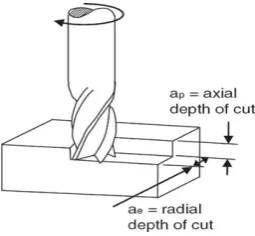
In the milling process, material is removed from the workpiece by a rotating cutter. The milling process can be classified into two parts; peripheral milling and face milling. Peripheral milling generates a surface parallel to the spindle rotation, while face milling generates a surface normal to the spindle rotation. End milling is a type of face milling, and is used for
facing, profiling and slotting processes.Fig. 1shows an illustration of interaction between cutting tool and workpiece for
removing material in the end milling process.
In the end milling process, the surface can be generated by two methods; up milling and down milling. Up milling is also called conventional milling; the cutter rotates against the direction of feed of the workpiece. Down milling is also called
climb milling; the rotation is in the same direction as the feed. These processes are illustrated inFig. 2.
A machining experiment was conducted based on the down milling process[20]. A mathematical model of the predicted
Rais expressed in Eq.(3)
Ra¼k
v
e1fe2
c
e3; ð3ÞwhereRais the predicted surface roughness in
l
m,v
is the cutting speed in m/min,fis the feed rate in mm/tooth,c
is theradial rake angle in°, andk,e1,e2ande3are the model parameters to be estimated using the experimental data.
2.1. Regression modeling
To develop the regression model for estimating theRavalue, the mathematical model given in Eq.(3)is linearized by
per-forming a logarithmic transformation as follows:
lnRa¼lnkþe1lnc1þe2lnc2þe3lnc3þ enlncn: ð4Þ
Eq.(4)can also be rewritten as follows:
y¼b0x0þb1x1þb2x2þb3x3 bnxn; ð5Þ
whereyis the logarithmic value of the experimentalRa,x0= 1 is a dummy variable,x1,x2,. . .,xnare the cutting condition
val-ues (logarithmic transformations), andb0,b1,b2,. . .,bnare the model parameters to be estimated using the experimental data.
The regression model of the predictedRafor end milling is expressed in Eq.(6) [20]
y¼b0þb1
v
þb2fþb3c
; ð6Þwhereyis the logarithmic value of the experimentalRain
l
m,v
is the cutting speed in m/min,fis the feed rate in mm/tooth,c
is the radial rake angle in°, andb0,b1,b2andb3are the model parameters to be estimated using the experimental data.2.2. ANN modeling
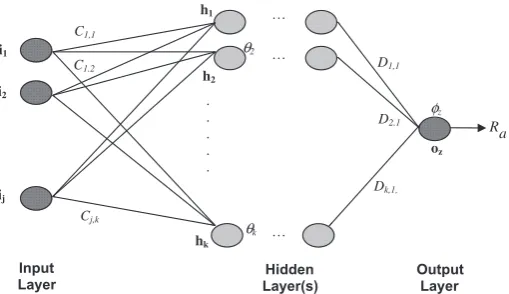
An illustration of the ANN structure used to develop a model forRais given inFig. 3.
FromFig. 3, considering the multilayer feedforward training network with one hidden layer is applied, the net input to
unitkin the hidden layer is expressed in Eq.(7)
net hidden¼X
J
j¼1
Cj;kijþhk; ð7Þ
whereJis number of nodes of the input layer,Cj,kis the weight between the input nodes and hidden nodes,ijis the value of
the input which consists of cutting conditions such as speed, feed rate and rake angle of the experimental sample, andhkis
the biases on the hidden nodes.
Consequently, the net input to unitzin the output layer is expressed in Eq.(8)
net output¼X
K
k¼1
Dk;zhkþ/z; ð8Þ
Fig. 2.Illustration of up and down milling processes.
a R
… … …
i1
i2
ij
oz
φz
Dk,1,
D2,1
D1,1
hk
h2
h1
Cj,k
θ2
θk
C1,2
C1,1
θ
θ θ
θ
θ
o .
.
. . . . .
Hidden Layer(s)
Output Layer Input
Layer
whereKis number of nodes of the hidden layer,Dk,zis the weight between hidden and output nodes,hkis the value of the
output for hidden nodes, and/zis the biases on the output nodes.
From Eqs.(7) and (8), the output for hidden nodes can be given as Eq.(9), and the output for output nodes can be given as
Eq.(10)
hk¼fðnet hiddenÞ; ð9Þ
oz¼fðnet outputÞ ¼Ra; ð10Þ
wherefis the transfer function to predictRavalue.
3. Experimental data of the case studies
The machining experiment by Mohruni[20]to measure theRavalue in the end milling was considered in this study. The
work piece used in the experiments was an annealed alpha–beta titanium alloy, Ti–6Al–4V (Ti-64). The chemical
composi-tion of the Ti–6Al–4V are listed inTable 1. Three types of end mills were used in the experiments, namely uncoated carbide
(WC-Co) and two TiAlN base coated carbide tools which include common PVD-TiAlN coated carbide tool and PVD with
en-riched Al-content TiAlN coated carbide tools (also called Supernitride coating or SNTR). The composition and properties of
these cutting tools are illustrated inTable 2.
3.1. Experimental design
Three cutting conditions are considered for end milling machining process. They are cutting speed, feed rate and radial
rake angle. Experimental design for the end milling process is given inTable 3. From this table, the five levels of cutting
con-dition of experimental design are1.4142,1, 0, +1 and +1.4142. The whole experiments were carried out under flood
con-ditions (6% concentration of water base coolants) with 5 mm constant axial depth of cut and 2 mm constant radial depth of cut.
Table 1
Chemical composition of Ti–6Al4V.
Al 6.37
V 3.89
Fe 0.16
C 0.002
Mo <0.01
Mn <0.01
Si <0.01
Ti Balance
Table 2
Properties of the cutting tool used in the experiments.
Tool type Uncoated TiAlN coated SNTRcoated
Substrate (wt%) WC 94 94 94
Co 6 6 6
Properties Grade K30 K30 K30
Grain size (lm) 0.5 0.5 0.5
Coating Process – PVD-HIS PVD-HIS
Coating thickness – Monolayer (3–4lm) Multilayer (1–8lm)
Film composition (mol-%AIN) – Approx. 54 Approx. 65–67
Table 3
Levels of cutting condition for end milling.
Cutting conditions Units Levels
1.4142 1 0 +1 +1.4142
Cutting speed,v m/min 124.53 130.00 144.22 160.00 167.03
Feed rate,f mm/tooth 0.025 0.03 0.046 0.07 0.083
3.2. Experimental results
A total of 24 experimental trials were executed based on eight data of two levels DOE 2kfull factorial, four center and
twelve axial points. AllRavalues were collected during actual machining for the three type of cutting tools, uncoated, TiA1N
coated and SNTRcoated cutting tools, are shown inTable 4.
4. Development of regression model
Regression models for each cutting tool are developed using SPSS software based on the experimental data given inTable
4. The coefficients value of modeled independent variable for uncoated, TiA1N coated and SNTRcoated cutting tools are given
inTables 5–7, respectively.
By transferring the coefficients value of independent variable (Tables 5–7) into Eq.(6), the regression model for each
cut-ting tool could be written as follows:
^
y1¼R^a uncoated¼0:4510:00267x1þ5:671x2þ0:0046x3; ð11Þ
^
y2¼^Ra TiA1N¼0:2920:000855x1þ5:383x20:00553x3; ð12Þ
^
y3¼^Ra SNTR¼0:2370:00175x1þ8:693x20:00159x3 ð13Þ
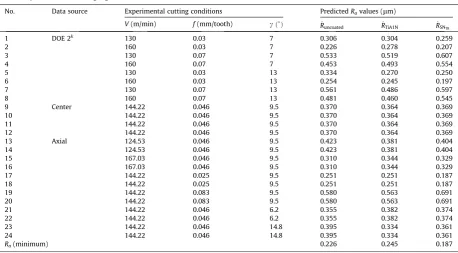
Eqs.(11)–(13)are used to calculate the predictedRavalues, and the results are summarized inTable 8. Then,Ravalues of the
experimental data (Table 4) and the predictedRavalues of regression model (Table 8) are compared. The line pattern data of
Rareal machining vs. predictedRaregression model in shown inFig. 4.
Table 4
ExperimentalRavalues for end milling.
No. Data source Setting values of experimental cutting conditions ExperimentalRavalue (lm)
v(m/min) f(mm/tooth) c(°) Ra_uncoated Ra_TiA1N RaSNTR
1 DOE 2k
130 0.03 7 0.365 0.32 0.284
2 160 0.03 7 0.256 0.266 0.196
3 130 0.07 7 0.498 0.606 0.668
4 160 0.07 7 0.464 0.476 0.624
5 130 0.03 13 0.428 0.260 0.280
6 160 0.03 13 0.252 0.232 0.190
7 130 0.07 13 0.561 0.412 0.612
8 160 0.07 13 0.512 0.392 0.576
9 Center 144.22 0.046 9.5 0.464 0.324 0.329
10 144.22 0.046 9.5 0.444 0.380 0.416
11 144.22 0.046 9.5 0.448 0.460 0.352
12 144.22 0.046 9.5 0.424 0.304 0.400
13 Axial 124.53 0.046 9.5 0.328 0.360 0.344
14 124.53 0.046 9.5 0.324 0.308 0.320
15 167.03 0.046 9.5 0.236 0.340 0.272
16 167.03 0.046 9.5 0.240 0.356 0.288
17 144.22 0.025 9.5 0.252 0.308 0.230
18 144.22 0.025 9.5 0.262 0.328 0.234
19 144.22 0.083 9.5 0.584 0.656 0.640
20 144.22 0.083 9.5 0.656 0.584 0.696
21 144.22 0.046 6.2 0.304 0.300 0.361
22 144.22 0.046 6.2 0.288 0.316 0.360
23 144.22 0.046 14.8 0.316 0.324 0.368
24 144.22 0.046 14.8 0.348 0.396 0.360
Ra(minimum) 0.236 0.232 0.190
Table 5
Coefficients values for uncoated cutting tool.
Independent variable Unstandardized coefficients Standardized coefficients T Sig.
B Std. error Beta
(Constant) 0.451 0.175 2.582 0.018
Speed 2.67E03 0.001 0.277 2.407 0.026
Feed 5.671 0.811 0.805 6.994 0
As illustrated inFig. 4, the three generated graphs for uncoated, TiA1N coated and SNTRcoated cutting tools gave a similar
pattern forRavalues between the experimental data and regression model data. Therefore, the assumption could be made is
that all cutting tools have given a good prediction in estimating the predictedRavalues.
In selecting the best regression model, a convenient approach is to evaluate all possible regression models[21]. In this
study, thettest is conducted to determine the cutting tool that it deals with the best end milling regression model. The
paired-samplettest using SPSS software was conducted to determine the best regression model and the results were
sum-marized inTables 9 and 10.
Table 9 shows that all three pairs of experimental data and regression modeling data are positively correlated,
r(N= 24) = 0.857 for pair 1,r(N= 24) = 0.859 for pair 2, andr(N= 24) = 0.965 for pair 3. FromTable 10, it can be seen that
the mean Ra value for pair 1 increased from the experimental result to the uncoated regression model result by
0.0000833,t(23) =0.007,p= 0.995. The 95% confidence interval ranges from0.0264 to 0.0263 (including zero). Therefore,
the two means of experimental result and regression model results are not significantly different from each other. The mean
Table 6
Coefficients values for TiA1N coated cutting tool.
Independent variable Unstandardized coefficients Standardized coefficients T Sig.
B Std. error Beta
(Constant) 0.292 0.158 1.85 0.079
Speed 8.55E04 0.001 0.098 0.854 0.403
Feed 5.383 0.731 0.843 7.36 0
Radial rake angle 5.53E03 0.005 0.129 1.122 0.275
Table 7
Coefficients values for SNTRcoated cutting tool.
Independent variable Unstandardized coefficients Standardized coefficients T Sig.
B Std. Error Beta
(Constant) 0.237 0.116 2.042 0.055
Speed 1.75E03 0.001 0.14 2.368 0.028
Feed 8.693 0.539 0.954 16.143 0
Radial rake angle 1.59E03 0.004 0.026 0.437 0.667
Table 8
PredictedRavalues of end milling regression model.
No. Data source Experimental cutting conditions PredictedRavalues (lm)
V(m/min) f(mm/tooth) cðÞ ^
Runcoated ^RTiA1N ^RSNTR
1 DOE 2k 130 0.03 7 0.306 0.304 0.259
2 160 0.03 7 0.226 0.278 0.207
3 130 0.07 7 0.533 0.519 0.607
4 160 0.07 7 0.453 0.493 0.554
5 130 0.03 13 0.334 0.270 0.250
6 160 0.03 13 0.254 0.245 0.197
7 130 0.07 13 0.561 0.486 0.597
8 160 0.07 13 0.481 0.460 0.545
9 Center 144.22 0.046 9.5 0.370 0.364 0.369
10 144.22 0.046 9.5 0.370 0.364 0.369
11 144.22 0.046 9.5 0.370 0.364 0.369
12 144.22 0.046 9.5 0.370 0.364 0.369
13 Axial 124.53 0.046 9.5 0.423 0.381 0.404
14 124.53 0.046 9.5 0.423 0.381 0.404
15 167.03 0.046 9.5 0.310 0.344 0.329
16 167.03 0.046 9.5 0.310 0.344 0.329
17 144.22 0.025 9.5 0.251 0.251 0.187
18 144.22 0.025 9.5 0.251 0.251 0.187
19 144.22 0.083 9.5 0.580 0.563 0.691
20 144.22 0.083 9.5 0.580 0.563 0.691
21 144.22 0.046 6.2 0.355 0.382 0.374
22 144.22 0.046 6.2 0.355 0.382 0.374
23 144.22 0.046 14.8 0.395 0.334 0.361
24 144.22 0.046 14.8 0.395 0.334 0.361
Ravalue for the pair 2 also increased from the experimental result to the TiA1N coated regression model result by 0.000542,
t(23) =0.047,p= 0.963. The 95% confidence interval ranges from0.0243 to 0.0232 (including zero), which also proves
Uncoted Cutting Tool
0.000 0.100 0.200 0.300 0.400 0.500 0.600 0.700
1 2 3 4 5 6 7 8 9 10 11 12 13 14 15 16 17 18 19 20 21 22 23 24
Ra value
Ra value
Ra value
Experimental Data Regression Model
TiA1N Coated Cutting Tool
0.000 0.100 0.200 0.300 0.400 0.500 0.600 0.700
1 2 3 4 5 7 8 9 10 11 12 13 14 15 16 17 18 19 20 21 22 23 24
Samples
Samples Samples
Experimental Data Regression Model
SNTR Coated Cutting Tool
0.000 0.100 0.200 0.300 0.400 0.500 0.600 0.700 0.800
1 2 3 4 5 6 7 8 9 10 11 12 13 14 15 16 17 18 19 20 21 22 23 24
Experimental Data Regression Model
6
Fig. 4.Experimental vs. regression forRavalues.
Table 9
Statistics and correlations (experimental vs. regression).
Variable Mean N Std. deviation Std. error mean Correlation Sig.
Pair 1 EXP_UNC 0.38558 24 0.12088 2.47E02 0.857 0.000
REG_UNC 0.38567 24 0.10363 2.12E02
Pair 2 EXP_TIAN 0.37533 24 0.10964 2.24E02 0.859 0.000
REG_TIAN 0.37587 24 9.42E02 1.92E02
Pair 3 EXP_SNTR 0.39167 24 0.1565 3.19E02 0.965 0.000
that the two means are not significantly different from each other. By looking at the pair 3 inTable 10, it can be seen that the
mean Ra value however reduced from experimental result to the SNTR coated regression model result by 0.000667,
t(23) = 0.079,p= 0.938. The 95% confidence interval ranges from0.0168 to 0.0181 (including zero). Therefore, the two
means too are not significantly different from each other.
As a conclusion, based on the results of the paired-samplettest, it could be summarized that the SNTRcoated cutting tool
has given the highest positive correlation and is the only pair that gave a reduced meanRavalue from the experimental
re-sult. Thus, it can be concluded that the predictedRaequation of SNTRcoated cutting tools, Eq.(13), is proposed as
optimi-Table 10
Paired samples test (experimental vs. regression).
Pair Paired differences T Df Sig.
(2-tailed)
Mean Std.
deviation
Std. error mean
95% Conf. inter. of the difference
Lower Upper
Pair 1 EXP_UNC and REG_UNC 8.33E05 6.24E02 1.27E02 2.64E02 2.63E02 0.007 23 0.995 Pair 2 EXP_TIAN and REG_TIAN 5.42E04 5.62E02 1.15E02 2.43E02 2.32E02 0.047 23 0.963 Pair 3 EXP_SNTRand REG_SNTR 6.67E04 4.13E02 8.43E03 1.68E02 1.81E02 0.079 23 0.938
zation objective function for end milling process. The minimum predicted surface roughness value of SNTRcoated cutting
tool that is selected as the best regression model is 0.187
l
m (the 17th and 18th row ofTable 8). The cutting conditionsval-ues that lead to minimum predicted surface roughness value of SNTRcoated are:v= 144.22 m/min,f= 0.025 mm/tooth and
c
¼9:5.5. Development of ANN model
The eight selection influencing factors in developing the ANN model are given as follows:
(i) The ANN network structure to give the best prediction result. (ii) The ratio of training and testing data for the developed ANN model.
(iii) The normalization of the input/output data made with the available experimental sample size data. (iv) The network algorithm to give the best prediction result.
(v) The transfer function to give the best prediction result.
(vi) The performance functions to give a low error rate in the predicted value.
(vii) The training function to give a low error rate in the response value for the developed ANN model. (viii) The learning function to give a low error rate in the response value for the developed ANN model.
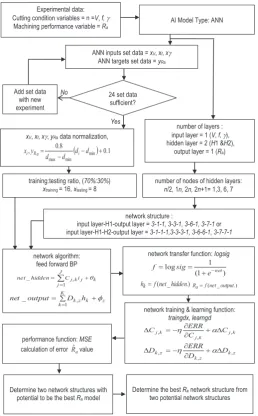
Considering the eight influencing factors above, the flow of development of the ANN model for end milling is illustrated in
Fig. 5.
Normalized machining cutting condition values are used as the inputs, and normalized machining performance value is
used as the target in the modeling process. A normalization equation suggested by Sanjay and Jyothi[22]as given as follows:
xi¼
0:8
dmaxdminð
didminÞ þ0:1 ð14Þ
Considering the normalization equation in Eq.(11), the normalized values for end milling experimental data are calculated
and given inTable 11. From 24 normalized experimental sets of data, they will be separated into two groups which are
train-ing and testtrain-ing set data. Four sets of center data (the 9th to 12th sets of experimental data) and twelve sets of axial data (the
13th to the last sets of experimental data), giving a total of 16 sets of data, were chosen as the training set data. DOE 2kdata
(the first eight experimental data) with a total of eight sets of data will be used as the testing data.
With the ANN Matlab toolbox (learning rate = 0.01, and momentum rate = 0.05), the modeling result (surface roughness
predicted value) for the training set data is summarized inTable 12. The MSE values for the testing set data is given in
Table 11
Normalized values of machining data.
No. Data source xi yRa
xspeed xfeed xrake angle yRauncoated yRaTiA1N yRaSNTR
1 DOE 2k 0.203 0.169 0.174 0.346 0.266 0.249
2 0.768 0.169 0.174 0.138 0.164 0.109
3 0.203 0.721 0.174 0.599 0.806 0.856
4 0.768 0.721 0.174 0.534 0.560 0.786
5 0.203 0.169 0.733 0.466 0.153 0.242
6 0.768 0.169 0.733 0.130 0.100 0.100
7 0.203 0.721 0.733 0.719 0.440 0.767
8 0.768 0.721 0.733 0.626 0.402 0.710
9 Center 0.471 0.390 0.407 0.534 0.274 0.320
10 0.471 0.390 0.407 0.496 0.379 0.457
11 0.471 0.390 0.407 0.504 0.530 0.356
12 0.471 0.390 0.407 0.458 0.236 0.432
13 Axial 0.100 0.390 0.407 0.275 0.342 0.343
14 0.100 0.390 0.407 0.268 0.243 0.306
15 0.900 0.390 0.407 0.100 0.304 0.230
16 0.900 0.390 0.407 0.108 0.334 0.255
17 0.471 0.100 0.407 0.130 0.243 0.163
18 0.471 0.100 0.407 0.150 0.281 0.170
19 0.471 0.900 0.407 0.763 0.900 0.811
20 0.471 0.900 0.407 0.900 0.764 0.900
21 0.471 0.390 0.100 0.230 0.228 0.370
22 0.471 0.390 0.100 0.199 0.258 0.369
23 0.471 0.390 0.900 0.252 0.274 0.381
24 0.471 0.390 0.900 0.313 0.409 0.369
Table 12
Predicted values of ANN training.
No. Data source
Uncoated TiA1N coated SNTRcoated
3–1– 1
3–3– 1
3–6– 1
3–7– 1
3–1– 1–1
3–3– 3–1
3–6– 6–1
3–7– 7–1
3–1– 1
3–3– 1
3–6– 1
3–7– 1
3–1– 1–1
3–3– 3–1
3–6– 6–1
3–7– 7–1
3–1– 1
3–3– 1
3–6– 1
3–7– 1
3–1– 1–1
3–3– 3–1
3–6– 6–1
3–7– 7–1
1 Center 0.069 0.185 0.348 0.291 0.224 0.406 0.417 0.409 0.255 0.334 0.160 0.342 0.229 0.387 0.372 0.296 0.308 0.366 0.519 0.317 0.081 0.387 0.385 0.412 2 0.069 0.185 0.348 0.291 0.224 0.406 0.417 0.409 0.255 0.334 0.160 0.342 0.229 0.387 0.372 0.296 0.308 0.366 0.519 0.317 0.081 0.387 0.385 0.412 3 0.069 0.185 0.348 0.291 0.224 0.406 0.417 0.409 0.255 0.334 0.160 0.342 0.229 0.387 0.372 0.296 0.308 0.366 0.519 0.317 0.081 0.387 0.385 0.412 4 0.069 0.185 0.348 0.291 0.224 0.406 0.417 0.409 0.255 0.334 0.160 0.342 0.229 0.387 0.372 0.296 0.308 0.366 0.519 0.317 0.081 0.387 0.385 0.412 5 Axial 0.033 0.328 0.277 0.225 0.197 0.481 0.346 0.441 0.565 0.576 0.449 0.043 0.474 0.390 0.463 0.157 0.769 0.425 0.057 0.006 0.057 0.457 0.317 0.297 6 0.033 0.328 0.277 0.225 0.197 0.481 0.346 0.441 0.565 0.576 0.449 0.043 0.474 0.390 0.463 0.157 0.769 0.425 0.057 0.006 0.057 0.457 0.317 0.297 7 0.362 0.454 0.295 0.276 0.357 0.241 0.095 0.031 0.118 0.284 0.333 0.609 0.130 0.390 0.247 0.438 0.088 0.302 0.150 0.648 0.267 0.355 0.509 0.412 8 0.362 0.454 0.295 0.276 0.357 0.241 0.095 0.031 0.118 0.284 0.333 0.609 0.130 0.390 0.247 0.438 0.088 0.302 0.150 0.648 0.267 0.355 0.509 0.412 9 0.262 0.240 0.027 0.255 0.189 0.283 0.247 0.456 0.098 0.232 0.157 0.319 0.127 0.457 0.374 0.135 0.104 0.640 0.159 0.254 0.427 0.386 0.330 0.097 10 0.262 0.240 0.027 0.255 0.189 0.283 0.247 0.456 0.098 0.232 0.157 0.319 0.127 0.457 0.374 0.135 0.104 0.640 0.159 0.254 0.427 0.386 0.330 0.097 11 0.028 0.524 0.648 0.653 0.889 0.383 0.615 0.337 0.902 0.469 0.670 0.432 0.762 0.325 0.406 0.801 0.877 0.220 0.461 0.567 0.051 0.333 0.464 0.759 12 0.028 0.524 0.648 0.653 0.889 0.383 0.615 0.337 0.902 0.469 0.670 0.432 0.762 0.325 0.406 0.801 0.877 0.220 0.461 0.567 0.051 0.333 0.464 0.759 13 0.127 0.101 0.578 0.528 0.211 0.404 0.013 0.436 0.227 0.388 0.640 0.138 0.101 0.406 0.540 0.218 0.422 0.294 0.731 0.117 0.238 0.409 0.174 0.231 14 0.127 0.101 0.578 0.528 0.211 0.404 0.013 0.436 0.227 0.388 0.640 0.138 0.101 0.406 0.540 0.218 0.422 0.294 0.731 0.117 0.238 0.409 0.174 0.231 15 0.038 0.624 0.066 0.076 0.262 0.266 0.890 0.059 0.310 0.100 0.277 0.447 0.876 0.305 0.330 0.525 0.183 0.219 0.009 0.834 0.053 0.332 0.468 0.432 16 0.038 0.624 0.066 0.076 0.262 0.266 0.890 0.059 0.310 0.100 0.277 0.447 0.876 0.305 0.330 0.525 0.183 0.219 0.009 0.834 0.053 0.332 0.468 0.432 Minimum
(Ra)
0.028 0.101 0.027 0.076 0.189 0.241 0.013 0.031 0.098 0.100 0.157 0.043 0.101 0.305 0.247 0.135 0.088 0.219 0.009 0.006 0.051 0.332 0.174 0.097
A.M.
Zain
et
al.
/Applied
Mathematical
Modelling
36
(2012)
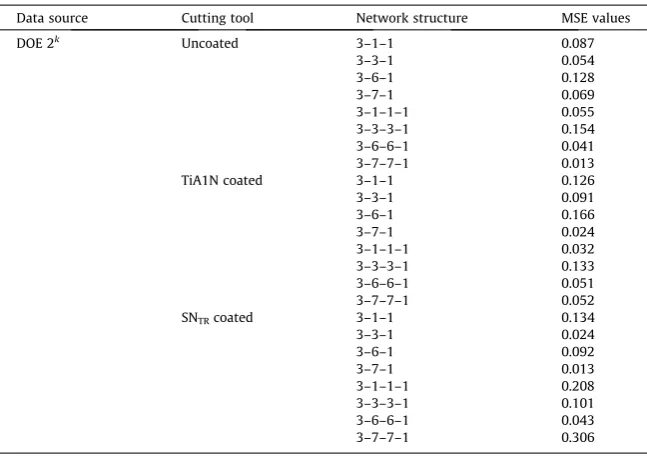
Table 13. The MSE plot results of Matlab optimization toolbox, with single hidden layer and two hidden layers of network
structure, for each cutting tool are given inFigs. 6 and 7, respectively.
In order to determine the best ANN model, overall, four factors are given consideration and separated into two parts. The first part is determination of the network structure with potential to be the best ANN prediction model. The second part is determination of the best network structure from two potential network structures.
For the first factor,Fig. 8shows six graphs which represent the line patterns of the data between the ANN targets and the
ANN outputs for uncoated, TiA1N coated, and SNTRcoated for ANN model with single hidden layer and two hidden layers.
According to the graphs inFig. 8, summary of the similarities in the line pattern criterion is given in the third column of
Table 14. The forth column ofTable 14presents the result of thettest which gives the correlation value between the ANN targets and the ANN outputs which is the second factor to be considered in determining the two networks with the potential to be the best ANN model.
Supported by quite similar of the pattern line and the high positive correlation values, according toTable 14, it could be
stated that the two networks with the potential to be the best ANN model are:
(i) The 3–7–7–1 network structure of TiA1N coated cutting tool.
(ii) The 3–7–7–1 network structure of SNTRcoated cutting tool.
Consequently, these two network structures will be considered with the next two factors to determine which network struc-ture offers the best ANN model. In order to state the network strucstruc-ture that is labeled as the best ANN model, the first
con-sideration factor is by referring to the last row ofTable 12, predictedRavalue of ANN training. It was obtained that the
minimum predictedRavalue in the testing phase for the 3–7–7–1 network structure of TiA1N coated and the 3–7–7–1
net-work structure of SNTRcoated are 0.135 and 0.097, respectively.
The second consideration factor is by referring to the last column ofTable 13, MSE values of ANN training. It was obtained
that the MSE value in the testing phase for the 3–7–7–1 network structure of TiA1N coated and the 3–7–7–1 network
struc-ture of SNTRcoated are 0.052 and 0.306, respectively.
With the two consideration factors above, it was found that the 3–7–7–1 network structure of TiA1N coated gave a
smal-ler value in terms of the minimum predictedRa; however the 3–7–7–1 network structure of SNTRcoated gave a smaller value
in terms of the minimum MSE value. Therefore, to decide the best model, this study considers to the higher correlation value
of the network structure. Since the 3–7–7–1 network structure of SNTRcoated has given a higher correlation value, it was
selected to be the best ANN model.
The minimum normalized predictedRavalue of SNTRcoated that selected as the best ANN model is 0.097 (the fifth and
sixth rows: axial data ofTable 12). The normalized cutting condition values that lead to minimum predictedRavalue for SNTR
coated are:
v
= 0.471,f= 0.100, andc
= 0.407 (the fifth and sixth rows: axial data ofTable 12). In terms of actual machiningvalues, the cutting conditions values that lead to the minimumRausing SNTRcoated are
v
= 144.22 m/min,f= 0.025 mm/tooth, and
c
¼9:5(the fifth and sixth rows: axial data ofTable 4).Table 13
MSE values of ANN testing.
Data source Cutting tool Network structure MSE values
DOE 2k
Uncoated 3–1–1 0.087
3–3–1 0.054
3–6–1 0.128
3–7–1 0.069
3–1–1–1 0.055
3–3–3–1 0.154
3–6–6–1 0.041
3–7–7–1 0.013
TiA1N coated 3–1–1 0.126
3–3–1 0.091
3–6–1 0.166
3–7–1 0.024
3–1–1–1 0.032
3–3–3–1 0.133
3–6–6–1 0.051
3–7–7–1 0.052
SNTRcoated 3–1–1 0.134
3–3–1 0.024
3–6–1 0.092
3–7–1 0.013
3–1–1–1 0.208
3–3–3–1 0.101
3–6–6–1 0.043
To estimate the actual value for the minimumRavalues, the normalization equation given in Eq.(11)is modified.
Calcu-lation for the expected actual value ofRais given as follows:
Uncoated
TiA1N coated
SN
TRcoated
3-1-1 network structure
0 10 20 30 40 50 60 70 80 90 100
10-2 10-1 100 100 Epochs T rai ni ng-B lue
Performance is 0.0871968, Goal is 0
3-1-1 network structure
0 10 20 30 40 50 60 70 80 90 100
10-1 100 100 Epochs T rai ni n g -B lu e
Performance is 0.126629, Goal is 0
3-1-1 network structure
0 10 20 30 40 50 60 70 80 90 100
10-1 100 100 Epochs Tr a in in g -B lu e
Performance is 0.134145, Goal is 0
3-3-1 network structure
0 10 20 30 40 50 60 70 80 90 100
10-2 10-1 100 Epochs T ra ini ng-B lu e
Performance is 0.0540497, Goal is 0
3-3-1 network structure
0 10 20 30 40 50 60 70 80 90 100
10-2 10-1 100 100 Epochs T rai ni ng-B lue
Performance is 0.091883, Goal is 0
3-3-1 network structure
0 10 20 30 40 50 60 70 80 90 100
10-2 10-1 100 Epochs Tr a in in g -B lu e
Performance is 0.0242942, Goal is 0
3-6-1 network structure
0 10 20 30 40 50 60 70 80 90 100
10-1 100 100 Epochs Tr a in in g -B lu e
Performance is 0.128728, Goal is 0
3-6-1 network structure
0 10 20 30 40 50 60 70 80 90 100
10-1 100 100 Epochs Tr a in in g -B lu e
Performance is 0.166976, Goal is 0
3-6-1 network structure
0 10 20 30 40 50 60 70 80 90 100
10-2 10-1 100 100 Epochs T rai ni n g -B lu e
Performance is 0.0925694, Goal is 0
3-7-1 network structure
0 10 20 30 40 50 60 70 80 90 100
10-2 10-1 100 Epochs T rai ni ng-B lue
Performance is 0.0696544, Goal is 0
3-7-1 network structure
0 10 20 30 40 50 60 70 80 90 100
10-2 10-1 100 Epochs Tr a in in g -B lu e
Performance is 0.0246142, Goal is 0
3-7-1 network structure
0 10 20 30 40 50 60 70 80 90 100
10-2 10-1 100 Epochs T rai ni n g -B lu e
Performance is 0.0136423, Goal is 0
di¼
ðyRa0:1ÞðdmaxdminÞ
0:8 þdmin¼
ð0:0970:1Þð0:6960:190Þ
0:8 þ0:190¼0:1881030:188
l
m ð15ÞUncoated
TiA1N coated
SN
TRcoated
3-1-1-1 network structure
0 10 20 30 40 50 60 70 80 90 100 10-2 10-1 100 Epochs Tr a in in g -B lu e
Performance is 0.0556075, Goal is 0
3-1-1-1 network structure
0 10 20 30 40 50 60 70 80 90 100 10-2 10-1 100 Epochs Tr a in in g -B lu e
Performance is 0.0320448, Goal is 0
3-1-1-1 network structure
0 10 20 30 40 50 60 70 80 90 100 10-1 100 100 Epochs T raining-B lue
Performance is 0.208184, Goal is 0
3-3-3-1 network structure
0 10 20 30 40 50 60 70 80 90 100 10-1 100 100 Epochs Tr a in in g -B lu e
Performance is 0.154356, Goal is 0
3-3-3-1 network structure
0 10 20 30 40 50 60 70 80 90 100 10-1 100 100 Epochs T rai ni ng-B lu e
Performance is 0.133258, Goal is 0
3-3-3-1 network structure
0 10 20 30 40 50 60 70 80 90 100 10-1 100 100 Epochs T rai ni ng-B lu e
Performance is 0.101925, Goal is 0
3-6-6-1 network structure
0 10 20 30 40 50 60 70 80 90 100 10-2 10-1 100 Epochs Tr a in in g -B lu e
Performance is 0.0419329, Goal is 0
3-6-6-1 network structure
0 10 20 30 40 50 60 70 80 90 100 10-2 10-1 100 Epochs Tr a in in g -B lu e
Performance is 0.0516778, Goal is 0
3-6-6-1 network structure
0 10 20 30 40 50 60 70 80 90 100 10-2 10-1 100 Epochs T ra ini ng-B lu e
Performance is 0.0430202, Goal is 0
3-7-7-1 network structure
0 10 20 30 40 50 60 70 80 90 100 10-2 10-1 100 Epochs Tr a in in g -B lu e
Performance is 0.0135666, Goal is 0
3-7-7-1 network structure
0 10 20 30 40 50 60 70 80 90 100 10-2 10-1 100 Epochs T rai ni n g -B lu e
Performance is 0.0520562, Goal is 0
3-7-7-1 network structure
0 10 20 30 40 50 60 70 80 90 100 10-1 100 100 Epochs Tr a in in g -B lu e
Performance is 0.306537, Goal is 0
Predicted value of single hidden layer ANN for uncoated cutting tool
0 0.2 0.4 0.6 0.8 1
1 2 3 4 5 6 7 8 9 10 11 12 13 14 15 16
ANN target ANN predicted 3-1-1 ANN predicted 3-3-1
ANN predicted 3-6-1 ANN predicted 3-7-1
Predicted value of single hidden layer ANN for TiAIN coated cutting tool
0 0.2 0.4 0.6 0.8 1
1 2 3 4 5 6 7 8 9 10 11 12 13 14 15 16
ANN target ANN predicted 3-1-1 ANN predicted 3-3-1
ANN predicted 3-6-1 ANN predicted 3-7-1
Predicted values of single hidden layer ANN for SNTR coated cutting tool
0 0.2 0.4 0.6 0.8 1
1 2 3 4 5 6 7 8 9 10 11 12 13 14 15 16
ANN target ANN predicted 3-1-1 ANN predicted 3-3-1
ANN predicted 3-6-1 ANN predicted 3-7-1
Predicted value of two hidden layers ANN for uncoated cutting tool
0 0.2 0.4 0.6 0.8 1
1 2 3 4 5 6 7 8 9 10 11 12 13 14 15 16
ANN target ANN predicted 3-1-1-1 ANN predicted 3-3-3-1
ANN predicted 3-6-6-1 ANN predicted 3-7-7-1
Predicted value of two hidden layers ANN for TiAIN coated cutting tool
0 0.2 0.4 0.6 0.8 1
1 2 3 4 5 6 7 8 9 1011 1213 14 15 16
ANN target ANN predicted 3-1-1-1 ANN predicted 3-3-3-1
ANN predicted 3-6-6-1 ANN predicted 3-7-7-1
Predicted value of two hidden layers ANN for SNTR coated cutting tool
0 0.2 0.4 0.6 0.8 1
1 2 3 4 5 6 7 8 9 10 11 12 13 14 15 16
ANN target ANN predicted 3-1-1-1 ANN predicted 3-3-3-1
ANN predicted 3-6-6-1 ANN predicted 3-7-7-1
Fig. 8.ANN target vs. ANN output.
Table 14
Correlation values and similarity of the line pattern of ANN model.
Cutting tool Pair of variables Pattern line Correlation value
Uncoated Experimental-ANN 311 Less similar .652
Experimental-ANN 331 Less similar .158
Experimental-ANN 361 Less similar .593
Experimental-ANN 371 Less similar .555
Experimental-ANN 3–1–1–1 Quite similar .724
Experimental-ANN 3–3–3–1 Less similar .422
Experimental-ANN 3–6–6–1 Less similar .500
Experimental-ANN 3–7–7–1 Quite similar .232
TiA1N coated Experimental-ANN 311 Quite similar .780
Experimental-ANN 331 Less similar .275
Experimental-ANN 361 Less similar .442
Experimental-ANN 371 Less similar .304
Experimental-ANN 3–1–1–1 Quite similar .544
Experimental-ANN 3–3–3–1 Less similar .543
Experimental-ANN 3–6–6–1 Less similar .048
Experimental-ANN 3–7–7–1 Quite similar .804
SNTRcoated Experimental-ANN 311 Quite similar .728
Experimental-ANN 331 Less similar .606
Experimental-ANN 361 Less similar .366
Experimental-ANN 371 Less similar .243
Experimental-ANN 3–1–1–1 Less similar .592
Experimental-ANN 3–3–3–1 Less similar .405
Experimental-ANN 3–6–6–1 Less similar .246
Experimental-ANN 3–7–7–1 Quite similar .869
Table 15
Statistics and correlations (experimental data vs. ANN training of 3–7–7–1 structure).
Variable Mean N Std. deviation Std. error mean Correlation Sig.
EXP_SNTR 0.38950 16 0.20067 5.0168E02 0.869 0.000
6. Validation and evaluation of results
It was observed inTable 8, the minimum predictedRavalue of the best regression model is 0.187
l
m, given by SNTRcoated cutting tool. The process of validation for the regression model, basically, could refer to the paired-samplettest
con-ducted in Section4in determining the best end milling model. According to the last row ofTables 9 and 10, it was proven
that the mean Ra value reduced from experimental result to the SNTR coated regression model result by 0.000667,
t(23) = 0.079,p= 0.938. The 95% confidence interval ranges from0.0168 to 0.0181 (including zero). Therefore, the two
means, experimental and SNTRcoated regression model are not significantly different from each other.
The results of the paired-samplettest for SNTRexperimental data coupled with predicted value of the ANN 3–7–7–1 SNTR
coated (the best ANN model) training data are summarized inTables 15 and 16as follows.
According toTables 15 and 16, it was proven that the meanRavalue reduced from SNTRcoated experimental result to the
SNTRcoated ANN model result by 0.008,t(15) = 0.320, p= 0.869. The 95% confidence interval ranges from0.04531 to
0.061317 (including zero). Therefore, the two means, SNTRcoated experimental and SNTRcoated ANN 3–7–7–1 model are
not significantly different from each other. In other words, the average surface roughness predicted value of the ANN 3–
7–7–1 SNTRcoated (the best ANN model) is similar to the average actual surface roughness found through experiment.
Consequently, focused on the predictedRavalue, the evaluation of the developed regression and ANN models are given as
follows:
(a) Experimental data vs. regression.
As shown inTable 4, the minimumRavalue among all the cutting tools for experimental data is 0.190
l
m, given bySNTRcutting tool. Therefore, withRa= 0.187
l
m (Table 8), it can be stated that the regression model has given a lowerminimum value of theRacompared to experimental data by about 0.003
l
m.(b) Experimental data vs. ANN.
WithRa= 0.188
l
m for ANN (Eq.(12)) andRa= 0.190l
m for experimental data, it can be stated that ANN has given alower minimum value of the predictedRaby about 0.002
l
m.(c) Regression vs. ANN.
WithRa= 0.187
l
m for regression, it can be stated that regression has given a lower minimum value of theRacom-pared to ANN by about 0.001
l
m.7. Conclusion
This study has applied two techniques for estimating the minimum machining performance value. First technique,
devel-opment of regression model, has been discussed in Section4. Second technique, development of ANN model, has been
dis-cussed in Section5.
According to the evaluation of the results discussed in Section6,Table 17summarizes results of the minimum machining
performance values of experimental data, regression, and ANN. Consequently,Table 18indicates the reduction percentage of
the surface roughness that was given by the regression and ANN models when compared to the results of experimental data.
According toTable 17, it is clear that this study has found that both modeling approaches have outperformed the
min-imumRavalue of the experimental. FromTable 18, it was found that both models have reduced the minimumRavalue of
experimental data at about 1.57% and 1.05% respectively. Overall, it could be stated that the regression has given a better
result when compared to ANN in predicting the minimumRavalue.
Table 16
Paired samples test (experimental data vs. ANN training of 3–7–7–1 structure).
Pair Paired differences T Df Sig. (2-tailed)
Mean Std. deviation Std. error mean 95% Conf. inter. of the difference
Lower Upper
EXP_SNTRand ANN_ SNTR 8.0000E03 0.10006 2.5015E02 4.5317E02 6.1317E02 0.320 15 0.754
Table 17
Minimum value of surface roughness.
Approach MinimumRa(lm)
Experimental 0.190
Regression 0.187
ANN 0.188
GA[23] 0.1385
Acknowledgments
Special appreciative to reviewer(s) for useful advices and comments. The authors greatly acknowledge the Research Man-agement Centre, UTM and Ministry of Higher Education (MOHE) for financial support through the Exploratory Research Grant Vot. No. 4L003.
References
[1] J.T. Lin, D. Bhattacharyya, V. Kecman, Multiple regression and neural networks analyses in composites machining, Compos. Sci. Technol. 63 (2003) 539– 548.
[2] N. Tosun, L. Ozler, A study of tool life in hot machining using artificial neural networks and regression analysis method, J. Mater. Process. Technol. 124 (2002) 99–104.
[3] K. Kanlayasiri, S. Boonmung, Effects of wire-EDM machining variables on surface roughness of newly developed DC 53 die steel: design of experiments and regression model, J. Mater. Process. Technol. 192–193 (2007) 459–464.
[4] U. Caydas, A. Hascalik, A study on surface roughness in abrasive waterjet machining process using artificial neural networks and regression analysis method, J. Mater. Process. Technol. 202 (2008) 574–582.
[5] I. Mukherjee, P.K. Ray, A review of optimization techniques in metal cutting processes, Comput. Ind. Eng. 50 (2006) 15–34.
[6] T. Ozel, Y. Karpat, Predictive modeling of surface roughness and tool wear in hard turning using regression and neural networks, Int. J. Mach. Tools Manuf. 45 (2005) 467–479.
[7] K.M. Rao, G. Rangajanardhaa, R.D. Hanumantha, R.M. Sreenivasa, Development of hybrid model and optimization of surface roughness in electric discharge machining using artificial neural networks and genetic algorithm, J. Mater. Process. Technol. 209 (2009) 1512–1520.
[8] H.C. Chen, J.C. Lin, Y.K. Yang, C.H. Tsai, Optimization of wire electrical discharge machining for pure tungsten using a neural network integrated simulated annealing approach, Expert Systems Appl. 37 (2010) 7147–7153.
[9] M. Nalbant, H. Gökkaya, I. Toktasß, G. Sur, The experimental investigation of the effects of uncoated, PVD- and CVD-coated cemented carbide inserts and cutting parameters on surface roughness in CNC turning and its prediction using artificial neural networks, Robot. Comput.-Int. Manuf. 25 (2009) 211– 223.
[10] D. Karayel, Prediction and control of surface roughness in CNC lathe using artificial neural network, J. Mater. Process. Technol. 209 (2009) 3125–3137. [11] N. Muthukrishnan, J.P. Davim, Optimization of machining parameters of Al/SiC-MMC with ANOVA and ANN analysis, J. Mater. Process. Technol. 209
(2009) 225–232.
[12] D. Venkatesan, K. Kannan, R. Saravanan, A genetic algorithm-based artificial neural network model for the optimization of machining processes, Neural Comput. Appl. 18 (2009) 135–140.
[13] H. Oktem, An integrated study of surface roughness for modelling and optimization of cutting parameters during end milling operation, Int. J. Adv. Manuf. Technol. 43 (2009) 852–861.
[14] M. Correa, C. Bileza, J. Pamies-Teixeira, Comparison of Bayesian networks and artificial neural networks for quality detection in machining process, Expert Systems Appl. 36 (2009) 7270–7279.
[15] E.S. Topal, The role of stepover ratio in prediction of surface roughness in flat end milling, Int. J. Mech. Sci. 51 (2009) 782–789.
[16] S. Aykut, M. Demetgul, I.N. Tansel, Selection of optimum cutting condition of cobalt-based superalloy with GONNS, Int. J. Adv. Manuf. Technol. 46 (2010) 957–967.
[17] P. Muñoz-Escalona, P.G. Maropoulos, Artificial neural network for surface roughness prediction when face milling Al 7075-T7351, J. Mater. Eng. Perform. 19 (2010) 185–193.
[18] A.M. Zain, H. Haron, S. Sharif, Prediction of surface roughness in the end milling machining using artificial neural network, Expert Systems Appl. 37 (2010) 1755–1768.
[19] Y.H. Tsai, J.C. Chen, S.J. Luu, An in-process surface recognition system based on neural networks in end milling cutting operations, Int. J. Mach. Tools Manuf. 39 (1999) 583–605.
[20] A.S. Mohruni, Performance Evaluation of Uncoated and Coated Carbide Tools When End Milling of Titanium Alloy Using Response Surface Methodology, Thesis Doctor of Philosophy, Universiti Teknologi Malaysia, Skudai, Johor, Malaysia, 2008.
[21] S.H. Yeo, M. Rahman, Y.S. Wong, Towards enhancement of machinability data by multiple regression, J. Mech. Work. Technol. 19 (1989) 85–99. [22] C. Sanjay, C. Jyothi, A study of surface roughness in drilling using mathematical analysis and neural networks. Int. J. Adv. Manuf. Technol. 29 (2006)
846–852.
[23] A.M. Zain, H. Haron, S. Sharif, Application of GA to optimize cutting conditions for minimizing surface roughness in end milling machining process, Expert Systems Appl. 37 (2010) 4650–4659.
[24] A.M. Zain, H. Haron, S. Sharif, Simulated annealing to estimate the optimal cutting conditions for minimizing surface roughness in end milling Ti–6Al– 4V, Mach. Sci. Technol. 14 (2010) 43–62.
Table 18
Reduction percentage of minimum surface roughness.
Approach Reduction ofRa(%)
Modeling Experimental vs. regression 1.57 Experimental vs. ANN 1.05 Optimization Experimental vs. GA 27