ISSN 1549-3636
© 2010 Science Publications
Corresponding Author: Muhammad Ikhwan Jambak, Department of Modeling and Industrial Computing,
Faculty of Computer Science and Information System, University Technology Malaysia, 81310, Johor Bahru, Malaysia
Soft Computing in Optimizing Assembly Lines Balancing
1
Muhammad Zaini Matondang and
1,2Muhammad Ikhwan Jambak
1
Department of Modeling and Industrial Computing,
Faculty of Computer Science and Information System,
2Soft Computing Research Group, Research Alliance on K-Economy,
University Technology Malaysia, 81310 Johor Bahru, Malaysia
Abstract: As part of manufacturing systems, the assembly line has become one of the most valuable researches to accomplish the real world problems related to them. Many efforts have been made to seek the best techniques in optimizing assembly lines. Problem statement: Since it was published by Salveson in 1955, some methods and techniques have been developed based on mathematical modeling. In recent years, some researches in Assembly Line Balancing (ALB) have been conducted using Soft Computing (SC) approaches. However, there is no comprehensive survey studies conducted regarding the use of SC in ALB problems, which is became the aim of this study. Approach: This study reviewed published literatures and previous related works that applied SC in solving ALB problems. Main outcomes: This study looks into the suitability of SC approaches in several types of ALB problems. Furthermore, this study provides the classification of ALB problems that can facilitate distinguishing those problems as fields of research. Result: This study found that Genetic Algorithms (GAs) are predominantly applied to solve ALB problems compared to other SC approaches. This high suitability in ALB refers to GAs’ main characteristics that include its robustness and flexibility. These SC approaches have mostly been applied to simple ALB problems, which are not problems that are covered in a real complex manufacturing environment. Conclusion/Recommendations: This study recommends that future researches in ALB should be conducted with regard to other issues, beyond the simple ALB problems and more practical to the industries. Besides the advantages of GAs, there are still opportunities to use other SC approaches and the hybrid-systems among them that could increase the suitability of these approaches, especially for multi-objective ALB problems. This study also recommends that human involvement in ALB needs to be considered as a problem factor in ALB.
Key words: Assembly lines balancing, soft computing, optimization
INTRODUCTION
A manufacturing system could be defined as a collection of integrated equipment (including production machines and tools, material handling and work-positioning devices and computer systems) and human resources, whose function is to perform one or more processing and/or assembly operations on raw materials, a part, or set of parts (Groover, 2008). In this system, human resources are required either full time or periodically to keep the system running. There are seven systems included in a manufacturing system: they are; taxonomy, single-station cells, group technology, a flexible manufacturing system, manual assembly lines, automated assembly lines and transfer lines. In this study, the discussion will focus on an assembly line
system. It is both an old problem and a new problem, due to the fact that many researchers still attempt to stumble on optimized ways, methods or techniques to assembly lines balancing.
142 based on mathematical modeling, such as the use of linear programming and then the latest are based on the soft computing approach, with the more famous one being the use of genetic algorithms.
MATERIALS AND METHODS
Optimization could be defined as the effort, way, technique, method or system to use for calculating or finding the best possibilities of utilization of resources (which can be people, time, process, vehicles, equipment, raw materials, supplies and others) needed to achieve an expected result, with it being the best possible solution to the problem. In mathematics, the simplest case of optimization, or mathematical programming, refers to the study of problems in which one seeks to minimize or maximize a real function by systematically choosing the values of real or integer variables from within an allowed set. The first optimization technique, which is known as steepest descent, goes back to Gauss. Historically, the first term to be introduced was ‘linear programming’, which was invented by George Dantzig in the 1940s. The term ‘programming’ in this context does not refer to computer programming (although computers are nowadays used extensively to solve mathematical problems). Instead, the term comes from the use of program by the United States military to refer to proposed training and logistics schedules, which were the problems that Dantzig was studying at the time. The wide variety of applications benefiting from optimization include: Production planning and scheduling, raw material blending, yield and revenue management, crew scheduling, financial portfolio management, product configuration, technician and truck dispatching, satellite mission planning and others. However, for those kinds of applications, there are many techniques and methods used for optimization purpose and basically they are divided according to the number of variables involved, which are called Single Variable Optimization (SVO) and Multi-Variable Optimization (MVO).
Another literature (Chong and Zak, 2008) stated the optimization problems are divided into two twice-differentiable functions: Constrained and unconstrained problems. Unconstrained problems can be solved by finding the points where the gradient of the objective function is zero and using the Hessian matrix to classify the type of each point. The existence of derivatives is not always assumed and many methods were devised for specific situations. The basic classes of methods, based on smoothness of the objective function, are: Combinatorial methods, derivative-free methods, first
and second order methods, gradient descent (aka steepest descent or steepest ascent), interior point methods, line search method, Newton's method, quasi-Newton methods, subgradient method-similar to gradient method in case there are no gradients and many others. Constrained problems can often be transformed into unconstrained problems with the help of Lagrange multipliers. Few other popular methods such as ant colony optimization, beam search, bee algorithms, differential evolution, dynamic relaxation, evolution strategy, genetic algorithms, harmony search, hill climbing, particle swarm optimization, quantum annealing, simulated annealing, stochastic tunneling and Tabu search. However, among those methods, genetic algorithms, which are part of soft computing approaches, is the most used technique today for optimization matters, even compared with other soft computing approaches. It is because genetic algorithms provide an alternative to traditional optimization techniques by using directed random searches to locate optimum solutions in complex landscapes.
In this study, a survey study of soft computing applications in assembly line balancing is presented. The survey study focused on the efforts of previous works in finding the best techniques to optimize assembly lines based on soft computing approaches. Furthermore, this study is looking for the suitability of SC approaches in several types of ALB problems.
The discussions of this study are managed as follow. At first, we present an overview of this study and explain a few definitions and facts about optimization problems and the techniques used. We continue the discussion by detailing the assembly lines balancing, including its characteristics, layout, problems classification, and its role in manufacturing. A brief discussion of soft computing and its general capabilities is presented, and furthermore the soft computing applications in assembly lines balancing as the core this survey. At the end of this critical review, we present our conclusion and recommendation for future researches.
Assembly line balancing: we brief an introduction in here to get more understanding about assembly lines balancing. The discussions cover basic knowledge about assembly lines, a few definitions, characteristics, problems classifications and the important of assembly lines balancing.
labor and the associated learning effects (Shtub and Dhar-El, 1989). Since then assembly lines have been gradually improved. Henry Ford’s introduction of assembly lines, from straight single-model lines to more flexible systems including, among others, lines with parallel work stations or tasks, customer-oriented mixed-model and multi-model lines, U-shaped lines as well as un-paced lines with intermediate buffers (Becker and Scholl, 2006).
Few definitions of assembly lines are given by few researchers. Becker and Scholl (2006) said that assembly lines are a traditional and still effective means of mass and large-scale production. They are also dubbed as flow-oriented production systems which are still typical in the industrial production of high-quantity standardized commodities and even gain importance in low-volume production of customized products. Lusa (2008) said that assembly lines could be defined as a production system made up of a series of workstations that are connected by a conveyor belt or a similar system that transports the object that is being assembled. Furthermore, Yaman (2008) stated that assembly lines are an example of flow lines which is the most commonly used system in a mass-production environment. Assembly lines enable the assembly of complex products by workers who have received a short training period (Gunasekaran and Cecile, 1998). Thus, an efficient assembly line design, as a part of a manufacturing system, is a vital problem for some companies. An assembly line is a usual solution for medium and high-production volumes.
In any case, an important decision problem, called also assembly line balancing problem, arises and has to be solved when (re-) configuring an assembly line. It consists of distributing the total workload for manufacturing any unit of the product to be assembled among the workstations along the line. Falkenauer (2005) explained that Assembly Lines Balancing (ALB), or simply Line Balancing (LB), are the problem of assigning operations to workstations along an assembly line, in such a way that the assignment is optimal in some sense. It has been an optimization problem which was very crucial for many industries. By managing an assembly line, few advantages occur, such as better labor and machine utilization, easy learning for workers, less work-in-process inventory and less space requirement (Veeramani, 2001). Mayers and Stephens (2005) stated some purposes of the assembly lines balancing technique. They are to equalize the workload among the assemblers, to identify any operational bottlenecks, to establish the speed of assembly lines, to determine the number of
workstations, to determine the labor cost of assembly and packaging, to establish the percentage workload of each operator, to assist in plan layout and to reduce production costs.
Few literatures have stated the main objective of an assembly line, which is to increase the efficiency of the system by maximizing the ratio between throughput and required cost. An assembly chart shows the sequence of operations required to put a product together as the final stage of manufacture. This assembly process can be shown graphically by using the parts list and related drawings. In complex products, the sequence of assembly may have other alternatives. For a good decision among these alternatives, time-standards and precedence lists are required (Meyers and Stephens, 2005; Boysen et al., 2007). With this background, an assembly line may be designed and balanced with the aim of optimizing the assembly system. For other descriptions of assembly systems and different balancing problems one could refer to Buxey et al. (1973); Baybars (1986); Shtub and Dhar-El (1989); Gosh and Gagnon (1989); Erel and Sarin (1998); Scholl (1999); Rekiek and Delchambre (2001) and the most recent survey of Becker and Scholl (2006).
Characteristics of assembly lines: There is a work element and workstation as a part in assembly lines. Then, it is better to know about a work element and workstation first, before knowing all about the assembly lines. A work element is the smallest unit productive work that adds values to the product, such as tightening (thinning/reduction) a screw, welding, inserting a gear assembly. A workstation is also dubbed as a collection of a set of work elements that are performed there. A product is passed down the line and visits each workstation in sequence. An assembly line contains of a set of sequential workstations, typically connected by a continuous material handling system. It is designed to assemble component parts of a product and perform any related operations to produce the finished product. There also other components in there, namely workers (manual and robotic), a material handling system (conveyors), buffers, unloading and storage space, layout (linear, U-shape and others).
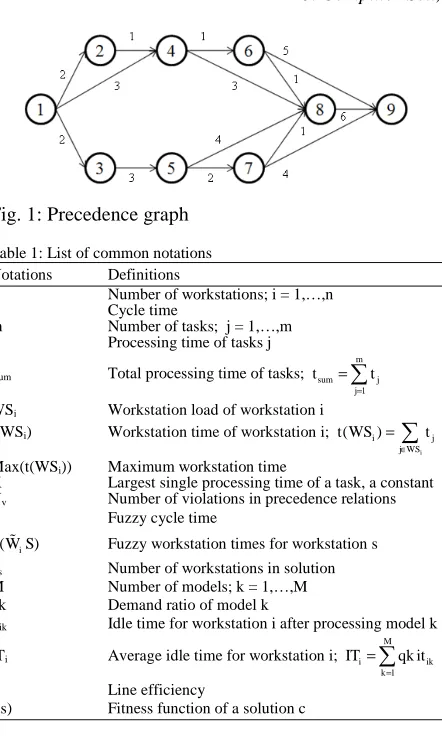
144 Fig. 1: Precedence graph
Table 1: List of common notations Notations Definitions
n Number of workstations; i = 1,…,n
c Cycle time
m Number of tasks; j = 1,…,m tj Processing time of tasks j
tsum Total processing time of tasks;
m
sum j
j 1
t t
=
=
∑
WSi Workstation load of workstation i
t(WSi)
Workstation time of workstation i; i j WSi j t(WS ) t
∈
=
∑
Max(t(WSi))
Maximum workstation time
K Largest single processing time of a task, a constant Nv Number of violations in precedence relations
c
ɶ Fuzzy cycle time
i
t(W S)ɶ Fuzzy workstation times for workstation s ns Number of workstations in solution
M Number of models; k = 1,…,M qk Demand ratio of model k
itik Idle time for workstation i after processing model k
ITi Average idle time for workstation i;
M
i ik
k 1 IT qk it
=
=
∑
E Line efficiency f(s)
Fitness function of a solution c
Figure 1 illustrates an example of precedence relations by a representation of a precedence graph, which contains 9 nodes for tasks, node weights in italic for task-processing times and arcs for orderings. It is noted that the most commonly used objective function in the literature is the maximization of line efficiency:
sum
t E
n c =
⋅
The following Table 1 presents the widely-used notations in assembly lines balancing literature (Tasan and Tunali, 2008).
As follows, the characterizations of the relevant properties of assembly lines, which have to be considered when balancing those lines, are given:
• Number and variety of products: If only one product or several products with (almost) identical production processes, e.g., production of compact discs (Lebefromm, 1999) or drinking cans (Grabau and Maurer, 1998) are assembled, the production system can be treated as a single-model line.
Fig. 2: Assembly line based on the number and variety of the products (redrawn Becker and Scholl, 2006). (a) single-model line; (b) mixed-model line; (c) multi-model line
In modern production systems however, several products or different models of the same base product often share the same assembly line. In general, two different forms of organization are distinguished (c.f. Wild, 1972; Buxey et al., 1973): A mixed-model line (A mixed-model line produces the units of different models in an arbitrarily intermixed sequence (cf. Scholl, 1999)) and a multi-model line (A multi-multi-model line produces a sequence of batches (each containing units of only one model or a group of similar models) with intermediate setup operations.). An illustration is given in Fig. 2, which shows the characteristics of assembly lines based on number and variety of the products
• Line control: Assembly systems can be distinguished with regard to the control of job movements between stations. The exact type of line control, which has far-reaching consequences for the structure of the balancing decision, is divided into paced and un-paced lines
• Variability of task times: In reality, task times are basically never deterministic (Tempelmeier, 2003) • Line layout: Traditionally, an assembly line is
organized as a serial line, where single stations are arranged along a (straight) conveyor belt. The actual line layout is, however, not necessarily determined prior to the balancing decision. The real-world arrangement of the conveyor belt does not usually affect the assignment decision and can thus be ignored
• Parallelization of assembly work: Assembly line production makes intensive use of increasing labor efficiency by partitioning the total work among different productive units
machines and tools which provide the skills and/or technological capabilities required. Furthermore, the necessary material must be made available • Assignment restrictions: In ALB, task assignments
to stations are always restricted by precedence relationships. In model formulations, the corresponding precedence graph might either have a general structure or be restricted to some special graph type, e.g., linear (Kimms, 2000), diverging or converging graphs. In any case, the precedence graph has to be (made) acyclic to find feasible task-processing sequences (Ahamdi and Wurgaft, 1994)
Objectives: Several of the extensions outlined above can only be considered in a meaningful way, if other objectives than the capacity-oriented ones introduced in previous discussion are observed. Whenever alternative resources are available, resource costs will need to be regarded in the associated selection problem.
Problem classification in assembly lines: There are a few ways in defining the problem of assembly lines balancing, while the problem also has variations which may add some complexity to the problem. Here are some variations which are introduced by Chow (1990):
• Multiple products: Since assembly processes and process times may not be the same for different products, a single line cannot be balanced for all products
• Variable process time: Variability may take a number of different forms and the two most common ones result from human inconsistencies found at manual operations and different reject conditions at test/ inspection operations
• Multiple workstations: If the mean process time of an operation is larger than a planned completion cycle, multiple workstations are needed. However, line sizing and balancing become interrelated problems
• Human factors: According to industrial experiences. it has been shown that the repetition of the same motion pattern induces excessive muscle fatigue and may lead to body injury • Product characteristics: An assembly line is usually
composed of a number of subassemblies and tasks that belong to different subassemblies should not be assigned to the same operation
• Length of cycle time: Assembly lines balancing problems are dependent on the selected cycle time and that the determination of cycle time is a complicated problem
Apart from the variations in the ways in defining the problems of assembly lines balancing as listed above and as stated earlier in this study, assembly lines balancing research has traditionally focused on the Simple Assembly Line Balancing Problem (SALBP), which has some restricting assumptions. However, nowadays, a lot of research work has been done in order to describe and solve more realistic generalized problems, namely General Assembly Lines Balancing Problems (GALBP).
Several version of ALBP also arise by varying the objective function (Scholl, 1999): They are Type-1 until Type-5 and Type-E and Type-F. Type-1 and Type-2 have a dual relationship; the first one tries to minimize the number of workstations for a given cycle time and the second one tries to minimize the cycle time for a given number of workstations. Type 3-5 corresponds to maximization of workload smoothness, maximization of work relatedness and multiple objectives, with Type 3 and 4 respectively (Kim et al., 1996). Type-E is the most general problem version, which tries to maximize the line efficiency by simultaneously minimizing the cycle time and a number of workstations. While the last, Type-F is an objective-independent problem, which is to establish whether or not a feasible line balance exists for a given combination of m and c.
Furthermore, several version of ALB problem also arise based on the problem structure. It can be classified into two groups. The first group are (Becker and Scholl, 2006; Scholl, 1999), divided into Single-Model Assembly Line Balancing (SMALB) which is involve only one product, Multi-Model Assembly Line Balancing (MuMALB) which is involve more than one product produced in batches and Mixed-Model Assembly Line Balancing (MMALB) which is refer to assembly lines, which are not in batches. Meanwhile, the second group (Baybars, 1986) is divided into Simple Assembly Line Balancing (SALB), which is involves only one product, with features such as paced line with fixed cycle time, deterministic independent processing times, no assignment restrictions, serial layout, one sided workstations, equally equipped workstations and fixed rate launching and General Assembly Line Balancing (GALB), which is include cost function, equipment selection, paralleling, U-shape line layout and mixed-model production.
146 as cost functions, equipment selection, paralleling, U-shaped line layout and mixed-model production. They are: do not balance but re-balance, workstation identities, un-moveable operations and zoning constraints, cannot eliminate workstations, loads equalization, multiple operators, multi-operator operations, ergonomic constraints (operator positions), multiple products and drifting operations. Figure 3 shows several problem versions which arise from varying the objective in SALBP.
From Fig. 3, few facts could be concluded as listed:
• SALBP-E maximizes the line efficiency E
• SALBP-1 minimizes the number m of stations given the cycle time c
• SALBP-2 minimizes cycle time c given number m of solutions
• SALBP-F seeks for a feasible solution given m and c
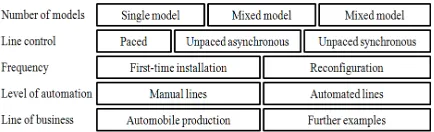
Based on a survey study by Boysen et al. (2008), assembly lines balancing problems are classified into a few groups in order to assign typical attributes to different aspects of real-world assembly systems. By doing so, joint occurrences of SALBP-extensions can be identified which are especially characteristic for certain groups of assembly systems in the real world. They are classified based on number models (single, mixed and multi-model), line control (paced line, un-paced synchronous and un-un-paced asynchronous), frequency (full-time installation and reconfiguration), level of automation (manual lines and automated lines) and lines of business (automobile production). Furthermore, a comparison with the existing literature can clarify if solution procedures for these typical cases already exist or if their development remains for future research. Figure 4 shows a classification of assembly lines balancing problems made by Boysen et al. (2008). On the other hand, due to very different conditions in industrial manufacturing, assembly line production systems and corresponding ALB problems show a great diversity (Boysen et al., 2007). For other descriptions of assembly systems and different balancing problems, please refer to, e.g., Buxey et al. (1973); Baybars
(1986); Shtub and Dhar-El (1989); Ghosh and Gagnon (1989); Erel and Sarin (1998); Scholl (1999) and Rekiek and Delchambre (2001), as well as the most recent survey of Becker and Scholl (2006). Table 2 summaries the classifications of assembly line balancing problem researches up to now. It is an adaptation from Tasan and Tunali (2008) and few modifications are made to complete it, based on the current surveys and investigations.
It is noted that Scholl and Becker (2006) present a survey on problem and methods for GALPB (seems quite similar with Baybars (1986)) with features such as cost/profit-oriented objectives, equipment selection/ process alternatives, parallel workstations/tasks, U-shaped line layout, assignment task processing times and mixed-model assembly lines.
RESULTS
The important research of assembly lines balancing: Assembly lines have been studied extensively (since Salveson, 1955) by introducing his mathematical modeling and looking to the original aim of assembly lines. Balancing assembly lines is a recurring task in operation management, where such models have been used to support the decision maker in configuring an efficient assembly system to optimize productivity (Scholl and Klein, 1999; Boysen et al., 2007), which depends on the kinds of assembly lines as classified in Fig. 3, 4 and Table 2, so it became important and carries more benefits and advantages by optimizing assembly lines in order to optimize the productivity.
Fig. 3: Version of simple assembly line balancing problem (redrawn Becker and Scholl, 2006)
Table 2: Classifications of assembly line balancing problem
Based on Based on problem structure
According to survey objective function --- by Chow (1990) Scholl (1999) Baybars (1986) Scholl (1999); Becker and Scholl (2006) Boysen et al. (2008) Multiple products Type-E Simple Assembly Line Balancing Single-Model Assembly Line Balancing Number models
Variable process time Type-F (SALB) (SMALB) Line control
Multiple workstation Type 1 and 2 General Assembly Line Balancing Multi-Model Assembly Line Balancing Frequency
Human factors Type 3-5 (GALB) (MuMALB) Level of automation
Product characteristics Mixed-Model Assembly Line Balancing Line of business
Fig. 4: Kinds of assembly lines (redrawn Boysen et al., 2008)
A well-known assembly design problem is the Assembly Line Balancing Problem (ALBP), which deals with the allocation of tasks among workstations so that the precedence relations are not violated and the given objective function is optimized.
ALPB falls into the non-deterministic polynomial hard (NP-hard) class of combinatorial optimization problems (Karp, 1972). The complexity of the ALBP renders optimum seeking methods impractical, for instance, of more than a few tasks and/or workstations, with assumptions there are m tasks and r precedence constraints and then there are m!r
2 possible task sequences (Baybars, 1986). Therefore, it can be time-consuming for optimum seeking methods to obtain an optimal solution within this vast search space. This fact also carries out to a conclusion that researches in assembly lines is very important to do. Even so, many attempts have been made in the literature to solve the ALBP using optimum seeking methods, such as: Linear programming by Salveson (1955), Integer programming by Bowman (1960), Dynamic programming by Held et al. (1963) and Branch-and-bound approaches by Jackson (1956). However, none of these methods have been proved to be of practical use for large problems, due to their computational inefficiency (Tasan and Tunali, 2008).
Furthermore, based on surveys by Tasan and Tunali (2008), Genetic Algorithms (GAs) received an increasing attention from researchers, since it provides an alternative to the traditional optimizations technique by using directed random searches to locate optimum solutions in complex landscapes. Few surveys also have been made regarding the subject, namely Dimopoulus and Zalzala (2000) who reviewed the use of evolutionary computation methods for solving manufacturing optimization problems, including the classic job-shop and flow-shop scheduling problems, assembly line balancing and aggregate production planning, Aytug et al. (2003) who have reviewed over 110 papers using genetic algorithms to solve various types of production and operations management problems including production planning and control,
facility layout design, line balancing, and supply chain management. They noted that none of these studies placed an adequate amount of emphasis on the use of genetic algorithms for solving ALBPs, since their scope was very broad., Scholl and Becker (2006) who presented a review and analysis of exact and heuristic solution procedures for solving ALBPs and Tasan and Tunali (2008) who presented the latest survey on it which conducts to the recent published literature on ALB including genetic algorithms and summarized the main specifications of the problems studied, the genetic algorithm suggested and the objective functions used in evaluating the performance of the genetic algorithms.
However, since there are many efforts by previous researchers in finding the best techniques in solving optimization problems in assembly lines balancing and of course there still wide open problems in ALB, those facts showed that research on assembly lines balancing is important and needs to be addressed in future. Furthermore, it will be important in manufacturing and for sure it is also of paramount importance in the industrial production of high-quantity standardized commodities (Boysen et al. 2007).
Soft computing: Soft computing, according to Bonissone (1997) refers to a fusion of techniques that mainly bring together neural networks, fuzzy logic, and evolutionary algorithms (Dubois and Prade, 1998). Here, we present a brief discussion of soft computing and their general capabilities. Furthermore the applications of soft computing in assembly lines balancing are discussed.
An overview of soft computing: The three techniques mentioned above are known as traditional technologies in soft computing. But nowadays, many more novel techniques in soft computing are arisen from behavioral studies, such as ant colony optimization, small world theory, and memes theory (Ovaska et al., 2006). Current results have concluded that these technologies have steadily changed the way to solve real-world problems in science and engineering.
148 computing techniques have attempted to give solutions to specific problems, it is not clear how this approach is generalized for solving all computational problems. Here are four such questions (Chaudhari et al., 2006):
• Is the given soft-computing technique general enough, in the sense that, is it possible to express any arbitrary computation in that technique
• Does the given soft-computing technique possess the ability of automatically generating a solution to any arbitrary problem for which an algorithm is known to exist
• Does the given soft-computing technique possess the ability of generating automatically the most efficient solution to an arbitrary computable problem
• When the given soft-computing technique does not generate the most efficient solution, does it generate a reasonably efficient solution, with the performance bound on how far the resulting solution would be from the most efficient solution?
However, few researchers (e.g., Turchin’s meta-computations (1993 and 1996a) and super-compilations (Turchin, 1996b), Mitchell’s investigations (1994) for cellular automata computations have attempted to answer those questions, even if it has been very difficult. Another interesting field in soft computing is evolutionary computation. Evolutionary computing is based on the concepts of biological evolutionary theory that mimics the mechanics of reproduction, mutation, recombination, natural selection, and survival of the fittest. Three basic kinds of evolutionary computations are genetic algorithms, genetic programming and evolutionary algorithms. Follow we present a brief introduction to the computational capabilities of some soft computing frameworks (adopted from Chaudhari et al., 2006).
Turing machine: There is a famous list of nineteenth century problems by Hilbert which is “Does there exists an algorithm for deciding whether or not a specific mathematical assertion does or does not have a proof?” (Weisstein, 1999). Alan Turing, in 1937, showed that the answer for this problem is negative for elementary number theory. In the process of obtaining the solution to this problem, he invented the formalism of “Turing Machine”, which is now accepted as (one of the models) to represent any arbitrary computation; in fact, it is an accepted notion today that the problems which can be “computed” are precisely the ones for which a Turing Machine exists (Chaudhari et al., 2006). Turing
machines are not assigned as a practical computing technology, but a thought experiment about the limits of mechanical computation. Thus, they were not actually constructed. Studying their abstract properties yields many insights into computer science and complexity theory.
Neural networks: A neural network is an artificial system that aims to perform intelligent tasks similar to those performed by the human brain (Pitts and McCullough, 1947). A neural network stores its knowledge through learning within inter-neuron connection strengths known as synaptic weights. These networks have shown themselves to be adept at solving function approximation including time series prediction, fitness approximation and modeling, data processing including filtering, clustering, and also nonlinear controller. The most common neural network model is Multi-Layer Perceptron (MLP). The MLP and other neural network models can be trained using a learning algorithm such as (error) back-propagation, steepest descent, least square error, genetic algorithm, evolutionary computation, expectation-maximization and non-parametric methods. Using one of these algorithms, the weights are determined and the network is said to be trained for a set of data.
Genetic algorithms: Genetic Algorithms (Goldberg, 1989) are based on the Darwinian-type survival of the fittest strategy with sexual reproduction and Mendel’s theory of genetics as the basis of biological inheritance. In these theories, stronger individuals in the population have a higher chance of creating offspring. Each individual in the population represents a potential solution to the problem to be solved. Genetic algorithms do not work with a single point on the problem space but use a set, or population of points to conduct a search. This gives genetic algorithms the power to search multi-modal spaces littered with local optimum points.
Genetic algorithms can be used to train a multi-layer perceptron in which weights form a parameter space. While genetic algorithms have the advantage of not getting stuck in local optima, they have other problems. When the search space is very large then genetic algorithm methods generally take a long time to converge to good quality solutions. The length of the search is due to the optimal generalization of the training process with no-prior knowledge about the parameter space.
group of algorithms and techniques that are based on the principles of natural processes involving biological evolution. Evolutionary Algorithms (EAs) are mainly meta-heuristic and optimization methods that share some generic concepts borrowed from the natural process of biological evolution. Research in this area has mainly been focused on solving the problems which can be formulated as an exhaustive search over the space of all possible solutions. Using evolutionary computing frameworks, many approaches have been proposed in the last decade. Some approaches for global optimization algorithms include the approaches based on evolution of species (Davis et al., 1999), immune system (Castro et al., 2002), social behavior of ants (Bonabeau et al., 2000), memetic and cultural evolution (Ong et al., 2004; Ong et al., 2006). Many variants of ECs are also studied by various researchers. For example, Boettecher and Percus (2001) proposed a new optimization algorithm that is based on the principles of natural selection, but it does not follow the basic genetic algorithm framework for population reproduction. Their approach is one step towards integrating different models like principles of self-organized criticality of Bak and Sneppen (1993) in a broad EC framework.
DISCUSSION
Soft computing application: Based on a survey of published theoretical and application literature, it can be concluded that soft computing applications have been used and developed in many research fields and industry. Few of them are automotive and manufacturing, bioinformatics, phylogenetics, computational science, engineering, economics, chemistry, manufacturing, mathematics, physics and other fields, such as neural networks, which are data-driven self-adaptive methods without depending much on prior knowledge about the structural relationship between demand forecasts and the determining factors, can approximate any continuous function arbitrarily well to any given accuracy (Pinkus, 1999). Other than the financial field, a major application of neural networks-based forecasting is in electricity load consumption study (Zhang, et al., 1998). As an approximator, similar to neural networks, fuzzy systems can also approximate any continuous function to any degree of accuracy (Ying, et al., 1999). Although the performance is similar, neural networks, which are known for their simplicity and model-free approach, have been well accepted in practice and used by many utilities for load forecasting (Hippert et al., 2001; Khotanzad, et al., 1998) and also there are many other soft computing applications for real-world problems.
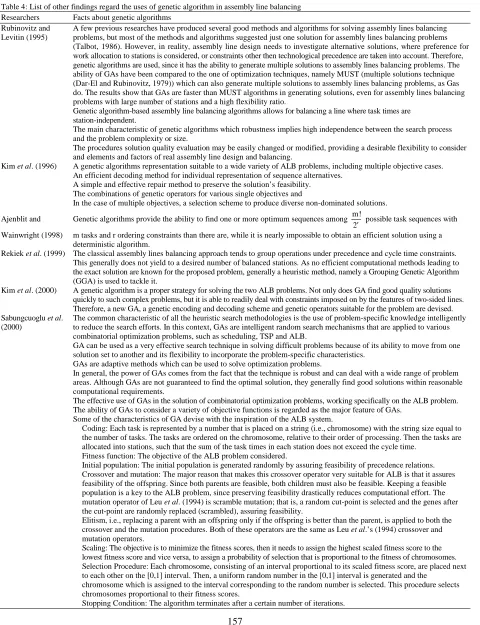
Soft computing in assembly lines balancing: It is reported that soft computing approaches have been used (among of them are fuzzy logic and genetic algorithms) in solving assembly lines balancing problems and it is also reported that genetic algorithms have been dominantly used. The uses of genetic algorithms received increasing attention from the researchers, since it provides an alternative to traditional optimization techniques by using directed random searches to locate optimum solutions in complex landscapes (Tasan and Tunali, 2008). In here, we discuss few previous works which used soft computing approaches in solving the assembly line balancing problems, and then the discussion followed by those who used genetic algorithms.
Hui et al., (2002) proposed fuzzy operator allocation for balance control of assembly lines in apparel manufacturing. In their work, they demonstrated the use of a fuzzy logic-based system in making balance control decisions. The experimental results show the advantages of the fuzzy logic-based approach over traditional methods, with its ability to reach the target production output more consistently. They also developed a system called FOA for operation allocation, based on a set of fuzzy rules and membership functions obtained through interview sessions with human experts. The performance of the FOA system was compared with that of the supervisors in a men’s shirt factory, using a set of data collected over 30 consecutive working days. It was found to outperform the actual supervisors and extends the literature by increased production efficiency of 30%.
Fonseca et al. (2005) proposed a work to model and solve the stochastic assembly line balancing problem with a fuzzy representation of the time variables as a viable alternative method. Two widely-used line balancing methods, the Computer Method for Sequencing Operations for Assembly Lines (COMSOAL) and Ranked Positional Weighting Technique were modified and then transformed to solve the ALBP with fuzzy operating times. The fuzzy heuristics were then automated via Visual Basic. Three test example problems from the available literature were used to successfully validate the constructed fuzzy techniques. Thus, a viable alternative approach to solving the stochastic assembly line balancing problem was developed. The experimental results show that the new fuzzy methods are capable of producing solutions similar to and in some cases better than, those reached by the traditional methods.
150 Patterson (1984) and a BFGP model for U-shaped assembly line balancing uses and extends the IP model of Urban (1998). Some results and advantages are yielded from the proposed model. They are:
• Allow decision-makers to consider the cycle time and the number of workstation goals as imprecise values
• Minimize the number of workstations and the cycle time at the same time in a fuzzy environment • It is solved using the Chang’s (2007) primary
BFGP method
• It is valid and useful for straight and U-shaped assembly line balancing problems
• Enable decision-makers to simultaneously consider conflicting objectives of assembly line balancing in a fuzzy environment
• Allow decision-makers to assign priorities to the goals using weighted goal programming approach • All these aspects to enable the proposed models to
be significant and integrated approaches for assembly line balancing
• The combinatorial nature of the assembly line balancing problems makes the development of fast and effective heuristics significant
Based on the BFGP approaches proposed in this study, the development of heuristics can be considered as topics for further researches.
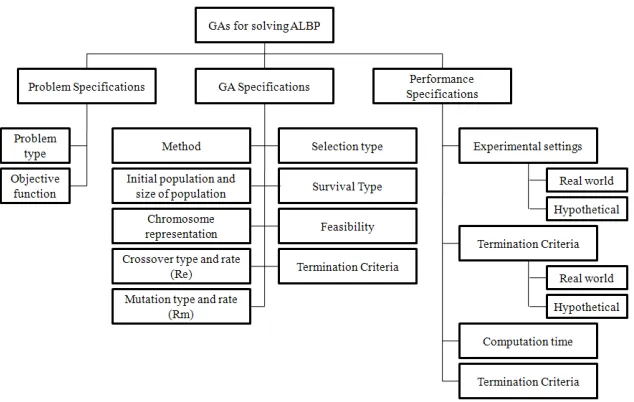
Genetic algorithm in assembly line balancing: The discussion according to this issue was adopted from the survey by Tasan and Tunali (2008). However, there are
also few additional surveys for completing. The survey made is based on the classification given in Baybars (1986) which is to identify the major trends in types of problems studied. Figure 5 represents the structural framework for reviewing, which is done by Tasan and Tunali (2008). However, the discussions only focus on the uses of genetic algorithms for solving ALBP, based on problem specifications only.
Since the research on the ALB problems which used genetic algorithms in solving the problems is much heavier than the other soft computing techniques, so that the discussions are divided into two groups, namely SALBP and GALBP. I will start with the first one, which is research on SALBP problem.
Research on SALB problem regarding the use of genetic algorithms: An assembly line consists of workstations k = 1,…m which are usually arranged along a conveyor belt or similar mechanical material handling equipment. The workpieces (jobs/tasks) are consecutively launched down the line and are moved from station to station. At each station, certain operations are repeatedly performed regarding the cycle time. Cycle time is a maximum or average time available for each work cycle. The basic problem described so far is called a Simple Assembly Line Balancing Problem (SALBP) in the literature (Baybars, 1986). We focus the discussion on SALB problems which used genetic algorithms or a hybrid system on it to solve the problem and continued by the discussion on GALB problem which used genetic algorithm.
Falkenauer and Delchamber (1992) were the first to solve the SALB problem with Genetic Algorithms (GAs). Falkenauer (1991) presented the Grouping Genetic Algorithm (GGA) especially for solving grouping optimization problems, where the aim was to group members of a set into a small number of families in order to optimize objective function under given constraints. GGA has a special chromosome representation scheme and genetic operators, which are used to suit the representation scheme. Later, Falkenauer and Delchambre (1992) implemented the GGA to two grouping optimization problems; i.e., a bin packing problem and a SALB Type-1 problem. This study was the first attempt to balance an assembly line Type-1 problem with a genetic algorithm. The authors first presented a special representation scheme and special genetic operators for the bin packing problem and they later modified the special genetic operators for line balancing. Other implementations of GGA for solving ALBPs can be found in Falkenauer (1997); Rekiek et al. (1999) and Brown and Sumichrast (2005).
After Falkenauer and Delchambre (1992), the SALB problem was also studied by many researchers. Leu et al. (1994) developed a genetic algorithm to solve SALB Type-1 problems and used heuristic procedures to determine the initial population. They also proposed a number of techniques to deal with the feasibility problems during initialization of the population as well as after the reproduction phase. They also demonstrated the possibility of balancing assembly lines with multiple criteria and zoning constraints.
The first article, which presented a genetic algorithm application to the SMALB Type-2 problem, was published by Anderson and Ferris (1994). The authors mainly aimed at showing the effective use of genetic algorithms in solving combinatorial optimization problems. They first described a fairly typical serial implementation of a genetic algorithm for the ALBP and studied the effects of various genetic algorithm variables on the performance of the genetic algorithm. Later, they introduced an alternative parallel version of the genetic algorithm, where each individual in the population resided on a processor. The comparative study between serial and parallel genetic algorithms showed that the quality of the solutions from the parallel implementations was worse than the best solutions obtained from serial implementation.
Rubinovitz and Levitin (1995) used a genetic algorithm to obtain a SALB Type-2 problem, in which the processing time of a task was dependent upon workstation assignment. The authors compared the proposed genetic algorithm to Dar El and Rubinovitz
MUST (1979), where the proposed genetic algorithm solved the problems involving more than 20 workstations faster than MUST. Finally, the authors concluded that their genetic algorithm achieved its greater advantage when the precedence constraints were the least restrictive.
Kim et al. (1996) developed a genetic algorithm to solve multiple objective SMALB problems. They addressed several types of ALBP, such as to minimize the number of workstations (Type-1), minimize the cycle time (Type-2), maximize workload smoothness (Type-3), maximize work relatedness (interrelated tasks are allotted to the same workstation as much as possible) (Type-4) and a multiple objective with Type 3 and 4 (Type-5). The authors placed the emphasis on seeking a set of diverse Pareto optimal solutions. Although, Kim et al.’s (1996) multi-objective genetic algorithm seems to be very promising, the chromosome representation scheme they used is not well suited to the some of the problem types, since they used a single chromosome representation scheme to represent all of the problem types.
Kim et al. (1998) considered maximizing the workload smoothness, which has been generally neglected in the literature. Extensive computational experiments were made and the advantages of incorporating problem-specific heuristics information into the algorithm were demonstrated. The experimental results showed that the proposed genetic algorithm outperformed the existing heuristics and the standard genetic algorithm.
Rekiek et al. (1999) proposed a grouping genetic algorithm by Falkenauer and Delchambre (1992) based on an Equal Piles approach for solving the SALB problem. They tried to assign tasks to a fixed number of workstations in such a way that the workload of each workstation was nearly equal by leveling on average the size of each workstation (minimizing the standard deviation of sizes). Therefore, the proposed method warranted obtaining the desired number of workstations and tried to equalize the workloads of workstations as much as possible. Later, Rekiek et al. (2001) developed a grouping genetic algorithm for solving multi-objective assembly line design problems.
152 They also revised GRASP by using weights and called it Greedy Randomize Weighted Adaptive Search Procedure (GRWASP). In the proposed method, the greedy heuristic methods were based on the application of priority rules for assignment of tasks to workstations such as the longest processing time and the greatest number of immediate successors. The greedy heuristic favors tasks with the best index value, while the genetic algorithm phase simply changes the order of elements in the solution. Their comparative study showed that the proposed genetic algorithm and GRWASP resulted in better performance than the greedy heuristics and GRASP.
Ponnambalam et al. (2000) developed a multi-objective genetic algorithm for SMALB Type-1 problems to optimize several objectives simultaneously: the number of workstations, the line efficiency and the smoothness index. Several comparisons were made between other heuristics on several examples. The results of the comparisons indicated that the genetic algorithm performed better in all cases studied. However, the execution time for the genetic algorithm was found to be longer.
Sabuncuoglu et al. (2000) developed a new genetic algorithm to solve the SMALB problem by utilizing the intrinsic characteristics of the problem. The authors also proposed a method called ‘dynamic partitioning’ that modified chromosome structure of genetic algorithms to save CPU time. The method modifies the chromosome structure by allocating tasks to workstations (i.e., freezing certain tasks) that satisfy some criteria and continues with the remaining unfrozen tasks. Furthermore, they constructed a new elitism structure adopted from the concept of simulated annealing. It is observed that this new elitism structure contributes significantly to the performance of the genetic algorithm. In fact, the results of extensive computational experiments indicated that the proposed genetic algorithm approach outperformed the well-known heuristics in the literature.
Carnahan et al. (2001) considered the physical demands placed on workers in solving the SALB Type-2 problem. In order to measure physical demand, the authors used grip strength capacity that represented the maximum finger flexor strength generated by a worker using a semi-pronated power grip. Three methods, i.e., a ranking heuristic, a combinatorial of the genetic algorithm and a problem space of the genetic algorithm, were developed to simultaneously minimize the maximum manual gripping demands and the cycle time. The authors concluded that the problem space of the genetic algorithm performed better than the others.
Goncalves and De Almedia (2002) presented a hybrid genetic algorithm, which combined heuristic priority rules with a genetic algorithm to solve the SALB Type-1 problem. Several problems from the literature have been used to demonstrate the effectiveness and robustness of the proposed hybrid genetic algorithm. The result of the experiments showed that the proposed method performed remarkably well.
Stockton et al. (2004a; 2004b) investigated the use of genetic algorithms for solving various problems that arise when designing and planning manufacturing operations; i.e., assortment planning, aggregate planning, lot sizing within material requirement planning environments, line balancing and facilities layout. In Stockton et al. (2004a), the authors have examined the application of a genetic algorithm to the SMALB Type-1 problem. They compared the performance of the genetic algorithm with a traditional solution method, i.e., Ranked Positional Weight (RPW) (Helgerson and Birnie, 1961). In Stockton et al. (2004b), the authors performed computational experiments in order to identify suitable genetic operators and parameter values.
Brown and Sumichrast (2005) compared the performance of grouping genetic algorithm GGA by Falkenauer (1991) against the performance of a typical genetic algorithm across a range of grouping problems, i.e., bin packing, machine part cell formation and SALB Type-1 problems. They applied the two techniques, i.e., standard GA and GGA, to a set of problems and compared the results, with respect to solution quality and computation time. They noted that both of the techniques managed to find the optimal solution for all the test problems, however GGA found the optimal solution more quickly.
Research on GALB problems regarding the uses of genetic algorithms: Simply, the discussion on GALB problems is all of the problems that are not SALB. Such as: balancing of single-model or mixed-model, parallel, U-shaped and two-sided lines, with stochastic, fuzzy or dependent processing times.
Following Tsujimura et al. (1995), several versions of GALB problems were studied by many researchers. Suresh et al. (1996) used a genetic algorithm to solve the SMALB Type-1 problem with stochastic processing times. A modified genetic algorithm, working with two populations (one allowing infeasible solutions) and exchange of specimens at regular intervals, were proposed for handling irregular search space (i.e., the infeasibility problem due to problem specifications). The authors believed that a population of feasible solutions would lead to a fragmented search space, thus increasing the probability of getting trapped in a local minimum. They stated that infeasible solutions can be allowed in the population only if the genetic operators can lead to feasible solutions from unfeasible ones. Throughout the generations, some solutions were exchanged at regular intervals between the two populations (i.e., the exchanged solutions have the same rank of fitness value in their own populations). The results of the experiments indicated that the genetic algorithm working with two populations can give better results than the genetic algorithm with only feasible population.
Falkenauer (1997) presented a genetic algorithm based on a Grouping Genetic Algorithm (GGA) by Falkenauer and Delchambre (1992) and a branch-and-bound algorithm for a SMALB Type-1 problem with resource-dependent processing times. The problem involved allocating resources with different cost and speed to each task and also assigning the tasks to workstations, in such a way that the total cost of the line is minimal. The author employed GGA to assign the tasks to workstations and then branch and bound algorithm to select the optimal source for each workstation. In this problem, the processing time of a task depends on the resources being used; therefore, resources with different costs and speeds are allocated to each task in addition to the assignment of tasks to workstations, in such a way that the total cost of the line is minimal. In the proposed method, the tasks were assigned to workstations by GGA and the optimal source for each workstation was selected by a branch-and-bound algorithm.
Ajenblit and Wainwright (1998) were pioneers in balancing the U-shaped SMALB Type-1 problem using genetic algorithms. The authors dealt with two possible variations of this problem; minimizing the total idle time and balancing the workload between workstations, or a combination of both. They developed six different assignment algorithms to interpret a chromosome and assign tasks to workstations. The authors applied the proposed genetic algorithm to 61 test problems. In comparison to previous researchers, they obtained
superior results in 11 cases, the same results in 49 cases and a worse result in one case.
Chan et al. (1998) proposed a genetic algorithm for a SMALB Type-1 problem in the clothing industry. The authors tried to improve the line efficiency by minimizing the time spent in assembly line balance planning. They also included the various skill levels of workers as problem-specific information to solve a 41-task ALBP. The experimental results showed that the performance of a genetic algorithm was much better than the performance of the greedy algorithm, which performed optimization by proceeding to a series of alternatives and assigned the most skillful worker to each task.
Kim et al. (2000) developed a genetic algorithm for balancing a two-sided SMALB Type-1 problem with positional constraints. Two-sided assembly lines consist of two connected serial lines in parallel, where some task can be performed at one of the two sides of the line, while the others can be performed at either side of the line. In the two-sided assembly lines, the tasks were classified into three types: L (left); R (right) and E (either) type tasks. L-type tasks are easily performed at the left-hand side of the line, similarly R-type tasks are easily performed at the right-hand side of the line and E-type tasks are easily performed at both sides of the line. The performance of the proposed genetic algorithm was compared to integer programming and other heuristic methods by Kim et al. (1998b), using five test problems. The results indicated that the proposed genetic algorithm showed a better performance than the heuristics studied. The authors stated that the proposed genetic algorithm can be directly applied to the different versions of the ALBP.
Simaria and Vilarinho (2001a) proposed an iterative search procedure, including a genetic algorithm for a MMALB Type-2 problem with parallel workstations. The proposed genetic algorithm procedure was originally based on the model developed in Simaria and Vilarinho (2001b) for a SMALB Type-2 problem, where the simulated annealing was used as a solution method. The iterative procedure starts with a lower bound of cycle time and successively solves the MMALB Type-1 problem by increasing cycle times. Once a feasible solution is found, the procedure employs a genetic algorithm to decrease the cycle time. Besides minimizing the cycle time, the procedure minimizes the workload balances. The iterative procedure was illustrated using a simple example with two assembly models and 25 tasks.
154 workload smoothness, minimizing the frequency of tool change, minimizing the number of tools and machines used and minimizing the complexity of assembly sequences. They classified the assembly line planning problems into line balancing, tooling and scheduling problems. The proposed method was improved by including heuristic solutions into initial population and developing a self-tuning method to correct infeasible chromosomes. Several examples were employed to illustrate the proposed genetic algorithm. Experimental results indicated that the proposed genetic algorithm efficiently yields many alternative assembly plans to support the design and operation of an assembly system.
Miltenburg (2002) solved the assembly line balancing Type-1 problem and sequencing problems simultaneously for mixed model U-shaped assembly lines. They proposed a genetic algorithm to solve the balancing and sequencing problems jointly. The proposed genetic algorithm was found to offer good solutions.
Valente et al. (2002) proposed a genetic algorithm to solve assembly line balancing Type-2 problem in a real-world application, a two-sided car assembly line. The solution to the problem involved satisfying the constraints that the length of each workstation was constant. The proposed genetic algorithm was found to reduce the total assembly time of the current line by 28.5%.
Brudaru and Valmar (2004) proposed a hybrid genetic algorithm for solving a SMALB Type-1 Problem. They considered the processing times of tasks as fuzzy numbers like Tsujimura et al. (1995). Their hybrid method combined the branch-and-bound and genetic algorithm. The authors presented a special chromosome representation scheme, embryonic representation, which used subsets of solutions rather than the individual solutions. They also proposed a new type of genetic operator called a growing operator to be
used for the hybrid genetic algorithm. The proposed hybrid genetic algorithm was found to take a longer computation time, with respect to solution quality.
Martinez and Duff (2004) addressed the U-shaped SMALB Type-1 problem. They first solved this problem using 10 heuristic rules adapted from the simple line balancing problem, such as maximum ranked positional weight, maximum total number of follower tasks or precedence tasks and maximum processing time and compared these heuristic solutions with the optimal solutions obtained from previous researches. Following on, they modified Ponnambalam et al. genetic algorithm (2000) and inserted the solutions obtained using these heuristic rules to the initial population. They illustrated the proposed genetic algorithm using Jackson’s problem (1956). The results showed that the addition of a genetic algorithm can improve the current solution.
Simaria and Vilarinho (2004) expanded the application of their previous work in Simaria and Vilarinho (2001), where they proposed an iterative genetic algorithm-based search procedure for a MMALB Type-2 problem with parallel workstations. The authors have also conducted a set of computational experiments on a set of generated ALBPs.
Levitin et al., (2006) proposed a genetic algorithm for solving a special kind of SMALB Type-2 problem, i.e., Robotic Assembly Line Balancing (RALB) problem. The authors defined a robotic assembly line, where robots with different capabilities and specializations were assigned to the assembly tasks. Various procedures for adapting the genetic algorithm to the RALB problem, such as a local optimization (hill climbing) work-piece exchange procedure, were introduced. Tests were conducted on a set of randomly-generated problems to determine the most effective genetic algorithm procedure, based on the best combination of parameters.
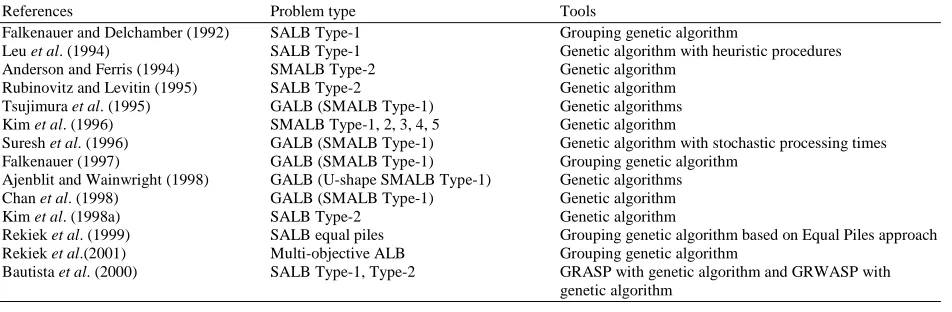
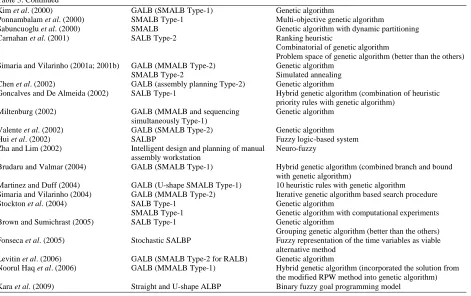
Table 3: Summary of the previous research
References Problem type Tools
Falkenauer and Delchamber (1992) SALB Type-1 Grouping genetic algorithm
Leu et al. (1994) SALB Type-1 Genetic algorithm with heuristic procedures Anderson and Ferris (1994) SMALB Type-2 Genetic algorithm
Rubinovitz and Levitin (1995) SALB Type-2 Genetic algorithm Tsujimura et al. (1995) GALB (SMALB Type-1) Genetic algorithms Kim et al. (1996) SMALB Type-1, 2, 3, 4, 5 Genetic algorithm
Suresh et al. (1996) GALB (SMALB Type-1) Genetic algorithm with stochastic processing times Falkenauer (1997) GALB (SMALB Type-1) Grouping genetic algorithm
Ajenblit and Wainwright (1998) GALB (U-shape SMALB Type-1) Genetic algorithms Chan et al. (1998) GALB (SMALB Type-1) Genetic algorithm Kim et al. (1998a) SALB Type-2 Genetic algorithm
Rekiek et al. (1999) SALB equal piles Grouping genetic algorithm based on Equal Piles approach Rekiek et al.(2001) Multi-objective ALB Grouping genetic algorithm
Table 3: Continued
Kim et al. (2000) GALB (SMALB Type-1) Genetic algorithm
Ponnambalam et al. (2000) SMALB Type-1 Multi-objective genetic algorithm
Sabuncuoglu et al. (2000) SMALB Genetic algorithm with dynamic partitioning Carnahan et al. (2001) SALB Type-2 Ranking heuristic
Combinatorial of genetic algorithm
Problem space of genetic algorithm (better than the others) Simaria and Vilarinho (2001a; 2001b) GALB (MMALB Type-2) Genetic algorithm
SMALB Type-2 Simulated annealing Chen et al. (2002) GALB (assembly planning Type-2) Genetic algorithm
Goncalves and De Almeida (2002) SALB Type-1 Hybrid genetic algorithm (combination of heuristic priority rules with genetic algorithm)
Miltenburg (2002) GALB (MMALB and sequencing Genetic algorithm simultaneously Type-1)
Valente et al. (2002) GALB (SMALB Type-2) Genetic algorithm Hui et al. (2002) SALBP Fuzzy logic-based system Zha and Lim (2002) Intelligent design and planning of manual Neuro-fuzzy
assembly workstation
Brudaru and Valmar (2004) GALB (SMALB Type-1) Hybrid genetic algorithm (combined branch and bound with genetic algorithm)
Martinez and Duff (2004) GALB (U-shape SMALB Type-1) 10 heuristic rules with genetic algorithm Simaria and Vilarinho (2004) GALB (MMALB Type-2) Iterative genetic algorithm based search procedure Stockton et al. (2004) SALB Type-1 Genetic algorithm
SMALB Type-1 Genetic algorithm with computational experiments Brown and Sumichrast (2005) SALB Type-1 Genetic algorithm
Grouping genetic algorithm (better than the others) Fonseca et al. (2005) Stochastic SALBP Fuzzy representation of the time variables as viable
alternative method Levitin et al. (2006) GALB (SMALB Type-2 for RALB) Genetic algorithm
Noorul Haq et al. (2006) GALB (MMALB Type-1) Hybrid genetic algorithm (incorporated the solution from the modified RPW method into genetic algorithm) Kara et al. (2009) Straight and U-shape ALBP Binary fuzzy goal programming model
Noorul Haq et al., (2006) proposed a hybrid genetic algorithm for solving MMALB Type-1 problems. They incorporated the solution from the Modified RPW (MRPW) method into the genetic algorithms randomly-generated initial population to reduce the search space within the global search space. It was noted that this integration reduced the search time. The authors illustrated the implementation of a hybrid genetic algorithm approach on seven problems and compared the results with the MRPW and the standard genetic algorithm. The results showed that the proposed approach performed better than the standard genetic algorithm. The following Table 3 presents the summaries of the previous work regarding assembly line balancing and the uses of genetic algorithms in solving the problems.
CONCLUSION
Assembly line balancing involves numerous problems such as costs, quality, environmental impact, safety, workers, products, reliability, accuracy, robustness of the system and others. In order to make the system stable and balanced, a good manager should take care of all the factors influencing assembly line
balancing, since the first-time installation or when it is needed to reconfiguration them. As an approach, soft computing differs from a traditional method, such a conventional or hard computing, in that soft computing approaches are tolerant of imprecision, uncertainty, partial truth and approximation. In effect, the role model for soft computing is the human mind (Zadeh). With all the capabilities of soft computing, especially in optimizing and the simply use of it, make soft computing suitable for assembly line balancing problems that always attempt to optimize the system. The capabilities of soft computing in optimizing have been proven and it is better than hard computing. On the other hand, soft computing approaches make the optimization process simple to do than using the conventional one, which is impractical and computationally inefficient.