Original Research Article
Hypertension and other morbidities among a rural geriatric
population of North Kerala
Sabitha Rose Jacob*, Suthanthira Kannan
INTRODUCTION
World population is ageing. It is both a great achievement and big challenge. Good quality health care facilities and improved standards of living led to increase in life expectancy. Population aging, which has been defined as progressive and generalized impairment of function leading to increased risk of age related diseases is a social challenge, especially in developing countries. In India, as per the census 2011, elderly population comprised 8.2%
of the total population and Kerala having largest proportion of 12.6%.1 Due to degenerative changes elderly suffer from different types of diseases mainly non communicable diseases. The simultaneous occurrence of two or more chronic medical conditions i.e. multi morbidity is the characteristic feature of old age can alter the course and outcome of each disease. This also affects care and may result in complex self-care needs.2,3 Majority of Indian elderly suffer from more than one chronic condition and 5% have some disability at any
ABSTRACT
Background: Ageing is a universal phenomenon characterized by an increase in morbidity, multi morbidity and
increased healthcare and social demands. An awareness of common morbidities is essential for planning the health care services for elder people. Objectives of the study were to identify reported morbidities and measure hypertension of a rural geriatric population.
Methods: A community based cross sectional study and estimation of BP was done.
Results: Study population included 403 elderly with majority (56.3%) in 60-70 age group and 66.5% females.
Among them 38.7% has lost spouses and 4% were staying alone. Illiterate were 22.8% and 46.9% had no income. Any one type of chronic morbidity was reported by 79.7% (n=321) 95%CI (75.83, 83.63) of the population and it was higher among females (82.5%). More than one morbidity was reported by 44.4% of population. Reported morbidities were hypertension (35.7%) and diabetes (23%) similar in both genders, joint symptoms (19.4%) higher in females, breathlessness (9.6%), known ischemic heart disease (7.6% ) and cerebro vascular attacks (6.5%) cancer (1.1%) higher in males venous diseases (3%) and mental illness (1%). As per BMI 19.6% were undernourished and 18.8% were overweight. Hypertension was newly detected for 130 (32.7%) persons thus making total prevalence 68.4%.Half of known hyper tensives were on regular treatment. Physical disability was present for 31(7.6%) and severe visual disability for 14%.
Conclusions: Morbidity is high among rural geriatric population, hypertension being commonest with half untreated
and an equal proportion being undetected. There is urgent need for intensifying regular screening programmes among this group.
Keywords: Geriatric population, Hypertension, Morbidity, Gender, Treatment
Department ofCommunity Medicine, Govt Medical College, Manjeri, Kerala, India
Received: 03 May 2018
Revised: 04 June 2018
Accepted: 05 June 2018
*Correspondence:
Dr. Sabitha Rose Jacob,
E-mail: [email protected]
Copyright: © the author(s), publisher and licensee Medip Academy. This is an open-access article distributed under
the terms of the Creative Commons Attribution Non-Commercial License, which permits unrestricted non-commercial use, distribution, and reproduction in any medium, provided the original work is properly cited.
time.4 Chronic diseases of Indian elderly usually include hypertension coronary heart disease and cancer.5 Compared to other Indian states, Kerala has higher life expectancy. Reported morbidity and duration of life lived with disease is also longer. In the context of limited available data on major morbidities of geriatric population in different settings, this study was planned with the objective to find out the prevalence of hypertension and other co morbidities among rural geriatric population of Northern Kerala which is essential for planning and evaluation of service.
METHODS
A community based cross sectional study was conducted among a rural population in North Kerala using cluster sampling technique from September 2010 to December 2010. Based on NSSO 60th round survey on reported morbidities (p=58%) sample size was calculated as 420 involving 42 participants from 20 clusters. 20 wards were selected from rural field practice area of Community Medicine department of a Govt. Medical college Kozhikode. Houses in that cluster were selected by lottery method. In each cluster houses were visited till required number of eligible population was covered. From eligible persons above 60 years those who were not critically ill and willing to participate were included in study. Data were collected by a semi structured pre tested questionnaire. We collected data on socio demographic variables like age, sex, education, income, living status, marital status and socio economic status based on Udai Pareek Scale. Data on morbidity were collected by patient’s reports. The details of treatment of chronic morbidity which is present for more than 3 months were verified by case record. Physical disability was assessed by Barthel index on activities of daily living. Snellens Chart and direct examination was done to look for visual
problems. Blood pressure was estimated by automated blood pressure measuring instrument OMRON® by taking 2 readings in right upper arm in seated position after 5 minutes of rest. Third reading was taken when it differed >4 mm Hg or in hypertensive range. The lowest reading if systolic BP of >140 and/or diastolic BP >90 mmHg were taken as hypertension as per JNC 7.7
Data were entered in Microsoft Excel spread sheet. Descriptive statistics like mean and proportions were calculated by using Statistical Package for Social Sciences version 13.0. Association between categorical variables was explored by Chi square test and Odds ratio with 95% Confidence Intervals (CIs) where applicable.
RESULTS
Socio demographic characteristics
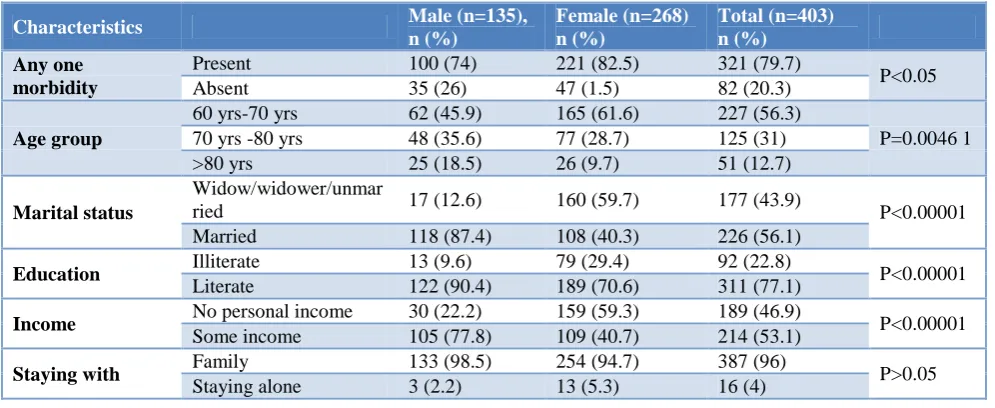
Study population included 403 elderly with majority (56.3%) in 60-70 age groups and 66.5%females.Mean age for males was 70.97±8.55 yrs and females 68.02±7.4 yrs. Widows were significantly much higher than widowers 53.5% versus 9.6%. Majority, 44.7% were staying with spouse and children while 36.5% were with children and 4% were staying alone. Financially dependent were 46.9%. By Udai Pareek rural scale, 200 (49.6%) belonged to low socio economic status. There was gender wise difference in socio demographic characteristics. Even though life expectancy is higher for women in Kerala, the proportion of them in 80+ category was lower in this study. Literacy and provision of any income was also lower for them. Work participation was less 9.5% including 2 females. The socio demographic characteristics of the study population and its gender wise distribution are given in Table 1.
Table 1: Gender wise distribution of socio demographic characteristics.
Characteristics Male (n=135),
n (%)
Female (n=268) n (%)
Total (n=403) n (%) Any one
morbidity
Present 100 (74) 221 (82.5) 321 (79.7)
P<0.05 Absent 35 (26) 47 (1.5) 82 (20.3)
Age group
60 yrs-70 yrs 62 (45.9) 165 (61.6) 227 (56.3)
P=0.0046 1 70 yrs -80 yrs 48 (35.6) 77 (28.7) 125 (31)
>80 yrs 25 (18.5) 26 (9.7) 51 (12.7)
Marital status
Widow/widower/unmar
ried 17 (12.6) 160 (59.7) 177 (43.9) P<0.00001 Married 118 (87.4) 108 (40.3) 226 (56.1)
Education Illiterate 13 (9.6) 79 (29.4) 92 (22.8) P<0.00001
Literate 122 (90.4) 189 (70.6) 311 (77.1)
Income No personal income 30 (22.2) 159 (59.3) 189 (46.9) P<0.00001
Some income 105 (77.8) 109 (40.7) 214 (53.1)
Staying with Family 133 (98.5) 254 (94.7) 387 (96) P>0.05
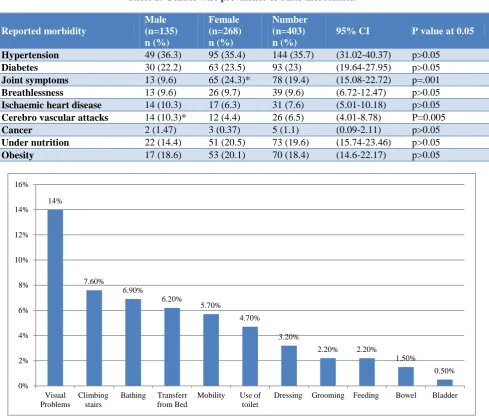
Table 2: Gender wise prevalence of other morbidities.
Reported morbidity
Male (n=135) n (%)
Female (n=268) n (%)
Number (n=403) n (%)
95% CI P value at 0.05
Hypertension 49 (36.3) 95 (35.4) 144 (35.7) (31.02-40.37) p>0.05
Diabetes 30 (22.2) 63 (23.5) 93 (23) (19.64-27.95) p>0.05
Joint symptoms 13 (9.6) 65 (24.3)* 78 (19.4) (15.08-22.72) p=.001
Breathlessness 13 (9.6) 26 (9.7) 39 (9.6) (6.72-12.47) p>0.05
Ischaemic heart disease 14 (10.3) 17 (6.3) 31 (7.6) (5.01-10.18) p>0.05
Cerebro vascular attacks 14 (10.3)* 12 (4.4) 26 (6.5) (4.01-8.78) P=0.005
Cancer 2 (1.47) 3 (0.37) 5 (1.1) (0.09-2.11) p>0.05
Under nutrition 22 (14.4) 51 (20.5) 73 (19.6) (15.74-23.46) p>0.05
Obesity 17 (18.6) 53 (20.1) 70 (18.4) (14.6-22.17) p>0.05
Figure 1: Pattern of disability among study population.
Reported morbidities
Details of any disease which was present for more than 3 months were collected. At least one chronic morbidity was reported by 79.7% (n=321) of the population 95%CI (75.83, 83.63) and it was higher among females 82.5%. More than one morbidity was reported by 44.4%. Reported morbidities were hypertension (35.7%) and diabetes (23%) similar prevalence’s among both genders, joint symptoms (19.4%) significantly higher in females, breathlessness (9.6%), known ischemic heart disease (7.6%) and cerebro vascular attacks (6.5%) cancer (1.1%) higher in males. Other morbidities included venous diseases (3%) and mental illness (1%). About nutritional status 19.6% were undernourished and 18.8% were overweight according to BMI.
Gender wise prevalence of reported morbidities other than hypertension is described and significant differences are highlighted in Table 2.
Prevalence and treatment of hypertension
Blood pressure measurement was taken from all participants. 274 persons were found to have either systolic BP >140 mmHg and/or diastolic BP >90 mm Hg at the time of measurement. Among those with high BP measurements 144 (52.6%) were previously diagnosed thus making the prevalence to 67.9%. Newly detected was 130 (32.7%). Mean duration was 7 years. Among those with known hypertension 91% were started on treatment majority from modern medicine either from general practitioners or nearby medical college. Only 23(15.9%) had well controlled BP.
Physical and visual disability
Physical disability was assessed by Barthel index on activities of daily living. Physical disability was present for 31 (7.6%). Causes of severe disability included blindness, severe mental illness and paralysis. On 14%
7.60%
6.90%
6.20%
5.70%
4.70%
3.20%
2.20% 2.20%
1.50%
0.50% 0%
2% 4% 6% 8% 10% 12% 14% 16%
Visual Problems
Climbing stairs
Bathing Transferr from Bed
Mobility Use of toilet
examination 60 (14%) had severe visual disability due to cataract. Immature cataract of either eye was seen with 315 (78.1%). The common areas of disability are shown in Figure 1.
DISCUSSION
Our findings on socio demographic characteristics were comparable with observations by Ingle et al that 48.2% of elderly persons were women, out of whom 55% were widows.5 A total of 73% of elderly persons were illiterate and dependent on physical labour. One-third was reported to be living below the poverty line, i.e., 66% of older persons were in a vulnerable situation without adequate food, clothing, or shelter. About 90% of the elderly were from the unorganized sector, i.e., they have no regular source of income. In our study, majority were females and 53.5% were widows. Education and economic condition marginally better with 77.8% literate and 46.9% financially dependent. 49.6% belonged to low socio economic status in our study.
Multimorbidity was reported by 44% of our study population. According to Kumar et al 50% of Indian elderly have chronic diseases and 5% of them suffer from immobility.8 One chronic morbidity was reported by 79.6% of our population, may be due to better health seeking behaviour.
A unit record data for Kerala state as analyzed from National Sample Survey Organization (NSSO), 60th round identified five most prevalent ailments in elderly as hypertension (12.1%), disorders of joints and bones (9.6%) and other diagnosed ailments (9%), diabetes mellitus (9.6%) and heart disease (5.5%). Our study found common reported morbidities as hypertension 35.7%, diabetes 23%, joint disorders 19.4% and heart disease as 6.5%.The prevalence of each was found to be higher compared to NSSO based report. Kalavathy et al reported a higher prevalence of 51.8% for hypertension among an elderly community sample from Kerala which had no gender difference. Half were not aware and only a quarter of the treated achieved control.9 The overall prevalence of hypertension was 65% in a multi centric study from Bangladesh and India and among this 45% were aware of the condition and 40% were taking antihypertensive drugs but only 10% achieved control.10 In this study 52.5% were aware and 90.9% were put on treatment but only 15.9% achieved control. In our study a higher prevalence 68.4% was found with no gender difference and half of them unaware and only 16% of those on treatment achieved control. Compared to a South Indian study by Kalaiselvi in which 24.8% of elderly were undernourished.10 We found lesser 19.6% to be undernourished.
Among elderly 10% suffer from impaired physical mobility and 10% are hospitalized at any given time, both proportions rising with increasing age.11 We observed a physical disability about 7.6%. A rural South Indian
study by Kumar et al and North Indian study by Jadhav et al reported the highest reported morbidity of 62.65% for eye problems including cataract and corneal opacity and secondly hypertension 44.3%.12 In latter study the prevalence was 40.6% for cataract and 21.6% hypertension.13 We found that 78.1% had immature cataract and 14% with severe visual disability. In South Indian population respiratory diseases had higher prevalence (34.1%) and diabetes much lower 13.4% compared to our study. Muskulo skeletal diseases had similar prevalence of 23% and stroke much lower 0.99% being reported
CONCLUSION
This study has established that overall morbidity was high in rural Kerala with non-communicable degenerative diseases comprising the major burden. Correctable visual impairment was also high. The rule of half in hypertension seemed to be unchanged which needs further evaluation after the recent implementation of National Program for prevention control of cardiovascular diseases diabetes and stroke. Gender difference in some morbidity namely musculoskeletal diseases among females requires further attention considering the increased life expectancy and financially dependent widowhood status.
ACKNOWLEDGEMENTS
The author acknowledges Dr. Thomas Bina and Dr. Lucy Raphael for departmental guidance and support and the study participants for their whole hearted cooperation and valuable time.
Funding: No funding sources Conflict of interest: None declared
Ethical approval: The study was approved by the Institutional Ethics Committee
REFERENCES
1. Elderly in India 2016.government of India. Ministry of statistics and programme implementation. Central statistics office (social statistics Division). Available at: www.mospi.gov.in. Accessed on 3 March 2018. 2. Van den Akker M, Buntinx F, Knottnerus JA.
Comorbidity or multimorbidity: what's in a name? A review of literature. Eur J Gen Pract. 1996;2:65–70. 3. Bayliss EA, Steiner JF, Fernald DH, Crane LA,
Main DS. Descriptions of barriers to self-care by pe rsons with comorbid chronic diseases. Ann Fam Med. 2003;1:15–21.
4. Asokan NN. Demography and social impact. Geriatrics update. Proceedings of Indo-US Conference of geriatrics Feb 2001, OP Sharma (Ed) Geriatric Society of India, New Delhi. 2001: 5-12. 5. Ingle GK, Nath A. Geriatric health in India:
6. Dilip TR. Age-specific analysis of reported morbidity in Kerala, India. World Health Popul. 2007;9(4):98-108.
7. National High Blood Pressure Education Program. The seventh Report of the joint National Commitee on prevention, Detection, Evaluation and Treatment of high Blood Pressure. Bethseda (MD): National Heart, Lung and Blood Institute (US); 2004. Classification of Blood Pressure. Available at: http://www.ncbi.nlm.nih.gov/books/NBK9633/. 8. Kumar V. Ageing in India: An overview. Indian J
Med Res. 1997;106:257-64.
9. Kalavathy MC, Thankappan KR, Sarma P S,Vasan RS. Prevalence, treatment and control of Hypertension in an elderly community based sample in Kerala, India. Natl Med J India. 2000;13(1):9-15. 10. Kalaiselvi S, Arjumand Y, Jayalakshmy R, Gomathi
R, Pruthu T, Palanivel C. Prevalence of under-nutrition, associated factors and perceived nutritional status among elderly in a rural area of Puducherry, South India. Arch Gerontol Geriatr. 2016;65:156-60.
11. Ashok Kumar T, Sowmiya KR, Radhika G. Morbidity Pattern among the Elderly People Living in a Southern Rural India-a cross sectional Study. Nat J Res Com Med. 2012;1(1):01-60.
12. Jadhav VS, Mundala VD, Gaikwad AV, Doibale MK, Kulkani AP. A study of morbidity profile of Geriatric population in the field practise area of health training Centre, Paithan of Govt Medical College, Aurangabad. ISOR. J Pharmacy. 2012;2(2):184-8.
13. Thakur RP, Banerjee A, Nikumb VB. Health Problems Among the Elderly: A Cross Sectional Study. Ann Med Health Sci Res. 2013;3(1):19-25.
Cite this article as: Jacob SR, Kannan S.Hypertension