www.ijaems.com
Mobile Apps as Supplements of a Typical
Discrete Mathematics Course: Benefits,
Features, and Design Elements
School of Engineering and Computing
Abstract— Mobile Apps have tremendous potential for use as very effective supplements to the exiting learning modalities in a typical introductory Discrete Mathematics course. In this article we consider the general nature of a typical introductory Discrete Mathematics courses derive elements of design which are expected to make the mobile Apps intended for use as supplements to such a course more effective. We enumerate the elements of the topical coverage and inherent characteristics of typical introductory Discrete Mathematics course, and the benefits of a mobile App course supplement. We then present the design aspects and desired salient features of mobile Apps intended for uses as supplements in a typical introductory Discrete Mathematics course, and the elements of user experience (UX) of such an App. We believe that several of these design elements could be adapted across several different courses and disciplines to enhance the learning experience.
Keywords—Course supplement, Design elements of Apps, Introductory Discrete Mathematics course, Mobile Apps, User Experience.
I. INTRODUCTION
We have been witnessing the profound impacts of the Mobile Apps on almost all facets of our lives. As concrete examples, in the short seven years since they were introduced, the number of mobile Apps available in each of the App Store and Google Play was about 1.5 Million in 2015. The total number of iOS App downloads in 2015 was 25 Billion and the total number of Android App downloads in 2015 was 50 Billion. The average time spent by an adult in 2015 has been about 3 hours per day on mobile devices alone.
Although the mobile Apps span a diverse variety of areas and applications, there has been a paucity of Apps as course supplements in the higher education domain. There are tremendous opportunities in higher education to leverage the mobile Apps for smartphones and tablets to serve as supplements to traditional lectures and textbooks, contributing to the enhancement of the effectiveness of learning/teaching beyond the class room. The im
Mobile Apps as Supplements of a Typical
e Mathematics Course: Benefits,
Features, and Design Elements
S.R. Subramanya
School of Engineering and Computing, National University, San Diego, CA 92123
have tremendous potential for use as very effective supplements to the exiting learning modalities in a typical introductory Discrete Mathematics course. In this article we consider the general nature of a typical introductory Discrete Mathematics courses and derive elements of design which are expected to make the mobile Apps intended for use as supplements to such a course more effective. We enumerate the elements of the topical coverage and inherent characteristics of typical atics course, and the benefits of a mobile App course supplement. We then present the design aspects and desired salient features of mobile Apps intended for uses as supplements in a typical introductory Discrete Mathematics course, and the r experience (UX) of such an App. We believe that several of these design elements could be adapted across several different courses and disciplines
Course supplement, Design elements of ete Mathematics course,
We have been witnessing the profound impacts of the Mobile Apps on almost all facets of our lives. As concrete examples, in the short seven years since they were obile Apps available in each of the App Store and Google Play was about 1.5 Million in 2015. The total number of iOS App downloads in 2015 was 25 Billion and the total number of Android App downloads in 2015 was 50 Billion. The average time lt in 2015 has been about 3 hours per day
Although the mobile Apps span a diverse variety of areas and applications, there has been a paucity of Apps as course supplements in the higher education domain. opportunities in higher education to leverage the mobile Apps for smartphones and tablets to serve as supplements to traditional lectures and textbooks, contributing to the enhancement of the effectiveness of learning/teaching beyond the class room. The important
thing to note is that such mobile Apps are not replacements for classroom lectures and textbooks, rather supplements which fill several gaps in the learning process.
In this article, we make a case for the use of Mobile Apps as effective supplements of an introductory Discrete Mathematics course. During a typical introductory Discrete Mathematics course students are required to use critical thinking skills, problem formulation, logical deductions, counting techniques, and mapping verbal descriptions of problems to mathematical objects and problems. Mobile apps are well suited for aiding the students in the understanding of concepts in a Discrete Mathematics course. Such a Mobile App needs to take into account several factors across different dimensio as shown in Fig. 1.
Fig. 1: Major dimensions to be considered in deriving the design factors of a mobile App supplement in an
introductory Discrete Mathematics course
These are (a) the specific characteristics of topics Discrete Mathematics; (b) mobile device and user characteristics; (c) pedagogical issues; (c)
interface and user experience
Some of the characteristics of a typical introductory Discrete Mathematics course are that they involve: (a) quantitative elements (things are very well defined and not much room for qualitative, subjective, or ambiguous judgments), (b) significant computations, (c) well
arguments, proof methods, and derivations to establish conclusions from a set of premises, (d) successiv building upon already established facts and truths, etc. Some of the pedagogical issues to be supported in a typical introductory Discrete Mathematics course are: (a)
Page | 958
Mobile Apps as Supplements of a Typical
e Mathematics Course: Benefits,
Features, and Design Elements
Diego, CA 92123
thing to note is that such mobile Apps are not replacements for classroom lectures and textbooks, rather supplements which fill several gaps in the learning
In this article, we make a case for the use of Mobile Apps s of an introductory Discrete Mathematics course. During a typical introductory Discrete Mathematics course students are required to use critical thinking skills, problem formulation, logical deductions, counting techniques, and mapping verbal of problems to mathematical objects and problems. Mobile apps are well suited for aiding the students in the understanding of concepts in a Discrete Mathematics course. Such a Mobile App needs to take several factors across different dimensions,
Major dimensions to be considered in deriving the design factors of a mobile App supplement in an
introductory Discrete Mathematics course These are (a) the specific characteristics of topics Discrete
le device and user characteristics; ; (c) the factors related to user interface and user experience (UX).
independent thinking, (b) analytical skills, (c) building on existing proficiencies, (d) problem representations, (e) mathematical reasoning /argumentation, (f) proof methods, (g) abstraction, (h) generalization, etc.
Some of the major user interface factors to be considered at a lower visual level are: (a) Fonts and sizes, (b) colors, (c) contrasts, (d) textures, (e) borders, (f) icons, (g) graphics, etc. At a higher user perception level, the factors to be considered are: (a) menus, (b) interactions, (c) use and mapping of real-world metaphors, etc. The factors need to be considered in the context of the mobile device constraints and user characteristics such as, (a) limited screen sizes of devices, (b) limited interaction modes on devices, (c) changing contexts of mobile users, (d) limited attention spans of mobile users, etc.
Incorporation of the design elements developed in this article into mobile Apps intended as supplements in an introductory Discrete Mathematics course is expected to provide not just a platform for getting answers to questions, but to provide an interactive, fun, and
environment for learning concepts in Discrete Mathematics. A well–designed App makes it engaging for the students, lowering their effort needed to understand concepts, while leveraging the instructors’ efforts in conveying hard and abstract concepts. This results in an enhanced teaching and learning experience.
II. RELATED WORK
The rapid pace of development of mobile technologies and their tremendous impacts on education domain have necessitated new thinking in the development of content, teaching, and learning. Due to space limitations, only a few samples of the work in this area is given in this section. The adoption of mobile technologies in learning environments and some of the design requirements are given in [1, 2]. The recent surge in the develop
Apps for smartphones has given a new impetus to several mobile learning related initiatives. These have spanned several areas such as (a) development of mobile content and applications, (b) research into pedagogical issues in using mobile devices/applications in learning [3, 4], (c) study and evaluation of the effectiveness of mobile Apps in learning [5], etc. A brief summarization of some of the literature related to mobile learning is given in [6]. A survey of perceptions by students of mobile lea
how it might enhance their present learning capabilities is given in [7].
In [8] some guidelines for learning in mobile environment are given, including defining mobile learning in terms of a flexible model to enable developers, tutors, and lear to identify learning practices and effective pedagogies, and identifying key elements unique to mobile learning. Reports of several work related to pedagogical issues in independent thinking, (b) analytical skills, (c) building on ) problem representations, (e) mathematical reasoning /argumentation, (f) proof methods, (g) abstraction, (h) generalization, etc.
Some of the major user interface factors to be considered at a lower visual level are: (a) Fonts and sizes, (b) colors, contrasts, (d) textures, (e) borders, (f) icons, (g) graphics, etc. At a higher user perception level, the factors to be considered are: (a) menus, (b) interactions, (c) use world metaphors, etc. The factors context of the mobile device constraints and user characteristics such as, (a) limited screen sizes of devices, (b) limited interaction modes on devices, (c) changing contexts of mobile users, (d) limited
n of the design elements developed in this article into mobile Apps intended as supplements in an introductory Discrete Mathematics course is expected to provide not just a platform for getting answers to questions, but to provide an interactive, fun, and creative environment for learning concepts in Discrete designed App makes it engaging for the students, lowering their effort needed to understand concepts, while leveraging the instructors’ efforts in ts. This results in an enhanced teaching and learning experience.
The rapid pace of development of mobile technologies and their tremendous impacts on education domain have necessitated new thinking in the development of content, learning. Due to space limitations, only a few samples of the work in this area is given in this section. The adoption of mobile technologies in learning environments and some of the design requirements are given in [1, 2]. The recent surge in the development of Apps for smartphones has given a new impetus to several mobile learning related initiatives. These have spanned several areas such as (a) development of mobile content and applications, (b) research into pedagogical issues in pplications in learning [3, 4], (c) study and evaluation of the effectiveness of mobile Apps in learning [5], etc. A brief summarization of some of the literature related to mobile learning is given in [6]. A survey of perceptions by students of mobile learning and how it might enhance their present learning capabilities is
In [8] some guidelines for learning in mobile environment are given, including defining mobile learning in terms of a flexible model to enable developers, tutors, and learners to identify learning practices and effective pedagogies, and identifying key elements unique to mobile learning. Reports of several work related to pedagogical issues in
science, math, and technical education have been compiled in [4]. The effectivene
mobile technologies in augmenting traditional teaching methods and in increasing the student engagement, motivation, and interaction is given in [9]. In [5], it is shown that the value propositions for engineering and liberal arts programs are significantly different. More work in the design elements and in the effectiveness of mobile Apps in higher education, especially in engineering and related sciences are needed.
III. SMARTPHONE APP INTRODUCTORY
MATHEMATICS
Although there have been several Apps used in academia, they are mostly for administrative purposes such as institutional and departmental information, maps and directions, information about programs and courses, calendar of events, etc. However,
widespread use of smartphone Apps as learning supplements in higher education, especially in Engineering and Computer Science courses. There is a tremendous opportunity to develop suitable Apps which could act as powerful catalysts and s
learning the concepts in the above courses. We envision great opportunities for the adoption of Mobile Apps as course supplements in engineering and related sciences in higher educational institutions. In this paper, we focus on the benefits, features, and design elements of mobile Apps in the context of a typical discrete mathematics course.
3.1 Course content in a typical introductory discrete mathematics course
There are numerous textbooks and syllabi adopted in introductory Discrete Mathe
coverage in a typical introductory Discrete Mathematics course based on a subset of chapters
Fig. 2.
Fig. 2: Topics covered in a typical introductory discrete mathematics course
science, math, and technical education have been compiled in [4]. The effectiveness and usefulness of mobile technologies in augmenting traditional teaching methods and in increasing the student engagement, motivation, and interaction is given in [9]. In [5], it is shown that the value propositions for engineering and rams are significantly different. More work in the design elements and in the effectiveness of mobile Apps in higher education, especially in engineering and related sciences are needed.
APP AS SUPPLEMENTS IN INTRODUCTORY DISCRETE
MATHEMATICS COURSES
Although there have been several Apps used in academia, they are mostly for administrative purposes such as institutional and departmental information, maps and directions, information about programs and courses, calendar of events, etc. However, there has not been widespread use of smartphone Apps as learning supplements in higher education, especially in Engineering and Computer Science courses. There is a tremendous opportunity to develop suitable Apps which could act as powerful catalysts and supplements for learning the concepts in the above courses. We envision great opportunities for the adoption of Mobile Apps as course supplements in engineering and related sciences in higher educational institutions. In this paper, we focus on , features, and design elements of mobile Apps in the context of a typical discrete mathematics
3.1 Course content in a typical introductory discrete
There are numerous textbooks and syllabi adopted in introductory Discrete Mathematics courses. The topical coverage in a typical introductory Discrete Mathematics course based on a subset of chapters of [10] is shown in
www.ijaems.com First, the notion of sets and the operations on sets are
introduced. Then the foundations of logic such as propositions, logical operators, predicates and quantifiers, nested quantifiers, and methods of proof are presented. This is followed by the concepts of functions, types of basic functions (one-to-one, onto, and one
onto), relations, and basic properties of relations (reflexivity, symmetry, transitivity), and types of relations (partial order, equivalence relations). The concepts of Boolean algebra and Boolean functions, which play a central role in the design of digital logic circuits are then covered, followed by logic gates and building basic circuitry using logic gates. The basic counting methods permutations, combinations, binomial coefficients, generalized permutations and combinations, and the advanced counting methods – recurrence relations, generating functions, and inclusion–exclusion, are an important part of any discrete mathematics course. Introduction to graph theory, representation of graphs, several of the interesting graph properties, and a few elementary and useful graph algorithms are covered in almost all discrete mathematics courses. Basic elements of automata, grammars, and languages are also covered in some courses, which form the basics / backgr material for courses on Automata Theory, Programming Languages, and Compilers.
3.2 Key skills to be learnt in a typical introductory discrete mathematics course
The previous subsection outlined the major topical coverage of a typical discrete mathematics course. In this subsection, we present the key skills expected to be learnt in a typical introductory discrete mathematics course, which are shown in Fig. 3.
Fig. 3: Skills expected to be learnt in a typical introductory discrete mathematics course
Generalization helps students of Mathematics and Computer Science extend the properties applicable to a small set of elements (or a few examples) to the largest set of elements possible. Abstraction is a skill that helps students in several areas of Comput
Abstraction is a technique which helps manage
nd the operations on sets are
introduced. Then the foundations of logic such as propositions, logical operators, predicates and quantifiers, nested quantifiers, and methods of proof are presented. This is followed by the concepts of functions, types of one, onto, and one-to-one and onto), relations, and basic properties of relations (reflexivity, symmetry, transitivity), and types of relations (partial order, equivalence relations). The concepts of ns, which play a central role in the design of digital logic circuits are then covered, followed by logic gates and building basic circuitry using logic gates. The basic counting methods – permutations, combinations, binomial coefficients, utations and combinations, and the recurrence relations, exclusion, are an important part of any discrete mathematics course. Introduction to graph theory, representation of graphs, the interesting graph properties, and a few elementary and useful graph algorithms are covered in almost all discrete mathematics courses. Basic elements of automata, grammars, and languages are also covered in some courses, which form the basics / background material for courses on Automata Theory, Programming
typical introductory
The previous subsection outlined the major topical ics course. In this subsection, we present the key skills expected to be learnt in a typical introductory discrete mathematics course,
kills expected to be learnt in a typical introductory discrete mathematics course Generalization helps students of Mathematics and Computer Science extend the properties applicable to a small set of elements (or a few examples) to the largest set of elements possible. Abstraction is a skill that helps students in several areas of Computer Science. Abstraction is a technique which helps manage
complexity of computer systems. It establishes a level of detail on which to interact with the system by the provision of well-defined interfaces to the level below the current interaction level via
complex details of the lower level. It is an extremely crucial concept since in computing systems, the range of entities and concepts range from 10
the concepts of abstraction, it would be practically impossible to comprehend and design systems consists of so many levels. Induction and recursion are important concepts crucial to algorithm and program development. Logical thinking and reasoning, and proof construction are central to establishing the correctness of al
and programs. Identification of patterns is a very important skill which plays a key role in generalization, algorithm development and program construction, and large–scale software development. Analytical problem solving involves the ability to v
conceptualize or solve problems based on the available information and constraints pertaining to the problem. Counting techniques are used in determining the possible outcomes of experiments, programs, design and test data for testing hardware and software, algorithm analysis, discrete probability, etc.
3.3 Expected benefits of the mobile App course supplement
The expected benefits of a well
supplement in a typical introductory Discrete Mathematics course is summari
described below.
Fig. 4: Expected benefits of a Mobile App supplement in introductory Discrete Mathematics course
Since the Apps are inanimate, the slow learners would not have hesitation to use them repeatedly to learn or reinforce concepts they have particular difficulty with. This, combined with the entertaining/engaging aspect, would be a motivating factor for usi
learning. The incorporation of appropriate positive feedback would provide encouragement in addition to motivation.
Page | 960 complexity of computer systems. It establishes a level of detail on which to interact with the system by the defined interfaces to the level below the current interaction level via suppressing the more complex details of the lower level. It is an extremely crucial concept since in computing systems, the range of entities and concepts range from 10–9 to 10+12. Without the concepts of abstraction, it would be practically comprehend and design systems consists of so many levels. Induction and recursion are important concepts crucial to algorithm and program development. Logical thinking and reasoning, and proof construction are central to establishing the correctness of algorithms and programs. Identification of patterns is a very important skill which plays a key role in generalization, algorithm development and program construction, and scale software development. Analytical problem solving involves the ability to visualize, formulate, conceptualize or solve problems based on the available information and constraints pertaining to the problem. Counting techniques are used in determining the possible outcomes of experiments, programs, design and test data hardware and software, algorithm analysis,
3.3 Expected benefits of the mobile App course
The expected benefits of a well–designed mobile App supplement in a typical introductory Discrete Mathematics course is summarized in Fig. 4, and briefly
Repetitious use of content will enable reinforcing abstract concepts. Due to limited times in class rooms, repetitions may not be possible/practical (beyond a limited number), and without an App, the only recourse for motivated students are self-reading, discussion with classmates, tutoring, etc. Mobile Apps facilitate repetitious use enabling retention.
The Apps can be designed making use of judicious combinations of text, graphics, audio, video, and animation to provide virtual hands-on experience. Mobile Apps provide by time’,
‘any-supporting continuous learning. Apps, by their interactive and media rich nature, would also facilitate exploration and experimentation, which are highly essential to comprehend and gain insight into abstract concepts. The Apps could be designed to be exploratory (as opposed to being limited to a narrow scope) by incorporating numerous related content, and by providing support for non–linear navigation, cross–referencing, and even making cross–disciplinary connections, as appropriate.
The Mobile Apps can evolve continuously using dynamic updates based on newer examples, incorporat (newer) game–like interactions, more effective interactions and self–assessments, etc. Thus they could be continually improved to better serve the users more effectively.
3.4 Desired salient features of the mobile App course supplement
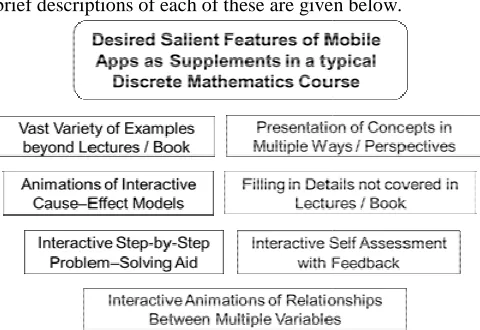
We have identified several desired salient features of a mobile App used as a supplement to an introductory Discrete Mathematics course are shown in Fig, 5 and brief descriptions of each of these are given below.
Fig. 5: Desired salient features of a Mobile App supplement in introductory Discrete Mathematics course Varieties of figures and examples related to concepts, from sources other than the textbook, are desirable to facilitate different views. Many times, the expositions of the same concept are done in different ways in different books and other sources. Inclusions of these would cater Repetitious use of content will enable reinforcing abstract concepts. Due to limited times in class rooms, repetitions ot be possible/practical (beyond a limited number), and without an App, the only recourse for motivated reading, discussion with classmates, tutoring, etc. Mobile Apps facilitate repetitious use
d making use of judicious combinations of text, graphics, audio, video, and on experience. Mobile -where’ access supporting continuous learning. Apps, by their interactive ture, would also facilitate exploration and experimentation, which are highly essential to comprehend and gain insight into abstract concepts. The Apps could be designed to be exploratory (as opposed to being limited to a narrow scope) by merous related content, and by providing referencing, and disciplinary connections, as
The Mobile Apps can evolve continuously using dynamic updates based on newer examples, incorporation of like interactions, more effective assessments, etc. Thus they could be continually improved to better serve the users more
3.4 Desired salient features of the mobile App course
ified several desired salient features of a mobile App used as a supplement to an introductory Discrete Mathematics course are shown in Fig, 5 and brief descriptions of each of these are given below.
Desired salient features of a Mobile App supplement in introductory Discrete Mathematics course Varieties of figures and examples related to concepts, from sources other than the textbook, are desirable to facilitate different views. Many times, the expositions of ferent ways in different books and other sources. Inclusions of these would cater
to different learning styles. Material from other sources (ex. Wikipedia) would be immensely useful in filling in several details and up-to-date content not found in a textbook.
It would be easier to build into an App multiple ways of explaining concepts, and building examples across multiple applications. This would facilitate catering to students with different capabilities, interests, and learning styles. Interactivity is easy to build into a mobile App. This can be advantageously used to provide a step
aid for concept learning and problem solving. Animation and graphics facilitate the comprehension of cause models of a real–world system.
The interactive self–assessment component draws upon a large pool of questions with varying difficulty levels. The self-assessment test presents questions to the learner in a progressive manner, with questions of gradually increasing difficulty. Based on the answers provided, App (system) determines the level of comprehension or difficulty areas of the learner, and focus more on those areas by providing more examples and assessment questions as needed. Thus it may have some form of personalization built in in the form seque
suited to the individual learners in order to reinforce the weak areas.
The relationships of two variables is easy to comprehend – when one of the variables is an independent variable and the other a dependent variable, one can observe th behavior of the dependent variable over the range of the independent variable. However, when multiple variables interact with each other, it becomes extremely difficult to understand the effect of a few variables on the others. An interactive animation component would be greatly aid in the above task.
3.5 Major user experience (UX) factors to be considered in the design of the mobile App course supplement
The approaches to usability issues with respect to mobile learning in the context of PDAs which have compiled in [11] are relevant in the Smartphone context as well. The “Five Es” of usability of a product according to [12] are very much relevant to Apps. Since the usability of Apps is very crucial from a user’s perspective. A product is usable when
(b) efficient, (c) engaging, (d) easy to learn, and (f) error tolerant. It is effective
accomplishment with minimum effort; allows rapid task completion with few errors; when it offers enjoyable day
learn when it supports rapid initial skill acquisition and expanded skill development with experience; tolerant when it prevents errors and supports error recovery.
to different learning styles. Material from other sources (ex. Wikipedia) would be immensely useful in filling in date content not found in a
It would be easier to build into an App multiple ways of explaining concepts, and building examples across multiple applications. This would facilitate catering to students with different capabilities, interests, and learning asy to build into a mobile App. This can be advantageously used to provide a step-by-step aid for concept learning and problem solving. Animation and graphics facilitate the comprehension of cause–effect
world system.
assessment component draws upon a large pool of questions with varying difficulty levels. The assessment test presents questions to the learner in a progressive manner, with questions of gradually increasing difficulty. Based on the answers provided, the App (system) determines the level of comprehension or difficulty areas of the learner, and focus more on those areas by providing more examples and assessment questions as needed. Thus it may have some form of personalization built in in the form sequence of questions suited to the individual learners in order to reinforce the
The relationships of two variables is easy to comprehend when one of the variables is an independent variable and the other a dependent variable, one can observe the behavior of the dependent variable over the range of the independent variable. However, when multiple variables interact with each other, it becomes extremely difficult to understand the effect of a few variables on the others. An omponent would be greatly aid in
3.5 Major user experience (UX) factors to be considered in the design of the mobile App course
www.ijaems.com Special considerations must be given to the d
content and user interfaces for mobile devices and applications. Some of the major content
that need to be addressed in mobile environments are presented in [13]. A model and some issues for the consumption experience of digital educational content have been proposed in [14]. The proposed model is expected to aid the designers and developers of digital educational content and services in enhancing the content consumption experience.
The user experience (UX) factors that we propose to considered in the design of the mobile App supplement are summarized in Fig. 6, and are briefly described below.
Fig. 6: Major user experience (UX) factors of a Mobile App supplement
Intuitive interface. An intuitive interface does not require detailed instructions and does hardly have any learning curve. The elements of the interface are thoughtfully designed and judiciously laid out. This makes it ‘natural’ for users to use.
Ease of use. An easy–to–use interface is important for the App to be appealing. The interface should hide the underlying complexities of functions and operations to enable the users to use the App effectively to accomplish the intended uses. The average number of (atomic) user actions (ex. Key clicks / taps) to accomplish a tas minimal.
Unambiguous affordances. An affordance
an object, or an environment, which allows an individual to perform an action. In the context of human
interaction (HCI) it indicates the easy discoverability of possible actions. In the case of mobile Apps, the affordances should be unambiguous to enable selection of actions to achieve intended operations, and eliminate/minimize the number of backtracking.
Minimal cognitive load. The average number of levels in the navigation to accomplish a given task / functionality contributes to the cognitive load. Minimal cognitive load is extremely important for acceptance of mobile Apps, especially when used as supplement to learning. With a low cognitive load, the user can focus more on the content and the learning aspects.
Engaging interaction/immersion. The interactions should be designed to be engaging and immersive to sustain the interest of the user to the point of finishing the tasks. This
Special considerations must be given to the design of
content and user interfaces for mobile devices and applications. Some of the major content-related issues that need to be addressed in mobile environments are presented in [13]. A model and some issues for the cational content have been proposed in [14]. The proposed model is expected to aid the designers and developers of digital educational content and services in enhancing the content
The user experience (UX) factors that we propose to be considered in the design of the mobile App supplement are summarized in Fig. 6, and are briefly described below.
Major user experience (UX) factors of a Mobile
An intuitive interface does not require ed instructions and does hardly have any learning curve. The elements of the interface are thoughtfully designed and judiciously laid out. This makes it ‘natural’
use interface is important for the aling. The interface should hide the underlying complexities of functions and operations to enable the users to use the App effectively to accomplish the intended uses. The average number of (atomic) user actions (ex. Key clicks / taps) to accomplish a task is
is a property of an object, or an environment, which allows an individual to perform an action. In the context of human–computer interaction (HCI) it indicates the easy discoverability of possible actions. In the case of mobile Apps, the d be unambiguous to enable selection of actions to achieve intended operations, and eliminate/minimize the number of backtracking.
The average number of levels in the navigation to accomplish a given task / functionality to the cognitive load. Minimal cognitive load is extremely important for acceptance of mobile Apps, especially when used as supplement to learning. With a low cognitive load, the user can focus more on the content
The interactions should be designed to be engaging and immersive to sustain the interest of the user to the point of finishing the tasks. This
is especially important considering the fact that the attention spans of mobile users are rather
Consistency of interactions and navigations. interactions and navigations should be consistent across tasks and functionalities. This makes App easy to learn and to use, with reduced cognitive burden.
IV. CONCLUSION The mobile Apps are just beginn
the higher education domain, and there is tremendous potential for Apps to supplement traditional course work and textbooks. In this article, we outlined the nature of an introductory Discrete Mathematics course, and the expected benefits, the desirable salient features, and the user experience factors that must be considered in a mobile App for use as supplement in a typical introductory Discrete Mathematics course. Well
Apps acting as supplements to traditional lectures and textbooks have the potential to enhance the effectiveness of teaching, and to enhance the learning experience.
REFERENCES
[1] Parson, D., Ryu, H., & Cranshaw, M. (2006). A Study of Design Requirements for Mobile Learning Environments, Proc. 6th International
Advanced Learning Technologies
[2] Rene, C.J. & Valdes, C.M. (2007). Are you Ready for Mobile Learning, Educase Quarterly
[3] Bransford, J.D., Brown, A.L., & Cocking, R.C. (Eds.) (2000). How People Learn: Brain, Mind, Experience, and School, Nat
Washington, DC.
[4] Fraser-Abder, P. & Wallace R.J., (Eds.). (2008). Pedagogical Issues in Science, Math, and Technical Education, Vol. 3 (ISBN: 0
[5] Percival, J. & Percival, N. (2008). Engineering Students’ Perceptions of Mobi
the World Congress on Engineering and Computer Science, San Francisco.
[6] Cobcroft, R. S., Towers, S. J., Smith, J. E., & Bruns, A. (2006). Mobile learning in review: Opportunities and challenges for learners, teachers, and institutions (pp. 21–30). Proc. Online Learning and Teaching (OLT) Conference, Queensland University of Technology, Brisbane.
[7] Vate-U-Lan, P. (2008). Mobile Learning: Major Challenges for Engineering Education, ASEE/IEEE Frontiers in Education Conference Saratoga Springs, NY.
Page | 962 is especially important considering the fact that the attention spans of mobile users are rather short.
Consistency of interactions and navigations. The interactions and navigations should be consistent across tasks and functionalities. This makes App easy to learn and to use, with reduced cognitive burden.
CONCLUSION
The mobile Apps are just beginning to make inroads in the higher education domain, and there is tremendous potential for Apps to supplement traditional course work and textbooks. In this article, we outlined the nature of an introductory Discrete Mathematics course, and the efits, the desirable salient features, and the user experience factors that must be considered in a mobile App for use as supplement in a typical introductory Discrete Mathematics course. Well–designed Apps acting as supplements to traditional lectures and textbooks have the potential to enhance the effectiveness of teaching, and to enhance the learning experience.
REFERENCES
Parson, D., Ryu, H., & Cranshaw, M. (2006). A Study of Design Requirements for Mobile Learning Proc. 6th International Conference on Advanced Learning Technologies.
Rene, C.J. & Valdes, C.M. (2007). Are you Ready Educase Quarterly, 2.
Bransford, J.D., Brown, A.L., & Cocking, R.C. (Eds.) (2000). How People Learn: Brain, Mind, Experience, and School, National Academy Press,
Abder, P. & Wallace R.J., (Eds.). (2008). Pedagogical Issues in Science, Math, and Technical
, Vol. 3 (ISBN: 0-615-12634-0).
Percival, J. & Percival, N. (2008). Engineering Students’ Perceptions of Mobile Learning, Proc. of the World Congress on Engineering and Computer
Cobcroft, R. S., Towers, S. J., Smith, J. E., & Bruns, A. (2006). Mobile learning in review: Opportunities and challenges for learners, teachers, and institutions Proc. Online Learning and Teaching , Queensland University of
[8] O'Malley, C., Vavoula, G., Glew, J. P., Sharples, M., & Lefrere, P. (2003). Guidelines for Learning/Teaching/Tutoring in a Mobile Environment, Report of MOBILearn Project (UoN, UoB, OU/D4.1/1.0) (www.mobilearn.org), 1–57. [9] Callaghan, M. J., Harkin, J., McGinnity, T. M.,
Woods, D. N., & Harrison, B. (2006). Technology Supported Pedagogy in a Flexible, Mobile, Learning Environment, Proc. Association of Pacific Rim
Universities Conference on Online Distance
Learning and Internet, Tokyo.
[10] Rosen, K. (2003). Discrete Mathematics and its Applications. McGraw-Hill, 2003.
[11] Kukulska–Hume, A. (2007). Mobile Usability in Educational Contexts: What have we Learnt?, International Review of Research in Open and Distance Learning, 8(2), (ISSN: 1492-3831).
[12] Quesenbery, W. The Five Dimensions of Usability, in M. J. Albers & B. Mazur (Eds.), Content and Complexity: Information Design in Technical Communication, Mahwah, NJ: Lawrence Erlbaum Associates.
[13] Subramanya, S.R., & Yi, B.K. (2005). Mobile Content Provisioning – Major Issues, Wireless World Research Forum, Paris.