Original Research Article
A cross sectional study to assess the knowledge and response to dog bite
among the urban and rural population of Hubballi taluk
Maneesha Godbole, Anjana Ramachandra Joshi*, Dattatraya D. Bant
INTRODUCTION
Rabies is one of the oldest and most terrifying diseases known to man.1 It has been recognized since the Vedic period (1500-500 BC) and described in the ancient Indian scripture Atharvaveda.2
Rabies remains an under-reported neglected zoonosis with a case-fatality rate of almost 100% in humans and animals. Dog-mediated human rabies causes tens and thousands of human deaths annually despite being 100% preventable. More than 95% of human cases are caused by the bite of a rabies-infected dog.3
It is a rapidly progressive, acute infectious disease of central nervous system caused by Lyssavirus of the family Rhabdoviridae.4
Rabies is categorized as one of the 17 neglected tropical diseases as stated by WHO, it is still a major public health problem, and a matter of global concern that rabies remains a neglected disease 133 years after the discovery of the rabies vaccine by Louis Pasteur (1885).5
The reasons for this neglect lie at various levels. Insufficient surveillance systems, access to the rabies vaccine, lack of awareness among the public and also
ABSTRACT
Background: Rabies is a fatal zoonotic disease of the central nervous system, most commonly caused by the bite of
rabid dogs. Globally canine rabies causes 59,000 human deaths, over 3.7 million DALYs and 8.6 billion USD economic losses annually. These losses are due to a lack of knowledge about wound management and post-exposure prophylaxis. The objective of the study was to assess the knowledge and practices following dog bite and its management among the urban and rural population.
Methods: A cross-sectional study was conducted in the field practice area of KIMS, Hubli. 120 households of the urban and rural locality were interviewed with a semi-structured pretested questionnaire.
Results: Overall 89.16% of the study population was aware that the disease can be prevented by vaccination. 35% of
the rural and 28% of the urban population believed that the disease can spread from person to person. The knowledge about the site and the number of doses of vaccine was poor among both the population. The harmful practices for treatment of bite were still prevalent among both rural (25%) and urban (8.3%) population.
Conclusions: The knowledge about the dog bite management and Rabies prevention is insufficient among both
populations. There are myths and misconceptions about the disease and wound management. Practices like application of harmful substances like lime, turmeric, mud are the problems hindering rabies prevention and control. Proper steps need to be taken up to control the canine rabies.
Keywords: Rabies, Myths, Misconceptions, Dog-bite, Post-exposure prophylaxis
Department of Community Medicine, Karnataka Institute of Medical Sciences, Hubballi, Karnataka, India
Received: 24 December 2018
Accepted: 11 January 2019
*Correspondence:
Dr. Anjana Ramachandra Joshi, E-mail: [email protected]
Copyright: © the author(s), publisher and licensee Medip Academy. This is an open-access article distributed under
the terms of the Creative Commons Attribution Non-Commercial License, which permits unrestricted non-commercial use, distribution, and reproduction in any medium, provided the original work is properly cited.
cooperation among the local leaders and policy makers all impede the efforts to control rabies.
And also still there are many myths and false beliefs regarding wound management. These include the application of oils, mud, turmeric and more faith in indigenous medicines and food restrictions.6
According to the latest WHO estimate about 59,000 human deaths due to rabies is reported worldwide every year, over 3.7 million disability-adjusted life years, around 15 million animal bites requiring post-exposure rabies prophylaxis, occur in India every year.7
According to GOI from National Rabies control programme, annual human rabies death incidence to be around 20,000 and the annual incidence of animal bites to be 1.7%.8
Global freedom from the threat of dog-mediated rabies is feasible within our lifetime. With the tools, vaccine, and evidence available, an integrated investment strategy and intersectoral approach is needed to make this vision a reality.9
There are various initiatives taken by the WHO and GOI for the prevention and control of human rabies. Public awareness, health education, dog vaccination and the availability and accessibility of post-exposure prophylaxis are key for rabies prevention and control.
In 2016, Triple Joint World Health Organization (WHO), World Organization for Animal Health (OIE), Food and Agriculture Organization of the United Nations (FAO) stated “Educate, Vaccinate, Eliminate: Achieving zero human deaths from dog-transmitted rabies by 2030”.10
The World Rabies Day 2018 theme is Rabies: Share the message. Save a life, health education regarding wound management is very important and it saves many lives.
Very few studies are done to assess the knowledge of awareness about rabies and its management among the general public and there are many differences in the practice of management in the urban and rural community. There is a need to improve the awareness about the prevention and management of dog-mediated rabies, the present study intends to assess the knowledge and practices after dog bite among the community.
Objectives
To assess the knowledge about dog bite
To identify the different practices following dog bite
To compare the knowledge and practices between urban and rural people.
METHODS
Study setting: Field practice area of Department of Community Medicine, KIMS, Hubli.
Study design: Community based cross sectional study.
Study population: Residents of urban and rural areas of Hubli Taluk.
Study period: From 13 April 2018 to 10 May 2018.
Sample size
Review of literature, came up with few studies about awareness of dog bite among the general population, therefore assuming that 50% of the population are aware of dog bite management, the sample size was calculated using (Z1-α)2PQ/d2.
At 97% confidence interval and 10% absolute precision, sample size came to 120
Sampling strategy
Inclusion criteria: Individuals above 18 years of age.
Exclusion criteria: Those who did not give consent for the study.
Study tool
Pre designed, semi structured piloted questionnaire was used.
Questionnaire was constructed under following headings.
Socio-demographic data of the study population.
Knowledge about the dog bite and the disease.
Attitude and practice of the study participants after the dog bite.
Method of data collection
Informed verbal consent was taken.
The data was collected from urban and rural field practice area of department of community medicine, KIMS, Hubli. House to house survey was done to collect the information. Streets were selected randomly and then in those streets, houses were randomly selected.
Data analysis
Data was entered into MS Excel program and analyzed using IBM SPSS Statistics 21 software. Descriptive statistics such as frequencies and percentage were used. Data analysis was performed using the chi square test and fisher exact test; and a p<0.05 was considered statistically significant.
RESULTS
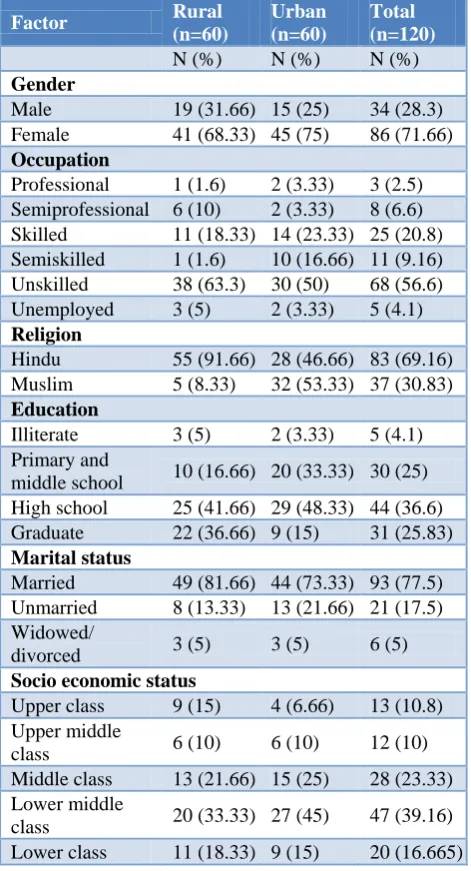
workers (rural-63.3%, urban-50%). Only 5%in rural and 3.3% in rural were illiterate. 53.33% in rural and 56.66% in urban population lived in nuclear family. Most of the families belonged to lower middle class.
Table 1: Socio demographic characters.
Factor Rural
(n=60)
Urban (n=60)
Total (n=120)
N (%) N (%) N (%)
Gender
Male 19 (31.66) 15 (25) 34 (28.3) Female 41 (68.33) 45 (75) 86 (71.66)
Occupation
Professional 1 (1.6) 2 (3.33) 3 (2.5) Semiprofessional 6 (10) 2 (3.33) 8 (6.6) Skilled 11 (18.33) 14 (23.33) 25 (20.8) Semiskilled 1 (1.6) 10 (16.66) 11 (9.16) Unskilled 38 (63.3) 30 (50) 68 (56.6) Unemployed 3 (5) 2 (3.33) 5 (4.1)
Religion
Hindu 55 (91.66) 28 (46.66) 83 (69.16) Muslim 5 (8.33) 32 (53.33) 37 (30.83)
Education
Illiterate 3 (5) 2 (3.33) 5 (4.1) Primary and
middle school 10 (16.66) 20 (33.33) 30 (25) High school 25 (41.66) 29 (48.33) 44 (36.6) Graduate 22 (36.66) 9 (15) 31 (25.83)
Marital status
Married 49 (81.66) 44 (73.33) 93 (77.5) Unmarried 8 (13.33) 13 (21.66) 21 (17.5) Widowed/
divorced 3 (5) 3 (5) 6 (5)
Socio economic status
Upper class 9 (15) 4 (6.66) 13 (10.8) Upper middle
class 6 (10) 6 (10) 12 (10) Middle class 13 (21.66) 15 (25) 28 (23.33) Lower middle
class 20 (33.33) 27 (45) 47 (39.16) Lower class 11 (18.33) 9 (15) 20 (16.665)
Knowledge, attitude and practices after dog bite
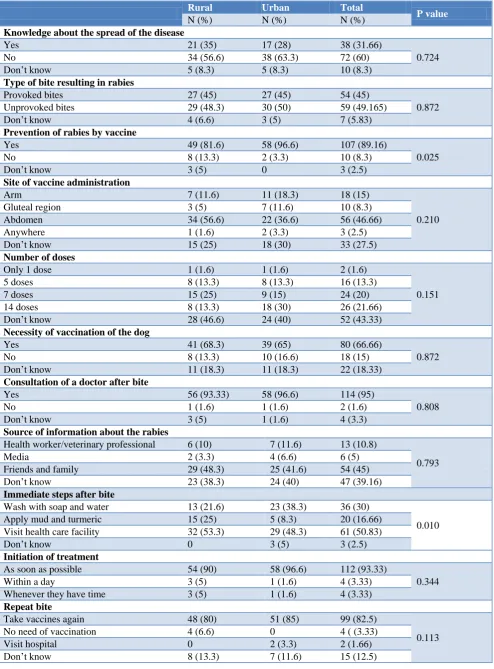
According to 56.6% of the rural and 63.3% of the urban population the disease rabies cannot spread from person to person.
48.3% of the rural and 50% of the urban were of the opinion that unprovoked bites results in rabies. 93.3%of the rural and 96.6% of the urban opine that they should consult doctor after the dog bite. Most of the study population (rural-86.6%, urban-96.6%) was aware that the dog bite disease can be prevented by vaccine. Only 23.3% of the rural and 15% of the urban thinks that only tetanus toxoid (TT) is sufficient.
Figure 1: Immediate measures taken after dog bite.
Figure 2: Prevention of rabies by vaccine.
76.6% of the rural and 66.6% of the urban was aware of specific vaccine for rabies. But the knowledge about the site and number of doses of vaccine was very poor among both urban and rural population. 56.6% of the rural and 36.6% among the urban still thinks that the site of vaccination is abdomen.
Most of the population (rural-46.6%, urban-40%) was not aware of the number of doses and only 13.3%of the urban and rural are aware of the correct number of doses. So there is a large gap about the knowledge about the dog bite management.
Only 21.6% of the rural and 38.3% of the urban were aware that the wound washing with soap and water is the important and immediate step after dog bite, 25% of the rural and 8.3% of the urban still prefers to apply mud, turmeric, lime. Food restrictions were followed by 56.66% of the population.
Most important source of information about rabies was friends and families (rural-48.3%, urban-41.6%), whereas health system was only 10% for rural and 11.6% for urban population. In spite of the nearest health care facility, health care set up was a poor source of information about rabies.
25%
1% 17%
54%
1% 2%
3%
Wash the wound with soap and water Tie a tourniquet
Apply mud, turmeric, lime Visit a health care facility Ignore it
Don’t know
88.3
10
1.7
Table 2: KAP regarding animal bite and rabies.
Rural Urban Total
P value
N (%) N (%) N (%)
Knowledge about the spread of the disease
Yes 21 (35) 17 (28) 38 (31.66)
0.724
No 34 (56.6) 38 (63.3) 72 (60)
Don’t know 5 (8.3) 5 (8.3) 10 (8.3)
Type of bite resulting in rabies
Provoked bites 27 (45) 27 (45) 54 (45)
0.872 Unprovoked bites 29 (48.3) 30 (50) 59 (49.165)
Don’t know 4 (6.6) 3 (5) 7 (5.83)
Prevention of rabies by vaccine
Yes 49 (81.6) 58 (96.6) 107 (89.16)
0.025
No 8 (13.3) 2 (3.3) 10 (8.3)
Don’t know 3 (5) 0 3 (2.5)
Site of vaccine administration
Arm 7 (11.6) 11 (18.3) 18 (15)
0.210 Gluteal region 3 (5) 7 (11.6) 10 (8.3)
Abdomen 34 (56.6) 22 (36.6) 56 (46.66) Anywhere 1 (1.6) 2 (3.3) 3 (2.5) Don’t know 15 (25) 18 (30) 33 (27.5)
Number of doses
Only 1 dose 1 (1.6) 1 (1.6) 2 (1.6)
0.151 5 doses 8 (13.3) 8 (13.3) 16 (13.3)
7 doses 15 (25) 9 (15) 24 (20)
14 doses 8 (13.3) 18 (30) 26 (21.66) Don’t know 28 (46.6) 24 (40) 52 (43.33)
Necessity of vaccination of the dog
Yes 41 (68.3) 39 (65) 80 (66.66)
0.872
No 8 (13.3) 10 (16.6) 18 (15)
Don’t know 11 (18.3) 11 (18.3) 22 (18.33)
Consultation of a doctor after bite
Yes 56 (93.33) 58 (96.6) 114 (95)
0.808
No 1 (1.6) 1 (1.6) 2 (1.6)
Don’t know 3 (5) 1 (1.6) 4 (3.3)
Source of information about the rabies
Health worker/veterinary professional 6 (10) 7 (11.6) 13 (10.8)
0.793
Media 2 (3.3) 4 (6.6) 6 (5)
Friends and family 29 (48.3) 25 (41.6) 54 (45) Don’t know 23 (38.3) 24 (40) 47 (39.16)
Immediate steps after bite
Wash with soap and water 13 (21.6) 23 (38.3) 36 (30)
0.010 Apply mud and turmeric 15 (25) 5 (8.3) 20 (16.66)
Visit health care facility 32 (53.3) 29 (48.3) 61 (50.83)
Don’t know 0 3 (5) 3 (2.5)
Initiation of treatment
As soon as possible 54 (90) 58 (96.6) 112 (93.33)
0.344 Within a day 3 (5) 1 (1.6) 4 (3.33)
Whenever they have time 3 (5) 1 (1.6) 4 (3.33)
Repeat bite
Take vaccines again 48 (80) 51 (85) 99 (82.5)
0.113 No need of vaccination 4 (6.6) 0 4 ( (3.33)
Rural Urban Total
P value
N (%) N (%) N (%)
Steps to reduce the dog bites and rabies prevention
Reduce the number of stray animals 24 (40) 28 (46.66) 52 (43.33)
0.122 Vaccination of stray animal 11 (18.33) 15 (25) 26 (21.66)
Health education regarding dog bite 5 (8.33) 8 (13.33) 13 (10.83) Free treatment for the animal bite 20 (33.33) 9 (15) 29 (24.66)
Table 3: History of dog bite and the treatment of the same among the family.
Mode of treatment taken for any previous episode of dog bite
Traditional healer 1 (n=4) 1 (n=10) 2 (14.28%)
Allopathic doctor 3 (n=4) 9 (n=10) 12 (85.71%)
Completion of course
Yes 2 (n=3) 9 (n=9) 11 (91.66%)
No 1 (n=3) 0 1 (8.33%)
80% of the rural and 85% of the urban was aware that they should take vaccines again in case of repeat bite. 68.3% of the rural and 65% of the urban population were aware of the need for vaccination of stray and domestic pets.
The knowledge about the immediate steps after dog bite and prevention by vaccine was significantly different among rural and urban population. The knowledge about the site and number of doses was poor among both the population.
Table 4: Ownership of the pet dog.
N (%) N (%)
Owns a pet dog
Yes 17 (28) (rural)
7 (11.6) (urban)
No 43 53
Vaccination of
pet dog n=17 n=7
Yes 8 (47.05) 2 (28.5) No 9 (52.95) 5 (71.42)
25% and 10% of dog bite victims from rural and urban took treatment from traditional healer respectively.
DISCUSSION
In the present study 90% of the people opine that dog bite is dangerous, almost similar (85%) in a study conducted by Chandan et al in Dharwad, where as in a study by Tripathy et al., it is 62.5%.11,12
In the present study only 30% of the study participants were aware of the need of washing of the wound after bite, in a study by Panesar et al in Delhi 22.1% were aware, in contrast to the study by Valekar et al in Maharashtra, 48.6%and Chandan et al in Dharwad, 73% were aware of the same.11,13,14
In the present study 71.6% of the participants were aware about the vaccine for dog bite, and is almost similar to study by Chandan et al (67%) in Dharwad where as it was very much high(95.8%) in a study by Valekar in Maharashtra.11,14
In the present study 20.83% still believe that there 14 injections are needed, and 13.33% population thinks that 5 injections are needed where as in a study by Valekar et al it was 31.9% and 19. 4% respectively.14
In the present study 66.66% of the study population think that vaccination of dog is necessary, where as in a study by Tripathy et al 70.2% participants and in a study by Chandan et al 81% participants think that it is necessary to vaccinate dogs.11,12
In the present study 16.66% apply lime/turmeric to the wound which is similar to the studies by Valekar et al (19.3%) and Chandan et al in Dharwad (20%), which means still there are many traditional practices going on everywhere in the community.11,14
In the present study 95% of the population prefer to consult a doctor if bitten by dog, where as it is very less in a study by Kamble et al (27.6%), 77% prefers to consult a doctor in a study by Chandan et al.11,13
In the present study, only 10.8% of the participants said that they get information from health workers which is lower compared to a study by Chandan et al (34%).11
In a study by Valekar et al 65.9% of the population thinks that abdomen is a site of vaccination where as in the present study 46.66% of the population thinks the same.14
CONCLUSION
number of doses and site of vaccination are the 2 important reasons for the under coverage of post exposure prophylaxis among dog bite victims and still there are false beliefs and practices after dog bite.
Limitations
Our study included most of the female population as we conducted interview during working hours.
Recommendations
There is a need to create awareness about the rabies prevention and management among both urban and rural population. Involvement of Veterinary professionals for reducing the animal rabies, proper training of health care professionals regarding the management of dog bite, and strict regulations for vaccination of the pet and stray animals will help in reducing the morbidity and mortality due to rabies.
ACKNOWLEDGEMENTS
The Authors thank all the participants in the study for their co-operation and participation in the study. The Author also thanks Dr Geeta V Bathija, Dr Laxmikant L, Dr Manjunath S N, Dr Mahesh D K, Dr Kantesh S, Dr Rana S for their constant help in the study.
Funding: No funding sources Conflict of interest: None declared
Ethical approval: The study was approved by the Institutional Ethics Committee
REFERENCES
1. WHO. Zero by 30 : The Global Strategic Plan to Prevent Human Deaths from Dog-Transmitted Rabies by 2030. 2015: 0–1. Available at: http://www.who.int/rabies/Executive_summary_draf t_V3_wlogo.pdf. Accessed on 3 October 2018. 2. Acharya AS, Kaur R, Lakra K. Rabies epidemiology
and control in India: a review. J Commun Dis. 2012;44(2):59–69.
3. WHO, OIE. Human and dog rabies vaccines and immunoglobulins: report of a meeting. Glob Elimin Dog-Mediated Hum Rabies. 2015: 1–19. Available at: http://apps.who.int/iris/bitstream/10665/199176/ 1/%0AWHO_HTM_NTD_NZD_2015.11_eng.pdf. Accessed on 3 October 2018.
4. Park K. Textbook of Preventive and Social Medicine. 24 ed. India: 2017: 660.
5. Bourhy H, Dautry-Varsat A, Hotez PJ, Salomon J. Rabies, still neglected after 125 years of vaccination. PLoS Negl Trop Dis. 2010;4(11):4–6. 6. Sekhon AS, Singh At, Kaur P, Gupta S.
Misconceptions and Myths in the Management of Animal Bite Cases. Indian J Community Med. 2002;27:9–11.
7. States M, Strategic WHO, Group A, Grade T, Sage T. Weekly epidemiological record Relevé épidémiologique hebdomadaire. 2017;34:477–500. 8. Director General of Health Services G of I. National
Rabies Control Programme (Zoonosis Division). 2014;1. Available at: http://dghs.gov.in/Write ReadData/userfiles/file/National Rabies Control Programme.pdf. Accessed on 3 October 2018. 9. Control and elimination strategies [Internet]. World
Health Organization. Available at: https://www.who.int/rabies/control/en/. Accessed on 12 June 2019.
10. World Health Organisation. Educate, Vaccinate, Eliminate: Achieving zero human deaths from dog- transmitted rabies by 2030. World Heal Organ. 2016.
11. Chandan N, Kotrabasappa K. Awareness of animal bite and rabies among agricultural workers in. Int J Community Med Public Heal. 2016;3(7):1851–5. 12. Tripathy RM, Satapathy SP, Karmee N. Assessment
of knowledge, attitude and practice regarding rabies and its prevention among construction workers: a cross-sectional study in Berhampur, Odisha. Int J Res Med Sci. 2017;5(9):3971.
13. Kamble B, Panesar, Das A, Roy N, Yadav G, Khokhar A, et al. Research Article Knowledge, Attitude And Practices Related To Animal Bites Among The Residents Of An Urbanized Village In South Delhi. 2016;5(3):2164–8.
14. Valekar S, Kshirsagar M, Ashturkar M, Mhaske M, Chawla P, Fernandez K. A cross-sectional study of awareness regarding dog bite and its management in rural community of Maharashtra. Int J Community Med Public Heal. 2014;1(1):8.
15. Kakrani V, Jethani S, Bhawalkar J. Awareness about dog bite management in rural population. Indian J Community Health. 2013;25(3):304-8.
Cite this article as: Godbole M, Joshi AR, Bant DD.