Original Research Article
Behavioral and emotional problems in school children: teachers and
parents perspective
Monika S. Masare
1*, Priti J. Patale
2, Seema S. Bansode–Gokhe
3INTRODUCTION
Looking after one‟s mind is as important as looking after one‟s body. Mental and emotional health or well-being is important to enable one to manage the life successfully. Emotional and spiritual resilience allows an individual to enjoy life and to survive the adverse life events. Mental health is a positive sense of well-being which allows one to live life with dignity and worth. WHO definesmental health as a “state of well-being in which every individual realizes his or her own potential, can cope with the normal stresses of life, can work productively and
fruitfully, and is able to make a contribution to her or his community”.The positive dimension of mental health is stressed in WHO's definition of health as contained in its constitution: "Health is a state of complete physical, mental and social well-being and not merely the absence of disease or infirmity".1 Children‟s behavior is a reflection of his mental health status, and behavioral and emotional problems in children have important implications for their health and well-being. Children with emotional and behavioral conditions are more likely to have poor academic performance, and are less likely to engage in social activities outside of school. Emotional, behavioral and psychiatric problems in children are a ABSTRACT
Background: The present research was carried out with an objective to study the behavioral problems and emotional problems of school children as perceived by their parents and teachers.
Methods: This cross sectional observational study was conducted on parents and teachers of 304 secondary school children of a metropolitan city. A pre formed semi structured questionnaire was used to assess the socio-demographic profile of the students. Parents and teachers rated Strength and difficulties questionnaire was used to assess their child‟s /students behavioral and emotional problemsas perceived by their parents & teachers. The analysis was done using Microsoft Excel and SPSS software.
Results: Regarding the perception of teachers and parents it was found that parents were not much concerned as the response rate for parent reported SDQ was only 64.8% and response rate among teachers was 100%. Out of 304 study subjects, 22 (7.2%) were having borderline total difficulties on teachers reported total difficulty scale of SDQ and 11 (3.6%) were reported to be abnormal. Parent reported SDQ showed that out of 197 parents, who filled the SDQ, 24 (7.9%) study subjects were having borderline total difficulties, while 33 (10.9%) were found to be abnormal on SDQ scale.
Conclusions: Parents, child-care givers, teachers and health care professionals if made aware of symptoms of mental health problems in their children‟s, we can restore their mental health conditions in time.
Keywords: Behavioral and emotional problems, Strength and difficulties questionnaire (SDQ), School children Department Of Community Medicine, 1SVNGMC, Yavatmal, 3Lokmanya Tilak Municipal Medical College, Sion, Mumbai, Maharashtra, India
2
Department of Assistant Director of Health Services, Nandurbar, Maharashtra, India
Received: 22 June 2018
Revised: 20 January 2019
Accepted: 21 January 2019
*Correspondence:
Dr. Monika S. Masare,
E-mail: [email protected]
Copyright: © the author(s), publisher and licensee Medip Academy. This is an open-access article distributed under the terms of the Creative Commons Attribution Non-Commercial License, which permits unrestricted non-commercial use, distribution, and reproduction in any medium, provided the original work is properly cited.
substantial public health problem in developing countries despite being less extensively studied and monitored than causes of physical mortality and morbidity such as infection, nutrition and injury.2 Children and adolescents constitute almost a third (2.2 billion individuals) of the world‟s population and almost 90% live in low-income and middle-income countries (LMIC), where they form up to 50% of the population.3 For young people, neuropsychiatric disorders are a leading cause of health-related burden, accounting 15–30% of the disability-adjusted life-years (DALYs) lost during the first three decades of life.4
Globally, one in every five children and adolescents suffersfrom a mental disorder, and two out of five who require mental health services do not receive them. It is expected that by 2020, childhood neuropsychiatry disorder will riseto over 50% and will become one of the five most common reasons of morbidity, mortality and disability among children.5 Mental disorders among adolescents and young children are often unidentified or diagnosed too late. The provision of adequate and good-quality comprehensive school health services would help to target this important and large population group both and will help in timely identification and treatment of the morbidity present in them, as well as using them as change agents carrying health education messages to their friends, families, and the community. The Renuka Ray committee, which proposed the school health services in India, had also mentioned inclusion of mental health services.6
In India the attempts to research in the field of mental health of school children is minimal. No study has been carried out to find the mental health problems of children at the school level, which is the crucial era of child‟s life. Same is with the understanding of mental health problems in parents and teachers. Therefore, this present study was conducted to assess the behavioral and emotional problems of secondary school children as perceived by their parent‟s/teacher‟s.
METHODS
The present one year (June 2013 to June 2014) cross sectional observational study carried out on teachers and parents of 304 secondary school children in the municipal schools in the field practice area of a tertiary health center in Mumbai. The study subjects in these schools were selected by systematic random sampling. The student who didn‟t gave consent for participation in the study as well as who were selected for the study, but remain absent during interview were excluded from the study.
Methodology
Study procedure was divided into three phases- Municipal schools in the study come under the jurisdiction of education department of Municipal Corporation. Initially information regarding total number
of Municipal and total number of children in secondary schools in the study area was obtained from education department. Permission to conduct the study was sought. Permission to conduct the study in selected schools was obtained from the respective principals of the schools. Approval for conduction of study was taken from institutional ethical committee. Semi-structured pro-forma was prepared regarding socio economic and demographic characteristics and parent and teacher reported Hindi language version of Strength and difficulties questionnaire6 was used to assess the parents and teachers perceptions regarding mental health of the students. The pro-forma was restructured accordingly after the analysis of pilot study data was done.
Data collection
Principal of each school under study was contacted, the purpose of the study was explained to them and permission for conduction of study was sought. Permission regarding approaching parents of the selected students in parents–teachers meeting was also sought. Class teachers of the selected students were explained their role in the study. For contracting parents of the selected students parent teacher meeting were attended. The purpose of study was explained to the parents (either mother/father whoever attended the meeting). The consent was obtained from them. Parents were approached in teachers and parents meetings and face to face interview was taken with the help of parent‟s version of SDQ. Teacher rated SDQ was also handed over to the concerned class teachers, after filling the basic information about the study subjects and they were asked to fill up the questionnaire keeping in mind the behavior of the students over last 6 months.
Statistical analysis
Data was entered in Microsoft excel sheet by investigator. Statistical analysis was done by using SPSS version 16 software. Descriptive statistics for Socio-demographic factors was done using Microsoft office 2007.
RESULTS
This cross sectional observational study carried out to check the perceptions of teachers and parents regarding their students/child‟s emotional and behavioral problems showed the following results.
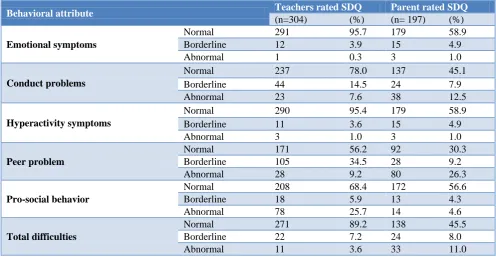
Table 2 shows on teachers reported SDQ, out of 304 study subjects, 22 (7.2%) were having borderline total difficulties on teachers reported total difficulty scale of SDQ and 11 (3.6%) were reported to be abnormal. Parent
reported SDQ showed that out of 197 parents, who filled the SDQ, 24 (7.9%) study subjects were having borderline total difficulties, while 33 (10.9%) were found to be abnormal on SDQ scale.
Table 1: Socioeconomic co-relates and total difficulties in behavior of school children (N=304).
Socio-economic status
Total difficulty scale
Total
Normal Abnormal
Frequency (n) Percentage (%) Frequency (n) Percentage (%)
Lower 3 1.1 4 10.3 7
Upper lower 142 53.6 23 59.0 165
Lower middle 119 44.9 12 30.7 131
Upper middle 1 0.4 0 0.0 1
Total 265 100 39 100 304
Fisher‟s exact test value=10.872, p=0.009 significant.
Table 2: Prevalence of behavioral problems and emotional problems among study subjects according to teachers and parents rated SDQ.
Behavioral attribute Teachers rated SDQ Parent rated SDQ
(n=304) (%) (n= 197) (%)
Emotionalsymptoms
Normal 291 95.7 179 58.9
Borderline 12 3.9 15 4.9
Abnormal 1 0.3 3 1.0
Conduct problems
Normal 237 78.0 137 45.1
Borderline 44 14.5 24 7.9
Abnormal 23 7.6 38 12.5
Hyperactivity symptoms
Normal 290 95.4 179 58.9
Borderline 11 3.6 15 4.9
Abnormal 3 1.0 3 1.0
Peer problem
Normal 171 56.2 92 30.3
Borderline 105 34.5 28 9.2
Abnormal 28 9.2 80 26.3
Pro-social behavior
Normal 208 68.4 172 56.6
Borderline 18 5.9 13 4.3
Abnormal 78 25.7 14 4.6
Total difficulties
Normal 271 89.2 138 45.5
Borderline 22 7.2 24 8.0
Abnormal 11 3.6 33 11.0
Table 3: Relationship between total difficulties in behavior and school studies (N=304).
Problems school studies
Total difficulty scale
Total
Normal Abnormal
Frequency (n) Percentage (%) Frequency (n) Percentage (%)
Yes 174 65.7 35 89.7 209
No 91 35.3 4 10.3 95
Total 265 100.0 39 100.0 304
Pearson Chi-square value 9.178, p=0.002, significant.
Table 3 shows that, out 39 subjects reported to be having behavioral problems 35 (89.7%) also reported to be having problems in doing their homework or school related studies too and the association between behavioral and emotional problems and problems in doing homework or school related studies was found to be
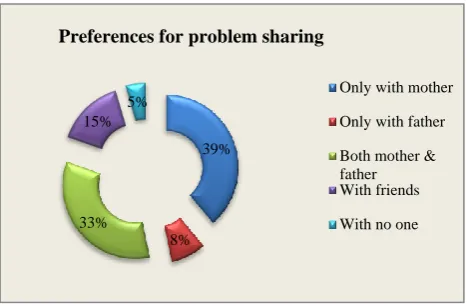
subjects share their problem with both mother and father whereas 46 (15.1%) study subjects share their problems with friends and 14 (4.6%) don‟t share their problems with anyone at all.
Figure 1: Distribution of study subjects according to their problem sharing preference (N=304).
DISCUSSION
The association between a student‟s emotional or behavioural difficulties and academic performance has been explored based on information on students collected from teachers using the SDQ. The SDQ comprises 25 questions probing five areas of psychological adjustment in children. Based on teacher and parents responses to the SDQ, a strengths and difficulties total score that can range from 0 to 40 was calculated. The risk of clinically significant emotional or behavioural difficulties can then be assessed with reference to the SDQ total score. Thus students with a score of 0–11 are identified as having low risk, those in the range 12–15 as having moderate risk, and those in the range 16–40 as having high risk of clinically significant emotional or behavioural difficulties. The prevalence of abnormal emotional symptoms according to the teachers rated SDQ was found to be only 0.3% (n=1/304) while 3.9% study subjects were found to be borderline on the scale. Regarding parents of the study subjects, the response rate was found to be 64.80% (n=197/304), the prevalence of abnormal emotional symptoms among the study subjects was found to be 1.52% (n=3/197) and 4.9% (n=15/197) study subjects were borderline on the parent rated scale of SDQ. Elhamid et al had conducted a population prevalence study of emotional and behavioural disorders among 1186, 6–12 year old children in Minia, Egypt in 2008 and the data was collected from teachers and parents using the strengths and difficulties questionnaire showed prevalence of emotional problems on multi informant „„emotional disorder‟‟ SDQ was 2%.8
The study also compared the prevalence child psychiatric disorders in Egypt and Britain as assessed by teachers and parents using the multi-informant SDQ algorithm. The prevalence of emotional disorder in Britain was 3.1%.7 When similar questions were asked to teachers, they reported that out of 304 study subjects 237 (78.0%)
were normal on conduct problem scale of SDQ, 44 (14.5%) study subjects were borderline, and 23 (7.6%) study subject was abnormal. According to parents, out of 197 study subjects 137 (45.1%) were normal on conduct problem scale of SDQ, 24 (7.9%) were borderline, and 38 (12.5%) study subjects were abnormal. On teacher reported hyperactivity scale of SDQ, out of 304 study subjects, only 11 (3.6%) were borderline on hyperactivity scale of SDQ and 3 (1%) were reported to be abnormal. Parent reported hyperactivity scale of SDQ showed that out of 197 parents, who filled the SDQ, reported 15 (4.9%) study subjects were borderline for hyperactivity, and only 3 (1%) were abnormal. Table 2: when similar questions were asked to teachers, they reported that out of 304 study subjects 171 (56.2%) were having normal relationship with their peers according to the teachers reported SDQ scale to asses peer problems, 105 (34.5%) study subjects were borderline on the scale, and 28 (9.2%) study subject were abnormal. Regarding parents of the study subjects, only 200 out of 304 parents responded for their children‟s peer problems. According to parents, out of 197 study subjects 92 (30.3%) were normal having normal peer relations on peer problems scale of SDQ. Table 2: on teachers reported pro-social behaviour scale of SDQ, out of 304 study subjects, only 18 (5.9%) were having borderline pro-social behaviour on teachers pro-social behaviour scale of SDQ and 78 (25.7%) were reported to be abnormal. Parent reported pro-social behaviour scale showed that out of 197 parents, who filled the SDQ, 13 (4.3%) study subjects were having borderline pro-social behaviour problems, while 14 (4.6%) were abnormal. A study in Pakistan, in 7 private and 8 community schools, assessment of children's mental health was conducted using SDQ. Parents rated 34.4% of children as falling under the "abnormal category on SDQ, slightly higher estimates 35.8% were reported by the teacher. The findings suggest a striking difference between parents and teachers ratings in prevalence of common child mental health problems.9
No comparable studies were found in India, assessing the perceptions of teachers and parents about mental health. The studies on psychiatric disorders among school going age children like, the Isles of Wright study has found out that the one year prevalence rate of significant psychiatric disorder at the age of fourteen years is about 20%. The same study mentions that in the 10-11 year age group attending state schools in the Isle of Wright, one-year prevalence rate of psychiatric disorders was about 7%, the rate in boys being twice that in girls.10 Regarding the effect of mental health problem on school related studies, a study done by Sharma in various districts of western region with the semi-structured interview done with 212 teachers, dealing with 23,320 students to find the different symptoms suggesting emotional and behavioral problem showed that out of the total 23320 students indirectly covered in the study, 8999 (38.58%) were found to have some sort of psychological problem. „Slow learners‟ was reported to be present by 77.83% of teachers in 4.98% of their students; suddenly degrading 39%
8% 33%
15% 5%
Preferences for problem sharing
Only with mother
Only with father
Both mother & father With friends
school performance was reported by 75% of teachers in 3.65% of students.11
Limitations
There are some limitations of our study which include-with the cross-sectional design of this study is unable to assess the behavioral problems in depth and state any causality. Even though utmost efforts were taken to build rapport and confidence in the respondents, the sensitive nature of the study questions might have led to deliberate under reporting by the respondents.
CONCLUSION
The parents and teachers has important role to play in building a child as a responsible human being, as they are the first to know the problems the child facing in their life. The results the study concludes that the teachers are more vigilant in observing and sorting the child‟s behavioral problems and the parents were not much concerned as the response rate for parent reported SDQ was only 64.8% and response rate among teachers was 100% for the teachers rated SDQ.
Recommendations
Mental health awareness programs and ongoing training sessions for teachers and parents should be considered as part of any child and adolescent mental health service development. Parents, teachers and health care professionals should be made aware of symptoms of behavioral problems of the children, to help in early detection and intervention, ameliorating the children‟s chances to restore their mental health conditions in time.
ACKNOWLEDGEMENTS
The authors sincerely thanks the department of community medicine, Seth GS Medical College and KEM Hospital, Parel, Mumbai, Maharashtra, as well authors would like to give thanks to education officer in-charge of primary and secondary education department and principals of the schools, for permission to conduct the study.
Funding: No funding sources Conflict of interest: None declared
Ethical approval: The study was approved by the Institutional Ethics Committee
REFERENCES
1. Mental health: A state of well-being, 2013. Available at: http://www.who.int/features/factfiles/ mentalhealth/en/. Accessed 9 December 2013. 2. Patel V, Flisher AJ, Hetrik S, McGorry P. Mental
health of young people: a global public-health challenge. Lancet. 2007;369:1302–13.
3. UNICEF. Report on Statistics and monitoring, 2008. Available at: http://www.unicef.org/. Accessed 5 December 2013.
4. Lopez AD. Disease Control Priorities Project. Global burden of disease and risk factors. New York, NY: Oxford University Press and Washington, DC: World Bank. 2006.
5. Children‟s Mental Health: An overview and key considerations for health system stakeholders: A report by National Institute for Health Care Management 2005.
6. Renuka Ray Committee. Report on Social Welfare and Welfare of Backward Classes. 1959.
7. Goodman R. The Strengths and Difficulties Questionnaire: A Research Note. J Child Psychol Psychiatry. 1997;38:581-6.
8. Elhamid A, Howe A, Reading R. Prevalence of emotional and behavioural problems among 6– 12 year old children. Egypt. Soc Psychiat Epidemiol. 2009;44:8.
9. Syed EU, Hussein SA, Haidry SE. Prevalence of emotional and behavioural problems among primary school children in Karachi, Pakistan--multi informant survey. Indian J Pediatr. 2009;76(6):623-7.
10. Rutter M, Tizard J, Yule W, Grahm P, Whitmore K. Isle of Write Studies, 1964-1974. Psychological Med. 1976;6:313-3.
11. Sharma N, Sharma VD. Behavioral problems in school children as recognized by untrained teachers.
J Psychiatrists‟ Association of Nepal. 2013;2,2:26-8.