Accounting Information Quality and Capital
Investment Choice in the Governance Perspective
– an Indonesian Evidence
Krismiaji
Accounting Academy of YKPN, Yogyakarta, Indonesia
Djaja Perdana
Accounting Academy of YKPN, Yogyakarta, Indonesia
Abstract
This paper discusses empirical research which investigated the effect of accounting information quality and governance efficiency on capital investment choice. This research uses a sample of 279 Indonesian Capital Market listed companies for the fiscal year ended in December 31, 2006 to 2015. The total observation is 2.790. Accounting information quality (Qual) is measured by inverse measure of absolute discretionary accrual which is calculated with Modified Jone’s Model. Governance is measured by the herfindahl index for shareholder’s stake in a listed company during the 10-year period, whereas capital investment choice is measured by the correlation between the growth rate of its own operating income and that of the industry as a whole based on the data during the past 10 years. This research uses four control variables namely company size, which is measured by the logarithmic average assets of the listed company over 10 years, corporate growth potential which is measured by the MTB mean of all listed companies in the 10-year period, corporate profitability, which is measured by the average ROA of the listed company in the 10-year period, and leverage company debt level, which are measured by the mean of the asset-liability ratio of all listed companies during the 10-year period. The data is obtained from Indonesian Capital Market Directory, Indonesian Stock Exchange database, and from company annual reports. This research found evidence of a positive association of accounting information quality and capital investment choices. With respect to governance involvement, this study proves that governance strengthen the effect of accounting information quality on capital investment choices.
Key Words: Capital investment choices, governance, leverage, ROA, size.
1.
INTRODUCTIONThis paper describes the result of empirical research which investigates the association between accounting information quality and capital investment choice in the governance perspective. This research is motivated by the fact that this issue is important for government, market participants, potential investors, and public firms since the findings of the research will help them to better and deeply comprehend governance function of accounting information, which in turn will help them to make their strategic decisions.
proves that earnings management can also affects companies’ internal decisions. Francis et al. (2009) investigate the effect of country's corporate transparency environment, which includes the quality of accounting information, on the efficiency of resource allocation. They find that industry growth rates across country are higher when there is a greater level of corporate transparency. This result is consistent with the fact that corporate transparency enables the allocation of resources across industry sectors. Chen et al. (2011) examine the role of financial reporting quality in private firms from emerging markets and suggests that financial reporting quality positively affects investment efficiency. Furthermore, they also find that the association between financial reporting quality and investment efficiency is increasing in bank financing, but this association is decreasing in incentives to minimize earnings for tax purposes.
Investment efficiency is also affected by other factors such as share ownership. Using the high-power setting of newly privatized firms from 64 countries, Chen, Ghoul, Guedhami, and Wang (2017) find that the relation between foreign ownership and investment efficiency is stronger when governments relinquish control and country-level governance institutions are weaker. Their findings highlight the important role of ownership type in determining firms' investment behavior and efficiency. Additionally, Chen, Sung, and Yang (2017 find that ownership concentration has a negative impact on investment efficiency, and this effect is more pronounced in SOEs than in private firms.
Previous research investigate the effect of accounting information quality and transparency on the resources allocation efficiency both in corporate and country levels, which focus on the perspective of over- and under-investment. Public firms often change the capital flow direction in large scale, and consequently company’s capital investment in the core business become the main factor in evaluation of capital allocation efficiency. Yet, there are still limited research investigate such issue, especially in emerging market such as Indonesia. This give an opportunity for us to enrich the existing literature by conducting empirical research. Therefore, this research aims to investigate the effect of accounting information quality and corporate governance on the capital investment in the core business decision. Specifically, the objective of this paper is to offer an answer to the following research questions:
RQ1. Do accounting information quality affect capital investment in the core business?
RQ2. What is the effect of external governance on the association between accounting information quality
and capital investment in the core business?
This research offers contributions to previous literature. First, this research explores the association between accounting information quality and firm’s capital investment choices which focus on the investment on the core business. Second, this research investigates the association from market strength perspective which affects the needs of governance function and accounting information efficiency.
This paper is organized as follows: Section 2 discusses the literature review along with the hypotheses development. The research method and results discussion are presented in Sections 3 and 4, respectively. Finally, Section 5 presents the conclusions along with the implications of the study, limitations, and suggestions for further research.
2.
LITERATURE REVIEW AND HYPOTHESES DEVELOPMENTThis research is based on agency theory to identify the problem and predict the association among research variables. Agency theory or the theory of agency relationship predicts and explains behavior of related parties in principal-agent relationships (Jensen and Meckling, 1976). In the principal-agent relationships or agency relationship, principal and agent are assumed to have a selfish behavior and act for their own interests. Thus, when principal delegates the authority, agent use the authority to engage in personal agendas such as empire building and wasting firm resources for personal benefits rather than fulfilling the principle interest (Barnea, Haugen, dan Senbet, 1985). Agency theory is the branch of game theory that studies the design of contracts to motivate a rational agent to act on behalf of a principal when the agent’s interests would otherwise conflict with those of the principal (Scott, 2009). Monitoring practice, to ensure that actions performed by agent are in line with the principle’s interests, is hard to be realized because of the complexity of agent’s activities. This situation leads to information asymmetry (Scott, 2009). Information asymmetry is a condition where some parties to business transactions may have a relevant information advantage over others. Agency problem will arise when there is information asymmetry both in term of activities and information owns by agent. The first problem is called hidden action and the second problem is called hidden information. Hidden action leads to moral hazard whereas hidden information leads to adverse selection (Arifin, 2007). Moral hazard is a type of information asymmetry whereby one or more parties to business transaction, or potential transaction, can observe their action in fulfillment of the transaction but not the other parties. Adverse selection is a type of information asymmetry whereby one or more parties to business transaction, or potential transaction, have an information advantage over other parties (Scott, 2009).
adverse selection problems, that is, agency risk, by increasing the monitoring of managements‘ actions and limiting managers‘ opportunistic behavior (Ashbaugh, Collins, and LaFond, 2005). Prior research argue that quality financial information reduces firm risk and the cost of equity by increasing market liquidity, therefore reducing transactions costs or increasing the demand for a firm‘s securities (Amihud and Mendelson 1986 and Diamond and Verrecchia, 1991)
2.1. Accounting Information and Investment Choice
The main objective of financial reporting is to help users in making decision (IASB, 2008; Beaver, 1989). Accounting information quality is measured by two methods. First is from stand point of usefulness. It means that information is useful for users to make valuation decision. Thus, usefulness indicates the pricing function of accounting information. The second is contract validity. It means that the accounting information benefits for contract arrangement, especially contract between investors and administrators (Zhai dan Wang, 2016). The contract validity reveals governance functions. Therefore, accounting information has two basic function, pricing and governance. First, accounting information implements its pricing function by influencing cost of capital and share price. High quality accounting information can reduce information asymmetry, hence increase cost of capital for external funding (Myers and Majluf, 1984; Easley and O’Hara, 2004; Zeng and Lu, 2006). Pricing function can also be realized by influencing stock price. The stock price of listed companies signals specific information. The higher quality and the more transparent information opens an opportunity to be reflected into the stock price. This, in turn, will attract some new investors. Secondly, by reducing information asymmetry among contract interest parties, accounting information will minimize the imperfectness of a contract and control and monitor the opportunistic behavior of management, therefore accounting information operate a function of governance. To obtain external capital, governance function of information help public companies to make rational decisions in the core business and allocate capital more efficiently.
Disclosure of high quality information useful for investors especially to monitor management, boost management to make efficient and effective investment decisions, which in turn improve capital allocation efficiency and provide more return for investors (Bushman and Smith, 2003). Moreover, Ball and Shivakumar (2005) argue that high quality accounting information support investors’ control of management by restricting for management expenditure for their own or others’ interests and improving investment decision making. Additionally, high quality accounting information may informs investors timely about capital investment orientation and help investors monitor managerial activities. Biddle et al. (2009) argue that, high quality accounting information reduces managerial opportunity to act wistfully and enhances investor’s capability to monitor manager’s investment decision efficiency.
The other objective of accounting disclosure is to provide information which useful for external stakeholders. The accounting information will affect investors’ belief toward company’s fundamental value. Thus, when stock price or corporate income decreases, investors will find a way to avoid loss through exercising their decision-making right to vote or voting with their feet. (Zhai and Wang, 2016). Therefore, accounting data become essential information resources in determining whether firm’s stock price over- or under-quoted. Ohlson (2005) had developed a model reflected the association between accounting information and firm’s value. Many scholars show the usefulness of accounting information by demonstrating how investor use accounting information to make decision (Beaver, 1968; Ball and Brown, 1968).
Investors interested in accounting information quality because it helps investors to better comprehend the firm’s operational situation and other financial fundamental factors. High quality accounting information provide comprehensive perceptive for stakeholders about firm’s fundamental and facilitate them to monitor management behavior. If management activities are not aimed to shareholders’ interest maximization, the primary shareholders may replace current management. Minority interest definitely unable to directly influence management, yet they may affect the stock price with their specific way. Institutional and strategic investors may also influence managerial changes both through their voting right or by their specific way. Therefore, high quality accounting information helps external stakeholders, who may impede management either directly and indirectly, to obtain the better understanding about firm’s capital use and firms performance, which in turn affect firm’s choice for capital investment. Therefore, we formulate the first hypothesis as follow.
H1. Accounting information quality positively affect capital investment choice in the core business.
2.2. Accounting Information Quality, Governance, and Investment Choice
differences across ownership classifications, firm sector, size, management experience, employees training program and business obstacles also have an impact on firms’ investment efficiency. Additionally, using the high-power setting of newly privatized firms from 64 countries, Chen, Ghoul, Guedhami, and Wang (2017) find that the relation between foreign ownership and investment efficiency is stronger when governments relinquish control and country-level governance institutions are weaker. Their findings highlight the important role of ownership type in determining firms' investment behavior and efficiency. However, Chen, Sung, and Yang (2017 find that ownership concentration has a negative impact on investment efficiency, and this effect is more pronounced in state-owned enterprises (SOEs) than in private firms.
In Indonesia, public companies established board of commissioners in the forum of general meeting of shareholders. However, their independence are still doubted especially for government-owned companies. This lead to the internal control problems. The board of commissioners assignment is simply to meet the formal requirement and regulation instead of to strengthen of corporate governance. Besides, independent board may be assigned by the chairman of boards. This lead to not fully independent since they have certain connection to the boards’ chair and controlling shareholders.
The scarcity of independent board and the complexity of external governance prevent corporate governance mechanism to normally functioned. In contrast, investors are able to externally supervise with their own ways when they feel that irrational investment do exist. This will place management in a situation where the stock prices are potentially threaten by revaluation and this may promote the efficient resource allocation. High-quality accounting information can help investors to identify inefficient investments. This produce a stock price revaluation and give pressure for the boards which in turn the boards impulse management to focus on the core business of the firm and enhance the capital allocation efficiency.
It can be concluded that when a company’s the internal and external governance environment is weak, the effect of high-quality accounting information on capital investment choice is stronger. Therefore, we suggest the second hypothesis as follow.
H2. Corporate governance moderates the association between accounting information quality and capital investment choices.
3. RESEARCH DESIGN
3.1. Sample Selection
The sample used in this research is firms listed at the Indonesian Stock Exchange (IDX). The sample was selected using the purposive sampling technique. The first requirement is that it is a public company listed at the IDX from 2006 to 2015. The second is that these firms have publicly available information. The data came from three sources, Indonesian Capital Market Directory (ICMD), www.idx.co.id, and company's website. The unit analysis used is firm-year.
3.2. Variable Definition and Measurement 3.2.1. Accounting Information Quality (AIQ).
Accounting information quality is a result of firm’s financial reporting system which routinely measures and disclosures quantitative information about audited and published financial position and firm’s performance (Bushman and Smith, 2003). Accounting quality is proxy by accounting earnings (Ashbaugh et al., 2004). This
variable is measured by discretionary accrual and estimated by ModifiedJones Model (Dechow, 1995) in the
following equation:
(
)
i i t i t t t i i t i t i t t i i t i tT
A
P
T
A
A
R
v
T
A
T
α
A
+
C
α
∆
−
∆
+
α
+
ε
=
− − − 1 3 1 , 2 1 , , 1R
e
1
(1)where TACit is the total accruals for firm i, for year t scaled by total assets for year t−1; TAit−1 is the total assets
for year t−1; ΔREVit are revenues for firm i, for year t less revenues for firm i for year t−1 scaled by total assets
for year t−1; ΔRECit are receivables for firm i for year t less receivables for firm i for year t−1, scaled by total
assets for year t−1; and PPEit gross property plant and equipment for firm i for year t scaled by total assets for year t−1. εit is the error term. Discretionary accruals (DA) for year t are estimated as the absolute values of residuals from the cross-sectional ordinary least-square (OLS) estimates of Equation (2). The value of absolute discretionary accruals (ABSDA) is a proxy of accounting information quality. ABSDA is an inverse measure of accounting information quality, therefore the lower ABSDA, the higher the quality of accounting information.
3.2.2. Capital Investment Choice (CIC)
growth and that of the industry as a whole. Therefore, using such approach this paper measures capital investment choice as the correlation between the growth rate of its own operating income and that of the industry as a whole based on the data during the past 10 years. The higher correlation, the more capital flow to the firm’s core business.
3.2.3. Corporate Governance (Gov).
Corporate governance as a moderating variables is measured by the herfindahl index of large shareholders during 10 years. The Indonesian Companies Act of 1995 requires firms to disclose directors’ report and ownership data in their annual reports. Hence, ownership data are readily available from the sections on the analysis of shareholdings and director’s reports of firms’ annual reports. Corporate governance (Gov) is measured by using Herfindahl index. The value of the H is the sum of the squares of the shares ownership of each kind of ownership and the value is between 0 and 1. It is calculated as follows:
where i refers to an individual firm and n refers to the number of firms. The higher the index, the more concentrated the ownership. Higher ownership concentration lead to the decrease of information disclosure and increase of agency problem (Leuz, Nanda, and Wysocki, 2003)
3.2.4. Control Variables
This research uses four control variables, which are firm’s size (SIZE), measured by log natural total assets, firm growth (MTB), measured by dividing total market value of the firm with book value, company’s profitability (ROA), measured by dividing net profit with total assets, and capital structure (LEV), measured by dividing total liabilities with total assets.
3.3. Model Specification
Regression model (2) and (3) use to test H1 and H2 respectively. In model (2), CIC is capital investment choice which represent a correlation between operating profit growth at the company and industry levels, calculated over a 10-year cycle, which are from t-9 to t. Qual is absolute residual value from regression equation (1). This is an inverse measure of accounting information quality. It means that the greater the magnitude of Qual, the lower the accounting information quality. Gov represents governance mechanism, measured by herfindahl index for firm’s share ownership structure. We use two regression model (2) and (3) as follow.
CICit = α0 + α1Qualit + α2Sizeit + α3MTBit + α4ROAit + α5LEVit + ɛit (2)
CICit = α0 + α1Qualit + α2Goverit + α3Qualit x Govit + α4Sizeit + α5MTBit +
α6ROAit + α7LEVit + ɛit (3)
Where:
CICit = Correlation between operating profit at firm’s level and operating profit at industry’s level of firm
i in the year t,
Qualit = Accounting information quality of firm i in the year t,
Govit = Corporate governance of firm i in the year t,
Sizeit = Log total asset, as the proxy of firm size of firm i in the year t,
MTBit = Ratio between equity’s market value and book value of firm i in the year t,
Levit = Leverage ratio of firm i in the year t,
ROAit = Profitability of firm i in the year t,
εit = error term.
Hypotheses 1 (H1) is accepted or confirmed by empirical data if estimated coefficient for Qual in equation (2) is negative and significant, whereas hypothesis 2 (H2) is accepted or confirmed by empirical data if estimated coefficient for Qual*Gov in equation (3) is negative and significant.
4. ANALYSIS AND DISCUSSION
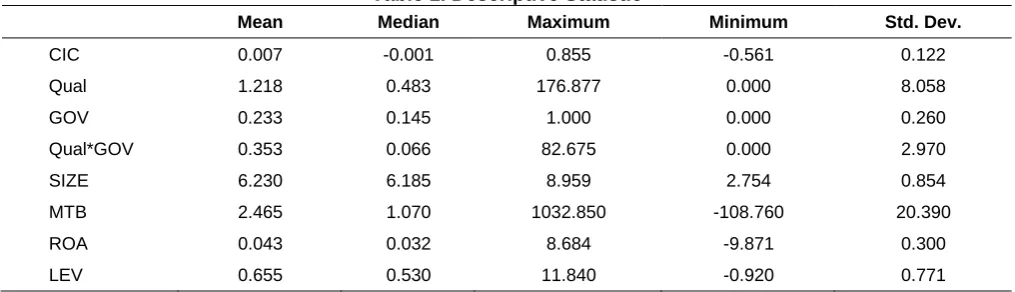
Table 1. Descriptive Statistic
Mean Median Maximum Minimum Std. Dev.
CIC 0.007 -0.001 0.855 -0.561 0.122
Qual 1.218 0.483 176.877 0.000 8.058
GOV 0.233 0.145 1.000 0.000 0.260
Qual*GOV 0.353 0.066 82.675 0.000 2.970
SIZE 6.230 6.185 8.959 2.754 0.854
MTB 2.465 1.070 1032.850 -108.760 20.390
ROA 0.043 0.032 8.684 -9.871 0.300
LEV 0.655 0.530 11.840 -0.920 0.771
From Table 1, it can be seen that the mean of the CIC shows a value of 0.007 with a median of -0.001 and a standard deviation of 0.122. The small number of CIC mean indicates that the growth of operating profit in the firm’s level has a weak correlation with the growth of operating profit in the industry’s level. Qual which is a measure of accounting information quality has a mean of 1.218 with standard deviation of 8.058. Gov has a mean of 0.233 with a standard deviation of 0.260.
To test the hypotheses, this study uses ordinary least square (OLS). The classic assumptions of the regression model were tested before the regression analysis was done. The assessment shows that the data are normally distributed and there is no problem with multicollinearity, heteroscedasticity, autocorrelation, and the existence of outliers in the data. Additionally, we also perform bivariate analysis in the form of Pearson correlation. The result is presented in Table 2.
Table 2. Pearson Correlation
CIC Qual SIZE ROA LEV GOV
Qual -.009
SIZE -.021 -.017
ROA -.012 .005 .083**
LEV .010 -.016 -.029 -.168**
GOV .005 .033 -.125** -.004 -.012
Qual*GOV -.022 .866** -.019 -.001 .000 .122**
**, * show that correlation is significant at the 0.01 level and 0.05 level respectively (2-tailed).
The Qual and CIC are negatively correlated, providing preliminary support for H1. This result indicates that accounting information quality (Qual) increase capital investment choice. A similar result is also found in the correlation between the Qual*Gov and CIC which show negative result. This is the preliminary evidence that governance strengthen the association between Qual and CIC. This result will be further examined in the regression analysis by involving four control variables which are ROA, MTB, Size and Lev. Table 2 also shows that there is collinearity between variables of interest since there are all correlation number less than 0.70.
The regression analysis results to test the hypotheses are presented in Table 3. Panel A shows that F statistic with coefficient value of 4.009 is significant at the level of 1%. This means that research model (2) eligible for analysis. Adjusted R-squared show the value of 0.044. This show that the behavior of dependent variable, CIC, is explained lightly by the behavior of independent variable (Qual) and control variables (ROA, MTB, SIZE, and LEV). Panel B shows that F statistic with coefficient value of 1.908 is significant at the level of 10%. This means that research model (2) eligible for analysis. Adjusted R-squared show the value of 0.020. This show that the behavior of dependent variable, CIC, is explained lightly by the behavior of independent variables (Qual, GOV, and Qual*GOV) and control variables (ROA, MTB, SIZE, and LEV).
To test whether accounting information quality positively affect capital investment choice in the core business (H1), the variable investigated is Qual. Panel A in Table 3 show a a negative (−0.003) and significant coefficient in the level α = 0.01 (p = 0.000) for Qual. This result indicates that the accounting information quality (Qual) significantly affects capital investment choice (CIC). Because Qual is an inverse measure of accounting information quality, it can be concluded that H1 which states that accounting information quality positively affect capital investment choice in the core business is accepted and supported by the empirical data. To test whether corporate governance moderates the association between accounting information quality and capital investment choices (H2), the variable of interest is interaction variable Qual*Gov. Panel B in Table 3 show that
negatively affect CIC since Qual is an inverse measure of accounting information quality, it can be concluded that H2 which stated that corporate governance moderates the association between accounting information quality and capital investment choices is accepted and supported by empirical data.
The statistical results confirm previous research performed by Beaver (1989) which stated that the main objective accounting information is to help the users to make a proper decision, Zhai and Wang (2016) which stated that accounting information provides benefit for contract arrangement and the validity of the contract reflects information function of governance, Bushman and Smith (2003) who find that high quality information disclosure useful for investors in monitoring and motivating management to make investment decision efficiently and effectively, which in turn improve the company’s efficiency of capital allocation and gains more return for investors, Ball and Shivakumar (2005) who belief that high quality accounting information strengthen investors’ monitoring toward management by optimizing investment decision making. Moreover, high quality accounting information may also inform investors in timely basis about capital orientation and help investor in controlling managerial activities. Finally, this results are also confirm research performed by Biddle et al. (2009) who suggest that high quality accounting information prevent management opportunity to act wastefully and enhance investors’ capability to supervise the efficiency of investment decision by management.
Table 3. Regression Analysis
Panel A:
CICit = α0+ α1Qualit + α2Sizeit + α3MTBit + α4ROAit + α5LEVit + ɛit (2)
Variable Coefficient t-Statistic Sig
Intercept 0.185 *** 217.749 0.000
Qual -0.003 *** -6.316 0.000
SIZE -0.009 *** -7.047 0.000
MTB 0.166 1.366 0.172
ROA 0.006 0.226 0.672
LEV 0.000 1.063 0.287
Adjusted R-squared 0.044
F-statistic 4.009 ***
Panel B:
CICit = α0 + α1 Qualit + α2Govit + α3 Qualit x Govit + α4Size it +α5MTB it + α6ROA it + α7LEVit + ɛit (3)
Variable Coefficient t-Statistic Sig
Intercept 0.013 *** 2.698 0.007
Qual 0.002 1.176 0.239
Gov -0.001 -0.290 0.771
Qual*Gov -0.001 * -1.714 0.086
SIZE 0.004 1.479 0.139
MTB -0.005 -0.958 0.338
ROA -0.002 *** -2.437 0.015
LEV -0.013 -0.647 0.771
Adjusted R-squared 0.020
F-statistic 1.918 *
***, **, * **, * show that correlation is significant at the 0.01, 0.05 and 0.10 level respectively
5. CONCLUSION
This research aims to find empirical evidence about the association between accounting information quality and capital investment choice in the governance perspective. The result shows that accounting information quality positively affect firms’ capital investment choice in the core business. This support hypothesis 1. Moreover, this result also proves that the existence of corporate governance strengthen positive effect capital investment choice on the capital investment choice in the core business. Thus, this supports hypothesis 2 which stated that corporate governance moderates the association between accounting information quality and capital investment choice in the core business.
This research have theoretical implication by proving and strengthening current theory which stated that the quality of accounting information increases usefulness for decision making by users. In this research, it is confirmed that the quality of accounting information increase investment choice in the core business. When we include government mechanism se a moderating variable, it is also proved that governance aspect strengthen the association between accounting information quality and capital investment choice. From practical aspect, this result enrich variables which is considered in making investment decision in the core business.
REFERENCE
Ali, A., and Zarowin, P., 1992. The role of earnings levels in annual earnings-returns studies. Journal of Accounting Research, 30(2): 286– 296.
Amihud, Y. and H. Mendelson. 1986. Asset pricing and bid-ask spread. Journal of Financial Economics, 17 (2): 223-249. Arifin. Z. 2007. Teori Keuangan dan Pasar Modal. First edition. Second printed. Yogyakarta: Ekonisia.
Ashbaugh, H., D.W. Collins, D.W. and R. LaFond. 2005. Corporate governance and the cost of equity capital, Working paper, University of Iowa.
Ball, R., and Brown, P., 1968. An empirical evaluation of accounting income numbers. Journal of Accounting Research, 6(2), 159–178. Ball, R., and Shivakumar, L., 2005. Earnings quality in UK private firms: comparative loss recognition timeliness. Journal of Accounting and
Economics. 39(1): 83–128.
Barnea, A., R. A. Haugen, and L. W. Senbet. 1985. Agency Problems and Financial Contracting. New Jersey: Prentice Hall, Inc Beaver, W.H., 1968. The information content of annual earnings announcements. Journal of Accounting Research, 6(3): 67–92. Beaver, W.H., 1989. An accounting revolution, second ed. Prentice Hall, Englewood Cliffs, NJ.
Bhattacharya, U., Daouk, H., and Welker, M., 2003. The world price of earnings opacity. Accouning Review, 78 (3): 641–678. Biddle, G., and Hilary, G., 2006. Accounting quality and firm-level capital investment. Accouning Review, 81(5): 963–982.
Biddle, G., Hilary, G., and Verdi, R., 2009. How does financial reporting quality relate to investment efficiency? Journal of Accounting and Economics. 48(2-3): 112–131.
Bushman, R.M. dan A.J. Smith. 2003. Transparency, financial accounting information, and corporate governance. Economic Policy Review, 9 (1): 65-87.
Chen, F., Hope, O.K., Li, Q.Y., and Wang, X., 2011. Financial reporting quality and investment efficiency of private firms in emerging markets. Accounting Review, 86 (4): 1255–1288.
Chen, R, S. El Ghoul, O. Guedhami, H.Wang. 2017. Do state and foreign ownership affect investment efficiency? Evidence from privatizations. Journal of Corporate Finance, 42: 408-421.
Chen, N., H.C. Sung, and J. Yang. 2017. Ownership structure, corporate governance and investment efficiency of Chinese listed firms.
Pacific Accounting Review, 29(3): 00-00
Dechow, P. M., R. G. Sloan, dan A. P. Sweeney. 1995. Detecting earnings management. The Accounting Review, 70 (2): 194-225. Dechow, P.M., and Dichev, I.D., 2002. The quality of accruals and earnings: the role of accrual estimation errors. The Accounting Review,
77 (Supplement): 35–59.
Diamond, D., and R. Verrecchia. 1991. Disclosure, liquidity, and the cost of capital. Journal of Finance, 46 (4): 1325-1359. Easley, D., and O’Hara, M., 2004. Information and the cost of capital. Journal of Finance, 59(4): 1553–1583.
Francis, J.R., Huang, S., Khurana, I.K., and Pereira, R., 2009. Does corporate transparency contribute to efficient resource allocation?
Journal of Accounting Research, 47(4): 943–989.
International Accounting Standard Board (2008), Exposure Draft of An Improved Conceptual Framework for Financial Reporting, IASB, London.
Jensen, M.C. and Meckling, W.H. 1976. Theory of the firm: managerial behavior, agency costs and ownership structure. Journal of Financial Economics, 3(4): 305-360.
Krismiaji, Y A. Aryani, and D. Suhardjanto. 2016. International Financial Reporting Standards, board governance, and accounting quality - A preliminary Indonesian evidence. Asian Review of Accounting, 24(4): 474 – 497.
Lev, B., 1983. Some economic determinants of the time-series properties of earnings. Journal of Accounting and Economics, 5: 31–38. Lev, B., and D. Nissim. 2003. Institutional Ownership, Cost of Capital, and Corporate Investment. Working paper. New York University. Leuz, C., D. Nanda, and P. Wysocki. 2003. Earnings management and investor protection: an international comparison, Journal of Financial
Economics, 69 (2003), 505–527.
Li, Q., 2009. Accounting information quality and capital allocation efficiency: empirical evidence of Chinese listed corporations. Nankai Business Review, 12: 115–124.
McNichols, M.F., and Stubben, S.R., 2008. Does earnings management affect firms’ investment decisions? Accounting Review, 83(6): 1571–1603.
Morck, R., Yeung, B., and Yu, W., 2000. The information content of stock markets: why do emerging markets have synchronous stock price movements? Journal of Financial Economics, 58(1-2): 215–260.
Myers, S.C., Majluf, N., 1984. Corporate financing and investment decisions when firms have information that investors do not have.
Journal of Financial Economics,13(2): 187–221.
Ohlson, J., 2005. On accounting-based valuation formulae. Review Accounting Studies, 10(2): 323–347. Scott, W.R. 2009. Financial Accounting Theory. Toronto, Canada: Prentice Hall Education Inc.
Zeng, Y., Lu, Z., 2006. The relationship between disclosure quality and cost of equity capital of listed companies in China. Journal of Economics. China 2, 69–76.
Zhai, J. dan Y. Wang. 2016. Accounting information quality, governance efficiency, and capital investment choice. China Journal of Accounting Research, 9: 251-266.
Zhou, Z., Chen, H., 2008. Accounting information transparency and resources allocation efficiency: theory and empirical evidence.