Importance of Establishing a Job Analysis Exercise in an Organisation:
A Case Study of Bread Manufacturing Companies in Zimbabwe. Mapira Nyasha (Corresponding author)
Teaching Assistant: Department of Human Resources Management-Bindura University of Science Education
Katsuro P [email protected]
Chairman: Department of Human Resources Management-Bindura University of Science Education.
Chazuza T [email protected]
Lecturer: Department of Human Resources Management-Bindura University of Science Education.
Mlingwa Margret Makaita [email protected]
Teaching Assistant: Department of Human Resources Management-Bindura University of Science Education
Togarepi Mukondiwa [email protected] Human Resources Officer-Afre Corporation.
Mutambatuwisi Farai [email protected]
Human Resources Officer-Uzumba Marambapfungwe (RDC).
Nhimba Nicholas Kudakwashe [email protected]
Senior Designated Agent-NEC (Welfare and Educational Institutions)
Umera Tafadzwa [email protected]
Human Resources Administrator-Barclays Bank
Machigere Taonga [email protected]
Human Resources Manager-Innscor Fast foods.
ABSTRACT
This research sought to find the impact of establishing a job analysis in the bread manufacturing companies in Zimbabwe. The research used a case study approach in which a sample of six companies out of a population of seven registered companies was used. The targeted population was nominated from six companies and a simple random sampling procedure was employed to come up with sample elements. Questionnaires and interviews were used in triangulation to collect data on the sample. After analyzing the collected data, it was found that there is a positive correlation between well established job analysis and employee and company performance, the impact was seen through improvements in compensation, training and development, health and safety and recruitment and selection. However, the research also found that in an era of continuous delayering and downsizing one of the most common problems derived from implementing a job analysis is employee fears. Employees see a job analysis as a threat to their current jobs or pay levels or both. This is based on the fact that in the past, job analysis was used as a means of expanding jobs while reducing the total number of employees.
INTRODUCTION
Job analysis increased simply to answer two basic questions, what tasks to be performed and what information is needed to enable the work to be done. Adams (2000) defines job analysis as a process to identify and determine in detail the particular job duties and requirements and the relative importance of these duties for a given job. Bread manufacturing companies in Zimbabwe was not spared from the prevailing harsh economic conditions and the board and management continued to look for various options to sustain the business while looking for opportunities to grow in line with dynamic economic environment. Considering the compensation problems, conflict of duties, poor training and performance review in the Bread manufacturing companies, the researchers observed that there is need for organizations to analyze the importance of establishing job analysis exercises in an organization as a way of solving the problems of compensation, training, selection, performance review and conflict of duties. This concurs with Redmon (2003), who argues that, the purpose of job analysis is to determine training needs, compensation, selection procedure and performance review. An increase in conflict of duties among employees forced Bread manufacturing companies to introduce job analysis in 2004 .However; this does not yield positive results since organizations tend to use job analysis more often for white-collar jobs rather than for manual employees. The concern for conflict of duties makes it vitally important for the company operating in a highly competitive market to make sure that employees know the tasks and duties they are to perform. In spite of the reasons for adopting job analysis, a well-established job analysis scheme can help lay a foundation of fairly and orderly pay structure and thus improve internal relationship.
The concept of job analysis is not new to the Zimbabwean economy, its use can be traced as far back as the nineteen sixties when large employing organizations such as the then Rhodesian Railways undertook various job analysis exercises to solve the problems of compensation, training, selection, performance review and conflict of duties. One such exercise carried out by the Railways in 1966 uncovered among others, the existence of irrational job titles which bore little or no resemblance to the actual work performed by the immigrants, cases of misuse of labor where employees were not being assigned work in accordance with their grades, wages and salaries differentials which could not be justified and the existence of poor training and performance review. However, the way job analysis exercises were undertaken remains a subject of debate. All these prompted the researchers to evaluate the importance of establishing a proper job analysis in the Bread Manufacturing Companies and recommend an appropriate action plan or solution to the difficulty of establishing job analysis and promote well-established job analysis practice in the manufacturing sector.
RELATED LITERATURE
Several studies have been conducted to give the importance of job analysis exercises in bread manufacturing companies. Much of the earlier research on job analysis has focused on methodological aspects of the concept of job analysis. These efforts made a significant contribution to the field of human resources management by developing various techniques and procedures to generate accurate and practically useful job-related data (Ash and Levine, 1980; Bemis et al., 1983; Gael, 1988). This laid the groundwork that allowed human resources professionals to identify and examine several possible applications of job analysis information. Unlike other countries, the previous research on job analysis in South Korea has focused on highlighting the necessity of job analysis as a strategic human resources management practice with potential contribution to realizing performance–based human resources management.
A study by Hackman and Oldham (1975) identifies those specific job characteristics that affect productivity, motivation and satisfaction. They state that their model is a useful guide in establishing job analysis and redesigning the jobs of individuals. The model specifies five core characteristics or dimensions, which are.
i) Skill variety: The degree to which a job requires a variety of different activities so one can use a number of different skills and talents;
ii) Task identity: The degree to which the job requires completion of a whole and identifiable piece of work;
iii) Task significance the degree to which the job has a substantial impact on the lives or work of other people;
iv) Autonomy: The degree to which the job provides substantial freedom, independence and discretion to the individual in scheduling the work and in determining the procedures to be used in carrying it out and
v) Feedback: The degree to which carrying out the activities required by the job results in the individual obtaining direct and clear information about the effectiveness of his or her performance.
likelihood of turnover. However, The studies do little justice as to how the proper job analysis has to be done so that its importance can be easily be analysed.As mentioned above, job analysis has not been properly practiced across the Bread Manufacturing Companies in Zimbabwe. Following this reasoning, this study is to identify the importance of establishing proper job analysis exercises in an organization.
Cross (2004) postulates that, once job analysis has been done, managers would be able to write job descriptions and job specifications. Job descriptions specify the tasks, responsibilities and duties and job specifications specify knowledge, skills and abilities to be possessed by the jobholder. This can be illustrated as below:
Job analysis diagram
© 2008 by Prentice Hall 4-6
Job Analysis: A Basic Human Resource Management Tool
Tasks Responsibilities Duties
Job Analysis
Job Descriptions
Job Specifications
Knowledge Skills Abilities
Staffing
Training and
Development
Performance Appraisal
Compensation
Safety and Health
Employee and Labor
Relations
Legal Considerations
Adopted from Cross (2004)
Explanation of the importance of job analysis
Cross (2004) states that job analysis information is used in staffing, training and development, performance appraisal, compensation, safety and health, employee and labor relations and legal considerations.
Determining Training Needs
Job analysis can be used in training needs assessment to identify or develop:
Training content;
Assessment tests to measure effectiveness of training;
Equipment to be used in delivering the training and
Methods of training (i.e., small group, computer-based, video, classroom...).
Compensation
Job analysis helps to identify or determine:
Skill levels;
Compensable job factors;
Work environment (e.g., hazards; attention; physical effort);
Responsibilities (e.g., fiscal; supervisory) and
Required level of education (indirectly related to salary level).
Selection Procedures
Job analysis assists to identify or develop:
Job duties that should be included in advertisements of vacant positions;
Minimum requirements (education and/or experience) for screening applicants;
Interview questions;
Selection tests/instruments (e.g., written tests; oral tests; job simulations);
Applicant appraisal/evaluation forms and
Orientation materials for applicants/new hires.
Performance Review
Job analysis can be used in performance review to identify or develop:
Goals and objectives;
Performance standards;
Evaluation criteria;
Length of probationary periods
Taber (2001) concurs with Cross (2004) and argues that, the general purpose of job analysis is to document the requirements of a job and the work performed. Job and task analysis is performed as a basis for later improvements, including: definition of a job domain; describing a job; developing performance appraisals, selection systems, promotion criteria, training needs assessment, and compensation plans.
Taber (2001) goes on and argues that, in the fields of human resources (HR) and industrial psychology, job analysis is often used to gather information for use in personnel selection, training, classification, and/or compensation, vocational rehabilitation uses job analysis to determine the physical requirements of a job to determine whether an individual who has suffered some diminished capacity is capable of performing the job with, or without, some accommodation and professionals developing certification examinations use job analysis (often called something slightly different, such as "task analysis") to determine the elements of the domain which must be sampled in order to create a content valid exam. When a job analysis is conducted for the purpose of valuing the job (i.e., determining the appropriate compensation for incumbents) this is called "job evaluation."
Locke (2004) propounds that, job analysis plays a vital role in making fair, transparent and defensible remuneration decisions. It allows managers to gain understanding of the content of the organization’s job roles.
Results of job analysis can be used for enhancing broader human resources strategies, activities and processes including recruitment, skill training, performance appraisal, workforce planning, organizational design and career development.
Principles of job analysis
Decenzo (1998) came up with principles concerning jobs and the process of analyzing them. He argues that, the purpose of the job analysis is to identify the experience, education, training and other qualifying factors, possessed by candidates for specific jobs. It can also be used to identify candidates’ qualification or their evaluation, referral and selection process. There are two key elements of a job analysis. First is identification of major job requirements (M.J.R) followed by the identification of knowledge, skill and abilities (K.S.A) required accomplishing each major job requirements? They came up with fundamental principles concerning jobs and the process of analyzing them, which are as follows:
i) All jobs can be analyzed and recorded; ii) Job analysis can enhance communication;
iii) The process of analyzing jobs can easily accommodate change;
iv) The process can be clear enough so employees and employers can understand and contribute to the process;
v) The process can be designed so that all major personnel decisions can be based on the resulting data;
vi) Skills, knowledge and ability can be defined in operational terms(application of skills, knowledge and abilities may be identified);
vii) Job analysis based on observable behaviors and work products contributes to efficient human resources management and
viii) Nearly everything that needs to be written to explain the work of job is already written.
analyzed further equips the analyst to develop useful job analysis information. He states that for effective job analysis the analyst must:
i) Evaluate how environmental challenges affect individual jobs;
ii) Eliminate unneeded job requirements that can cause discrimination in employment; iii) Discover job elements that help or hinder the quality of work life;
iv) Plan for future human resources requirements; v) Match job applicants and job opening;
vi) Determine training needs for new and experienced employees; vii) Create plans to develop employee potential;
viii) Set realistic performance standards and
ix) Place employee in jobs that use their skills effectively.
Al-Ajmi (2001) argues that in an era of continuous delayering and downsizing one of the most common
problems faced when establishing a job analysis are employee fears. Employees see a job analysis as a threat to their current jobs or pay levels or both. This is based on the fact that in the past, job analysis was used as a means of expanding jobs while reducing the total number of employees and this gives rise to the need of carrying this research.
However, Staw and Ross (2003) states that organization must overcome employee’s fear by involving them or their representatives so that they will give accurate information. Employees should be told why it should be instituted, who will initiate it, how the employees will be affected and why their inputs are critical before the procedure begins.
RESEARCH METHODOLOGY
The research adopted a case study research design in which both qualitative and quantitative techniques were used. The case study was chosen because the researchers had insufficient funds to carry a census of all the registered bread manufacturing companies in Zimbabwe. Results of the bread manufacturing companies in Harare and Marondera will be used to infer for the population of all bread manufacturing companies in Zimbabwe.
Study Site
The study was carried out in Harare and Marondera 60 kilometers from Harare. The registered bread manufacturing companies in Harare and Marondera were seven and are grouped into two categories which are market leaders and market followers. The market leader group consists of Bakers Inn, Proton and Lobels whilst Perfect Bakery, Vivon, Mitchell and Simbo bakery make up the followers group. The concept of job analysis in the bread manufacturing companies is that, the analysis is conducted on the person not the job and the product of the analysis is the description and specification of the person not the job, this then gives the researcher room to carryout the research so that it gives them an insight of how job analysis should be done.
Sampling methodology
The population of this study was seven companies six in Harare and one in Marondera. A sample size of four companies targeting middle managers and lower level employees was chosen as it is a fair representation of the population for the seven bread manufacturing companies. This sample is approximately 10% of the whole population as noted by Best and Khan (2006), who states that a sample equal or above 10% is valid to generalize results for the whole population. Harare has 6 registered bread manufacturing companies from which 4 companies were selected; the researcher adopted the stratified random sampling technique.
The researcher divided the population into strata and then randomly sampled from each of the strata. Ten percent of each group was selected using random sampling method. Each stratum had an equal chance of being selected.
N small cards with names of bread manufacturing companies were prepared for the sampling and were put in a box. Then n cards were randomly picked and the selected units became part of the sample. This then gives sample elements which are Lobels Bread, Bakers Inn, Vivon and Mitchell. To avoid duplication a picked name was not returned in the box.
Data collection instruments
modified, rephrased or discarded. Edwards (2003) posits that pretesting of instruments in the field can serve as a reality check indicating to the researcher how well conceptualization of the problem matches the actual experience of the practitioner. Self administration of the formal questionnaire was maintained to ensure total response to all questions as there was a chance for probing techniques. Since the questionnaire was designed in English, there was chance to translate it into Shona to ensure that respondents understood what was being required of them.
Key informant interviews because they give the interviewer room to adjust questions as necessary, clarify, and ensure that the questions are properly understood by repeating or rephrasing them (Monton, 1996). Interviews also make it possible for the researcher to take note of non verbal clues from the respondents, for example, frowns and nervous tapping which can be used to determine the final result.
Data entry and analysis
The data obtained was analyzed and classified into specific categories of data levels to allow determination of the type of presentations and statistical operations to be employed. All data was presented in tables and figures.
Results
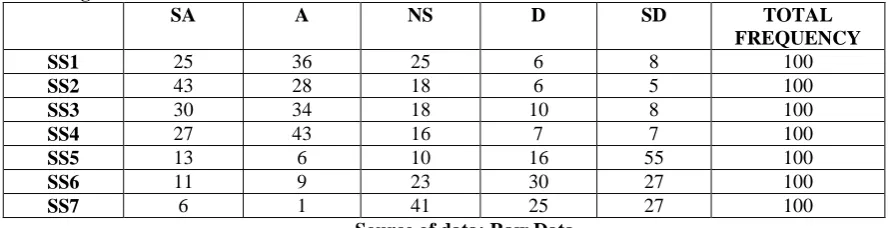
The table below shows responses by respondents on the importance of establishing a job analysis exercise in an organization.
Table 1. Responses to suggested statements (SS) on the importance of establishing a job analysis exercise in an organization.
SA A NS D SD TOTAL
FREQUENCY
SS1 25 36 25 6 8 100
SS2 43 28 18 6 5 100
SS3 30 34 18 10 8 100
SS4 27 43 16 7 7 100
SS5 13 6 10 16 55 100
SS6 11 9 23 30 27 100
SS7 6 1 41 25 27 100
Source of data: Raw Data Key: SS-Suggested Statement
SS1: Job analysis is still poor in the bread manufacturing industry SS2: Job analysis improves overall organizational performance. SS3: There is a positive relationship between job analysis and training SS4: Time is the major challenge affecting job analysis exercise SS5: Job analyst must facilitate job analysis exercise.
SS6: Job analysis exercise only benefit those with executive posts
SS7: Job analysis exercise does not increase employee’s fears of losing their jobs.
Key: Responses to SS
SA:Strongly Agree; A: Agree; NS: Not Sure; D: Disagree; SD: Strongly Disagree
Suggested importance of establishing a job analysis exercise in an organization
The following importances of job analysis were highlighted by the respondents: compensation, disputes resolution, health and safety.
Analysis of table 1
The majority (61%) of the respondents agreed that job analysis process is still poor in the bread manufacturing companies while 14% of the respondents thought otherwise. On the statement that job analysis improves overall organizational performance, an overwhelmingly 71% agreed with the statement with as big as 43% of the respondents strongly agreeing to it. However, 11% of the respondents did not agree with the suggested statement. On SS3, the majority (64%) of the respondents are in favour of the statement that, there is a positive relationship between job analysis and training while on the other hand only 18% of the respondents did not agree. On SS4, 70% of the respondents attributed that time is the major challenge that affects job analysis exercise while only 14% disagrees citing other factors.
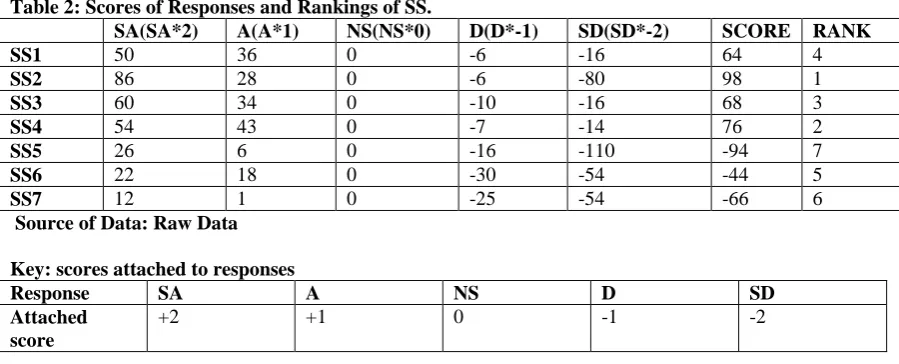
The table below, which is derived from the responses table above, explores the extents to which each statement was supported by respondents through the means of ranking the scores obtained by each suggested statement.
Table 2: Scores of Responses and Rankings of SS.
SA(SA*2) A(A*1) NS(NS*0) D(D*-1) SD(SD*-2) SCORE RANK
SS1 50 36 0 -6 -16 64 4
SS2 86 28 0 -6 -80 98 1
SS3 60 34 0 -10 -16 68 3
SS4 54 43 0 -7 -14 76 2
SS5 26 6 0 -16 -110 -94 7
SS6 22 18 0 -30 -54 -44 5
SS7 12 1 0 -25 -54 -66 6
Source of Data: Raw Data Key: scores attached to responses
Response SA A NS D SD
Attached score
+2 +1 0 -1 -2
SS2 is the suggested statement to which the respondents significantly agreed to with a score of 98. The order cascaded down through SS4 (score 76); SS3 (score 68); SS1 (score 64); SS6 (score -44); SS7 (score -66) until the least agreed SS5 with a score of -94.
DISCUSSION
The findings on the statement job analysis improves organizational performance tend to concur with Locke (2004)”s findings who states that the results of job analysis can be used for enhancing broader human resources strategies, activities and processes including recruitment, skill training, performance appraisal, workforce planning, organizational design and career development and this will improve organizational performance. Contrary, Al-Ajmi (2001) argues that, particularly in an era of continuous delayering and downsizing one of the most common problems are employee fears. Employees may see a job analysis as a threat to their current jobs or pay levels or both and this may affect the performance of an organization.
The findings on the third statement showed that the majority agreed that there is positive relationship between job analysis and training and development. The argument being that once bread manufacturing companies engages in job analysis, the company will use the information in determining skills gap which facilitates training and development. Cross (2004) also share the same sentiments. However, the minority argued that well-established job analysis does not have any relationship with training and development citing that bread manufacturing companies is secret scoundrel with the aim of maximizing profits by simply allocating duties and tasks not taking in cognizance the need to establish a job analysis exercise first. They apply the principle of hiring and firing such that they only employ cheap unskilled labor rather than looking at the skills needed or training the employees so that they will cover the skills gap.
Findings on current state of job analysis revealed that job analysis in the bread manufacturing companies is very poor because respondents argued that they do not know their job descriptions which states their duties and tasks but they just do what ever they are asked to. Respondents also revealed in the interviews that job analysis in the bread manufacturing companies is still developing because if it was sufficiently developed employees will not resist performing some duties and tasks assigned by the management. It can be safely concluded that, job analysis schemes in the bread manufacturing companies is still in the transition stage, from poor to developing as the majority of respondents suggested.
Findings on the relationship between job analysis and employee performance suggested that job analysis specifies the duties, tasks to be carried out. Once an employee knows the duties he/she is likely to perform to his/her full potential bearing in mind that they are accountable for the outcomes of their performance. Cross (2004) also states that, the output of job analysis is performance appraisal and this improves the performance of employees. Those who were against the statement dismissed it on the basis that it aims at increasing the workload by specifying duties to be carried out which are not theirs.
about why job analysis is being done to overcome the challenge of reluctant to participate and ensure greater cooperation.. However, besides the above mentioned challenges, Al-Ajmi (2001) argues that, particularly in an era of continuous delayering and downsizing one of the most common problems are employee fears. Employees see a job analysis as a threat to their current jobs or pay levels or both. This is based on the fact that in the past, job analysis was used as a means of expanding jobs while reducing the total number of employees.
Findings on the importance of establishing a job analysis concurs with the findings from Cross (2004) who states that job analysis is vital because it is used in:
1) Performance appraisal; 2) Safety and health; 3) Legal consideration and 4) Employee and labor relations.
However, the minority of the respondents stated that job analysis is not important because the employers do not implement the finding which renders the process useless and the executives only benefit. Findings on who will implement the job analysis exercises revealed that, everyone in the company must participate for the benefit of the organization.
Findings on the statement, job analysis does not increase employee’s fear of losing their jobs revealed that the majority disagree with the statement. This concurs with Staw and Ross (2003) who states that, organization must overcome employee’s fear so that employees or their supervisors will give accurate information. One of the most successful methods of reducing employee fear is to inform and involve employees or their representatives. Employees should be told why it should be instituted, who will initiate it, how the employees will be affected and why their inputs are critical before the procedure begins. Management must write a commitment that the organization will not terminate the contract of any employee, lower the pay of any employee or decrease the total number of jobs because of the results of the job analysis; such measures may enable the job analyst to obtain complete information from employees.
CONCLUSION
From the research carried it can be concluded that well established job analysis has positive implications on employees, organisational performance, labour turnover, growth, market share and market value of bread manufacturing companies. However, it was noted that, for the process to be effective, Job analysts must inform employees on who will initiate the process, how the employees will be affected .Informed consent protect the rights of participants thereby promoting freedom and self determination.
REFERENCES
1. Adams, R. (2000). Addressing Employee Concern: University of Virginia: Falls Church Campus. 2. Al-Ajmi, R. (2001). The Effects of Personal Characteristic on job satisfaction: Englewood Cliffs: New
Delhi.
3. Best, W. and Kahn, V. (2006). Research in Education (3rd Edition), Person Education, Essex. 4. Cross, S. (2004). Human Resources Management Tools: Prentice Hall: New Jersey
5. Decenzo, F and Robbins, D. (2001). Human Resources Management: Prentice Hall Upper Saddle River: New York.
6. Freud. (1923). Personnel Management in Human Resources: Upper Saddle River: Merill. 7. Gist, M. (2004). Self Efficiency: Implication for Organizational Behavior: Homewood: Irwin 8. Locke, E. (2004). The Micro Analysis: Methods and Analysis: Anaan: New York.
9. Nancy, A. (1988). Job Satisfaction: How People Feel About Their Jobs: New York: Lexington Books. 10. Queen, C. (1999). Aspects to Be Analyzed: Working Paper Number 10.
11. Redmon. (2003). Human Resources Management in Construction Projects: Taylor and Francis Ltd. 12. Sounders, L. (1997).Research Methods for Business Studies: London: Edward Arnold Ltd.