© 2018 IJSRSET | Volume 4 | Issue 1 | Print ISSN: 2395-1990 | Online ISSN : 2394-4099 Themed Section : Engineering and Technology
Developing A Web-Based Application for Accelerating Data
Management : Construction Materials Section
Mohammadmehdi Danesh
Department of Architecture, Iran University of Science and Technology (IUST), Tehran, Iran
ABSTRACT
Construction industry requires different tools to advance on-site tasks. Construction material management applications are one group of such efficient tools. Purchasing project materials in advance of their use allows Project Managers to assure a specified material is available especially before and after crisis conditions in accordance with the construction schedule. However, in such conditions, Project managers have to manage huge amount of data related to construction materials on jobsites. The objective of this research is to introduce a new application which helps the project manager access the huge stored amount of data easily in critical situations. As a result, time can be saved in such situations. This application is developed to store data relating to purchasing, storing, and using construction materials before and after predictable crisis condition such as hurricanes. It means that Project Managers can handle such situations through fast access to the data before and after the crisis.
Keywords : Construction Materials, Project Management, Web-Based Application, Data Management
I.
INTRODUCTION
Different people involved in the construction industry like main contractors, subcontractors and dozens of material suppliers works at different organizations [1]. Crisis situation, like natural disasters, can cause various problems on the jobsite. One of the difficulties is the management of construction materials which are stored. During critical situations, construction materials are needed to renovate buildings; but, material suppliers cannot supply sufficient construction materials. It means that Project Managers have to buy construction materials in advance in order to guarantee that operation on jobsite will proceed. Like other prediction in building industry, such as energy performance of buildings [2,3], this prediction help the project managers to do their job well.
Material costs are over 50% of the building costs [4]. Therefore, purchases, material deliveries, manage the
fleet of vehicles to carry construction materials [5], and Productivity of labour working [6] play an important role in construction processes. Supply construction materials on time offers a large cost saving potential. In addition, bulky and heavy standard materials are difficult to handle and store at the site, increase the potential accident and injuries [7]. If Project Managers do not plan unloading and transportation at the site in advance (before crisis), the extra work can be time-consuming. For example, it took a whole day for two men to carry a bundle of board from the wrong unloading place to the right destination. As a matter of fact, it is significant to choose0 a proper place to store construction materials in crisis conditions [8].
coast and completion time [9, 10]. Therefore, expertise in construction science should find some solution to solve this problem such as developing robots and applications which will be used as an assistance at jobsites.
According to the issues mentioned in above paragraphs, it is crucial that project managers have the ability to manage crisis conditions by an easy access to the data base; hence, this web-based application helps Project Managers to decrease time required for managing construction materials.
II.
DEVELOPMENT
This application is based on storing data about construction materials in predictable crisis conditions created by Zoho creator web-based online application.
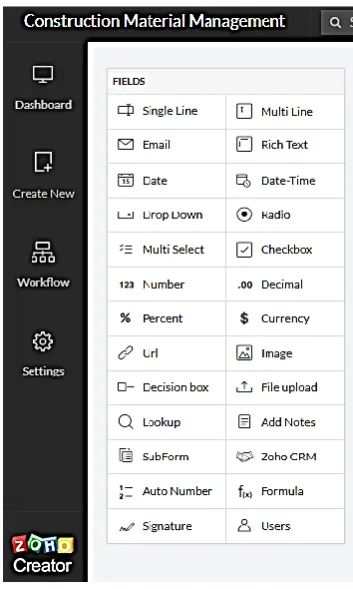
Zoho Creator is an easy-to-use low-code development tool. Built with a straightforward minimalist style, Zoho doesn't bog the user down in a cluttered selection of features. Zoho Creator was among the easiest tools; but, it’s not proper tool to write complex applications [11]. Zoho creator has several fields to write an application (Figure 1).
Figure 1. Zoho Creator’s fields
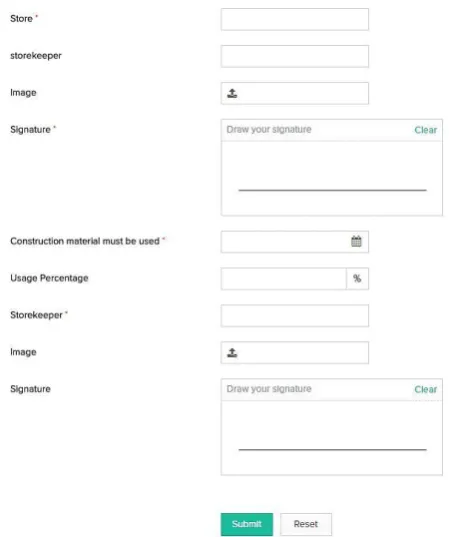
Figure 2. The process of developing the Construction Material Management application, construction materials are received by craftsman (the first user)
Two different people who are working on the construction site, use this application. One of them is a craftsman who receives construction materials from a delivery. The craftsman imports the name of material suppliers, a person who is in charge of selling construction materials at the company, contact information, and type of construction material. Then, according to the quantity and quality of construction material, the craftsman decides to approve or reject the construction materials. If the construction materials are rejected, the form will be submitted, and
recipient information, name, picture, and signature of delivery. Finally, the form is submitted.
Additionally, storekeeper also is responsible to store the construction materials. According to the information provided, craftsman decides which store is proper for the delivered materials. Other significant fields at this part are the time at which construction materials should be used and the amount of material which should be used at that time. Actually, Project Managers define the date and the usage percentage of construction materials.
Figure 3. The process of developing the Construction Material Management, construction materials are
delivered to a store (The second user)
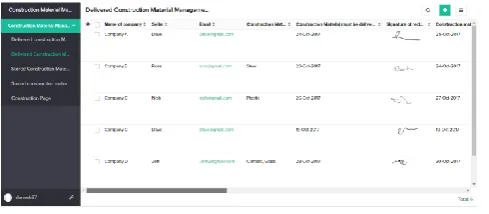
Figure 4. A data base extracted from the application according to the input data
III.
EVALUATION AND DISCUSSION
The most obvious characteristic of a productive application is being user-friendly. To assess this features and the productivity of software, participants are divided into two groups, control and experimental group, 21 Architecture and Construction Science students participate at this survey. Two questioners are developed. The first questioner compares the results of two groups who assess the function of application according to the data provided to each group. The control group, 11 students, have to extract data in a typical way, read the inputted data printed on a spreadsheet and extract requested information. Participants, then, should mention the amount of time that takes to find information for each question. According to the table 1, in average, each participant in control group, needs 00:08:34 to extract data for 6 questions. Student C-7 who made a mistake, was eliminated from the survey.
Table 1: Amount of mean time each applicant in control group needs to extract data from 6 questions
Stu den t ID Q1: Whe n is mate rial B deliv ered? Q2: whe re is mat eria l C stor ed? Q3: Wh en will mat eria l F be use d? Q4: Whe n is mate rial A deliv ered? Q5: Wh ere is mat eria l B stor ed? Q6: Wh en will mat eria l D be use d? Tim e
C-1 00:0 1:25 00:0 1:03 00:0 1:32 00:0 1:28 00:0 1:31 00:0 1:21 00:0 8:20 C-2 00:0
1:38 00:0 1:40 00:0 1:12 00:0 1:19 00:0 1:14 00:0 1:24 00:0 8:27 C-3 00:0
1:10 00:0 1:31 00:0 0:49 00:0 1:32 00:0 1:37 00:0 1:52 00:0 8:31 C-4 00:0
1:12 00:0 1:07 00:0 1:14 00:0 1:17 00:0 1:28 00:0 1:39 00:0 7:57 C-5 00:0
1:28 00:0 1:16 00:0 1:45 00:0 1:32 00:0 1:19 00:0 1:26 00:0 8:46 C-6 00:0
1:50 00:0 1:21 00:0 1:12 00:0 1:31 00:0 1:49 00:0 1:53 00:0 9:36 C-7 wron
g answ er 00:0 1:14 00:0 1:13 00:0 1:42 wro ng ans wer 00:0 1:19 ---
C-8 00:0 1:02 00:0 1:39 00:0 1:35 00:0 1:23 00:0 1:41 00:0 1:34 00:0 8:54 C-9 00:0
1:43 00:0 1:41 00:0 1:21 00:0 1:38 00:0 1:54 00:0 1:22 00:0 9:39 C-10 00:0 1:17 00:0 1:08 00:0 1:19 00:0 1:22 00:0 1:56 00:0 1:31 00:0 8:33 C-11 00:0 1:09 00:0 1:03 00:0 1:07 00:0 1:12 00:0 1:11 00:0 1:15 00:0 6:57 Total mean time 00:0
8:34
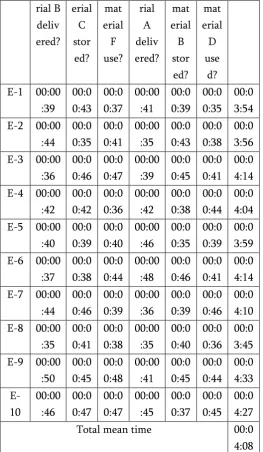
The experimental group, 10 students, use the application to input data. According to the table 2, in average, each participant, in experimental group, needs 00:04:08 to extract data from 6 questions. Therefore, by using the application, if users use this application, huge amount of time will be saved. In addition, users don’t make mistake when they are extracting data from the data base.
Table 2 : Amount of mean time each applicant in experimental group needs to extract data from 6
rial B deliv ered? erial C stor ed? mat erial F use? rial A deliv ered? mat erial B stor ed? mat erial D use d? E-1 00:00
:39 00:0 0:43 00:0 0:37 00:00 :41 00:0 0:39 00:0 0:35 00:0 3:54 E-2 00:00
:44 00:0 0:35 00:0 0:41 00:00 :35 00:0 0:43 00:0 0:38 00:0 3:56 E-3 00:00
:36 00:0 0:46 00:0 0:47 00:00 :39 00:0 0:45 00:0 0:41 00:0 4:14 E-4 00:00
:42 00:0 0:42 00:0 0:36 00:00 :42 00:0 0:38 00:0 0:44 00:0 4:04 E-5 00:00
:40 00:0 0:39 00:0 0:40 00:00 :46 00:0 0:35 00:0 0:39 00:0 3:59 E-6 00:00
:37 00:0 0:38 00:0 0:44 00:00 :48 00:0 0:46 00:0 0:41 00:0 4:14 E-7 00:00
:44 00:0 0:46 00:0 0:39 00:00 :36 00:0 0:39 00:0 0:46 00:0 4:10 E-8 00:00
:35 00:0 0:41 00:0 0:38 00:00 :35 00:0 0:40 00:0 0:36 00:0 3:45 E-9 00:00
:50 00:0 0:45 00:0 0:48 00:00 :41 00:0 0:45 00:0 0:44 00:0 4:33 E-10 00:00 :46 00:0 0:47 00:0 0:47 00:00 :45 00:0 0:37 00:0 0:45 00:0 4:27 Total mean time 00:0
4:08
The second questioner is provided to estimate the productivity of application in users’ view. They use their input data to assess the application. Participants score each item in this questioners from 10 to 100. Applications heat map showing in figure 4 is provided according to the questioner.
Figure 5. Application assessment heat map
However, most participants complain that Project Manager is not capable to send email or text message to the users through the application. Actually, Zoho Creator application does not support this service.
IV.
LIMITATION
The assessment of the application is assessed by students who have Architecture and construction science background; so, there is no guarantee that users in real situation experience the same results.
V.
CONCLUSION
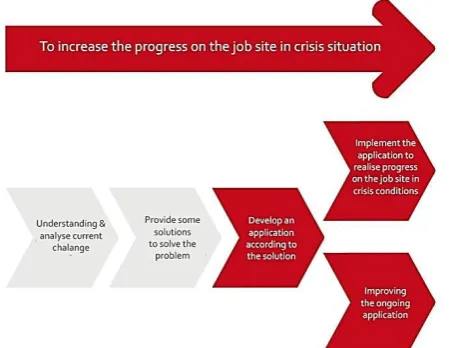
Figure 6. Developing the application according to the challenge
VI.
REFERENCES
[1]. J. L. Burbidge, P. Falster, Reducing delivery times for OKP products, Production Planning and Control 5 (1) (1993) 97-102.
[2]. Sadeghi, S. A., & Karava, P. (2014). Stochastic Model Predictive Control of Mixed-mode Buildings Based on Probabilistic Interactions of Occupants with Window Blinds.
[3]. Sadeghi, S. A. (2015). Integration of Occupant
Interactions with Window Blinds on Model Predictive
Control of Mixed-Mode Buildings. ASHRAE
Transactions, 121, 1VV.
[4]. J.A. Brimson, Activity Accounting: An Activity-Based Costing Approach, Wiley, New York, 1991.
[5]. Asl, V. M., Sadeghi, S. A., & Fathi, S. (2012). A mathematical model and solving method for multi-depot and multi-level vehicle routing problem with fuzzy time windows. Advances in Intelligent Transportation Systems, 1(1), 19-24.
[6]. Khanzadi, M., Dabirian, S., Mohammadpour, A., & Makhmalbaf, M. O. (2011, June). Selecting the best strategy of labour productivity improvement in Tehran grade 1-3 construction contractor companies by applying analytic hierarchy process and statistical analysis of effective factors on labour productivity. In The International Symposium on the Analytic Hierarchy Process (ISAHP), Sorrento (Naples) (pp. 15-18).
[7]. Escamilla, E., and Ostadalimakhmalbaf, M., &
Saseendran (2017). Hispanic Workers: Identification of Factors Impacting Fatal and Non-Fatal Injuries in the Construction Industry. The Professional Constructor. 42(2), 61-75.
[8]. T. Wegelius-Lehtonen, Measuring and re-engineering
logistics chains in the construction industry, in: J. Browne, D. O’Sullivan (Eds.), Re-engineering the Enterprise, Chapman and Hall, London, 1995.
[9]. Escamilla, E., & Ostadalimakhmalbaf, M. (2016). Capacity Building for Sustainable Workforce in the Construction Industry. The Professional Constructor, 41(1), 51-71.
[10].Escamilla, E., Ostadalimakhmalbaf, M., & Bigelow, B. F. (2016). Factors impacting Hispanic high school students and how to best reach them for the careers in the construction industry. International Journal of Construction Education and Research, 12(2), 82-98.
[11].Zoho Creator, (2017). Available in: