The Moderating Effect of Technology Awareness on the Relationship
between UTAUT Constructs and Behavioural Intention to Use Technology:
A Conceptual Paper
Faruq Muhammad Abubakar (Corresponding Author) Business Administration Department,
Bauchi State University,Nigeria. PhD Student, Universiti Utara Malaysia.
Assoc. Prof. Dr. Hartini B. Ahmad
Director, Centre for University Industry collaboration, Universiti Utara Malaysia
ABSTRACT
The volume and value of cash-based transactions in Nigeria is high and expected to rise. This is liked to non-adoption of new e-payment process introduced by the Central Bank. The non-adoption of Point of Sale (POS) terminal is reported to be very low. A number of researchers have used several technology adoption theories to answer a similar phenomenon, but their studies were fragmented. Thus the Unified Theory of acceptance and Use of Technology (UTAUT) combined eight among those numerous theories and models of technology adoption, toward a unified view. However, several studies that used UTAUT and investigate behavioural intention to use technology yielded conflicting findings. Therefore this paper, based on review of past literature, conceptualised that ‘technology awareness’ moderates the relationship between performance expectancy, effort expectancy, social influence, facilitating conditions and behavioural intention to use POS.
Keywords: Retail business, technology adoption, strategic change, e-commerce
1. INTRODUCTION
Ahmad, (2012) stressed that the rapidly ever-changing and yet technology-driven market place calls for a paradigm shift in the approach to managing businesses, thus requires the deployment of alternative management designs. Also, with the advancements in information and communication technology (ICT), such as e-commerce, business processes becomes much easier, but yet the competition from external environment remains or even stiffer. These necessitate the emergence of technology management approach to managing businesses.
Nigerian business environment is not in isolation in this regard, as managers of Nigerian economy has shown some great concerns on the high volume and value of cash circulating in the economy, which resulted in persistently high ‘actual and projected’ cost of cash management (Chima, 2011). The phenomenon is linked to resistance to payment process change by merchants, from cash-based to cashless payments such as POS, because of the emergence of business process technologies such as electronic payment system (EPS). Even more worrisome, the Federal Government of Nigeria through the Central Bank of Nigeria (CBN) has embarked on a serious monetary policy revolution it called “the cash-less policy”, which entail payment processes to be done electronically, using various forms of e-payment systems. EPS is a means by which monetary transaction takes place through the use of information and communication technology (ICT), to transfer funds from payer (customer) to payee (merchant) bank accounts, without recourse to physical cash (Turban, Lee, King, Liang, & Turban, 2009).
and deposits) for individual and N1,000,000 for corporate bodies. In its further effort to reduce the volume and value of cash-based transactions, the Nigerian government through the CBN, roll-out a new policy called “cash-less economy”, with a pilot project embarked upon in Lagos State, southeast of Nigeria. The project, which is tagged ‘Cash-Less Lagos”, was launched in January 2012. The policy according to CBN, the cashless project has two set of objectives; to minimise the use of physical cash and encourage the use of electronic payment mechanism such as the POS. The POS terminal has been targeted by the CBN as a means to address the excess cash-based economy. The device is defined First Bank Nigeria (2012) defines POS as an electronic device which uses internet connection and credit/debit card (a.k.a ATM Card) to process payments for goods and services. However, there is high rate of resistant to change to electronic payment system by both consumers and merchants, as a recent survey puts usage of the system at 6% in Nigeria (Adepetun, 2012). On the other hand, Spain for example, with a population of 14 million people has 1.6 million active POS, an average of 1 POS for every 9 individuals, India records 36 million transactions per annum, with about 500,000 POS installed, while Nigeria with about 160 people, has only 3,000 active POS (Uzor, 2012). The largest users of POS terminals are the retailing industry (Tan, 2012).
2. THEORETICAL BACKGROUND
Jean, et al., (2011) declared that acceptance and use of e-payment systems by consumers and businesses, largely depends on economic condition, technological sophistication and social factors among others (Ayo & Ukpere, 2012). Although there is boost in the level of acceptance and use of (ICT), ironically, there is raise in the amount of physical cash circulating in Nigeria (Ayo & Ukpere, 2012). Similarly, Ogunleye, et al., (2012) believed that there is growth in technological development in the retail payment mechanism, but that has not changed situation from cash-based to cashless. This in inline with Alozie, Akpan-Obong, & Foster, (2011) assertion, who posited that sub-Saharan Africa is lagging behind in terms of adoption/diffusion of information systems and technologies compared to other continents.
In the field of technology management, several researchers have previously used the conventional theories; Innovation Diffusion Theory (IDT) (Rogers, 1962), Theory of Reasoned Action (TRA) (Fishbein & Ajzen, 1975), Theory of Planned Behaviour (TPB) (Ajzen, 1991), Social Cognitive Theory (SCT) (Compeau & Higgins, 1995), Technology Acceptance Model (TAM) (Davis, 1985), Model of PC Utilization (MPCU) (Thompson & Higgins, 1991), The Motivational Model (TMM) (Davis, Bagozzi, & Warshaw, 1992), Task Technology Fit (TTF) (Goodhue & Thompson, 1995), Combined TAM and TPB (C-TAM-TPB) (Taylor & Todd, 1995), TAM2 (Venkatesh & Davis, 2000) and relatively broader model, The Unified Theory of Acceptance and Use of Technology (UTAUT) (Venkatesh, Morris, Davis, & Davis, 2003). The purpose of this study is to propose a moderating variable of ‘technology awareness’, to moderate the relationship between UTAUT constructs and behavioural intention to use POS.
3. BEHAVIORAL INTENTION
The main variable of interest to the researcher in this study is Behavioral Intention to use e-payments system. Several researchers asserted that behavioral intention is the most important determinant of actual behavior. For example, Zhou, (2008) argued that the most important factor that determines user acceptance and use of technology such as e-payment, is the user’s intention. Behavioral intention has been widely researched, especially in the information system research; however, there is need for further research to further enhance our understanding of the phenomenon. “Extensions to the various models identified in previous research mostly enhance the predictive validity of the various models beyond the original specifications” (Venkatesh, et al., 2003, p. 445).
and Facilitating Conditions (Alrawashdeh, Muhairat, & Alqatawnah, 2012), Performance Expectancy, Effort Expectancy, Social Influence and Disturbance Concerns (Lai, Lai, & Jordan, 2009) etc.
Having consider the unification of greater number of these variables by Venkatesh et al., (2003) and theorized UTAUT and its subsequent performance in explaining about 70% variance in behavioral intention (Van Biljon & Kotzé, 2007; Venkatesh, et al., 2003; Y. L. Wu, Tao, & YangJ, 2007). This study selected four main constructs of the UTAUT namely; Performance Expectancy, Effort Expectancy, Social Influence and Facilitating Conditions.
3.1 Performance Expectancy
The variable is defined “as the degree to which an individual believes that using the system will help him/her to attain gains in job performance” (Venkatesh et al. 2003 p. 447). The constructs that are similar to performance expectancy in the past models and theories are perceived usefulness of TAM, relative advantage in DOI, job-fit in MPCU, outcome expectancy in SCT and extrinsic motivation in TMM. The effect was stronger in male younger workers Venkatesh et al. 2003). Interestingly, empirical evidences from past literatures confirmed that age and gender plays very important moderating effect on the influence of performance expectancy on behavioural intention.
Foon and Fah, (2011) studied behavioural intention of internet banking users, Yahya, Nadzar, Masrek, & Rahman, (2011) examined e-sharia portal usage among Shariah court Judges and Alrawashdeh, et al., (2012) investigated the perception of entrepreneurs on information technology innovation. These studies concluded that performance expectancy significantly influenced behavioural intention. However, all the studies shared the same contextual/cultural similarities, as well as the same level of technological development and sophistication, because they were all conducted in Malaysia. Therefore, their conclusion might not be generalised to other context or countries such as Nigeria, whose technological sophistication is not up to Malaysia’s (Anckar, 2003). Studies in China and Taiwan yielded a contrasting findings to those obtained in Malaysia. Cheng, Yu, Huang, Yu, & Yu, (2011) investigated the adoption of mobile devices for mobile learning in China and Wu, Yu, & Weng, (2012)’s study on electronic ticketing adoption among Taiwanese train passengers. Their studies contradicts Foon and Fah, (2011), Yahya, et al., (2011) and Alrawashdeh, et al., (2012)’s findings. Performance expectancy was found insignificant in influencing behavioural intention. Therefore, we found that previous studies on the relationship between performance expectancy and behavioural intention remained inconclusive, hence required further investigation (Li, 2010).
3.2 Effort Expectancy
Effort Expectancy is “the degree of ease associated with the use of system” (Venkatesh et al. 2003 p. 450). Origins of the construct can be traced in TAM as perceived of use, DOI and MPCU as complexity. According to Venkatesh et al. (2003), evidences from past literature indicated that the influence of effort expectancy on behavioural intention is stronger in older workers and young women, thus they hypothesised gender, age and experience to moderate the relationship between the constructs.
Wong and Dioko, (2013) investigated adoption of interactive whiteboard among Australian early childhood teachers, Gao and Deng, (2012) empirically investigate the determinant of Chinese users’ acceptance of mobile e-books, Wu, et al., (2012) studied the adoption of I Pass among Taiwan passengers, Deng, Liu, & Qi, (2011) examined acceptance of online question/answer service among Chinese users, Huang and Qin, (2011) investigated the adoption of virtual fitting room in China, Yamin and Lee, (2010) studied Malaysian students’ acceptance of e-mail system Birch and Irvine, (2009) examined the influence of effort expectancy on Canadian teachers’ acceptance of e-learning portal, Van Dijk, et al., (2008) studied e-government acceptance in Netherland and Lai, et al., (2009) studied mobile commerce adoption among Hong Kong consumers. Others are Alrawashdeh, et al., (2012) study on e-learning in Jordan, Moghavvemi, Salleh, Zhao, & Mattila, (2012) study on IT Innovation adoption in Malaysia, Yahya, et al., (2011) Pappas, Giannakos, Pateli, & Chrissikopoulos, (2011), Foon and Fah, (2011) and Al-Shafi and Weerakkody, (2009). They found the relationship between effort expectancy on behavioural intention was significant.
investigated mobile e-learning adoption among employees of top enterprises in Taiwan. Their findings was not different from Sumak, et al., (2010)’s. Further insignificant influence of effort expectancy on behavioural intention was found in Zhou, (2012) and Yu, (Yu, 2012) studies on location-based service and mobile banking in China and Taiwan respectively.
3.3 Social Influence
Venkatesh, et al., (2003) defined it “is the degree to which an individual perceives that important others believe he/she should use the new system” (Venkatesh et al. 2003 p. 451). This construct is synonymous to subjective norms in TRA, TAM, TPB and C-TAM-TPB. It can also be traced to MPCU and DOI as social factors and image respectively. Similarly, age, gender, experience, and voluntariness of use were theorised to moderate the influence of social influence and behavioural intention, because past literatures has proven that the effect was stronger in women and those with experience in mandatory situation (Venkatesh et al. 2003).
Inconsistency in the relation between social influence and behavioural intention was observed recently. Al-Shafi and Weerakkody, (2009) found that there is significant relationship between the two constructs, while Birch and Irvine, (2009) found no relationship between them. In addition, the works of, Lai, et al., (2009), Sumak, et al., (2010), Yamin and Lee, (2010), Foon and Fah, (2011), Pappas, et al., (2011), Huang and Qin, (2011), Yahya, et al., (2011), Cheng, et al., (2011), Moghavvemi, et al., (2012), Alrawashdeh, et al., (2012), Yu, (2012), Zhou, (2012) and Wu, et al., (2012) substantiate Al-Shafi and Weerakkody, (2009)’s findings. On the other hand, the works of, Cheng and Wang, (2010), Deng, et al., (2011), Gao and Deng, (2012) and Wong, et al., (2013) found the relationship among the constructs as insignificant, which confirm Birch and Irvine, (2009)’s earlier findings.
3.4 Facilitating Conditions
The variable is defined “as the degree to which an individual believes that an organizational and technical infrastructure exists to support use of the system” (Venkatesh et al. 2003 p. 453). Similar to UTAUT’s facilitating conditions in the past models and theories are TPB/DTPB’s perceived behavioural control, DOI’s compatibility and TAM-TPB’s facilitating conditions. Ironically, presence of performance expectancy and effort expectancy diminishes the influence of facilitating conditions on behavioural intentions. However, empirical evidence proved that the influence is stronger for experienced older workers, thus age and experience are hypothesised to moderate the effect (Venkatesh et al., 2003).
Although the construct was not initially proposed as direct determinant of behavioural intention in UTAUT because the core concepts in the constructs were largely taken care of by most of effort expectancy items (Venkatesh, et al., (2003), it was earlier established in MPCU, IDT, TPB and DTPB theories that facilitating condition is a direct determinant of behavioural intention to use technology. This forms the basis for researchers to test a direct causal relationship between the constructs. However, these studies produced contradictory findings. For example, Wang and Yang, (2005) conducted a study on the adoption of online stocking system among Taiwanese investors. Although facilitating condition was seen through the moderating effect of personality traits (extraversion, openness, agreeableness, conscientiousness and neuroticism), it was found that the influence of facilitating conditions on behavioural intention was stronger for personality trait (neuroticism) with internet experience. Nevertheless the moderating effect, the finding was significant.
On the other hand, Marchewka, et al., (2007) applied UTAUT model to understand the perception of US university students on courseware management software (Blackboard). Unlike Venkatesh, et al., (2003), Marchewka, et al, (2007) hypothesized a direct causal relationship between facilitating conditions and behavioral intention. Result of correlation analysis reveals that there is no relationship between the constructs. This further substantiate Venkatesh, et al., (2003) claim, however contrary to Wang and Yang, (2005)’s findings. The discrepancy might be associated with contextual difference. While Wang and Yang, (2005)’s study was conducted among Taiwanese investors irrespective of their internet experience, Marchewka, et al., (2007)’s study examined the perception of US students, whose internet experience is considerably higher Van Slyke, et al., (2004) because of their frequent internet usage. It can be deducted here that, facilitating conditions such as infrastructure was not an issue in developed countries, unlike in the developing countries (Gholami, Ogun, Koh, & Lim, 2010; Rehman, Esichaikul, & Kamal, 2012; Yaqub, Bello, Adenuga, & Ogundeji, 2013).
They found that facilitating condition was insignificant predictor of behavioural intention. Similarly in the e-learning context, Wong, et al., (2013) examined the adoption of interactive white board among student-teachers in Australian university. The same result was obtained. It should observe that both studies were conducted in the education sector, particularly university; subjects of the studies were both undergraduate students taking degree in education and both countries are developed economies (International Monetary Fund, 2012).
Aside the explanation for the inconsistencies above, there are studies that shared contextual similarities, however they were unable to produce consistent findings with regards to relationship of the two constructs. For example, Foon and Fah, (2011) studied the adoption of internet banking in Malaysia, the found that facilitating conditions significantly influence behavioural intention to use. To the contrary, Huang and Qin, (2011) investigated the influence of facilitating conditions on behavioural intention to use virtual fitting room in China, the found no significant influence exists. However, Alrawashdeh, et al., (2012) conducted a study on the adoption of e-learning in Jordan; they found a significant relationship among the constructs. China, Jordan and Malaysia are Asian countries and classified by International Monetary Fund, (2012), as developing countries, thus their infrastructure is not adequate compared to developed economy (Gholami, et al., 2010; Rehman, et al., 2012; Yaqub, et al., 2013).
3.5 UTAUT Constructs and Nigerian Context
Interestingly, Chiemeke and Evwiekpaefe, (2011) relates that the perception of several users of new electronic devices such as the POS, is that the system is somewhat difficult to use and are doubtful of its performance. Similarly, Biola and Dan, (2012) argued that behaviors of Nigerians are usually controlled by the actions of others, whom they have a high regard for, such as friends, parents, religious leaders, sports personalities, teachers, and politicians and celebrities. Their behaviors are also reactive to the influence of television, radio, internet, social media and print media.
It is therefore appropriate to conclude that the resistant to change to e-payment systems by merchandise in Nigeria can be associated with lack of adequate infrastructure to support the use of the system, fear of uncertainty of the performance of the system and the required effort and influence of people who are important to others. Therefore there are substantial justifications to theorise that UTAUT constructs; Performance Expectancy, Effort Expectancy, Social Influence, and Facilitating Conditions are related to the Nigerian context, thus this study conceptualised that they are factors that influences the adoption of technology in the said context.
4. MODERATING VARIABLE
A moderating variable is an interacting term which is said to emerge when the relationship between independent and dependent variables is surprisingly weak or inconsistent relationship or no relationship at all, thus the moderating variable is introduced to reduce or strengthen the relationship (Baron and Kenny, 1986; Sekaran and Bougie, 2009). The moderator variable can be inform of qualitative and quantitative; such as gender, race, level of awareness etc and weight, salary, blood count etc respectively. (Baron and Kenny, 1986).
Justification for a moderator
Based on the above definition and the inconsistencies that exist in the past literature, it is evident that a moderating variable can be introduced to moderate the relationship between these constructs. Furthermore, Venkatesh, et al., (2003) unlocked ample of opportunities for future researchers to enhance our understanding of technology acceptance and usage. They thus suggested;
“While the variance explained by UTAUT is quite high for behavioural research, further work should attempt to identify and test additional boundary conditions of the model in an attempt to provide an even richer understanding of technology adoption and usage behaviour. This might take the form of additional theoretically motivated moderating influences, different technologies (e.g., collaborative systems, e-commerce applications), different user groups (e.g., individuals in different functional areas), and other organizational contexts (e.g., public or government institutions). Results from such studies will have the important benefit of enhancing the overall generalizability of UTAUT and/or extending the existing work to account for additional variance in behaviour” (Venkatesh, et al., 2003, p.470)
literature. The moderator should be logically aligned with the phenomena under study (Sekaran and Bougie, 2009). This connection is therefore presented in next section.
4.1. Technology Awareness as a Moderator
Information and communication technology experts in Nigeria believed that prospective users of POS are not aware of the system. If there is awareness, the penetration of the system will be high (Ilesanmi, 2012). It can be deducted here, that the higher the awareness, the higher the diffusion of the POS and vice-versa. Furthermore, previous studies yielded conflicting findings on the relationship between UTAUT constructs and behavioural intention (Alrawashdeh, et al., 2012; Birch & Irvine, 2009; Foon & Fah, 2011; Gao & Deng, 2012; Huang & Qin, 2011; Lai, et al., 2009; Sumak, Polancic, & Hericko, 2010; Yamin & Lee, 2010). Accordingly, once there is conflicting findings, the same study can be replicated to expand the boundary of knowledge (Li, 2010; Mitchell & Jolley, 1992). However, where there are inconclusive findings of previous research, Baron and Kenny, (1986) suggested a test of moderation effect.
Reffat, (2003) observed that lack of knowledge of how government carry out its functions leads to citizens’ not involvement to benefit from government services. Bamberg & Möser, (2007) posited that awareness is an important requirement for the development of moral norm, unfortunately there is lack of awareness in developing countries, especially in respect of e-government services (Rehman, et al., 2012). Interestingly and specific to POS adoption in Nigeria, researchers and ICT experts attributed the slow adoption of POS to lack of awareness. For example, Yaqub, et al., (2013) believed that the reason for slow adoption of e-payment in Nigeria is lack of awareness of advantages of the system; hence there is need for awareness to aid the diffusion of POS in Nigeria (Ilesanmi, 2012). Also as cited in Chiemeke and Evwiekpaefe, (2011), “The Economist Intelligence Unit, 2006 noted that the introduction of e-commerce services is hampered by a lack of public awareness on how to use the technologies” (p. 1723). It should be noted that these researcher beliefs were not empirically tested, especially the moderating effect of awareness on the relationship of UTAUT constructs and behavioral intention. Consequently, the current study proposes “Technology Awareness” as moderating variable to moderate the influence of performance expectancy, effort expectancy, social influence, and facilitating conditions on behavioural intention to use POS. It is expected that technology awareness construct will moderate the above mentioned relationships.
Mofleh, Wanous, & Strachan, (2008) defines awareness as citizen’s knowledge about the existence and advantages of using the e-government. Similarly, a variable related to awareness is ‘technology cognizance’, which was studied in Nambisan, Agarwal, & Tanniru, (Nambisan, Agarwal, & Tanniru, 1999). As cited in the study, Rogers (Rogers, 1995) defined it as “user's knowledge about the capabilities of a technology, its features, potential use, and cost and benefits, i.e., it relates to awareness-knowledge” (p. 372). Based on the definition of awareness and technology cognizance, the current study coined and operationalized the construct as ‘technology awareness’ and define it as the merchant’s knowledge of the existence, features, costs, benefit and simplicity or otherwise of using POS in their businesses.
4.2 Previous study on Technology Awareness
Although there are no much study that examines the relation between awareness and behavioural intention, the few ones are reviewed and found awareness as important predictor of behavioural intention. For example, Charbaji and Mikdashi, (2003) empirically investigated the influencing e-government adoption factors among Lebanese postgraduate students. Findings of the study indicated that awareness significantly influenced behavioural intention to use e-government.
Similarly, Rehman, Esichaikul, & Kamal, (2012) empirically examined the adoption of e-government among internet users in Pakistan. The study was carried out in two folds. The first was to determine behavioural intention to get information and secondly, to determine the behavioural intention to transact. It was found that awareness significantly influence behavioural intention in both cases. In the field of environmental management, Wan, Cheung, & Shen, (2012) coined the variable as ‘awareness of consequences’ and investigated its influence on behavioural intention to recycle among Hong Kong university staff and students. They found that awareness of consequence significantly influenced behavioural intention.
Awareness to perfectly moderate the relationship between the variables. Therefore this study differentiate itself by proposing a moderating effect of technology awareness on the relationship between UTAUT constructs (performance expectancy, effort expectancy, social influence and facilitating conditions) and behavioural intention to use POS in Nigerian retail industry.
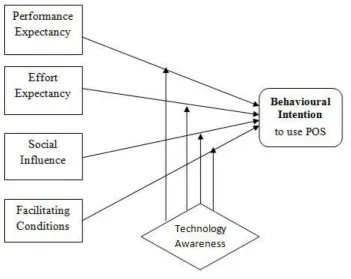
The proposed research framework in this study gives a clear picture of the whole idea of the study and illustrates the schematic diagram in figure 1;
5. PROPOSITIONS
Based on the review of literature above, the inconsistencies found and the justifications for introduction of technology awareness as a moderator, the following propositions are therefore proposed;
Figure 1: The conceptual framework
P1: The influence of performance expectancy on behavioral intention to use POS is moderated by technology awareness.
P2: The influence of effort expectancy on behavioural intention to use POS is moderated by technology awareness.
P3: The influence of social influence on behavioral intention to use POS is moderated by technology awareness.
P4: The influence of facilitating conditions on behavioral intention to use POS is moderated by technology awareness.
6. CONCLUSION
REFERENCE
Adepetun, A. (2012, 30 JULY 2012). Survey puts PoS usage, penetration in Nigeria at six per cent, The Guardian.
Ahmad, A. (2012). Technology Management School: Evolution and Imperative. International Journal of Business, Humanities and Technology, 2(2), 156-162.
Ajzen, I. (1991). The theory of planned behavior. Organizational behavior and human decision processes, 50(2), 179-211.
Alozie, N. O., Akpan-Obong, P., & Foster, W. A. (2011). Sizing up information and communication technologies as agents of political development in sub-Saharan Africa. Telecommunications Policy, 35(8), 752-763.
Alrawashdeh, T. A., Muhairat, M. I., & Alqatawnah, S. M. (2012). Factors affecting acceptance of web-based training system: Using extended UTAUT and structural equation modeling. arXiv preprint arXiv:1205.1904.
Anckar, B. (2003). Drivers and inhibitors to e-commerce adoption: Exploring the rationality of consumer behavior in the electronic marketplace. ECIS 2003 Proceedings, 24.
Ayo, C. K., & Ukpere, W. I. (2012). Further Development of a Secured Unified E-Payment System in Nigeria: A Critical Viewpoint. E-BUSINESS–APPLICATIONS AND GLOBAL ACCEPTANCE, 41.
Bamberg, S., & Möser, G. (2007). Twenty years after Hines, Hungerford, and Tomera: A new meta-analysis of psycho-social determinants of pro-environmental behaviour. Journal of environmental psychology, 27(1), 14-25.
Baron, R. M., & Kenny, D. A. (1986). The moderator-mediator variable distinction in social psychological research: Conceptual, strategic, and statistical considerations. Journal of personality and social psychology, 51(6), 1173-1182.
Biola, K., & Dan, O. (2012). Research Shows Friends are No.1 Influence on Nigerian Youths, as Airtel Repositions as Friendship Network. Retrieved 15 April, 2013, from TMKG Publishing
www.brandworknigeria.com
Birch, A., & Irvine, V. (2009). Preservice teachers’ acceptance of ICT integration in the classroom: applying the UTAUT model. Educational media international, 46(4), 295-315.
Chang, S.-C., & Tung, F.-C. (2008). An empirical investigation of students' behavioural intentions to use the online learning course websites. British Journal of Educational Technology, 39(1), 71-83. doi: 10.1111/j.1467-8535.2007.00742.x
Charbaji, A., & Mikdashi, T. (2003). A path analytic study of the attitude toward e-government in Lebanon.
Corporate Governance, 3(1), 76-82.
Cheng, Y.-S., Yu, T.-F., Huang, C.-F., Yu, C., & Yu, C.-C. (2011). The Comparison of Three Major Occupations for User Acceptance of Information Technology: Applying the UTAUT Model. iBusiness, 3(2), 147-158.
Chiemeke, S., & Evwiekpaefe, A. (2011). A Conceptual framework of a modified unified theory of acceptance and use of technology (UTAUT) Model with Nigerian factors in E-commerce adoption. Educational Research, 2(12), 1719-1726.
Chima, O. (2011, 6 Oct. 2011). CBN: Cash Mgt Cost May Rise to N192bn, News, ThisDay. Retrieved from
http://www.thisdaylive.com/articles/cbn-cash-mgt-cost-may-rise-to-n192bn/99900/
Compeau, D. R., & Higgins, C. A. (1995). Computer self-efficacy: Development of a measure and initial test.
MIS quarterly, 189-211.
Davis, F. D. (1985). A technology acceptance model for empirically testing new end-user information systems: Theory and results. Massachusetts Institute of Technology, Sloan School of Management.
Davis, F. D., Bagozzi, R. P., & Warshaw, P. R. (1992). Extrinsic and intrinsic motivation to use computers in the workplace1. Journal of applied social psychology, 22(14), 1111-1132.
Deng, S., Liu, Y., & Qi, Y. (2011). An empirical study on determinants of web based question-answer services adoption. Online Information Review, 35(5), 789-798.
Du, H., Zhu, G., Zhao, L., & Lv, T. (2012). An empirical study of consumer adoption on 3G value-added services in China. Nankai Business Review International, 3(3), 257-283.
FirstBank Nigeria. (2012). POS Terminals Retrieved 19/09/2012, 2012, from
www.firstbanknigeria.com/EBanking/PoSTerminals/tabid/114/Default.aspx
Foon, Y. S., & Fah, B. C. Y. (2011). Internet banking adoption in Kuala Lumpur: an application of Utaut model.
International Journal of Business and Management, 6(4), p161.
Gao, T., & Deng, Y. (2012). A study on users' acceptance behavior to mobile e-books application based on UTAUT model. Paper presented at the Software Engineering and Service Science (ICSESS), 2012 IEEE 3rd International Conference on.
Gholami, R., Ogun, A., Koh, E., & Lim, J. (2010). Factors affecting e-payment adoption in Nigeria. Journal of Electronic Commerce in Organizations (JECO), 8(4), 51-67.
Goodhue, D. L., & Thompson, R. L. (1995). Task-technology fit and individual performance. MIS quarterly, 213-236.
Huang, N., & Qin, G. (2011). A study of online virtual fitting room adoption based on UTAUT. Paper presented at the E -Business and E -Government (ICEE), 2011 International Conference on.
Ilesanmi, F. (2012). Cashless Policy: Disconnects Must be Fixed - Adeyemi | Nigeria CommunicationsWeek. Retrieved 10/9/2012, from Communicationsweek Media Limited (Nigeria)
www.nigeriacommunicationsweek.com.ng/e-guest/cashless-policy-disconnects-must-be-fixed-adeyemi
International Monetary Fund. (2012). World Bank list of economies. Jean, L., Scott, B., & Patrick, D. (2011). World Payments Report. Scotland
Lai, D. C.-F., Lai, I. K.-W., & Jordan, E. (2009). An extended UTAUT model for the study of negative user adoption behaviours of mobile commerce. Paper presented at the Proceedings of the Ninth International Conference on Electronic Business.
Lam, T., Cho, V., & Qu, H. (2007). A study of hotel employee behavioral intentions towards adoption of information technology. International Journal of Hospitality Management, 26(1), 49-65.
Li, L. (2010). A Critical Review of Technology Acceptance Literature. Retrieved April, 19, 2011.
Liao, C., Liu, C.-C., & Chen, K. (2011). Examining the impact of privacy, trust and risk perceptions beyond monetary transactions: An integrated model. Electronic Commerce Research and Applications, 10(6), 702-715.
Lin, C.-S., Tzeng, G.-H., Chin, Y.-C., & Chang, C.-C. (2010). Recommendation sources on the intention to use e-books in academic digital libraries. Electronic Library, The, 28(6), 844-857.
Ling, K. C., Chai, L. T., & Piew, T. H. (2010). The effects of shopping orientations, online trust and prior online purchase experience toward customers’ online purchase intention. International Business Research, 3(3), P63.
Lu, Y., Cao, Y., & Yang, S. (2010). An empirical investigation of behavioral intention to use online services.
Paper presented at the Information Management and Engineering (ICIME), 2010 The 2nd IEEE International Conference on.
Mardikyan, S., Beşiroğlu, B., & Uzmaya, G. (2012). Behavioral Intention towards the Use of 3G Technology.
Communications, 2012.
Mitchell, M. L., & Jolley, J. M. (1992). Generating the research hypotheses : Tapping intuition, theory and existirrg research. Journal of Clinical Neuroscience, 15(2), 37-90.
Mofleh, S., Wanous, M., & Strachan, P. (2008). The gap between citizens and e-government projects: the case for Jordan. Electronic Government, an International Journal, 5(3), 275-287.
Moghavvemi, S., Salleh, N. A. M., Zhao, W., & Mattila, M. (2012). The entrepreneur's perception on information technology innovation adoption: An empirical analysis of the role of precipitating events on usage behavior. Innovation: Management, Policy & Practice, 14(2), 231-246.
Nambisan, S., Agarwal, R., & Tanniru, M. (1999). Organizational Mechanisms for Enhancing User Innovation in Information Technology. MIS quarterly, 23(3), 365-395. doi: 10.2307/249468
Ogunleye, G., Adewale, O., & Alese, B. (2012). An exploratory study on electronic retail payment systems: user acceptability and payment problems in Nigeria. Paper presented at the 24th National Conference of the Nigeria Computer Society, Lagos.
Omar, K., Ala’a, Al-Nasrallah. (2011). Determinants of e-Gov Adopt in Kuwait: The Case of the Traffic Violation E-payment System (TVEPS) Paper presented at the Second Kuwait Conference on e-Services and e-Systems, Kuwait.
Pappas, I., Giannakos, M. N., Pateli, A., & Chrissikopoulos, V. (2011). Online purchase intention: investigating the effect of the level of customer perceptions on adoption.
Reffat, R. (2003). Developing a successful e-government. Paper presented at the Symposium on e-Government: Opportunities and Challenge. Muscat Municipality, Oman.
Rehman, M., Esichaikul, V., & Kamal, M. (2012). Factors influencing e-government adoption in Pakistan.
Rogers, E. M. (1962). Diffusion oflnnovation. New York: The. Rogers, E. M. (1995). Diffusion of innovations: Simon and Schuster.
Sumak, B., Polancic, G., & Hericko, M. (2010). An empirical study of virtual learning environment adoption using UTAUT. Paper presented at the Mobile, Hybrid, and On-Line Learning, 2010. ELML'10. Second International Conference on.
Tan, A. (2012). Industry of POS Retrieved 14 Nov. 2012, 2012, from http://www.irrica.com/point-of-sales-system-pos/133-industry-of-pos.html
Taylor, S., & Todd, P. A. (1995). Understanding information technology usage: A test of competing models.
Information systems research, 6(2), 144-176.
Thompson, R. L., & Higgins, C. A. (1991). Personal Computing: Toward a Conceptual Model of Utilization.
MIS quarterly, 125.
Turban, E., Lee, J. K., King, D., Liang, T. P., & Turban, D. (2009). Electronic commerce 2010: Prentice Hall Press.
Uzor, B. (2012, 22 Aug. 2011). Only 3, 000 functioning PoS terminal in Nigeria, Newspaper, BusinessDay Newspaper. Retrieved from http://www.businessdayonline.com/NG/index.php/tech/78-computing/26343-only-3-000-functioning-pos-terminal-in-nigeria
Van Biljon, J., & Kotzé, P. (2007). Modelling the factors that influence mobile phone adoption. Paper presented at the Proceedings of the 2007 annual research conference of the South African institute of computer scientists and information technologists on IT research in developing countries.
Van Slyke, C., Belanger, F., & Comunale, C. L. (2004). Factors influencing the adoption of web-based shopping: the impact of trust. ACM SigMIS Database, 35(2), 32-49.
Venkatesh, V., & Davis, F. D. (2000). A theoretical extension of the technology acceptance model: Four longitudinal field studies. Management science, 46(2), 186-204.
Venkatesh, V., Morris, M. G., Davis, G. B., & Davis, F. D. (2003). User acceptance of information technology: Toward a unified view. MIS quarterly, 425-478.
Wan, C., Cheung, R., & Shen, G. Q. (2012). Recycling attitude and behaviour in university campus: a case study in Hong Kong. Facilities, 30(13/14), 630-646.
Wong, I. A., & Dioko, L. D. A. (2013). Understanding the mediated moderating role of customer expectations in the customer satisfaction model: The case of casinos. Tourism Management, 36, 188-199.
Wu, M.-Y., Yu, P.-Y., & Weng, Y.-C. (2012). A Study on User Behavior for I Pass by UTAUT: Using Taiwan\'s MRT as an Example. Asia Pacific Management Review, 17(1), 92-111.
Wu, Y. L., Tao, Y. H., & YangJ, P. C. (2007). Using UTAUT to explore the behavior of 3G mobile communication users. Paper presented at the Industrial Engineering and Engineering Management, 2007 IEEE International Conference on.
Yahya, M., Nadzar, F., Masrek, N., & Rahman, B. A. (2011). Determinants of UTAUT in Measuring User Acceptance of E-Syariah Portal in Syariah Courts in Malaysia. Paper presented at the The 2 nd International Research Symposium in Service Management Yogyakarta, Indonesia.
Yamin, M., & Lee, Y. (2010). Level of acceptance and factors influencing students' intention to use UCSI University's e-mail system. Paper presented at the User Science and Engineering (i-USEr), 2010 International Conference on.
Yaqub, J., Bello, H. T., Adenuga, I. A., & Ogundeji, M. O. (2013). The Cashless Policy in Nigeria: Prospects and Challenges. International Journal of Humanities and Social Science, 3(3), 200-212.
Yu, C.-S. (2012). Factors Affecting Individuals to Adopt Mobile Banking: Empirical Evidence from the UTAUT Model. Journal of Electronic Commerce Research, 13(2), 104-121.