* To whom all correspondence should be addressed. E-mail: [email protected],
Study of Hard Formation Drilling by
Multiple Control Micro Detonation
Prince Julius1 and K. Vishnu2
Department of Petroleum Engineering, Amet University, Chennai -603 112, India.
doi: http://dx.doi.org/10.13005/bbra/1422
(Received: 15 August 2014; accepted: 10 October 2014)
The demand for oil and gas is increasing at a far greater rate than ever before. Geologists across the globe are in search of new reserves. Some of them are easily exploitable some are not. One major problem that we come across in Petroleum industry is Hard formations encountering the successful drilling operation. Drilling through hard formations is time consuming and uneconomical at times. As far as the petroleum industry is concerned time equals money and operations have to be time bound. Here we presented a new technique namely Multiple Control Micro Detonation that can be used to drill through hard rock formations. Multiple Control Micro Detonation (MCMD) will help us to drill through hard rock formations in an effective and time saving manner with minimum expenditure. As for now we have many techniques to drill through hard rock formations, but their effectiveness in terms of money and time is not appreciable and till day hard rock formations are a nightmare for any Drilling Engineer or any Petroleum Engineer. MCMD is very effective and efficient technique when executed with care, precise calculations and also with the help of accurate Geological data. Geological data about proves to be a vital element in the successful completion of this technique at any location. Multiple Control Micro Detonation is a self innovated unconventional drilling technique. As the name suggests this technique uses the power of an controlled explosion or micro detonations to drill through hard formations. Here we use detonators in a controlled manner to make the formation loose. Once the formation becomes loose it can be drilled easily. This paper contains all technical aspects of Multiple Control Micro Detonation .This paper also include Mathematical proofs and calculations involved in this technique. The Mathematical proof given in this paper is a clear evidence of how well this technique can be implemented. This technique can be effectively applied for formation ranging from Medium Hard, Hard, Very Hard and even in Granite formations. Proper and well calculated implementation of MCMD we can counter any kind of hard formation without compromising the economic and safety aspects. Thus this technique will help us to overcome a major problem our Petroleum industry faces, and will contribute in solving the oil crisis the World is facing now.
Key words: Hard formation drilling, Micro detonation.
In an Industry where time and money are the key players in decision making, hard rock formations have always posed a threat the Petroleum Economists and Engineers. The cost and time of drilling always posses a stress on drilling engineers. The cost of bit and their constant wear
and tear while drilling hard formations and time it takes are always the main concerns.
Multiple Controlled Micro Detonation is a technique suggests the detonation power of an explosive charge is used to help in drilling easily and effectively through hard formation.
Methodology
Multiple control micro detonations technique use the power of an explosive charge to make the formation weak. The explosive charge is inserted in the hard rock formation that is to be drilled. When triggered the charge explodes and make the surrounding rock weak. So this weaken section can be drilled effortlessly using conventional techniques. This is the basic method of operation.
Creating the hole
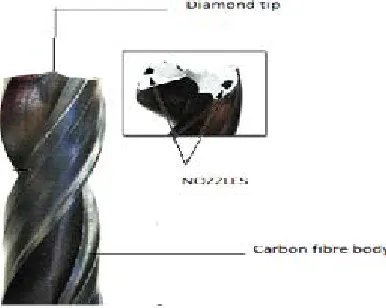
The first step is to create holes in the formation to insert the charge. In order to create a hole in the hard formation special drill has been designed. This bit looks similar to that of a regular house hold drill bit, but the difference is that it is made up of Carbon fibre with a diamond tip (fig 1). The bit is made of carbon fibre because of it’s high strength and high elastic modulus. The diamond tip will give it good penetration rates. Since it is a point force that acts on the formation making a hole is easy. The following diagrams show the replica of a carbon fibre bit Fig.1 and the bottom hole tool making a hole in the formation Fig.2.
contain any particles of size larger than that of the nozzle size. So the drilling fluids used here consists only fluids. Mostly any lubricating oil of low viscosity is used.
Fig. 1. A prototype of the drill bit
From Fig.1 we can clearly see the nozzles in the drill bit. These are used to pump the drilling fluids. The drilling fluid helps in lubricating the bit. It also functions in reducing the temperature of the bit. The drill bit will get heated up so much that it may cause the bit to break. The drilling fluids used here are not like the once used for conventional drilling. Since these nozzles are very small the drilling fluids used here should not
Fig. 2. Drill bit along with other BHA tools making a hole in the formation
The bit is designed to makes not just one hole but three holes in at that same run, making one hole after the other. The number of holes depends on the diameter of the bore hole to be detonated. For a small diameter bore hole only one hole need to be made. For a larger diameter bore hole three holes has to be there to attain complete detonation.
Fig. 3. Single hole arrangement
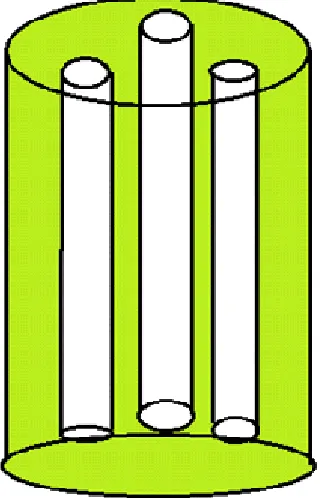
In the single hole arrangement the hole is drilled at the centre of the formation as seen in figure Fig.3 and in the three hole arrangement the three holes form a equilateral triangle Fig.4.
three hole arrangement. We can see that the three hole form a triangular shape. The detonating charge is inserted to these holes.
Inserting the Detonator or detonation charge
The next step is to insert the detonation charge in to the hole created. The detonation charge is not a single column of detonation material but consist of numerous capsules. This is done for various purposes. The most important of which is to reduce the undesirable effects on neighbouring formations and also to reduce the
effect of a big blast to the wellbore equipments like the casing above. When the charge is divided in to capsules, instead of a big blast there will be numerous small detonations, so the harm to any well bore equipment is minimum and yet we can achieve the desired amount of rock formation being deformed or blasted.
The advantage having a capsule arrangement along with an emergency cut off is that it allows more controlled detonation, and that we can stop the detonation at any instance with the push of a button. So in case of an emergency or any problems we can stop the detonation at any instance.
The detonating material is given an outer covering or coating that prevents the detonating material getting wet due to any external reasons. This coating material will be mostly a poly ethylene coating. This is done because there may be some fluids present in the drilled hole. The fluid used while making the hole are not what is used for normal drilling operation.
Fig. 4. Three hole arrangement
Fig. 5. Cross-sectional view of the three holes
Fig. 6. Detonation charge with emergency cut off
Detonating the charge or Exploding
The detonator is exploded using an electric blasting cap1. The electric blasting cap will
charge. Each capsule consist a blasting cap which explodes each capsule independently
Drilling out the shattered rock
When the capsules detonate the surrounding rock gets shattered. These shattered rock fragments are easy to drill now. The shattered rock is drilled using a standard roller cone bit, or a PDC bit if required. Drilling through this shattered rock section is much easier than drilling at normal circumstances. The shattered rocks are drilled faster and easier compared to normal drilling operations at the same area2.
Mechanism of Blast
Basically any explosion can be defined as a rapid release of heat and large quantities of high pressure gasses. These two factors (heat and high pressure gasses) contribute to the blasting effect. The heat will melt the surrounding rock formation and the shock wave will crack the rock and the gasses will further dislocate them. The velocity at which the gasses are released is very critical in determining the effect of the blast. So determination of blast velocity is very critical.
There are three basic mechanisms that has to be understood in order to understand the how a blast will affect the surrounding rock they are:
Heat generation
The heat generated during the blast will melt the surrounding rock. This mechanism depends on the amount of heat generated. If the heat generated is low it will only heat the rock, but if the heat is sufficient enough it will melt a small volume of nearby rock.
Detonation Shock Wave
An energy pulse or shock wave is generated that travels at the front of detonation zone. This shock wave is transmitted in to the adjacent rock2. Shock waves travel in all directions
as compression waves, at detonation velocity. The shock wave is actually responsible for creating
the fracture in the rock formation. The degree of fracture created depends on how much times the force of shock wave exceeds the rocks elastic limit.
Gas pressure
Along with the shock wave superheated gasses are released at high pressures that may exceed 1.5 million psi. This gas pressure helps in moving the fractured rock from its original position, or dislocate them. The generated gas pressure must exceed the inertia of the fractured rock only then the pressured gas can move the rock fragments3.
Table 1. Properties of Hard Rock
Properties Granite Basalt
Density 2.75g/cm3 2.8g/cm3
Young’s Modulus 70 Gpa 78 Gpa
Poison’s Ratio 0.3 0.25
Tensile Strength 25 Mpa 14 Mpa Compressive Strength 250 Mpa 266 Mpa
Table 2. Properties of detonating materials
Product Densityg/cc VelocityFt/sec Fume Class Water Resistance
Emulex 510 1.15 16,300 1 Excellent
Emulex 520 1.16 15,200 1 Excellent
Emulex 710 1.19 18,000 1 Excellent
Emulex 730 1.21 17,000 1 Excellent
Emulex 750 1.35 19,000 1 Excellent
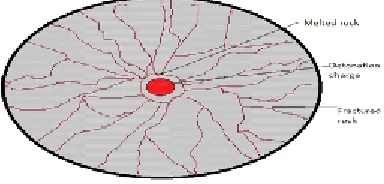
Fig. 7. Effect of detonation on a rock section
Fig.7 shows a section of rock that has been detonated using a detonation charge. The diagram shows the melted section of rock and the fractured rock fragments.
Observation and Discussion
that of detonator properties. The rock properties that have to be considered are volume of rock, density of rock, elastic limits and stress coefficients5. The detonator properties that have
to be considered are density of material, detonation velocity, fume class and water resistance.
The hardest formation that we may encounter during drilling may be Granite or Basalt. So let us check some of the properties of granite and basalt that has to be considered. These values will be useful in determining the detonator that has to be used.
Now we have to check some of the properties of commonly used detonators. The detonator properties are critical in determining the effect of the detonator on a formation4. The
detonator values have to overcome the rock’s strength values. So the values of some of the most commonly used detonating materials are given in Table 2.
By comparing the rock and detonator properties we have to decide the type and amount of detonating material that can be used. The rock properties may vary from site to site so a selection of the detonating material is done onsite. The selection of detonating material also depends on the availability of detonator at that time on a site. The political scenario of the location also plays a role in the selection and use of detonators because we may have permission to use certain class of detonators in certain places5.
CONCLUSION
The scope and area of usage of Multiple Control Micro Detonation is broad, but a proper knowledge of what type of rock has to be detonated
is required. For that appropriate geological and geophysical data should be available. Apart from geological data there should be a clear idea about the type of detonator used and its properties6.
An onsite Detonation expert will assist the driller in deciding the type of detonator, the volume of detonator used. He will also help the driller in taking safety precautions while using this technique. He will work out and find out the type and volume of detonator to be used by using rock strength data provided by the geologist.
This technique can be used in any hard rock formation that may be encountered during drilling. The main advantage of this technique is that the procedures for operations are simple and same irrespective of the type of formation. Only the type and amount of detonator used will vary according to the type of formation.
REFERENCES
1. “Back to Basics”., The Fundamental of Blast Design, Author: Wesley L. Bender, 1999 2. Gordon, J., Saicic P., and McAllan, R.,
Deepwater Developments: Challenging Equipment Limits (132516-MS), SPE Asia Pacific Oil and Gas Conference and Exhibition, Brisbane, Queensland, Australia, October 18-20, 2010, 9 p.
3. Rock Mechanism and Rock Engineering., January- march 1995, Volume 28 Issue 1, PP 1-15
4. Common rock Densities.,Geology.about.com 5. The Effect of the Stress Path on Squeezing
Behaviour in Tunnelling.,Authors: Cantieni, Linard; Anagnostou, Georgios