Original Research Article
An observational study to assess the knowledge and attitude of medical
students regarding hand washing
Shashi Saxena, Saurabh Mishra*, Huma Khan
INTRODUCTION
In spite of much importance and simplicity of hand washing practices, awareness regarding hand washing comes out to be very low. To address this problem, continuous efforts are being made to identify effective and sustainable strategies. One of such efforts is the introduction of an evidence-based concept of “My five moments for hand hygiene” by World Health Organization. These five moments that call for the use of hand hygiene include the moment before touching a patient, before performing aseptic and clean procedures, after being at risk of exposure to body fluids, after touching a patient, and after touching patient’s surrounding. This concept has been aptly used to improve understanding, training, monitoring, and reporting hand hygiene among healthcare workers.
Maintenance of hand hygiene is a very convenient and effective way to prevent communicable diseases. Correct and effective hand hygiene knowledge, practices, and skills are essential for reducing healthcare associated infections. However, compliance of healthcare workers to hand hygiene guideline is reportedly not up to the mark. It is important to instill adequate knowledge, positive attitude and good practices at the time of primary care training of healthcare workers including medical students. Although causal links between hand hygiene and rates of infectious disease have also been established earlier, studies focusing on hand hygiene among university-going students are not adequate in number. The present study has been done to judge basic knowledge, identify gaps in knowledge, attitudes, skills, and practices on hand hygiene among undergraduate medical students. A pre-tested questionnaire-based
cross-ABSTRACT
Background: Hand hygiene is a milestone in the field of infectious disease control. Promotion of improved hand hygiene has been recognized as an important public health measure. Therefore hand washing is being promoted in various ways. This study has been conducted to assess the level of knowledge and attitude regarding hand hygiene practices amongst the medical students to identify areas of gaps in their knowledge, attitude and practices.
Methods: This is a cross sectional study conducted among medical undergraduates of a private medical college in western Utter Pradesh. A pre tested questionnaire with multiple choice questions was used for collection of data.
Results: A total of 246 MBBS students participated in the study out of which 50.4 % students were male and rest were female. 78.5% participants were belonging to the age group 19-21 years. Students have good knowledge of hand washing irrespective of their educational front.
Conclusions: The results of our study are fairly good still a proper training program is required to generate awareness among the community. Maintenance of hand hygiene should be a part of our education system at primary level.
Keywords: Hand washing, Infections, Hygiene
Department of Community Medicine, Shri Ram Murti Smarak Institute of Medical Sciences, Bareilly, U.P., India
Received: 26 April 2019
Revised: 10 June 2019
Accepted: 11 June 2019
*Correspondence:
Dr. Saurabh Mishra,
E-mail: [email protected]
Copyright: © the author(s), publisher and licensee Medip Academy. This is an open-access article distributed under the terms of the Creative Commons Attribution Non-Commercial License, which permits unrestricted non-commercial use, distribution, and reproduction in any medium, provided the original work is properly cited.
sectional study has been conducted among various batches of medical students. The study will reveal that if the participants have basic knowledge on various aspects of hand hygiene like frequency, correct method of hand washing, use of right temperature of water used for hand washing, hand drying, and skills at health care facility needs further improvement, which can be done by reinforced training, observation and improving skills. Healthcare-associated infections affect hundreds of millions of patients worldwide every year. Nosocomial infections are caused by many different factors related to systems and processes of care provision as well as to human behavior that is conditioned by education, societal norms, and beliefs. Most infections, however, are preventable. Hand hygiene is the primary measure to reduce infections. WHO First Global Patient Safety Challenge, Clean Care is Safer Care, is focusing part of its attention on improving hand hygiene standards and practices in health care workers. Annually more than 3.5 million under 5 years children die due to diseases of GI Tract, Respiratory infections, etc.1 Studies have suggested that most of these morbidities can be prevented by simple intervention measures, like proper hygiene, hand washing, availability of safe water, food hygiene, education etc. Medical establishments have a major role in training their staff in basic hand hygiene practices. The first historical evidence on the importance of hand washing was revealed in maternity clinics on Vienna, as early as in 1847. Many studies carried across the world have demonstrated that proper hand washing practices reduce the risk of infectious diseases. It has been suggested that the incidence of hospital-acquired infections can be reduced by approx. 15% if hand hygiene recommendations are implemented.2 Hand-washing can reduce the risk of severe intestinal infections and shigellosis up to 48% and 59% respectively Another meta-analysis reported that all eligible studies showed a 6.0% to 44% reduction in respiratory diseases with proper hand washing.3 A study among medical and university students in Turkey found hand washing less than 5 times a day among 27% students, reasons for skipping hand washing was the student's belief of 'no need' (63.7%).4 In a study conducted among medical and nursing students, in Sri Lanka found moderate knowledge (77%), but attitudes, practices,and satisfaction of facilities were found to be poor (<50%).5 A similar study in Nigeria in teaching hospital among health worker found hand washing after interacting with patients to be 9.3% among nurses and 51.2% among doctors.6 The present study will evaluate knowledge, attitude, and practices among medical students of 1st year to 3rd year MBBS students of a Medical College.
METHODS
The present study was conducted at Shri Ram Murti Smarak Institute of Medical Sciences Bareilly, (UP) India
among medical students during the period from March to April 2019. Consent of participants was taken. The purpose of the study and important aspects related to hand washing were explained to participants. The questionnaire is prepared by using previously published studies.5,7 Questionnaire was pretested to validate questions and necessary amendments were done to obtain feasible responses. The questionnaires were filled in the presence of investigator in a separate session. Responses were statistically analyzed and validated using software SPSS version 20. P value less than 0.05 is considered to be significant.
Inclusion and exclusion criteria
All medical undergraduate students who were willing to participate in the study were included and those who were absent on the day of survey or not willing to participate were excluded.
RESULTS
A total of 246 students participated in the study. 93, 66 and 87 students were belonging to MBBS first, second and third year respectively. Overall male and female students were almost equal in number. Male participants from first, second and third year were 46.2%, 40.9% and 62.1% respectively. Majority of the participants (78.5%) lies in the age group 19-21 years.
Table 1: Age and gender wise distribution of the students.
Sr. No. Parameter MBBS 1st year MBBS 2nd year MBBS 3rd year
No. of students in the batch n=93 n=66 n=87
N % N % N %
1 Gender Male 43 46.2 27 40.9 54 62.1
Female 50 53.8 39 59.1 33 37.9
2 Age (in
years)
Under 19 8 8.6 0 0.0 0 0.0
19-21 79 84.9 60 90.9 54 62.1
22-23 5 5.4 6 9.1 29 33.3
above 23 1 1.1 0 0.0 4 4.6
Table 2: Basic knowledge regarding hand washing.
Sr. No. Parameter MBBS 1st year MBBS 2nd year MBBS 3rd year
No. of students in the batch n=93 n=66 n=87
Question Response N % N % N %
1
Hand washing is necessary for prevention of
transmission of disease
Yes 93 100.0 66 100.0 87 100.0
No 0 0.0 0 0.0 0 0.0
2
Do you routinely use soap/hand wash solution for hand washing
Yes 90 96.8 65 98.5 87 100.0
No 3 3.2 1 1.5 0 0.0
3 Have you received any
training in hand washing
Yes 78 83.9 37 56.1 30 34.5
No 15 16.1 29 43.9 57 65.5
4 How many times in a day do
you wash your hands
Never 0 0.0 1 1.5 0 0.0
1-2 times 5 5.4 1 1.5 2 2.3 3-5 times 63 67.7 30 45.5 47 54.0 6-10 times 25 26.9 34 51.5 38 43.7
Table 3: Participants attitude towards hand washing.
Sr. No.
Parameter MBBS Ist year MBBS 2nd year MBBS 3rd year
P value
No. of students in the batch n=93 n=66 n=87
Question Response N % N % N %
1
Hot water should be used for hand washing
Agree 69 74.2 46 69.7 66 75.9
0.694 Disagree/don't know 24 25.8 20 30.3 21 24.1
2 No need to wash
wrists
Agree 6 6.5 4 6.1 4 4.6
0.856 Disagree/don't know 87 93.5 62 93.9 83 95.4
3
Hands need to be washed at least 15 seconds
Agree 84 90.3 58 87.9 79 90.8
0.823 Disagree/don't know 9 9.7 8 12.1 8 9.2
4 Need drying after
washing hands
Agree 87 93.5 60 90.9 73 83.9
0.099 Disagree/don't know 6 6.5 6 9.1 14 16.1
Table 4: Knowledge of hand washing practices among participants.
Sr. No.
Parameter MBBS Ist year MBBS 2nd year MBBS 3rd year P
value No. of students in the batch n=93 n=66 n=87
Hand washing is required N % N % N %
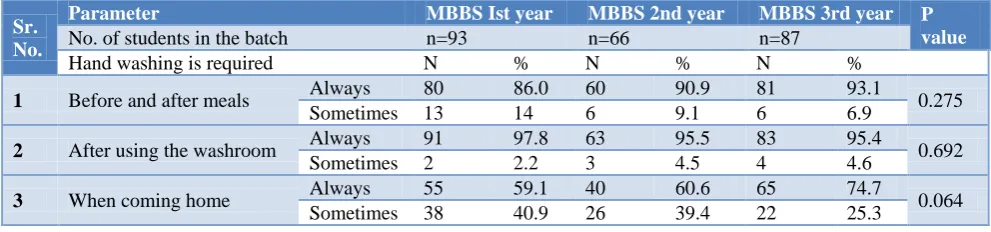
1 Before and after meals Always 80 86.0 60 90.9 81 93.1 0.275 Sometimes 13 14 6 9.1 6 6.9
2 After using the washroom Always 91 97.8 63 95.5 83 95.4 0.692 Sometimes 2 2.2 3 4.5 4 4.6
3 When coming home Always 55 59.1 40 60.6 65 74.7 0.064 Sometimes 38 40.9 26 39.4 22 25.3
Sr. No.
Parameter MBBS Ist year MBBS 2nd year MBBS 3rd year
P value No. of students in the batch n=93 n=66 n=87
Hand washing is required N % N N % N
4 After touching animals Always 85 91.4 57 86.4 79 90.8 0.577 Sometimes 8 8.6 9 13.6 8 9.2
5 Before preparing meals Always 80 86.0 62 93.9 80 92.0 0.199 Sometimes 13 14 4 6.1 7 8.0
6 After blowing the nose Always 86 92.5 54 81.8 81 93.1 0.040 Sometimes 7 7.5 12 18.2 6 6.9
7 After touching garbage Always 93 100.0 64 97.0 85 97.7 0.395 Sometimes 0 0.0 2 3.0 2 2.3
8 Before touching sick
people
Always 52 55.9 31 47.0 57 65.5
0.071 Sometimes 41 44.1 35 53 30 34.5
9 After touching sick people Always 86 92.5 62 93.9 85 97.7 0.130 Sometimes 7 7.5 4 6.1 2 2.3
Table 5: Hospital based knowledge and actions.
Sr. No.
Parameter MBBS Ist year MBBS 2nd year MBBS 3rd year
No. of students in the batch n=93 n=66 n=87
N % N % N %
1
Main cause of transmission of harmful germs between patients in a hospital
Staff hands are not
clean 33 35.5 17 25.8 37 42.5
Environment of
hospital 6 6.5 14 21.2 2 2.3
Patient’s bed, chair,
tables etc. 38 40.9 19 28.8 28 32.2 Instruments 16 17.2 16 24.2 20 23.0
2 Hand hygiene actions prevents transmission of germs between sick and healthy people
a Before/after touching a
patient
Yes 90 96.8 58 87.9 87 100.0
No 3 3.2 8 12.1 0 0.0
b Immediately after exposure
to body fluid
Yes 87 93.5 63 95.5 82 94.3
No 6 6.5 3 4.5 5 5.7
c After exposure to immediate
surroundings of a patient
Yes 83 89.2 55 83.3 79 90.8
No 10 10.8 11 16.7 8 9.2
d Immediately before a
clean/septic procedure
Yes 83 89.2 59 89.4 80 92.0
No 10 10.8 7 10.6 7 8.0
DISCUSSION
Present study assess knowledge, attitude and practices of hand washing among medical students in a tertiary care hospital in Bhojipura block of district Bareilly in North India. This study also determines the association of various parameters of hand washing hygiene to educational status of participants. The results shows that study participant have good knowledge of hand hygiene. p values for almost all the parameters are insignificant which shows that there is no association between the parameters and the professional year of the students. It means that all the participants have sufficient knowledge regarding the hand hygiene irrespective of they are first year, second year or third year students.
In a study carried out in Turkey among university students frequency of hand washing was found to be 6-10 times a day, another study found only 41.4 % of
participants wash their hands 11 times a day which was recommended as the cut off point for proper hand washing.3,5 In our study 39.4 % participants wash their hands 6-10 times a day.
In present study 89.4% of participants are agree with the fact that one should dry hands after hand washing. 26.7% of medical students were not aware with the fact that water temperature is an important hand hygiene issue. Maximum students wash their hand after using washroom and after coming back to home. High number of students stated that they wash their hands after handling garbage, cleaning room, touching animals, touching sick people etc. Another study showed that majority of students washes their hands after using washrooms.8
in frequency of hand washing between genders.9 No such evaluation was done with regard to gender in current study. A similar study on evaluation of compliance to hand hygiene guidelines among health care workers and the medical students were found to be more compliant.2 Limitations are inherent in research therefore there exists some limitations in the present study also. No structured observations were made to analyze the inputs given to students on hand hygiene practices at various stages of their study, no correlation was made with sex and socio-economic status. We were concerned with their learning with regards to an important parameter and a factor on nosocomial infections in a medical setup, as proper hand hygiene practices, knowledge, practices and skills are basics for medical students. Study highlights to improve current training programmes on hand hygiene practices among medical students with continuous monitoring and evaluation. It is important to provide the best appropriate knowledge and proper training regarding basic preventive practices.
CONCLUSION
The medical students have moderate knowledge, attitude and skills. Reinforcement of WHO guidelines and proper training programs for hand hygiene and practices are required to generate awareness among community.
Funding: No funding sources Conflict of interest: None declared
Ethical approval: The study was approved by the Institutional Ethics Committee
REFERENCES
1. Abd Elaziz KM and Bakr IM. Assessment of knowledge, attitude, and practice of hand washing among health care workers in Shams University Hospitals in Cairo. J Prev Med Hyg. 2009;50(1):19-25.
2. Currie CE, Elton RA, Todd J, Platt S. Indicators of socioeconomic status for adolescents: the WHO Health Behavior in School-aged Children Survey. Health Education Res. 1997;9(3):385-97.
3. Hand washing reducing the risk of common infections, 2011. Hamilton: Canadian Center for Occupational Health and Safety. International Scientific Forum on Home Hygiene (ISFHH); 2008. 4. Kennedy AM, Elward AM, Fraser VJ. Survey of
knowledge, beliefs, and practices of neonatal intensive care unit healthcare workers regarding nosocomial infections, central venous catheter care, and hand hygiene. Infect Control Hosp Epidemiol. 2004;25(9):747-52.
5. Kennedy M and Burnett E. Hand hygiene, knowledge and attitudes: Comparison between student nurses. J Infect Prev. 2011;12(6):246-50. 6. Larson EL, Bryan JL, Adler LM, Blane C. A multi
faced approach to changing handwashing behavior. Am J Infection Control. 1997;25(1):3-10.
7. Abinye B, Hart A, Opara PI. Handwashing practices among health workers in a Teaching Hospital. Am J Inf Dis. 2011;7(1):8-15.
8. Ariyaratne MHJD, Gunasekara TDCP, Weerasekara MM, Kottahachchi J, Kudavidanage BP, Fernando SSN. Knowledge, attitudes andpractices of hand hygiene among final year medical and nursing students at the University of Sri Jayewardenepura. Srilankan J Infect Dis.2013;3(1):15-25.
9. Jerry E, Jabulani RG. Knowledge, attitude, and practices (KAP) Survey on water, sanitation and hygiene in selected schools in Vhembe District, Limpopo, South Africa. Int J Environ Res Public Health. 2013;10(6):2282-95.