Vol.4 No.3 | June-2014 ISSN: 1839 - 0846
THE EFFECTS OF ORGANIZATIONAL COMMUNICATION ON ORGANIZATIONAL COMMITMENT AND AN APPLICATION
Vedat Zeki Yenen
Assist. Prof. Dr. at Beykent University İstanbul - Turkey
M. Halil Öztürk
Master Student at Beykent University İstanbul - Turkey
Çiğdem Kaya (Corresponding Author)
Assist. Prof. Dr. at Business Administration Department Istanbul Arel University
Türkoba Mahallesi Erguvan Sokak No:26 / K 34537 Tepekent – Büyükçekmece, İstanbul-Turkey
ABSTRACT
This paper aims at investigating the effects of organizational communication on the organizational commitment, emphasizing the importance of communication. This study provides an empirical effort into a very limited research on the effects of sub-concepts of communication which is one of the organizational and task-based factors that are the determinants of organizational commitment on organizational communication. Data related to the research has been collected through internet and face-to-face surveys. This research has been conducted in Istanbul province with the employees from various sectors, mainly service sector employees. Data collected by 215 survey participants in January 2014 has been transferred to SPSS program and tested by means of Cronbach’s alpha reliability test, correlation analysis and regression analysis. Results show that there is a partial effect of organizational communication style on the organizational commitment; other types of organizational communication have no impact on organizational commitment. These findings indicate that organizational commitment of the employees, in the service sector mainly, are affected by the communication styles of their managers. The reason for that is human labor emerges as a main factor in this sector and they need to be allocated more time for communication by their managers since the sector offers working opportunities under the difficult conditions and managers influence employees and employees perform their work and behave in a way they are affected by their managers. These findings also indicate that some variables might affect organizational commitment in a sector and others might not. Organizational problems/results about the communication might differentiate from one sector to another. Discussion and managerial implications are also presented in the study.
Keywords: Organizational Communication, Organizational Commitment, Types of Communication, Communication Style
JEL Code: M12, M54
1. INTRODUCTION
Communication is constant, and the employees allocate the biggest part of their time in their organization to either individual communication or as a group. They might use the same shuttle vehicle while commuting before and after the work, have some food together in the breaks, and participate in the same social event on holidays by communicating constantly for the sake of the organization. “Communication is a vital component in the everyday existence of all living creatures” (Ewing, 2013). People need communication for survival in the society, and they direct their decisions throughout their lives by means of communicational processes. It is a significant factor in giving positive or negative decisions because of dense communication traffic within the society. Exemplifying, employees’ communication with social parties such as social environment, family or friends might have a great importance on the direction of their decisions on career plans. Starting from education, decisions that might be made in business life, social environment, and family life do not only affect the person himself or herself individually, but also creates some changes that might lead to different cases in the social environment. That is, during the communication process, interaction processes take place too.
Managers have a broad array of communication methods such as face-to-face, telephone, publications, e-mail, and video conferences (Robbins & Coulter, 2009, p. 333-4). In today’s technology, it is easy to use all the communication methods and communication is now spread much easier than it is in the past. Written forms of communication within the organizations are widely used, and this facilitates the confidentiality and accessibility of the information. This situation, at the same time, causes organizations to manage communicational processes properly and protect the information privacy since false information that might come out in the organization and spread by the rumors and gossip leads to more complexity in the end. Need for blocking these unwanted cases reminds us of the necessity of managing the organizational communication in a much more advanced and planned way. Organizations must manage this information sources by benefiting the communication channels in the best way. Formal communication channels and vertical communication channels help organizing task hierarchy. For example, “when a manager asks an employee to complete a task, it is formal communication and help organizing task hierarchy” (Robbins & Coulter, 2009, p. 339). Similarly, workflow in the horizontal level communication channels might speed up with non-formal forms of communication. For example, “when employees talk with each other in the lunch room, as they pass in hallways, or as they are exercising at the company wellness facility, it is informal communication” (Robbins & Coulter, 2009, p. 339).
It is only possible to get the best performance from the employees when the communication channels and methods are managed very well. When taken a look at the previous periods, it is seen that human force was managed under the name of “Personnel Management,” which is quite narrow and stereotyped. In the present day, together with generation change and the increase in countries' level of education, humans in the organizations are managed with the developed broad and different practices under the name of "Human Resources". In the new styles of management, organizational forms of communication are quite important and it is known that regulations that make employees more committed to the organization are bigger in number. Employees’ organizational commitment will be improved by including them in the organizational decision making processes, and their job satisfaction will increase. Therefore, employee turnover rate will decrease and organizational productivity will increase. Dawson-Sheperd & White (1994) refer to a report created by the Institute of Directors about the companies that have employee communications policies. The report credited 65.1% of the companies with improving productivity, 80.3% with improvements in loyalty, and 68.1% with fewer industrial disputes (Dawson-Sheperd & White, 1994). It takes long years to provide employees’ organizational commitment. At the same time, it is known that organizational commitment cannot be ensured only by financial benefits such as money. Employees’ organizational commitment is also tied with seniority, educational background, and age factors. Organizational communication should be accomplished in the most accurate ways to ensure moral satisfaction of the employees who act within their emotional and psychological state. When the employees are kept away from the ideas of quitting a job that will lead a decrease in turnover rate, they will not only contribute to the organization financially and spiritually but also help the country values improve. Each employee has a different intellectual background and information regarding the organizational privacy factors. Because of that, when the employees quit their jobs, company owners will lose more money spent for the new staff for their job adaptation and education processes. Also, an employee who quits his or her job because of negative factors such as communication problems will experience psychological and emotional disorder which, in turn, will damage both individual and the social structure of the community. As Hall (1973, p. 56) stated, “communication problems are symptoms of difficulties at more basic and fundamental levels of corporate life”. Human communication, therefore, has always been central to organizational action (Yates & Orlikowski, 1992, p. 299). “Without communication, nothing would ever get done in organizations” (Robbins & Coulter, 2009, p. 329).
this research will contribute positively and productively to the society. In this research, it is aimed to find out the effects of organizational communication on organizational commitment and discuss the positive and negative outcomes of the hypothesis about the mentioned topic. This research has been conducted with the employees who are working mainly in the service sector companies in Turkey, and the results have been found out by means of survey questions entries. This study provides an empirical effort into a very limited research on the effects of sub-concepts of communication which is one of the organizational and task-based factors that are the determinants of organizational commitment on organizational communication.
This study is composed of three parts. In the first part, organizational communication is discussed starting from the conceptual structure and types of communication process. In the second part, conceptual and theoretical processes related to the organizational commitment are discussed. And in the third part of the research, results that have been found out via reliability, validity, correlation, and regression analysis are discussed, and some ideas for both managers and academicians are presented.
2. LITERATURE REVIEW 2.1. Organizational Communication
2.1.1. The Concept of Communication
Because communication term has origins in Latin language as a word formation “Communis” and “mutual and altogether” meanings are inferred when taken a look at the core of the word, it can be said that communication has an aim with a social aspect (Zıllıoğlu 2003).
Communication is “the transfer and understanding of meaning” (Robbins & Coulter, 2009, p. 333-4). In another definition, communication is the message traffic happening between either sender and receiver or speaker and listener (Çamdereli, 2000). Similarly, communication has been defined as the transformation of information, sense and ideas among people or businesses providing that there is mutual understanding (Şimşek, 2001). According to Gerbner, communication is the social interaction which happens by means of messages (Mutlu, 2008). Within the social system, communication is a continious need for the community (Oskay, 1982) since communication is a bonding element that makes it possible working in a consistent way within a social group by connecting people (Eren, 2010).
Communication helps people explore new opportunities for better motivation and coordination while making them more informed and directed in a unique and responsive way. Via communication, creative problem solving techniques can be used ultimately. Future, unity, and cooperation of the organizations can only be made possible when all of these processes of communication is applied properly (Tikici, et al. 2004). Communication is one of the most important actions for the activities of the organizations. Managers can transfer the information about what, how and when they do with the help of communication. High levels of cooperation and understanding each other depend on mutual communication among the employees (Atak, 2005). The organizations in which there is an advanced level of communication system can satisfy their employees’ need of personnel development, realizing themselves and being respected (Bakan & Büyükbeşe 2004). A communication policy is an integrative mechanism and, is conceptualized as a synthesizer force that is able to improve organizational effectiveness (Tourish & Hargie, 1998).
2.1.2. Organizational Communication
Communication is one of the most important processes for organizations to operate efficiently and effectively (Ataman, 2002). Organizational communication ensures that many people come together within a particular aim, they work effectively and unitedly for the mutual goals and targets of the organization, and they show necessary cooperation and problem solving skills in a formal and informal ways (Akıncı Vural, 2003). Organizations do not only work for the in-organization cooperation but also they connect with the outer world in order to keep up with the competitive and dynamic environmental conditions. To make sure that this success is in their hands, they should have an effective and working way of organizational forms of communication (Gürüz & Gürel, 2006). It is possible to classify the purposes of organizational communication out as follows (Sabuncuoğlu & Gümüş, 2008):
Since organizational communication is the main sub-structure that bonds the people in it and the departments of it, people and departments can work together in a coordinated way.
Organizational communication has an active role in determining the hierarchical order and maintaining the discipline within the organization. All incoming and outgoing documents, information and other sorts of documents are stored and kept in accordance with the organizational communication rules.
Organizational communication assures that small groups in the organization are connected with both among themselves and the rest of the whole organization, and this leads to the improvement and development of belonging.
Organizational communication is the form of communication that people use among each other for the sake of organizational purposes and targets. It is possible to organize some event and to solve some problems when the organizational communication is emphasized.
Organizational communication is the most important tool for the management. Plans, decision-making, and discipline are maintained when the organizational communication is available.
When there is an advanced organizational communication system within the organizations, employees have high-level morale and motivation and this leads to high-quality production as they are properly and correctly informed, which also increases the speed of getting things done, and saves times. As the participation becomes faster and the feedback mechanism works more quickly, the number of the mistakes decreases (Mısırlı, 2011).
As can be seen in Figure 1, organizational communication process occurs when the organizational management, which is in the position of a sender, sends the messages to the organizational environment, which is in the position of a receiver.
Organizational Management
Messages about the organization
Communication channel
Organizational Environment
Figure 1. Organizational Communication Process
Source: (Gürüz & Gürel, 2006, s. 349).
When it comes to in-organization communication process, it can be defined that manager who is in the sender position sends his or her messages to the employees who are in the receiver position as shown in Figure 2. (Gürüz & Gürel, 2006).
Manager Messages
about work
Communication
channel Employee
Figure 2. In-organization Communication Process
Source: (Gürüz & Gürel, 2006, s. 349). Feedback
Types of organizational communication are divided into two groups such as formal and informal communication. Formal communication stands for the official communication in the organization. Formal communication is such kind of communication that regulates the information transfer among the employees and the way and limits that they communicate with each other. With these standardized in-organization standing rules, procedure and regulations, possible problems can be prevented and the roadmap to solve the problems is figured out (Sabuncuoğlu, 1987; Özarallı & Torun, 2011). Informal communication works with the interpersonal network and is the indicator of how the employees attitudes towards the organization. This type of communication is usually available in such environment where employees know a lot about each other, and the permission of senior authority is not present. Informal communication shows up when the interpersonal relations are natural, and formal communication is not adequate. It is spontaneous communication that realizes without planning (Gürsel 2006; Çağlar & Kılıç, 2008; Ada, Alver, & Atlı, 2008). Unlike the slow working system of formal communication, informal communication works in a speedy and flexible way (Gürüz & Özdemir Yaylacı, 2004). However, much problematical is the formal communication system, informal communication and the rumours increase at the same rate, and these actions include taking actions, distortion, elimination, and aggravation. Communication, whose main goal is to make the organization mainstreamed, is dissolved and the relations among the employees and groups weaken and this leads to decrease in morale levels (Gürüz & Gürel, 2006).
There are some ways that organizational communication can flow: top-down, bottom-up, horizontal, and crosswise (Sabuncuoğlu, 1987; Özarallı & Torun, 2011). Top-down communication: This is a way of communication that is composed of the messages that the managers of the organization send to the employees of it. In such kind of communication, orders, task instructors, general information about working conditions, information about performance and success evaluation of the employees, and requirements to make them adopt the aims of the organization are transmitted. Usually, written form of communication is used (Gürsel & Kesici, 2003). Bottom-up communication: This way of communication is based on the hierarchy and follows the chain of command. In this type of communication, information regarding the employee performance and activities are sent to managers. This communication includes positive or negative messages that go from subordinates to seniors, results or case reports about the duties given by the seniors, help requests for decision-making processes and problem solving, recommendations for better work performance, changes in office hours, and permit requests (Akıncı Vural, 2003). Horizontal Communication: Within the scope of this type of communication, in which peers and departments of the organization communicate among themselves, employees do not take orders from seniors and this process involves cooperation and coordination about works (Gürsel & Kesici, 2003; Sabuncuoğlu, 1987). Crosswise Communication: This can be defined as a communication in unusual occasion when a manager directly communicates with another employee or employees in a different department (Sabuncuoğlu, 1987).
2.2. Organizational Commitment
2.2.1. Organizational Commitment Concept
Organizational commitment has been described in variety of ways (Somers, 1995; Meyer & Allen 1997). “Organizational commitment is the degree to which an employee identifies with a particular organization and its goals and wishes to maintain membership in that organization” (Robbins & Coulter, 2009, p. 303). Bartlett (2001, p. 336) defined organizational commitment as employees’ level of attachment toward the organization.
Organizational commitment occurs as a result of the relation between the organization and the employee, and this shows that the employee feels affection towards the organization for which he works. These commitments can be made possible by wage increase and presenting new career opportunities (Ölçüm Çetin, 2004; Çorbacı & B. Bostancı, 2013). Commitment is the result of behavioral action of a person from the psychological aspect. According to Luchak and Gellatly (2007), commitment is the process that makes the person committed to either an organization or an activity. According to Meyer & Allen (1997, p. 3), organizational commitment is to stay at the organization, attend work regularly, protect company assets, and share company goals. They also defined the concept as a psychological link between employees and their organizations that makes less likely to leave the organizations willingly for the employees (Meyer & Allen, 1997, p. 252). Becker (1960) states that organizational commitment improves by means of personal side-bet benefits that are equivalent to the identification of the areas of interest. Side-bet benefits examples include retirement wage, seniority, and organizational friendship (Altın Gülova & Demirsoy, 2012).
quality and the level of organizational commitment. This type of communication also has an effect on job performance and satisfaction (Eroğluer, 2011). When there is an efficient and high-quality communication between seniors and juniors in the organization, employees feel more connected to the organization with a high-level job satisfaction, employee turnover will decrease due to the positive attitude, and effective forms of communication will solve the problems (Taplin & Winterton, 2007, 13).
Final point after all the research conducted on this area is that organizational commitment is not a unidimensional concept, but it has different dimensions (Bakan, 2011).
One of the early studies about the classification of organizational commitment has been conducted by Etzioni. Etzioni assumes that power or competencies that the organization has over the organization members derives from the fact that members feel closer to the organization itself. Etzioni classified organizational commitment in three categories: alienative, moral and calculative commitment (Bayram, 2005; Saldamlı, 2009). Alienative commitment happens when the personal behaviours are strictly limited, and this shows a negative attitute within the organization. These types of commitment occur when an employee sees the organization as punisher and the harming. Employees are forced to stay committed to the organization even if they do not feel connected to it psychologically (Gül, 2002). Moral commitment is an intensive and positive-sided orientation which is based upon the internalization of organizational targets, values and norms, and identification by the given authority (Gül, 2002). Calculative commitment comes out when the employees are given attention about meeting their personal spur (Saldamlı, 2009).
Allen and Meyer (1990, p.1) have defined organizational commitment as the behavior that shapes with the relations of employees and organization and their decisions of being a continuous member of the organization. They said this concept is three dimensional: affective commitment, continuance commitment and normative commitment. Affective commitment maintains employees’ commitment to the organization emotionally and their personal satisfaction about the happiness that they feel when they are within the organization. Continuance commitment expresses the cost of leaving the job by the employee. Normative commitment addresses employees' emotions on compulsion to stay in the organization.
According to Salancik, organizational commitment is the condition that employees feel committed to the organization as a result of behaviors those strengths their interest and desire for the organization. When an employee has a balance between the attitude and behavior, he or she will feel stressed and show commitment (Saldamlı, 2009). Salancik states that not every behavior ends up with the same commitment and some behaviors are efficient in the commitment. Exemplifying this case, an employee, who is requested to keep working in the job interviews, will keep working within the given conditions, and he or she will show his or her commitment behavior in this way (O' Reilly and Caldwell, 1981). When there is some behavior that is not in line with the personal attitude, there occurs a problem with attitude and behavior. For example, when employees who do not like working with numbers starts working in an accounting department, problems arise with their behaviors and attitudes but if the employee has no chance to find another job that is different from their present one, they will start to change their attitudes and show adaptation behavior (Bakan, 2011).
2.2.2. Determinants of Organizational Commitment
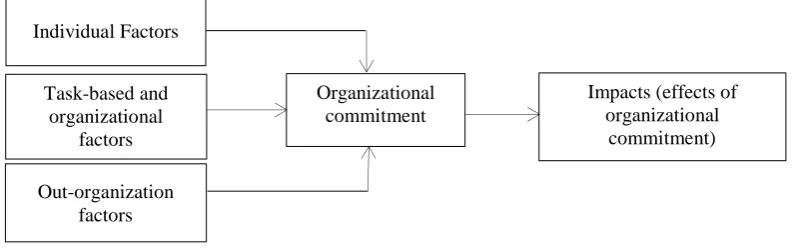
Many researches have been conducted about finding out the reasons of organizational commitment. According to Mowday et al., determinants of organizational commitment are personal traits, job specifications, job experience and structural specifications. Determinants of organizational commitment are detailed in Figure 3 as it is used widely in the literature (Bakan, 2011).
Figure 1. Organizational commitment effect modelSource: (Nijhof, Jong, and Beukhof 1998, p. 245). Individual Factors
Task-based and organizational
factors
Out-organization factors
Organizational commitment
Impacts (effects of organizational
Age, gender, education level, marital status, and working time are stated under the personal factors of determinants of organizational commitment. Age variables vary in organizational commitment and job satisfaction. It can be said that young employees are more eager, enthusiastic and committed to workplace compared to those who are about to retire because of the reason that they have less job experience and fewer job opportunities and alternatives. There are different research results about the correlation between organizational commitment and gender factor. According to Hrebiniak & Alutto (1972), women have more organizational commitment compared to men and because of that, they less tend to change their jobs. According to another view, because men earn more wage than women, they are more committed to the organizations than women do (Arbak & Kesken, 2005). According Balay (2000), gender does not affect organizational commitment. There is inverse ratio between education level and organizational commitment. When the education level increases, commitment rate decreases. When people have more educational background, their demands on job satisfaction and wage increase at the same rate. In addition, more educational level diversifies the possible new job opportunities for the employee (Çöl & Gül, 2005). It is important to state that married employees are more prone to keep working because of the economic issues (Abdulla & Shaw, 1999). With the increase in seniority, wage and authority level will also go up. Of two parallel commitment factors, age is related to emotional commitment, and seniority is related to commitment (İnce & Gül, 2005).
Organizational and task-based factors can affect the employees’ life in and out of the organization. Job quality, wage and career opportunities, and communication factors make up the organizational and task-based factors. When the job quality is examined, as long as the employees’ expectation, and scope and quality of the job are in harmony, they can use their abilities within this line; organizational commitment will increase (Cengiz, 2000). In terms of wage and career opportunities, equitably distribution wage among the employees, compliance between wage and job description, rewards as a result of wage increases are the factors that will undoubtedly increase the level of organizational commitment of employees. Research shows that most of the reasons of job quittance are tied to wage (İnce & Gül, 2005). At the same time, it is thought that there is a big impact of career opportunities that organizations offer for employees on the level of organizational commitment (Özdevecioğlu, 2003). When we examine in terms of communication, it is important to note that there should be some effective organizational forms of communication in order to make it possible for the employees to share their emotions and opinions with the manager of organization. Managers spend 75% of their time in the organization in the communicational processes (Bakan, 2011). In an organization where subordinates and managers have a healthy communication, the level of job commitment increases (Gözler, 2007). Unlike the communication problems that lead employees to look for new job opportunities, they can freely voice their ideas which, in the end, results in increased self-satisfaction if there is an open communication system in the organization (Gürbüz & Bekmezci, 2012). Therefore, when the employees have a chance to participate in decision-making processes with their own ideas and opinions, they will reach to job satisfaction, and their desire to stay at the job will strengthen.
Fayol (1949) expressed the importance of horizontal communication with the concept of gangplank. According to this concept, without using vertical communication which is called as authority chain, employees who are at the same level can make use of horizontal communication unless it is a trivial issue, to solve the problems and can save time that leads to increased efficiency in the organization. Every beginner level employee starts working by making use of formal communication methods but when he or she has new friends in the organization and his or her affection level for the job increases, informal communication methods will start to appear. As informal communication methods are, because of its structure, not written rules and move with rumors and gossip, controlled and balanced flow of this type of communication will decrease the possible communication problems and protect the balance of organizational commitment level. In this case, this all reminds us of the importance and necessity of formal organizational communication channels. Because of the official structure of formal organizational communication channels, it will move within a given area and communication rules which will decrease the possible struggle for problems.
conflict, and organizational trust concepts are among the in-organization determinants of organizational commitment. Out-organization determinants can be listed as professionalism and finding new job opportunities.
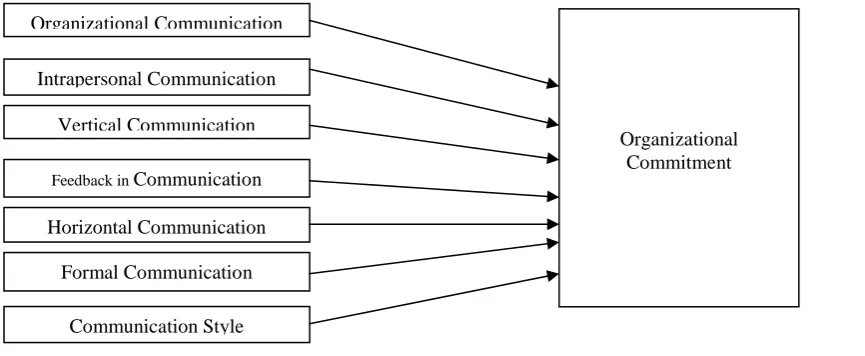
Previously conducted studies about organizational communication and organizational commitment have been examined and it has been detected that the research on the effects of sub-concepts of communication which is one of the organizational and task-based factors that are the determinants of organizational commitment on organizational communication is very limited and the following hypotheses have been formulated based on the literature review:
H1: Organizational communication has an impact on organizational commitment.
H2: Intrapersonal communication used in the organization has a positive direct impact on the organizational commitment.
H3: Vertical communication used in the organization has a positive direct impact on the organizational commitment.
H4: Feedback used in the organizational communication has a positive direct impact on the organizational commitment.
H5: Horizontal communication used in the organization has a positive direct impact on the organizational commitment.
H6: Formal communication used in the organization has a positive direct impact on the organizational commitment.
H7: Communication style used in the organization has a positive direct impact on the organizational commitment.
Figure 4. Research Model
3. METHODOLOGY
This research aims to find out the effects of organizational communication on organizational commitment. While trying to reach findings of this study, it was also aimed to induce people to positive and constructive ideas by emphasizing the necessity and importance of communication. Most of the survey participants are the service sector employees of the companies working in İstanbul. Completing the sampling process has been performed by sending a link of the survey via e-mail and social media platforms and also some surveys have been conducted face-to-face. A total of 215 employees participated in this research.
Survey questions have been created by using similar previous reliable and valid research questionnaire questions in line with the findings after the literature review. Commitment part of the evaluation tool has been taken from commitment scale that Meyer and Allen has developed as nine questions separately from affective, normative, and continuance commitment parts. The final survey which includes 31 questions has been edited with the consultation of the experts and before the dissemination, a pilot study has been done in order to find out and correct the missing and incorrect parts.
In the survey, there are nine questions about organizational commitment, 12 questions for organizational communication, and ten questions about demographical information. Except for the demographical information part, all other questions have been prepared according to five-Likert scale.
3.1. Analysis and Results
Data obtained in this research has been analyzed on SPSS for Windows 21.0 program. Correlation among the dependent and independent variables such as organizational commitment, organizational communication, and
Organizational Commitment Organizational Communication
Intrapersonal Communication
Vertical Communication
Feedback in Communication
Horizontal Communication
Formal Communication
sub-hypothesis in the research has been tested by Pearson correlation, and the impact of these variables has been tested with regression analysis. Obtained data has been evaluated in the 95% confidence interval, and 5% significance level.
For the scale used in the research, Cronbach’s alpha reliability analysis has been applied. According to this analysis, when the parameters are over the value 0,70 and closer to 1, this means that the scale is reliable. After the analysis, reliability parameters of the scales have been found out between 0,768 and 0,889. This shows that the research scale is reliable. Data regarding the reliability parameters are given in Table 1.
Table 1. Scale Reliability Parameters.
Scale Cronbach’s Alpha Organizational commitment 0,889 Intrapersonal communication 0,799
Vertical communication 0,876
Feedback in communiation 0,797 Horizontal communication 0,824
Formal communication 0,801
Communication style 0,768
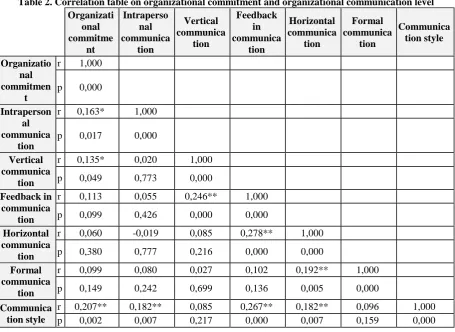
As can be seen in Table 2, correlation analysis has been conducted in order to find out whether there is a relationship between organizational communication variables and organizational commitment. Correlation among the variables has been controlled in <0,05 significance level.
Table 2. Correlation table on organizational commitment and organizational communication level
Organizati onal commitme nt Intraperso nal communica tion Vertical communica tion Feedback in communica tion Horizontal communica tion Formal communica tion Communica tion style Organizatio nal commitmen t
r 1,000
p 0,000
Intraperson al communica
tion
r 0,163* 1,000
p 0,017 0,000
Vertical communica
tion
r 0,135* 0,020 1,000
p 0,049 0,773 0,000
Feedback in communica
tion
r 0,113 0,055 0,246** 1,000
p 0,099 0,426 0,000 0,000
Horizontal communica
tion
r 0,060 -0,019 0,085 0,278** 1,000
p 0,380 0,777 0,216 0,000 0,000
Formal communica
tion
r 0,099 0,080 0,027 0,102 0,192** 1,000
p 0,149 0,242 0,699 0,136 0,005 0,000
Communica tion style
r 0,207** 0,182** 0,085 0,267** 0,182** 0,096 1,000
p 0,002 0,007 0,217 0,000 0,007 0,159 0,000
When they are evaluated by one-to-one correlation, half of the variables seem to be meaningful. In the next step, all causal relationship in the model has been analyzed and shown by using regression model. Regression analysis is a method that is used for measuring the casual relationship between two or among more than two variables. Analysis that is done after the inclusion of many variables is called multi-regression analysis. With the help of this analysis method, causal relationships between the variables are shown (Nakip, 2003). Table 3 shows the regression analysis of this research:
Table 3. Regression Analysis of Organizational Communication and Organizational Commitment Dependent Variable Independent Variable ß t p F Model (p) R2
Organizational Commitment
Fixed 1,422 3,138 0,002
2,940 0,009 0,052 Intrapersonal
Communication 0,112 1,832 0,068 Vertical Communication 0,109 1,593 0,113 Feedback In Communication 0,033 0,390 0,697 Horizontal Communication 0,004 0,047 0,963 Formal Communication 0,083 0,982 0,327 Communication Style 0,182 2,263 0,025
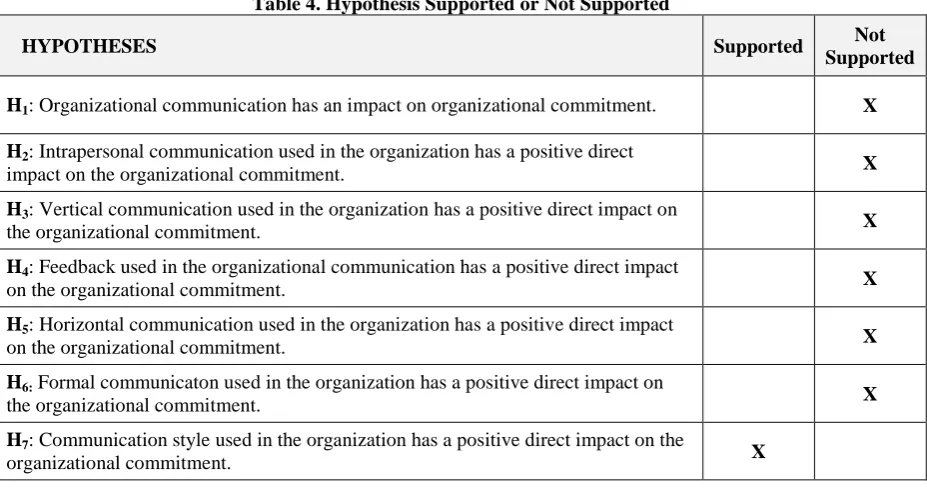
According to Table 3, Intrapersonal Communication (p=0.068>0.05), Vertical Communication (p=0.113>0.05), Feedback in Communication (p=0.697>0.05), Horizontal Communication (p=0.963>0.05), and Formal Communication (p=0.327>0.05) levels do not have an impact on the level of organizational commitment. The level of the employees’ Communication Style increases the level of organizational commitment (p=0.025>0.05; ß=0,182). This means that organizational commitment is basically effected by the Communication Style variable. Hence, according to the research results, H7 hypothesis has been supported while H2, H3, H4, H5, H6
hypotheses have not been supported. As can be seen from Table 3, when the organizational communication is examined with its all sub-categories, organizational communication has an impact on organizational commitment (F=2,940; p=0,009<0.05). As the determinant of the level of organizational commitment, effect of the organizational communication is weak (R2=0,052). Explanation power of the constructed regression model is 0,052 and this 5% variation of organizational commitment variable can be explained by the organizational communication style. However, because most of the hypotheses claimed in the research are not supported, main hypothesis H1 isnot supported too. In Table 4, supported or not supported hypothesis are shown:
Table 4. Hypothesis Supported or Not Supported
HYPOTHESES Supported Not
Supported
H1: Organizational communication has an impact on organizational commitment. X
H2: Intrapersonal communication used in the organization has a positive direct
impact on the organizational commitment. X
H3: Vertical communication used in the organization has a positive direct impact on
the organizational commitment. X
H4: Feedback used in the organizational communication has a positive direct impact
on the organizational commitment. X
H5: Horizontal communication used in the organization has a positive direct impact
on the organizational commitment. X
H6: Formal communicaton used in the organization has a positive direct impact on
the organizational commitment. X
H7: Communication style used in the organization has a positive direct impact on the
organizational commitment. X
Intrapersonal communication is one of the methods that people connect with their inner world in order to solve the personal problems that they encounter and try to find out possible solutions for them. Solution can or cannot be found at some cases. People will be able to decide about what to do by consulting someone else when they cannot find one on their own, and this might end up with quitting a job in the organization. It is one of the possible results that intrapersonal communication is associated with organizational commitment. One of the reasons that affects to intrapersonal communication is socio-psychological factors. As these factors are not easily observed, it is very hard for the managers to remove these factors or even to correct them (Artan, 1999). In this research, it has been found out that there is no causal relationship between intrapersonal communication and organizational commitment. And because of that, examining the socio-psychological factors can explain this result in detail.
Vertical communication level includes the design of the formal structure, and that managers’ use towards their subordinates in the organizations. In vertical communication, orders, performance and success evaluation of the employees, and selling them on the targets of the organization are included to describe the necessary information (Gürsel & Kesici, 2003). Orders may not be carried out, transferred to position it may concern, or may be transferred inaccurate due to communication deficit between the subordinates and managers (information deficit and meaningless messages). Many problems, thus, might show up about the quality and quantity of the information (Artan, 1999). These problems might affect organizational results such as employees’ organizational commitment and job satisfaction. However, other different problems than those arousing from vertical communication might be more effective on organizational results. On the other hand, such problems might have effects on the types of commitment such as career commitment, group-team commitment, colleague commitment, and job commitment that are similar to organizational commitment. In this research, it has been concluded that vertical communication level has no impact on organizational commitment. Within this scope, other types of commitment can be observed to find out detailed reasons.
Feedback in communication process constitutes a part of organizational commitment. Even if it is thought that approval feedback given during the communication might affect morale and motivation and increase the organizational commitment, in this research, reverse ideas have been found. Reason of this can be that intrapersonal communication only composes a limited part of the organizational communication process. It is possible to find out different results in different sectors and business areas.
As horizontal communication process usually covers the communication process of the same-level employees, it is thought that possible problems that occur among the employees and are not announced to senior managers and kept silent do not affect organizational commitment. In some cases, however, employees might decide to quit the job due to problems in horizontal communication. The fact that horizontal communication has no impact on organizational commitment might be different in other research results.
Formal communication moves by arranging organizational commitment process. According to this, proper organizational communication process means the support for organizational system. Because of the fact that formal communication prevents or decreases possible gossip and rumors within the organization, it is thought formal communication is in relation with organizational commitment for more peaceful working environment. But the research results are different from this idea. Normally, vertical communication processes occur based upon the hierarchy within organization and moves towards different steps and the communication slows down the number of the steps increases and time is lost (Sabuncuoğlu, 1987). Many different factors that hinder the information from reaching to the necessary destinations are in these steps and the only remaining information can be transmitted to the intermediate stages (Artan, 1999). At this point, informal communication variable, which is not included in this research, can come into stage for more detailed results.
Communication style might have increasing or decreasing impact on misunderstanding of employees during the communication process. According to this, if the communication is established in a constructive way, especially by the managers of the organization, organizational commitment of employees can be affected. At the same time, if there is a destructive communication style, opposite and negative ideas will develop. From this aspect, results of the research suggest that communication style has an affect on organizational commitment.
4.DISCUSSION AND CONCLUSION
It has been a crucial aspect in terms of both economic and organizational factors, and even social environment that organizations keep the employee turnover rate at its minimum by providing an integrative structure. Because of that, providing organizational commitment requires a high and serious effort. We have attempted to show in what ways organizational communication has an impact on organizational commitment in this study.
In this research, it has been concluded that intrapersonal communication, vertical communication, feedback in communication, horizontal communication and formal communication, which are the determinants of organizational communication, have no impact on the organizational commitment. As we emphasized at the beginning, we collected data from various sectors. Sectoral distribution of the research participants is as follows: Education/Banking/Finance (%18,6), Food/Drink/Tobacco (%15,3), Entertainment/Tuourism (%7,4), IT/Telecommunication (%9,8), Tree/Paper/Press/Printing (%1,4), Medicine/Medical/Health, (%5,1), Clothing/Textile/Leather (%10,7), Machine-Tools/Metal (%4,7), Furniture/Chemistry/Gasoline/Tire (%1,4), and Others (%25,6). The important thing here is that organizational problems/results about the communication might differentiate from one sector to another. In real sector, for example, wage and age variables might affect organizational commitment, while other variables might have an impact in service sector. If we give an example from service sector at this point, more time should be allocated for communication in the service sector because it offers working opportunities under the difficult conditions, and human labor emerges as a main factor in the service sector. This issue is one of the limitations of this study. Thus, doing a research by separating sectoral base might provide information about whether organizational communication has an effect on organizational commitment, and if it has an effect in what direction.
Multi-commitment approach has been defined with the improvement of the concept of organizational commitment. Employees might experience a lot of different types of commitments depending on target and values of the multiple groups (Reichers, 1985). According to this, organizations are not composed of different parts of a whole, but contrary to this, each organization is individually composed of different combinations of missions and values. According to multi-commitment, it is accepted that people show different types of commitment to organizations, professions, managers or customers. Moreover, this approach suggests that a person’s commitment to his or her organization, profession, managers, or customers might differ from other individuals’ commitment (Saldamlı, 2009, s. 25). Therefore, organizational communication may be associated with commitment to the profession or commitment to the manager. At this point, using different organizational commitment scales may cause different results. This is another limitation of this research. In addition, since the scales used in this research have foreign origins and the possibility of being not suitable for the Turkish context, correlation between organizational communication and organizational commitment might not have shown clearly.
It has been concluded that communication style, which is one of the dimensions of communication, is in positive relation with organizational commitment and it affects the organizational commitment. Similarly, Vries, Bakker-Pieper, and Oostenveld (2010) found that the communication styles are related to knowledge sharing behaviors, satisfaction with the leader, perceived leader performance, and subordinate’s team commitment. It will surely be a positive behavioral pattern for managers to realize communication process in an effective style. For this reason, employess will feel valued and they will have positive attitude towards their job and manager. Especially new recruits will not want to take place in the organizations where they do not find the communication style as positive and warm. As they are only in the beginning of the road, they will easily leave the job (Barutçugil, 2004). Moreover, personal factors such as age, gender, educational background, marital status, and working hours, organizational and task-based factors such as work quality, wage and career opportunities, organization culture, role ambiguity and role conflict, and organizational trust, and out-organization factors such as professionalism and finding new job opportunities affect out-organizational commitment. According to what this research has found out, communication style has a five percent impact on organizational commitment.
It can be given as the suggestion for the institutions that communication style used in the social life cannot be used effectively and adequately in the organizational processes and, therefore, corporate trainings should be organized. It also another important point that managers should not forget that communication is a two-way process keeping in mind that feedback and suitable communication style is of high importance and necessity. Similarly, Azman, Asniah, and Fahimi (2012) found out mentor’s ability to practice communication openness, which is one of the important communication styles, is an important predictor of academic performance.
communication channels enable us diverse and active ways to use these channels. For example, sometimes written forms of communication can be better and helpful than oral forms of communication. Surveying with employees about their suggestion and ideas is a good way for useful data obtained from written forms of communication.
Previous research proves that organizational communication and organizational commitment are two inter-related concepts and organizational communication has an impact on organizational commitment (e.g. Varona, 1996). Even if, in this research, it is seen that organizational communication has no impact on organizational commitment, this can be related to a number of conceptual, scale and research universe limitation. Communication process is an important tool for the individuals to produce solutions to problems or develop social relationships; therefore, it is the most important need within the organizations. For this reason, communication skills should be maintained at its best with the idea of every new good practice of communication will contribute to organizational commitment and the other areas of development.
REFERENCES
1. Abdulla, M. H.A., & Shaw J. D. (1999). Personal Factors And Organizational commitment: Main Interactive Effects In the United Arab Emirates. Journal of Managerial Issues 11 (1), 77-93.
2. Ada, N, Alver, I., & Atlı, F. (2008). Örgütsel İletişimin Örgütsel Bağlılık Üzerine Etkisi: Manisa Organize Sanayi Bölgesinde Yer Alan İmalat Sektörü Çalışanları Üzerinde Yapılan Bir Araştırma. [Effects of Organizational Communication on Organizational Commitment: A Research on Manufacturing Sector Employees in Manisa Organized Industrial Zone]. Ege Akademik Bakış, 8 (2), 487-518.
3. Akıncı Vural, Z. B. (1998). Kurum Kültürü ve Örgütsel İletişim.[Corporate Culture and Organizational Communication]. İstanbul: İletişim Yayıncılık.
4. Allen, N. J. & Mayer, J. P. (1990). The measurement and antecedents of affective, continuance and normative commitment to the organization. Journal of Occupational Psychology, 63, 1-18.
5. Altın Gülova, A., & Demirsoy, Ö. (2012). Örgüt Kültürü ve Örgütsel Bağlılık Arasındaki İlişki: Hizmet Sektörü Çalışanları Üzerinde Ampirik Bir Araştırma. [The Relationship between Organizational Culture and Organizational Commitment: An Empirical Study on Service Sector Employees]. Business And Economics Research Journal, 3 (3), 49-76.
6. Arbak, Y., & Kesken, J. (2005). Örgütsel bağlılık, sağlık hizmetlerinde sürekli gelişim için davranışsal
bir yaklaşım. [Organizational commitment, a behavioral approach for continuous improvement in health care.]. İzmir: Dokuz Eylül Üniversitesi Yayınları.
7. Artan, İ. (1999). İletişim “Davranışlarımızdan Seçmeler: Örgütsel Yaklaşım” içinde, [“Communication” in A Selection of our Behavior: Organizational Approaches] pp. 157-188, Ed. Suna Tevruz, İnci Artan, Tülay Bozkurt, İstanbul: Beta Yayınları.
8. Atak, M. (2005). Örgütlerde Resmi Olmayan İletişimin Yeri ve Önemi. [The Role and Importance of Informal Communication in Organizations]. Havacılık ve Uzay Teknolojileri Dergisi, 2 (2), 59-67. 9. Ataman, G. (2002). İşletme Yönetimi: Temel Kavramlar, Yeni Yaklaşımlar [Business Administration:
Basic Concepts, New Approaches], İstanbul: Türkmen Kitabevi.
10. Azman, I., Asniah, A., and Ahmad Fahimi, A. (2012). Mentors’ Communication Styles As Predictors Of Mentees’ Academic Performance. Studies in Business & Economics, 7 (3), 14-26.
11. Bakan, İ. (2011). Örgütsel Stratejilerin Temeli, Örgütsel Bağlılık, Kavram, Kuram Sebep ve Sonuçlar.[Fundamentals of Corporate Strategy, Organizational Commitment, concepts, theories, causes and conclusions]. Ankara: Gazi Kitabevi.
12. Bakan, İ., & Büyükbeşe, T. (2004). Örgütsel İletişim İle İş Tatmini Unsurları Arasındaki İlişkiler: Akademik Örgütler İçin Bir Alan Araştırması. [The Relationship Between Organizational Communication and Elements of Job Satisfaction: A Field Research for Academic Organisations].
Akdeniz İktisadi ve İdari Bilimler Fakültesi Dergisi, 4 (7), 1-30.
13. Balay, R. (2000). Özel ve Resmi Liselerde Yönetici ve Öğretmenlerin Örgütsel Bağlılığı,[
Organizational Commitment of Administrators and Teachers in Private and Public High-Schools], Yayınlanmamış Doktora Tezi. Ankara: Ankara Üniversitesi Sosyal Bilimler Enstitüsü.
14. Bartlett, K.R. (2001), The relationship between training and organizational commitment: a study in health care field. Human Resource Development Quarterly, 12 (4), 335-352.
15. Barutçugil, İ. (2004). Stratefik İnsan Kaynakları Yönetimi [Strategic Human Resource Management].
İstanbul: Kariyer Yayıncılık.
16. Bayram, L. (2005). Yönetimde Yeni Bir Paradigma: Örgütsel Bağlılık. [A New Paradigm in Management: Organizational Commitment]. Sayıştay Dergisi, 59, 125-139.
18. Çağlar, İ., & Kılıç, S. (2008). Eğitim Fakülteleri İçin Genel İletişim [General Communication for
Faculties of Education]. Ankara: Nobel Yayın Dağıtım.
19. Çamdereli, M. (2000). Ana Çizgileriyle Halkla İlişkiler [Outline of Public Relations]. İstanbul: Çizgi Yayınevi.
20. Cengiz, A. A. (2000). Enformasyon Çağında Örgüt Bağlılığını Geliştirmenin Yollarına Genel Bir Bakış [A General Overview to the Ways of Enhancing Organizational Commitment in the Information Age]
Anadolu Üniversitesi İktisadi ve İdari Bilimler Fakültesi, 16 (1-2), 509-538.
21. Çöl, G., & Gül, H. (2005). Kişisel Özelliklerin Örgütsel Bağlılık Üzerine Etkileri ve Kamu Üniversitelerinde Bir Uygulama [Effects of Personal Characteristics on Organizational Commitment and A Case Study in Public Universities]. Atatürk Üniversitesi İktisadi ve İdari Bilimler Dergisi, 19 (1). 291-306.
22. Çorbacı, S., & Bostancı, A. B. (2013). Okullarda Öğretmenlere Yönelik Performans Yönetimi Uygulamaları ile Öğretmenlerin Örgütsel Bağlılık Düzeyleri Arasındaki İlişki [Relationship between Performance Management Application for Teachers in schools and Their Organizational Commitment Level]. Uşak Üniversitesi Sosyal Bilimler Dergisi, Özel Sayı, 231-247.
23. Dawson-Sheperd, A, & White, J. (1994), Communication: Why UK Managers are Shooting Themselves in the Foot', Business News, May 1994, p.6.
24. De Vries, R. E., Bakker-Pieper, A., and Oostenveld, W. (2010). Leadership = Communication? The Relations of Leaders’ Communication Styles with Leadership Styles, Knowledge Sharing and Leadership Outcomes, Journal of Business Psychology, 25, 367-380.
25. Dennis, A. R., Fuller, R. M., and Valacich, J. S. (2008). Media, Tasks, And Communication Processes: A Theory Of Media Synchronicity. MIS Quarterly, 32 (3), 575-600.
26. Durmaz, M. (2002). Kişiler Arası İletişim ve Motivasyon [Interpersonal Communication and
Motivation]. İzmir: Ege Üniversitesi Basımevi.
27. Eren, E. (2010). Örgütsel Davranış ve Yönetim Psikolojisi [Organizational Behavior and Management
Psychology]. İstanbul: Beta Basım Yayım Dağıtım.
28. Eroğluer, K. (2011). Örgütsel İletişim ile İş Tatmini Unsurları Arasındaki İlişkiler: Kuramsal Bir İnceleme [Relationship Between Components of Organizational Communication and Job Satisfaction: A Theoretical Study]. Ege Akademik Bakış, 11 (1), 121-136.
29. Ewing, J. (2013). Communication. Salem Press Encyclopedia of Science. 30. Fayol, H. (1949). General and Industrial Management. London: Pitmann Press.
31. Gözler, Ö. (2007) http://www.capital.com.tr/kotu-yonetici-isi-biraktiriyor-haberler/19528.aspx, [Bad managers cause employees to leave the organization] (Retrieved: 20.01.2014).
32. Gül, H. (2002). Örgütsel Bağlılık Yaklaşımlarının Mukayesesi ve Değerlendirmesi [Comparison and Evaluation of Organizational Commitment Approach]. Ege Akademik Bakış Ekonomi, İşletme,
Uluslararası İlişkiler ve Siyaset Bilimi Dergisi, 2 (1), 37-56.
33. Güney, S. (2011). Örgütsel Davranış.[Organizational Behavior]. İstanbul: Nobel Akademik Yayıncılık.
34. Gürbüz, S., & Bekmezci, M. (2012). İnsan Kaynakları Yönetimi Uygulamalarının Bilgi İşçilerinin İşten Ayrılma Niyetine Etkisinde Duygusal Bağlılığın Aracılık ve Düzenleyicilik Rolü [Mediationg and Regulating Role of Affective Commitment on the effect of Human Resource Management Practices on Intention to Quit of Knowledge Workers]. İstanbul Üniversitesi İşletme Fakültesi Dergisi, 41 (2), 189-213.
35. Gürsel, M. (2006). Eğitimde Yönetim ve Sisteme İlişkin Çeşitlemeler [Related Variations in
Management and Systems in Education]. Konya: Eğitim Kitabevi Yayınları.
36. Gürsel, M., & Kesici, Ş. (2003). Endüstri ve Örgüt Psikolojisi [Industrial and Organizational Psychology]. Ed. Hüseyin Izgar. Konya: Eğitim Kitabevi Yayınları.
37. Gürüz, D., & Gürel, E. (2006). Yönetim ve Organizasyon, Bireyden Örgüte, Fikirden Eyleme [Management and Organization, From individuals to Organization, From Idea to Action]. Ankara: Nobel Yayın Dağıtım.
38. Gürüz, D., & Özdemir Yaylacı, G. (2004). İletişimci Gözüyle İnsan Kaynakları Yönetimi [Human
Resources Management Through the Eyes of Communicator]. İstanbul: Kapital Medya Hizmetleri. 39. Hall, J. (1973). Communication Revisited, California Management Review, 15 (3), 56-67.
40. Hrebiniak, L. G. & Alutto, J. (1972). Personal and role-related fac tors in the development of or ganizatlonal commitment, Administrative Sclence Quarterly, 17: 555-572.
41. İnce, M., & Gül, H. (2005). Yönetimde Yeni Bir Paradigma: Örgütsel Bağlılık [A New Paradigm on
Management: Organizational Commi,tment]. Ankara: İleri Giden Ofset.
43. Luchak, A. A, & Gellatly, I. R. (2007). A comparison of linear and nonlinear relations between organizational commitment and work outcomes. Journal of Applied Psychology, 92 (3), 786-93. 44. Meyer, J.P., and Allen, N.J. (1997). Commitment in the Workplace, Thousand Oaks, CA: Sage.
45. Mısırlı, İ. (2011). Genel ve Teknik İletişim, Kavramlar, İlkeler, Uygulamalar [General and Technical Communication, Concepts, Principles and Applications]. Ankara: Detay Yayıncılık.
46. Mutlu, E. (2008). İletişim Sözlüğü [Communication Dictionary]. Ankara: Ayraç Medya Yapım. 47. Nakip, M. (2013). Pazarlama Araştırmalarına Giriş (SPSS Uygulamalı) [Introduction to Marketing
Research], 4. Baskı, İstanbul: Seçkin Yayıncılık.
48. Nijhof, W. J., J. de Jong, M, and Beukhof, G. (1998). Employee commitment in changing organizations: an exploration. Journal of European Industrial Training, 22 (6), 243-248.
49. O' Reilly, C. A., & Caldwell, D. F. (1981). The Commitment and Job Tenure of New Employees: Some Evidence of Postdecisional Justification. Adminstrative Science Quartery, 26 (4), 597-616. 50. Ölçüm Çetin, M. (2004). Örgüt Kültürü ve Örgütsel Bağlılık [Organizational Culture and
Organizational Commitment]. Ankara: Nobel Yayın Dağıtım.
51. Oskay, Ü. (1982). XIX. Yüzyıldan Günümüze Kitle İletişiminin Kültürel İşlevleri Kuramsal Bir
Yaklaşım [A Theoretical Approach on Cultural Functions of Mass Communication from XIX. Century to the Present]. Ankara: Ankara Üniversitesi Siyasal Bilgiler Fakültesi Yayınları.
52. Özarallı, N., & Torun, A. (2011). Biçimsel ve Biçimsel Olmayan İletişim, Yönetici İle Kuruma Duyulan Güven ve Üstün Uzmanlık Gücü Arasındaki İlişkiler Üzerine Bir Araştırma [A Research on the Relationship Between Formal and Non-Formal Communication, Trust in Manager and Corporation, and Expert Power of Executives]. Bilgi Ekonomisi ve Yönetimi Dergisi, 6 (2), 101-113.
53. Özdevecioğlu, M. (2003). Algılanan Örgütsel Destek ile Örgütsel Bağlılık Arasındaki İlişkilerin Belirlenmesine Yönelik Bir Araştırma [A Research on the Determination of the Relationship Between Perceived Organizational Support and Organizational Commitment]. Dokuz Eylül Üniversitesi İktisadi ve İdari Bilimler Dergisi, 18 (2), 113-130.
54. Reichers, A. E. (1985). A Review and Reconceptualization of Organizational Commitment. Academy of Management Review, 10 (3), 465-476.
55. Robbins, S. P., & Coulter, M. (2009). Management (10th Edition) Pearson International Edition: Prentice Hall.
56. Sabuncuoğlu, Z. (1987). Çalışma Psikolojisi [Work Psychology]. Bursa: Uludağ Üniversitesi Basımevi. 57. Sabuncuoğlu, Z., & Gümüş, M. (2008). Örgütlerde iletişim [Communication in organizations].
İstanbul: Arıkan Basım Yayım Dağıtım.
58. Saldamlı, A. (2009). İşletmelerde Örgütsel Bağlılık ve İş Gören Performansı [Organizational
Commitment and Job Performance in Business Organizations]. Ankara: Detay Yayıncılık.
59. Somers, M.J. (1995), Organizational Commitment, Turnover and Absenteeism: An Examination of Direct and Interaction Effects. Journal of Organizational Behavior, 16, 49-58.
60. Şimşek, M. Ş. (2002). Yönetim ve Organizasyon [Management and Organization]. Konya: Günay Ofset.
61. Taplin, I. M., & Winterton, J. (2007). The Importance Of Management Style In Labour Retention.
International Journal of Sociology and Social Policy, 27 (1/2), 5-18.
62. Tikici, M., Kaya, et al. (2004). Toplam Kalite Yönetimi Tekniği Olarak Kıyaslama [Benchmarking as
Total Quality Management Technique]. Ankara: Nobel Yayın Dağıtım.
63. Tourish, D., & Hargie, O. D. W. (1998). Communication between Managers and Staff in the NHS: Trends and Prospects. British Journal of Management, 9, 53-71.
64. Varona, F. (1996). Relationship Between Communication Satisfaction and Organizational Commitment in Three Guatemalan Organizations. The Joumal of Business Communication, 33 (2), 111-140.
65. Yates, J. & Orlikowski, W. I. (1992). Genres Of Organizational Communication: A Structurational Approach To Studying Communication And Media, Academy Of Management Review, 17 (2), 299-326.