INTRODUCTION
The genus Scutellaria (Lamiaceae family) has more than 350 species spread in tropical mountainous and temperate regions (Shu et al., 1994). Scutellaria orientalis L. is wide spread in Turkey with 18 subspecies, many of which are endemic. Scutellaria orientalis L. subsp. bicolor (HOCHST.) Edmondson is a perennial endemic shrub 10 - 40 cm high that fl owers in June - July and grows on poor and arid soil slopes of high altitudes, volcanic rocks and barren lands extending from Meditterranean coasts to Central parts of Eastern Anatolia (Edmondson, 1982, Anonymous 2015) with average 1000 seed weight of 0.6454 g. They have antis leafy spikes that bear pale grey white or pale grey white violet
fl owers (Duman, 2000). The plant has high value as rock garden plant in arid land scaping, as the plant is drought tolerant and needs low amount of water for maintenance.
All subspecies contain anti fungal compounds that repel insects due to specifi c odour (Rodriguez et al., 1993, Bruno et al., 2002, Rosselli, et al., 2007).1
A Fethi Ahmet Ozdemir and Mehmet Ugur Yildirim contributed
equally to the paper in the capacity of fi rst author
Plant parts like herbs, leaves, fruits and seeds are used to obtain various secondary metabolites of pharmaceutical and pharmacological importance. Aerial parts of S. orientalis are collected (Anonymous 2015) in Turkey and their extracts are used for treatment stres and many disorders in folk medicine. Scutellaria species contain sesquiterpenoids, monoterpenoids and phenylpropane derivatives iridoid glycosides (Hernandez, 1999) and glucuronide or aglucuronide type phenolic compounds (Nishikawa et al., 1999). All species of Scutellaria are rich in scutellarin, that is known to have anti cancer properties and induce apoptosis of breast and ovarian tumor cells in vitro and is long time used in treatment of cardiovascular diseases. Plants grown through tissue culture are excellent source of obtaining secondary metabolites in alternative way (Cui et al. 2010).
In vitro plant propagation techniques help to standardize production of biochemically and medicinally active secondary products synthesis, and select clones of superior individual genotypes (Li et al. 2000).
Tascan (2007) studied S. baicalensis in liquid culture medium to evaluate fl avonoid contents. The researcher Scutellaria orientalis L. subsp. bicolor (HOCHST.) Edmondson is a perennial endemic shrub bearing pale grey-white fl owers that grows on marginal lands. They have high value as rock garden plants and in managed arid land scaping. They are also important medicinally for valuable secondary metabolites of pharmaceutical importance. The study compared effects of 1 and 2 × KH2PO4 concentratedMS medium for micropropagation of the plant using cotyledon leaf, cotyledon petiole, cotyledon node and hypocotyl explants. Variable number of healthy green shoots were regenerated on above mentioned explants variants of TDZ in 2 × KH2PO4 concentratedMS medium with maximum shoot regeneration on cotyledon node explants on 0.04 μg/ml TDZ. These were rooted on 1 × KH2PO4 concentratedMS medium containing 0.50 μg/ml NAA. All developing plants were acclimatised in greenhouse to fl ower and set seeds. The study serve to provide basic information on role 2 × KH2PO4 for Scutellaria mass propagation and will help in breeding and genetic transformation studies in future.
Keywords: KH2PO4; Mass propagation; MS medium;Skullcaps; Thidiazuron
A B S T R A C T
R E G U L A R A R T I C L E
Micropropagation of endemic
Scutellaria orientalis
L.
subsp.
bicolor
using modi
fi
ed MS medium & TDZ
Fethi Ahmet Ozdemir1A, Mehmet Ugur Yildirim2*, Parisa Pourali Kahriz21Department of Molecular Biology and Genetics, Faculty of Sciences, Bartin University, 74100, Bartin, Turkey, 2Department of Field Crops, Faculty of Agriculture, Ankara University, 06110 Diskapı, Ankara, Turkey
doi: 10.9755/ejfa.2015-04-148 http://www.ejfa.me/
*Corresponding author:
Mehmet Ugur Yildirim, Department of Field Crops, Faculty of Agriculture, Ankara University, 06110 Diskapı, Ankara, Turkey. Tel: +90 312 596 15 40. E-mail: [email protected]
2
also evaluated effects of TDZ treatments for different durations of time in MS medium (containing MS salts, B5 vitamin and 3% sucrose), to induce regeneration. Similarly, shoot and callus culture techniques have also been used to observe phenolic compound in S. orientalis, S. baicalensis, S. iyoensis, S. taurica, S. laterifl ora, S. ventenatii, S. pontica, S. taurica, S. galericulata, S. integrifolia and S. alpina (Nishikawa et al. 1999, Hirotani et al. 1998, Zobayed et al. 2004 and Joshee et al. 2007).
No data regarding in vitro tissue cultures for S. orientalis sub sp. bicolor is available. The present study evaluated four different explants of S. orientalis sub sp. bicolor for their ability to regenerate under in vitro conditions.
MATERIALS AND METHODS
The experimental material (seeds) was obtained from the Department of Biology, Faculty of Art and Science, Bitlis Eren University, Bitlis, Turkey. Voucher specimens of plants are deposited at Herbarium of the Faculty of Science, Firat University, Elazig, Turkey.
The seeds are 1.8 mm ±0.2 mm long and 1.2 mm±0.2 mm wide. They were initially tested with tetrazolium for vitality. Thereafter, they were treated with 100% commercial bleach (5% NaOCl Ace, Turkey) for 20 min. Surface sterilized seeds were rinsed 3 × 3 min with sterilized distilled water. Thereafter, they were cultured on agar solidified MS medium (Murashig and Skoog, 1962) containing 1 × concentration of KH2PO4 + 3% (w/v) sucrose in Petri dishes. These were sprouted under 16 h light photoperiod (35 μMol photons m-2 s-1) in Sony versatile growth chamber at 24 ± 1°C. (MS medium contain 170 μg/ml KH2PO4;, therefore, it was called 1 × KH2PO4 concentratedMS medium and when the concentration of KH2PO4 was doubled to 340 μg/ml it was called 2×KH2PO4 concentrated MSmedium. This terminology was coined to understand the differences in experimental results easily). Cotyledon leaf, hypocotyl, cotyledon petiole and cotyledon node explants were obtined from 7 - 8 days old young seedlings. These explants were cultured on MS medium containing both 1 and 2 × concentrated KH2PO4 + 0.00 (control), 0.04, 0.08, 0.12, 0.16, 0.20, 0.24, 0.28, 0.32, 0.36, and 0.40 μg/ml TDZ + 3% (w/v) sucrose.
Regenerating shoots were cultured on MS medium containing 0.50 μg/ml NAA for rooting. In vitro regenerated plants were potted in peat moss and transferred to greenhouse under 16 h light photoperiod for 20 day.
Statistical analysis
All experimental datas were generated from the means of 60 explants per treatment, each of which was divided into 12 replications containing 5 explants per replication. Statistical analysis was carried out using one way ANOVA of IBM SPSS 20 for Windows. Probability of P < 0.05 was considered signifi cant. Care was taken to arcsine transform all datas taken in percentages according to Snedecor and Cochran (1967) before subjecting them to statistical analysis.
RESULTS
Tetrazolium test showed that all seeds had 100% vitality. This confi rmed that the seed material was safe to proceed for tissue culture studies.
Effects of various TDZ concentrations on shoot regeneration from cotyledon leaf explant of S. orientalis subsp. bicolor
The four type of explants were compared and evaluated for shoot regeneration on variants of TDZ in MS medium concentrated with 1 and 2 × concentrated KH2PO4.
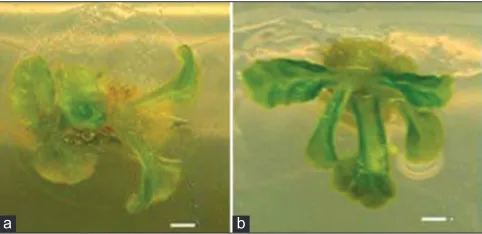
All 11 concentrations were inhibitive or non regenerative and the explants induced severe hyperhydricity when they were cultured on MS medium containing 1 × concentrated KH2PO4 + any concentration of TDZ (Fig. 1a). However, all explants on 2 × KH2PO4 concentratedMS medium + 0.20 μg/ml TDZ induced 40.33% callus regeneration only. These calli were partially regenerative and induced shoot buds on respective explants. The shoot buds showed severe dormancy and were diffi cult to elongate. About 20% explants cultured on 0.08 μg/ml TDZ + 2 × KH2PO4 concentratedMS mediuminduced direct shoot regneration with 3 -4 shoots per explant (Fig. 1b). Rest of the explants failed to induce any callus or shoot irrespective of the concentration of TDZ in the culture.
Fig 1. Shoot regeneration from cotyledon leaf explant of S. orientalis
subsp. bicolor (a) inhibitive and hyperhydric shoots regenerated on MS medium containing 1 × concentrated KH2PO4 + 0.20 μg/ml TDZ
(b) Induction of shoots on 0.08 μg/ml TDZ + 2 × KH2PO4 concentrated
MS medium. Bar Fig 1a, b= bar=0.75 cm.
Effects of various TDZ concentrations on shoot regeneration from hypocotyl explant of S. orientalis subsp. bicolor
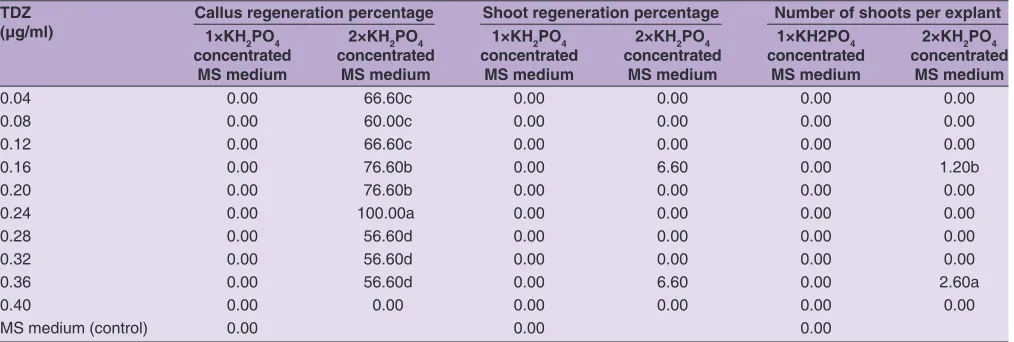
All explants cultured on 1 × KH2PO4 concentratedMS medium + variants of TDZ induced swelling followed by hyperhydricity and growth of abnormal structures on explants that died after 10 days due to high necrosis. All these observations were counted as no regeneration (Table 1).
No callus regeneration was noted on any hypocotyl explant cultured on 2 × KH2PO4 concentratedMS medium (control - Table 1). All hypocotyl explants cultured on variants of TDZ (except 0.40 μg/ml TDZ) in 2 × KH2PO4 concentratedMS medium promoted callus regeneration (Table 1) variably. Increase in concentration of TDZ promoted callus regeneration with maximum callus regeneration percentage of 100.00% on 2 × KH2PO4 concentratedMS medium containing 0.24 μg/ml TDZ. It was followed by 76.60% callusing on 2 × KH2PO4 concentratedMS medium containing 0.16 and 0.20 μg/ml TDZ each (Table 1).
Although shoot buds were very visible on explants, all of them were stunted and showed no shoot regeneration. Negligible shoot regeneration was noted on 2 × KH2PO4 concentratedMS medium containing 0.16 and 0.36 μg/ml TDZ with 1.20 and 2.60 shoots per explant respectively.
Effects of various TDZ concentrations on shoot regeneration from cotyledon petiole explant of S. orientalis
Regeneration on all cotyledon petiole explants cultured on all concentrations of TDZ on 1 × KH2PO4 concentrated MS medium was proceeded by swelling of explants followed by growth of shoot meristems on a very few explants and treatments. The developing shoots were hyperhydric with abnormal translucent leaves. These were
counted nil at the time of fi nal collection of data (Table 2). The experiment was terminated here.
Second experiment on 2 × KH2PO4 concentratedMS medium containing variants of TDZ showed partial recovery of hyperhydric shoots. Cotyledon petiole explant was moderately regenerative in terms of callus and shoot regeneration percentage. No callus or shoot regeneration was noted on 2 × KH2PO4 concentratedMS medium containing 0.04 μg/ml TDZ or 0.32, 0.36 and 0.40 μg/ml TDZ. Callus regeneration percentage on rest of the cultures ranged 6.60 to 66.60% (Table 2). Maximum percentage of callusing explants was noted on 2 × KH2PO4 concentrated MS medium containing 0.24 and 0.28 μg/ml TDZ.
Shoot regeneration percentage was very moderate with narrow range of 16.60 to 30.00%. Highest shoot regeneration percentage was noted on 2 × KH2PO4 concentrated MS medium containing 0.08 μg/ml TDZ. Increasing concentrations of TDZ were inhibitive resulting in decreased or no shoot regeneration on respective treatments. Visible shoots had diffi culty in attaining length and were stunted.
Number of shoots per explant excluding non regenerative cultures decreased from 8.00 to 2.20 shoots per explant. Increasing concentrations of TDZ had negative effects on number of shoots per explant. Highest number of shoots were noted on 2 × KH2PO4 concentratedMS medium containing 0.08 μg/ml TDZ. It was followed by 6.60 shoots per explant that differed signifi cantly from the number of shoots on rest of the treatments.
Effects of various TDZ concentrations on shoot regeneration from cotyledon node explant of S. orientalis
All developing shoots had partial hyperhydricity after 3 - 4 weeks of culture and showed translucent abnormal
Table 1: Effects of various TDZ concentrations on 1 and 2×KH2PO4 concentrated MS medium on shoot regeneration from hypocotyl explant of S. orientalis subsp. bicolor
TDZ (μg/ml)
Callus regeneration percentage Shoot regeneration percentage Number of shoots per explant 1×KH2PO4
concentrated MS medium
2×KH2PO4 concentrated
MS medium
1×KH2PO4 concentrated
MS medium
2×KH2PO4 concentrated
MS medium
1×KH2PO4 concentrated
MS medium
2×KH2PO4 concentrated
MS medium
0.04 0.00 66.60c 0.00 0.00 0.00 0.00
0.08 0.00 60.00c 0.00 0.00 0.00 0.00
0.12 0.00 66.60c 0.00 0.00 0.00 0.00
0.16 0.00 76.60b 0.00 6.60 0.00 1.20b
0.20 0.00 76.60b 0.00 0.00 0.00 0.00
0.24 0.00 100.00a 0.00 0.00 0.00 0.00
0.28 0.00 56.60d 0.00 0.00 0.00 0.00
0.32 0.00 56.60d 0.00 0.00 0.00 0.00
0.36 0.00 56.60d 0.00 6.60 0.00 2.60a
0.40 0.00 0.00 0.00 0.00 0.00 0.00
MS medium (control) 0.00 0.00 0.00
4
shaped structures on explants cultured on 1 × KH2PO4 concentratedMS medium containing variants of TDZ (Fig. 2a). No callus regeneration was noted on MS medium.
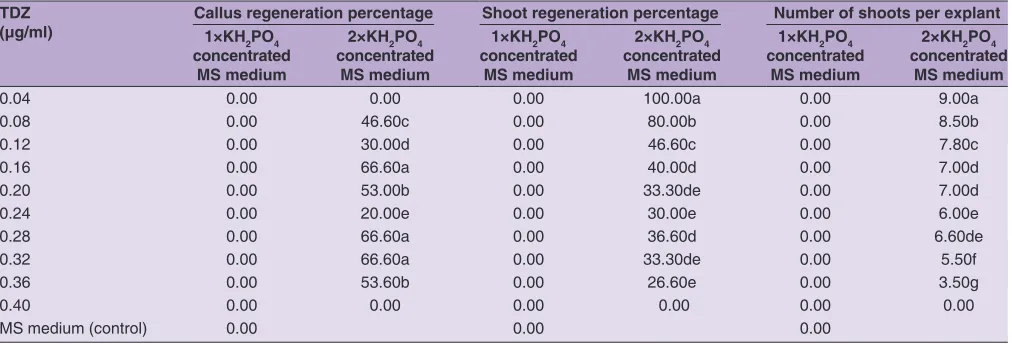
Regeneration on cotyledon node explants proceeded after 9 to 11 days of callus induction on 2 × KH2PO4 concentrated MS medium containing variants of TDZ. It was followed by growth of shoot meristems that converted to shoots within 20 - 21 days. Callus regeneration percentage on rest of the cultures remained 20.00 to 66.60% (Table 3). 2 × KH2PO4 concentratedMS medium containing variants of TDZ induced inconsistent callusing. Maximum callus regeneration was noted on 2 × KH2PO4 concentrated MS medium containing 0.16, 0.28 and 0.32 μg/ml TDZ (66.60%).
No shoot regeneration was noted on 2 × KH2PO4 concentratedMS medium containing 0.40 μg/ml TDZ. Shoot regeneration percentage had range of 26.60% to 100.00% (Table 3). Maximum shoot regeneration was noted on 2 × KH2PO4 concentratedMS medium containing 0.04 μg/ml TDZ. Shoot regneration percentage decreased drastically with each increasing concentrations of TDZ in 2 × KH2PO4 concentratedMS medium.
Number of shoots per explant decreased consistently on 2 × KH2PO4 concentratedMS medium containing 0.04 to 0.40 μg/ml TDZ with range of 3.50 - 9.00 shoots/explant (Fig. 2b) (excluding no shoot regeneration on 0.40 μg/ml TDZ). Highest number of 9.00 shoots per explant was noted on 2 × KH2PO4 concentratedMS medium containing 0.04 μg/ml TDZ.
Rooting and acclimatisation
S. orientalis sub-sp. bicolor shoot regenerated on cotyledon node explant rooted readily on 2 × KH2PO4 concentrated
MS medium containing containing 0.5 μg/ml NAA. The plants were transferred to pots containing peat moss on attaining 4 - 5 cm length. The rooting percentage after four weeks of culture was 80.40%; whereas, no rooting was noted on MS medium (control). The rooted plants were acclimatized in Sanyo versatile environmental test chamber at 24 ± 2°C under 3000 lux light and 16 h light photoperiod. Rooted plantlets were hardened and acclimatized under greenhouse conditions; where, they continued to grow without signs of water stress.
DISCUSSION
TDZ is an important cytokinin that has been used by numerous researchers for inducing shoot regeneration in many plant species. The results showed that 1 × KH2PO4 concentratedMS medium containing variants of TDZ was inhibitory and tended to induce hyperhydricity followed by necrosis. However, 2 × KH2PO4 concentratedMS medium containing any concentration of TDZ showed variable regeneration on cotyledon leaf, hypocotyl, cotyledon petiole and cotyledon node of S. orientalis Table 2: Effects of 1 and 2×KH2PO4 concentrated MS medium containing variants of TDZ on shoot regeneration from cotyledon petiole explant of S. orientalis
TDZ
(μg/ml) Callus regeneration percentage1×KH Shoot regeneration percentage Number of shoots per explant 2PO4
concentrated MS medium
2×KH2PO4 concentrated
MS medium
1×KH2PO4 concentrated
MS medium
2×KH2PO4 concentrated
MS medium
1×KH2PO4 concentrated
MS medium
2×KH2PO4 concentrated
MS medium
0.04 0.00 0.00 0.00 0.00 0.00 0.00
0.08 0.00 33.30b 0.00 30.00a 0.00 8.00a
0.12 0.00 13.30d 0.00 26.60b 0.00 6.60b
0.16 0.00 6.60e 0.00 26.60b 0.00 2.20c
0.20 0.00 20.00c 0.00 20.00c 0.00 2.60c
0.24 0.00 66.60a 0.00 26.60b 0.00 3.20c
0.28 0.00 66.60a 0.00 16.60d 0.00 3.20c
0.32 0.00 0.00 0.00 0.00 0.00 0.00
0.36 0.00 6.60e 0.00 0.00 0.00 0.00
0.40 0.00 0.00 0.00 0.00 0.00 0.00
MS medium (control) 0.00 0.00 0.00
All values in a single column showed by different small letters are signifi cantly different at 0.05 level of signifi cance using Tukeys test
Fig 2. Shoot regeneration from cotyledon node explant of S. orientalis
subsp. bicolor (a) Partial hyperhydric shoots after 3 - 4 weeks of culture with translucent abnormal shaped structures on explants cultured on 1 × KH2PO4 concentratedMS medium containing variants of TDZ. (b) shoot regeneration on 2 × KH2PO4 concentratedMS medium containing 0.40 μg/ml TDZ. Bar Fig 2a, b= bar=0.85 cm.
sub sp. Bicolor. It was found that each explant behaved variably on 1 and 2 × KH2PO4 concentratedMS medium containing variants of TDZ in concentration dependent manner. The best shoot regeneration in terms of callus regeneration percentage and shoot regeneration was noted on 2 × KH2PO4 concentratedMS medium containing variants of TDZ using cotyledon node explants. Similarly, Aasim et al. (2009) compared the effects 0.15, 0.25, 0.35 mg/l (μg/ml) thidiazuron (TDZ), on regeneration of cowpea and found maximum number of shoots per explant on MS medium containing 0.25 mg/l (μg/ml) TDZ. Hyperhydricity was recorded on some regenerated shoots. Composition of regeneration medium play important role on callusing and shoot regeneration. Physiological disorders like hyperhydricity are very diffi cult chllenges in tissue culture of almost all plant species. Variable factors are known to cause growth disorders including hyperhydricity and shoot tip necrosis. The results of the experiment clearly shows that TDZ based hyperhydricity could be reduced signifi cantly, when the concentration of KH2PO4 inMS medium was doubled (or 2 × KH2PO4 concentratedMS medium was used in the experiment). Similarly, Reed et al. (2011) noted effect of mineral stock solutions on development of hyperhydricity and shoot tip necrosis etc. They tested effects of MS macro and minor elements over a range of concentrations in a 5 dimensional experimental design. Hyperhydricity was more prominent with low concentration of macro elements. They noted that hypertrophy was either due to interactions between macro elements and KNO3 or to low NH4NO3. They noted that callus induction was very common on MS medium and positively affected by low concentrations of NH4NO3.
The experiment showed that cotyledon node regenerated shoots had no problem in shoot regeneration on 2 × KH2PO4 concentratedMS medium containing variants
of TDZ. The results are in agreement with Mohamed (2011), who found that Dianthus caryophyllus explant growth and morphogenesis were positively affected by increasing phosphate level in MS medium.
Shoot regeneration percentage was maximum on 2 × KH2PO4 concentratedMS medium containing any concentration of TDZ on cotyledon node explant. Cotyledon leaf explant was extremely recalcitrant and induced regeneration on neglibly reduced number of explants. Although hypocotyl explant induced variable callus but shoot regeneration was almost negligible that was noted on only two regeneration treatments. Cotyledon petiole was partially regenerative and did not induce more than 30.00% regeneration. This confi rmed that these explants (Cotyledon leaf, hypocotyl, cotyledon petiole and cotyledon node explants) had variable regeneration capacity and they behaved variably on reaction with 2 × KH2PO4 concentratedMS medium containing different concentrations of TDZ.
Aasim et al. (2009) suggested that TDZ could be effectively used to induce high number of shoots. 2 × KH2PO4 concentratedMS medium containing higher TDZ concentrations reduced shoot regeneration and resulted in stunted growth on shoots in partial agreement with Malik and Saxena (1992). It was assumed that inhibition in regeneration on 3 out of 4 explants was mostly due to excretion of phenolics that inhibited growth of tissues in agreement with Khawar et al (2002, 2004). Ivanova and Van Staden (2011) observed liquid media containing TDZ induced hyperhydricity and lost results in their ability of explants to regenerate. The use 1 × KH2PO4 concentrated MS medium containing any concentration of TDZ resulted in no or very low shoot regeneration and high hyperhydricity. Shoot regneration from S. orientalis has never been reported Table 3: Effects of 1 and 2×KH2PO4 concentrated MS medium containing variants of TDZ on shoot regeneration on cotyledon node explant of S. orientalis
TDZ
(μg/ml) Callus regeneration percentage1×KH Shoot regeneration percentage Number of shoots per explant 2PO4
concentrated MS medium
2×KH2PO4 concentrated
MS medium
1×KH2PO4 concentrated
MS medium
2×KH2PO4 concentrated
MS medium
1×KH2PO4 concentrated
MS medium
2×KH2PO4 concentrated
MS medium
0.04 0.00 0.00 0.00 100.00a 0.00 9.00a
0.08 0.00 46.60c 0.00 80.00b 0.00 8.50b
0.12 0.00 30.00d 0.00 46.60c 0.00 7.80c
0.16 0.00 66.60a 0.00 40.00d 0.00 7.00d
0.20 0.00 53.00b 0.00 33.30de 0.00 7.00d
0.24 0.00 20.00e 0.00 30.00e 0.00 6.00e
0.28 0.00 66.60a 0.00 36.60d 0.00 6.60de
0.32 0.00 66.60a 0.00 33.30de 0.00 5.50f
0.36 0.00 53.60b 0.00 26.60e 0.00 3.50g
0.40 0.00 0.00 0.00 0.00 0.00 0.00
MS medium (control) 0.00 0.00 0.00
6
earlier. S. orientalis is highly important medicianl plant that could be mutiplied easily under laboratory conditions in the presence of TDZ on 2 × KH2PO4 concentratedMS medium with correct selection of explants and has not been reported previously. Similar results were noted in Hibiscus rosa-sinensis by Preece et al. (1991); who confi rmed use of TDZ for shoot regneration. In general terms, 2 × KH2PO4 concentratedMS medium containing lower doses of TDZ were more effective compared to higher doses of TDZ in shoot regeneration in agreement with Khawar et al. (2004), who obtained shoot regeneration from nodal explants cultures of lentil on media supplemented with 0.05 mg/l (μg/ml) TDZ. Similarly, Khawar et al. (2005); found that Plantago lanceolata could be effectively micropropagated on various concentrations of TDZ + IBA.
The developing shoots were rooted on 1 × KH2PO4 concentratedMS medium containing 0.50 μg/ml (mg/l) NAA. The results are not in agreement with Fratini and Ruiz (2002), who found that TDZ inhibits rooting.
The plants were easily rooted and acclimatised using peat moss without any problem in growth chamber and established in the greenhouse. This practice helped in chlorophyll autobiosynthesis and led to easy establishment of plants under outside conditions.
Previous studies by Kendir et al. (2009) emphasize that an increase in root length and number is very important for acclimization under ex vitro conditions. Yıldırım (2013) and Ozdemir et al. (2014) also emphasise that number of roots and their length helps in easy uptake of water, and nutrients under in vitro conditions during rooting of Origanum acutidens and Lallemantia iberica respectively.
CONCLUSION
Present study contribute positively to objective of the study and underlines importance of TDZ + KH2PO4 concentration in the culture medium. The results would be of enormous economic importance in effi cient mass propagation, breeding and genetic transformation studies in future.
ACKNOWLEDGEMENT
The authors acknowledge help from the Tarbiyotek section of the Department of Field crops, Ankara University, Ankara, Turkey for carrying out research.
Author contribution
Fethi Ahmet Ozdemir & Mehmet Ugur Yildirim planned the project, collected the plant material and executed the
experiments, collection of experimental data, scientifi c literature and writing of the experiment. Parisa Pourali Kahriz helped in execution of experiment, statistical analysis, with proper commentary to the results describing the results.
REFERENCES
Aasim, M., K.M. Khawar and S. Özcan. 2009. In vitro micropropagation from plumular apices of Turkish cowpea (Vigna unguiculata L.) cultivar Akkiz. Sci. Hortic. 122(3): 468-471.
Anonymous. 2015. Available from: http://www.tubives.com/. [Last accessed on 2015 Jan 12].
Bruno, M., F. Piozzi, A.M. Maggio and M.S.J. Simmonds. 2002. Antifeedant activity of neo-clerodane diterpenoids from two Sicilian species of Scutellaria. Biochem. Syst. Ecol. 30: 793- 799. Cui, X.H., D. Chakrabarty, E.J. Lee and K.Y. Paek. 2010. Production
of adventitious roots and secondary metabolites by Hypericum L. in a bioreactor. Bioresource Technol. 101: 4708-4716. Duman, H. 2000. Scutellaria L. In: A. Güner., N. Özhatay., T. Ekim
and K.H.C., Baser (eds). Flora of Turkey and the East Aegean Islands (supplement II) Edinburgh University Press, Edinburgh. pp. 198-199.
Edmondson, J.R. 1982. Scutellaria L. In: Davis, P.H. (Ed). Flora of Turkey and the East Aegean Islands vol. 7, Edinburgh University Press, Edinburgh. pp. 78-100
Fratini, R and M.L. Ruiz. 2002. Comparative study of different cytokinins in the induction of morphogenesis in lentil (Lens culinaris Medik.). In vitro Cell Dev. Pl. 38: 46-51.
Hernandez, H.P. 1999. Scutellaria L. In: de Padua LS, Bunyapraphatsana N, Lemmens RHMJ (eds.). Plant resources of South-East Asia, Medicinal and Poisonous Plants 1, Blackhuys Publishers, Leiden, Netherlands. pp. 735–736.
Hirotani, M., S. Nagashima and T. Yoshikawa. 1998. Baicalin and baicalein productions of cultured Scutellaria baicalensis cells. Nat. Med. 52: 440-443.
Ivanova, M. and J. Van Staden. 2011. Infl uence of gelling agent and cytokinins on the control of hyperhydricity in Aloe polyphylla.
Plant cell Tiss. Org. Cult. 104: 13-21.
Joshee, N., S.R. Mentreddy and A.K. Yadav. 2007. Mycorrhizal fungi and growth and development of micropropagated Scutellaria integrifolia plants. Ind. Crop Prod. 25: 169-177.
Kendir, H., N. Sahin-Demirbag, M. Aasim and K.M. Khawar. 2009.
In vitro plant regeneration from Turkish Narbon Vetch (Vicia narbonensis L. var. narbonensis L.). Afr. J. Biotech. 8(4): 614-618. Khawar, K.M. and S. Ozcan. 2002. High frequency shoot regeneration
from cotyledonary node explants of different lentil (Lens culinaris
Medik) genotypes and in vitro micrografting. Biotechnol. Biotec. Eq. 16 (1): 12-17.
Khawar, K.M., C. Sancak, S. Uranbey and S. Ozcan. 2004. Effect of thidiazuron on shoot regeneration from different explants of lentil (Lens culinaris Medik.) via organogenesis. Turk J. Bot. 28: 421-426.
Khawar, K.M., E.O. Sarihan, C.S. Sevimay, S. Çöçü, I. Parmaksız, S. Uranbey, A. Ipek, M.D. Kaya, C. Sancak and S. Özcan. 2005. Adventitious shoot and regeneration and micropropagation of
Plantago lanceolata L. Period. Biol.107: 113-116.
Malik, K.A. and P.K. Saxena. 1992. In vitro regeneration of plants: a novel approach, Naturwissenschaften. 79: 136-137.
Mohamed, M. 2011. A protocol for the mass-micropropagation of carnation (Dianthus caryophyllus L.). J. Hortic. Sci. Biotech. 86(2): 135–140.
Murashige, T. and F. Skoog. 1962. A revised medium for rapid growth and bioassays withtobacco tissue cultures. Physiol. Plantarum. 15: 473-97.
Nishikawa, K., H. Furukawa, T. Fujioka, H. Fuji, K. Mihashi, K. Shimomura and K. Ishmaru. 1999. Flavone production in transformed root cultures of Scutellaria baicalensis Georgi. Phytochem. 52: 885-890.
Ozdemir, F.A., M.U. Yildirim and M.P. Kahriz. 2014. Effi cient Micropropagation of Highly Economic, Medicinal and Ornamental Plant Lallemantia iberica (Bieb.) Fisch. and C. A. Mey. BioMed. Res. International. 2014: ID 476346. doi:10.1155/2014/476346. Preece, J.E., C.A. Huetteman, W.C. Ashby and P.L. Roth. 1991. Micro
and cutting propagation of silver maple. I. Results with adult and juvenile propagules. J. Amer. Soc. Hort. Sci. 116: 142-148. Reed, B.M., S. Wada, J. DeNoma, T.J. Evens and R.P. Niedz. 2011.
In Vitro Biology Meeting Abstract Issue. In Vitro Cell. Dev. Biol.-Animal. DOI 10.1007/s11626-011-9416-5.
Rodriguez, B., M.C. De la Torre, B. Rodriguez, M. Bruno, F. Piozzi,
G. Savona, M.S.J. Simmonds, W.M. Blaney and A. Perales. 1993. Neo-Clerodane insect antifeedants from Scutellaria galericulata. Phytochem. 33:309.
Rosselli, S., M. Bruno, M.S.J. Simmonds, F. Senatore, D. Rigano and C. Formisano. 2007. Volatile constituents of Scutellaria rubicunda
Hornem subsp. linnaeana (Caruel) Rech. (Lamiaceae) endemic in Sicily. Biochem. Syst. Ecol. 35: 797 -800.
Shu, H.Q., H.B. Yang, H.N. Noel, Robert R. Mill R.R. 1994. Flora of China, FOC vol. 17, pp. 75. (http://www.efl oras.org/fl orataxon. aspx?fl ora_id=2&taxon_id=129910 Accessed 17.09.2015) Snedecor, G.W. and W.G. Cochran. 1967. Statistical methods. The
Iowa State University Press, Ames, Iowa. pp. 289.
Tascan, A. 2007. In vitro Liquid Culture Systems of Scutellaria
Species. Masters Thesis. Clemson University, South Carolina USA. pp. 1-19.
Yildirim, M.U. 2013. Micropropagation of Origanum acutidens (Hand.-Mazz.) Ietswaart using stem node explants. Sci. World. Journal. 2013: ID 276464. doi:10.1155/2013/276464.