Original Research Article
A cross sectional study on health seeking behavior of migrant
workers: Bangalore city
Shwetha
1*, K. N. Prasad
2INTRODUCTION
Migration is an integral part of population dynamics. International Organization for Migration [IOM], has defined migration as a process of moving, either across an international border, or within a state. Human development report on human mobility and development estimates the total global migrant population at 214 million people, which accounts for approximately 3% of world population.1
As per 2001 census 307.2 million people or about 30% of the 1028.6 million populations in India were migrants as reported by place of birth, of which 42.1 million were interstate migrants in India. Migration rate in urban area per 1000 households in India is 33. Among many reasons of migration 2/3rd of migrants migrate from one place for another for employment. 21% of migration is for studies. Other reasons for migration of households include forced migration (natural disaster, social/political problem, and displacement by development projects), acquisition of
ABSTRACT
Background: Global migrant population is 214 million people, which accounts for approximately 3% of world
population.As per 2001 census 307.2 million people, which is 30% population in India were migrants as reported by place of birth, of which 42.1 million were interstate migrants in India. Migrant populations as being a non-native population, are vulnerable and are exposed to many health problems. Most of the health problems of migrants are ascribed to their migration to urban areas, decreased awareness about local health facility, inability to cope with psychological stress, unhealthy sexual practices, and frequent travelling. The objective of the study was to assess the health seeking behavior of the migrant worker in Bengaluru.
Methods: This is a cross sectional, exploratory and community based study. The study was conducted in the field practice area of department of Community Medicine of Dr. B. R. Ambedkar Medical College and Hospital, Bengaluru. Total study subjects were 295 were selected by convenient sampling method. The study was conducted between May 2017 to June 2017. Data regarding health seeking behaviour was collected using semi structured questionnaire.
Results: Migrants were from different states of our country. 25.7% were from other districts of Karnataka, 58.3% of
them belonged to high risk occupation and 41.7% to low risk. Around 85% of the migrants discussed their health problem, 59% of them preferred home remedy as a first priority for their illness & 41% preferred private hospitals for major illness. Around 52.9% of study subjects waited for more than 3days before seeking health care.
Conclusions: The health seeking behaviour was poor and delay in seeking healthcare during their illness.
Keywords: Health seeking behaviour, Migrants
Department of Community Medicine, 1Dr B R Ambedkar Medical College, Bengaluru, 2Sambhram Institute of Medical Sciences, Kolar, Karnataka, India
Received: 13 February 2018
Accepted: 07 March 2018
*Correspondence:
Dr. Shwetha,
E-mail: [email protected]
Copyright: © the author(s), publisher and licensee Medip Academy. This is an open-access article distributed under
the terms of the Creative Commons Attribution Non-Commercial License, which permits unrestricted non-commercial use, distribution, and reproduction in any medium, provided the original work is properly cited.
own flat/house, housing problems, health care, postretirement, marriage etc.2-4
Migrant populations as being a non-native population, are vulnerable and are exposed to many health problems. Most of the health problems of migrants are ascribed to their migration to urban areas, decreased awareness about local health facility, inability to cope with psychological stress, unhealthy sexual practices, and frequent travelling. Other factors are: food insecurity, climate, and other environmental hazards.5
Bengaluru, which is considered unique among the Indian cities, has its own history of migration with the dimensions of outward, inward and return migration. There is a higher influx of labor migration to Bengaluru city is seen in last 10-15 years, as there is increase of activities in the infrastructure and construction sectors. People migrate to have more opportunities in life but when the poorest migrate, in the context of limited resources and choices they often face conditions of vulnerability to high risk on health and life. Migrant labourers have limited protection on health, safety, security and face problems of availing it. The study was undertaken to assess health seeking behaviour of the migrant workers in the field practice area of Dr. B. R. Ambedkar Medical College.
METHODS
This is a cross sectional, exploratory and community based study. The study was conducted in the field practice area of Department of Community Medicine of Dr. B. R. Ambedkar Medical College and Hospital, Bengaluru. Total study subjects in the present study are 295 and subjects were selected by convenient sampling method. Study was initiated after obtaining approval from institutional ethics committee. The study was conducted between 25th May 2017 to 15th June 2017. The subjects interviewed were from various occupations like labourers, factory workers, painters, drivers, sellers & vendors, carpenters, plumbers and electricians etc. Data
was collected using pretested semi structured
questionnaire after explaining them the importance of the study. They were interviewed at their work place and some of them at their shelter/residence. The study subjects were interviewed at their work place between 10 AM to 1 PM and between 4 PM to 6 PM at their residence.
For analysis purpose we have classified the occupations into high risk and low risk.
High risk: Threat to life or disability. It includes labourers, factory workers, painters, drivers, electricians.
Low risk: Threat to health status. It includes sellers and vendors, carpenters, plumbers.
Data was analyzed using frequencies, percentages and chi square test using SPSS 18.0 version.
RESULTS
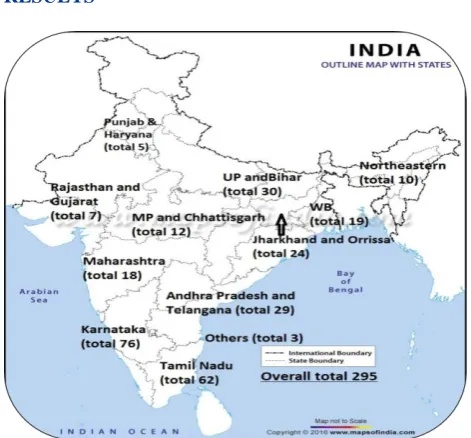
Figure 1: Distribution of the study subjects based on the states from which they have migrated.
Figure 1 shows the pattern of migrants to Bangalore urban area. Out of 295 migrants, 25.8% (76) were from other districts of Karnataka and 74.2% (219) were from outside Karnataka.
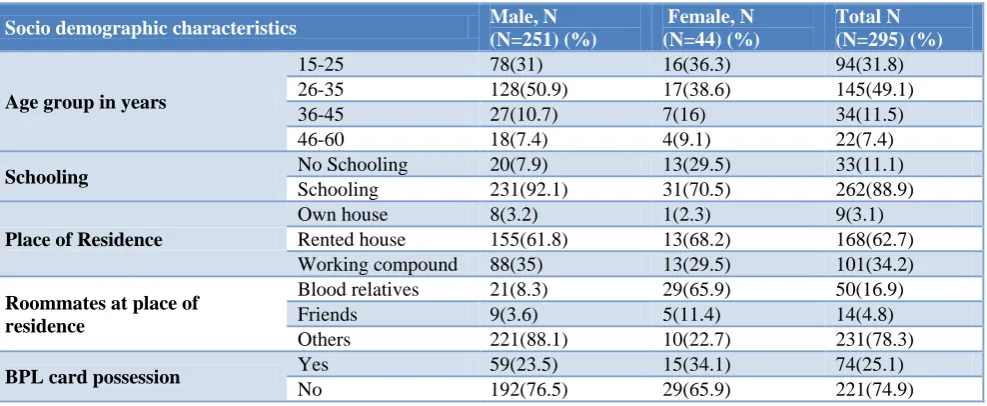
Table 1 shows majority of study subjects were in the age group of 15-35 years accounting for` 80.9% and the proportion was same in males and females. Among 295 study subjects 88.8% had schooling. Around 62.7% (168) of the total study subjects were staying in the rented houses and 34.2% in the working compounds or sheds. Around 16.9% were staying with their blood relatives (including spouses) and 78.3% were living alone at the place of migration. Migrants who were staying with blood relatives were more among females compared to males. Out of 295 study subjects 25.1% were having the BPL cards which are only functional in their respective states.
Table 1: Socio demographic characteristics of study subjects.
Socio demographic characteristics Male, N
(N=251) (%)
Female, N (N=44) (%)
Total N (N=295) (%)
Age group in years
15-25 78(31) 16(36.3) 94(31.8)
26-35 128(50.9) 17(38.6) 145(49.1)
36-45 27(10.7) 7(16) 34(11.5)
46-60 18(7.4) 4(9.1) 22(7.4)
Schooling No Schooling 20(7.9) 13(29.5) 33(11.1)
Schooling 231(92.1) 31(70.5) 262(88.9)
Place of Residence
Own house 8(3.2) 1(2.3) 9(3.1)
Rented house 155(61.8) 13(68.2) 168(62.7)
Working compound 88(35) 13(29.5) 101(34.2)
Roommates at place of residence
Blood relatives 21(8.3) 29(65.9) 50(16.9)
Friends 9(3.6) 5(11.4) 14(4.8)
Others 221(88.1) 10(22.7) 231(78.3)
BPL card possession Yes 59(23.5) 15(34.1) 74(25.1)
No 192(76.5) 29(65.9) 221(74.9)
Numbers in parenthesis indicates percentage.
Table 2: Distribution of the study subjects based on occupation, duration of migration, working hours and rest days/month.
Occupational characteristics Male, N
(N=251) (%)
Female, N (N=44) (%)
Total N (N=295) (%)
Type of occupation High risk 155 (61.8) 17 (38.6) 172 (58.3)
Low risk 96 (38.3) 27 (61.4) 123 (41.7)
Duration of migration <1 year 31 (12.4) 16 (36.4) 47 (15.9)
>1 year 220 (87.7) 28 (63.6) 248 (84.1)
Working hours
< 6 hours 5 (2.0) 8 (18.2) 13 (5.2)
7- 10 hours 171 (68.1) 30 (68.2) 201 (68.1)
>10 hours 75 (29.9) 6 (13.6) 81 (27.8)
Rest days per month 1-3 66 (26.3) 9 (20.5) 75 (25.8)
4-8 185 (73.7) 35 (79.6) 220 (74.2)
Numbers in parenthesis indicates percentage.
Figure 2: Distribution of study subjects based on health seeking behaviour.
82.9 17.1
55.8 44.2 8
82.9 9.2
55.8 44.2
62.9 37.1
93.2 6.8
77.3 22.7
18.2
70.5 11.4
65.9 34.1
70.5 29.5
0 20 40 60 80 100
Yes No Yes No < 1 1 to 3 > 3 Yes No Govt. Private
Discu
ss
io
n
of
h
ealth
p
robl
em
Pr
actice
o
f
h
o
m
e
re
m
ed
y
for
illn
ess
Del
ay
in
d
a
y
s
b
efore
tr
eatm
en
t
Ov
er
the
co
u
n
ter
d
rugs (self
m
ed
icatio n)
Util
izatio n of
h
ealth
ser
v
ice
s
Female (N=44)
Male (N=251)
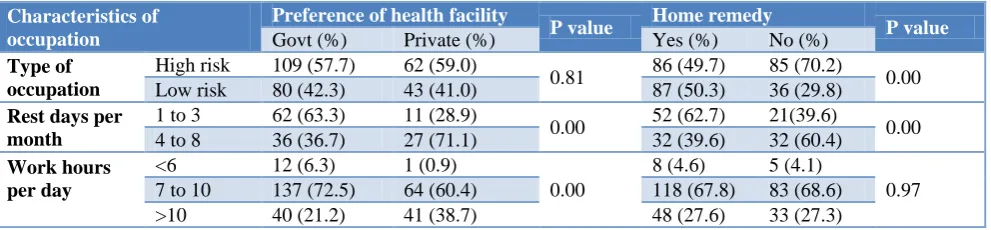
Table 3: Factors effecting health seeking behaviour of migrant workers.
Characteristics of occupation
Preference of health facility
P value Home remedy P value
Govt (%) Private (%) Yes (%) No (%)
Type of occupation
High risk 109 (57.7) 62 (59.0)
0.81 86 (49.7) 85 (70.2) 0.00
Low risk 80 (42.3) 43 (41.0) 87 (50.3) 36 (29.8)
Rest days per month
1 to 3 62 (63.3) 11 (28.9)
0.00 52 (62.7) 21(39.6) 0.00
4 to 8 36 (36.7) 27 (71.1) 32 (39.6) 32 (60.4)
Work hours per day
<6 12 (6.3) 1 (0.9)
0.00
8 (4.6) 5 (4.1)
0.97
7 to 10 137 (72.5) 64 (60.4) 118 (67.8) 83 (68.6)
>10 40 (21.2) 41 (38.7) 48 (27.6) 33 (27.3)
Numbers in parenthesis indicates percentage.
Figure 2 shows around 84.4% of study subjects discussed their health problems with others and it was almost equal among both sexes. More than 50% of the study subjects practised home remedy for their illness. Around 81% of them delayed seeking health care for their illness by 1 to 3 days whereas very few (9.5%) received health care within one day. Among 295 study subjects 57.3% (169) practiced self medication for their illness and it was more among females (65.8%) compared to males (55.8%).
Table 3 shows occupational characteristics affecting health seeking behaviour of study subjects. There was no significant association between type of occupation with preference of health facility and working hours per day with use of home remedy for their illness (p>0.05). There was significant association between rest days per month, work hours per day with preference of health facility and also between type of occupation, rest days per month with use of home remedy for illness (p<0.05).
DISCUSSION
In our study male study subjects were more (85%) compared to females which was similar in other study by Mitra et al.6 A study by Rajesh et al among rural agricultural migrants had 55.7% males and 44.3% females. Around 54% preferred health care facility for their illness (48% government and 28% private hospital).7
In a technical report by European centre for disease prevention and control about 87.6 percent of migrants were working in high risk occupation and in our study 58.3% were working in high risk occupation and males were more compared to females in such occupation.8 In our study half of the study subjects depended on home remedies for their illness and it was 77.3% and 55.8% among males and females respectively. More than 50% of migrants depended on government services for their illness and over the counter drugs. There was no much difference between males and females. In a study by Surabhi et al 28.6% and 22.3% of study subjects were dependent on over the counter drugs and government hospital respectively for their illness which is different to the observational in our study.
A study on Tamil Migrants in Kochi, the health seeking behaviour varies from seeking health care from private hospitals to medical shops to government hospitals to not taking any treatment. Linguistic difficulties and temporary nature of stay also affected the health seeking behaviour.9 Drug stores/on the counter drugs were identified as main source of health care outside home for majority of migrants. The important factor determining the choices of health care are the belief and perceptions of illness causation.10 A study by Saikia in Kerala found poor patterns of health care seeking; and the main reason for poor health seeking behaviour was lower socio economic status.11
Noncompliance to treatment, non utilisation of preventive services, poor access to health services, social, personal, economic, cultural, political and experimental factors were found to be the reasons for poor health seeking behaviour.12-14 In other study language barriers, lack of time and lack of knowledge about the healthcare by govt. etc were some of the reasons for poor health seeking behaviour.15 A study by Sreejini around 28.6% preferred over the counter drugs for their illness, 47.1% and 22.3% preferred government and private hospital respectively. Socio economic status and duration of migration had an impact on their health seeking behaviour.16
In our study, study subjects utilized govt. services more than private services that rules out the possibility of poor health seeking behaviour due to of lack of knowledge of available services. Most of the migrants preferred on the counter drugs and home remedy as their first choice, this could be due to their working hours and accessibility to their services from their work place, due to their perception about health care or their affordability etc.
ACKNOWLEDGEMENTS
Funding: No funding sources Conflict of interest: None declared
Ethical approval: The study was approved by the Institutional Ethics Committee
REFERENCES
1. International Organization for Migration. World Migration Report 2011: Communicating Effectively about Migration. Geneva: IOM; 2011. Available at https://publications.iom.int/system/files/pdf/wmr201 1_english.pdf. Accessed on 1 October 2017
2. Census of India 2001. Data Highlights, Migration Tables DI, D1 (Appendix), D2 and D3 Tables. Registrar General and Census Commissioner, India. Available at censusindia.gov.in/Tables.../D.../Tables _on_Migration_Census_of_India_2001.aspx. Accessed on 1 November 2017.
3. Ministry of Statistics & Program Implementation. Government of India, Migration in India,
2007-2008. Available at: http://www.mospi.nic.in/
Mospi_New/ upload/533_final.pdf. Accessed on 1 October 2017.
4. Nitika, Ayush L, Nongkynrih B, Gupta SK.
Migrants to Urban India: Need for Public Health Action. Indian J Community Med. 2014;39(2):73-5. 5. Babu BV, Swain BK, Mishra S, Kar SK. Primary
healthcare services among a migrant indigenous population living in an eastern Indian city. J Immigr Minor Health. 2010;12:53-9.
6. Mitra A, Murayama M. Rural to Urban Migration: A District Level Analysis for India. International J Migration, Health Social Care. 2009;5:35-52.
7. Kulkarni RR, Shivaswamy MS, Mallapur MD.
Health-seeking behavior of rural agricultural workers: A community-based cross-sectional study. Int J Med Public Health. 2013;3(1):33-7.
8. European Centre for Disease Prevention and
Control. Technical Report. Migrant health:
Background note to the ‘ECDC Report on migration and infectious diseases in the EU’. Stockholm: ECDC; 2009.
9. Surabhi KS, Ajith Kumar N. Working Paper No.16,
Labour Migration to Kerala: A Study of Tamil Migrant Labourers in Kochi. Kochi: Centre for Socio-economic & Environmental Studies; 2007. Available at: http://csesindia.org/admin/modules/
cms/docs/publication/16.pdf. Accessed on 1
November 2017.
10. Ma GX. Between two worlds: The Use of
Traditional and Western Health Services by Chinese Immigrants. J Community Health 1999;24:421-37. 11. Saikia D. Economic conditions of the In-Migrant
workers in Kerala. A Case study in the Thiruvananthapuram district. [Munich Personal RePEc Archive (MPRA) Paper, 2011]. Available at: http://mpra.ub.uni-muenchen.de/28579/. Accessed on 20 December 2017.
12. Muela SH, Ribera JM, Nyamongo I. Health-seeking
behaviour and the health system response. DCPP Working paper No.14, 2003. Available at: http://www.dcp2.org/file/29/wp14.pdf, Accessed on 1 September 2017.
13. Shaikh BT, Hatcher J. Health seeking behaviour and health service utilization in Pakistan: challenging the policy makers. J Public Health. 2005;27:49-54. 14. MacKian S. HSD/WP /05/03, A review of health
seeking behaviour: problems and prospects.. Health Systems Development Programme. Available at: http://www.dfid.gov.uk/R4D/PDF/Outputs/HealthS ysDev_KP/0503_health_seeking_behaviour.pdf. Accessed on 15 April 2017.
15. Ajith Kumar N. Working Paper No.26,
Vulnerability of Migrants and Responsiveness of the state: The case of unskilled migrant workers in Kerala, India. Kochi: Centre for Socio-economic &
Environmental Studies; 2011. Available at:
http://csesindia.org/admin/modules/cms/docs/public ation/29.pdf. Accessed on 12 April 2012.
16. Sreejini J. Factors associated with Health seeking behaviour and Self-reported morbidity pattern
among the Interstate migrant labourers in
Thiruvananthapuram district. A dissertation
submitted to Achutha Menon Centre for Health Science Studies Sree Chitra Tirunal Institute for
Medical Sciences and Technology
Thiruvananthapuram, Kerala India October, 2012: 30-42.
Cite this article as: Shwetha, Prasad KN.A cross