Original Research Article
Pattern of exposure among victims of suspected rabid animal attending
anti-rabies clinic of tertiary care hospital
Uruj A. Qureshi*, Mariya A. Qurieshi
INTRODUCTION
Rabies is an acute progressive encephalitis caused by
RNA viruses in the family Rhabdoviridae, genus
Lyssavirus.1,2 It is almost always fatal following the onset of symptoms. Rabies is a neglected tropical disease that predominantly affects the most vulnerable humans- children.3 Children are especially at risk because they are more likely to approach animals without caution, including apparently tame wild animals, and therefore to be attacked and bitten, especially on the arms and face. About 40% of deaths occur in children under the age of 15 years. Considerable geographical variation exists
worldwide, with 95% of rabies cases in humans occurring in Africa and Asia; 84% of these in rural areas. Dogs are the source of infection in more than 99% of cases in humans.
Half of the human population worldwide lives in countries endemic for canine rabies.4 Vampire bats have been associated with several rabies outbreaks in South America. Rabies gets into the body through wounds or direct exposure of mucous membranes, usually as a result of bites from infected animals, or through transplantation of tissues or organs from someone who died from rabies. Humans are an end host. The incubation period is ABSTRACT
Background: Rabies, a neglected tropical disease, is vaccine preventable and occurs in more than 150 countries. It is almost always fatal. About 40% of deaths due to rabies occur in children under the age of 15 years. Objectives were to study the pattern of injury following exposure to canine bite, bear maul and rabid cow among the attendees of Antirabies clinic of SMHS hospital, Srinagar and to classify the type of exposure using WHO guidelines for initiation of post exposure prophylaxis.
Methods: The study was conducted over a period of three months from 1st June 2016 to 31st August 2016, in Anti Rabies Clinic of Department of Community Medicine, Government Medical College, Srinagar. It was a descriptive Study and included all victims of canine bite and rabid cow. A total of 134 patients were received.
Results: Most [83 (61.9%)] of the patients were males with mean age of 36.63 years. Legs were the most common [57 (43.2%)] site of exposure followed by hands [15 (11.2%)] and thigh [13 (9.7%)]. Contact with a rabid cow was present in 5 (3.7%). Class II exposure was most frequently encountered [83 (61.9%)]. Class III exposure was seen in 49 (36.6%). All patients who attended anti rabies clinic for post exposure prophylaxis received free Antirabies Vaccine. Combined Antirabies vaccine and immunoglobulin was received by 49 (36.6%).
Conclusions: Dog bite related injuries happen frequently in Srinagar. There is proper post exposure prophylaxis in place in SMHS hospital. There is need for curbing the ever increasing dog population and enforcing rabies vaccination in dogs.
Keywords: Rabies, World Health Organization, Post exposure prophylaxis, Antirabies vaccine
Department ofCommunity Medicine, Government Medical College Srinagar, Jammu and Kashmir, India
Received: 15 February 2018
Revised: 12 March 2018
Accepted: 14 March 2018
*Correspondence:
Dr. Uruj A. Qureshi,
E-mail: [email protected]
Copyright: © the author(s), publisher and licensee Medip Academy. This is an open-access article distributed under the terms of the Creative Commons Attribution Non-Commercial License, which permits unrestricted non-commercial use, distribution, and reproduction in any medium, provided the original work is properly cited.
variable, with a mean incubation time in one study of 273.6 days (median 80 days, range 12 days to 10 years.5 The longer incubation periods emphasize that post-exposure prophylaxis is always indicated even if exposure occurred months or years earlier, provided neurological symptoms have not developed. Death is almost always inevitable in unimmunized patients.6 Many countries have successfully reduced the impact of the disease by tackling the gap between public and animal health through a concerted “one health” approach.4 Countries predominantly affected by rabies often have poor diagnostic and reporting capacities, leading to a lack of accurate data and considerable uncertainty around estimates of global burden. In 2011 the World Health Organization reporting database Rabnet closed, as limited data and under-reporting contributed to a lack of priority for this disease.5
The global economic burden of rabies has been estimated at $6bn (£3.8bn; €5bn), comprising the cost of both disease in humans, domestic animals, and wildlife and prevention through control measures in animals and post-exposure prophylaxis in humans.4 From a health policy maker perspective, control of canine rabies is highly cost
effective and even cost saving.7 In India, the country with the highest number of deaths from rabies, only one in six patients receives appropriate post-exposure prophylaxis.4 The World Health Organization (WHO) supports targets for elimination of human rabies transmitted by dogs in South-East Asia by 2020.Around 15 million animal bites requiring post exposure rabies prophylaxis, occur in India every year.8 There is little data on the incidence of animal bites from India. The available studies on dog bites and rabies in India are mostly hospital‑based, and limited to disease management.9,10
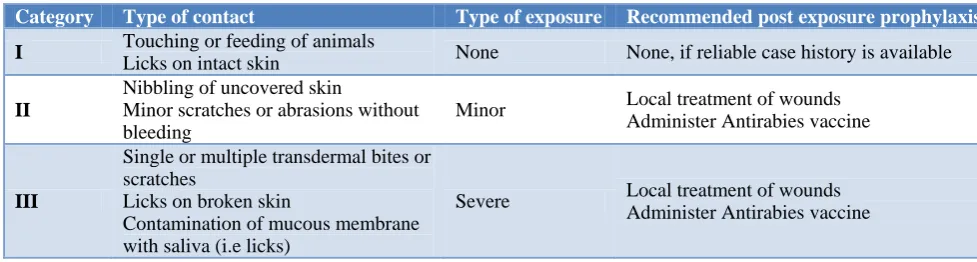
The canine bite exposures are categorised as per WHO guidelines.11
The estimates of suspected rabid animal bite victims from Kashmir are available from a single hospital based data. In Kashmir, victims of suspected rabid animal bite are mainly managed at SMHS hospital which is a tertiary care hospital situated in District Srinagar. It has been reported that in three years (2011-2013) a total of 13852 victims of canine bite victims were managed at Anti rabies clinic of SMHS hospital.12
Table 1: Categorization of bite cases as per WHO guidelines.
Category Type of contact Type of exposure Recommended post exposure prophylaxis
I Touching or feeding of animals
Licks on intact skin None None, if reliable case history is available
II
Nibbling of uncovered skin
Minor scratches or abrasions without bleeding
Minor Local treatment of wounds
Administer Antirabies vaccine
III
Single or multiple transdermal bites or scratches
Licks on broken skin
Contamination of mucous membrane with saliva (i.e licks)
Severe Local treatment of wounds
Administer Antirabies vaccine
With this backdrop the present project was undertaken to know the pattern of injury, type of animal involved and the site of injury among the patients attending Antirabies clinic for post exposure prophylaxis.
Objectives of the study
1. To study the pattern of injury following exposure to canine bite, bear maul and rabid cow among the attendees of antirabies clinic of SMHS hospital, Srinagar.
2. To classify the type of exposure using WHO
guidelines for initiation of post exposure prophylaxis among the individuals attending antirabies clinic of SMHS hospital.
METHODS
The present study was conducted in Anti rabies clinic of SMHS hospital which is under the administrative control of Department of Community Medicine Government
Medical College Srinagar. The study was carried out over a period of three months from 1st June 2016 to 31st August 2016, in a single institutional unit (anti rabies Clinic) of Department of Community Medicine. It was a descriptive Study and included all victims of canine bite or exposure to rabid cow or bear maul attending Anti rabies clinic of SMHS hospital.
The study included patients of different age groups and both sex who were attending antirabies clinic during the study period. All those patients attending the clinic who gave consent for being included in the study irrespective of sex, age, severity of bite and treatment taken were included in the study. The patients were evaluated for the site of exposure, class of exposure and modalities of management.
antirabies clinic were given proper wound care, vaccination with modern anti-rabies vaccines and administration of rabies immunoglobulins. The attending
physician provided correct post-exposure rabies
prophylaxis (PEP). After receiving initial management the subjects were interviewed after taking consent. The interview was carried by using a structured questionnaire. History included name, age, sex, occupation, educational status. Socioeconomic status of the patient was assessed by below poverty line certification and economic parameter was assessed by taking into account to family income. A detailed examination of the wound was performed to get the information about type of exposure, site of exposure and class of exposure.
Ethical clearance was sought by the Ethical Committee of Government Medical College, Srinagar.
Statistical analysis
The collected data was entered in Microsoft excel and analyzed using Statistical software for Social Sciences SPSS 20.Categorical data was summarized as frequency and percentages and continuous data was summarized as mean with standard deviation.
RESULTS
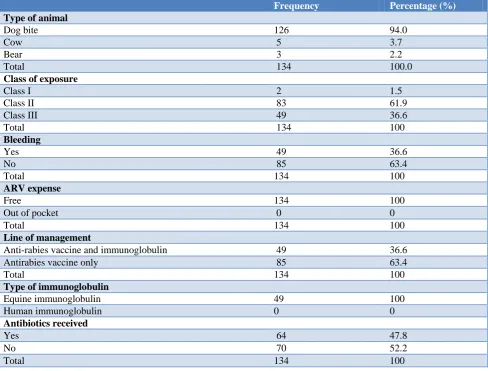
A total of 134 patients who attended the clinic were given wound management and vaccination. Mean age of the patients was 36.63±26.5 standard deviation. Most of the patients 67 (49.8%) were from age group of 21 to 50 years of age group. Most of the attendees of the Antirabies Clinic were males 83 (61.9%). Most of the patients were illiterate 43 (32.1 %). Only 23(17.1%) had completed higher secondary level and graduation. 25 (18.7%) of patients were dealing with business and equal number were unskilled laborers. School goers and Government employees were also equal in number 18 (13.4%). A total of 70 (52.2%) of patients had a family size of five to seven. In most of the cases 91 (67.9%) patients had only one earning member in the family followed by 29 (21.6%) who had two earning members. Legs were the most common site of exposure in 57 (43.2%) of patients followed by hands in 15 (11.2%) and thigh in 13 (9.7%) patients. Contact with a rabid cow was present with 5 (3.7%) cases. Class II and Class III exposure was most frequently encountered with 83 (61.9%) and 49 (36.6%) of cases. Out of 134 patients 49 (36.5%) reported bleeding of varying degree at the site of exposure. All of the patients 134 (100%) who attended anti rabies clinic for post exposure prophylaxis received free antirabies vaccine. Combined antirabies vaccine and immunoglobulin was received by 49 (36.6%) of patients. All the patients with Category III exposure received equine immunoglobulin as a part of post exposure prophylaxis.
Table 2: Sociodemographic profile of patients attending antirabies clinic of hospital for post
exposure prophylaxis against rabies.
Characteristics Frequency Percentage
(%)
Age group
<10 29 22.0
11-20 15 11.1
21-30 23 17.1
31-40 25 18.6
41-50 19 14.1
51-60 14 10.4
61-70 7 5.2
71-80 2 1.5
Sex
Male 83 61.9
Female 51 38.1
Educational status
Illiterate 43 32.1
Primary 30 22.4
Middle 21 15.7
Secondary 17 12.7
Higher Secondary 6 4.4
Graduate and above 17 12.7
Occupational status
Government employee 18 13.4
Private/self employed 17 12.7
Business 25 18.7
School goers/students 18 13.4
Homemakers 21 15.7
Nil 10 7.4
Unskilled laborer 25 18.7
Total family members
<4 37 27.6
5-7 70 52.2
8-10 23 17.2
>12 4 3.0
Total earning members
1 91 67.9
2 29 21.6
3 10 7.5
4 1 0.7
Information not
available 3 2.2
Below poverty line certified
Yes 25 18.7
No 109 81.3
Income in Rupees
≤7000 36 26.9
7001-11000 31 23.1
11001-20000 39 29.1
≥20001 28 20.9
such ID sites per visit (one on each deltoid area, an inch above the insertion of deltoid muscle) on days 0, 3, 7 and 28. The day 0 is the day of first dose of administration of IDRV and may not be the day of rabies exposure/animal bite. The dose was drawn by aseptic technique and the vaccines were stored in a refrigerator at 2ºC to 8ºC.The
reconstituted vaccines was utilized within 6 to 8 hours if kept at 2ºC to 8ºC. All unused reconstituted vaccine was discarded. Wound toileting was done in all the patients and all of them received tetanus toxoid injection irrespective of the previous immunization status. In 64 (47.8%) of patients antibiotics were prescribed.
Table 3: Distribution of patients as per the site of exposure to bite including contact with rabid cow.
Site of exposure Frequency Percentage (%)
Leg 57 43.2
Hand 15 11.2
Thigh 13 9.7
Buttock 11 8.2
Arm 10 7.5
Foot 9 6.7
Contact with rabid cow 5 3.7
Back 4 3.0
Head 4 3.0
Abdomen 1 0.7
Chest 1 0.7
Elbow 1 0.7
Face 1 0.7
Flank 1 0.7
Total 134 100.0
Table 4: Characteristics of exposure and wound management.
Frequency Percentage (%)
Type of animal
Dog bite 126 94.0
Cow 5 3.7
Bear 3 2.2
Total 134 100.0
Class of exposure
Class I 2 1.5
Class II 83 61.9
Class III 49 36.6
Total 134 100
Bleeding
Yes 49 36.6
No 85 63.4
Total 134 100
ARV expense
Free 134 100
Out of pocket 0 0
Total 134 100
Line of management
Anti-rabies vaccine and immunoglobulin 49 36.6
Antirabies vaccine only 85 63.4
Total 134 100
Type of immunoglobulin
Equine immunoglobulin 49 100
Human immunoglobulin 0 0
Antibiotics received
Yes 64 47.8
No 70 52.2
Total 134 100
DISCUSSION
The present study was conducted in antirabies clinic of SMHS hospital, a tertiary care hospital. The antirabies clinic is run by the Department of Community Medicine, Government Medical College Srinagar.
A total of 134 patients attended the clinic to receive post exposure prophylaxis against rabies. The mean age of the patients was 36.63±26.5. Most of the patients (49.8%) were in the age group of 21 to 50 years. Most [83 (61.9%)] of the attendees of the antirabies clinic were males. Studies conducted in other parts of India including Kashmir have shown similar findings. A study from Haryana has reported 23.9 years as a mean age of patients who present themselves at the clinic with male preponderance 70.4%.13 A study from Kashmir has reported mean age of patients as 27.69 years and 68% as males.12 This section of population represents the most productive age group and those who are outside to earn their livelihood; therefore at a higher risk of exposure.
Out of total attendees, 43 (32.1 %) patients were illiterate and 30 (22.4%) had completed primary level. Only 23(17.1%) had completed higher secondary level and graduation. 25 (18.7%) patients were dealing with business and equal number were unskilled laborers. School goers and government employees were also equal in number; 18 (13.4%). Most [39 (29.1%)] belonged to Rs 11001-20000 income range. Only 25 (18.7%) of patients were certified Below Poverty Line as per their economic status.
Legs were the most common site of exposure followed by hands and thigh, a finding also documented by Abubakar et al.14 The most frequently encountered animal exposure was dogs; seen in 126(94%) patients followed by cow in 5 (3.7%) and bear in 3 (2.2%). There are more than 150,000 dogs in the city, meaning 36 dogs for every human resident.15,16 Class II and Class III exposure was most frequently encountered with 83 (61.9%) and 49 (36.6%). Out of 134 patients; 49 (36.5%) reported bleeding of varying degrees at the site of exposure. Almost all of the patients [133 (99.3%)] who attended anti rabies clinic for post exposure prophylaxis received Antirabies Vaccine, which was remarkably higher than documented by Abubakar et al.14 This is probably connected with the availability of the antirabies vaccine free of cost in the hospital. Combined antirabies vaccine and immunoglobulin was received by 49 (36.6%) of patients. The present observations fall close to the previous observations made from the secondary data collected from the same clinic over a period of three years. In that retrospective survey it was observed that out of 13852 canine bite injuries, the lower limb was the leading site affected (46.5%) followed by hand & feet (32%). A total of 10250 (74%) sustained severe wounds (class III). 96% of patients had received combined vaccination and immunoglobulin.12
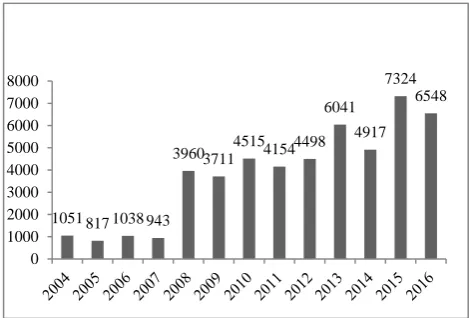
Figure 1: Number of persons receiving post exposure prophylaxis from period 2004 to 2016.
Figure 1 is showing the number of persons receiving post exposure prophylaxis from period 2004 to 2016.
In the present study all the patients with Category III exposure received equine immunoglobulin as a part of post exposure prophylaxis, despite the fact that immunoglobulin was to be purchased out of pocket. The fear of consequences of rabies forces patients to get this medicine from market, however given a choice they are
unable to purchase costlier human rabies
immunoglobulin.
All patients received antirabies vaccine free of cost except for immunoglobulin which patients had to procure from the market as it is not in the hospital supply. The patients have to bear the expenses for immunoglobulin. It is a costly medication.
CONCLUSION
Dog bite related injuries happen frequently in Srinagar. There is proper post exposure prophylaxis in place in SMHS hospital. There is need for curbing the ever increasing dog population and enforcing rabies vaccination in dogs.
Funding: No funding sources Conflict of interest: None declared
Ethical approval: The study was approved by the Institutional Ethics Committee
REFERENCES
1. Fooks AR, Brookes SM, Johnson N, McElhinney
LM, Hutson AM. European bat lyssaviruses: an
emerging zoonosis. Epidemiol Infect.
2003;131:1029-39.
2. Botvinkin AD, Poleschuk EM, Kuzmin IV,
Borisova TI, Gazaryan SV, Yager P, et al. Novel lyssaviruses isolated from bats in Russia. Emerg Infect Dis. 2003;9(12):1623-5.
1051 817 1038 943
3960 3711 4515 4154 4498 6041
4917 7324
6548
3. Wunner WH, Briggs DJ. Rabies in the 21 century. PLoS Negl Trop Dis. 2010;4:e591.
4. World Health Organization. WHO expert
consultation on rabies: second report. WHO Press, 2013.
5. Carrara P, Parola P, Brouqui P, Gautret P. Imported
human rabies cases worldwide, 1990-2012. PLoS Negl Trop Dis. 2013;7:e2209.
6. Crowcroft NS, Thampi N. The prevention and
management of rabies. BMJ. 2015;350:g7827. 7. Nel LH. Discrepancies in data reporting for rabies,
Africa. Emerg Infect Dis. 2013;19:529-33.
8. Shim E, Hampson K, Cleaveland S, Galvani AP.
Evaluating the cost-effectiveness of rabies post-exposure prophylaxis: a case study in Tanzania. Vaccine. 2009;27:7167-72.
9. Gogtay NJ, Nagpal A, Mallad A, Patel K, Stimpson
SJ, Belur A, et al. Demographics of animal bite victims & management practices in a tertiary care institute in Mumbai, Maharashtra, India. Indian J Med Res. 2014;139:459‑62.
10. Umrigar P, Parmar GB, Patel PB, Bansal RK.
Epidemiology of animal bite cases attending municipal tertiary care centres in Surat city: A cross
‑sectional study. Natl J Community Med.
2013;4:153‑7.
11. WHO Expert Consultation on rabies. World Health Organ Tech Rep Ser. 2005;931:1-88.
12. Lone KS, Bilquees S, Khan MS, Haq IU. Analysis of dog bites in Kashmir. An unprovoked threat to population. National J Comm Med. 2014:5:66-9.
13. Salve H, Kumar S, Rizwan SA, Rai SK, Shashikant,
Pandav CS. Feasibility of sustainable provision of intradermal Postexposure prophylaxis against rabies at primary care level-evidence from rural Haryana. BMC Health Services Res. 2014;14:278.
14. Abubakar SA, Bakari AG. Incidence of dog bite injuries and clinical rabies in a tertiary health care institution: a 10-year retrospective study. Ann Afr Med. 2012;11(2):108–11.
15. Schalamon J, Ainoedhofer H, Singer G, et al. Analysis of dog bites in children who are younger than 17 years. Pediatrics. 2006;117(3):374–9. 16. Fleisher GR. The management of bite wounds. N
Engl J Med. 1999;340:138–40.