Original Research Article
Community-based intervention study on knowledge and training needs
of disaster medicine among local residents in a disaster-prone
coastal area of Southern India
Devi Kittu, Lalithambigai Chellamuthu*, Aishwarya Sivasoupramanian
INTRODUCTION
Disaster medicine is the area of medical specialization serving the dual areas of providing health care to disaster survivors and providing medically related disaster preparation, disaster planning, disaster response and disaster recovery leadership throughout the disaster life cycle.1 The intensity and frequency of natural and man-made disasters have been noticeably increasing all over the world. Hurricane, earthquake, flood, outbreaks of infectious diseases, nuclear leakage, oil spills and other disasters in recent years have caused huge economic losses, serious environmental disruption and lasting
psychological impairment to the survivors.2 While not all
natural calamities can be predicted and prevented, a state of preparedness and ability to respond quickly to a natural calamity can considerably mitigate loss of life, loss of property , human suffering and restore normalcy at the earliest.3 Community residents are the very ones directly affected by disasters. Therefore, self-rescue and mutual-aid are essential to form the first defence line. Hence, community residents being one of the key components of first responders should be sufficiently trained to perform timely and effective medical rescue.4 Researches on disaster medicine have mainly been conducted in developed countries while data from developing countries like India are scarce.5-8 With this background the study was conducted with the following ABSTRACT
Background: A state of preparedness to a natural calamity can considerably mitigate loss of life and property and the human suffering and restore normalcy at the earliest. This study aimed at evaluation of knowledge levels on disaster management among community residents in Puducherry.
Methods: Community based intervention study involving 150 community residents from a disaster affected coastal area was carried out employing convenient sampling. One-to-one interview was conducted using a structured questionnaire. Intervention through posters, lectures and disaster management mock drills was done. Evaluation was made using the same questionnaire following the intervention. The pre- and post-test evaluation were compared and analysed.
Results: The study showed lower levels of knowledge regarding disaster management. Following the intervention there was a significant rise in the knowledge levels (p<0.005).
Conclusions: This study may be useful for planning future training needs and IEC strategies for the community regarding disaster management.
Keywords: Disaster management, Community residents, Costal area, Intervention study, Demand survey
Department ofCommunity Medicine, Indira Gandhi Medical College and Research Institute, Puducherry, India
Received: 01 February 2019 Revised: 11 March 2019 Accepted: 12 March 2019 *Correspondence:
Dr. Lalithambigai Chellamuthu, E-mail: [email protected]
Copyright: © the author(s), publisher and licensee Medip Academy. This is an open-access article distributed under the terms of the Creative Commons Attribution Non-Commercial License, which permits unrestricted non-commercial use, distribution, and reproduction in any medium, provided the original work is properly cited.
objectives: to evaluate knowledge levels on disaster management among community residents in Puducherry, to do a demand survey for training needs assessment in improving their disaster management skills, to create awareness and train them regarding disaster management and to compare the pre-test and post-test knowledge levels of community residents.
METHODS
A community-based intervention study was carried out among disaster prone community residents in a coastal area of Puducherry called Chinnakalapet. The study period was two months from June to August 2016. Adults above 18 years of age who were willing to participate and gave consent were included in the study. Convenience sampling was employed to select the study participants from the community. The sample size was calculated as
150 using the formula n=4pq/d2 with proportion of
knowledge on disaster management being 40% from the pilot study, absolute precision as 20%, drop-out rate as 10%. A pre-tested and validated structured questionnaire which included demographic details, knowledge levels and training needs on disaster management was used for face-to-face interview with the participants. If the selected participants were not available at the time of the first visit, two more visits were made to contact them personally. If the participant could not be met even after 3 visits, no further attempts were made to contact them. Following the pre-test, an intervention was organized for the study population based on the demand survey results and also after discussion with the concerned officer in-charge of disaster management in the revenue department of the locality. The intervention mainly focused on the important aspects of disaster management and also priorities were given to the topics preferred by the community residents. It was in the form of posters, speech and disaster management mock drills. Evaluation was done using the same questionnaire following the intervention. The pre-test and post-test evaluation were compared and analyzed.
Data entry and analysis were done using MS Excel 2010 and SPSS 17 software respectively. Descriptive statistics was used to express the demographic details of the participants. Paired t-test was used to test for significance in pre-and post-test scores.
Written informed consent was sought and confidentiality was ensured. Institute scientific research as well as ethical committee approval was obtained.
RESULTS
Socio-demographic profile
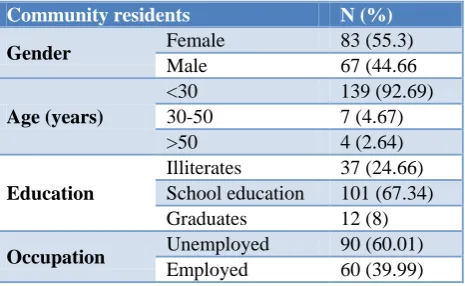
More than half of the study population comprised of females and majority of the residents were young (<30 years). Two-third of the participants had at least school level education but more than half of the population was unemployed (Table 1).
Knowledge levels on disaster management
The study results showed that the most common source of acquiring information regarding disaster management was television and radio (60%) followed by newspaper (25%). Half of the community residents surveyed had attended disaster management awareness campaigns in the past. Most of the community participants (90%) had knowledge about emergency exit; 53%, 52%, 50% of them had known about cyclones, tsunami and earthquakes respectively; 17% had known about the existing emergency numbers.
Table 1: Socio demographic details of the study population (n=150).
Community residents N (%)
Gender Female 83 (55.3)
Male 67 (44.66
Age (years)
<30 139 (92.69)
30-50 7 (4.67)
>50 4 (2.64)
Education
Illiterates 37 (24.66)
School education 101 (67.34)
Graduates 12 (8)
Occupation Unemployed 90 (60.01)
Employed 60 (39.99)
Demand survey
Majority (90%) of the population were willing to participate in the interventions on disaster management. When asked about most preferred method of learning on disaster management 37% of the residents opted for videos, 24% said to include disaster management in syllabus at school level, 21% thought practical training would be a better method of learning. Almost 90% of the study group felt that disaster management education is important and essential for children. More than half of the residents were willing to participate in the disaster management drills and around 80% of them felt that a volunteer team should be set up for disaster relief also 50% of them were ready to join the volunteer team. First aid skills were found to be the most important topic in disaster medicine learning for 42% of the residents followed by triage, evacuation and referral accounting for 31% and fundamental principles of disaster management by 29% (Figure 1).
Training needs assessment
Figure 1: Demand survey among community residents on most important topic about disaster management.
Figure 2: Knowledge levels of community residents on disaster management.
Table 2: Paired samples test for comparing the pre-test and post-test knowledge levels of community residents.
Variables
Paired differences
t df Sig. (2 tailed)
Mean Standard deviation
Standard error mean
95% confidence interval of the difference
Lower Upper
Pair
pre-test-1 post -test -8.833 2.991 0.244 -9.316 -8.351 -36.172 149 0.000
Pre-test and the post-test scores of the community residents at 0.000 level of significance.
Figure 3: Comparison of pre and post-test scores of the community residents.
42
29 31
0 10 20 30 40 50 60 70 80 90 100
Fundamental principle
Disaster disposal Triage,evacuation & referral
Perc
entag
e
o
f
co
m
m
unity
residents
Most importatnt topic about disaster medicine
0% 20% 40% 60% 80% 100%
Emergency Nos
Emergency exit
Disaster kit First aid kit Earthquake Tsunami Cyclone Fire 17.30%
90.60%
45.30%
35.30%
50.60% 52.60% 53.30%
24%
44.10%
80.90%
0% 10% 20% 30% 40% 50% 60% 70% 80% 90% 100%
Comparison of pre and post-test
The total average score percentage of the pre-test on knowledge levels about disaster management was obtained as 44%. After the intervention the knowledge levels of the community residents was re-assessed and the average score percentage post intervention was found to be 80% (Figure 3).
A paired t-test was done between the pre and post-test scores and the difference was found to be statistically significant (p<0.05) (Table 2).
DISCUSSION
The study was conducted among adult population residing in a disaster-prone coastal area in Puducherry. More than half of the study population comprised of females and majority of the residents were young. Two-third of the participants had at least school level education but more than half of the population was unemployed (Table 1). This might be due to women predominance in the study population and most of them being housewives. Among employed individuals, one fifth of the study population was fishermen as the study setting was a coastal area. In a study conducted in Iran on household natural disaster preparedness by Mahdaviazad et al, similar socio-demographic profile of study population has been described with majority of respondents aged between 15 and 30 years, two thirds of them had a high school or lower level of education and most participants were self-employed (27.4%) or were a
stay-at-home wife or husband (27.2%).9
In the present study, the most common source of acquiring information about disaster management was media which was in consistence with the results of a study done in Shanghai, China.2 Al Thobaity et al, in their study on perceptions of knowledge of disaster management among military and civilian nurses in Saudi Arabia cited that majority of participants perceived that they had acquired knowledge and skills on disaster management through disaster drills and participation in
continuing education courses.10 The knowledge about
earthquake in the present study was low in comparison to the Shanghai study.2 This might be due to the fact that earthquakes are not common in the study setting of the present study. The knowledge on tsunami and cyclones were better as the study setting is a coastal area and the people had experienced these calamities in their past. The total average score percentage for the pre-test result was low which could be indirectly due to unemployment in
majority of the study population. Unemployed
individuals might have less opportunity for exposure to information regarding disaster management compared to working class people and thereby it could have reduced their scores, the other reason could be that almost half of the participants had not attended any kind of awareness campaigns regarding disaster management earlier.
The difference in the pre and post-test scores was significant as a result of awareness and education on disaster management which plays an important role in raising the knowledge levels. Alim et al, have conducted a similar evaluation study on disaster preparedness training and disaster drill among nursing students in Indonesia in which the pre-test score was 9.84 and the post-test score was 14.46 with a significant difference in
the pre and post-test scores (p=0.001).11 Training
programs such as disaster simulation and disaster drills have proven to be effective and can rapidly deliver core elements of disaster medicine and improve the knowledge level and ability of disaster response.
Nearly one third of the residents’ surveyed were willing to attend the disaster simulation drills regularly and also half of the residents felt that a volunteer team has to be set up for the disaster relief. This shows the residents’ interest in learning about disaster medicine and also their positive attitude towards practising it. When asked about most important topic to be learnt in disaster medicine first aid skills, triage, evacuation, referral and fundamental principles of disaster management were listed. These results are comparable with the Shanghai study where the residents had enlisted first aid skills and fundamental principles as important topics in disaster medicine learning.2 One another study on disaster preparedness among Hong Kong nurses by Fung et al, reported that first aid, basic life support, advanced cardiovascular life support, field triage were considered important topics in
disaster preparedness learning.12 Based on the needs
assessment in the present study focus was more on first aid skills in the intervention organized for the study participants.
CONCLUSION
In general, the results of the current study reflected a high vulnerability of the population when facing disaster. The knowledge level of disaster medicine was not satisfactory among the community residents. Various factors like education, occupation, awareness campaigns could have influenced their scores. Following the intervention there was a rise in the knowledge level which is significant. This infers that by educating and creating awareness among the people there is raise in knowledge levels and thereby reduction in the mortality and morbidity occurring due to the disasters. The demand survey revealed that the participants are willing to learn more about the disasters and fill their knowledge gaps. As most of such research evidence on disaster medicine is from developed countries and there is dearth of information in India, these results might be useful for planning future training needs and IEC strategies for the community regarding disaster management.
Strengths
needs among the population that would be involved in disaster rescue or affected by disasters. Our study enables a more comprehensive evaluation of current disaster preparedness situation and facilitates designing future disaster medicine training programs in India and other developing countries.
Limitations
The study had certain limitations. Our community participants were from a selected small coastal area in Puducherry. The sampling technique used “Convenient sampling” for selection of individuals is a non-probability sampling technique. Furthermore, the study involves smaller sample size which limits the generalizability of the study.
Recommendations
Future studies with larger sample size should be undertaken which would give us a better picture on knowledge levels of people on disaster management and thereby help in planning for training of the community residents in disaster management and preparedness.
ACKNOWLEDGEMENTS
We thank ICMR (Indian Council of Medical Research) for funding this project. We would like to acknowledge the support given by the officer in-charge of disaster management in the revenue department of Puducherry for conducting the disaster management drill as a part of intervention.
Funding: ICMR (Indian Council of Medical Research) Conflict of interest: None declared
Ethical approval: The study was approved by the Institutional Ethics Committee
REFERENCES
1. Hawley A, Matheson J. Making sense of disaster
medicine: A hands-on guide for medics. 1st edition CRC press; 2010.
2. Su T, Han X, Chen F, Du Y, Zhang H, Yin J, et al.
Knowledge levels and training needs of disaster medicine among health professionals, medical students, and local residents in Shanghai, China. PLoS One. 2013;8(6):e67041.
3. Department of revenue and disaster management:
Disaster management Action plan for Flood and cyclone North-east monsoon, 2008. Available at: www.indiaenvironmentportal.org.in/files/REV-DMAP-2008.pdf. Accessed on 5 January 2019.
4. Huntington MK, Gavagan TF. Disaster medicine
training in family medicine: a review of the evidence. Family Med. 2011;43(1):13.
5. Scott LA, Carson DS, Greenwell IB. Disaster 101: a
novel approach to disaster medicine training for
health professionals. J Emergency Med.
2010;39(2):220-6.
6. Kaiser HE, Barnett DJ, Hsu EB, Kirsch TD, James
JJ, Subbarao I. Perspectives of future physicians on disaster medicine and public health preparedness: challenges of building a capable and sustainable auxiliary medical workforce. Disaster Med Public Health Preparedness. 2009;3(4):210-6.
7. Pfenninger EG, Domres BD, Stahl W, Bauer A,
Houser CM, Himmelseher S. Medical student disaster medicine education: the development of an educational resource. Int J Emergency med. 2010;3(1):9-20.
8. Kaji AH, Coates W, Fung CC. A disaster medicine
curriculum for medical students. Teaching Learning Med. 2010;22(2):116-22.
9. Mahdaviazad H, Abdolahifar G. Assessing
household natural disaster preparedness in Shiraz, Iran, 2011: results of a knowledge, attitude, and practices survey. Disaster Med Public Health Preparedness. 2014;8(4):349-52.
10. Al Thobaity A, Plummer V, Innes K, Copnell B.
Perceptions of knowledge of disaster management among military and civilian nurses in Saudi Arabia. Australasian Emergency Nursing J. 2015;18(3):156-64.
11. Alim S, Kawabata M, Nakazawa M. Evaluation of
disaster preparedness training and disaster drill for nursing students. Nurse Edu Today. 2015;35(1):25-31.
12. Fung OW, Loke AY, Lai CK. Disaster preparedness
among Hong Kong nurses. J Adv Nur.
2008;62(6):698-703.
Cite this article as: Kittu D, Chellamuthu L,
Sivasoupramanian A.Community-based intervention