Int. J. Nanosci. Nanotechnol., Vol. 11, No. 3, Sept. 2015, pp. 209-217
Short Communication
Specific Fast Response CH
4Gas Sensor
Based on Metal Oxide, Tungsten
Carbide /SnO
2Core-Shell Modified
Interdigitated Electrode
S.Nikmanesh1*, M.M.Doroodmand2 and M.H.Sheikhi1
1. School of Electrical and Computer engineering, Shiraz University, I. R. Iran 2. Department of Chemistry, College of Sciences, Shiraz University, I. R. Iran
(*) Corresponding author: [email protected]
(Received: 28 May 2013 and Accepted: 28 Dec. 2014)
Abstract
In this study, a specific CH4 sensor is fabricated based on interdigitated electrode that
modified with core-shell of tungsten carbide/tin oxide (WC/SnO2) nanoparticles by wet
chemical method in different percents of carbon and tungsten. The morphology of wet
chemical-synthesized WC/SnO2 core-shell was evaluated by different methods such as
patterned X-ray diffraction (XRD), and particle size analyzer (PSA). The fabricated sensor is
selected as specific nanomaterial for CH4 detection. In the fabricated CH4 sensor, change in
resistance of the sensor was considered as the detection system. In this study, figures of merits such as linearity, specificity, response time were also evaluated. No serious interference was
evaluated for different foreign gases, introduced to a certain concentration of CH4. The
reliability of the fabricated CH4 sensor was evaluated via measuring CH4 in several gaseous
samples. A fast response time about 8s and recovery time 11s has obtained from (5.0%
WC-doped SnO2).
Keywords: CH4 gas sensor, SnO2, Core-shell, Fast response time.
1. INRODUCTION
Recently, gas sensing, as a typical application in intelligent systems, is receiving increasing attention in both industry and academia. Gas sensing technology has become more significant because of its widespread and common applications in the following areas: (1) industrial production (e.g., methane detection in mines) [1]; (2) automotive industry (e.g., detection of polluting gases from vehicles) [2]; (3) medical applications (e.g., electronic noses simulating the human olfactory system) [2-5]; (4) indoor air quality supervision (e.g., detection of carbon monoxide)[3-5];(5) environmental
studies (e.g., greenhouse gas monitoring) [4]. Methane (CH4) is major constituent of
natural gas that is widely used in our daily life as prime energy-source material. This compound is much stronger green house gas compared to carbon dioxide. The explosive limit of CH4 is ~5wt.% in air. Compared to
other hydrocarbons, CH4 has very low
explosive limit [1]. Therefore, the major risk of CH4 is an explosion hazard, which
may occur if CH4 concentration reaches its
explosive limit. These all show the strong necessity of CH4 detection and
CH4 [2]. However, there are various types
of commercial CH4 sensors, but none of
these sensors can detect CH4 without
fault.Most of these commercial CH4 sensors
are fabricated using metal oxide [2]. Semiconducting metal oxide gas sensors have attracted much attention in the field of gas sensing under atmospheric conditions due to their low cost and flexibility in production; simplicity of their use. In addition to the conductivity change of gas-sensing material, the detection of this reaction can be performed by measuring the change of capacitance, work function, mass, optical characteristics or reaction energy released by the gas/solid interaction [3]. But, high working temperature (~400 ◦C) of metal oxide-based CH4 sensors may easily
lead to explode the CH4 [4].
Tin oxide is by far as the most key functional semiconductor oxide for gas sensing applications because of high surface-area to bulk-ratio, good chemical stability and high sensitivity at lower operating temperature, compared to other oxides for detection of reducing and oxidizing gases [5].
Tin oxide (SnO2) is an n-type granular
material whose electrical conductivity is dependent on the density of pre-adsorbed oxygen ions on its surface. The resistance of tin dioxide changes according to the variation of gas concentration such as methane (CH4) .It is a wide band gap
(Eg = 3.6 eV). Because of its excellent optical and electrical properties, SnO2 is
extensively used as a functional material for the optoelectronic devices, gas sensors, varistor, ion sensitive field effect transistors, and transparent conductive coatings for organic light emitting diodes. Radio frequency (RF) Sputtering, direct current (dc)-magnetron sputtering, thermal evaporation, ion beam deposition, spray pyrolysis, and sol-gel are the most studied methods for the preparation of SnO2 [6-8].
Now much attention has been focused on resistive type gas sensor based on SnO2 in
practice for detecting CH4.It can be adjusted
to respond to different gases by choosing
operating temperature, nanostructure modification and by the use of dopant and catalyst.
Sensing properties such as sensitivity, selectivity, working temperature can be improved by several approaches including nanoscale, crystallies, additives, etc. One of the characteristics of nanometric materials is their high surface area/volume ratio. Thesis improves the adsorption of CH4 on
the sensor and can increase the sensitivity of device because the collision between the analytes and the sensing part is higher. Various dopants such as Pd, Pt, W, Fe, WO3, etc. have been widely used to reduce response time and working temperature and sensitivity.
Cabot et al. studied [9] a correlation between the catalytic activity and the sensor response of different modified SnO2
samples to CH4 as target gas. It was found
that, the catalytic oxidation of methane is more pronounced for Pd than Pt.
JiptoSujitno and Sudjatmoko also found that, the influence of platinum dopant on SnO2 thin film can reduce significantly the
resistance of thin film. Also, different response time and sensitivity were evaluated during different replicated fabrication of sensor [10].
Thin films of undoped and 0.1wt.% Ca-doped SnO2 with 30–60 ˚A Pt layers
deposited by ion beam sputtering have been structured on Si substrates. CH4 sensitivities
for those Pt.-covered undoped and Ca-doped SnO2 sensors are compared in terms
of root-mean-square surface roughness’s measured by Bong-Ki Min et al [15].
CH4 gas sensors made of the
nanocomposites of Sn/In/Ti oxides were investigated by BaiShoulia et al. The sensing tests showed that these nanocomposites exhibited high response and selectivity for the detection of CH4 at
operating temperatures between 200-250 ◦C [11].
In this study, a specific CH4 sensor is
fabricated based on interdigitated electrode on SiO2 that modified with core-shell of
wet chemical method. Compared to previously reported CH4 sensor [4], the
fabricated sensor has significant novelties such as specificity, reproducibility, high sensitivity, more improved detection limit and short response time.
2. EXPERIMENTAL
2.1. Preparation of sensing materials
Tungsten powder (99.9%) was first dissolved in 30wt.% H2O2 to give a 3.0 M
solution of tungsten, which was used as the source of tungsten for the synthesis of the carbide. The tungsten solution with added SnO2 and carbon was stirred for 30min with
200±2 rpm speed and stayed at room temperature for 24 h. The solution was sonicated for 15min then was centrifuged and obtained powder was introduced to the CVD instrumentation system that was handmade, for core-shelling on SnO2. It was
followed by flowing a mixture of Ar and H2
gases with Ar/H2 volume ratio of 10
through the SnO2 at 700 °C for ~3h.this
mixure played the role of catalyst to create WC-doped SnO2. Finally, the temperature
was decreased to room temperature with a cooling rate of 5 °C min-1.Obtained samples was in different proportion of SnO2, W and
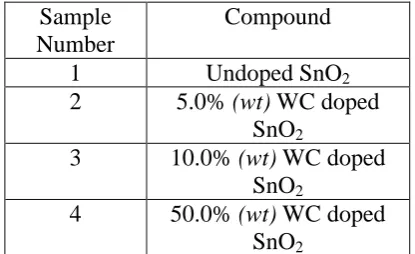
C as follows:
Sample Number
Compound
1 Undoped SnO2
2 5.0% (wt) WC doped SnO2
3 10.0% (wt) WC doped SnO2
4 50.0% (wt) WC doped SnO2
2.2. Characterization of sensing materials
Figure 1 shows the XRD pattern of WC doped SnO2 and W doped SnO2
nanopowder. Morphologies of SnO2 and
tungsten carbides (WC, W2C) are clearly
shown in Figure. 1. To determine the particle size of components, particle size
analyzer (PSA Horiba-LB 550) used as shown in Fig. 2 .According to Fig.2 the size of sample #2 is approximately 140nm (Figure. 2(a)) and the size of sample #3 is obtained ~300nm as shown in Fig. 2(b) . Also Figure. 3 presents the "Scanning Electron Microscopic" (SEM) images of samples. Figure 3(a) shows the SEM image of undoped SnO2 and also the core-shell
structure of 5.0% WC doped SnO2 is
observed in Figure. 3(b)
2.3. Measurement of sensor response
The sensitivity of samples in the presence of methane was tested inside test chambers that measure the change in surface resistance of the samples on gas exposure as shown in Figure.4. The sensing unit in Fig. 4 includes gold interdigitated electrodes on SiO2 substrate that sensing materials are
coated on electrodes. After coating the sensing materials, they are sintered in the temperature of 250-500°C.
The sensitivity is defined as:
S= (Rgas –R air) / Rair(1)
Where Rair and Rgas are the resistance of the
sensor in air and gas at the same temperature.
3. GAS SENSING
3.1. Mechanism of sensing
The electronic effect of the adsorption of CH4 on the SnO2 surface can be described
by the band structure model. The fundamental conduction model of metal oxide has been discussed in details in [17]. In the following, the electronic structure of the semiconductor and changes of its band structure by adsorption processes will be described. For simplification, the influence of the adsorption processes on the electronic band structure will be shown on the basis of oxygen adsorption. Figure.5 shows the sensing mechanism of this SnO2 type
methane sensor. SnO2 is an n-type
majority carriers. In air, the conductance value reduces due to the chemisorptions of oxygen, but in presence of reducing gas such as methane, the chemisorbed oxygen reacts with the methane to increase the electrical conductance.
(a)
(b)
Figure1. XRD patterns of SnO2 thin film
including (a) WC-SnO2 and (b) W-SnO2.
Whereas the electrical conductance of WC doped SnO2 decreases in presence of
methane because WC (tungsten carbide) is a p-type and SnO2 is an n-type semiconductor
when they interact with each other the potential difference between WC and SnO2
neutral region is:
ψ0 =ψn– ψp= φTlnNd Na / ni2(2)
Where Nd , Na are donor and acceptor
concentration. In Fig. 6 with sensing CH4, Nd related to SnO2 increases and cause to
increasing ψ0. Therefore, the electrical
conductance of WC doped SnO2 decreases
in opposite of undoped SnO2.
(a)
(b)
Figure2. Histograms showing the size
distribution of
(a)5%WC/SnO2and(b)10%WC/SnO2 thin
film.
The sensitivities of various samples to CH4
were measured over an operating temperature range of 90–300 ◦C and correlated with their composition and operating temperature. The sensitivity data are presented in Fig.8. These results indicate that the 5.0%WC doped.
4. RESULTS AND DISCUSSION 4.1. Sensor Response to CH4
justly influenced by the presence of amount of CH4 gas [10].
Compared to the previously reported CH4
sensors, the fabricated sensor operates at lower temperatures between 180-270 oC. The results are shown in Figure. 7. As clearly evaluated based on the Figure. 7, significant lowering is observed in the
background resistance of the sensor at temperature below 250 oC.
SnO2nanocompositecalcined at 600 ◦C has
the largest response value of 10 to 5000 parts per million (ppm) CH4at 200 ◦C; thus,
it is the optimum composite for the detection of CH4as shown in Figure.
(a) (b)
Figure3. SEM images of different samples including (a) undoped SnO2and (b) 5.0%WC- SnO
This sample (#2) has the largest sensitivity value at T=200◦C that operated at lower temperature than other reported works on metal oxides gas sensors. It is an advantage for this composite.
According to the Figure.9 maximum sensitivity value is belong to 5.0 %WC doped SnO2 at T=200 ℃ for 10000ppm
CH4. It can be seen from this Figure that
increasing in the operating temperature to 270 ºC cause to decreasing in sensitivity value of WC doped SnO2 from 10 to 6.
4.2 Type of materials sensing conductivity
The variation from undoped SnO2 to
WC-doped SnO2 shows the potential in
obtaining different semiconductor types (n-type and p-(n-type).So as adding tungsten carbide (WC) has been caused that n-type SnO2 convert to p-type WC-SnO2. From
Fig.10, it can be seen that, during the CH4injection, the resistance decreases due
to n-type conductivity of SnO2, but in
Fig.11 on exposure to CH4, the resistance of
WC-SnO2 increases rapidly because WC-
SnO2 is p-type. This change of
semiconductor type cause improvement in behavior sensor.
Here, to ensure the sensor response to CH4, not to the pressure of the gas inlet is
changed in the absence of CH4 gas, but also
the pressure of Ar gas is doubled up during the time interval. In accordance with Fig. 12, it can be seen that, the electrical resistance has approximately constant process.
4.3. Limit of Detection
Figure.13 shows that this sensor with 5%WC-SnO2 compound can detect 100ppm
CH4at T=120 ºC with sensitivity value equal
to ~4%.
Figure.13. Response of 5%WC doped SnO2 to 100ppm CH4 at operating
temperature T=120 ºC.
However, in the present work, it was found that all the four SnO2 sensors showed
shorter than 60 s. The results indicate that the different samples can affect the sensitivity, and have a great effect on the response time of the sensors as sample#2 is the fastest sensor that shows an ultra-fast reversible sensor at low temperature(T=120℃).
Figure4. Gas sensing set up.
Figure5. Electronic structure of
semiconductor before and after gas adsorption on the surface. Band bending of
a n-type semiconductor.[17]
Figure6. The step pn junction: potential
diagrams.
Figure7. Effect of temperature on the
resistance of SnO2 thin film.
Figure8. Response of various
nanocomposites to 5000ppm CH4 at
different operating temperature.
There are very few reports on metal oxide-based methane gas sensors with high response and shorter response and recovery time. So far the reported sensor structures based on oxide semiconductors and operating in the resistive mode at high temperature showed relatively longer response (>10 s) and recovery (>40 seconds) time for CH4 sensing. In this
investigation, particularly the WC doped SnO2 sensor shows short response time
(∼22s), and recovery time (∼17s) as compared to the values reported by others [14-17].
4. CONCLUSION
In summary, we used SnO2 and WC/SnO2
thin film for specific detection of methane. Compared to previously reported methane sensor, the fabricated sensor has significant novelties such as specificity,
0 200 400 600 800 1000 1200 1400 1600
0 100 200 300
Res
is
ta
nc
e (
Ko
hm
)
reproducibility, high sensitivity, more improved detection limit and short response time.
Figure.9. Response of various
nanocomposite to different concentration of
CH4 at operating temperature T=200 ℃ ,
270 ℃.
Figure10: Response of undoped SnO2 to
5000ppm methane at T=270 ºC.
Figur11: Response of 5%WC doped SnO2
to 5000ppm methane at T=270 ºC.
Figure12: Response of sensor to pressure
change of Ar in the absence of CH4.
Table1. Response and Recovery time of our
sensors and others.
Sample Number
Response Time (s)
Recovery Time (s)
Sensitivity Temp.
1- Undoped SnO2
65 56 3.5% 200℃
2- 5%WC-SnO2
22 17 14% 120℃
3- 10%WC-SnO2
34 29 18% 200℃
4- 50%WC-SnO2
45 38 5.6% 200 ℃
Other Works
SnO2
(Mosadeg h sedghi et al.[16])
- - 0 200 ℃
SnO2(B.K
.Min et al. [15])
- - 1% 250℃
SnO2(K.G
roßman et al. [13])
<40 680 - 300 ℃
0.01%Sb-SnO2
(K.Großm an et al.[ 13])
80 560 - 300 ℃
0. 1%Sb-SnO2
(K.Großm an et al. [13])
<40 600 - 300 ℃
3%Sb-SnO2
(K.Großm ann et al. [13])
80 >1200 - 300 ℃
13.75 13.8 13.85 13.9 13.95 14
00
:00
.0
05
:45
.6
11
:31
.2
17
:16
.8
Re
sis
ta
nce
(K
oh
m
)
Figure13: Response of 5%WC doped SnO2
to 100ppm CH4 at operating temperature
T=200 ºC.
ACKNOWLEDGEMENTS
The authors wish to acknowledge the support of this work by Pars Petroleum Company and Shiraz University Research Council.
REFERENCES
1. Q. Schiermeier: “Methane Finding Baffles Scientists”, Nature, Vol.439, No.128, (2006) [2] A. Trinch, W. Wlodarski, Y.X. Li, G. Feglia, G. Sberveglieri: “P ,Ga2O3/ SiCMRSiC
Devices: A Study of the Hydrogen Response”, J. Phys. D. , Vol. 38 , No. 754, (2005).
2. S. Liua, M. Xiea, Y. Lia, X. Guoa, W. Ji a, W. Dinga, C. Aub: Sensors and Actuators B, Vol. 151, (2010) , pp. 229–235.
3. J. C. Kim, H. K. Jun, J.S. Huh, D. D. Lee, Sensors and Actuators B, Vol. 45, No. 271, (1997).
4. B .R. Eggins, Chemical sensors and Biosensors, John Wiley & Sons Ltd., England, 2003 (R. Luo, L. Chen, and A. Chen. Chemical Industry Press, Beijing, July, (2005).
5. T.W. Kim, D. U. Lee, J. H. Lee, D. C. Choo, M. Jung, and Y. S. Yoon, “Structural, electrical, and optical properties of SnO2nanocrystalline
thin films grown on p- InSb (111)
substrates,”: Journal of Applied Physics, Vol. 90, No. 175, (2001) . 6. B.-K. Min and S.-D. Choi, “SnO2 thin
film gas sensor fabricated by ion beam deposition: Sensors and Actuators B, Vol. 98, No. 239, (2004).
7. G. Korotcenkov, V. Brinzari, V. Golovanov, and Y. Blinov,“Kinetics of gas response to reducing gases of SnO2films,deposited by spray
pyrolysis,”: Sensors and Actuators B, Vol. 98, No. 41, (2004).
8. Cabot, A. Vil ` a, and J. R. Morante, “Analysis of the catalytic activity and electrical characteristics of different modified SnO2 layers for gas
sensors”: Sensors and Actuators B, Vol. 84, No. 12, (2002).
9. T .Sujitno, Sudjatmoko, ”The influence of Platinum dopant on the characteristic of SnO2 thin film for
gas sensor application” : Center for Research and Development of Advanced Technology National Nuclear Energy Agency.
10. B. Shoulia, C. Liangyuanb, Y. Pengchenga, L. Ruixiana, C. Aifana, C.Liub,” Sn/In/Ti nanocomposite sensor for CH4 detection”: Sensors
and Actuators B, Vol. 135, No. 1, (2008).
11. C. Liewhirana, b, d, N. Tamaekongb, A. Wisitsoraatc, S. Phanichphantb, "Highly selective environmental sensors based on flame-spray-made SnO2 nanoparticles "Sensors and
actuators B (2012) .
12. K. Großmann, Krisztina E. Kovácsb, David K. Phamb, Lutz Mädlerb ,”Enhancing performance of FSP SnO2-based gas sensor through
Sb-doping and Pd functionalization ”,Sensors and Actuators B, Vol. 158, (2011), pp. 388-392.
13. M. S. Aleksanyan, "Methane Sensor Based on SnO2/In2O3/TiO2
Academy of Sciences), Vol. 45 (2010), pp. 77–80.
14. B. K. Min and S.-D. Choi, "Undoped and 0.1wt. %Ca-doped Pt-catalyzed SnO2 sensors for CH4 detection":
Sensors and Actuators B, Vol. 108,(2005),pp.119–124.
15. S. Mosadegh Sedghi, Y. Mortazavi, A. Khodadadi, "Low temperature CO and CH4 dual selective gas sensor
using SnO2 quantum dots prepared by
sonochemical method ":Sensors and Actuators B, Vol. 145, (2010), pp. 7– 12.