THE ROLE OF WORKER'S MULTIPLE INTELLIGENCES ON THEIR
PRODUCTIVITY IN CULTURAL INSTITUTIONS OF MOGHAN
Qader Vazifeh Damirchi (PHD Student)
Management Department of Islamic Azad University, Jolfa International Branch, East Azerbaijan, Tabriz, IRAN, +989144514570
E-mail: [email protected]
Gholamreza Rahimi (PHD)
Assistant Professor in Management Department of Islamic Azad University, Jolfa International Branch, East Azerbaijan, Tabriz, IRAN
Mir Hossein Seyyedi (PHD Student)
Management Department of Islamic Azad University, Jolfa International Branch, East Azerbaijan, Tabriz, IRAN.
E-mail: [email protected]
ABSTRACT
The main focus of this study is Cultural Institutions of Moghan region in Iran. The theory of multiple intelligences was developed in 1983 by Howard Gardner. He suggests that the traditional notion of intelligence, based on I.Q. testing, is far too limited. Instead, Dr. Gardner proposes eight different intelligences to account for a broader range of human potential in children and adults. These intelligences are linguistic intelligence, logical intelligence, spatial intelligence, bodily intelligence, musical intelligence, interpersonal intelligence, intrapersonal intelligence and Naturalist intelligence. The purpose of this research is surveying of relationship between multiple intelligences and productivity of Cultural Institutions workers in Moghan. The methodology of study is descriptive and analytical study. Data collection instrument was a questionnaire that its reliability was confirmed by Crohn Bach’s alpha and library studies. The results show that, there is a relationship between multiple intelligences and productivity of Cultural Institutions workers in Moghan.
Keywords: multiple intelligences, productivity, Cultural Institutions, Moghan
1. INTERDICTION
Cultural institutions are elements within a culture or sub-culture that are perceived to be important to, or traditionally valued among, its members for their own identity. Examples of cultural institutions in modern Western society are museums, churches, schools, work and the print media (Wikipedia, 2010). Television as a Cultural Institution Another example of a cultural institution is television. Television's has the power to communicate social values and ideas within a society through the shows and stories it exhibits. Television is viewed all over the world and has the power to shape society's political, social, and moral views. Experts commonly name the following five cultural institutions as needed (at least in some way) in any society in order to survive: education, economic system, government, family, and religion (Lotz, 2007).
Iran has few museums, and those that exist are of relatively recent origin. The two exceptions are the Golestān Palace Museum in Tehrān, which was opened in 1894, and the All Saviour’s Cathedral Museum of Jolfā (Eṣfahān), which was built by the Armenian community in 1905. The only gallery devoted solely to art is the Tehrān Museum of Modern Art, opened in 1977. Other well-known museums include the National Museum of Iran (1937) and Negārestān (1975) in Tehrān and Pārs (1938) in Shīrāz. Among the learned societies, all of which are located in Tehrān, the most important are the Ancient Iranian Cultural Society, the Iranian Mathematical Society, and the Iranian Society of Microbiology. There are also a number of research institutes, such as those devoted to cultural, scientific, archaeological, anthropological, and historical topics. In addition to libraries at the various universities, there are public and private libraries in Tehrān, Mashhad, Eṣfahān, and Shīrāz (Britannica, 2010).
The term "multiple intelligences" was coined by psychologist, Dr. Howard Gardner in 1983, to include the six other intelligences we use every day. He recognized that we all tend to develop a preference for some intelligences over others, and to use these more than the others as our preferred ways of learning, thinking, and operating in the world. There are 8 Multiple Intelligences, two of which we are all familiar with: Linguistic and Logical/Mathematical, and 6 more which are not so well-known. These are: Visual/Spacial Intelligence, Body Kinesthetic, Musical, Interpersonal, Intrapersonal and Naturalist (BCM, 2011).
Productivity is a measure of the efficiency of production. Productivity is commonly defined as a ratio of a volume measure of output to a measure of input use (OECD, 2001). Productivity is a ratio of what is produced to what is required to produce it. Usually this ratio is in the form of an average, expressing the total output divided by the total input. Productivity is a measure of output from a production process, per unit of input (Saari, 2006). At the national level, productivity growth raises living standards because more real income improves people's ability to purchase goods and services, enjoy leisure, improve housing and education and contribute to social and environmental programs. Productivity growth is important to the firm because it means that the firm can meet its (perhaps growing) obligations to workers, shareholders, and governments (taxes and regulation), and still remain competitive or even improve its competitiveness in the market place (Saari, 2006).
2. LITERATURE REVIEW 2.1 Multiple Intelligences
Howard Gardner of Harvard has identified eight distinct intelligences. This theory has emerged from recent cognitive research and "documents the extent to which students possess different kinds of minds and therefore learn, remember, perform, and understand in different ways," according to Gardner (1991). According to this theory, "we are all able to know the world through language, logical-mathematical analysis, spatial representation, musical thinking, the use of the body to solve problems or to make things, an understanding of other individuals, and an understanding of ourselves. Where individuals differ is in the strength of these intelligences - the so-called profile of intelligences -and in the ways in which such intelligences are invoked and combined to carry out different tasks, solve diverse problems, and progress in various domains."( Lane, 2008). The theory of multiple intelligences was developed in 1983 by Dr. Howard Gardner, professor of education at Harvard University. It suggests that the traditional notion of intelligence, based on I.Q. testing, is far too limited. Instead, Dr. Gardner proposes eight different intelligences to account for a broader range of human potential in children and adults. These intelligences are:
Linguistic intelligence ("word smart")
Logical-mathematical intelligence ("number/reasoning smart") Spatial intelligence ("picture smart")
Bodily-Kinesthetic intelligence ("body smart") Musical intelligence ("music smart")
Interpersonal intelligence ("people smart") Intrapersonal intelligence ("self smart")
Naturalist intelligence ("nature smart")[ Gardner, 1983].
Gardner says that our schools and culture focus most of their attention on linguistic and logical-mathematical intelligence (Gardner, 2000). We esteem the highly articulate or logical people of our culture. However, Dr. Gardner says that we should also place equal attention on individuals who show gifts in the other intelligences: the artists, architects, musicians, naturalists, designers, dancers, therapists, entrepreneurs, and others who enrich the world in which we live. Unfortunately, many children who have these gifts don’t receive much reinforcement for them in school. Many of these kids, in fact, end up being labeled "learning disabled," "ADD (attention deficit disorder," or simply underachievers, when their unique ways of thinking and learning aren’t addressed by a heavily linguistic or logical-mathematical classroom. The theory of multiple intelligences proposes a major transformation in the way our schools are run. It suggests that teachers be trained to present their lessons in a wide variety of ways using music, cooperative learning, art activities, role play, multimedia, field trips, inner reflection, and much more. The good news is that the theory of multiple intelligences has grabbed the attention of many educators around the country, and hundreds of schools are currently using its philosophy to redesign the way it educates children (Armstrong, 2009). The bad news is that there are thousands of schools still out there that teach in the same old dull way, through dry lectures, and boring worksheets and textbooks. The challenge is to get this information out to many more teachers, school administrators, and others who work with children, so that each child has the opportunity to learn in ways harmonious with their unique minds (Armstrong, 1999).
example, the highly bodily-kinesthetic individual who is stuck in a linguistic or logical desk-job when he or she would be much happier in a job where they could move around, such as a recreational leader, a forest ranger, or physical therapist) (Armstrong, 1989). The theory of multiple intelligences gives adults a whole new way to look at their lives, examining potentials that they left behind in their childhood (such as a love for art or drama) but now have the opportunity to develop through courses, hobbies, or other programs of self-development (Armstrong, 2002).
2.2 Worker Productivity
Employers, regardless of what type of business they manage, know that worker productivity is the key to an organization’s success. Workers who are not using their time and resources effectively are costing the company money. Unfortunately, measuring productivity can prove to be quite difficult — especially in industries where work is primarily knowledge based. Traditionally, worker productivity was figured by dividing company revenue by the number of employees. However, this measurement fails to take into account the varying skill levels and job responsibilities of workers within a business. It is simply not logical to expect that a new intern at your company has the same level of worker productivity as a mid-level employee with 10 years of experience. Counting billable hours in a manner similar to what is standard at law firms is also a bad idea. As most workers can attest, productivity starts to decline when people are working long hours with no time for needed rest and relaxation. The goal of assessing productivity should be to encourage people to use their time and resources more effectively instead of simply putting in longer hours at their jobs. Most experts now believe that assessing worker productivity requires a careful balance between objective and subjective measurements. Objective performance data is relatively easy to find. For example, the number of sales calls made, reports written, products sold, or conferences attended can provide input into how an employee is utilizing his/her time. To find subjective performance data, however, you’ll need to ask the employees within a particular organizational department to assist in creating a system to measure worker productivity. Since managers are not generally involved in the day-to-day operation of a company, workers can provide valuable insight into what tasks are required on a regular basis. In situations where workers must perform as part of a team, measuring productivity presents additional challenges. Clashing personality types within a team may limit worker productivity. There are also situations in which one member of the team may not stand out because he/she is busy making the others look good. Therefore, it is best to assess productivity on both an individual and team basis for all employees. Although it may seem like a good idea to include monitoring of e-mail and computer usage as a measurement of worker productivity, this strategy may inadvertently backfire. The perceived invasion of privacy may contribute to a lower morale among employees, thus decreasing efficiency (Hinders, 2003-2011).
Labor productivity is the amount of goods and services that a worker produces in a given amount of time. It is one of several types of productivity that economists measure. Workforce productivity can be measured for a firm, a process, an industry, or a country. It was originally (and often still is) called labor productivity because it was originally studied only with respect to the work of laborers as opposed to managers or professionals.
The OECD defines it as "the ratio of a volume measure of output to a volume measure of input"(OECD, 2002). Volume measures of output are normally gross domestic product (GDP) or gross value added (GVA), expressed at constant prices i.e. adjusted for inflation. The three most commonly used measures of input are:
1. hours worked; 2. workforce jobs; and
3. number of people in employment.
Measured labor productivity will vary as a function of both other input factors and the efficiency with which the factors of production are used (total factor productivity). So two firms or countries may have equal total factor productivity (productive technologies) but because one has more capital to use, labor productivity will be higher.
Output per worker corresponds to the "average product of labor" and can be contrasted with the marginal product of labor, which refers to the increase in output those results from a corresponding (marginal) increase in labor input.
competitive conditions microeconomic theory predicts equilibrium wages will equal the added revenue generated by a marginal unit of labor (marginal revenue product). From a macroeconomic point of view, productivity gains are the key to improvements in material standard of living. If Labor Productivity remained unchanged, then rising wages would increase the cost of producing a given quantity of output. If this occurred across the economy, then prices would rise, even under competitive conditions, undermining any real gain in worker purchasing power. On the other hand, if Labor Productivity is rising, then nominal wage growth is expected to outpace inflation, implying rising real wages and purchasing power. Two key factors that can affect productivity are advances in technology and improvements in education and training. Differences in Labor Productivity are a key determinant of wage differences between industrialized and developing countries. In order for an economy to make further gains in material standard of living, workers must continue to invest in education and training, and firms must continue to invest in new technology (swcollege, 2000).
2.2. 1 Measurement Worker productivity
Worker productivity can be measured in physical terms or in price terms.
Whilst the output produced is generally measurable in the private sector, it may be difficult to measure in the public sector or in NGOs. The input may be more difficult to measure in an unbiased way as soon as we move away from the idea of homogeneous labor ("per worker" or "per standard labor hour"):
- the intensity of labor-effort, and the quality of labor effort generally. - the creative activity involved in producing technical innovations.
- the relative efficiency gains resulting from different systems of management, organization, co-ordination or engineering.
- the productive effects of some forms of labor on other forms of labor. -
These aspects of productivity refer to the qualitative, rather than quantitative, dimensions of labor input. If you think that one firm/country is using labor much more intensely, you might not want to say this is due to greater labor productivity, since the output per labor-effort may be the same. This insight becomes particularly important when a large part of what is produced in an economy consists of services. Management may be very preoccupied with the productivity of employees, but the productivity gains of management itself might be very difficult to prove. Modern management literature emphasizes the important effect of the overall work culture or organizational culture that an enterprise has. But again the specific effects of any particular culture on productivity may be un-provable.
In macroeconomic terms, controlling for hours worked (i.e. expressing labor productivity as per worker-hour) should result in readily comparable productivity statistics, but this is often not done since the reliability of data on working hours is often poor. For example, the US and UK have much longer working hours than Continental Europe--this will inflate the figures on productivity in these countries if it is not accounted for. When comparing labor productivity statistics across countries, the problem of exchange rates must be considered because differences in how output is accounted for in different countries will change labor productivity statistics, quite apart from the obvious issues surrounding converting different currency units to a standard base.
The validity of international comparisons of labor productivity can be limited by a number of measurement issues. The comparability of output measures can be negatively affected by the use of different valuations, which define the inclusion of taxes, margins, and costs, or different deflation indexes, which turn current output into constant output. Labor input can be biased by different methods used to estimate average hours or different methodologies used to estimate employed persons. In addition, for level comparisons of labor productivity, output needs to be converted into a common currency. The preferred conversion factors are PPPs, but their accuracy can be negatively influenced by the limited representativeness of the goods and services compared and different aggregation methods. To facilitate international comparisons of labor productivity, a number of organizations, such as the OECD, the Groningen Growth Centre, International Labor Comparisons Program, and The Conference Board, prepare productivity specifically to enhance the data’s international comparability.
In contrast, total employment is easier to measure than the total number of hours worked. However, total employment is less recommended as a measure of labor productivity because it neither reflects changes in the average work time per employee nor changes in multiple job holdings and the role of self-employed persons (nor in the quality of labor)
2.2. 2 Factors affecting labor productivity
In a survey of manufacturing growth and performance in Britain, it was found that:
―The factors affecting labor productivity or the performance of individual work roles are of broadly the same type as those that affect the performance of manufacturing firms as a whole. They include: (1) physical-organic, location, and technological factors; (2) cultural belief-value and individual attitudinal, motivational and behavioral factors; (3) international influences – e.g. levels of innovativeness and efficiency on the part of the owners and managers of inward investing foreign companies; (4) managerial-organizational and wider economic and political-legal environments; (5) levels of flexibility in internal labor markets and the organization of work activities – e.g. the presence or absence of traditional craft demarcation lines and barriers to occupational entry; and (6) individual rewards and payment systems, and the effectiveness of personnel managers and others in recruiting, training, communicating with, and performance-motivating employees on the basis of pay and other incentives. The emergence of computers has been noted as a significant factor in increasing labor productivity in the late 1990s, by some, and as an insignificant factor by others, such as R.J. Gordon. Although computers have existed for most of the 20th century, some economic researchers have noted a lag in productivity growth caused by computers that didn't come until the late 1990s (Adnan et al, 2007)".
3. METHODOLOGY
The main focus of this study is Cultural Institutions of Moghan region in Iran and it is a field work methodically and applied from the goal point of view. The nature of the study is co-relational. In this research for collecting data we used the library and field resources so that for compiling the literature of the research we used library sources, and field work resources to test the thesis of the research. The statistical population is Moghan's Cultural Institutions. We determined the amount of the sample size with the used of p.q sampling method, which obtained 26 with 95 percent confidence level. These workers have been selected through the simple random samplingmethod. Each worker had at least 5 years experience in him or her job.
Analyzing the data resulted from collected questionnaires deductive and descriptive statistical methods are used, and to describe the answers to questions, we used abundance chart and percentage of answers to every question. Also to display some statistical data we used column diagram and in deductive level to test the hypothesis of the research we used Pierson correlation test (r) and to determine the meaningfulness level of (r) we used t-test.
4. ANALYSIS AND CONCLUSION 4.1 Descriptive Analysis
Table1, shows Std. Error of Mean, Median, mode, Std. Deviation, Variance, Maximum, Range, minimum and sum of all variables.
Statistics Producti vity Musical intellige nce Bodily intellige nce Logical-mathem atical intellige nce Spatial intellige nce Linguisti c intellige nce Interpers onal intellige nce Intrapers onal intellige nce Naturali st intellige nce multiple intellige nces
N Valid 26 26 26 26 26 26 26 26 26 26
Missing 0 0 0 0 0 0 0 0 0 0
Std. Error of
Mean .962 .328 .237 .253 .267 .278 .298 .327 .235 1.484 Median 46.00 13.00 12.00 13.00 12.00 12.00 12.00 12.00 12.00 98.00
Mode 37a 14 13 12 12 13 10 12 12 85
Std. Deviation 4.928 2.001 1.211 1.388 1.562 1.661 1.560 1.828 1.376 8.522 Variance 31.239 4.002 1.718 1.926 2.439 2.758 2.434 3.343 1.892 72.626
Range 19 7 5 5 6 7 5 6 4 37
Minimum 38 9 10 10 9 9 10 9 10 79
Maximum 57 15 15 15 15 16 15 15 14 116
Table2 shows responders degree. According to table1, 19.23 percent of the responders have Diploma degree, 30.77 percent have AD degree, 46.15 percent have BA degree, 3.85 percent have MA degree.
Responders degree Vali
d Frequency Percent Percent Valid Cumulative Percent
Diploma 5 19.23 19.23 19.23
AD 8 30.77 30.77 50
BA 12 46.15 46.15 96.15
MA and
Up 1 3.85 3.85 100.0
Total 26 100.0 100.0
Table2- Responders degree
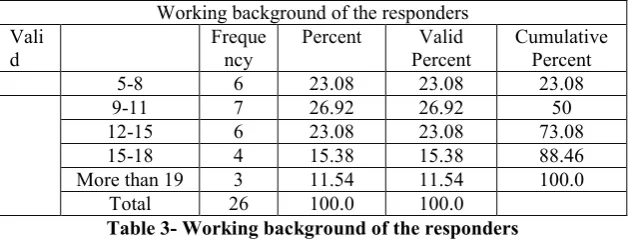
Table-3 shows working background of the responders. According to table 3, from the precedence point of view about 30 percent of responders have 5-8. 31 percent 9-11 years, 20 percent 12-15 years, 14 percent 15-18 years experience in working and finally 5 percent have more than 19 years of working experience which is shown in table3.
Working background of the responders Vali
d
Freque ncy
Percent Valid Percent
Cumulative Percent
5-8 6 23.08 23.08 23.08
9-11 7 26.92 26.92 50
12-15 6 23.08 23.08 73.08
15-18 4 15.38 15.38 88.46
More than 19 3 11.54 11.54 100.0
Total 26 100.0 100.0
Table 3- Working background of the responders
4.2 Data Analysis
The results obtained from survey and testing the research hypothesis have come in the Table 4 and the details explain after it.
R r t H 52.27 0.753 5.13 1 26 0.51 2.9 1--1 18.15 0.426 2.31 1--2 22.47 0.474 2.65 1--3 18.31 0.428 2.33 1--4 24.21 0.492 2.8 1--5 21.62 0.478 2.58 1--6 16.16 0.358 2.16 1--7 23.23 0.482 2.7 1--8
Table 4- r and t-test Results
H1.There is a relationship between worker multiple intelligences and their productivity in Moghan's Cultural Institutions
variance of productivity of Moghan's Cultural Institution workers. This means that 52.27percent of variation in productivity of Moghan's Cultural Institution workers is dependent upon independent variable.
We can say that, there is a relationship between workers multiple intelligences and their productivity in Moghan's Cultural Institutions
H1-1.There is a relationship between worker musical intelligences and their productivity in Moghan's Cultural Institutions
This hypothesis is measured by four questions which is blending of four first questions (1-4) relating to musical intelligence and 12 questions relating to productivity of Moghan's Cultural Institutions. According to obtained t (2.9) from testing the sub-hypothesis which is bigger than the critical point of t-table in fault ability level α=0/05, so with reliability level of 95 percent we can be said the sub-hypothesis is approved, and we can say that musical intelligence of Moghan's Cultural Institutions are affecting in productivity and according to obtained determination quotient, musical intelligence variable of workers explains 26 percent of dependent variable variance of productivity of Cultural Institutions workers in Moghan. This means that 26 percent of variation in productivity of Moghan's Cultural Institutions workers is dependent upon musical intelligence.
H1-2.There is a relationship between worker bodily intelligences and their productivity in Moghan's Cultural Institutions
This hypothesis is measured by four questions which is blending of four second questions (5-8) relating to bodily intelligence and 12 questions relating to productivity of Moghan's Cultural Institutions. According to obtained t (2.31) from testing the sub-hypothesis which is bigger than the critical point of t-table in fault ability level α=0/05, so with reliability level of 95 percent we can be said the sub-hypothesis is approved, and we can say that bodily intelligence of Cultural Institutions workers in Moghan is affecting in productivity and according to obtained determination quotient, bodily intelligence variable of workers explains 18.15 percent of dependent variable variance of productivity of Cultural Institutions workers in Moghan. This means that 18.15 percent of variation in productivity of Moghan's Cultural Institutions workersis dependent upon bodily intelligence.
H1-3.There is a relationship between worker Logical intelligences and their productivity in Moghan's Cultural Institutions
This hypothesis is measured by four questions which is blending of four second questions (9-12) relating to Logical intelligence and 12 questions relating to productivity of Moghan's Cultural Institutions. According to obtained t (2.65) from testing the sub-hypothesis which is bigger than the critical point of t-table in fault ability level α=0/05, so with reliability level of 95 percent we can be said the sub-hypothesis is approved, and we can say that Logical intelligence of Cultural Institutions workers in Moghan is affecting in productivity and according to obtained determination quotient, Logical intelligence variable of workers explains 22.47percent of dependent variable variance of productivity of Cultural Institutions workers in Moghan. This means that 22.47percent of variation in productivity of Moghan's Cultural Institutions workers is dependent upon Logical intelligence.
H1-4.There is a relationship between worker spatial intelligences and their productivity in Moghan's Cultural Institutions
This hypothesis is measured by four questions which is blending of four second questions (13-16) relating to Spatial intelligence and 12 questions relating to productivity of Moghan's Cultural Institutions. According to obtained t (2.33) from testing the sub-hypothesis which is bigger than the critical point of t-table in fault ability level α=0/05, so with reliability level of 95 percent we can be said the sub-hypothesis is approved, and we can say that Spatial intelligence of Cultural Institutions workers in Moghan is affecting in productivity and according to obtained determination quotient, Spatial intelligence variable of workers explains 18.31percent of dependent variable variance of productivity of Cultural Institutions workers in Moghan. This means that 18.31percent of variation in productivity of Moghan's Cultural Institutions workersis dependent upon Spatial intelligence.
H1-5.There is a relationship between worker Linguistic intelligences and their productivity in Moghan's
Cultural Institutions
obtained t (2.8) from testing the sub-hypothesis which is bigger than the critical point of t-table in fault ability level α=0/05, so with reliability level of 95 percent we can be said the sub-hypothesis is approved, and we can say that Linguistic intelligence of Cultural Institutions workers in Moghan is affecting in productivity and according to obtained determination quotient, Linguistic intelligence variable of workers explains 24.21percent of dependent variable variance of productivity of Cultural Institutions workers in Moghan. This means that 24.21percent of variation in productivity of Moghan's Cultural Institutions workers is dependent upon Linguistic intelligence.
H1-6.There is a relationship between Interpersonal intelligences worker and their productivity in Moghan's Cultural Institutions
This hypothesis is measured by four questions which is blending of four second questions (21-24) relating to Interpersonal intelligence and 12 questions relating to productivity of Moghan's Cultural Institutions. According to obtained t (2.58) from testing the sub-hypothesis which is bigger than the critical point of t-table in fault ability level α=0/05, so with reliability level of 95 percent we can be said the sub-hypothesis is approved, and we can say that Interpersonal intelligence of Moghan's Cultural Institutions workers is affecting in productivity and according to obtained determination quotient, Interpersonal intelligence variable of workers explains 21.62 percent of dependent variable variance of productivity of Cultural Institutions workers in Moghan. This means that 21.62 percent of variation in productivity of Moghan's Cultural Institutions workers is dependent upon Interpersonal intelligence.
H1-7.There is a relationship between worker Intrapersonal intelligences and their productivity in Moghan's Cultural Institutions
This hypothesis is measured by four questions which is blending of four second questions (25-28) relating to Intrapersonal intelligence and 12 questions relating to productivity of Moghan's Cultural Institutions. According to obtained t (2.16) from testing the sub-hypothesis which is bigger than the critical point of t-table in fault ability level α=0/05, so with reliability level of 95 percent we can be said the sub-hypothesis is approved, and we can say that Intrapersonal intelligence of Cultural Institutions workers in Moghan is affecting in productivity and according to obtained determination quotient, Intrapersonal intelligence variable of workers explains 16.16 percent of dependent variable variance of productivity of Cultural Institutions workers in Moghan. This means that 16.16 percent of variation in productivity of Moghan's Cultural Institutions workers is dependent upon Intrapersonal intelligence.
H1-8.There is a relationship between worker Naturalist intelligences and their productivity in Moghan's Cultural Institutions
This hypothesis is measured by four questions which is blending of four second questions (29-32) relating to Naturalist intelligence and 12 questions relating to productivity of Moghan's Cultural Institutions. According to obtained t (2.7) from testing the sub-hypothesis which is bigger than the critical point of t-table in fault ability level α=0/05, so with reliability level of 95 percent we can be said the sub-hypothesis is approved, and we can say that Naturalist intelligence of Cultural Institutions workers in Moghan is affecting in productivity and according to obtained determination quotient, Naturalist intelligence variable of workers explains 23.23 percent of dependent variable variance of productivity of Cultural Institutions workers in Moghan. This means that 23.23 percent of variation in productivity of Moghan's Cultural Institutions workers is dependent upon Naturalist intelligence.
RESOURCES
1. Gardner, Howard. Frames of Mind: The Theory of Multiple Intelligences. New York: Basic,1983 2. Gardner, Howard. Intelligence Reframed: Multiple Intelligences for the 21st Century. New York:
Basic, 2000.
3. Armstrong, Thomas. Multiple Intelligences in the Classroom 3rd ed. Alexandria, VA: Association for Supervision and Curriculum Development, 2009.
4. Armstrong, Thomas. 7 Kinds of Smart: Identifying and Developing Your Many Intelligences. New York: Plume, 1999.
5. Armstrong, Thomas. In Their Own Way: Discovering and Encouraging Your Child's Personal Learning Style, New York: Tarcher/Putnam, 1987.
7. Saari, S. 2006, Productivity, Theory and Measurement in Business, Productivity Handbook (In Finnish),MIDO OY. pp. 272
8. Saari, S. (2006),"Productivity, Theory and Measurement in Business" (PDF, Espoo, Finland: European Productivity Conference.
9. OECD, 2002, Manual: Measuring Productivity; Measurement of Aggregate and Industry-Level Productivity Growth.
10. Lane.C.(2008). The Distance Learning Technology Resource Guide, Multiple Intelligences. 11. Wikipedia (2011). http://en..org/wiki/Cultural_institutions#cite_ref-0
12. Hinders D.(2003-2011). Worker Productivity. Edited By: O. Wallace. Copyright Protected: Conjecture Corporation
13. Adnan et al (2007). Manufacturing In Britain: A Survey Of Factors Affecting Growth & Performance, ISR/Google Books, revised 3rd edition. 2007, page 58.
14. Lotz, A. (2010). The Television Will Be Revolutionized.
15. Britannica.(2010). Cultural and institutions. Encyclopædia Britannica.
http://www.britannica.com/EBchecked/topic/293359/Iran/230071/Cultural-institutions