Optimization of the Machining Performance During Hard Turning of AISI 4340
Steel Under Different Cutting Environments Using Taguchi-Grey Approach
Sanjeev Kumar
1, Dilbag Singh
2and Nirmal Singh Kalsi
31Research Scholar, Ph.D., I.K.G. Punjab Technical University, Jalandhar, Punjab, India.
2Department of Mechanical Engineering, Beant College of Engineering and Technology, Gurdaspur, Punjab, India. 3Department of Mechanical Engineering, Beant College of Engineering and Technology, Gurdaspur, Punjab, India.
Article Received: 14 July 2017 Article Accepted: 29 July 2017 Article Published: 01 August 2017
1.INTRODUCTION
Hard turning finds a broad range of applications in automobile, bearing, and tool and dies industries. One of the prime challenges during hard turning process is the high heat generation at the cutting zone due to high friction at tool-workpiece and chip-tool interfaces. It causes earlier tool wear which leads to deteriorating the surface quality of the finished goods. In the metal cutting industries, the cutting fluids are commonly employed to lessen the friction at tool-chip and tool-workpiece interfaces. The cutting fluids improve the surface quality, tool life, dimensional accuracy and shearing mechanisms [1]. Apart from the benefits, the cutting fluids have lots of harmful effects. Most of the cutting fluids used during the machining process contain hazardous chemical constituents. These cutting fluids are often produced airborne mist on the shop floor cause the air pollution and can affect the operator’s health. In addition, the cutting fluids are very difficult to dispose of and costly to recycle [2]. Since the adverse effects are related to the use of cutting fluids and inflexible environmental legislations, numerous studies have been conducted to decreasing the utilization of cutting fluids [1–4]. The use of minimum quantity lubrication (MQL) can be alternate to flooded cooling. In MQL the small amount of cutting fluids along with compressed air is supplied to the cutting zone [5]. Many researchers have investigated the performance of providing minimum quantity lubrication during machining. Dhar et al. reported that tool wear and surface roughness are decreased with MQL during the machining of AISI 4340 steel [6]. Choudhury et al. examined that cutting forces are reduced from 5 % to 20% by the use of MQL supply during the machining [7]. Kumar and Ramamurthy reported the machining performance during MQL supply is depends on nozzle pressure, the number of pulses, and the amount of fluid in every pulse [8]. Khan et al. reported that surface quality and tool life are improved during turning of AISI
9310 steel with vegetable oil based MQL supply based. It is due to decreased in cutting temperature [9]. Ekinovic et al. investigated that cutting forces are reduced to 16% with MQL based machining of Aluminium bronze. The reduction in cutting forces leads to less power consumption [10]. Naigade et al. observed superior surface quality during MQL based hard turning of AISI 4340 steel. The results indicate that cutting forces are highly influenced by the depth of cut [11]. Lawal et al. reported that tool wear and thrust force are reduced during vegetable oil based MQL assisted machining of AISI 9310 steel [12]. Kumar et al. investigated that surface quality is improved by 7 % to 10 % with MQL assisted hard turning when compared to flooded coolants [13].
Although, many predictive models and optimization studies were available for MQL assisted hard turning. However, the cutting speed, feed rate and environmental conditions (dry, wet and MQL) are relevant parameters during hard turning and very few optimization studies were available using Taguchi-Grey analysis. Therefore, in this study, the performance of MQL assisted hard turning of AISI 4340 steel regarding cutting force and temperature are analyzed. The comparison of the outcomes is made with dry and wet conditions of machining. Further, ANOVA for cutting force and temperature are carried out to study the significance of the process parameters. Finally, an optimum cutting condition which gives low values of chip-tool interface temperature and cutting force are suggested.
2. EXPERIMENTAL DETAILS
In this study, the heat-treatable AISI 4340 steel is chosen as workpiece material. AISI 4340 steel has a broad range of applications in manufacturing sectors such as aerospace, automobile and general engineering industries. For the experimentations, the 65 mm diameter and 350 mm length of the workpiece is selected to maintain the L/D ratio not more A B S T R A C T
Environmental conditions play a significant role in deciding the performance of hard turning. As during hard turning the high heat is generated at the cutting zone, it causes earlier tool wear which leads to decrease the machining performance. Traditionally the heat generation is controlled by using cutting fluids. But due to strict environmental regulations, their applications in the manufacturing industries become restricted. The use of a minimum quantity of cutting fluids (MQL) during machining is an alternative to wet conditions. Therefore, an effort has been made in this research work to investigate the machining performance under different of cutting environments (dry, wet and MQL). The cutting speed and feed rate are selected as process parameters during experimentations. The cutting force and chip-tool interface temperature are chosen as performance parameters. The experimental work has been carried out by using orthogonal array form Taguchi approach. The grey relational technique is used to optimize the process parameters. The results indicate that superior machining performance was obtained with the minimum quantity of lubrication.
than ten as per ISO 3685 standards 1993 [14]. The chemical composition of AISI 4340 steel is given in Table 1. Before machining the workpiece materials are heat-treated (through-hardened) to attain the hardness 45±2 HRC. The hardness was measured at three locations by Rockwell hardness tester. The average of three hardness values was taken. The cutting tool inserts material chosen for this study is grade K5625 having 65% CBN content having nose radius 1.2 mm with ISO geometry SNGA 431S0425MT of Kennametal. The inserts were mounted on an MSSNR2525M12 (ISO) tool holder. The water soluble based cutting fluid was used during experimentations.
Table 1. Chemical composition of AISI 4340 steel Element
s % C Mn Si S P Cr Ni Mo
0 .4 2 0 .5 8 0 .2 7 0 .0 2 4 0 .0 2 6 1 .0 6 1 .4 7 0 .2 2
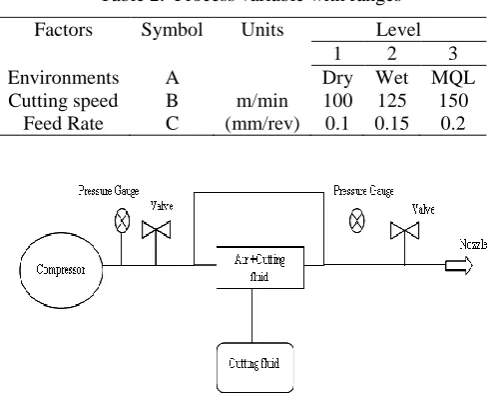
Several parameters influence the performance of hard turning. The main relevant parameters are the cutting conditions, cutting tool materials and cutting tool geometry. Therefore, in this research work, cutting speed and feed rate is selected as input variables. The levels of the input variables are selected based on the previous research papers and machining data handbook. The dry, wet and MQL are chosen as environmental conditions. The cutting force and temperature are selected as the performance parameters. The process variables with their ranges are given in Table 2.
Table 2. Process variable with ranges
Figure 1: Line diagram of set-up for providing minimum quantity of lubrication
The high rigidity of machine tool is the prime requirement for hard turning process. Therefore, highly rigid HMT made lathe is selected for experimentations. The main component of cutting force generated on tool point in the hard turning was recorded online using a high-precision lathe tool dynamometer (Make DKM 2010 of TeLC, Germany, software XKM 2000). The measurement system built with strain gauge sensors with minimal deflection, range 2000N, resolution 1 N, data acquisition rate adjustable 5 – 100 SPS. The cutting temperature was measured by using IR
thermometer (make: HTC-IRX-66, range -30oC to 1550oC and an optical resolution of 30:1).
For supplying the minimum quantity of cutting fluid during machining the set-up is designed as represented by line diagram as shown in Fig. (1) The setup is designed for supplying the cutting fluid at a flow rate of 100 ml– 200 ml/hr.
3.DESIGN OF EXPERIMENTS
3.1 Taguchi’s design of experiments
The Taguchi technique from the design of experiments was selected to optimize the process parameters. Taguchi method is a valuable tool for developing the high-quality system. Taguchi uses of orthogonal arrays to conduct small, fractional factorial experiments equal to larger, full factorial experiment [15]. The L9 orthogonal array was chosen for
performing the experimentations. The design matrix as per L9
orthogonal array is shown in Table 3.
Table 3a. Orthogonal array L9
3.2 Grey relational analysis
The hard turning process is very complicated than traditional turning process due to the several process variables involved. The grey relational analysis (GRA) provides a solution to multi-objective problems. The GRA is useful to find the optimal setting of different process variables by relating the entire range of performance parameter values into a single value [16]. The initial step in GRA is to convert the performance of all alternatives into a similarity arrangement between [0, 1], this act is known as normalization. The next step is to define the reference (ideal) order and the calculation of grey relational coefficient (GRC) among actual sequence and ideal sequence. After, then grey relational grade (GRD) is computed between the ideal sequence and every comparability sequences from GRC. The highest GRD is the best choice. For larger-the-better condition, the actual series (experimental results) is normalized by using Eq. (1); ) ( min ) ( max ) ( min ) ( )
( xi k xi k
k xi k
xi k
yi (1)
Where, xi(k) is the actual series, yi(k) series after normalization, max xi(k) and min xi(k) indicate the highest and lowest value of xi(k). For smaller-the-better condition, the actual series is normalized by applying Eq. (2);
) ( min ) ( max ) ( ) ( max ) ( k xi k xi k xi k xi k yi
(2)
Factors Symbol Units Level
1 2 3
Environments A Dry Wet MQL
Cutting speed B m/min 100 125 150
Feed Rate C (mm/rev) 0.1 0.15 0.2
Run No.
Environments Cutting speed
Feed rate
1 Dry 100 0.1
2 Dry 125 0.15
3 Dry 150 0.2
4 wet 100 0.15
5 wet 125 0.2
6 wet 150 0.1
7 MQL 100 0.2
8 MQL 125 0.1
After the normalization of data then grey relational coefficient (GRC) is calculated. The GRC is indicating the correlation among actual and ideal normalized values. The ideal sequence is represented by yo(k) and it is taken as 1. The GRC is calculated from the ideal sequence yo(k) and the actual sequence yi(k). GRC show the correlation between ideal and actual sequence. The larger the GRC closer the yi(k) and yo(k) are. The GRC is calculated by using Eq. (3),
max max min
i
ij (3)In above Eq. (3), ζi is represented the coefficient of grey relational between yi(k) and yo(k); ∆ij=│yo(k) – yi(k)│ deviation sequences; Δmin = minimum from Δi(k); Δmax = maximum from Δi(k); δ is the distinctive coefficient, δ ϵ [0,1]. The role of the distinctive coefficient is to increase or decrease the range of the GRC. The range of distinctive coefficient δ is chosen between [0,1]. Usually, δ =0.5 is used because it offers reasonable distinctive outcome and constancy [17]. The next step after calculating the GRC is to calculate the Grey relational grade (GRD) by using following Eq. (4),
n
k
n i k
i
1
1
( )
(4)In Eq. (4), 𝛶i is the GRD between yij and yoj. The GRD designate the degree of resemblance between the actual and the ideal series. The higher value of GRD indicates that corresponding cutting parameter is closer to optimal. In other words, optimization of the complex multi responses problems is transformed into optimization of a single GRD. The values of GRD are fallen within [0, 1].
4. RESULTS AND DISCUSSION
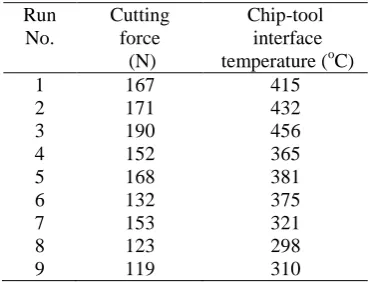
In this research work the performance of hard turning was analyzed under different environmental conditions (dry, wet and MQL). The cutting speed and feed rate are chosen as process variables. The Taguchi design approach was used to perform the experiments. The cutting force and chip-tool interface are to analyze the machining performance. The experimental outcomes are represented given in Table 3.
Table 3b. Machining results for each run
The grey relational model is prepared from the results obtained. The experimental data first converted between (0,1), this is known as normalization. Normalization of chip-tool interface temperature and cutting force is carried
out by using Eq.(2). The normalized data is represented in Table 4. The next step is to calculate the grey relational coefficient (GRC) from the normalized data. The estimated value of GRC shows the correlation between the ideal and actual (experimental) data.
The Eq. (3) is used to derive the GRC. The calculated GRC is represented in Table 5. Then the last step is to calculate the grey relational grade (GRD). For the calculation of GRD, the significance of all performance characteristics was assumed to be equal. The weights of the two performance characteristics were all the same (1/2). The GRD can be calculated by using Eq. (4). The calculated GRD for each run is given in Table (5). Based on the calculated GRD the rank is prepared to recognize the excellent input arrangement. It is observed that run no 8 has highest GRD of 0.948. Higher GRD signifies the input parameters corresponding to run no 8 provide superior performance.
Table 4 . Linear normalization of the responses
Table 5. Grey relational coefficient and grade Run
No.
Grey relational coefficient
Grey relational
grade
Rank
Cutting Force
(N)
Temperature (oC)
1. 0.424 0.402 0.413 7
2. 0.405 0.370 0.387 8
3. 0.333 0.333 0.333 9
4. 0.518 0.540 0.529 5
5. 0.419 0.487 0.453 6
6. 0.730 0.506 0.618 4
7. 0.510 0.773 0.641 3
8. 0.897 1 0.948 1
9. 1 0.868 0.934 2
To analyze the significance of the process parameters, the analysis of variance (ANOVA) was performed. The ANOVA for Grey relational grade (GRD) represented in Table 6.
The ANOVA for grey relational grade (GRD) shows the percentage contribution of each factor. From the ANOVA table, it has been observed that cutting environments is the primary important factor which influences the machining performance. From the grey relational grade, response table is generated to identify the optimum combinations of the parameters. The response for a grey relational grade is given in Table 7.
Run No.
Cutting force
(N)
Chip-tool interface temperature (oC)
1 167 415
2 171 432
3 190 456
4 152 365
5 168 381
6 132 375
7 153 321
8 123 298
9 119 310
Run No.
Cutting force
(N)
Chip-tool Interface temperature (oC)
1 0.323 0.259
2 0.267 0.151
3 0 0
4 0.535 0.575
5 0.309 0.474
6 0.816 0.512
7 0.521 0.854
8 0.943 1
Table 6. Analysis of Variance for Means for GRD
Table 7. Response table for Grey reasoning grade
Level A B C
1 0.3777 0.5277 0.6597
2 0.5333 0.5960 0.6167
3 0.8410 0.6283 0.4757
Delta 0.4633 0.1007 0.1840
Rank 1 3 2
The optimal levels of the input parameters which maximize the machining performance are MQL as cutting environment with 150 m/min of cutting speed and with 0.1 mm/rev of feed rate during the hard turning. Main effects plot for means of GRD is shown in Fig 2. It has been observed from the plot that high cutting speed with low feed rate and MQL as cutting environment maximize the grey relational grades which in turn maximize the machining performance.
Figure 2: Main effects plot for mean of GRD
5. PREDICTION AND VALIDATION OF THE OPTIMUM RESULT
After selecting the optimal level of a process variable, the next step is to predict the machining performance using optimal level of the process variable. A verification test is carried out to analyze performance. The outcome of the grey relational analysis is utilized to validate the experiment results. The Eq.(5) used to estimate the predicted mean (μpredicted) of GRD using optimum level of process variables.
predicted A3mB3mC1m3mean (5)
Where A3m, B3m, and C1m are the mean of the optimal level of the process variables and μmean is the total mean of GRD. At optimal level of input variables, the μpredicted = 0.961. The validation of the test is carried out at same experimental setup. The experimental value of GFRD at optimal values of parameters = 0.923. Therefore, the optimal values of process
parameters are 150 m/min cutting speed, 0.1 mm/rev of feed rate and minimum quantity of cutting fluid. The low values of cutting force and chip-tool interface temperature are obtained at optimal process parameters.
6. CONCLUSION
In this research work, the tests are performed to analyze the effects of cutting environments on machining performance during hard turning of AISI 4340 steel. The Taguchi based grey relational technique is selected for optimization of the process variables. The optimized results indicate that superior machining performance was obtained with high cutting speed, low feed rate and with a minimum quantity of cutting fluids supplied as cutting environments.
ACKNOWLEDGEMENT
The authors are highly thankful to I.K.G. Punjab Technical University, Kapurthala for continuous technical support in this research work.
REFERENCES
[1] Taylor, Frederick Winslow. Scientific management. Routledge, 2004.
[2] Tawakoli, T., M. J. Hadad, M. H. Sadeghi, A. Daneshi, S. Stöckert, and A. Rasifard. "An experimental investigation of the effects of workpiece and grinding parameters on minimum quantity lubrication—MQL grinding." International Journal of Machine Tools and Manufacture 49, no. 12 (2009): 924-932.
[3] Aronson, Robert B. "why dry machining-a few manufacturers are scrambling to get rid of coolant as environmental fines begin to hurt, but it’s still hardly common practice." Manufacturing Engineering 114, no. 1 (1995): 33-36.
[4] Klocke, F. A. E. G., and G. Eisenblätter. "Dry cutting." CIRP Annals-Manufacturing Technology 46, no. 2 (1997): 519-526.
[5] Sreejith, P. S., and B. K. A. Ngoi. "Dry machining: machining of the future." Journal of materials processing technology 101, no. 1 (2000): 287-291.
[6] Dhar, Nikhil Ranjan, Sumaiya Islam, and Mohammad Kamruzzaman. "Effect of minimum quantity lubrication (MQL) on tool wear, surface roughness and dimensional deviation in turning AISI-4340 steel." Gazi University Journal of Science 20, no. 2 (2007): 23-32.
[7] Choudhury, S. M. A., N. R. Dhar, and M. M. A. Bepari. "Effect of minimum quantity lubricant on temperature chip and cutting force in turning medium carbon steel." In Proceedings of the international conference on mechanical engineering 2007 (ICME2007), pp. 1-5. 2007.
[8] Kumar, CH R. Vikram, and B. Ramamoorthy. "Performance of coated tools during hard turning under minimum fluid application." Journal of Materials Processing Technology 185, no. 1 (2007): 210-216.
Source df SS MS Fcal P
% Contrib
ution
A 2 0.333 0.166 59.20 0.017 81.21
B 2 0.015 0.007 2.81 0.262 3.65
C 2 0.055 0.027 9.81 0.092 13.41
Residual
error 2 0.005 0.002 1.21
[9] Khan, M. M. A., M. A. H. Mithu, and Nikhil Ranjan Dhar. "Effects of minimum quantity lubrication on turning AISI 9310 alloy steel using vegetable oil-based cutting fluid." Journal of materials processing Technology 209, no. 15 (2009): 5573-5583.
[10] Ekinovic, S., H. Prcanovic, and E. Begovic. "Investigation of influence of MQL machining parameters on cutting forces during MQL turning of carbon steel St52-3." Procedia Engineering 132 (2015): 608-614.
[11] Naigade, Deepak M., Deepakkumar H. Patil, and Mudigonda Sadaiah. "Some investigations in hard turning of AISI 4340 alloy steel in different cutting environments by CBN insert." International Journal of Machining and Machinability of Materials 14, no. 2 (2013): 165-193.
[12] Lawal, Sunday Albert, Imtiaz Ahmed Choudhury, and Yusoff Nukman. "A critical assessment of lubrication techniques in machining processes: a case for minimum quantity lubrication using vegetable oil-based lubricant." Journal of Cleaner Production 41 (2013): 210-221.
[13] Kumar, Sanjeev, Dilbag Singh, and Nirmal S. Kalsi. "Analysis of Surface Roughness during Machining of Hardened AISI 4340 Steel using Minimum Quantity lubrication." Materials Today: Proceedings 4, no. 2 (2017): 3627-3635.
[14] Standard, I. S. "O, Tool Life Testing with Single-Point Turning Tools." ISO/DIS8688 (1986).
[15] Ross, Phillip J. Phillip J. Taguchi techniques for quality engineering: loss function, orthogonal experiments, parameter and tolerance design. 1996.
[16] Park, Hong-Seok, Trung-Thanh Nguyen, and Xuan-Phuong Dang. "Multi-objective optimization of turning process of hardened material for energy efficiency." International Journal of Precision Engineering and Manufacturing, Vol 17, no. 12 (2016): 1623-1631.