*Corresponding author:Dr. R. Rajab Ali
PHARMACEUTICAL RESEARCH
ISSN: 2395-6429, Impact Factor: 4.656
Available Online at www.journalcmpr.com
Volume 5; Issue 05(A); May 2019; Page No. 4169-4173
DOI: http://dx.doi.org/10.24327/23956429.ijcmpr201905648
Research Article
EVALUATION OF KINETIC FRICTION IN MONOCRYSTALLINE CERAMIC, POLYCRYSTALLINE
CERAMIC AND COMPOSITE BRACKETS IN DRY AND WET FIELD
Dr. R. Rajab Ali
1, Dr. A. Nandakumar
2, Dr. Pradeep Babu Kommai
3and Dr. Roshan Eliyas
41,4
Department of Orthodontics Dentofacial & Orthopeadics, Sri Venkateshwaraa Dental College, Puducherry
2
Department of Orthodontics Dentofacial & Orthopeadics, Meenakshi Ammal Dental
College & Hospital, Chennai, Tamil Nadu
3
Department of Orthodontics Dentofacial & Orthopeadics, Narayana Dental
College & Hospital, Nellore, Andhra Pradesh
ARTICLE INFO ABSTRACT
Introduction: Friction and sliding mechanics results in a reduced delivery of force in the orthodontics
appliance system. As the demand for esthetic brackets is on the rise, kinetic friction of these brackets needs to be taken into consideration. The resistance to orthodontic movement within the appliance system has been challenge since the inception of orthodontics.
Aim& objectives: The purpose of the study was to evaluate the kinetic frictional resistance generated
by esthetic brackets (Monocrystalline ceramic brackets, polycrystalline ceramic brackets and composite brackets) using a 0.019”x0.025” SS straight length wire in a 0.022” slot in a simulated sliding movement.
Methodology: This study was performed with 3 different types of brackets of MBT discipline. Group
1: Monocrystalline ceramic (Illusion, JJ orthodontics),Group 2: Polycrystalline ceramic (Clear, JJ orthodontics) and, Group 3: Composite brackets (Oro, JJ orthodontics). Samples size of each group n=48. Four mandibular central incisor brackets with 00 tip and -60 torque was used, in 0.022” X 0.030” slot Pre adjusted edgewise appliance. Brackets were bonded to an acrylic sheet. The brackets and wire units were submitted to frictional test with Instron machine (No-3382). This test was done in both dry and wet condition. Artificial saliva was used to stimulate oral condition. The lower cross head was design to hold the acrylic fixture, and upper cross head was holding the wire. Each sample was pulled at the speed of 2mm per minute. Student T test and Two-way ANOVA were applied and results tabulated.
Results: In both dry and wet condition composite brackets expressed a statically significant higher
frictional value with respect to monocrystalline and polycrystalline brackets. Polycrystalline ceramic brackets showed least frictional resistance. Monocrystalline ceramic brackets showed intermittent frictional value.
Conclusion: The polycrystalline ceramic brackets showed least friction among the 3 groups followed
by monocrystalline ceramic and composite Brackets.
Copyright © 2019 Dr. R. Rajab Ali et al. This is an open access article distributed under the Creative Commons Attribution License, which permits unrestricted
use, distribution, and reproduction in any medium, provided the original work is properly cited.
INTRODUCTION
Friction is the force that acts on the surface between two objects when one object slides relative to the other. Importance of friction in orthodontics was first observed by stoner in 1960.He stated that recognition must always be given to the fact that because of appliance design, applied force is lost to friction and it is difficult to control and determine the amount of force that is being received by the individual tooth. Friction occurs at the bracket and arch wire interface.1Though static and kinetic friction are observed the latter is more pertinent in tooth movement.
In contemporary orthodontics, the utilization of sliding mechanics for retraction and space consolidation have brought
the study of friction to the fore.2 Minimizing the frictional force that opposes the initiation and maintenance of the tooth movement, will provide a more efficient and reproducible mechanical system. Ideally the clinician should be alert as to which characteristics of the appliance contributes to friction and individually to what degree. There is an amount of force lost in the active element (brackets) at the point of delivery to the tooth.3
Several variables exist that can be directly or indirectly contribute to frictional force level between the bracket and the wire.4The rise in demand for esthetic treatment have shown an increased use of plastic and ceramics brackets.5,6 Kinetic friction of these brackets differ from there stainless steel counterparts. The clinician should be wary of this difference.
Article History:
Received 6th February, 2019 Received in revised form 15th March, 2019
Accepted 12th April, 2019 Published online 28th May, 2019
Key words:
Tooth color brackets have become the go-to material of choice, and many are available on the market.7The influence of bracket material on friction cannot be overstated as it is the primary means of force delivery to the tooth. The study included assessment of monocrystalline ceramic, polycrystalline ceramic and composite brackets.8,9 Since sliding mechanics is commonly employed kinetic friction was assessed.
The purpose of the study was to evaluate the kinetic frictional resistance generated by esthetic brackets (MCB, PCB, CB) using a 0.019”x0.025” SS straight length wire in a 0.022” slot and to find out effective sliding movement during retraction in a dry field and wet field.
MATERIALS AND METHODS
The study was undertaken as an, invitro study in Indira Gandhi Institution of dental sciences, which was completed over a period of 24 months and 10 days in the years 2013 - 2015. A sample size of 144 was used for this study. The sample was divided into 3 groups based on the type of bracket used. Each group was further divided into two sub groups of wet and dry fields.
Lower anterior brackets were used to ensure adequate fixation on the template (acrylic),which were directly supplied by the manufacturer. The arch wire chosen is routinely used in retraction stage of treatment. The brackets and arch wire were visually checked for imperfection prior to fixation. No ethical clearance was required, but the study was cleared by the Institution Review Board.
In the study PAE brackets (lower anterior 00- Tip, -6- Torque) of 022” slot size (MBT) were used. The three types of brackets were Monocrystalline ceramic brackets (Illusion, J.J) [fig-1(a)], Polycrystalline ceramic brackets (clear, J.J) [fig-1(b)], Composite brackets (Oro, J.J) [fig-1(c)]. Total sample size was 144, which were divided into 3 groups based on brackets materials. Each of 48 brackets were further divided into 2 sub-groups for dry and wet field.
Stainless steel straight length rectangular wire of 0.019”x 0.025” was ligated using 0.009 ligature wire (HP). Artificial saliva of Shelly’s formula of pH 6.8 was used. the saliva contains Ammonium Chloride233mg/lt, Calcium Chloride Dihydrate 210 mg/lt, Magnesium Chloride hexa hydrate 43 mg/lt, Potassium Chloride 1163mg/lt, Potassium Dihydrogen orthophosphate 354mg/lt, Potassium Thiocyanate 222 mg/lt,Sodium Citrate 13mg/lt, Sodium Hydrogen Carbonate 535 mg/lt, Disodium hydrogen Orthophosphate 375mg/lt.12 In the evaluation of the kinetic friction between archwire and brackets was measured by moving the arch wire at increment of 2 mm over the distance of 10 mm. The friction value measure was tabulated according to bracket materials.
Acrylic sheetsof different colours were used (20cmx5cm), in which lower anterior brackets were mounted, using cyanoacrylate adhesive, in a straight line (using vertical and horizontal markings) in which the bracket has 00 Tip, and -60 Torque. Each template consisted of 4 brackets at a separation of 10 mm to simulate position in the oral cavity. The brackets were cleansed using 95% ethanol prior to attachment.0.019”x 0.025 straight length Stainless steel rectangular archwire was placed in a bracket slot and using 0.009 ligature wireindividual ligation was done on the bracket.13,14,15
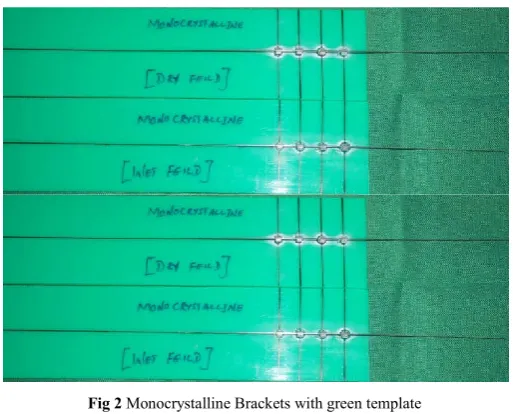
A.Green Template: Monocrystalline ceramic brackets [fig-2].
B.Red Template: Polycrystalline ceramic brackets [fig-3]. C.Blue Template: Composite Brackets [fig-4]
The acrylic sheets with the brackets and stainless steel wire, were mounted on the Instron machine to evaluate the frictional force. Instron machine (Universal testing machine 3382) consists of upper and lower jaw, in which lower jaw was fixed, whereas the upper jaw was freely movable in a vertical axis. The template was placed in the Instron machine, to which lower jaw was holding the template and upper jaw was holding the straight length stainless steel wire.
The templates were placed in the Instron testing machine with 1 kilo Newton force, and the wire was moved in a verticaldirection (upper jaw), and the kinetic friction reading wasrecorded for every 2 mm of movement.16 The groups were further subdivided into-
GROUP A1 Dry field, GROUP A2 Wet field,
GROUP B1 Dry field, GROUP B2 Wet field,
GROUP C1 Dry field, GROUP C2 Wet field,
Each group consists of 12 templates of which 6 templates were examined for friction in dry field, another 6 templates were examined for friction in wet field using artificial saliva.17 The entire fixture was immersed in container containing artificial saliva for 2 min to replicate the oral environment, and these templates were placed in the Instron machine, and frictional force measured.
The data obtained was entered and analysed using SPSS software version 20.0(SPSS Inc., Chicago, Il, USA). Statistical analysis was performed using a Student T test and 2-way ANOVA. T test was used to find the differences in the mean and standard deviation between the groups. The level of significance was established at <0.005. ANOVA was used to determine the subject variation between the groups.
RESULT
The composite brackets (Group-C) showed the highest frictional force value with statistically significant (p .005) followed in decreasing order by the Group-A (Monocrystalline) and Group-B (polycrystalline) with the least frictional values.
The result of the study showed decreasing amount of friction, which is observed in the wet field (Group- A1, B1, C1) compared to the dry field (A2, B2, C2) for all the 3 groups of esthetic brackets. Ceramic brackets (Group-A, B) were producing less amount of friction than compared to composite brackets in both wet and dry field.
Group-B (polycrystalline Brackets) had the least amount of frictional resistances when compared to Group A (Monocrystalline Brackets) and Group B (composite brackets).
Group-A (Monocrystalline Brackets) had the less frictional resistance when compared to Group-C (composite brackets). But when compared Group-B increased in frictional values were observed.
Fig 1 Monocrystalline ceramic, Polycrystalline ceramic and Composite brackets
Fig 2 Monocrystalline Brackets with green template
Fig 3 Polycrystalline Brackets with red Template
Fig 4 Composite Brackets with blue Template
Table 1 GROUP-A1&A2 - Monocrystalline Ceramic (Dry & Wet Field)
Table 2 GROUP-B1 & B2 - Polycrystalline Ceramic (Dry& Wet Field)
Table 3 GROUP-C1 &C2 - Composite Brackets (Dry&Wet Field)
Distance of wire traveled
2mm
DRY WET
4mm
DRY WET
6mm
DRY WET
8mm
DRY WET
10mm
DRY WET
Template 1 9.27N 4.11N 9.16N 4.06N 8.80N 3.93N 8.70N 3.83N 8.73N 3.84N
Template 2 9.02N 4.14N 9.02N 4.10N 8.94N 4.02N 8.88N 3.98N 8.70N 3.92N
Template 3 9.32N 4.10N 9.22N 4.05N 9.11N 3.95N 9.04N 3.90N 8.93N 3.86N
Template 4 9.02N 4.34N 8.94N 4.38N 8.92N 4.19N 8.70N 4.22N 8.63N 4.12N
Template 5 9.00N 4.11N 9.12N 4.09N 9.28N 4.02N 8.84N 3.96N 8.90N 3.88N
Template 6 8.28N 4.09N 8.45N 4.02N 8.70N 4.00N 8.74N 3.91N 9.00N 3.85N
Table 4 Frictional Force
Field Mean N Std.
Deviation Minimum Maximum
GROUP-A
GROUP-A1 4.4783 6 .35437 3.98 4.76
GROUP-A2 2.8300 6 .11747 2.67 2.99
Total 3.6542 12 .89686 2.67 4.76
GROUP-B
GROUP-B1 3.6317 6 .65441 2.77 4.46
GROUP-B2 1.7493 6 .28612 1.45 2.13
Total 2.6905 12 1.09462 1.45 4.46
GROUP-C
GROUP-C1 8.9083 6 .16726 8.63 9.12
GROUP-C2 4.0300 6 .11171 3.95 4.25
Total 6.4692 12 2.55123 3.95 9.12
Total
GROUP-A1,B1,C1 4.4959 18 3.24806 1.45 9.12
GROUP-A2,B2,C2 4.0467 18 .54149 2.77 4.76
Total 4.2713 36 2.30620 1.45 9.12
Table 5 Dependent Variable: Frictional Force - Tests of Between-Subjects Effects (t test)
Source Type III Sum
of Squares DF
Mean
Square F Sig.
Corrected Model 182.700a 5 36.540 317.759 .000
Intercept 656.777 1 656.777 5711.466 .000
Brackets 92.525 2 46.262 402.307 .000
Field 1.816 1 1.816 15.794 .000
brackets * field 88.359 2 44.179 384.193 .000
Error 3.450 30 .115
Total 842.927 36
Corrected Total 186.150 35
DISCUSSION
Most fixed appliance techniques involve some degree of sliding between the brackets and the arch wire.18There is a loss in efficiency of the appliance as friction results in less force delivery to the tooth. One approach to this problem is to use “frictionless” mechanics, which avoid tooth movement along the arch wire as for as possible. Another approach is to use sliding mechanics but to design the appliance to reduce friction as in the Begg’s techniques. The widespread adoption of pre-adjusted edgewise system has increased interest in the use of sliding mechanics but in this technique encountering friction is inevitable.19,20,21 It is known that increased friction between the brackets and wire results in binding between the two. The tooth movement may be affected. The resistance of movement slows retraction of anterior teeth and may transmit excessive forces to posterior anchorage. Once force is applied the initial static friction must be surpassed to achieve tooth movement. Once the teeth begin to move dynamic friction occurs.
Several variables have been found to affect the levels of friction between the brackets and the wire. Some variables that affected the force of friction include the bracket materials, size of the slot, width of the bracket, placement of the bracket, and typed of arch wires used.22,23
To date austenitic stainless is the most suitable alloy for orthodontics brackets although these offer little in terms of esthetics.25 This has led to the introduction of ceramic brackets, superior esthetics are the only the advantage of the ceramic brackets and short comings include a tendency to fracture during treatment and debonding, enamel damage during debonding, high frictional resistance and enamel abrasion of the opposing teeth.26 Now ceramic brackets with metal slot have satisfied the frictional prospect and the esthetics simultaneously. This study sought to compare the frictional resistance between different ceramic brackets and composite brackets of similar slot size.
Ceramic materials used in dentistry include metal oxide element and non-metal elements. Glasses, precious stones, clays, and mixture of ceramic compounds are used. Newer more modern ceramics have different atomic structures, such as alumina or aluminium oxide. Alumina or aluminium oxide (A12O3) is a typical member of modern ceramics.6
Monocrystalline and polycrystalline alumni are harder than stainless steel. Enamel abrasive due to this hardness might occur if the teeth contact the ceramic bracket.27
It is observed that ceramic brackets fracture more easily than their stainless steel counterparts. Higher fracture toughness is seen in polycrystalline alumina when compared to monocrystalline alumina.6
Orthodontic movement can only be achieved once friction is overcome. A detail assessment of desired movement of each tooth and the force lost due to friction should be known. Knowledge of varies friction levels in different (materials is important) matching the patient’s malocclusion with the brackets system will go a long way in improving orthodontic efficiency. The mechanics involved in the treatment of the patients with esthetic concerns must reduce the loss of force due to dynamic friction. Minimizing the pitfalls of treatment due to (arch wire interference should be a priority.
The limitation of the study includes variation in dynamic friction with in the oral cavity based on bonding and ligation preferences of the operator. The study gives a prospective on what kind of force delivery the operator could expect when using the brackets used in the study.
Friction is a parameter that must be overcome when orthodontic movement is desired. To better control the desired movement of each tooth by applied force the frictional loss should be known. The innate advantages and disadvantages of different bracket materials must be known. It is always better to select an appliance suited to the patient’s malocclusion and the result to be achieved.
In this study, the polycrystalline ceramic brackets show acceptable frictional values so that we can consider this bracket when esthetics is a concern. Composite brackets can be used in cases of minimal force and treatment of short duration and for the patients having economic constraints. Lubrication via saliva reduces the overall friction and all the brackets showed reduced values in a wet field. The orthodontist who begins treatment with the end goals in mind may increase productivity and efficiency by implementing different systems into practice. Although, the advantages of the system may improve any treatment approach, the practice that uses predefined goals, specific treatment sequences and individual patient procedures and mechanics should be used.
CONCLUSION
This in vitro study was carried out to comparably evaluate the kinetic frictional resistance generated by monocrystalline, polycrystalline and composite brackets, with rectangular stainless steel wire under dry and wet condition. The results showed the kinetic frictional resistance of composite bracket is more than all other brackets in both wet and dry fields. The monocrystalline brackets have less friction when compared to composite brackets, and more friction than polycrystalline brackets. Polycrystalline brackets have less friction when compared to monocrystalline brackets and composite brackets.
References
1. Frank CA, Nikolai RJ. A comparative study of frictional resistance between orthodontics brackets and arch wire. Am J Ortho. 1980;593-609
2. P.S. Prashat, Nandan H, Meera. J Pharm Bioallied Sci. 2015 Aug; 7 (suppl 2): S334-S338.
3. Kusy RP, Whitly JQ. Friction between different wire- brackets configuration and materials. Semi OrtVaughod. 1997; 3:166-77
4. Vaughan JL, Duncanson MG, Jr, Nanda RS, Currier GF. Relative kinetic frictional forces between sintered stainless steel brackets and orthodontic wires. AJODO. 1995; 107:20-7.
5. Faltermeier A, Rosentritt M, Faltermeier R, Mussig D. Influence of fibre and filler reinforcement of plastic brackets: an in vitro study. Eur J Orthod. 2007; 29:304– 309.
6. Karamouzos A, Athanasiou AE, Papadopoulos MA. Clinical characteristics and properties of ceramic brackets: a comprehensive review. Am J Orthod Dentofacial Orthop. 1997;112(1):34-40.
7. Rosvall MD, Fields HW, Ziuchkovski J, Rosenstiel SF, Johnston WM. Attractiveness, acceptability, and value of orthodontic appliances. Am J Orthod Dentofacial Orthop. 2009; 135:276 e1–e12.
8. Swartz ML. Ceramic brackets. J
ClinOrthod 1988; 22: 82–8.
9. Kusy RP. Morphology of polycrystalline alumina brackets and its relationship to fracture toughness and strength. Angle Orthod 1988; 58:197–203.
10. Dreschers D, Bourauel C, Schumacher HA. Frictional force between brackets and arch wires. AJODO. 1989; 96:397-404.
11. Loftus BP, Artun J, Nicholls JI, Alonzo TA, Stoners JA. Evaluation of friction during tooth movement in various brackets- arch wire combination. AJODO. 1999; 116:336-45.
12. Ghom AG, Ghom A. Textbook of oral medicine, 3rd edition 2014.
13. Pallai AR, Gangadharan A, Shah A. Comparison of the frictional resistance between archwire and different brackets system:An in vitro study. J Pharm Bioallied Sic. 2014 Jul (suppl 1): S150-S155.
14. Keith O, John SP, Davis EH. The influence of the bracket material, ligation force and wear on frictional resistance of orthodontic brackets. Br J Orthod. 1993; 20:109-15
16. Dinesh SPS, Arun AV. An indigenously designed apparatus for measuring orthodontics force. JCDR. 2013;7; 11:2623-26.
17. Jithesh C, Venkatarmanan V. Comparative evaluation of nickel discharge from brackets in artificial saliva at different time interval. J Pharm Bioallied Sci. 2015; Aug; 7(suppl 2): S587- S593.
18. Woodside DG, Weiss L. Frictional characteristics of aesthetic brackets in sliding mechanics. Reviews and Abstracts. Am J Orthod & Dentofac Orthop. 1994; 105:319
19. Garner LD, Allai WW, Moore BK. A comparison of frictional forces during simulated canine retraction of a continuous edgewise archwire. Am J Orthod & Dentofac Orthop. 1986; 90:199-03.
20. Riley, J. L., Garrett, S. G., and Moon, P. C.: Frictional forces of ligated plastic and metal edgewise brackets, J. Dent. Res. 58: A21, 1979.
21. Andreasen GF, Quevado FR. Evaluation of frictional forces in the 0.022X0.028 Edgewise bracket in vitro. J Biomech, 1970; 3: 151-160 as quoted in Am J Orthod&Dentofac Orthop. 1989; 96: 397 – 04.
22. Saunders CR, Kusy RP. Surface topography and frictional characteristics of ceramic brackets. Am J Orthod&DentofacOrthop. 1994; 106:76 – 87.
23. Keith O, John SP, Davis EH. The influence of the bracket material, ligation force and wear on frictional resistance of orthodontic brackets. Br J Orthod. 1993; 20:109-15
24. Tselepis M, Brockhurst P, West VC. The dynamic frictional resistance between orthodontics brackets and arch wires. AJODO. 1994; 106: 131-8.
25. Downing A, McCabe JF, Gordon PH. The effect of artificial saliva on the frictional forces between orthodontic brackets and archwire. British Journal of Orthodontics 22: 41–46.
26. Holt MH, Nanda RS, Duncanson MG. Fracture resistance of ceramic brackets during arch wire torsion. American Journal of Orthodontics and Dentofacial Orthopedics 99:287 –293.
Jena AK, Duggal R. Physical Properties and Clinical Characteristics of Ceramic Brackets: A Comprehensive Review.Artif. Organ. JCO Vol20(2); PP101-115: 2007.
How to cite this article:
Dr. R. Rajab Ali et al (2019) ' Evaluation of Kinetic Friction in Monocrystalline Ceramic, Polycrystalline Ceramic and Composite Brackets in Dry and Wet Field', International Journal of Current Medical And Pharmaceutical Research,
05(05), pp 4169-4173.