Highly Energy Efficient and Scalable Distributed Clustering Procedure for Dense
Wireless Sensor Networks
R.Satheesh Kumar
1, N.Krishnaraj
2and G.Keerthana
31Associate Professor, Department of Computer Science and Engineering, Sahrdaya College of Engineering and Technology, Kerala, India.
2
Professor, Department of Computer Science and Engineering, SASI Institute of Technology and Engineering, Andhra Pradesh, India.
3
Fulltime Research Scholar, Anna University Chennai, Tamilnadu, India.
Article Received: 15 August 2017 Article Accepted: 30 November 2017 Article Published: 30 December 2017
1. INTRODUCTION
Wireless Sensor Networks (WSN) finds applicable in many real-world applications (figure 1) like military, target
tracking, environmental monitoring and civilian applications. A WSN can be generally styled as a network of nodes
that cooperatively sense and regulates the environment. The activity of sensing, processing and communication
under restricted amount of energy projects a need to pattern distributed mechanisms for data processing, MAC and
communication protocols. Generally, a wireless sensor node is powered by limited- powered battery. Much of the
energy consumption takes place during wireless communications.
On the other hand, data processing in WSN requires consuming tasks to be accomplished to avoid unnecessary
processing power. Energy efficiency can be accomplished at different levels starting from physical layer, MAC
layer and routing protocols up to the application level. The concerning protocols in WSNs can be classed into three
major categories: routing protocols, sleep/awake scheduling protocols and clustering protocols [1].
One prime method to attain energy efficiency is to efficiently group the sensor nodes into clusters. In order to trim
down the data transmission time and energy consumption, the sensor nodes are clustered into a number of small
groups called clusters. The grouping of sensor nodes is known as clustering. Each and every cluster has a leader
which is branded as cluster-head (CH). A CH is also one of the sensor nodes which are basically affluent in
resources. The CH is selected by the sensor nodes in the respective cluster.
The CH may also be pre-assigned by the user. The main advantages of clustering are that it transmits the aggregated
data to the sink or base station (BS), provides scalability for large number of nodes and diminishes the energy
consumption.
A B S T R A C T
Wireless sensor network (WSN) is a low-powered prestigious network fashioned by sensor nodes that treasures application in civilian, military, visual sense models and many others. Reduced energy utilization is an exigent task for these sensor networks. By the data aggregation procedure, needless communication between sensor nodes, cluster head and the base station is eluded. An evaluation of energy efficient optical low energy adaptive clustering hierarchy has been performed and the enactments have been compared with the prevailing low energy adaptive clustering hierarchy algorithm, between two detached wireless sensor network fields. The proposed clustering procedure has been primarily implemented to join two distinct wireless sensor fields. An optical fiber is used to join two reserved wireless sensor fields. This distributed clustering methodology chiefly targets in exploiting the parameters like network lifetime, throughput and energy efficiency of the whole wireless sensor system.
Figure 1: Application of WSN for environmental monitoring.
Clustering may be centralized or distributed, based on the planning of CH. In centralized clustering, the CH is fixed
but in distributed clustering CH has no fixed architecture. Distributed clustering mechanism is used for some
exclusive reasons like sensor nodes prone to failure, better collection of data and minimizing redundant information
[2]. Hence these distributed clustering mechanisms have highly self-organizing capability. The rest of this paper
has been prearranged as follows. The existing clustering methodologies have been discussed in section II. Section
III gives the conceptual description and review of a well-distributed clustering algorithm, the optical low energy
adaptive clustering hierarchy (O-LEACH). Simulation results have been briefed in section IV. Section V concludes
the paper and gives few ideas for an improvement over the existing algorithm.
2.EXISTING CLUSTERING METHODOLOGIES
Massive research efforts have been taken to lessen the energy consumption and to prolong the lifetime of WSNs.
The algorithms described here are utterly distributed and CH changes from node to node based on some criteria.
They diverge in the methodology by which the CH is elected. Algorithm for Cluster Establishment (ACE) [3] is a
highly uniform clustering, self-organizing, effectual coverage, lesser overlapping and emergent cluster forming
algorithm for WSNs. This is scale-independent and converges in time proportional to the deployment density of the
nodes regardless of the overall number of nodes in the network. ACE requires no understanding of geographic
location and requires only petite amount of communication overhead [4-6].
In a distributed clustering algorithm, the nodes make autonomous decisions. In Hausdroff Clustering (HC), once
cluster formations take place it remains unchanged throughout the network lifetime. Moreover, to evenly use the
energy among all the nodes, CH is rotated among the cluster members. This algorithm expands the lifetime of each
cluster in order to increase the life time of the wireless sensor system. CH selection is essentially based on residual
energy of the sensor nodes. Clustering methods have reduced the running down of energy in WSNs.
Ring-structured Energy-efficient Clustering Architecture (RECA) uses deterministic CH management pattern to
wide range of networks settings.
Low Energy Adaptive Clustering Hierarchy (LEACH) is a clustering mechanism that distributes energy
consumption all along its network; the network is broken down into clusters. The CHs which are purely distributed
in manner and the randomly elected CHs, gathers the information from the nodes which are coming under its
cluster. It forms clusters based on the received signal strength and uses the CH nodes as routers to the BS. LEACH
also forms one-hop intra and inter cluster topology where each node can transmit directly to the CH and thereafter
to the BS. Consequently, it is irrelevant to networks deployed in wider regions. In the case of Two-Level Low
Energy Adaptive Clustering Hierarchy (TL-LEACH), the CH collects data from other cluster members as original
LEACH, but rather than transferring data to the BS directly, it uses one of the CHs that lie between the CH and the
BS as a relay station. The primary CH in each cluster communicates with the secondaries, and the secondaries
communicate with the nodes in their sub-cluster. Data fusion is also tasked as in LEACH. The two-level structure
of TL-LEACH reduces the number of nodes, which need to transmit data to the BS, effectively lowering the total
energy usage.
CLUBS is an algorithm that forms clusters through local broadcast and converge in a time proportional to the local
density of nodes. CLUBS can be implemented in asynchronous environment without losing efficiency and
simplicity. Furthermore, CLUBS satisfies many constraints that are common in other distributed environment such
as limited topology knowledge or access to global IDs. The major problem of CLUBS algorithm is the clusters
having their CHs within 1-hop range of each other. If this is the case, both clusters will collapse and CH election
process will restart. Multi-hop Overlapping Clustering Algorithm (MOCA) is a randomized, distributed multi-hop
overlapping clustering algorithm for organizing the sensors into overlapping clusters. The aspiration of the
clustering process is to ensure that each node is either a CH or within the cluster radius from at least one CH. The
CH nomination probability is used to control the number of clusters in the network and the degree of overlap amid
them.
In Threshold sensitive Energy Efficient Network (TEEN), at every cluster change time, in addition to the attributes,
the CH broadcasts to its members. This scheme is eminently suited for time critical data sensing applications. A
smaller value of the threshold gives a more accurate picture of the network, at the expense of improved energy
consumption. Thus, the user can govern the trade-off between energy efficiency and accuracy. The decentralized
technique, Fast Local Clustering Service (FLOC) is suitable for clustering large-scale wireless sensor networks. It
is fast, scalable, produces non-overlapping and approximately equal-sized clusters. This algorithm achieves
locality, in that each node is only affected by the nodes within two units. Distributed Weight-based Energy-efficient
Hierarchical Clustering (DWEHC) is a well distributed clustering algorithm which spawns well balanced clusters.
The high-ranking advantage of DWEHC is that, it shows a vast improvement in both intra-cluster energy
In O-LEACH algorithm, the infrastructure of a sensor network is composed of a distributed optical fiber sensor
(DFS) link and two separated WSN fields. The two WSN fields are crowded with randomly deployed nodes and
these nodes can or cannot communicate with each other depending on the required applications. Unlike simple
WSNs, since the DFS provide data processing, at one end of the DFS link, the sink or the BS for all WSN nodes is
located. The CH node compress data arriving from nodes that belong to the relevant cluster, and sends the fused
data to the BS in order to further reduce the amount of information to be transmitted to the BS. After a given
interval of time, to maximize the uniformity of energy consumption of the network, randomized rotation of the role
of CH is conducted. Sensors elect themselves to be local CHs at any time with a certain probability. The O-LEACH
algorithm is only a fairly incremental modification to the original LEACH algorithm. Though O-LEACH protocol
is comparatively much more energy efficient, the focal drawback in this approach is the random selection of CHs.
In the worst case, the CH nodes may not be evenly distributed among the nodes and it will have its effect on the data
gathering. Hybrid Energy Efficient Distributed Clustering (HEED) is a distributed clustering algorithm which
selects the CH based on both residual energy and communication cost. Principally HEED was proposed to avoid
the random selection of CHs.
3.THE OPTICAL LEACH CLUSTERING METHODOLOGY
In O-LEACH algorithm, the construction of the sensor network encompasses of a distributed fiber sensor link and
two detached wireless sensor network fields. Figure 1, displays the disposition of sensor nodes in the two fields.
The Distributed Fiber Sensor (DFS) link is positioned at the center of the sensor fields and can cover a certain area.
The two WSN fields are occupied with randomly scattered nodes and these nodes can or cannot communicate with
each other liable on the required applications. Since the DFS offer data processing, at one end of the DFS link, the
base station for all the sensor nodes is situated.
Although the lifetime of the DFS may have to be deliberated as well, the lifetime of such a sensor network is largely
determined by the WSN. It consequences that the clustering based algorithm still displays good energy efficiency in
the sensor network, particularly when two WSNs are not accessible to each other. As the DFS shelter extended
rectangular area, O-LEACH algorithm is used to examine the lifetime of the hybrid sensor network with
rectangular topology by isolating and connecting a series of WSNs around the DFS.
The CH nodes aggregates the arriving data from the nodes that fit to the suitable cluster and propel the aggregated
packet to the base station in order to furthermore trim down the amount of data that must be forwarded to the base
station, thereby augmenting the system lifetime. Succeeding to a given interval of time, to adjust the uniformity of
energy dissipation of the network, randomized rotation of the concern of cluster head is carried out. Sensors elect
operation is likewise separated into two phases, and the steady phase is as same as LEACH.
During the setup phase, the selection of cluster head follows the analogous criteria as LEACH, but there are two
major alterations between O-LEACH and LEACH: (i) Nodes in WSNs cannot be deployed in the DFS coverage
area and (ii) The cluster head and the node must be within the same WSN field if two WSNs cannot communicate
with each other.
For most applications, it is superior to assume that the two WSN fields are isolated due to the following reasons: (i)
Lengthier data transfer distance over the DFS terrain ends with advanced energy consumption and (ii) Wireless
communication over the DFS area is not even permitted for some applications.
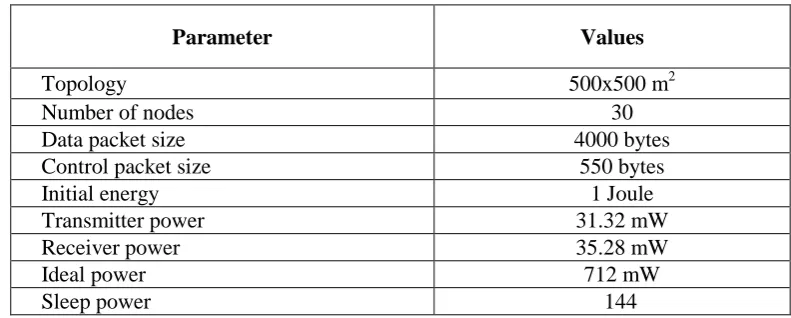
Table 1: Simulation Parameter Setup
Parameter Values
Topology 500x500 m2
Number of nodes 30
Data packet size 4000 bytes
Control packet size 550 bytes
Initial energy 1 Joule
Transmitter power 31.32 mW
Receiver power 35.28 mW
Ideal power 712 mW
Sleep power 144
4. SIMULATION RESULTS
The O-LEACH algorithm has been simulated using the network simulator (NS-2). Table 1, displays the necessary
simulation parameter setup. In O-LEACH, the base station is expected to be situated at the center of the left edge of
the two wireless sensor fields. The network energy dissipation is absolutely a arithmetical behaviour due to the
random distribution of WSN nodes. As the DFS is absolutely active, the lifetime of the DFS is not deliberated.
Figure 2, demonstrates the network performance in terms of the percentage lifetime of O-LEACH and LEACH.
Initially in 100 rounds, the percentage lifetime is 90 for both the algorithms. In 500 rounds, the percentage lifetimes
of O-LEACH and LEACH are 72 and 53 respectively. Similarly in 3000 rounds, the percentage lifetimes of
O-LEACH and LEACH are 14 and 1 respectively.
The percentage lifetime is found to be linearly increased in O-LEACH, when compared to LEACH. This is because
of the usage of DFS link for connecting the sensor fields, which greatly reduces the losses while routing the packets
to the base station. It is to be noted that in most practical applications, the DFS coverage is very specific and cannot
Table 2: Percentage lifetime for LEACH and O-LEACH
Number of Rounds 100 500 1000 1500 2000 2500 3000
% L
if
et
im
e
LEA CH
90 53 40 20 4 2 1
O
-LE
ACH 90 72 62 43 24 20 14
Figure 2: Percentage Lifetime versus Number of Rounds
Figure 3: Throughput versus Number of Rounds (O-LEACH and LEACH) 0
20 40 60 80 100
0 500 1000 1500 2000 2500 3000
%
L
if
et
im
e
Number of Rounds
LEACH O-LEACH
0 20 40 60 80 100
0 500 1000 1500 2000 2500 3000
%
T
hro
ug
hp
ut
Number of Rounds
Table 3: Percentage throughput for LEACH and O-LEACH
Number of Rounds 100 500 1000 1500 2000 2500 3000
% T
hrough
pu
t
LEA CH 27 22 20 36 33 30 24
O
-LEA CH 32 30 26 38 40 36 37
Figure 3, shows the performance evaluation of throughput and number of rounds for the two algorithms. Initially in
100 rounds, for O-LEACH and LEACH, the percentage of throughput is 32 and 27 respectively. Similarly in 3000
rounds, the throughput is 37 and 24 for O-LEACH and LEACH respectively. This slight increase in throughput in
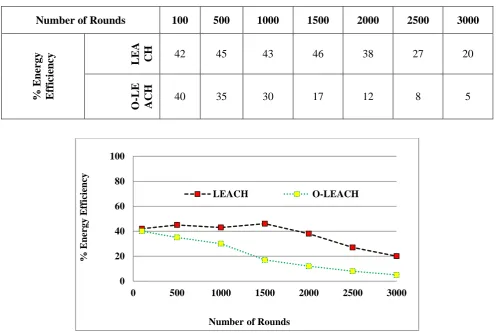
O-LEACH is mainly due the usage of DFS link for data packet transmission to the base station. Figure 4, shows the
energy efficiency comparison of the two algorithms. After 100 rounds, the energy efficiency is found to be
improved linearly in O-LEACH when compared to LEACH, for every successive rounds. This clearly indicates
that, O-LEACH is efficient mainly when two wireless sensor networks have to be connected together.
Table 4: Energy Efficiency for LEACH and O-LEACH
Number of Rounds 100 500 1000 1500 2000 2500 3000
% E
nergy
E
ff
ici
en
cy LEA CH 42 45 43 46 38 27 20
O
-LE
ACH 40 35 30 17 12 8 5
Figure 1: Energy efficiency versus Number of Rounds (O-LEACH and LEACH) 0
20 40 60 80 100
0 500 1000 1500 2000 2500 3000
%
E
nerg
y
E
ff
iciency
Number of Rounds
5. CONCLUSION
Generally, a wireless sensor node is powered by limited- powered battery. Much of the energy consumption takes
place during wireless communications. On the other hand, data processing in WSN requires consuming tasks to be
accomplished to avoid unnecessary processing power. Energy efficiency can be accomplished at different levels
starting from physical layer, MAC layer and routing protocols up to the application level. Clustering is the most
significant issue for networks where resources are restricted. Thus, it is required to make use of the available energy
efficiently. There becomes a need in wireless sensor network to effectively group the sensor nodes in to clusters. In
this paper, a review of O-LEACH algorithm has been carried out and the performance evaluation has been done
against the existing LEACH algorithm, between two separate wireless sensor network fields. It could be clearly
seen that the performance of O-LEACH is comparatively better, thereby O-LEACH is efficient mainly when two
separate wireless sensor networks have to be connected together. The optical fiber links leads to various
disadvantages like: i) Scattering losses, it is not applicable to use the DFS link for efficient long haul
communications, ii) The changes in the light properties usually happen in the sensor, iii) Need for more expensive
optical transmitters and receivers, iv) More difficult and expensive to employ splices and v) Difficult to carry
electrical power to operate the terminal devices. These drawbacks could be overcome by changing the DFS link
with an alternate medium for communication and effectively connecting two separate wireless sensor fields.
REFERENCES
[1] Akyildiz, I, Su, W, Sankarasubramaniam, Y & Cayirci, E 2002, ‘A survey on sensor networks’, IEEE
Communications Magazine, vol. 40, no. 8, pp. 102-114.
[2] Ali, M, Voigt, T & Uzmi, ZA 2006, ‘Mobility management in sensor networks’, Proceedings of the 2nd
International Conference on Distributed Computing in Sensor Systems, pp. 131-140.
[3] Baranidharan, B & Shanthi, B 2010, ‘A survey on energy efficient protocols for wireless sensor networks’,
International Journal of Computer Applications, vol. 11, no. 10, pp. 0975-8887.
[4] Guo, L, Xie, Y, Yang, C & Jing, Z 2010, ‘Improvement on LEACH by combining adaptive cluster head election
and two-hop transmission’, Proceedings of the 9th International Conference on Machine Learning and Cybernetics,
pp. 11-14.
[5] Haitao, Z, Shiwei, Z & Wenshao, B 2014, ‘A clustering routing protocol for energy balance of wireless sensor
network based on simulated annealing and genetic algorithm’, International Journal of Hybrid Information
the IEEE International Conference on Intelligent Computing and Intelligent Systems, pp. 507-511.
AUTHOR BIOGRAPHIES
Satheesh Kumar R is an Associate Professor in Sahrdaya College of Engineering & Technology. He
received his Master’s degree in Information Technology and MBA degree in Information Systems.
He also received his PhD degree in Information and Communication Engineering. His research areas
are Cloud Computing, Natural Language Processing, Network Security, Data Mining, Web Mining, Text Mining
and Opinion Mining. E-mail: [email protected]
Krishnaraj N is a Professor in SASI Institute of Technology and Engineering, Andhra Pradesh, India.
He received his Master’s degree in Software Engineering and. He also received his PhD degree in
Computer Science and Engineering. His research areas are Image Processing, Network Security,
Cloud Computing, Data Mining, Text Mining and Opinion Mining. E-mail: [email protected]
Keerthana G is a Research Scholar in Anna University Chennai, Tamilnadu, India. She received her
Bachelor's degree in Electronics and Communication Engineering and Master's degree in Applied
Electronics. She is a Life Member in various Professional Bodies like IAENG, IRED, SDIWC. Her
research interest includes image processing, mobile wireless ad hoc networks (MANETs), Data