Available online at: www.ijcncs.org
E-ISSN 2308-9830 (Online) / ISSN 2410-0595 (Print)
Gossip-Based Energy Aware Routing Algorithm for Wireless
Sensor Network
S.pishyar1, A.Ghiasian2 and M.R.Khayyambashi3
1
Faculty of Computer Engineering, Najafabad Branch, Islamic Azad University, Isfahan, Iran
2
Assistant Professor, Faculty of Engineering, Shahrekord University, ShahreKord, Iran
3
Assistant Professor, Department of Computer Architecture, Faculty of Computer Engineering, University
of Isfahan, Isfahan, Iran
E-mail: [email protected], [email protected], [email protected]
ABSTRACT
Many advances have been made in wireless sensor networks (WSNs) which are as varied as the applications; and many more are in progress. There are some intrinsic limitations related to WSNs, including scarcity of energy supply, limited processing ability, and lack of processing memory. One of the important considerations of network designers is to devise protocols and algorithms in order to tackle with mentioned restrictions. Among different algorithm categories, routing protocols have direct impact on energy consumption and life time of the network. In this paper we propose three routing schemes based on the well-known Gossiping protocol. The proposed algorithms are evaluated in terms of different parameters by simulation tools. The achieved results of simulations show performance improvement of network operation in terms of network lifetime, delay and packet loss compared to Gossiping and FELGossiping algorithms.
Keywords:
Energy Consumption, Routing Algorithms, Network Lifetime, Wireless Sensor Network.
1 INTRODUCTION
Wireless sensor networks (WSN) consists of many tiny sensors which are usually used to collect local information such as pressure and temperature and send the gathered information to a base station (also known as sink). Sensor networks are deployed in several environments including military, medical and household applications. In all of those fields, energy consumption plays a significant role in the performance of WSN. The reason is that sensor nodes are equipped with a limited amount of power supply. In many applications, it's not a feasible task to replace the old empty battery with a new one. Consequently, various aspects of data delivery in WSN, including routing algorithms, should be energy aware. The requirements of routing protocols designed for environmental applications are different from those designed for military or healthcare applications in many aspects [1,2,3]. However, a common target of routing protocols in
WSN, regardless of the application, is to maximize the network lifetime and minimize the overall energy consumption.
improve-ment of the proposed algorithms compared to Gossiping and FELGossiping.
The remaining of the paper is organized as follows. In section 2, the system model is presented. In section 3, related works and problems are reviewed. The proposed algorithms are presented in section 4. In section 5, simulation results are presented and discussed. Finally we conclude the paper in section 6.
2 RADIO MODEL
To model the behavior of the sensor, we use a classic radio model in [6]. The model assumes that transmission and reception of packets consumes some amount of energy which is proportional to the packet length. The block diagram representation of the radio model is shown in fig. 1. The model consists of a pair of transmitter and receiver with distance “d” between them. Etx, Erx are the amount of energy consumption in processor and electronic part of transmitter and receiver respectively. Eamp is the amount of energy depletion in transmitter amplifier which is in relation to the type of propagation model, either free space or multipath. The parameter k in the model represents the size of packet in bits and parameter n is the path loss exponent. The value of n is 2 for free space and 4 for multipath propagation.
When a node transmits a packet, each bit in a packet consumes Etx amount of transmitter energy, and Eamp amount of amplifier energy. Then, a packet of length k consumes an overall energy of Et as shown in equation (1).
Fig. 1. radio model[6]
(1) Et = (k *Etx) + (k * Eamp * d
n
)
The receiver part of each node consumes Erx amount of energy per bit. Then the total volume of
energy depletion at the receiver can be calculated by equation (2).
(2) Er = (k *Erx)
3 RELATED ROUTING ALGORITHMS
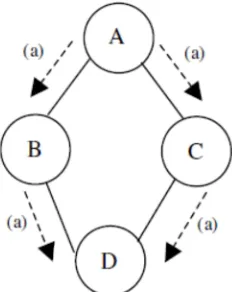
The simple and naïve routing method is flooding [7]. In flooding, each sensor receiving a data packet broadcasts it to all of its neighbors and this process continues until the packet arrives at the destination or the maximum number of hops for the packet is reached. Although flooding is very easy to implement, it has several drawbacks. We refer to Figures 2 and 3 which are adopted from [8]. Such drawbacks include implosion problem which is caused by duplicated messages sent to the same node and overlap problem which occurs when two nodes in the same region send similar packets to the same neighbor node. Obviously, flooding approach causes a large amount of energy wastage and because of energy limitation in wireless sensor network is not a good candidate for routing strategy.
Gossiping is an improved version of flooding where the receiving node sends the packet to a randomly selected neighbor, which picks another random neighbor to forward the packet to and so on [7]. Gossiping avoids the problem of implosion by just selecting a random node to send the packet rather than broadcasting. However, this can cause a large delay in propagation of data through the nodes. Meanwhile, blind selection of the forwarding neighbors would increase the possibility of packet loss.
Fig. 3. The overlap problem. Two sensors cover an overlapping geographic region and C gets the same copy of data form these sensors.
FLossiping Protocol: combines the approaches of both Flooding and Gossiping routing protocols. When a node has a packet to send, it chooses a threshold and saves it in the packet header, then randomly selects a neighbor to send the packet in Gossiping mode, while the other neighbor nodes listen to this packet and generate a random number. The neighbors whose randomly generated numbers are smaller than the threshold will broadcast the packet in Flooding mode. As a result, FLossiping improves the incurred problems of Flooding and the delay issue of Gossiping [9].
SGDF Protocol: Single Gossiping with Directional Flooding routing protocol is divided into two phases: Network Topology Initialization and Routing Scheme. In the first phase, each node generates a gradient that represents the number of hops to the sink. In the second phase, in order to deliver the packet, SGDF uses single gossiping and directional flooding routing schemes. As a result (see Figure 4), SGDF achieves a high packet delivery ratio, low message complexity, and short packet delay [10]. However, the undesirable side effect of this protocol is that the large amount of repetitive packets still exists due to directional flooding.
Fig. 4. Routing scenario in SGDF[10]
LGossiping Protocol: In Location based Gossiping protocol, it is assumed that each node knows its location as well as its neighbor locations (e.g., by GPS). When a node has an event to send, it randomly chooses a neighboring node within its transmission radius and towards the sink. Once the neighbor node receives this event, randomly chooses another node within its transmission radius and sends it in turn. This process will continue until the sink is reached. As a result, the delay problem has been solved to some extent. Figure.5 shows the main objective of LGossiping [11].
Fig. 5. Schematic of data routing in LGossiping[11]
Although by LGossiping, the delay problem of Gossiping has been solved to some extent, there is still the problem of many events not reaching to the sink. Moreover, this protocol uses GPS to determine the location of each node. Hence, it incurs additional hardware, which means extra expenses and more energy consumption.
ELGossiping Protocol: In Energy Location base Gossiping protocol, when a node detects an event and wants to send information, it selects a neighboring node within its transmission radius with the shortest distance to the sink (path with the minimum number of hops) and more remaining energy compared to other neighbors. Once the neighboring node receives the event, it will in turn select another neighboring node within its transmission radius and the shortest distance to the sink, and so on. As a result, the problems of latency and packet loss have been removed to some extent [12]. Figure 6 shows more details of this protocol.
to the base station. However, all the neighboring selection is done deterministically and without any randomness.
Fig. 6. Routing in ELGossiping[12]
FELGossiping protocolconsists of three phases: Initialization, Information Gathering and Routing[13]. In the first phase, each node generates the gradient to the sink. In the second phase, the FELGossiping sends a request message to the other nodes to receive the information of other members or neighboring nodes. Once the hop count and the remaining energy of the member nodes are known, FELGossiping chooses two neighbors which have shorter distance to the sink at the third phase. After selecting two candidate nodes with minimum number of hop count to the sink, the protocol needs to only choose one of them to send the packet. At this stage, the node with more residual energy is selected to forward the packet towards the sink. See Figure 7. This protocol, increases lifetime of the network and decreases average delay of the packets compared to other Gossiping based protocols. The issue of FELGossiping is that selection of the neighbor is based on remaining energy of the neighbor, while other nodes along the path towards the sink might suffer from energy starvation. Another drawback of the FELGossiping is that all the selections are deterministic. In some circumstances, randomness can help to enhance the performance of the routing protocols. In the next section we propose three new routing algorithms based on Gossiping technique and show that they would outperform Gossiping as well as
FELGossiping in terms of network life time, delay and packet loss.
Fig. 7. Routing in FELGossiping[13]
4 PROPOSED ALGORITHMS
In order to resolve the drawbacks of the Gossiping algorithm, three new algorithms are proposed as extensions to Gossiping.
4.1 Proposed Method-1
The new algorithm consists of three phases termed as, sending control packet phase, path selecting phase, and data packet sending phase. The main idea for increasing network life time is to select a path through which there are no critical energy state nodes. This section follows with the explanation of three parts of the algorithm.
A: Sending Control Packet Phase
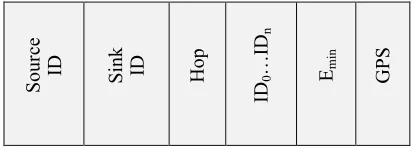
Sending control packet phase starts after the sensor nodes are randomly distributed in the application area. In the beginning, the base station creates a random number and broadcasts a “control packet” to its neighbors. The control packet includes the following information:
Hop: Hop count from the current node to the base sta-tion.
Emin:Energy of the node with the least amount of
energy along the path.
GPS:Geographical location.
ID0…IDn: Each sensor node generates control
packets and puts its ID and a sequence number in this packet as a source node and broadcasts this packet to its neighbor nodes.
Rand number: each node puts its Rand number in this packet and broadcasts this packet to its neighbor nodes. The Fig.8 shows the format of the control packet.
GPS
Emin
ID
0
…ID
n
Hop
Sink ID
Sour
ce
ID
Fig. 8. Control Packet Format.
After broadcasting the control packet, adjacent nodes are selected randomly and base station sends control packet to them. The following conditions must be met by the nodes in order to be able to forward the control packet:
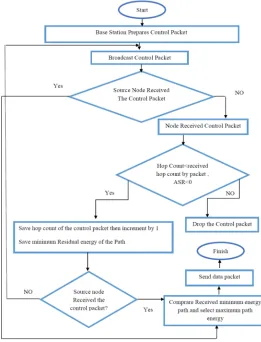
1. Each node saves the hop count in its memory and increases the hop count by 1. The new hop count is then replaced with the old one. After each node has received the control packet it will continue to broadcast this message to farther nodes. When a node receives a control packet it will compare its hop count value to the hop count of its own message. If the latter is smaller, it will add 1 to the hop count prior to broadcasting it. Otherwise, it will discard the message. This case occurs due to previously broadcasted messages through different routes. As a result, the shortest route is selected through control packet broadcasting phase.
Since using the flooding-based technique in the network makes it possible for the packets to travel far from the sink node, a hop field is used in the control packets to control this issue.
2. The geographical position of nodes (say node R) is defined according to equation (3). d(x,y) stands for the distance between nodes x and y. If this parameter is less than zero,
the node sends control packet. Otherwise, it will discard the message [14]. We note that in case sensor nodes are not equipped with GPS, hop count can be used instead of geographical distance.
ASR=d(S,D)-d(R,D) (3)
3. Along the path, the amount of nodes’ energy is compared with the energy contained in the control packet and the larger value is replaced with the smaller one. This approach is used to find the minimum amount of node's energy along the path, the value which will be used in path selection phase.
4. Each sensor node generates control packets and puts its ID in this packet as a source node and broadcasts this packet to its neighbor nodes. Here, the idea of the algorithm DSR is used in order to send the packet[15].
5. A random number is generated by the node
compared with the random number
contained in the packet and if it is more, node sends control packet. Otherwise, it will discard the message
In this section, the following assumption is adopted that if a node receives one control packet more than once, it would neglect the repetitive packets. This assumption prevents the creation of the loops in the network.
• B: Path Selecting Phase
In this phase, Source node waits for a certain amount of time to receive Control packets from different paths and finally selects the best path. The best path is the path that its minimum energy field is maximum compared to other paths. Indeed, source node compares received minimum energy fields from different paths and select the path with the largest minimum energy.
C: Sending Data Packet
4.2 Proposed Method-2
Similar to the proposed method-1, this algorithm is composed of three phases: sending control packet phase, path selecting phase, and sending data packet phase.
The difference is that the first stage of the route selecting is not random and control packet is broadcasted in Flooding method.
Other parts remain intact. Figure.9 shows proposed Method-2 in abstract.
4.3 Proposed Method-3
This algorithm is basically similar to the second algorithm except its second phase. Thus, the sink node propagates control packets and neighboring nodes transfer the packet until it reaches to the source node according to the conditions mentioned above. In this method the best path is defined as the path with maximum utility, where the utility of a
path is defined in equation (4). Indeed, in addition to the residual energy of the nodes, in this algorithm the number of hops between source and sink is also taken in to consideration. We observe that this modification improves the performance of
the algorithm significantly.
= ( ) (4)
5 SIMULATION AND EVALUATION
In this section the performance of proposed algorithms are compared to FELGossiping and Gossiping in terms of the number of live nodes, total network energy, packet delay and packet loss. We have used Opnet simulator while the parameters and values used in simulation are given in Table 1. The assumptions of the simulation is as follows:
1. Radius: the radius of coverage of the sensors is 40¬m.
2. All the nodes are static and are location aware. 3. Standard IEEE 802.11 MAC is used.
4. The maximum hop value is considered to be 12.
Table1: Simulation parameters
100 * 100 (m) Network Size
100 Number Of Nodes
0.1 j Initial Energy
50nj/bit ETX
100pj/bit/m2 ERX
50 bit k(Control packet)
400 bit k(Data packet)
40m Network's Radius
A. Network Lifetime
Calculating the number of live nodes in the network shows its lifetime, which is the time that the first node depletes all of its energy. Figure .10 illustrates network life time for all five algorithms. As it is presented in diagram, the proposed algorithms have increased network lifetime significantly compared to FELgossiping and Gossiping algorithms. The reason is that, we try to prohibit selection of low battery nodes in path selection. Among the proposed algorithms, method-3 outperforms other methods because in this method, number of hops is considered as well as residual energy of the nodes. This approach makes the algorithm more compelling.
Fig. 10. Amount of live nodes.
B. Energy Consumption
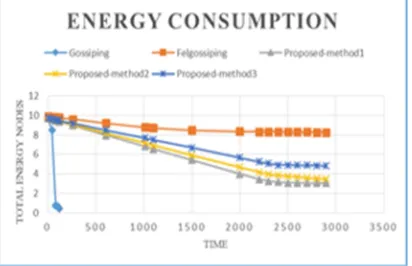
One of the most important parameters for optimization in wireless sensor networks is energy consumption of the nodes. To evaluate the energy consumption of nodes under proposed routing algorithms, the total energy consumption of the
nodes in the network is calculated during simulation time and shown in Figure.11. Note that the all proposed algorithms consume much energy in comparison to FELGossiping, while they achieve longer life time. The interesting result that may seems contradicting. However, these two figures (10 and 11) are indeed supporting a common fact that the necessity to increase network life time is to construct diverse paths from source towards sink during time. After a while that nodes along shorter paths deplete their energy, selection of longer paths is inevitable to prohibit battery depletion of specific nodes along short paths. Due to selection of longer paths, more energy is consumed. But despite consuming more energy than FELGossiping, since energy consumption in the network is distributed, the lifetime of the network as shown in Figure.10 has improved significantly.
Fig. 11. Energy Consumption
C. Delay
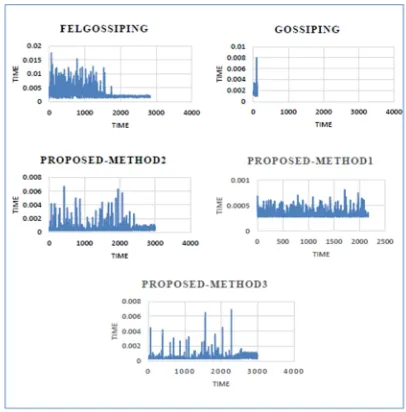
The delayed of a packet is defined as the time difference between data gathering in the source node and data deliver to the sink node. Figure.12, represents the delay of packets and shows better performance of the proposed algorithms in terms of
delay in comparison to Gossiping and
FELGossiping.
overall delay. The reason that our proposed algorithms consume less processing time is that implementation of the algorithm is done just once in the source node and the route is carried by the packet in its header. Thus, the intermediate nodes do not need to implement any specific algorithm and play only the role of a relay node. But in the FELGossiping method, in each node the algorithm must be executed and between the two neighbors, with fewer steps, the neighbor that has more energy should be selected. This has led to the increase of the processing delay of FELGossiping as its impact is shown by simulation in Figure.12.
Fig. 12. Delay
D. Packet Loss
The amount of packet loss, is equal to the difference between the number of data packets generated at the source, and the number of packets received at the destination. Figure.13 shows the amount of packet loss during simulation time. As it is observed, the number of lost packets in the proposed algorithms are fewer than FELGossiping and Gossiping. The main reason is larger number of dead nodes along the forwarding path in FELGossiping algorithm, the fact that is illustrated in Figure.10.
Fig. 13. Packet loss
6 CONCLUSION
In this article we reviewed the pros and cons of some Gossiping-based routing algorithms in wireless sensor network. To improve the performance of those algorithms, we proposed three new routing schemes which have many common characteristics but are slightly different in some features. In the proposed algorithms the attempt is to transfer data packets from the source to the destination by selecting the routes that do not include critical nodes with low energy.
The proposed algorithms have been evaluated in terms of different parameters by simulation tools. The achieved results of simulations showed performance improvement of network operation in terms of network lifetime, delay and packet loss compared to Gossiping and FELGossiping algorithms.
1)
9 REFERENCES
[1] Á. Lédeczi, A. Nádas, P. Völgyesi, G. Balogh, B. Kusy, J. Sallai, G. Pap, S. Dóra, K. Molnár, M. Maróti and G Simon, “Countersniper
System for Urban Warfare,” ACM
Transactions on Sensor Networks, Vol. 1, No. 2, 2005, pp. 153-177.
[3] S. Bandyopadhyay and E. Coyle, “An Energy Efficient Hierarchical Clustering Algorithm for Wireless Sensor Networks,” Proceedings of the 22nd Annual Joint Confer-ence of the IEEE Computer and Communications Societies (INFOCOM 2003), San Francisco, 30 March-3 April 2003, pp. 1713-1723.
[4] Y. Chen and Q. Zhao, “On the Lifetime of
Wireless Sen-sor Networks,” IEEE
Communications Letters, Vol. 9, No. 11, 2005, pp. 976-978.
[5] A. Norouzi and A. Sertbas, “An Integrated Survey in Efficient Energy Management for
WSN Using Architec-ture Approach,”
International Journal of Advanced Net-working and Applications, Vol. 3, No. 1, 2011, pp. 968- 977.
[6] W. Heinzelman, A. Chandrakasan, H.
Balakrishnan, “Energy-efficient
communication protocol for wireless sensor networks”, in: Proceeding of the Hawaii International Conference System Sciences, Hawaii, January 2000.
[7] S. Hedetniemi and A. Liestman, “A survey of gossiping and broadcasting in communication networks,” Networks, Vol. 18, No. 4, pp.319349, 1988.7.
[8] W. Heinzelman, J. Kulik, H. Balakrishnan,
Adaptive protocols for information
dissemination in wireless sensor networks, in: Proceedings of the 5th Annual ACM/IEEE
International Conference on Mobile
Computing and Networking (MobiCom_99), Seattle, WA, August 1999.
[9] Y. C. Zhang and L. Cheng, “Flossiping: A New Routing Protocol for Wireless Sensor Networks,” Proceedings of the 2004 IEEE International Conference on Networking, Sensing & Control Taipei, Taipei, March 21-23 2004, pp. 1218-1223.
[10]W. Yen, C.-W. Chen and C.-H. Yang, “Single Gossiping with Directional Flooding Routing Protocol in Wireless Sensor Networks,” 3rd IEEE Conference on Industrial Electronics and Applications, Taipei, 3-5 June 2008, pp. 1604-1609.
[11]S. Kheiri, M. B. Ghaznavi, G. M. Rafiee and B. Seyfe, “An Improved Gossiping Data Distribution Technique with Emphasis on Reliability and Resource Constraints,” IEEE
2009 International Conference on
Communications and Mobile Computing, Singapore, 6-8 January 2009, pp. 1604-1609. [12]A. Norouzi, M. Dabbaghian, A. Hatamizadeh
and B. B. Ustundag, “An Improved
ELGossiping Data Distribution Technique with
Emphasis on Reliability and Resource Constraints in Wireless Sensor Network,” 2010 Interna-tional Conference on Electronic
Computer Technology (ICECT), Kuala
Lumpur, 7-10 May 2010, pp. 179-183. [13]A. Norouzi, F. Babamir, A. H. Zaim, “ A
Novel Energy Efficient Routing Protocol in Wireless Sensor Networks,” October 2011. [14] Y. Liu, L.X. Cai, and X. Shen,
“Spectrum-Aware Opportunistic Routing in Multi-Hop Cognitive Radio Networks”, IEEE JOURNAL
ON SELECTED AREAS
COMMUNICATIONS, VOL. 30, NO. 10, NOVEMBER 2012.

![Fig. 6. Routing in ELGossiping[12]](https://thumb-us.123doks.com/thumbv2/123dok_us/1327465.1640918/4.612.324.519.127.324/fig-routing-in-elgossiping.webp)