Pre-service and Practicing Teachers’
Commitment to and Comfort with Social
Emotional Learning
Lauren D. Goegan, Amanda K. Wagner, Lia M. Daniels
University of AlbertaAlthough teachers’ beliefs about social-emotional learning have become a topic of interest, understanding how they relate to teachers’ own social-emotional competence is unknown. We used a predictive correlation design to examine how Canadian pre-service (n=138) and in-service (n=276) teachers’ beliefs about social-emotional competence relate to their comfort with and commitment to social-emotional learning, and how both sets of beliefs are related to their perceived efficacy for classroom management and engagement with students. Regression analyses revealed that comfort with social-emotional learning significantly predicted both outcomes for both groups whereas commitment to social-emotional learning did not. Perceived social-emotional competence also played an important role. Pre-service teachers felt more committed to social-emotional learning, whereas in-service teachers felt more comfortable and believed they had higher levels of social-emotional competence themselves. Implications for supporting the development of teachers’ own social-emotional competence and suggestions for future research are provided.
Si les croyances des enseignants relatives à l’apprentissage socio-affectif suscitent beaucoup d’intérêt, on ignore le lien entre celles-ci et la compétence socio-affective des enseignants eux-mêmes. Nous appuyant sur une conception de corrélations prédictives, nous avons examiné le lien entre les croyances des stagiaires (n=138) et des enseignants en exercice (n=276) relatives à la compétence socio-affective d’une part, et l’aise et l’engagement dont ils font preuve face à l’apprentissage socio-affectif, d’autre part. De plus, nous nous sommes penchés sur la mesure dans laquelle les croyances des participants sont liées à leur perception de l’efficacité de leur gestion de classe et de leur engagement avec les élèves. Des analyses de régression ont révélé qu’un sentiment d’aisance avec l’apprentissage socio-affectif prédit de manière significative les deux résultats pour les deux groupes alors que ce n’était pas le cas pour un engagement face à l’apprentissage socio-affectif. La perception de la compétence socio-affective a également joué un rôle important. Les stagiaires avaient un sentiment d’engagement plus fort envers l’apprentissage socio-affectif, tandis que les enseignants en exercice se sentaient plus à l’aise et croyaient que leur niveau de compétence socio-affective était plus élevé. Nous présentons quelques implications d’appuyer le développement de la compétence socio-affective des enseignants et des suggestions pour la recherche à l’avenir.
interpersonal interactions and experiences effectively” (Collie, Martin, & Frydenberg, 2017, p. 2). To help their students develop SEC, teachers are responsible for delivering social-emotional learning (SEL) either through specific programming or more subtly through everyday interactions (Durlak, Weissberg, Dymnicki, Taylor, & Schellinger, 2011; Humphrey et al., 2016; Jones, Bouffard & Weissbourd, 2013). SEL has been established as important for students’ achievement and wellbeing (Frydenberg, Martin, & Collie, 2017) and is rapidly emerging as important for teachers’ wellbeing as well (Collie, 2017).
As teachers become increasingly responsible for formal and informal development of students’ SEC through SEL programming, it becomes crucial to understand the role of teachers’ beliefs not only about SEL but also about their own SEC. In Alberta, the Canadian province in which this research was conducted, SEL is built into the program of studies for kindergarten through Grade 12 (Alberta Education, 2016a). Furthermore, data from nearly ten years ago suggests that according to a number of Alberta schools when students are taught SEL the school culture feels more safe and caring (Alberta Education Learning and Teaching Resources Branch, 2008). Despite the expectation for teachers to successfully implement SEL programming, the largest pre-service teacher education program has essentially no required instruction on SEL. This is true not only of Alberta but much of Canada, the United States, and Australia (Australian Institute for Teaching and School Leadership, 2015; Schonert-Reichl, Hanson-Peterson, & Hymel, 2015). Thus, although both in-service and pre-service teachers are professionally responsible for SEL programming, without formal training it may be that individuals with high SEC are at an advantage (Freeman & Strong, 2017). Addressing this possibility, our research examined the relationships among teachers’ beliefs about their own SEC, their comfort with and commitment to SEL, and two important cognitions related to effective teaching: self-efficacy for classroom management and engagement with students. Acknowledging that pre-service and in-service teachers often hold different beliefs (Azar, 2010; Damnjanovic, 1999; Daniels, Radil, & Goegan, 2017), we examined these relationships in separate samples of pre-service and in-service teachers.
Social and Emotional Competence
Alternatively, teachers with low SEC may be less likely to achieve these positive outcomes. Despite the premise that “successful implementation [of SEL] may depend on the teacher's SEC to create an environment that is conducive” (Jennings & Greenberg, 2009, p. 504), there has been surprisingly little research that empirically examines teachers’ beliefs about their own SEC1
and subsequent relationships with beliefs about SEL.
Beliefs about Social and Emotional Learning
Rather than focus on SEC, researchers have measured teachers’ beliefs about SEL arguing, as many have done before (e.g., Bandura, 2001; Fives & Gill, 2014; Pajares, 1992), that beliefs exert a strong influence on teachers’ behaviour. Three sets of teacher beliefs have been identified as particularly influential in shaping the effectiveness of SEL program implementation and thus have become the focus of much of the recent research with teachers: comfort with SEL, commitment to SEL, and culture of SEL (Brackett, Reyes, Rivers, Elbertson, & Salovey, 2012). Brackett et al. demonstrated that beliefs about comfort with SEL, or teachers’ confidence to implement SEL, were negatively correlated with teacher depersonalization and positively associated with feelings of personal accomplishment and efficacy. Commitment to SEL positively correlated with efficacy only. Finally, a culture of SEL, or the amount of institutional support for SEL programming, negatively correlated with emotional exhaustion and positively related with administrator support. Moreover, beliefs related to comfort and commitment were positively associated with more than half of the indicators of quality SEL program implementation.
Furthering the field’s understanding of these beliefs, Collie, Shapka, and Perry (2012) found that comfort with SEL positively predicted teachers’ sense of efficacy and negatively predicted their stress from students’ behaviour. In contrast, commitment to SEL positively predicted both stress from students’ behaviour and stress related to workload, but also positively predicted overall job satisfaction. In reconciling the different effects for comfort and commitment, Collie et al. suggest that teachers who are comfortable with SEL may have higher SEC themselves; however, this speculation has not yet been tested. More recently, Collie, Shapka, Perry, and Martin (2015) identified three profiles of teachers based on combinations of their beliefs about SEL. SEL-thrivers were characterized by high levels of comfort, commitment, and support for SEL. SEL-strivers were characterized by high commitment but low comfort and support. Finally, SEL-advocates were characterized by high commitment to and comfort with SEL but low levels of implementation support. The groups also differed on the amount of stress and job satisfaction they experienced: SEL-thrivers were least susceptible to stress and most satisfied.
Although the work on beliefs about SEL makes an important contribution, it does not take into account teachers’ beliefs about their own SEC. The current research seeks to expand the importance of teachers’ beliefs by considering both beliefs about SEL and SEC. We further examine these relationships in terms of two important teacher cognitions: sense of efficacy for classroom management and engagement with students. These two cognitions map onto Jennings and Greenberg’s (2009) notions of effective classroom management and healthy-student relationships, and therefore are theorized to be directly impacted by teachers’ beliefs about SEC and SEL.
Underpinning these actions is a teacher’s sense of efficacy, or his/her beliefs about being able to “bring about desired outcomes of student engagement and learning, even among those students who may be difficult or unmotivated” (Tschannen-Moran & Woolfolk Hoy, 2001, p. 783). A teacher’s sense of efficacy can have a powerful influence in the classroom (Tschannen-Moran, Woolfolk Hoy, & Hoy, 1998; Putman, 2012). For more than three decades research has been finding that efficacious teachers have a strong positive effect on student performance (Berman et al., 1977 as cited in Tschannen-Moran, Woolfolk Hoy, & Hoy, 1998; Dembo & Gibson, 1985; Nurlu, 2015; Shaughnessy, 2004; Woolfolk & Hoy, 1990). In addition, teachers who were more efficacious appear to implement what they learned from an in-service into their classroom activities (Smylie, 1988), report lower stress and greater personal wellbeing (Coladarci, 1992; Parkay et al., 1988 as cited in Tschannen-Moran, Woolfolk Hoy, & Hoy, 1998), are less likely to leave (Glickman & Tamashiro, 1982), and more committed to teaching (Coladarci, 1992). Sense of efficacy for classroom management specifically has been associated with higher levels of job satisfaction (Klassen & Chiu, 2011) as well as a number of important student outcomes including motivation and interest (Fauth, Decristan, Rieser, Klieme, & Büttner, 2014; Kunter, Baumert, & Köller, 2007).
Engagement with Students
Individuals are considered engaged in their work when they are willing to invest energy and be actively involved in the demands of their job (Christian, Garza, & Slaughter, 2011). Klassen, Yerdelen, and Durksen (2013) point out that teaching may be particularly unique in its demand for social engagement, or the necessity to invest energy to build and maintain relationships with both colleagues and students. Given that many teachers report choosing a career in teaching to meet the needs of students (Serow, Eaker, & Ciechalski, 1992; Su, 1993; Watt, et al., 2012), it should not be surprising that the quality of relationship between teachers and students consistently emerges as important for student and teacher outcomes (Butler, 2012; Klassen, Perry, & Frenzel, 2012). Indeed, Klassen et al. found across three separate studies that teachers’ levels of relatedness with their students was positively associated with engagement and positive emotions and negatively related to negative emotions. Moreover, teachers’ relationships with students were more influential than their feelings of relatedness with colleagues. From the students’ perspective, teachers with relational goals were perceived as more socially supportive and more mastery-focused in the classroom (Butler, 2012). For pre-service teachers, Durksen and Klassen (2012) determined that self-reported engagement with students followed a U-shape pattern over a nine-week practicum placement: The individuals were initially highly engaged, then dropped down, and eventually rebounded upwards finishing similar to initial levels.
Conceptual Framework and Hypotheses
pre-service and in-pre-service teachers have differed on other important beliefs such as teaching efficacy (Tschannen-Moran, Woolfolk Hoy, & Hoy, 1998) and achievement goals (Daniels, 2015). Therefore, it is possible that in a similar fashion SEC and SEL beliefs may differ between pre-service and in-pre-service teachers. The purpose of our research was to examine the relationship between teachers’ SEC and SEL beliefs and their efficacy for classroom management and perceived engagement with students in separate samples of pre-service and in-service teachers. We posed three research questions:
1. Do pre-service and in-service teachers differ in their beliefs about their own SEC, comfort with SEL, or commitment to SEL? We hypothesized that in-service teachers would have higher comfort with SEL and consider themselves more socially-emotionally competent than pre-service teachers, but pre-service teachers may have higher commitment to SEL
appropriate for those currently acquiring the knowledge and skills associated with the profession.
2. Are comfort with and commitment to SEL differently correlated based on one’s belief about their own social-emotional competence? We expected that beliefs about one’s own SEC would be significantly positively correlated with comfort with SEL but not correlated with commitment to SEL. This hypothesis was based on Collie et al.’s (2012) speculation that comfort may be related to one’s own level of competence but commitment to SEL may be compromised if social-emotional competences are perceived as lacking.
3. Do pre-service and in-service teachers’ beliefs about comfort with and commitment to SEL relate to their sense of efficacy for classroom management and sense of engagement with students after controlling for their SEC? We hypothesized that pre-service and in-service teachers’ comfort with SEL would positively predict their sense of efficacy for classroom management and engagement with students but commitment would not (Collie, Shapka, & Perry, 2012; Jennings & Greenberg, 2009).
Method
Pre-service and in-service teachers provided self-report data through an exploratory predictive correlational research design. This study was approved by the University’s Research Ethics Board.
Participants and Procedure
Goetz, 2015).
Participants ranged in age from 18 to 36 and were predominately females (83%). More participants were training to be secondary school teachers (53.8%) than elementary school teachers (41.5%) and eight did not indicate their level. Twenty-seven participants were in Year 1, 55 in Year 2, 22 in Year 3, 9 in Year 4, and 25 students were in the after-degree program. Participants represented a range of majors including generalists (n = 38), biology majors (n = 22), English, (n = 12), physical education (n = 11), and mathematics (n = 10).
In-service teachers. Data were collected from a convenience sample of in-service teachers (n = 276) who were attending a two-day mandatory teachers’ convention. Teachers who attended came from a number of primarily urban school districts drawing from both public and catholic school boards. Research assistants (RAs) approached teachers with a clipboard and asked that they complete a questionnaire requiring no more than 15 minutes on site. In addition to answering the items related to SEC/SEL, efficacy, and engagement relevant for this study, the survey included items measuring self-determination theory, boredom, mindsets, professional learning, and emotions, which are beyond the scope of the current research (Durksen, 2015). RAs offered participants information letters detailing the purpose of the study and explained that consent was implied by completion of the questionnaire.
Participants were mostly female (72%) as is representative of the general population of teachers in the province (Government of Alberta, 2017). Sixty-six percent of participants identified as Canadian, with the remaining self-reported as follows: European (13.8%), Asian (3.6%), Aboriginal (3.3%), and other (4.7%). Participants ranged in age from 21 to 67 years. Years of teaching experience ranged from 0 to 41 years. Of the total, 184 reported being full-time teachers, while the remaining indicated that they were employed part-time, substitute teachers, administrators or other. In terms of teaching level, four participants were pre-school teachers, 114 taught elementary, 62 taught junior high school, 52 taught high school, while 38 suggested that they taught a range of levels. Participants also taught a range of subject areas including: English/language arts (24%), social studies (19%), science (26%), mathematics (26%), physical education (14%), second languages (9%), arts (15%), special education (8%), and CTS (career and technology studies, 7%). The final sample consisted of 205 teachers who were currently teaching full or part time and had at least one year of experience.
Measures
For consistency between the two samples, all participants completed the same items. However, some of the items were slightly adapted (e.g., from “I do” to “I will”) in the pre-service sample to reflect the future-oriented practice of the participants.
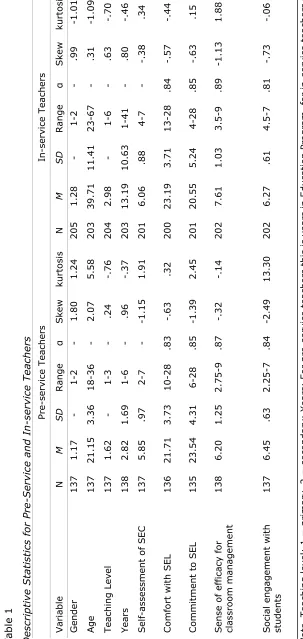
Demographic measures. Four demographic variables were included in our analyses. For pre-service teachers, we controlled for gender, age, teaching level in the program (i.e., elementary or secondary), and years in teacher education program. For in-service teachers, we controlled for comparable variables: gender, age, level of teaching (i.e., elementary, junior high, high school), and years of teaching experience. All descriptive information is provided in Table 1.
responsible and constructive decisions, and managing conflict ethically and effectively. Thinking about yourself as a [pre-service] teacher, please select the option that best describes your personal response to each of the following statements.” All items were completed on a response scale ranging from 1 “strongly disagree” to 7 “strongly agree.”
We used a single item to assess teachers’ beliefs about their own level of social-emotional competence: “Based on the skills listed above, I consider myself to be socially-emotionally competent.” Next, eight out of twelve original items from a measure of teachers’ beliefs about SEL published by Brackett et al. (2012) were used to assess participants’ beliefs related to their comfort with and commitment to SEL. Participants responded to four items from the comfort subscale (e.g., “I feel confident in my ability to provide instruction on social and emotional learning”), and four items from the commitment subscale (e.g., “I want to improve my ability to teach social and emotional skills to students”). The subscales had adequate reliability in both samples (Table 1). Because pre-service teachers do not have a permanent school from which to answer items related to culture, we chose to omit this subscale.
Sense of efficacy for classroom management. Four items from the Teachers’ Sense of Efficacy Scale (TSES) short form (Tschannen-Moran &Woolfolk Hoy, 2001) were used to measure the extent to which teachers felt efficacious in their classroom management (e.g. “How confident are you that you will be able to control disruptive behavior in the classroom? Response scale 1 = not at all; 9 = a great deal). The reliability for pre-service teachers was α = .87 and for in-service teachers was α = .89. We choose to include only the subscale that assessed classroom management because it matched most closely with the notion of classroom management in the prosocial classroom model (Jennings & Greenberg, 2009).
Engagement with students. Four items from The Engaged Teacher Scale (ETS; Klassen, Yerdelen, & Durksen, 2013) were used to measure social engagement with students (e.g., In class, I will be empathetic towards my students. Response scale 1 = never; 7 = always). The reliability for pre-service teachers was α = .84 and for in-service teachers was α = .81. We chose this subscale because it focuses explicitly on perceived social engagement between teachers and students and thus matches closely with the notion of healthy student-teacher relationships in the prosocial model (Jennings & Greenberg, 2009).
Rationale for Analyses
We conducted our analyses in three steps. After examining the reliabilities of all subscales (Table 1), we used independent samples t-tests to compare pre-service teachers and in-service teachers on measures of their own SEC and their comfort with and commitment to SEL. Second, we ran zero-order correlations for all variables. Third, we used separate hierarchical regression analyses to examine relationships among beliefs related to SEC and SEL and the two outcomes of interest: efficacy for classroom management and perceived engagement with students. Specifically, in Step 1 we included gender, age, teaching level, years of experience, and beliefs about one’s own SEC. In Step 2 we added comfort with and commitment to SEL. This allowed us to examine the effect of SEL beliefs after controlling for a personal assessment of SEC. All analyses were run separately for pre-service and in-service teachers.
Results
According to independent samples t-tests pre-service and in-service teachers differed on all three beliefs. Specifically, pre-service teachers (M = 5.85, SD = .97) believed they were less socially-emotionally competent than in-service teachers (M = 6.06, SD = .88), t (334) = -2.07, p = .04. For beliefs about SEL, pre-service teachers (M = 21.71, SD = 3.73) were less comfortable with SEL than in-service teachers (M = 23.19, SD = 3.71), t (332) = -3.56, p <.001. In contrast, pre-service teachers (M = 23.54, SD = 4.31) were more committed to SEL than in-service teachers (M = 20.54, SD = 5.25), t (332) = 5.50, p˂ .001.
Correlations
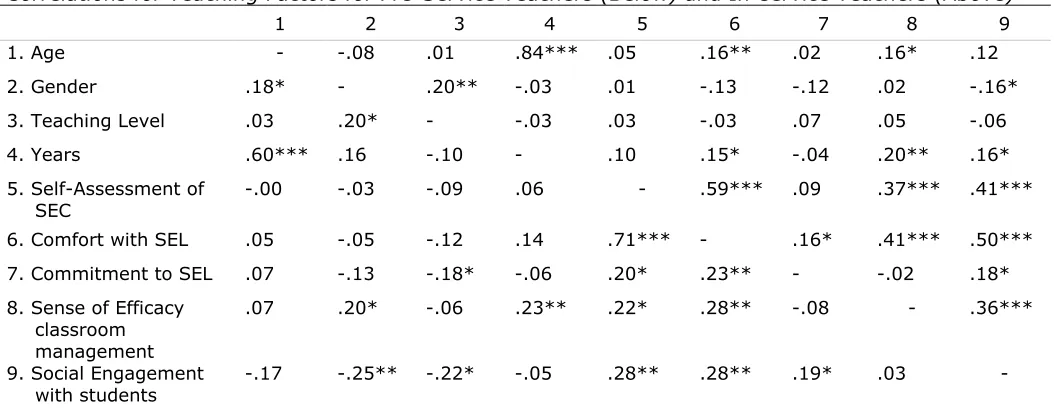
Correlations are presented separately for pre-service and in-service teachers in Table 2. Many of the relationships are consistent with other research (e.g., Collie et al., 2012) providing some evidence of external validity. For example, in both samples comfort with SEL was positively correlated with commitment to SEL. Comfort with SEL was also positively correlated with efficacy for classroom management whereas commitment to SEL was not, revealing a similar pattern as in Collie et al. (2012). In terms of the relationship between SEC beliefs and SEL beliefs, SEC was strongly positively correlated with comfort with SEL in both the pre-service and in-service samples. However, SEC was only positively correlated with commitment to SEL in pre-service and not in-service teachers.
Regression Analyses
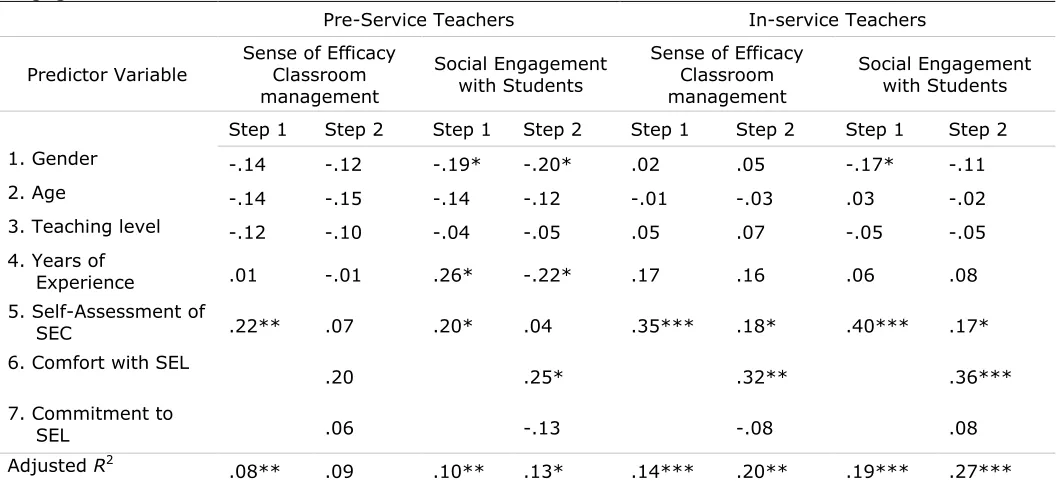
Pre-service teachers. All standardized beta weights from the regression analyses are presented in Table 3 for pre-service and in-service teachers. In terms of pre-service teachers’ self-efficacy for classroom management, the only significant relationship was with SEC beliefs in
Table 2
Correlations for Teaching Factors for Pre-Service Teachers (Below) and In-service Teachers (Above)
1 2 3 4 5 6 7 8 9
1. Age - -.08 .01 .84*** .05 .16** .02 .16* .12
2. Gender .18* - .20** -.03 .01 -.13 -.12 .02 -.16*
3. Teaching Level .03 .20* - -.03 .03 -.03 .07 .05 -.06
4. Years .60*** .16 -.10 - .10 .15* -.04 .20** .16*
5. Self-Assessment of SEC
-.00 -.03 -.09 .06 - .59*** .09 .37*** .41***
6. Comfort with SEL .05 -.05 -.12 .14 .71*** - .16* .41*** .50***
7. Commitment to SEL .07 -.13 -.18* -.06 .20* .23** - -.02 .18*
8. Sense of Efficacy classroom management
.07 .20* -.06 .23** .22* .28** -.08 - .36***
9. Social Engagement
with students -.17 -.25** -.22* -.05 .28** .28** .19* .03 -
Step 1. The model, F (5, 126) = 3.33, p = .007, explained 8% of the variance and Step 2 did not result in a significant change. For pre-service teachers’ engagement with students, three significant relationships emerged in Step 1. First, gender was negatively related to engagement suggesting women were more engaged with students than men. Second, years of experience (here measured by years in the B.Ed. program) was positively related to engagement with students. Third, SEC beliefs were positively related to engagement. The effects for gender and years of experience persisted in Step 2 of the analyses; however, SEC beliefs were no longer significant and instead comfort with SEL was positively related to engagement with students. This suggests that the SEC beliefs had no significant association with the outcome once the shared variance with SEL was controlled for. In total, the model explained 13% of the variance, F (7, 124) = 3.81, p= .001.
In-service teachers. The results for in-service teachers differed to some extent from those of pre-service teachers but were similar across the two outcomes within the group. For both outcomes there were no significant relationships with any of the demographic or experience variables. However, SEC beliefs were positively associated with both efficacy for classroom management and engagement with students in Step 1 of the regression. Moreover, for both outcomes the effects persisted, albeit at a reduced level, when beliefs about comfort with and commitment to SEL were entered in the second step of the regression. This suggests that effect of high SEC beliefs is reduced after controlling for the shared variance of comfort with SEL specifically. Commitment to SEL did not emerge as a significant predictor. In total, the model explained 20% of the variance in efficacy beliefs, F (7, 187) = 7.94, p < .001 and 27% of the variance in engagement with students, F (7, 186) = 11.32, p < .001.
Table 3
Standardized Beta Weights from Regression Analyses Predicting In-service Teachers’ Efficacy and Engagement
Pre-Service Teachers In-service Teachers
Predictor Variable Sense of Efficacy Classroom management
Social Engagement with Students
Sense of Efficacy Classroom management
Social Engagement with Students
Step 1 Step 2 Step 1 Step 2 Step 1 Step 2 Step 1 Step 2
1. Gender -.14 -.12 -.19* -.20* .02 .05 -.17* -.11
2. Age -.14 -.15 -.14 -.12 -.01 -.03 .03 -.02
3. Teaching level -.12 -.10 -.04 -.05 .05 .07 -.05 -.05
4. Years of
Experience .01 -.01 .26* -.22* .17 .16 .06 .08
5. Self-Assessment of
SEC .22** .07 .20* .04 .35*** .18* .40*** .17*
6. Comfort with SEL
.20 .25* .32** .36***
7. Commitment to
SEL .06 -.13 -.08 .08
Adjusted R2
.08** .09 .10** .13* .14*** .20** .19*** .27***
Note. * p < .05, ** p < .01; Teaching level: 1 = primary, 2 = secondary; Years: For pre-service teachers this is
Discussion
The purpose of this research was to examine how pre-service and in-service teachers’ beliefs related to their own SEC, and how their comfort with and commitment to SEL was related to their sense of efficacy for classroom management and perceived social engagement with students. In this discussion we focus on how the results are similar and different for pre-service and in-service teachers. First, we discuss possible explanations for the finding that pre-service teachers reported a greater commitment to SEL; whereas, in-service teachers reported higher beliefs in their own SEC and more comfort with SEL. Second, we discuss relationships between beliefs about SEC and SEL and describe the possible advantages of measuring both. Finally, we discuss the different roles for beliefs related to SEC and SEL comfort and commitment in understanding teachers’ sense of efficacy for classroom management and social engagement with students. We conclude with a review of the limitations of this study and suggest future research directions.
Pre-service and In-service Teachers’ Differences in Beliefs
Our results highlight some important differences between pre-service and in-service teachers. We believe many of these differences may be rooted in the distinction between pre-service teachers basing their responses on future expectations and in-service teachers basing their responses on a more realistic understanding of what occurs in the classroom. In other words, pre-service teachers often lack experience in the classroom thereby reducing their chances for mastery experiences (Bandura, 1999), and leaving them somewhat unfamiliar with the “realities and complexities of the teaching task” (Woolfolk Hoy, 2000, p. 5). In many ways, pre-service teachers are still students—learning the pedagogy and expertise of the profession. Thus, it may not be surprising that pre-service teachers reported higher levels of commitment to SEL than in-service teachers. Pre-in-service teachers have been found to be eager to participate in additional professional development to prepare them for working with students (Kagan, 1992); whereas, in-service teachers admit that they “don’t have much time left to teach SEL” (Buchannan, Gueldner, Tran, & Merrell., 2009, p. 198). While SEL in the classroom is a reality in Alberta, one of the known barriers to SEL implementation in classrooms is lack of time (Buchannan et al., 2009), and this may explain why in-service teachers are less committed than pre-service teachers.
Relationships between SEC and SEL Beliefs
Whether pre-service or in-service, participants who felt comfortable with SEL also believed they were more socially-emotionally competent themselves. In fact, these were the strongest correlations amongst any variables. This logical presumption had not been tested before, and our results provide some evidence that comfort with SEL in the classroom is closely tied to one’s own sense of being socially-emotionally competent. Moreover, beliefs about one’s own SEC were not correlated with commitment to SEL in the in-service sample and had only a small positive correlation for pre-service teachers. These results shed some preliminary light on Collie et al.’s (2012) speculation that “teachers who are comfortable implementing SEL in their classroom also have higher social–emotional competence” (p. 1197). In contrast, a weaker or a lack of relationship with commitment to SEL implies that beliefs in one’s own SEC (or lack thereof) is not sufficient to compel in-service teachers to commit to SEL. Freeman and Strong (2017) argue that increasing teachers’ SEC is one way to build capacity in teachers to deliver SEL; it is thus imperative that future research continues to tease apart the relationships between beliefs about SEC and SEL as well as measuring teachers’ actual SEC skills.
Relationships with Sense of Efficacy for Classroom Management and Student Engagement
Beliefs about one’s own SEC were positively related to sense of efficacy for classroom management and engagement with students for both pre-service and in-service teachers. This new finding provides support for the prosocial classroom model (Jennings & Greenberg, 2009), which positions SEC at the beginning of the model. It seems the more a teacher believes in his or her own SEC, the more efficacious and engaged with students they feel. Indeed, for pre-service teachers, adding SEL beliefs in Step 2 of the regression did not increase the variance explained in sense of efficacy for classroom management. For in-service teachers when beliefs about comfort with and commitment to SEL were entered into the analyses, the effects for SEC persisted along with a positive relationship for comfort with SEL suggesting that the two types of beliefs each make a unique contribution to understanding efficacy and engagement. This was not the case for pre-service teachers’ engagement. The results highlight the need to consider beliefs about SEC and SEL separately.
what they lack in commitment they make up in comfort, which appears to be the more influential perspective. Although the models were very similar in the sense that comfort with SEL was the strongest predictor in both groups, it is interesting to note that the model explained more than twice as much variance in the in-service teacher sample than in the pre-service teacher sample. Nonetheless, these results add to a growing body of literature documenting that teachers’ beliefs about SEL, and now also SEC, have an important impact on teacher cognitions (Brackett, et al., 2012; Collie et al., 2012).
Suggestions for Professional Development
Based on the similarities and differences between pre-service and in-service teachers, the two groups may need different types of support in developing their own SEC, comfort with, and commitment to SEL. On the one hand, in-service teachers who believe that they are more socially-emotionally competent are more comfortable but not as committed to SEL as pre-service teachers. However, only SEC beliefs and comfort with SEL were positively related to perceptions of efficacy and engagement in the regression analyses. Thus, although administrators may be inclined to increase in-service teachers’ commitment to SEL, SEC and comfort appear to be the more important beliefs. Because in-service stand-alone professional development programs for teachers have historically been viewed as irrelevant and boring (Desimone, 2009; Wilson & Berne, 1999), we suggest taking a more active approach to developing SEC and comfort with SEL. For example, embedded collaborative opportunities within schools (Hunzicker, 2011) may allow for less comfortable teachers to be paired with more comfortable teachers in a consultative process discussing how SEL can be integrated into the classroom. Alternatively, Alberta Education, the provincial regulatory body in Alberta, has created a number of online resources including videos and practical suggestions for teachers to access and improve their comfort with SEL (https://education.alberta.ca/social-emotional-learning/what-is-social-emotional-learning/?searchMode=3).
Evidence is beginning to accumulate on the effectiveness of certain programs to support the development of teachers’ SEC. For example, results of a small quasi-experimental study on Finnish teachers who participated in a Teacher Effective Training (TET) program showed increased knowledge and application of social skills (Talvio, Lonka, Komulainen, Kuusela, & Lintunen, 2013). The Cultivating Awareness and Resilience in Education (CARE) program is another example of innovative professional development combining didactic instruction and experiential activities to support teachers’ practice, application, and reflection in a way that appears to be enhancing SEC (Jennings, Frank, Snowberg, Coccia, & Greenberg, 2013). For any type of SEC or SEL initiative to be successful, teachers will have to allocate adequate time for planning and implementation (Birman, Desimone, Porter, & Garet, 2000).
research needs to examine how commitment turns into comfort perhaps through qualitative investigations with pre-service teachers at different points in their training.
Limitations and Directions for Future Research
There are three primary limitations in this study. First, although we used established scales to measure beliefs about SEL, we used a single item to assess participants’ beliefs about their own level of SEC. Participants were provided with a definition and a list of skills to anchor their response, but the use of single items poses psychometric issues that cannot be ignored (Ainley & Patrick, 2006; McGregor & Elliot, 2002; McMillan, 2008; Messick, 1995). Our results suggest that self-assessment of SEC is an important addition to pre-service and in-service teachers’ beliefs about SEL and thus future research is needed to create a scale and collect validity evidence for a measurement tool of SEC. Because of the number of skills associated with SEC, one option may be to use situational judgement tests to assess SEC. Klassen, Durksen, Rowett, and Patterson (2014) showed that situational judgement tests—that is, tests designed to capture the personal attributes of prospective teachers—are proving to be a valid, reliable, and effective selection tool. Despite the psychometric limitations, empirically the correlations between SEC and SEL provide some evidence of convergent validity. Moreover, researchers have conceptually argued (Ainely & Patrick, 2006) and empirically demonstrated (Gogol et al., 2014) that when constructs have a clear experiential factor they can be adequately measured by single items.
Second, although our study advanced previous research by examining SEC, it focused on a small portion of the prosocial classroom model (Jennings & Greenberg, 2009) and we did not consider any reciprocal relationships. In particular, we did not consider contextual factors either within or outside of the school—factors that have been previously examined and deemed important for SEL (Collie et al., 2012). Before contextual and cultural influences can be included in models with pre-service teachers, researchers need to understand what factors are relevant when an individual does not have a permanent teaching school. Future research should also pursue longitudinal data that would allow cross-lag models or multi-level modeling to be conducted thereby teasing apart the reciprocal relationships between the different components of the prosocial classroom model.
A third limitation of our study is the reliance on self-report data related to perceptions exclusively. There are no objective or observational indicators of pre-service or in-service teachers’ actual levels of SEC, efficacy, or engagement with students. While extending our research beyond self-report data would have provided us with additional information for understanding these constructs, the reliance on self-report data is not uncommon in this area. In fact, a meta-analysis by Klassen and Tze (2014) examining teachers’ self-efficacy, personality, and teaching effectiveness found that over 99% of studies included within-teacher outcomes (e.g. self-report measures). Future research beyond self-report measures is clearly needed to examine these constructs and their relationships; however, this need does not undo the contribution made by the self-reported perspectives of these participants.
Conclusion
tapping into their commitment to SEL. Once they become in-service teachers, their comfort with SEL will contribute to the development of SEL environments that involve effective classroom management and social engagement with students. This is an area of much needed research for both pre-service and in-service teachers to better understand the connections within the prosocial classroom model, and how to support these individuals to develop skills related to SEC and SEL.
Acknowledgements
This work was supported by a Standard Grant from the Social Sciences Research Council of Canada (#410–2009–0172) awarded to Dr. L. Daniels and is based on Wagner, A. K. (2013), How Social and Emotional Learning and Beliefs Predict Efficacy and Engagement Beliefs in Practicing and Preservice Teachers (Master’s thesis, University of Alberta, Edmonton, Canada). Retrieved from https://era.library.ualberta.ca/files/sf268534z#.WAZSjJMrJuU.
References
Ainley, M., & Patrick, L. (2006). Measuring self-regulated learning processes through tracking patterns of student interaction with achievement activities . Educational Psychology Review, 18, 267–286. doi:10.1007/s10648-006-9018-z
Alberta Education (2016a). Social-emotional learning: What is social-emotional learning? Retrieved from https://education.alberta.ca/social-emotional-learning/what-is-social-emotional-learning/
Alberta Education (2016b). Teaching in Alberta: What you need to know. Retrieved from
https://education.alberta.ca/teaching-in-alberta-what-you-need-to-know/the-teaching-profession/ Alberta Education Learning and Teaching Resources Branch (2008). Support positive behaviour in
Alberta schools: A school-wide approach. Retrieved from the Legislative Assembly of Alberta website: http://www.assembly.ab.ca/lao/library/egovdocs/2008/aled/165332.pdf
Australian Institute for Teaching and School Leadership. (2015). Accreditation of initial teacher
education programs in Australia: Standards and procedures. Retrieved from Australian Institute for Teaching and School Leadership website: http://www.aitsl.edu.au/docs/default-source/initial-teacher-education-resources/accreditation-of-ite-programs-in-australia.pdf
Azar, A. (2010). In-service and pre-service secondary science teachers' self-efficacy beliefs about science teaching. Educational Research and Reviews, 5(4), 175-188. doi: 10.5897/ERR09.243
Bandura, A. (1997). Self-efficacy: The exercise of control. New York: Freeman.
Bandura, A. (1999). Social cognitive theory of personality. In L.A. Pervin & O. P. John (Eds), Handbook of personality: Theory and research (pp. 154-196). New York: Guilford Press.
Bandura, A. (2001). Social cognitive theory: An agentic perspective. Annual Review of Psychology, 52(1), 1-26. doi:10.1146/annurev.psych.52.1.1
Birman, B. F., Desimone, L., Porter, A. C., & Garet, M. S. (2000). Designing professional development that works. Educational Leadership, 57(8), 28-33. Retrieved from
http://www.vodppl.upm.edu.my/uploads/docs/edu5822_1456883720.pdf
Brackett, M. A., Reyes, M. R., Rivers, S. E., Elbertson, N. A., & Salovey, P. (2012). Assessing teachers’ beliefs about social and emotional learning. Journal of Psychoeducational Assessment, 30(3), 219-236. doi:10.1177/0734282911424879
Butler, R. (2012). Striving to connect: Extending an achievement goal approach to teacher motivation to include relational goals for teaching. Journal of Educational Psychology, 104, 726-742.
doi:10.1037/a0028613
Chambers, S. M. (2003, February). The impact of length of student teaching on the self-efficacy and classroom orientation of pre-service teachers. Paper presented at the Annual Meeting of the Southwest Educational Research Association, San Antonio, TX. Retrieved from
http://www.eric.ed.gov/PDFS/ED477509.pdf
Christian, M. S., Garza, A. S., & Slaughter, J. E. (2011). Work engagement: A quantitative review and test of its relations with task and contextual performance. Personnel Psychology, 64, 89-136.
doi:10.1111/j.1744-6570.2010.01203.x
Collaborative for Academic, Social, and Emotional Learning. (2015). What is SEL? What is social and emotional learning (SEL)? Retrieved from http://casel.org/why-it-matters/what-is-sel
Coladarci, T. (1992). Teachers’ sense of efficacy and commitment to teaching. The Journal of Experimental Education, 60, 323-337. doi:10.1080/00220973.1992.9943869
Collie, R. J. (2017). Teachers’ social and emotional competence: Links with social and emotional learning and positive workplace outcomes. In E. Frydenberg, A. J. Martin, & R. J. Collie (Eds.), Social and emotional learning in Australia and the Asia-Pacific: Perspectives, programs and approaches (pp. 167-184). Singapore: Springer.
Collie, R. J., Martin, A. J., & Frydenberg, E. (2017). Social and emotional learning: A brief overview and issues relevant to Australia and the Asia-Pacific. In E. Frydenberg, A. J. Martin, & R. J. Collie (Eds.), Social and emotional learning in Australia and the Asia-Pacific: Perspectives, programs and approaches (pp. 1-13). Singapore: Springer.
Collie, R. J., Shapka, J.D., & Perry, N.E. (2012). School climate and social-emotional learning: Predicting teacher stress, job satisfaction, and teaching efficacy. Journal of Educational Psychology, 104, 1189-1204. doi:10.1037/a0029356
Collie, R. J., Shapka, J. D., Perry, N. E., & Martin, A. J. (2015). Teachers' beliefs about social-emotional learning: Identifying teacher profiles and their relations with job stress and satisfaction. Learning and Instruction, 39, 148-157. doi: 10.1016/j.learninstruc.2015.06.002
Damnjanovic, A. (1999). Attitudes toward inquiry‐based teaching: Differences between preservice and in‐ service teachers. School Science and Mathematics, 99(2), 71-76.
doi:10.1111/j.1949-8594.1999.tb17450.x
Daniels, L. M. (2015). From pre-service to practicing teacher: Considering the stability of personal and classroom mastery and performance goals. Educational Psychology, 35, 984-1005.
doi:10.1080/01443410.2013.870329
Daniels, L. M., Radil, A. I., & Goegan, L. D. (2017). Combinations of personal responsibility: Differences on pre-service and practicing teachers’ efficacy, engagement, classroom goal structures and wellbeing. Frontiers in Psychology, 8, 1-12. https://doi.org/10.3389/fpsyg.2017.00906
Daniels, L. M., Tze, V.M.C, & Goetz, T. (2015). Examining boredom: Different causes for different coping profiles. Learning and Individual Differences, 37, 255-261. Retrieved from
https://doi.org/10.1016/j.lindif.2014.11.004
Dembo, M. H., & Gibson, S. (1985). Teachers' sense of efficacy: An important factor in school improvement. The Elementary School Journal, 86(2), 173-184. Retrieved from
http://www.jstor.org/stable/1001201
Desimone, L. M., (2009). Improving impact studies of teachers' professional development: Toward better conceptualizations and measures. Educational Researcher, 38(3), 181–199.
doi:10.3102/0013189X08331140
Durksen, T. L. (2015). Promoting professional growth: A developmental and motivational approach to teachers’ professional learning (Doctoral dissertation). Retrieved from
Durksen T. L., & Klassen, R. M. (2012). Pre-service teachers’ weekly commitment and engagement during a final training placement: A longitudinal mixed methods study. Educational and Child Psychology, 29(4), 32-46. Retrieved from
https://shop.bps.org.uk/publications/publication-by-series/educational-and-child-psychology.html
Durlak, J. A., Weissberg, R. P., Dymnicki, A. B., Taylor, R. D., & Schellinger, K. B. (2011). The impact of enhancing students’ social and emotional learning: A meta-analysis of school‐based universal interventions. Child Development, 82(1), 405-432. doi: 10.1111/j.1467-8624.2010.01564.x
Evertson, C. M., & Weinstein, C. S. (2011). Classroom management as a field of inquiry. In C. M. Evertson & C. S. Weinstein (Eds.), Handbook of classroom management: Research, practice, and
contemporary issues (pp. 3-15). New York, NY: Routledge, Taylor & Francis Group.
Fauth, B., Decristan, J., Rieser, S., Klieme, E., & Büttner, G. (2014). Student ratings of teaching quality in primary school: Dimensions and prediction of student outcomes. Learning and Instruction, 29, 1–9. doi:1016/j.learninstruc.2013.07.001
Fives, H., & Gill, M. G. (Eds.). (2014). International handbook of research on teachers’ beliefs. New York, NY: Routledge.
Freeman, E., & Strong, D. (2017). Building teacher capacity to promote social and emotional learning in Australia. In E. Frydenberg, A. J. Martin, & R. J. Collie (Eds.), Social and emotional learning in Australia and the Asia-Pacific: Perspectives, programs and approaches (pp. 413-435). Singapore: Springer.
Frydenberg, E., Martin, A. J. & Collie, R. J. (Eds). (2017). Social and Emotional Learning in Australia and the Asia-Pacific: Perspectives, programs and approaches. Singapore: Springer.
Glickman, C., & Tamashiro, R. (1982). A comparison of first-year, fifth-year, and former teachers on efficacy, ego development, and problem solving. Psychology in Schools, 19, 558-562.
doi:10.1002/1520-6807(198210)19:4<558::AID-PITS2310190426>3.0.CO;2-F
Gogol, K., Brunner, M., Goetz, T., Martin, R., Ugen, S., Keller, U., Fischbach, A., Preckel, F. (2014). “My Questionnaire is Too Long!” The assessments of motivational-affective constructs with three-item and single-item measures. Contemporary Educational Psychology, 39(3), 188-205.
doi:10.1016/j.cedpsych.2014.04.002
Government of Alberta (2017). Industry Profiles 2017: Educational Services Industry. Retrieved from Government of Alberta, Ministry of Labour website: https://work.alberta.ca/documents/industry-profile-educational-services.pdf
Humphrey, N., Barlow, A., Wigelsworth, M., Lendrum, A., Pert, K., Joyce, C., Stephens, E., Wo, L.; Squires, G., Woods, K., Calam, R., Turner, A. (2016). A cluster randomized controlled trial of the Promoting Alternative Thinking Strategies (PATHS) curriculum. Journal of School Psychology, 58, 73-89. doi: 10.1016/j.jsp.2016.07.002
Hunzicker, J. (2011). Effective professional development for teachers: A checklist. Professional Development in Education, 37(2), 177-179. doi:10.1080/19415257.2010.523955
Jennings, P. A., Frank, J. L., Snowberg, K. E., Coccia, M. A., & Greenberg, M. T. (2013). Improving classroom learning environments by Cultivating Awareness and Resilience in Education (CARE): Results of a randomized controlled trial. School Psychology Quarterly, 28(4), 374-390.
doi:10.1037/spq0000035
Jennings, P. A., & Greenberg, M. T., (2009). The prosocial classroom: Teacher social and emotional competence in relation to student and classroom outcomes. Review of Educational Research, 79(1), 491-525. doi:10.3012/0034654308325693
Jones, S. M., Bouffard, S. M., & Weissbourd, R. (2013). Educators' social and emotional skills vital to learning. Phi Delta Kappan, 94(8), 62-65. doi:10.1177/003172171309400815
Kagan, D. M. (1992). Professional growth among preservice and beginning teachers. Review of Educational Research, 62(2), 129-169. doi:10.3102/00346543062002129
and pre-service teachers: Influence of self-efficacy, job stress, and teaching context. Contemporary Educational Psychology, 36(2), 114-129. doi: 10.1016/j.cedpsych.2011.01.002
Klassen, R., Durksen, T., Rowett, E., & Patterson, F. (2014). Applicant reactions to a situational judgment test used for selection into initial teacher training. International Journal of Educational Psychology, 3(2), 104-124. doi:10.4471/ijep.2014.07
Klassen, R. M., Perry, N. E., & Frenzel, A. C. (2012). Teachers’ relatedness with students: An underemphasized component of teachers’ basic psychological needs. Journal of Educational Psychology, 104(1), 150-165. doi:10.1037/a0026253
Klassen, R. M., & Tze, V. M. (2014). Teachers’ self-efficacy, personality, and teaching effectiveness: A meta-analysis. Educational Research Review, 12, 59-76.
http://dx.doi.org/10.1016/j.edurev.2014.06.001
Klassen, R. M., Yerdelen, S., & Durksen, T. L. (2013). Measuring teacher engagement: Development of the Engaged Teachers Scale (ETS). Frontline Learning Research, 1(2), 33-52.
http://dx.doi.org/10.14786/flr.v1i2.44
Kunter, M., Baumert, J., & Köller, O. (2007). Effective classroom management and the development of subject-related interest. Learning and Instruction, 17(5), 494-509. doi:
10.1016/j.learninstruc.2007.09.002
McGregor, H. A., & Elliot, A. J. (2002). Achievement goals as predictors of achievement-relevant processes prior to task engagement . Journal of Educational Psychology, 94(2), 381-395. doi:10.1037/0022-0663.94.2.381
McMillan, J. H. (2008). Educational research: Fundamentals for the consumer (5th ed.). Boston, MA: Pearson.
Messick, S. (1995). Validity of psychological assessment: Validation of inferences from persons’ responses and performances as scientific inquiry into score meaning. American Psychologist, 50, 741–749. doi:10.1037/0003-066X.50.9.741
Nurlu, Ö. (2015). Investigation of teachers' mathematics teaching self-efficacy. International Electronic Journal of Elementary Education, 8(1), 21-40. Retrieved from
http://files.eric.ed.gov/fulltext/EJ1078848.pdf
Pajares, M. F. (1992). Teachers’ beliefs and educational research: Cleaning up a messy construct. Review of Educational Research, 62(3), 307-332. doi:10.2307/1170741
Pajares, F. (1993). Preservice teachers' beliefs: A focus for teacher education. Action in Teacher Education, 15(2), 45-54. doi:10.1080/01626620.1993.10734409
Putman, S. M. (2012). Investigating teacher efficacy: Comparing preservice and inservice teachers with different levels of experience. Action in Teacher Education, 34(1), 26-40.
doi:10.1080/01626620.2012.642285
Schonert-Reichl, K. A., Hanson-Peterson, J. L., & Hymel, S. (2015). SEL and preservice teacher education. In J. A. Durlak, C. E. Domitrovich, R. P. Weissberg, & T. P. Gullotta (Eds.), Handbook of social and emotional learning: Research and practice (pp. 406–421). New York: Guilford.
Serow, R. C., Eaker, D., & Ciechalski, J. (1992). Calling, service, and legitimacy: Professional orientations and career commitment among prospective teachers. Journal of Research and Development in Education, 25(3), 136–141. Retrieved from http://psycnet.apa.org/record/1992-44875-001 Shaughnessy, M. F. (2004). An interview with Anita Woolfolk: The educational psychology of teacher
efficacy. Educational Psychology Review, 16(2), 153-176. doi: 10.1023/B:EDPR.0000026711.15152.1f Smylie, M. A. (1988). The enhancement function of staff development: Organizational and psychological
antecedents to individual teacher change. American Educational Research Journal, 25, 1-30. doi:10.3102/00028312025001001
Su, J. Z. (1993). The study of the education of educators: A profile of teacher education students. Journal of Research and Development in Education, 26(3), 125–132. Retrieved from
Talvio, M., Lonka, K., Komulainen, E., Kuusela, M., & Lintunen, T. (2013). Revisiting Gordon’s teacher effectiveness training: An intervention study on teachers’ social and emotional learning. Electronic Journal of Research in Educational Psychology, 11(3), 693–716. doi:10.14204/ejrep.31.13073 Tschannen-Moran, M., Woolfolk Hoy, A. (2001). Teacher efficacy: Capturing an elusive construct.
Teaching and Teacher Education, 17, 783-805. Retrieved from:
http://mxtsch.people.wm.edu/Scholarship/TATE_TSECapturingAnElusiveConstruct.pdf
Tschannen-Moran, M., Woolfolk Hoy A., & Hoy, W. K. (1998). Teacher efficacy: Its meaning and measure. Review of Educational Research, 68, 202-248. doi: 10.3102/00346543068002202
Watt, H. M., Richardson, P. W., Klusmann, U., Kunter, M., Beyer, B., Trautwein, U., & Baumert, J. (2012). Motivations for choosing teaching as a career: An international comparison using the FIT-Choice scale. Teaching and Teacher Education, 28, 791-805. doi:10.1016/j.tate.2012.03.003
Weissberg, R. P., Durlak, J. A., Domitrovich, C. E., & Gullotta, T. P. (2015). Social and emotional learning: Past, present, and future. In J. A. Durlak, C. E. Domitrovich, R. P. Weissberg, & T. P. Gullotta (Eds.), Handbook of social and emotional learning: Research and practice (pp. 3-19). New York: Guilford. Wilson, S. M. & Berne, J. (1999). Teacher learning and the acquisition of professional knowledge: An
examination of research on contemporary professional development. Review of Research in Education, 24, 173-209. doi:10.2307/1167270
Woolfolk Hoy, A. (2000, April). Changes in teacher efficacy during the early years of teaching. Paper presented at the annual meeting of the American Educational Research Association, New Orleans, LA. Retrieved from
http://citeseerx.ist.psu.edu/viewdoc/download?doi=10.1.1.553.2527&rep=rep1&type=pdf Woolfolk, A. E., & Hoy, W. K. (1990). Prospective teachers' sense of efficacy and beliefs about control.
Journal of Educational Psychology, 82(1), 81-91. doi: 10.1037/0022-0663.82.1.81
Note
1 Researchers have made many statements about teachers’ SEC by borrowing from related constructs such as mindfulness, self-regulation, perspective-taking, teacher-student relationships, and decision-making (see Collie, 2017 for a thorough review of how constructs have been leveraged to represent SEC).
Lauren D. Goegan is a Doctoral Student in the Department of Educational Psychology at the University of Alberta. Her research interests include academic engagement, academic success, students transitioning from high school to post-secondary education, motivation and accessibility.
Amanda K. Wagner is a graduate of the University of Alberta's Educational Psychology Master's program. Her interests in social emotional competence and motivation have led her to build a business focused on consumer behaviour and work with retailers to enhance the overall customer experience.
Lia M. Daniels is an Associate Professor in the Department of Educational Psychology at the University of Alberta. Her research interests include understanding relationships between student and teacher